What Is an Infrared Electric Fireplace? How It Heats, What It Costs, and Where It Works Best
An infrared electric fireplace is an electric fireplace that warms a room with infrared heat. A quartz tube or coil inside the unit glows hot, and the infrared energy it gives off travels through the air and warms the people, furniture, and walls it reaches. The room feels warm because the objects in it are warm, not because the air alone was heated first.
That difference matters when you shop. Most electric fireplaces use a fan to blow air across a hot coil, which warms the air in the room. An infrared electric fireplace works more like sunshine through a window. You feel the warmth on your skin within minutes of switching it on, even before the air temperature changes much. This guide explains how the heat works, how much warmth you can expect, what it costs to run, and how to pick the right size for your room.
Heads Up: Read This Before You Plug One In
An infrared electric fireplace is a high-wattage appliance. Plug it straight into a wall outlet on its own circuit when you can, and never run it through an extension cord or a power strip. Keep at least three feet of clear space in front of the heater, keep blankets, curtains, and paper away from it, and unplug the unit before you clean it or move it.
If your home needs a new outlet or a dedicated circuit, call a licensed electrician. Do not open the unit or change its wiring yourself. This article gives general guidance only, and your model manual always comes first.
At a Glance
- What it is: An electric fireplace that heats with infrared radiation from a quartz element.
- How it feels: Warmth on your skin fast, like standing in sunlight.
- Typical power: Most plug-in models top out at 1,500 watts on a standard household circuit.
- Best for: Zone heating in a living room, bedroom, or den where people sit near the unit.
- Not for: Heating a whole house or replacing a central heating system.
- Running cost: Depends on your electricity rate and how many hours you run it. See the worked example below.
What Is an Infrared Electric Fireplace?
An infrared electric fireplace is a type of electric fireplace that uses an infrared heating element instead of, or in addition to, a fan-forced coil. Inside the unit, one or more quartz tubes heat up when the power is on. Those tubes give off infrared energy, which is a form of light your eyes cannot see but your skin can feel as warmth.
The flame you see on an infrared electric fireplace is not real fire. It is a light effect, usually made with LEDs and a moving pattern or a rotating reflector, shown behind glass or a screen. The flame effect and the heater are separate parts. You can run the flame look on its own for mood, with the heat turned off, on most models.
Manufacturers sell infrared electric fireplaces in the same styles as other electric fireplaces. You will find freestanding stoves, wall-mounted units, inserts that slide into an existing fireplace opening, and media consoles with a fireplace built in. The outside style tells you where the unit fits in your room. The infrared label tells you how it heats.
How Infrared Heat Works
Heat moves in three ways: conduction, convection, and radiation. A fan-forced heater relies mostly on convection. It warms the air, and the warm air rises and spreads through the room. An infrared heater relies on radiation. It sends energy in straight lines until that energy hits something solid, and then that object absorbs the energy and warms up.
Think of a sunny winter day. The air outside can be cold, yet your face feels warm in direct sun. The sun is not heating the air around you first. It is sending infrared energy straight to your skin and clothes. An infrared electric fireplace works on the same idea, on a much smaller scale, inside your room.
The Quartz Heating Element
The heart of the unit is the quartz heating element. Quartz tubes hold a heating coil, and the tube can reach high temperatures fast. When the coil is powered, the tube glows and gives off infrared energy. Many models also have a small fan that moves room air gently across the warm parts of the unit, which helps spread heat a little further, but the main warmth still comes from the infrared energy itself.
Because the element heats up in seconds, you feel warmth almost right away. A fan-forced heater needs time to warm the air in the whole room before you notice much change. With infrared, the warmth reaches you first, and the room air catches up later as the warmed objects give off their own heat.
Why Objects Warm First
Infrared energy passes through air without heating it much. It warms the first solid surface it meets: your skin, your chair, the rug, the wall. Those warmed surfaces then release heat into the air around them. That is why a room with an infrared heater can feel comfortable even when a thermometer near the ceiling reads lower than you might expect.
This also explains why placement matters. Infrared heat works best when the unit has a clear line of sight to the seating area. A sofa, a coffee table, or a tall chair placed between you and the fireplace blocks the direct warmth. Leave the space in front of the unit open so the energy can reach the people using the room.
Infrared vs Fan-Forced Electric Fireplaces
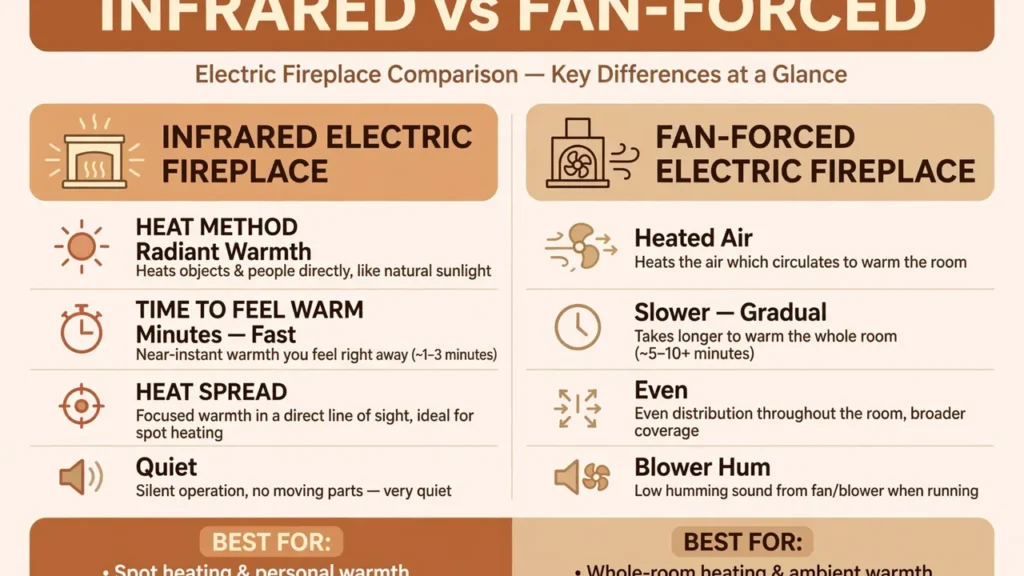
Both types are electric fireplaces, and both can look good in a living room. The difference is how they move heat into the room, and that difference changes how fast you feel warm, how the heat spreads, and how noisy the unit is.
A fan-forced electric fireplace heats air with a coil and pushes that warm air out with a blower. It warms the whole room more evenly over time, but it takes longer before you feel the change. An infrared electric fireplace warms you and the objects near you directly. You feel it sooner, but the warmth is strongest in the area facing the unit.
| Feature | Infrared Electric Fireplace | Fan-Forced Electric Fireplace |
|---|---|---|
| How it heats | Radiant energy warms people and objects directly | Heated air is blown into the room |
| Time to feel warm | Minutes, as soon as the element glows | Longer, while room air warms up |
| Heat spread | Strongest in front of the unit, line of sight matters | More even across the room over time |
| Noise | Often quiet, small fan or none at all | Blower noise is normal while heating |
| Effect on air | Dries the air less, since air is not the main target | Can feel drier as warm air circulates |
| Best use | Zone heating where people sit near the unit | Even warming of a closed room |
Some models combine both methods. A hybrid unit uses an infrared element plus a fan to push warm air further into the room. If you like the fast warmth of infrared but want the heat to reach the far corners, a hybrid can be a good middle ground. Read the product manual to see which heating method a model uses, since the outside look gives no clue.
To learn the basics that apply to every electric fireplace, read our guide on how an electric fireplace works. It covers the flame effect, the controls, and the parts that all electric models share.
How Much Heat Does an Infrared Electric Fireplace Give Off?
Most plug-in infrared electric fireplaces top out at 1,500 watts. That limit comes from a standard household circuit. A normal 120-volt, 15-amp outlet can supply 1,800 watts in theory, but a heater that runs for hours should stay below that ceiling, so makers cap plug-in models at 1,500 watts. A 1,500-watt heater gives off about 5,120 BTU per hour. That figure is a unit conversion, not a marketing claim, since one watt equals about 3.412 BTU per hour.
Some larger infrared fireplaces are hardwired on a 240-volt circuit and can run at higher wattage. Those models need a licensed electrician to install, and they cost more up front. For most living rooms and bedrooms, a plug-in 1,500-watt model is the common choice, and it is the type this guide focuses on.
Heat output alone does not tell you how warm a room will feel. Ceiling height, insulation, windows, drafts, and outdoor temperature all change the result. A well-insulated room with closed doors holds heat far better than a drafty room with tall ceilings and single-pane windows. Treat any square-foot rating on the box as a rough guide for supplemental heat, not a promise.
Room Size Guidance
Makers often rate a 1,500-watt infrared electric fireplace for rooms up to about 400 square feet, and some list ratings as high as 1,000 square feet. Those higher numbers usually assume a well-insulated room used for extra warmth on top of central heat, not a cold room heated from scratch. Use the table below as a starting point, then think about your own room.
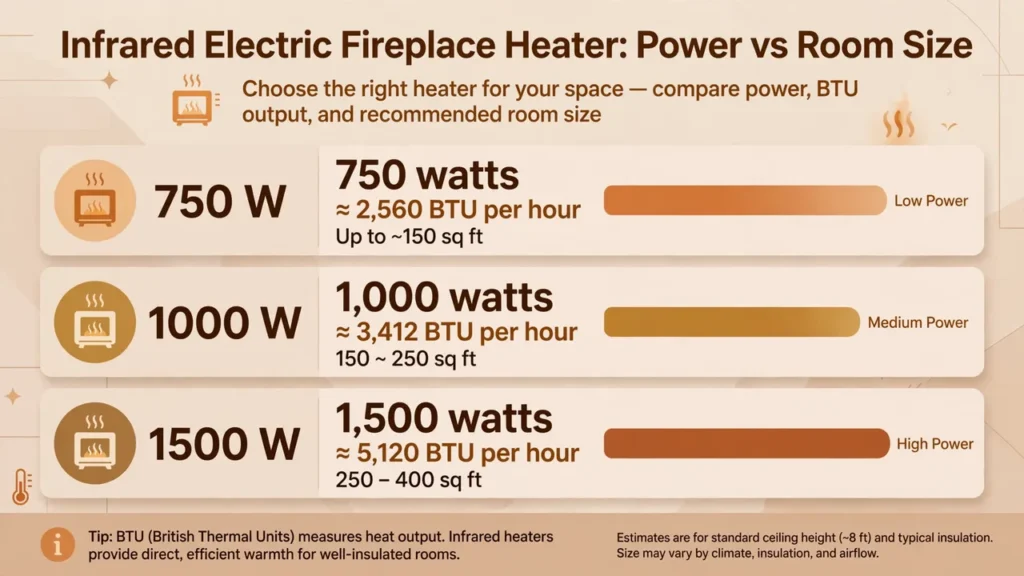
| Heater Power | Heat Output | Room Size (Supplemental Heat) | Good For |
|---|---|---|---|
| 750 watts | About 2,560 BTU per hour | Up to about 150 sq ft | Small bedroom, home office |
| 1,000 watts | About 3,412 BTU per hour | About 150 to 250 sq ft | Bedroom, small den |
| 1,500 watts | About 5,120 BTU per hour | About 250 to 400 sq ft | Living room, large bedroom |
BTU figures are unit conversions from watts. Room sizes are typical maker guidance for supplemental heat in an insulated room. Your results will vary with insulation, ceiling height, and outdoor temperature.
For help matching a unit to your room, see our guide on what size electric fireplace you need. It walks through measuring your space and checking the width of the wall or opening where the unit will sit.
What Size Infrared Electric Fireplace Do You Need?
Picking the right size has two parts: the heat output for your room and the physical size for your wall or fireplace opening. Work through the three checks below in order, and you will avoid the two most common mistakes, which are buying a unit too weak for the room and buying a unit too wide for the space.
Measure the Room First
Measure the length and width of the room in feet and multiply them to get the square footage. A room that is 15 feet by 20 feet is 300 square feet. Write the number down, then note the ceiling height and the number of windows. A room with 10-foot ceilings and large windows needs more heat than a room of the same floor area with 8-foot ceilings and one small window.
Match the Wattage to the Room
Use the table above to match your square footage to a wattage. A 300-square-foot living room points to a 1,500-watt model. A small bedroom of 120 square feet does fine on a lower setting, and many 1,500-watt units have a low-heat mode around 750 watts for smaller spaces or milder days. Check that the model you like has more than one heat setting so you can turn it down instead of switching it off and on all evening.
Check the Outlet and the Circuit
Look at the outlet where the fireplace will plug in. A plug-in infrared electric fireplace needs a grounded three-prong outlet. It should be the only large appliance on that circuit while it runs. If the same circuit already serves a space heater, a hair dryer, or a microwave, the breaker may trip. When in doubt, ask a licensed electrician to check the circuit before you buy.
Pro Tip: Test the Spot Before You Commit
Mark the width of the unit on the wall with painter tape and live with the outline for a day. Sit in your usual seat and check the view, the walking path, and the distance to the nearest outlet. A tape outline costs nothing and catches sizing mistakes before the box arrives.
What Does an Infrared Electric Fireplace Cost to Run?
The running cost of an infrared electric fireplace depends on three things: the wattage you run, the number of hours it runs, and the price you pay for electricity. The math itself is simple, and you can work it out with your own electricity rate from your bill.
Start with the formula. Divide the watts by 1,000 to get kilowatts, multiply by the hours you run the heater, and multiply that by your electricity rate per kilowatt-hour. A 1,500-watt heater running for 5 hours uses 7.5 kilowatt-hours. At an example rate of 16 cents per kilowatt-hour, that evening costs about $1.20. That rate is an example only, so check your own bill for your real rate.
| Use (1,500-Watt Heater) | Electricity Used | Cost at 16 Cents per kWh (Example) |
|---|---|---|
| 1 hour per day | 1.5 kWh | About $0.24 per day |
| 3 hours per day | 4.5 kWh | About $0.72 per day |
| 5 hours per day | 7.5 kWh | About $1.20 per day |
| 5 hours per day for 30 days | 225 kWh | About $36.00 per month |
Costs are worked examples using a 16-cent rate. Your rate is on your electricity bill and varies by state, provider, and plan. The flame-only mode uses far less power than the heater, since LEDs draw only a few watts.
Running the flame effect without heat costs very little. The LEDs behind the flame use only a few watts, so you can enjoy the look all evening for a few cents at most. The heater is where the cost sits, so the thermostat and timer are your best tools for keeping the bill in check. Set the thermostat to the lowest setting that keeps the room comfortable, and use the timer so the unit turns off after you leave the room or go to bed.
Zone heating is where an infrared electric fireplace can save money. If you spend the evening in one room, heating that room with the fireplace while turning down the central heat for the rest of the house can cost less than heating the whole home. The savings depend on your home, your climate, and your electricity and gas rates, so track your first month of use and compare it with a month before you bought the unit.
For a wider look at power use across all electric fireplaces, read our guide on whether electric fireplaces are energy efficient. It covers the same math for fan-forced models and explains why electric heat converts nearly all of its power into warmth inside the room.
Pros and Cons of an Infrared Electric Fireplace
No heater is right for every home. Infrared electric fireplaces have clear strengths, and they have real limits too. Weigh both sides before you buy.
Pros
- Fast warmth. You feel heat within minutes, since the infrared energy reaches your skin directly.
- Quiet running. Many models have no blower at all, and hybrids use a small fan that stays quieter than a fan-forced unit.
- No vent or chimney. There is no combustion, no smoke, and no flue to install or clean.
- Flame without heat. The flame effect runs on its own, so you can use the look in summer without warming the room.
- Simple setup. Most plug-in models need no tools beyond a screwdriver and no work on the house wiring.
- Air stays comfortable. Infrared heat does not blow dry air around the room, so the air often feels less drying than forced-air heat.
Cons
- Heat stays near the unit. The warmth is strongest in front of the fireplace, and furniture can block it.
- Limited range. A plug-in model tops out at 1,500 watts, so it heats one room, not a whole home.
- Needs a clear line of sight. You have to sit where the unit can “see” you, which limits where you place chairs.
- Electricity cost adds up. Daily use for long hours shows on the electricity bill, mainly in cold months.
- Hot surface. The front glass and the heating element area get hot, so keep children and pets from touching the unit while it runs.
- Not a primary heat source. In a cold climate, it works as extra heat in one room, not as a replacement for central heating.
Safety Rules for Infrared Electric Fireplaces
Electric fireplaces are safer than open flames, but they are still heaters that draw a lot of power. Follow the rules below every time you use one, and read our full guide on whether electric fireplaces are safe for the wider picture.
- Plug straight into the wall. Use a grounded outlet, and never use an extension cord, a power strip, or a plug adapter.
- Keep clear space. Leave at least three feet in front of the unit and follow the clearance numbers in your manual for the sides and top.
- Keep flammables away. Curtains, blankets, paper, and clothing should never sit on or near the heater.
- Do not cover the unit. Never drape anything over the fireplace or block its air vents.
- Watch children and pets. The glass front can get hot enough to burn skin. Teach children not to touch it, and keep pet beds away from the front.
- Unplug before cleaning or moving. Let the unit cool down first, then unplug it before you dust it or move it.
- Check the cord. If the plug or cord feels hot, looks damaged, or smells of burning, turn the unit off, unplug it, and stop using it until a professional checks it.
- Never leave it running unattended for long stretches. Turn it off when you leave the house, and use the timer or thermostat instead of running it all night.
- Do not use it in a damp room. Keep the unit out of bathrooms and away from water, unless the manual states it is rated for that use.
Infrared electric fireplaces do not burn fuel, so they give off no carbon monoxide and need no vent. That is a real advantage over gas and wood heat. It does not remove the electrical risks, though, so treat the unit with the same respect you would give any 1,500-watt appliance.
Buying Checklist: What to Look For
Use this checklist when you compare models. It covers the features that change how the unit heats, how it looks, and how long it lasts in daily use.
- Heat settings. Look for at least two heat levels, such as 750 and 1,500 watts, plus a flame-only mode.
- Thermostat. A built-in thermostat holds the room at your chosen temperature instead of running at full power all evening.
- Timer. An auto-off timer from 30 minutes to 8 hours keeps the unit from running longer than you need.
- Remote control. A remote lets you change heat and flame settings from your chair, which matters on cold nights.
- Tip-over and overheat shutoff. These shut the unit off if it tips over or gets too hot. Check the manual to confirm your model has them.
- Flame settings. Look for flame brightness and color choices, and check whether the flame looks natural to you in person or in a clear video.
- Size and style. Measure the wall or opening first, then pick a width that leaves a few inches of space on each side.
- Noise level. If quiet matters to you, pick a model with no blower or a low-noise fan, and check buyer reviews for noise complaints.
- Warranty and support. A warranty of at least one year is common. Keep the receipt and the manual in one place.
- Certification marks. Look for a safety certification mark from a testing lab such as UL or ETL on the unit and the box.
Common Mistakes to Avoid
Most problems with infrared electric fireplaces come from a handful of avoidable mistakes. Here are the ones we see most often, and what to do instead.
Blocking the heat with furniture. A coffee table, a tall chair, or a stack of cushions between you and the fireplace blocks the infrared energy. Leave the front of the unit open, and sit where the unit has a clear view of the seating area.
Buying for the whole house. A 1,500-watt unit heats one room. If you expect it to warm an open-plan floor, you will be let down. Pick the room where you spend your evenings, and heat that room well.
Running it on an extension cord. Heaters draw heavy current for hours. An extension cord can overheat, even a thick one. Plug the unit straight into the wall, and move the unit closer to an outlet if the cord does not reach.
Ignoring the room itself. Drafty windows and bare floors pull heat away fast. Sealing a draft and adding a rug underfoot can make the same fireplace feel far more effective in the same room.
Leaving it on full power all evening. Full power heats the room fast, but the thermostat does the rest. Set the temperature you want, let the thermostat cycle the heater, and use the timer at bedtime.
Frequently Asked Questions
Do infrared electric fireplaces really heat a room?
Yes, within limits. A 1,500-watt model gives off about 5,120 BTU per hour, which warms one room of about 250 to 400 square feet as extra heat. It will not heat a whole house, and it works best in an insulated room with the doors closed.
Are infrared electric fireplaces safe to leave on overnight?
Most makers advise against running any space heater overnight while you sleep. Use the timer and thermostat, keep clear space around the unit, and turn it off when you go to bed. If you need heat through the night, your central heating system is the safer choice.
Do infrared electric fireplaces dry out the air?
Less than a fan-forced heater. Infrared energy warms objects and people directly instead of heating and blowing air, so the air often feels less dry. In a very dry home in winter, a small humidifier can still help, whatever heater you use.
Can I use an infrared electric fireplace in a bedroom?
Yes, if the room is the right size and you follow the safety rules. Pick a model with a thermostat and a timer, keep three feet of clear space in front of it, and never run it through an extension cord. Turn it off when you leave the room or go to sleep.
How long do infrared electric fireplaces last?
That depends on the build quality and how often you run the heater. The flame LEDs can last many years, while the quartz heating element wears out sooner with heavy use. No maker publishes a single lifespan number, so check the warranty length and buyer reviews for the model you are considering.
Do infrared electric fireplaces cost more to run than fan-forced models?
Not at the same wattage. A 1,500-watt infrared unit and a 1,500-watt fan-forced unit use the same amount of electricity per hour. The infrared model may feel warmer sooner, so you may run it for fewer hours, which can lower the bill in practice.
Quick Reference Card
What it is: Electric fireplace that heats with infrared energy from a quartz element, warming people and objects directly.
Typical power: 1,500 watts max for plug-in models, about 5,120 BTU per hour.
Room size: About 250 to 400 square feet as extra heat.
Running cost: Watts divided by 1,000, times hours, times your rate per kilowatt-hour.
Safety first: Plug straight into the wall, keep three feet clear in front, never use an extension cord.
Pick it when: You want fast warmth in one room where people sit near the unit.
Skip it when: You need to heat a whole home or a large open-plan space.
The Bottom Line
An infrared electric fireplace is a good fit when you want fast, quiet warmth in one room. It heats people and furniture directly, it needs no vent or chimney, and the flame effect works on its own for looks alone. Its limits are real too: it tops out at 1,500 watts on a plug-in circuit, it heats one room rather than a whole home, and it works best when nothing blocks the space between the unit and your seat.
Measure your room, match the wattage, check the outlet, and keep the safety rules in mind. Do that, and an infrared electric fireplace can make your living room or bedroom the warmest spot in the house all winter. To compare it with other heater types, read our infrared vs oil-filled heaters guide, and if you want the broader picture first, start with whether electric fireplaces give off heat.