How Much Do Electric Fireplace Inserts Cost? A Full Price Guide for 2026
Last updated: November 5, 2026. All prices in this guide are estimates for 2026, based on common retail ranges and typical installer rates. Your final bill depends on your home, your region, and the model you pick.
So, how much do electric fireplace inserts cost? Most buyers spend between $250 and $2,500 for the insert itself, and between $900 and $5,500 for a finished project once installation and trim are included. A basic plug-in swap can land under $700 in total. A large built-in project with new wiring and a new surround can pass $5,000.
This guide breaks down each part of that range. You will see unit prices by size and type, what pushes a price up or down, what an electrician charges, what trim and finishing add, and what the insert costs to run each month. Read the whole guide before you buy, and you will know which quotes are fair and which extras you can skip.
Safety First: Read This Before You Plan Wiring
Most electric fireplace inserts draw up to 1,500 watts on high heat. That is a heavy load for one outlet. Plug the insert into a dedicated circuit where possible, and check that the circuit can carry the load without sharing it with other large appliances.
Keep the clearances in your manual. Keep curtains, furniture, bedding, and other combustibles away from the front and sides of the unit. Never run a heater insert on an extension cord or a power strip, and never plug it into a damaged or loose outlet. Hire a licensed electrician for any new circuit, new outlet, or panel work. If an outlet feels warm, smells hot, or trips the breaker again and again, switch the insert off and call an electrician before you use it again.
At a Glance: Insert Costs in 2026
- Insert only: $200 to $3,500, depending on size, flame style, and features
- Typical mid-range insert: $600 to $1,200
- Plug-in swap total: $250 to $700, with no new wiring
- Standard install total: $900 to $2,200, with minor electrical work and basic trim
- Full built-in project total: $2,500 to $5,500 or more, with new wiring and a new surround
- Running cost on heat: about $0.26 per hour at 1,500 watts and 17 cents per kilowatt-hour
- Flame-only mode: about $1 to $3 per month with regular evening use
All figures are 2026 estimates. Prices vary by brand, retailer, and local labor rates.
What Is an Electric Fireplace Insert, in Price Terms?
An insert is a firebox unit that slides into an existing fireplace opening or into a built-out wall cavity. You pay for the box, the flame display, the heater, and the controls. You do not pay for a chimney, a gas line, or venting, because an electric insert needs none of those.
That missing venting is the main reason inserts cost less to install than gas or wood options. The trade-off is heat output. Most inserts heat one room, not a whole house. If you need whole-home heat, an insert is the wrong tool, and no price comparison will fix that gap.
Before you compare prices, measure your opening twice: width, height, and depth. An insert that is a half inch too wide will not fit, and a return or exchange will eat any saving you found on a bargain model. If you want a step-by-step measuring guide, see our separate post on how to make an electric fireplace look built-in, which covers fit and trim planning.
Insert Prices by Size and Type
Size is the strongest price driver. Small inserts suit bedrooms and small dens. Mid-size inserts fit most standard fireplace openings. Large and linear models suit wide walls and open living spaces, and they carry the highest price tags.
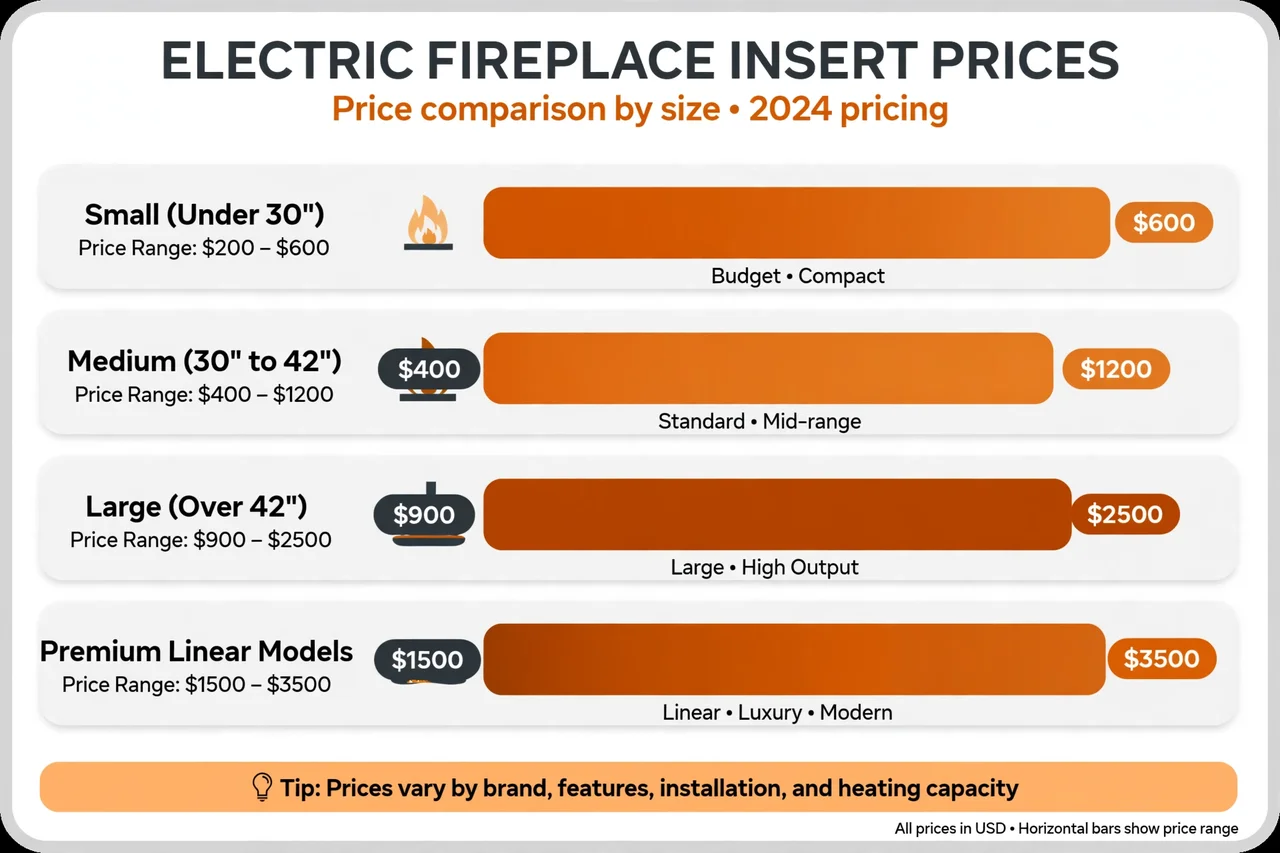
The table below gives 2026 retail estimates for the insert alone, before installation, trim, or tax. Sale prices can fall below these ranges, and premium brands can sit above them.
| Insert size and type | Typical width | Insert only, 2026 estimate | Best for |
|---|---|---|---|
| Small plug-in insert | Under 30 inches | $200 to $600 | Bedrooms, small dens, apartments |
| Standard insert | 30 to 42 inches | $400 to $1,200 | Most existing fireplace openings |
| Large insert | Over 42 inches | $900 to $2,500 | Wide openings, large living rooms |
| Linear wall insert | 50 to 100 inches | $1,500 to $3,500 | Modern feature walls, new builds |
| Log set style insert | 18 to 30 inches | $150 to $500 | Existing fireboxes, flame look with light heat |
Our guide to how much an electric fireplace costs covers full freestanding and wall-mounted units too, so you can compare an insert against those formats before you commit.
What Drives the Price Up or Down?
Seven factors explain most of the price spread between a $300 insert and a $2,000 insert. Work through them in order, and you will see which features are worth paying for in your room.
1. Flame realism
Basic inserts use LED flames on a flat screen. Mid-range models add layered flames, glowing logs, and ember beds. High-end models add 3D flame effects, crackling sound options, and color changing flames. Each step up adds cost, and the jump from basic to realistic is often $300 to $800 on a similar size.
2. Heat output and controls
Most inserts heat with 750 watts on low and 1,500 watts on high. That covers roughly 400 square feet on high, though room layout, ceiling height, and insulation change the result. Models with a thermostat, a timer, and a remote cost more than models with a manual dial, but they also waste less power because they cycle off when the room reaches the set temperature.
3. Size and build quality
A wider glass front, a heavier steel body, and a better fan all add cost. Cheap inserts can rattle, run loud fans, or show hot spots in the flame. Read reviews that mention fan noise and flame evenness, not only star ratings.
4. Brand and warranty
Known brands tend to charge $100 to $400 more than no-name models of the same size. In return you often get a longer warranty, spare parts, and a support line that answers. For a unit you plan to keep for ten years, that gap can be money well spent.
5. Smart features
Wi-Fi control, app control, and voice control add $50 to $200 to the price. They are nice to have, but they do not change heat output or flame quality. Skip them if your budget is tight.
6. Trim kit included or not
Some inserts ship with a trim kit that covers gaps around the opening. Others sell it separately for $50 to $250. Always check the box contents before you compare two prices, or a cheaper insert can turn out to be the dearer buy.
7. Where you buy it
Big-box stores, fireplace dealers, and online retailers price the same model differently, and shipping on a heavy insert can add $50 to $150. A local dealer may include delivery and basic setup, while an online deal may leave you to carry a 60 pound box upstairs alone.
Installation Costs: DIY Versus Hiring an Electrician
Installation is where two buyers with the same insert can end up $1,000 apart. The difference is almost always electrical work, not the insert itself.
When a Plug-In Swap Costs Almost Nothing
If your opening already has a grounded outlet inside or right beside it, and that outlet sits on a circuit with spare capacity, installation can be a do-it-yourself slide-in job. You set the insert in place, fit the trim, plug it in, and test the heater and flame. Budget $0 to $150 for basic trim, sealant, and touch-up paint.
This path only works when the outlet, the circuit, and the clearances are already right. If any one of those fails, stop and get a professional quote. Guessing at electrical capacity is not a saving.
What an Electrician Charges
Electrician rates vary by region, but the pattern is steady: a short, simple job costs far less than new wiring through finished walls. The table below gives 2026 estimates for common jobs. Get a written quote for your home, because panel condition, wall access, and local code rules move these numbers.
| Job | 2026 estimate | Notes |
|---|---|---|
| New outlet near the fireplace | $200 to $500 | Cheaper when the panel is close and walls are open |
| New dedicated circuit | $400 to $900 | Recommended for 1,500 watt inserts on shared circuits |
| New circuit plus panel work | $900 to $2,000 | Applies when the panel is full or outdated |
| Hardwired connection | $150 to $400 | Cleaner look, no visible cord, needs an electrician |
| Electrician call-out and inspection | $100 to $250 | Often credited against the job if you proceed |
Heads Up: Three Wiring Mistakes That Cost More Later
- Extension cords and power strips: Heaters draw high current for hours. A cord or strip can overheat even when it feels fine at first. Use a proper outlet on a circuit rated for the load.
- Shared circuits with other heaters: Two heaters on one circuit can trip breakers or overheat wiring. Tell your electrician what else shares the circuit.
- DIY panel work: Breaker panels carry lethal voltage even with the main switch off in some setups. Leave panel work to a licensed electrician, full stop.
For the full fitting sequence, see how to install an electric fireplace. That guide pairs well with this price guide: one tells you what to do, this one tells you what each step tends to cost.
Trim, Surround, and Finishing Extras
Trim is the part buyers forget in the budget, then notice on the final bill. A bare insert in a rough opening looks unfinished, and the fix ranges from a $50 trim kit to a $2,000 surround rebuild.
- Trim kit: $50 to $250, covers gaps and gives a clean edge
- New mantel shelf: $150 to $800, depending on wood, stone, or composite
- Tile or stone facing: $400 to $1,500 for materials and labor on a standard wall
- Full surround rebuild: $1,000 to $3,000, including framing, board, facing, and paint
- Paint, caulk, and touch-up: $30 to $150 for a basic finish job
- Built-in wall cavity (new build or remodel): $800 to $2,500, including framing, drywall, and finishing
A simple rule helps here. If your opening is already square, clean, and close to the insert size, budget $100 to $300 for trim. If the opening is damaged, oddly sized, or missing a surround, budget $800 or more, and get a carpenter quote before you order the insert.
Running Costs: The Electricity Math, Worked Out
Running cost is the part most articles gloss over with a vague line about cheap operation. Here is the math, step by step, so you can redo it with your own electricity rate.
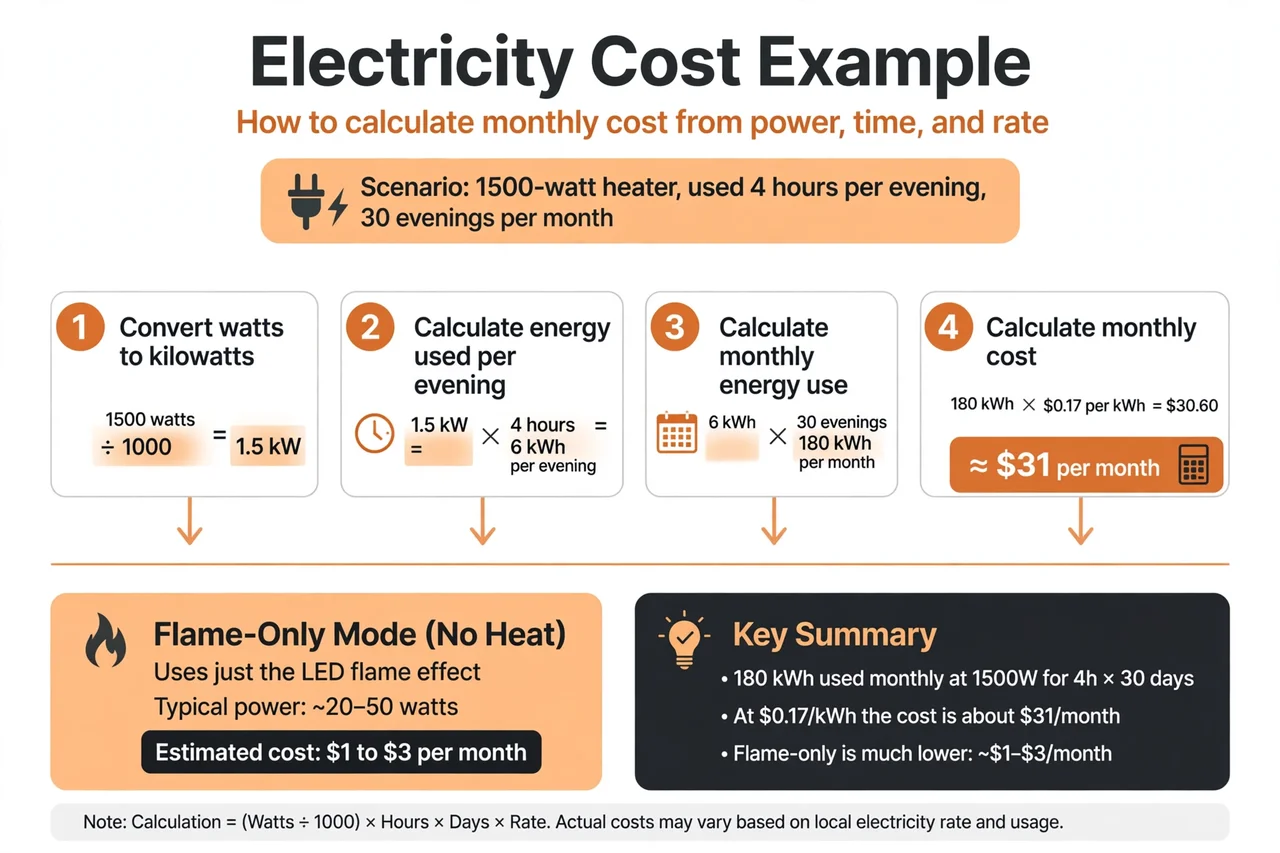
Most inserts use 1,500 watts on high heat. Divide watts by 1,000 to get kilowatts: 1,500 watts equals 1.5 kilowatts. Multiply kilowatts by hours used to get kilowatt-hours. Multiply kilowatt-hours by your rate per kilowatt-hour to get the cost.
The formula is: kilowatts x hours x rate per kilowatt-hour = cost.
Worked Example: Evening Use for One Month
Step 1: 1,500 watts / 1,000 = 1.5 kilowatts
Step 2: 1.5 kilowatts x 4 hours per evening x 30 evenings = 180 kilowatt-hours
Step 3: 180 kilowatt-hours x $0.17 per kilowatt-hour = $30.60 per month
Result: About $31 per month for four hours of high heat every evening.
On low heat at 750 watts, the same pattern costs about $15 per month. With a thermostat, the heater cycles off once the room warms up, so real bills often land below the full-power figure. Flame-only mode uses only the lights and fan, about 20 to 60 watts, which works out to roughly $1 to $3 per month for the same evening pattern.
Running Cost at Different Rates and Habits
Your electricity rate changes the answer more than any other factor. The table below holds the insert at 1,500 watts and shows monthly cost for three habits at three rates. Find your rate on a recent bill, then read across to your habit.
| Evening habit | Hours per month | At 12 cents per kWh | At 17 cents per kWh | At 25 cents per kWh |
|---|---|---|---|---|
| 2 hours, 20 evenings | 40 | $7.20 | $10.20 | $15.00 |
| 4 hours, 30 evenings | 120 | $21.60 | $30.60 | $45.00 |
| 8 hours, 30 days (main heat) | 240 | $43.20 | $61.20 | $90.00 |
One caution: an insert heats one room. If you run it for eight hours a day as main heat while your central heat still runs for the rest of the house, you may pay twice. The saving comes from turning the central thermostat down and heating only the room you use. Our post on whether an electric fireplace uses more electricity than central heat explains that trade-off in detail.
Total Project Cost: Three Realistic Examples
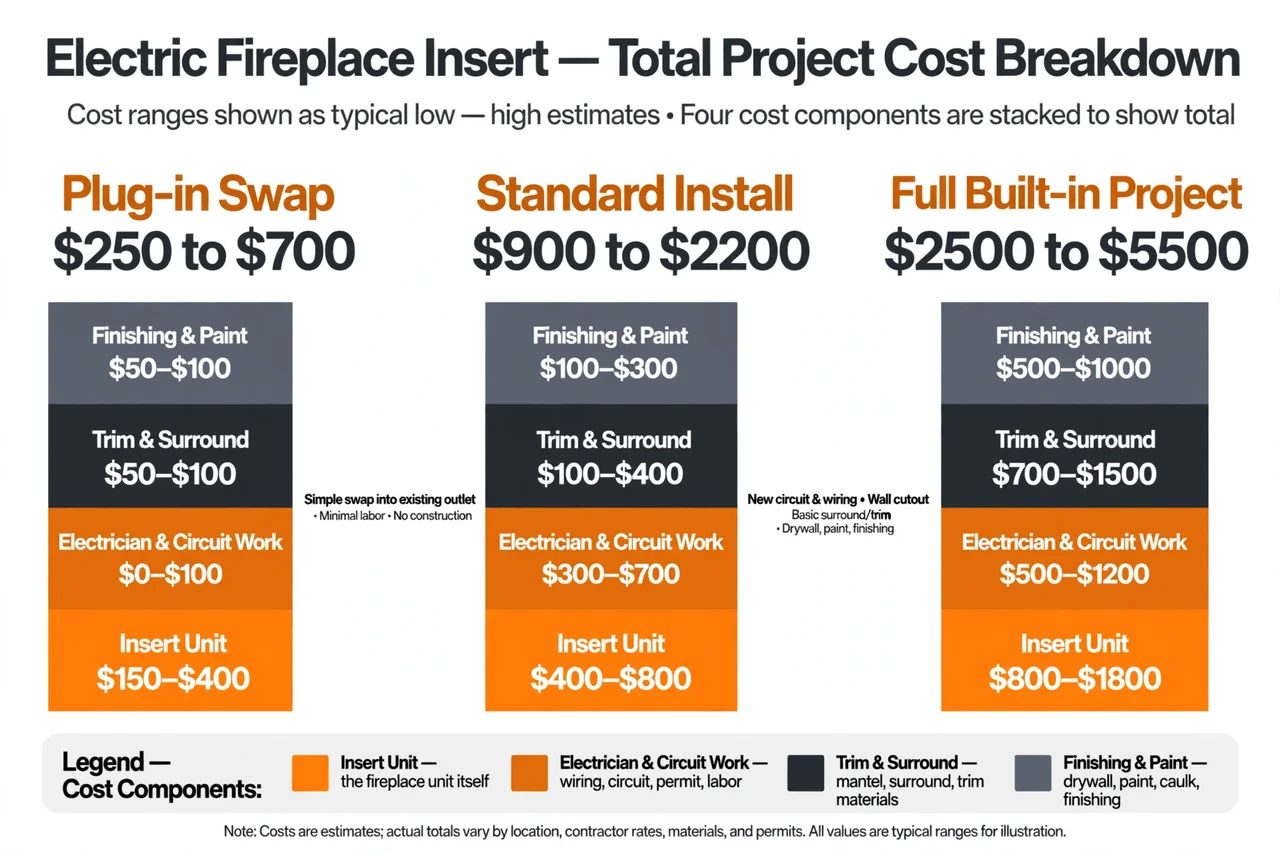
Unit prices alone mislead. The examples below add unit, electrical, trim, and finishing, so you can match your home to the closest case.
| Project | Insert | Electrical | Trim and finish | Total, 2026 estimate |
|---|---|---|---|---|
| Plug-in swap, good outlet already in place | $250 to $500 | $0 | $50 to $150 | $300 to $650 |
| Standard install, new outlet and basic trim | $600 to $1,200 | $250 to $500 | $100 to $400 | $950 to $2,100 |
| Full built-in, new circuit and new surround | $1,200 to $2,500 | $500 to $1,200 | $800 to $2,000 | $2,500 to $5,700 |
Tax, delivery, and disposal of an old unit can add $50 to $200 on top of these totals. Ask every quote whether it includes those items, or you will compare a complete price against a partial one.
Common Budget Traps
Most overspends come from small planning gaps, not from the insert itself. Watch for these five.
| Trap | What it costs you | How to avoid it |
|---|---|---|
| Wrong size ordered | Return shipping, restocking fees, weeks of delay | Measure width, height, and depth twice before ordering |
| Trim kit sold separately | $50 to $250 surprise add-on | Check box contents and add the kit to the comparison price |
| No outlet in the opening | $200 to $900 of electrical work | Get an electrician quote before you buy, not after |
| Paying for smart features you never use | $50 to $200 | Pick flame quality and thermostat control first |
| Ignoring running cost | $30 to $90 per month at heavy use | Run the kilowatt-hour math with your own rate |
Ways to Keep the Total Down Without Cutting Corners
First, buy the size your opening needs, not the largest model that catches your eye. A mid-size insert in a standard opening gives the best value for most living rooms.
Second, keep the surround work light when the opening is already sound. A trim kit and a coat of paint can look finished for under $300, while a full rebuild only pays off when the old surround is damaged or badly dated.
Third, use the thermostat and timer. Heating a room for four hours in the evening costs far less than leaving the heater on all day, and the room still feels warm when you sit down.
Fourth, compare delivered prices, not headline prices. Add shipping, trim, and any electrical quote to each option before you rank them. The cheapest insert on the page is often the dearest project in the end.
Is an Insert the Right Spend for You?
An insert makes sense when you have an existing opening or a wall you plan to build out, you want room heat plus a flame look, and you want to avoid chimney and gas work. It makes less sense when you need whole-home heat, when your panel needs major work that doubles the project cost, or when your opening needs a full rebuild that pushes the total past a freestanding alternative.
For a value check alongside this price guide, read are electric fireplace inserts worth it. That post weighs the pros and cons, while this post answers the money question in full.
Quick Reference Card: Budget at a Glance
- Tight budget: $300 to $650 total, small plug-in insert, existing outlet, trim kit only
- Mid-range: $950 to $2,100 total, standard insert, new outlet, basic trim
- Premium built-in: $2,500 to $5,700 total, large or linear insert, new circuit, new surround
- Monthly running cost: $10 to $31 at typical evening use, $61 to $90 at heavy all-day use, $1 to $3 flame-only
- First step: Measure the opening, then get one electrician quote before ordering
Frequently Asked Questions
How much do electric fireplace inserts cost in total?
Most finished projects cost $900 to $2,200 for a standard install, $300 to $650 for a basic plug-in swap, and $2,500 to $5,700 for a full built-in project with new wiring and a new surround. All figures are 2026 estimates and vary by region.
What does an electric fireplace insert cost on its own?
The insert alone usually costs $200 to $1,200 for small and standard sizes, $900 to $2,500 for large models, and $1,500 to $3,500 for wide linear models. Trim kits, delivery, and tax sit outside that unit price.
Do I need an electrician to install an electric fireplace insert?
Not always. A plug-in swap into a suitable outlet on a circuit with spare capacity needs no electrician. You need a licensed electrician for a new circuit, a new outlet, hardwiring, or any panel work. Never use an extension cord or power strip for a heater insert.
How much does it cost to run an electric fireplace insert per month?
At 1,500 watts, four hours each evening for 30 evenings, and 17 cents per kilowatt-hour, the cost is about $31 per month. On low heat it is about $15 per month for the same pattern, and flame-only mode costs about $1 to $3 per month.
Is a dedicated circuit required for an electric fireplace insert?
It is strongly recommended for 1,500 watt inserts, and local code or the manual may require it. A dedicated circuit avoids tripped breakers and overloaded wiring. Ask a licensed electrician to check your panel and circuit load before you install.
What extras should I budget for besides the insert?
Budget for a trim kit at $50 to $250, electrical work at $200 to $900 for a new outlet or circuit, and finishing at $30 to $2,000 depending on whether you need paint only or a full surround rebuild. Delivery and tax can add $50 to $200 more.
Are cheap electric fireplace inserts worth buying?
A low price can work for a small room when the size fits and the outlet is suitable. Check fan noise, flame quality, warranty length, and whether a trim kit is included. A cheap insert that needs a return, a new circuit, and a trim kit can cost more than a mid-range model bought once.
How long does an electric fireplace insert last?
Most inserts last 10 to 20 years with normal use, though heater elements, fans, and LED parts may need repair sooner. A longer warranty and a brand with spare parts help protect that lifespan. Keep vents clear and follow the manual for cleaning and care.
Final Word
Start with your opening size and one electrician quote. Those two facts set your real price range faster than any shopping search. From there, pick the insert that fits, add trim and finishing honestly, and run the electricity math with your own rate. Done that way, the final bill holds few surprises, and the fire you sit beside each evening is one you budgeted for, not one you are still paying off.