Eucalyptus Firewood: Burning Guide for Seasoning, Splitting, and Safe Burning
Eucalyptus firewood burns hotter than oak, smells wonderful, and leaves a long-lasting bed of coals. It also tests your patience. A stack of green eucalyptus can sit for a year and still be too wet to burn well, and the same natural oils that give it such fierce heat make it pop and throw sparks.
This guide walks you through the whole process in order: how to split it at the right time, how to stack and season it, how to test it, and how to burn it without overheating your stove or coating your chimney in creosote. By the end you will know exactly when a eucalyptus log is ready and how to build a fire with it that burns hot, clean, and steady.
Safety first: never burn eucalyptus, or any wood, in an unvented indoor space. Fit working carbon monoxide detectors in your home, and have your chimney inspected and swept once a year by a certified chimney sweep. Green or oily wood raises creosote buildup and chimney fire risk. If you smell gas, feel dizzy, or your CO alarm sounds, get outside and call emergency services. This article is general guidance, not a substitute for your stove manual or a licensed professional.
What You Need
- Seasoned eucalyptus splits
- Oak or other cooler-burning splits for mixing
- Dry kindling and one firelighter
- Firewood moisture meter
- Hydraulic log splitter or maul and wedges
- Chainsaw with sharp chain and bar oil
- Work gloves, eye protection, ear protection
- Steel-toe boots and chainsaw chaps
- Raised firewood rack or pallets
- Waterproof cover for the top of the stack
- Fireplace screen or stove with glass doors
- Long-handled poker and ash bucket with lid
At a Glance: The Steps
- Check your stove manual and local burn rules
- Split the rounds 5 to 7 days after cutting
- Stack the splits with gaps for air
- Cover the top of the stack
- Test the moisture before you burn
- Lay kindling, oak, and eucalyptus in layers
- Light the fire from the bottom
- Mix cooler wood in and tend the fire
What Eucalyptus Firewood Brings to Your Fire
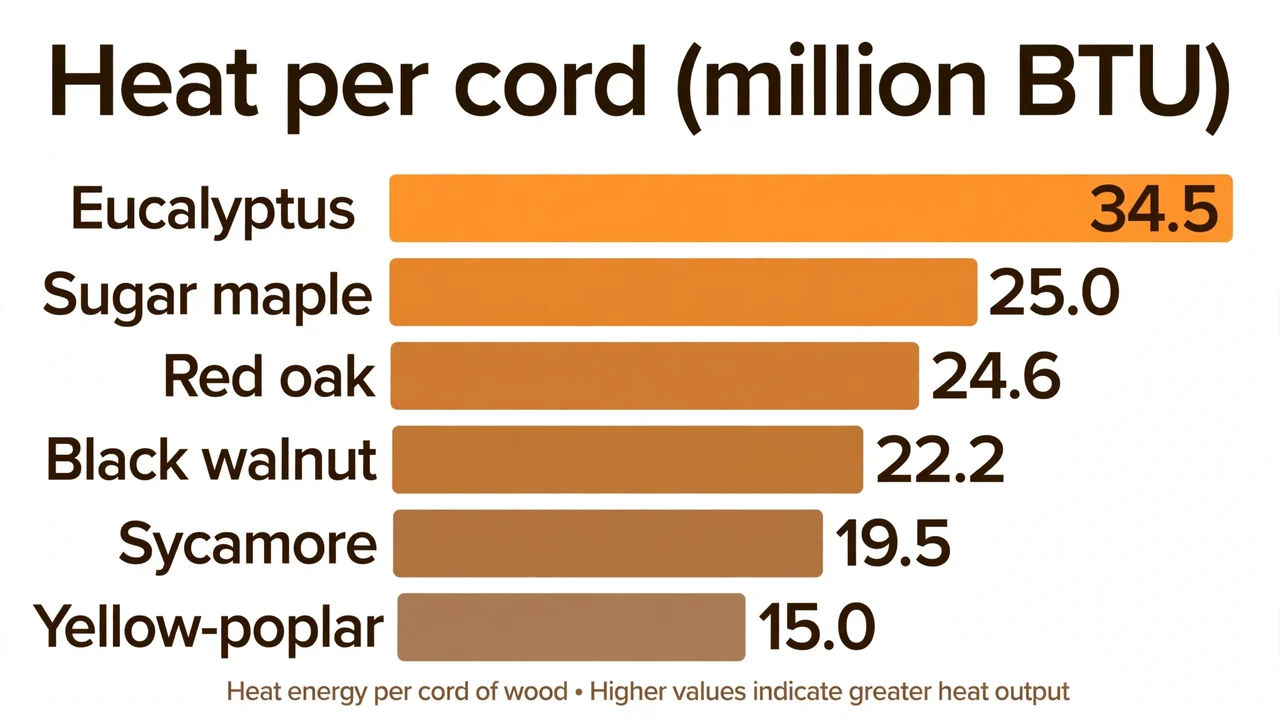
Eucalyptus is a dense hardwood, and there are more than 700 species of it, so exact figures vary from tree to tree. Firewood guides commonly list eucalyptus at about 34.5 million BTU per cord, which puts it near the top of the heat charts. Red oak, a trusted heating wood, sits near 24.6 million BTU per cord on the same lists.
That heat comes from two sources: dense wood and natural oils. The oils help the wood catch and burn with a strong flame, and they give off a sweet, medicinal smell that many people love. Once the fire is going, eucalyptus forms a deep bed of coals that holds heat for hours and leaves little ash behind.
The same oils are the reason eucalyptus needs care. Oil pockets trapped in the wood pop and throw sparks as they heat, even in seasoned logs. The oils also add to creosote buildup on chimney walls. Seasoning cuts that risk a lot, but it never removes it, so a screen or glass doors and a yearly chimney sweep matter more with eucalyptus than with most woods.
| Firewood | Million BTU per Cord | Seasoning Time | How It Burns |
|---|---|---|---|
| Eucalyptus | 34.5 | 18 to 24 months | Very hot, long coals, pops and sparks |
| Sugar maple | 25.0 | 12 months | Hot and steady, good coals |
| Red oak | 24.6 | 18 to 24 months | Hot, slow, excellent coals |
| Black walnut | 22.2 | 12 to 24 months | Medium heat, burns clean, light smoke |
| Sycamore | 19.5 | 12 to 18 months | Moderate heat, burns fast, needs mixing |
| Poplar | 15.0 | 6 to 12 months | Low heat, lights fast, poor coals |
Figures are commonly published averages for seasoned wood near 20 percent moisture. Eucalyptus figures come from firewood guides; other species figures come from Rutgers Cooperative Extension. Real values vary with species, growing conditions, and moisture.
Worked Example: What 40 Percent More Heat Means
Eucalyptus at 34.5 million BTU per cord minus red oak at 24.6 million BTU per cord leaves a gap of 9.9 million BTU. Divide 9.9 by 24.6 and you get about 0.40, or 40 percent more heat from the same stacked volume.
Put another way, one cord of seasoned eucalyptus holds roughly the heat of 1.4 cords of red oak. That is why a small load of eucalyptus can overheat a stove sized for oak, and why mixing it with cooler wood is part of burning it well rather than an optional extra.
Green or Seasoned: The Difference Is Everything
Green eucalyptus is one of the poorest fuels you can put in a stove. It holds a lot of water on top of its oils, so it hisses, smokes, and struggles to catch. The smoke it makes is thick and sour, and it lays creosote down fast.
Seasoned eucalyptus is a different fuel. The smoke drops away, the flame turns strong and clean, and the wood burns hot for a long time on a small load. The change does not happen in a few months. Plan on 18 to 24 months from splitting to burning, and test with a meter rather than guessing from the calendar.
Green Eucalyptus
- Heavy, wet, and hard to light
- Thick smoke and a sour smell
- Fast creosote buildup in the flue
- Weak flame that dies out
- Bark still tight and damp inside
Seasoned Eucalyptus
- Light in the hand, ends checked and cracked
- Little smoke, sweet medicinal smell
- Moderate creosote with a yearly sweep
- Strong flame and a deep coal bed
- Moisture meter reads below 20 percent
Check Your Stove Manual and Local Burn Rules
Open your stove or fireplace manual before you buy or cut a single log. Some stove makers warn against very hot burning woods, and eucalyptus sits at the top of that list. A small stove can overheat on a full load of it, which can warp parts and void a warranty.
Check your local burn rules at the same time. Some areas restrict open burning on poor air quality days, and some have firewood transport rules to slow the spread of pests. A quick check with your local authority costs little and saves a fine. If you buy rather than cut, ask the seller when the wood was split and whether it has been tested; our guide on where to buy firewood shows what to look for in a load.
Heads up: eucalyptus burns hot enough to damage a stove that is loaded like it holds oak. Start with small loads, watch your stove thermometer, and keep the air control where your manual says it belongs. If the stove top glows or the thermometer passes the safe range, close the air down and let the load burn down before you add more.
Split the Rounds 5 to 7 Days After Cutting
Timing matters more than muscle with this wood. Split eucalyptus about 5 to 7 days after the tree comes down, while the wood is still green enough to give. Wait longer and it hardens into one of the toughest splitting jobs in the woodpile.
Work with a hydraulic splitter if you can borrow or hire one. A maul and wedges will do the job on straight-grained rounds, but twisted grain fights back and wears you out fast. Cut rounds to 14 to 16 inches so they fit a standard firebox with room for air around them.
Wear gloves, eye protection, ear protection, and steel-toe boots, and keep children and pets well clear of the splitting area. Never work alone with a chainsaw. If a round has metal, nails, or wire in it, set it aside and do not cut it.
Pro tip: split the rounds a little smaller than you would split oak. Eucalyptus seasons from the split faces inward, so thinner splits dry faster and reach the target moisture sooner.
Stack the Splits With Gaps for Air
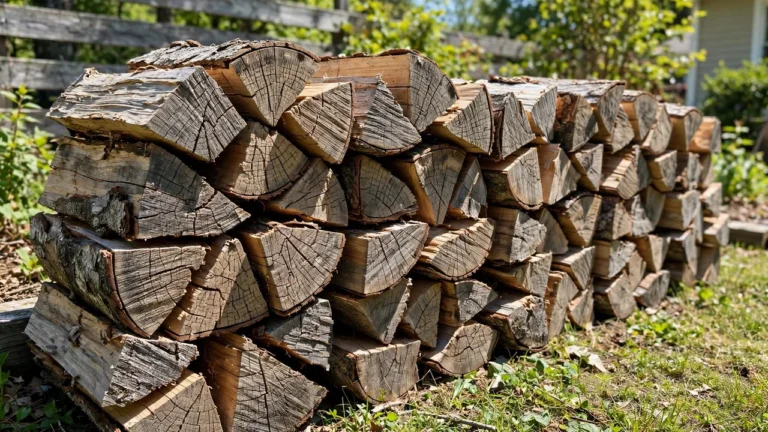
Pick a sunny, breezy spot and raise the stack off the ground on pallets or a rack. Ground contact traps damp and invites rot and insects. Build the stack in a single row if you have the space, since air moving through the row dries the wood faster than a wide block does.
Leave a finger-width gap between splits where you can, and keep the bark side up on the top layer so rain runs off. Point the cut ends toward the wind. A solar kiln for drying firewood speeds the process in damp climates, but a well-sited open stack works in most places if you give it the full seasoning time.
Cover the Top of the Stack
Lay a waterproof cover over the top of the stack only, and let the sides stay open to the air. A tarp draped down the sides traps damp air inside and slows drying to a crawl. The top cover keeps rain off while the open sides let wind carry moisture away.
Weigh the cover down so a storm cannot lift it. Check the stack after heavy rain and after winter, and re-seat any cover that has slipped. Mark the stack with the month you split it, so you know when the 18 month mark arrives without guessing.
Test the Moisture Before You Burn
Do not trust the calendar alone. Split one piece open and press the pins of a moisture meter into the fresh face, not the dry outside. The reading you want is below 20 percent. Readings between 13 and 17 percent burn well; wood below 12 percent burns very fast, so load smaller amounts.
If the meter reads above 20 percent, the wood goes back on the stack for another season. Two pieces knocked together should give a sharp crack rather than a dull thud, and the ends should show deep cracks. Those signs help, but the meter reading is the one that decides.
Read Your Moisture Meter
- Above 25 percent: do not burn it. It will smoke, waste heat, and coat the flue.
- 20 to 25 percent: still too wet for indoor burning. Give it more time on the stack.
- Below 20 percent: ready to burn indoors. This is the target for every load.
- 13 to 17 percent: the sweet spot for a clean, steady burn.
Lay Kindling, Oak, and Eucalyptus in Layers
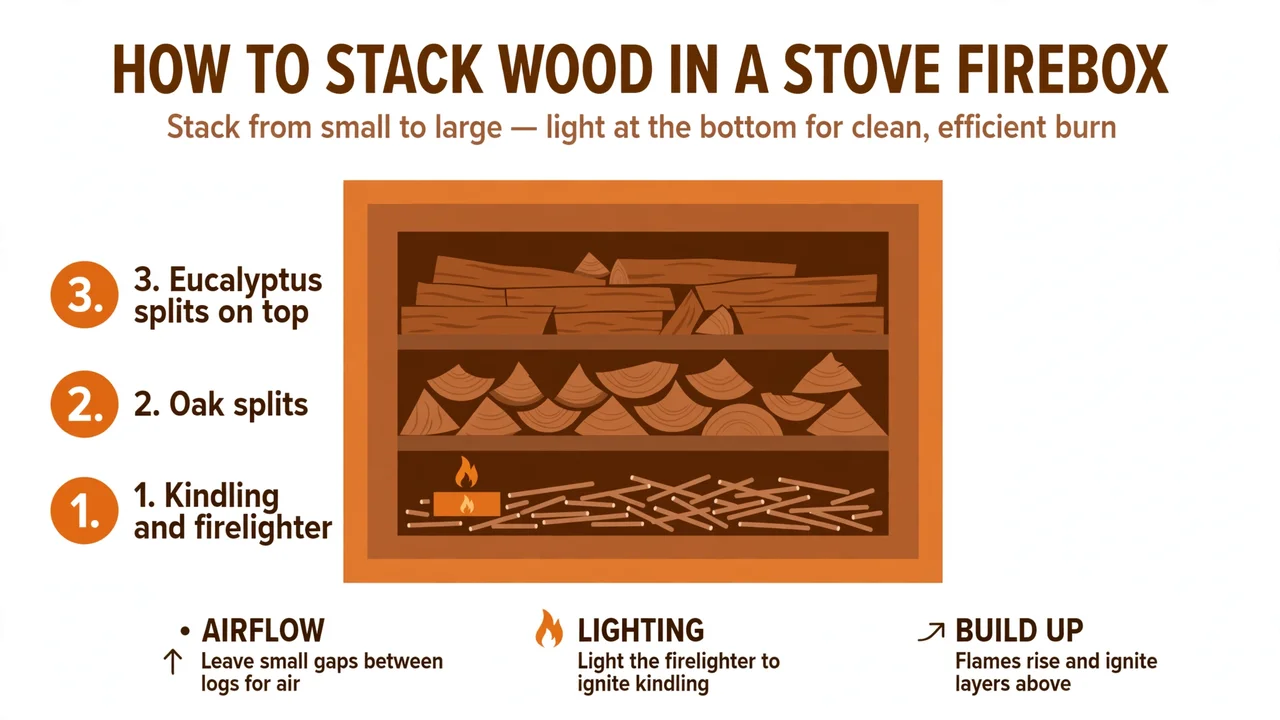
Build the fire in layers with the smallest wood at the bottom. Start with dry kindling and one firelighter on the firebox floor, then lay two or three oak splits across them with gaps for air. Set two eucalyptus splits on top, bark side out, with a gap between them.
The layering has a purpose. Kindling lights fast and warms the flue, oak catches next and builds a steady flame, and the eucalyptus on top ignites from the rising heat once the fire is established. Putting eucalyptus at the bottom of a cold stove is the most common reason a eucalyptus fire sulks and smokes.
Light the Fire From the Bottom
Light the firelighter and leave the stove door cracked open a finger width until the kindling catches well. Watch the flame climb from the kindling into the oak. The eucalyptus on top should catch within a few minutes once the fire is hot.
Open the air control fully for the first 10 to 15 minutes so the flue warms and draws well. A cold flue and a starved fire are what make eucalyptus smoke. Once the oak is burning brightly and the eucalyptus has caught, set the air control to the level your stove manual recommends for a steady burn.
Mix Cooler Wood In and Tend the Fire
Feed the fire with a mix, not eucalyptus alone. A good starting mix is one eucalyptus split for every two oak splits. That ratio gives you the long coals and high heat without pushing a small stove past its safe range. Adjust from there once you know how your stove behaves.
Keep the fireplace screen closed or the glass doors shut while eucalyptus burns, because oil pockets can pop without warning and throw embers across the room. Add new logs one or two at a time, and give each load time to catch before you add more. A stove thermometer takes the guesswork out of this: if the needle climbs past the safe zone, add oak next, not eucalyptus.
Heads up: never burn eucalyptus near an open fireplace without a screen, and never leave a sparking fire unattended. Keep rugs, paper, and kindling at least three feet from the hearth, and keep a working fire extinguisher in the room.
Shut the Fire Down and Look After the Chimney
Let the fire burn down to coals on its own. Close the air control down in small steps rather than shutting it all at once, which can smother the fire and make smoke. Once the coals are cold, scoop the ash into a metal bucket with a lid and store it outside, away from the house, for at least three days before you throw it away.
Book a chimney sweep once a year, and sooner if you burn eucalyptus as your main fuel. Tell the sweep what you burn so they know what to look for. Between sweeps, watch for signs of trouble: smoke spilling into the room, a tar smell near the stove, or a flue that draws worse than it used to. Any of those means the chimney needs attention before the next fire.
Test your carbon monoxide detectors once a month and change their batteries on schedule. CO has no smell and no color, and a blocked or coated flue is one of the ways it gets into a home. A detector is cheap protection against a risk you cannot see.
Troubleshooting: When the Fire Misbehaves
| If This Happens | Try This |
|---|---|
| The fire will not catch | Test the moisture. Above 20 percent means the wood needs more time. Rebuild with dry kindling at the bottom and eucalyptus on top. |
| Thick smoke fills the room | Open the air control and warm the flue before you load more wood. Green wood is the usual cause, so check the meter reading. |
| Sparks fly from the fire | Close the screen or glass doors. In a stove this is contained, so a screen is the fix for open fireplaces. |
| The stove runs too hot | Stop adding eucalyptus and feed oak instead. Load smaller amounts and keep the air control where your manual sets it. |
| The fire dies soon after lighting | The flue may be cold or the load may be packed too tight. Leave gaps between splits and give the fire 10 to 15 minutes of full air. |
| A tar smell hangs near the stove | Creosote may be building up. Burn only seasoned wood from now on and book a chimney sweep before the next fire. |
Frequently Asked Questions
Is eucalyptus firewood safe to burn indoors?
Yes, when it is fully seasoned to below 20 percent moisture and burned in a stove or a fireplace with a screen or glass doors. Have the chimney swept once a year, and keep working carbon monoxide detectors in the home.
Is burning eucalyptus wood toxic?
No, the smoke from burning eucalyptus wood is not toxic. The leaves and the concentrated oil are toxic if eaten, which is a different risk from burning the wood. Do not cook food over a eucalyptus fire, since the oils can reach the food.
How long does eucalyptus take to season?
Plan on 18 to 24 months from splitting to burning. Split the rounds 5 to 7 days after cutting, stack them with airflow, and test with a moisture meter. The wood is ready when the meter reads below 20 percent.
Why does eucalyptus pop and spark?
Pockets of natural oil trapped in the wood heat up and burst as the log burns. Seasoning reduces the popping but does not remove it. A fireplace screen or glass doors keep the embers where they belong.
Does eucalyptus make a lot of creosote?
Seasoned eucalyptus makes a moderate amount of creosote because of its oils. Green eucalyptus makes far more. Burn only seasoned wood and have the chimney swept once a year, sooner if eucalyptus is your main fuel.
Is eucalyptus better than oak for firewood?
Eucalyptus gives more heat per cord, about 34.5 million BTU against about 24.6 million for red oak, but it takes as long to season and it sparks more. Many burners get the best results by mixing the two rather than burning eucalyptus alone.
Quick Reference Card
What you need: seasoned eucalyptus splits, oak splits for mixing, kindling, firelighter, moisture meter, splitter or maul, PPE, raised rack, top cover, screen or glass doors.
Key numbers: split 5 to 7 days after cutting; season 18 to 24 months; burn below 20 percent moisture; about 34.5 million BTU per cord; mix one eucalyptus split to two oak splits.
- Check your stove manual and local burn rules.
- Split the rounds 5 to 7 days after cutting.
- Stack the splits with gaps for air.
- Cover the top of the stack.
- Test the moisture before you burn.
- Lay kindling, oak, and eucalyptus in layers.
- Light the fire from the bottom.
- Mix cooler wood in and tend the fire.
After the fire: let coals cool, ash into a lidded metal bucket, sweep the chimney once a year, test CO detectors monthly.
Ready for the Hottest Fire in the Woodpile
Eucalyptus firewood rewards the burner who respects its two rules: season it fully, and mix it with cooler wood. Give it 18 to 24 months on the stack, test it with a meter, and it will pay you back with fierce heat, a sweet smell, and coals that last into the night.
Start with the stack you have. If your eucalyptus still reads above 20 percent, it is not a failure, it is a stack that needs one more season. While you wait, our guide to the best firewood for Christmas fires can help you pick a faster-seasoning wood for the fires you want this winter.
Sources: BTU figures for eucalyptus from firewood guides (Awesome Axes, Timber Gadgets); other species figures from Rutgers Cooperative Extension; safety and creosote guidance from Lekto Woodfuels. Figures vary by species and moisture, so treat them as guides, not guarantees.