Black Walnut Firewood: Burning Guide, Seasoning, and Heat
Black Walnut Firewood: Burning Guide — if you have a walnut tree down in the yard, or a load of dark, chocolate-brown logs offered at a fair price, you may be wondering whether it belongs in the fireplace. The short answer is yes. Black walnut burns as a solid mid-range hardwood: it lights well when dry, gives steady warmth, leaves good coals, and smells pleasant. It does not match oak or hickory for raw heat, and it needs a full seasoning period before it earns that reputation.
This guide covers how to spot black walnut, how long to dry it, what kind of fire to expect, where it works best, and the mistakes that turn a good load into a smoky, disappointing burn. Figures here come from published firewood charts, which do not all agree — where sources differ, this guide says so rather than picking one number and calling it settled.
⚠️ Heads Up: Burn Safe, Every Time
Never burn wood in an unvented indoor space, and never burn in a fireplace or stove that has not been inspected. Fit working carbon monoxide (CO) detectors in your home, and have your chimney inspected and swept at least once a year by a qualified chimney professional.
Wet or green wood makes more smoke and more creosote, the flammable deposit that builds up inside chimneys and can catch fire. Never burn treated, painted, or stained wood, plywood, MDF, particleboard, trash, or glossy printed material. Respect local burn bans, and follow your state or local rules on moving firewood, which exist to slow the spread of tree pests and disease. When anything about your chimney, stove, or venting seems off, stop and call a licensed professional.
Black Walnut at a Glance
Black walnut (Juglans nigra) is a hardwood native to central and eastern North America. Woodworkers prize it for furniture, which is why clean, straight walnut logs often cost more as lumber than as fuel. Yard trees, storm-damaged limbs, and offcuts that are not fit for the sawmill are the usual route into the firewood pile.
As firewood, black walnut sits in the middle of the pack. That middle spot is still a useful place to be: it beats most softwoods and lighter hardwoods for heat, lights with less fuss than some dense woods, and suits evening fires, shoulder-season heating, and outdoor fires. For all-night heat in deep winter, most burners pair it with a denser wood or save the densest logs for the coldest nights.
Quick Reference Card: Black Walnut Firewood
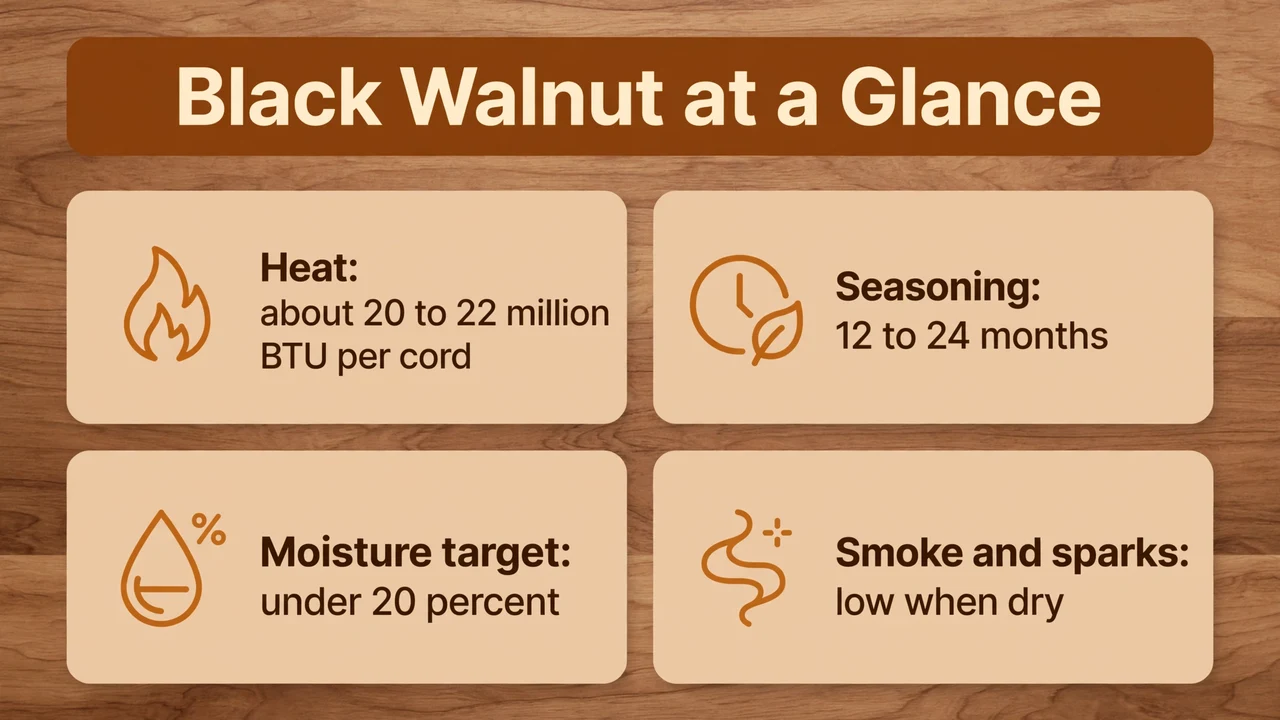
| Heat output | About 20 to 22.2 million BTU per cord in most charts; some charts list around 24 million |
| Seasoning time | 12 to 24 months for split, stacked wood; 6 months is the low end cited for small splits in dry, breezy conditions |
| Moisture target | Under 20% on a moisture meter, measured on a fresh split face |
| Smoke and sparks | Low when fully dry; heavy smoke and extra creosote risk when wet |
| Coals | Good, steady coals; shorter-lived than oak coals |
| Smell | Pleasant, mild, nutty or earthy aroma when dry |
| Best role | Evening and shoulder-season fires, mixed loads, fire pits, and campfires |
Spot Black Walnut Before You Split It
Black walnut heartwood is the giveaway. Freshly cut, it runs from medium chocolate brown to a darker, purplish brown, with a paler creamy sapwood band near the bark. Few common firewoods show that deep brown tone across the whole cut face. The bark is grey-black, thick, and deeply furrowed into long, narrow ridges that form a rough diamond pattern.
In leaf, black walnut carries compound leaves — one central stem with 15 to 23 leaflets arranged in pairs, plus a single leaflet at the tip. In autumn, the round green husks, about 1.5 to 2.25 inches across, turn black as they fall and rot. Those husks stain hands, driveways, and clothing a dark brown, so wear gloves if you handle fallen nuts.
Two lookalikes cause mix-ups. Butternut, also called white walnut, is paler and lighter in weight. Ash bark can look similar, but ash heartwood is much lighter in color and lacks walnut’s chocolate tone. When in doubt, check the cut face: dark brown heartwood plus deeply ridged, grey-black bark points strongly to black walnut.
How Black Walnut Burns
Heat output
Published firewood charts put seasoned black walnut at about 20 to 22.2 million BTU per cord, with some charts listing around 24 million BTU per cord. The spread reflects different chart sources, wood density assumptions, and moisture levels — not a mistake in your wood. Treat the range as the honest figure: solid mid-range heat, clearly above pine, fir, poplar, and cottonwood, and clearly below oak and hickory.
Weight tells the same story. A dry cord of black walnut weighs roughly 3,192 pounds in the commonly cited chart figures, against about 4,584 pounds green. Denser wood packs more heat per load, and walnut’s medium density is exactly why it lands in the middle of the heat table.
Flame, coals, and burn time
Dry black walnut catches fire readily, burns with a steady flame, and settles into good coals. Those coals hold heat well for an evening fire, though they do not last as long as oak coals through the night. Several experienced burners note that walnut burns a bit faster than oak, which makes it a natural partner wood: walnut for a quick, pleasant fire, oak alongside it for staying power.
For a long, slow burn, load larger splits and pack the firebox more tightly once the fire is established. For a short evening fire, smaller splits and a looser stack give a livelier flame and a faster finish. Either way, dryness matters more than split size: wet walnut smolders, smokes, and gives back far less heat.
Smoke, smell, and sparks
Seasoned black walnut produces little smoke and few sparks, which is one reason it suits open fireplaces and outdoor fires. The smell is widely described as pleasant — mild, nutty, and earthy, without the sharp edge of some softwoods. Burners who prize a fragrant fire often rank walnut above many other hardwoods on aroma alone.
Green walnut is a different story. Fresh-cut walnut holds a lot of water, and burning it before it dries produces thick smoke, weak heat, and faster creosote buildup. If your walnut fire smokes heavily, the first suspect should be moisture, not the species. Check the wood with a meter before blaming the tree.
Creosote: what to watch
All wood fires produce some creosote, and walnut is no exception. Dry walnut burned in a hot fire with good airflow keeps creosote formation low. Wet wood, smoldering fires, and restricted airflow raise it. Keep the flue hot, avoid damping a fire down to a long smolder overnight with wet wood, and hold to the yearly chimney inspection and sweeping schedule. A chimney fire is a preventable failure, and dry wood plus a clean flue are the two main defenses.
Season Black Walnut the Right Way
Black walnut seasoning times in published guides run from 6 months to 2 years, with most sources landing on at least a year and many recommending 12 to 24 months. Larger rounds and humid climates push toward the long end. Plan on a full year as your baseline, and let the moisture meter make the final call.
Split logs soon after cutting
Split walnut as soon as practical after cutting. Whole rounds dry slowly from the ends only, and walnut heartwood can stay damp in the middle for a long time if left in the round. Splitting opens the grain and lets air reach the wet interior. Walnut splits with little resistance compared with stringy woods like elm, and straight-grained pieces often split cleanly with a maul.
Stack for sun, wind, and drainage
Stack split walnut off the ground on pallets, rails, or a rack, in a single row where possible so wind can pass through. Face the stack toward sun and prevailing wind, and cover only the top — a tarp draped down the sides traps damp air and slows drying. Leave the sides open. If you stack against a wall, pull the row a few inches out so air can move behind it.
Test moisture on a fresh face
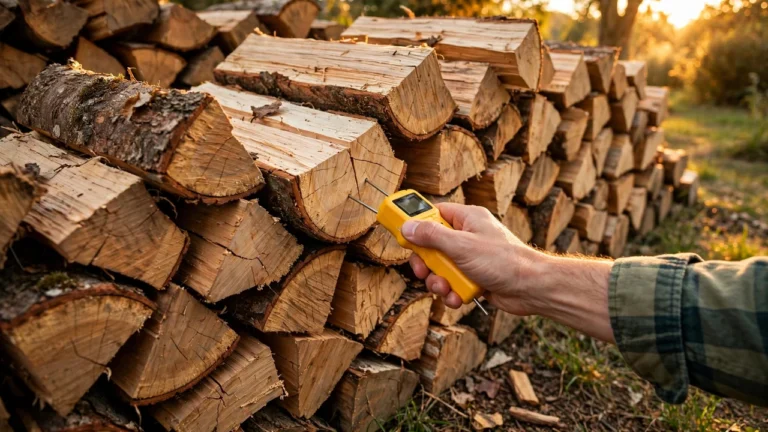
Split a piece open and press the meter pins into the fresh face, not the weathered outside. The outside can read dry while the center still holds water. Burn only wood that reads under 20%. Wood above that line is harder to light, gives less heat, and smokes more. If you want a deeper look at moisture checks, see our guide to whether firewood can be too dry — and note that over-drying is far less common a problem than burning wood that is still wet.
Two field checks back up the meter. Dry walnut sounds hollow and sharp when two pieces are knocked together, and the cut ends show radial cracks, called checks. Neither check replaces a meter reading, but both help when you are sorting a mixed pile at a glance. For a full rundown of the costs of skipping this step, read why you should not burn wet firewood.
Store Walnut So It Stays Dry
Seasoned walnut reabsorbs water if left uncovered in rain or sitting on bare soil. Keep the finished stack topped with a cover that sheds rain, sides open, and base raised. Bring only a day or two of wood indoors at a time, and keep indoor wood away from the stove and fireplace opening. A rack beside the hearth holds the evening’s wood without crowding the fire.
Watch for one walnut-specific storage habit: fallen nuts and husks left in the pile stain and rot, and damp husk material holds moisture against the logs. Clear husks and leaf litter out of the stack area each autumn. The same husks that stain driveways will stain a porch if a load sits there through a wet spell.
Black Walnut Against Other Common Firewoods
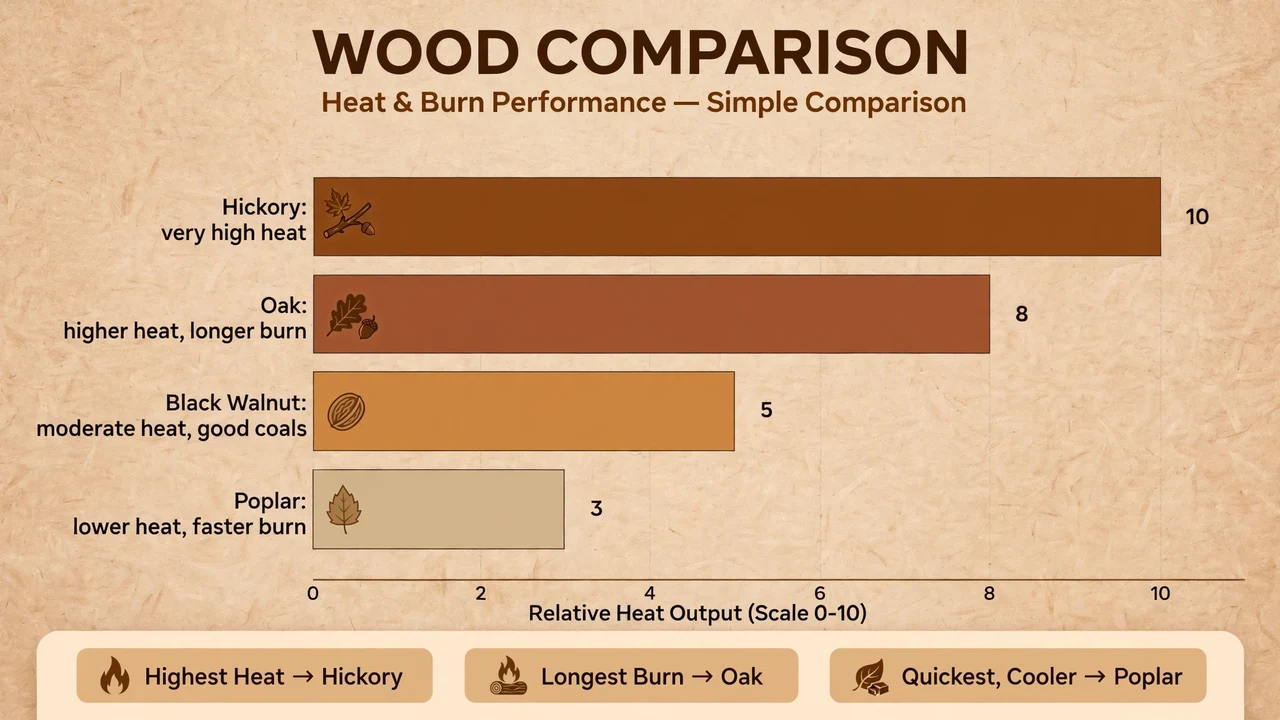
Comparisons only help if the direction is honest. Black walnut out-heats the light woods, trails the dense woods, and wins on aroma and low spark output against several rivals. The table below keeps the comparison qualitative except for walnut itself, where published chart figures are given as a range.
| Firewood | Heat | Burn character | Best role |
|---|---|---|---|
| Black walnut | Mid-range, about 20–22.2 million BTU per cord | Steady flame, good coals, low smoke and sparks when dry, pleasant nutty smell | Evening fires, mixed loads, fire pits |
| Oak | Higher than walnut | Long, slow burn with long-lasting coals; needs a long seasoning period | Overnight heat, coldest nights |
| Hickory | Higher than walnut | Very hot, long burn; heavier to handle | Maximum heat, wood stoves |
| Poplar | Lower than walnut | Fast, lighter burn; burns through a load more quickly | Quick fires, kindling support, mixed loads |
| Cottonwood | Lower than walnut | Fast burn, more ash, needs full seasoning | Shoulder-season fires, campfires |
For closer looks at the lighter woods in that table, see our poplar firewood burning guide and our cottonwood firewood burning guide. Both show why mixing a fast, light wood with a mid-range wood like walnut gives a more flexible fire than either wood alone.
Where Black Walnut Works Best
Fireplaces
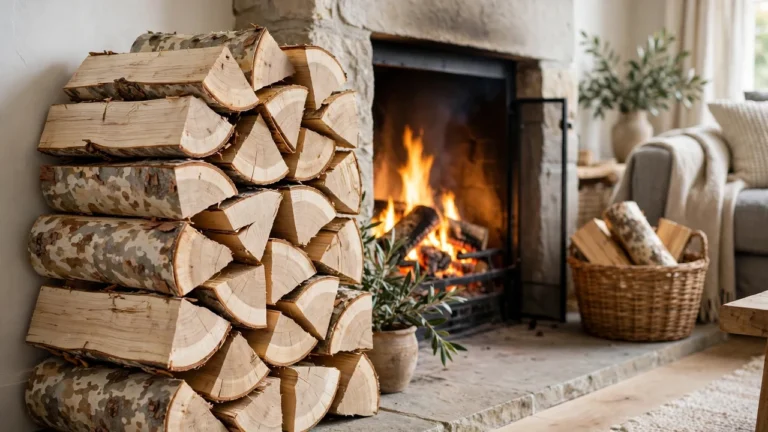
Black walnut is a natural fireplace wood. It lights well when dry, throws a pleasant-smelling fire, and pops and sparks far less than many woods, though a screen is still good practice with any open fire. Use it for evening fires and gatherings, and mix in oak when you want the fire to hold longer after the room has warmed up.
Wood stoves
In a wood stove, walnut gives steady, controllable heat and good coals for cooking on a stove top or reheating a kettle. Size splits to your firebox, keep the air control open enough to hold a lively flame, and avoid packing a stove full of walnut and damping it down hard — a smoldering load wastes fuel and builds creosote faster than a hot, clean burn.
Fire pits and campfires
Low smoke, few sparks, and a pleasant smell make walnut a strong fire-pit wood. It suits social fires where people sit close to the flames. Follow the same rules as any outdoor fire: clear the area, keep the fire modest in size, never leave it unattended, and douse it fully before leaving. If you are sorting out what else belongs in an outdoor fire, our guide to what you can burn in a fire pit covers the safe list and the never-burn list in one place.
Smoking and cooking: use with care
Black walnut wood is sold by some barbecue suppliers as a smoking wood, and reputable smoking references list walnut as safe for food use but strong — best used sparingly or blended with a milder wood. Its smoke flavor runs strong and can turn bitter if used heavily, so it suits thick red meats and game better than fish or poultry. Never use raw walnut shells or husks picked off the ground for smoking: they are far stronger, may carry mold, and are not a food-grade product. For smoking, buy processed, food-grade wood chunks from a supplier, and keep walnut as a small share of the smoke blend.
Nut allergy is a separate caution. People with tree-nut allergy should not eat food smoked with walnut wood, and anyone with a known walnut allergy should avoid breathing walnut sawdust when cutting or sanding. When in doubt, pick a different smoking wood.
What Not to Burn — and the Juglone Question
Black walnut trees produce juglone, a compound that harms certain plants growing near the tree. Gardeners know it well: tomatoes, peppers, potatoes, apples, pines, and birch are among the plants sensitive to juglone. That plant effect does not mean walnut smoke is uniquely toxic to people — seasoned walnut firewood is burned widely as ordinary firewood — but it does give two practical rules for the ash pile and the stable.
- Keep walnut ash out of sensitive garden beds. Do not spread walnut ash where tomatoes, peppers, potatoes, or other juglone-sensitive plants grow. Compost or discard it away from those beds.
- Never use walnut shavings or sawdust as horse bedding. Black walnut shavings are a documented cause of laminitis, a serious hoof condition, in horses through skin contact. Keep sawdust and shavings from the horse barn entirely.
- Never burn treated, painted, or stained walnut. Old walnut furniture, flooring, or trim may carry finishes, glues, or preservatives. Burn only clean, untreated walnut cut for fuel.
- Never burn plywood, MDF, particleboard, trash, or yard waste treated with chemicals. Species does not make these safe — the glues and treatments do the damage.
Buying walnut rather than cutting it yourself? Check the seller’s seasoning claims with a meter, and confirm the load is the species advertised. Our guide to where to buy firewood covers questions to ask a supplier and warning signs of a wet or mixed load.
Troubleshoot a Poor Walnut Fire
Check moisture first
A walnut fire that smokes, hisses, or refuses to hold a flame is almost always a moisture problem. Split a log and meter the fresh face. Readings above 20% mean the wood goes back to the stack, not into the stove. Hissing at the cut ends and dark, wet-looking wood at the center are visible signs of the same problem.
Open the air before blaming the wood
A starved fire smolders no matter the species. Open the stove air control or fireplace damper, build the fire with dry kindling and small splits, and add larger walnut splits only after a hot coal bed forms. A cold chimney also draws poorly: warming the flue with a small, hot kindling fire first helps the main load catch.
Mix woods to cover walnut’s weak spots
Walnut burns faster than oak and gives less overnight heat. Pairing walnut with oak, hickory, or another dense hardwood covers both needs — walnut for a fast start and pleasant flame, dense wood for staying power. The reverse mix also helps: a few walnut splits add aroma and a lively flame to a load of slower, denser wood.
Clean up more ash, more often
Some burners report more ash and soot from walnut than from oak. That is a cleaning chore, not a fault in the wood. Empty ash only when fully cold, into a metal container with a lid, stored away from the house and any flammable material. Ash can hold heat far longer than it looks.
Common Mistakes With Black Walnut
- Burning it green. Fresh walnut looks dry on the outside long before the center dries. Meter it, or wait the full seasoning period.
- Leaving rounds unsplit. Whole walnut rounds can stay damp at the heart for years. Split promptly.
- Covering the whole stack. A tarp down the sides traps damp air. Cover the top only.
- Saving walnut for lumber money, then burning the wrong part. Clean, straight walnut logs may be worth more as lumber than as fuel. If a log looks like furniture wood, get a sawmill opinion before cutting it for the stove.
- Spreading ash in the vegetable garden. Juglone-sensitive plants suffer from walnut ash. Keep it out of those beds.
- Skipping the chimney sweep. Dry wood helps, but it does not replace a yearly inspection and sweep.
Frequently Asked Questions
Is black walnut good firewood?
Yes, it is a solid mid-range hardwood. It gives steady heat, good coals, low smoke and few sparks when dry, and a pleasant smell, though it trails oak and hickory for raw heat and overnight staying power.
How long does black walnut take to season?
Plan on 12 to 24 months for split, stacked wood, and burn only wood that reads under 20% on a moisture meter. Small splits in dry, breezy conditions may reach that target sooner, while large rounds in a damp climate take longer.
What is the BTU of black walnut firewood?
Most published charts list about 20 to 22.2 million BTU per cord, and some charts list around 24 million BTU per cord. The range reflects different chart sources and moisture levels, so treat 20 to 22.2 million as the common figure.
Does black walnut burn hot?
It burns with a steady, moderately hot flame when dry, hotter than softwoods and lighter hardwoods such as poplar and cottonwood, but cooler than oak and hickory. Mixed loads pair walnut’s lively flame with a denser wood’s staying power.
Does black walnut produce a lot of creosote?
Dry walnut burned in a hot fire with good airflow produces low creosote, like other dry hardwoods. Wet walnut, smoldering fires, and restricted airflow raise creosote buildup, so dryness and a yearly chimney sweep matter more than species alone.
Can you burn black walnut in a wood stove?
Yes, seasoned black walnut works well in a wood stove, giving steady heat and good coals. Size splits to your firebox, keep the fire hot rather than damped to a smolder, and follow your stove maker’s manual for loading and airflow.
Is black walnut smoke toxic?
Seasoned black walnut firewood is burned widely as ordinary firewood, and its smoke is not uniquely toxic to people. The juglone concern applies to sensitive plants and to walnut shavings used as horse bedding, not to smoke from seasoned firewood, and people with tree-nut allergy should still avoid walnut-smoked food and walnut sawdust.
Can you smoke meat with black walnut?
You can, but use it sparingly or blended with a milder wood, since its smoke is strong and can turn bitter. Buy processed, food-grade chunks from a supplier, never use raw shells or husks from the ground, and skip walnut entirely for anyone with tree-nut allergy.
What should you not do with black walnut ash?
Do not spread it on beds where juglone-sensitive plants such as tomatoes, peppers, and potatoes grow, and never use walnut shavings or sawdust as horse bedding. Empty ash only when fully cold, into a metal container with a lid.
Final Word: Should You Burn Black Walnut?
Burn it, with two conditions: dry it fully, and know its place. Fully seasoned black walnut gives a clean, pleasant, mid-range fire that suits evenings, fire pits, and mixed loads. It will not out-heat oak or hickory, and it will not carry a house through the coldest night on its own. Paired with a denser wood, stored dry, and burned in a clean, inspected chimney, it is a wood most burners are glad to have in the pile — especially when it came from a tree that had to come down anyway.
Check your stack with a meter, split what is still in the round, and give walnut the year or more it needs. The fire you get back will be worth the wait.