How to Light a Gas Fireplace: A Safe Step-by-Step Guide
⚠️ Safety First — Read Before You Light Anything
Gas fireplaces can release carbon monoxide (CO), a colorless and odorless gas you cannot see or smell. Put a CO alarm on every level of your home and near sleeping areas. Test each alarm once a month and replace alarms as the maker directs.
Gas-smell rule: If you smell gas — a rotten-egg odor — do not touch light switches, flames, or appliances. Leave your home at once with people and pets. Call your gas utility emergency line or 911 from outside. Do not go back inside to look for a leak or to relight the fireplace.
Never open a gas line, bypass a safety device such as a thermocouple or oxygen-depletion sensor, block a vent, or turn off a CO alarm. Work on gas lines, venting changes, conversions, and repairs past basic cleaning and normal user controls belongs to a licensed gas professional. Pets, above all birds, react to CO and fumes sooner than people do, so keep them out of the room if you have any worry at all.
Learning how to light a gas fireplace gives you warm, steady heat on a cold night without wood, ash, or smoke in the room. Most gas fireplaces use a pilot flame, a small flame that stays lit and lights the main burner when you ask for heat. Some models use an electronic spark in place of a standing pilot, so your own manual is the last word on your model.
This guide walks through the pilot-light type step by step, in the order you will do each job. You will check for a gas smell, find the controls, light the pilot, and set the main flame. The whole job takes a few minutes once you know where the controls sit.
If any step does not match what you see on your fireplace, stop and read your manual. Models differ in knob labels, panel clips, and switch spots. A pause to check the manual beats a guess with gas, and a licensed gas professional can help when a part will not work as it should.
⏱ Time and Difficulty: Time: 10–15 minutes for a first try, 5 minutes once you know the steps | Difficulty: Beginner | Tools: None for most models (a long lighter helps on some older models) | Best for: Pilot-light gas fireplaces
What You Need
- Your fireplace manual (check the model name on the rating plate if you need to find it online)
- A flashlight, so you can read small knob labels in a dark access space
- A long lighter or long match, only if your manual calls for one
- A working CO alarm on the same level as the fireplace, tested this month
- A clear space in front of the fireplace, with no paper, cloth, or clutter near the glass or vents
At a Glance: 8 Steps to Light a Gas Fireplace
- Check for a gas smell.
- Open the access panel.
- Turn the knob to Pilot.
- Press the pilot button down.
- Light the pilot flame.
- Wait and release the button.
- Turn the knob to On.
- Set the flame and close the panel.
🔥 Know Your Controls Before You Start
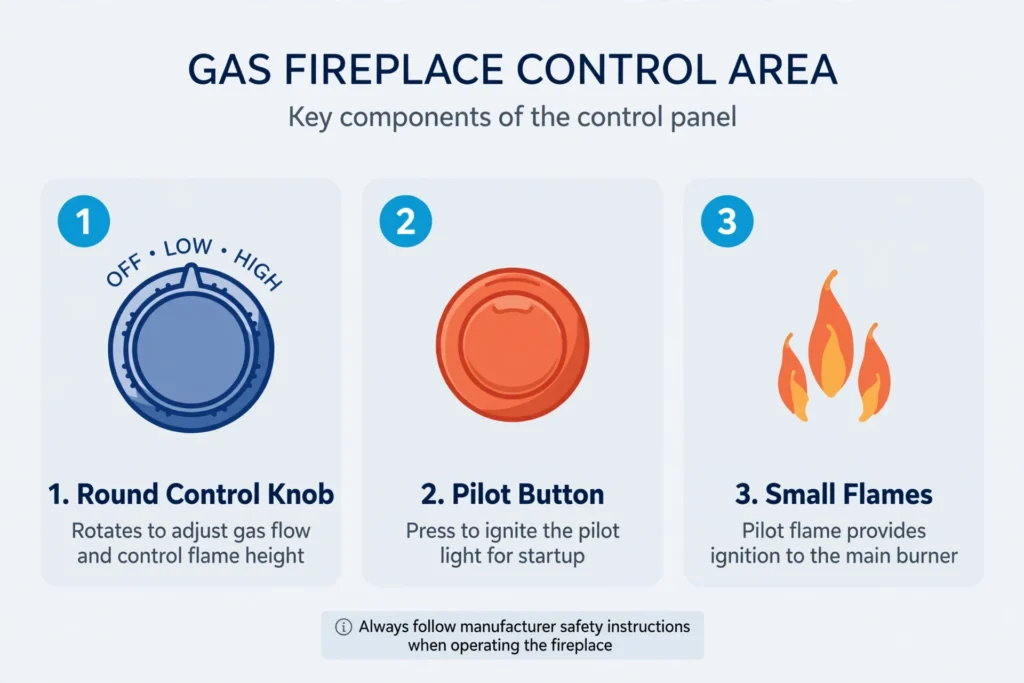
Most pilot models have three parts in one small area: a gas control knob marked Off, Pilot, and On; a pilot button you press down; and a spark button or a spot for a lighter flame. The pilot flame sits near the main burner, low in the firebox.
Find these parts with the gas off and the room calm, before you press or turn anything. A minute spent on this look saves fumbling in the dark later, and it lets you spot a knob that feels stuck or a label you cannot read.
Check for a Gas Smell
Stand near the fireplace and sniff the air for a rotten-egg smell. Check low spots too, since gas can pool near the floor. If you smell gas at all, leave the home with people and pets and call for help from outside. Do not flip a switch, light a match, or try the fireplace that day.
Open the Access Panel
Look for a lower front panel, a bottom grille, or small side clips on your model. Lift or slide the panel off with care and set it where it will not get scratched. The gas valve and pilot parts sit in the space behind that panel. Keep the panel close, since you will put it back at the end of the job.
Turn the Knob to Pilot
The gas control knob has marks for Off, Pilot, and On. Turn it slowly to Pilot and stop there. Do not force the knob if it sticks, since a stuck knob can mean a fault that needs a pro. A knob that moves with a firm, smooth turn is ready for the next step.
Press the Pilot Button Down
Push the pilot button down and keep it held with one hand. This step lets a small flow of gas reach the pilot tube. Your other hand stays free to work the spark button or lighter in the next move. Hold the button down the whole time you light the pilot, with no breaks.
Light the Pilot Flame
Press the spark button in short clicks while you still hold the pilot button down. On a model without a spark button, touch a long lighter flame to the pilot tube as your manual shows. A small blue flame should catch at the pilot tip. If no flame catches after a few tries, let go of the button and wait before you try again.
Wait and Release the Button
Keep the pilot button held for about 30 to 60 seconds after the pilot flame lights. Heat from the flame warms a small safety part that holds the gas valve open. Your manual may give a different hold time, so follow its number when it differs. Let go of the button with care, then watch the pilot flame to make sure it stays lit.
Turn the Knob to On
Move the gas control knob from Pilot to On in one slow move. The main burner should light from the pilot flame within a few seconds. A soft whoosh is normal on many models as the burner catches. If the burner stays dark, turn the knob back to Pilot and check the pilot flame again.
Set the Flame and Close the Panel
Use the wall switch, remote, or thermostat to call for heat at your preferred flame height. Look at the flame through the glass: it should look steady, with blue at the base and yellow tips on many gas models. Put the access panel back in place and check that vents stay clear. Call a licensed gas professional if the flame looks weak, yellow all over, or lifts off the burner.
📋 Pilot vs. Electronic Ignition: Which Type Do You Have?
Standing pilot: A small flame burns all the time. You light it by hand with a knob, a pilot button, and a spark button or lighter.
Electronic ignition: No standing flame. A wall switch, remote, or thermostat sends a spark when you call for heat.
If your fireplace has no pilot knob, do not hunt for one. Follow the electronic-start steps in your manual, and read about whether a gas fireplace can run without electricity if a power cut is your worry.
Troubleshooting: When the Fireplace Will Not Light
| Problem | Likely Cause | What to Do |
|---|---|---|
| Pilot lights, then goes out when you let go | The safety part did not get hot enough | Hold the pilot button for the full time your manual gives, then try once more |
| No spark when you press the button | A dead igniter battery or a worn spark part | Swap the battery if your manual shows one; if not, call a pro |
| Main burner stays dark | The knob is still on Pilot, or the pilot flame is out | Check the pilot flame, then move the knob to On |
| You smell gas at any point | A gas leak may be present | Leave at once with people and pets; call the gas utility or 911 from outside |
| Flame looks weak or sooty | Blocked burner ports or a vent problem | Turn the fireplace off and call a licensed gas professional |
A fireplace that needs three or more tries to light has a fault worth a pro visit. Keep trying the same steps can fill the firebox with unburned gas, so stop and get help. The same rule holds for a knob that sticks, a pilot that will not stay lit, or any part that looks cracked or burnt.
Seasonal Tips and Care
Light the fireplace for the first time each fall before the coldest night arrives. An early test gives you time to book a pro if the pilot will not hold or the burner looks off. Dust the glass and the area near the vents with a dry cloth while the unit is cool and off.
Before you light up for winter, it helps to know whether gas fireplaces are safe to use indoors and how vented and ventless models differ, since vent rules shape how you use the unit. If your home has a wood fireplace you are thinking of swapping, read whether you can convert a wood fireplace to gas before you plan any change.
🏠 Running Cost and Chimney Notes
A gas fireplace costs less to run than many people guess, but the bill rests on your gas rate, the size of the unit, and how long it runs. See how much it costs to run a gas fireplace for the factors that move the total up or down.
Some gas models vent through a chimney and some vent straight out a wall. Read whether gas fireplaces need a chimney if you are unsure which type sits in your home, and keep the vent path clear in all seasons.
Frequently Asked Questions
Do I need to light the pilot each time I use the fireplace? No, not on a standing-pilot model. The pilot stays lit between uses, so you turn the knob to On or use the wall switch when you want heat. You light the pilot again only after it goes out, after the gas was shut off, or at the start of the season.
What should I do if I smell gas while lighting the fireplace? Stop at once. Do not touch switches, phones inside the home, or the fireplace controls. Leave the home with people and pets, then call your gas utility emergency line or 911 from outside.
Why does my pilot go out when I let go of the button? The safety part that holds the valve open may not have warmed up yet. Hold the button for the full time your manual gives, often 30 to 60 seconds. If it still goes out, the safety part may be worn, and a licensed gas professional should check it.
Can I light a gas fireplace with a match? Some older models allow a long match or long lighter, but many new models use a built-in spark button. Your manual says which way fits your model. Never use a short match, and never reach past hot glass or a hot burner to light a pilot.
Is it safe to leave a gas fireplace on all night? Most makers say to follow the manual for your model, and many homes turn the unit off at bedtime as a habit. Keep a working CO alarm near sleeping areas, keep vents clear, and never block the glass or air openings. Ask a licensed gas professional if your model has a timer or shutoff you should use.
Quick Reference Card
✅ Light It in 8 Moves
- Smell check — no gas smell before you start
- Panel off — find the valve and pilot parts
- Knob to Pilot — stop at the Pilot mark
- Button down — hold it the whole time
- Spark or lighter — catch a small blue pilot flame
- Hold 30 to 60 seconds — let the safety part warm up
- Knob to On — the main burner lights
- Set heat, panel back — vents clear, flame steady
Gas smell? Leave at once with people and pets. Call the gas utility or 911 from outside.
Conclusion
- Check for a gas smell before you touch any control.
- Light the pilot in order, hold the button, then turn the knob to On.
- Keep CO alarms working and vents clear all season.
- Call a licensed gas professional when a step does not work as it should.