Do Gas Fireplaces Need a Chimney? The Short Answer, Plus How Each Vent Type Works
⚠️ Gas Safety: Read This First
Gas fireplaces burn fuel, and burning fuel can make carbon monoxide (CO). CO has no color and no smell, so you cannot see it or smell it. Put a working CO alarm on each level of your home and near sleeping areas. Test alarms each month and replace them as the maker directs.
Pets can be harmed by CO and fumes sooner than people can. Birds are very sensitive. If a pet acts sick, weak, or dizzy near a gas fireplace, get fresh air and call a vet and a gas professional.
If you smell gas (a rotten-egg smell): Do not touch light switches, flames, or appliances. Leave right away with all people and pets. From outside, call your gas utility emergency line or 911. Do not go back in to look for a leak, open a gas line, or relight a fireplace after a strong gas smell. Only a licensed gas professional should check the system.
Do not open gas lines, change gas valves beyond the normal user controls in your appliance manual, bypass safety parts such as thermocouples, oxygen-depletion sensors, or spill switches, block vents, or turn off CO alarms. Work on gas lines, venting, conversion, and repairs past basic cleaning and normal user controls belongs with a licensed gas professional.
Time to read: About 10 minutes | Difficulty: Easy to read, but venting decisions need a pro | Best for: Homeowners choosing a new gas fireplace or planning a change to an old fireplace | Do not do alone: Gas, venting, and chimney changes
Most gas fireplaces need some form of venting, but not all of them need a classic brick chimney. That split causes a lot of confusion. Some models vent through a pipe in a wall. Some vent up through a roof. A few vent-free models have no chimney or vent pipe at all.
The right choice depends on the model you pick, the vent path your home can offer, and the rules in your area. Your appliance manual and a licensed gas professional make the final call. This guide helps you ask good questions before you buy or change anything.
At a Glance
- Short answer: Most gas fireplaces need venting, but a classic masonry chimney is only one option.
- Direct-vent: A sealed unit that vents through a wall or roof. It does not need an open chimney.
- B-vent: A vented unit that uses a vertical vent pipe or chimney flue.
- Vent-free: No chimney or vent pipe, but it has clear safety limits and local rules.
- Gas inserts and log sets: They go in an old wood fireplace, and the old chimney must be checked, cleaned, and fitted to the new unit.
- Blocked or damaged vents: Stop use and call a licensed gas professional.
- Before you buy: Use the checklist near the end of this guide with a licensed pro.
Chimney vs. Vent vs. Flue: What Each Word Means
People use these three words as if they mean the same thing. They do not. A chimney is the tall structure that holds a flue and rises above a roof. It can be brick, stone, or a factory-built metal box.
A vent is the full path that carries exhaust gas out of a home. A flue is the inner passage inside that path. In plain terms, the flue is the tunnel, and the chimney or vent pipe is the structure around it.
That split matters for gas fireplaces. A home can have a chimney with no working flue for gas use. A home with no chimney can still have a vent pipe through a wall. A gas pro checks the full path, not the outside shape alone.
Chimney, Vent, and Flue in Plain Language
| Word | What it means | Example |
|---|---|---|
| Chimney | The tall structure above the roof | A brick chimney on an old home |
| Vent | The full exhaust path out of the home | A pipe through a side wall |
| Flue | The inner passage for exhaust gas | A liner inside an old chimney |
Why Venting Matters for a Gas Fireplace
When gas burns, it makes heat, water vapor, and exhaust gas. That exhaust can hold carbon monoxide and other byproducts. Good venting moves those byproducts out of the room and out of the home.
Water vapor matters too. Burned gas adds moisture to indoor air. In a vented unit, much of that moisture leaves with the exhaust. In a vent-free unit, that moisture stays in the room. Over time, extra moisture can fog windows and feed damp spots.
Venting also helps a fireplace burn as the maker planned. A clear, correct vent path gives steady draft. A blocked, leaky, or wrong-size vent can push exhaust back into a room. That is called spillage, and it is a warning sign, not a small flaw.
Direct-Vent Gas Fireplaces: Sealed, and No Open Chimney Needed
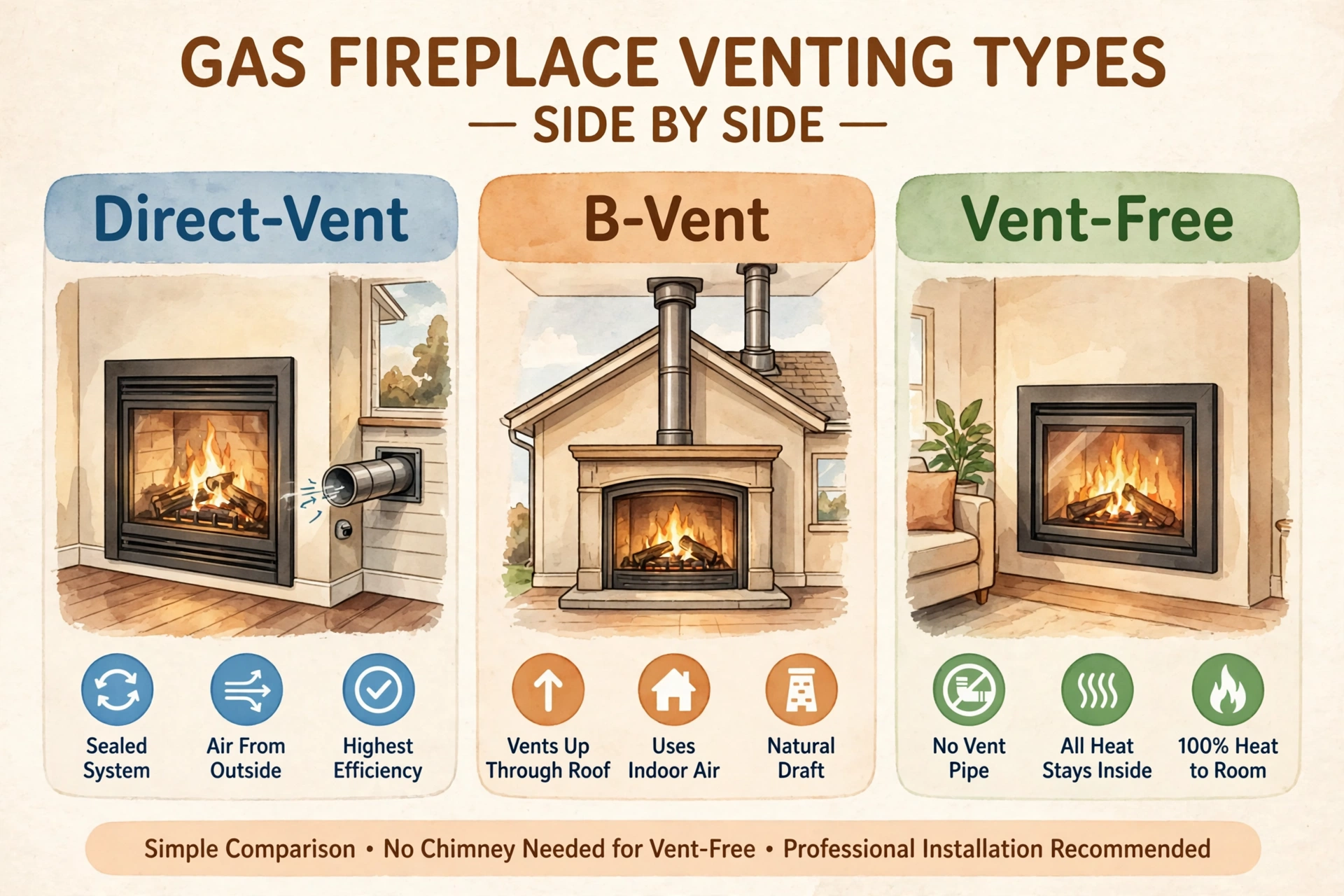
Direct-vent fireplaces have a sealed glass front. They pull outside air in for burning and send exhaust gas out through a sealed pipe. Room air does not mix with the burn chamber in normal use.
The vent pipe can go out through a side wall or up through a roof. That makes direct-vent units a good fit for homes with no chimney. It also makes them a good fit for rooms where a chimney would be hard to add.
An old chimney can sometimes serve as a chase, which is a protected path for the new vent pipe or liner. The maker must allow that use, and a licensed pro must fit it to the model. Never assume an old chimney is ready for a new direct-vent unit. For a closer look at how this type works, see what a direct-vent gas fireplace is.
B-Vent (Natural-Vent) Gas Fireplaces: A Vertical Vent Path
B-vent fireplaces, also called natural-vent fireplaces, use room air for burning. They send exhaust up a vertical vent pipe. That pipe may run inside a chimney flue or as a metal vent that rises through the roof.
These units need a clear, tall, vertical path. They do not vent well through a short side-wall pipe. A home with a sound chimney flue may suit a B-vent unit, but the flue still needs an inspection and the right size for the model.
Draft matters more here than with a sealed direct-vent unit. Cold air, wind, and a blocked cap can change how well exhaust rises. If you smell exhaust, see soot marks, or hear a CO alarm, stop use and call a licensed gas professional.
Venting Types at a Glance
| Type | Needs a classic chimney? | Vent path | Key point |
|---|---|---|---|
| Direct-vent | No | Wall or roof pipe | Sealed glass front |
| B-vent | Often, or a vertical vent | Up through a flue or roof vent | Uses room air; needs good draft |
| Vent-free | No | None — exhaust stays in the room | Strict limits; check local codes |
| Gas insert / log set | Uses an old fireplace chimney | Through the old flue, fitted per maker | Old chimney must be inspected first |
Vent-Free (Ventless) Gas Fireplaces: No Chimney, With Clear Limits
Vent-free fireplaces, also called ventless fireplaces, have no chimney and no vent pipe. They burn gas in the room and release combustion byproducts into that room. Those byproducts include carbon monoxide and water vapor.
That fact sets hard limits. Vent-free units are restricted or banned in some states, cities, and building types. They are also restricted or banned in some bedrooms and small rooms. Local codes, not a sales page, decide if one is allowed in your home.
A vent-free unit must have a working oxygen-depletion sensor. That sensor shuts the unit off if oxygen in the room drops too low. You also need a working CO alarm in the room and near sleeping areas. Never block vents, never disable a sensor or alarm, and never treat a vent-free unit as risk-free.
Vent-free units can also add a lot of moisture to a room. If windows fog, walls feel damp, or the air feels heavy, stop use and ask a licensed gas professional for advice. If you want a full safety check before you consider this type, read are gas fireplaces safe to use indoors.
Gas Inserts and Log Sets in an Old Wood Fireplace
A gas insert is a sealed metal box that fits inside an old wood fireplace opening. A gas log set is a set of gas logs and a burner placed in an old fireplace firebox. Both use the old chimney in some form, but neither can use it without checks.
Before any change, a pro should inspect the chimney, clean it, and check the flue, damper, cap, and liner. Old soot, cracks, blockages, and wrong flue size can all cause trouble. The new unit must be fitted per its maker, which may mean a new liner or a change to the damper.
Do not run a gas log set or insert in a chimney that has not been inspected for gas use. Wood use and gas use do not place the same demands on a flue. If you are weighing this change, see can you convert a wood fireplace to gas and gas fireplace insert vs. gas log set for help with the choice.
What Happens If a Vent Is Blocked or Damaged?
A blocked vent can push exhaust back into a room. Signs can include a smell of exhaust, soot marks near the unit, a pilot that will not stay lit, or a CO alarm that sounds. A damaged vent can leak exhaust into walls or other rooms.
If you see any of these signs, stop using the fireplace. Do not try to clear a vent, fix a flue, or relight a unit after a strong gas smell on your own. Open no gas lines and do not bypass safety parts. Call a licensed gas professional and, for a gas smell, call your gas utility emergency line or 911 from outside.
Yearly checks help catch trouble early. Ask a pro to check the vent path, cap, joints, and safety parts. Keep the area near the vent clear, and keep CO alarms working all year.
Choose the Right Path: A Simple Decision Flow
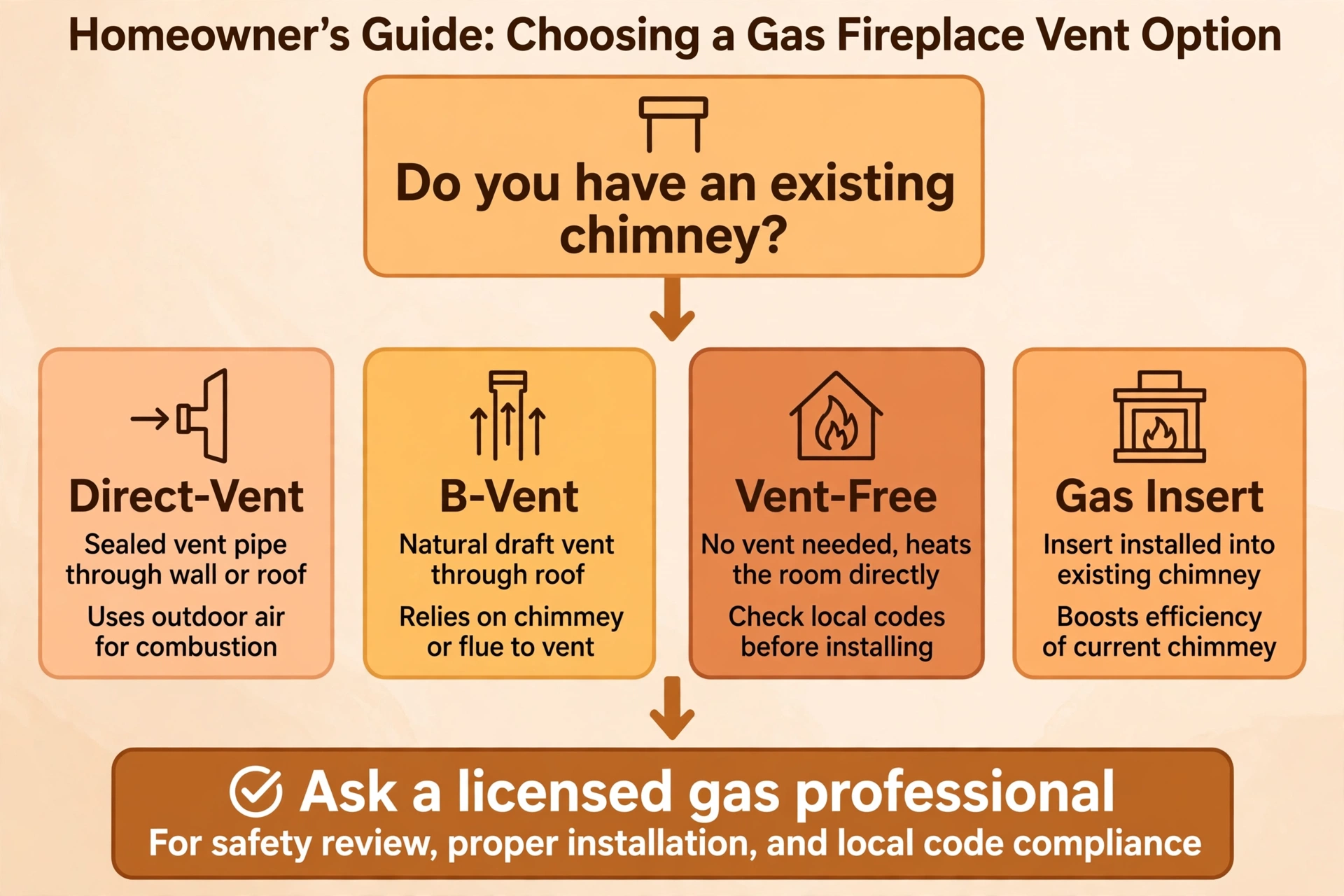
Start with your home, not with a model you like in a photo. Ask which vent paths are real options in your rooms. Then match a model to that path, with help from a licensed pro.
If you have a sound chimney that a pro clears for gas use, a B-vent unit or a gas insert may fit. If you have no chimney, a direct-vent unit with a wall or roof vent may fit. If no vent path is possible, a vent-free unit may seem tempting, but check local codes first and weigh the moisture and safety limits.
Ask a Licensed Pro These Questions Before You Buy or Change Anything
- Is my chimney or flue in good shape for gas use, and does it need cleaning, repair, or a new liner?
- Which vent type does my room layout allow: direct-vent, B-vent, vent-free, or a gas insert?
- Does the model I like allow my chimney to serve as a chase, and what liner or fitting does the maker require?
- Do local codes allow a vent-free unit here, and what room-size or bedroom limits apply?
- Where should CO alarms go, and how often should the vent path be checked?
- What is the full scope of work, and which parts need a licensed gas professional or a permit?
- What will it cost to run the unit over time? For a plain look at running costs, see how much it costs to run a gas fireplace.
Common Mistakes to Avoid
Mistake 1: Assuming an old chimney is ready. A chimney that worked for wood may not suit gas. Get an inspection and a cleaning first, and fit the new unit per its maker.
Mistake 2: Treating vent-free as risk-free. Vent-free units release byproducts into the room. Check local codes, keep the oxygen-depletion sensor working, and keep CO alarms working.
Mistake 3: Hiding or blocking a vent to improve a look. Never block a vent, cap a flue, or cover a vent outlet for style. Blocked vents can push exhaust into a home.
Mistake 4: Trying gas or vent work without a license. Gas lines, vent changes, and repairs past basic cleaning belong with a licensed gas professional. A mistake can harm people and pets.
Mistake 5: Skipping CO alarms. CO has no smell and no color. Alarms are your warning system. Test them each month and replace them as the maker directs.
FAQ
Do gas fireplaces need a chimney?
Most gas fireplaces need venting, but not all need a classic masonry chimney. Direct-vent units vent through a wall or roof pipe, B-vent units use a vertical vent or chimney flue, and vent-free units have no chimney or vent pipe, with strict safety limits and local rules.
Can a gas fireplace vent through a wall?
Yes, if it is a direct-vent model made for that vent path. A licensed gas professional must confirm the vent route, clearances, and termination point follow the appliance manual and local codes.
Can I use my old wood chimney for a gas fireplace?
Sometimes, but only after inspection, cleaning, and fitting per the new unit’s maker. A licensed gas professional must check the flue size, condition, damper, cap, and liner before any gas unit uses the old chimney.
Are vent-free gas fireplaces safe?
Vent-free units release combustion byproducts, including carbon monoxide and water vapor, into the room. They are restricted or banned in some jurisdictions and bedrooms, need a working oxygen-depletion sensor and CO alarm, and readers must check local codes before buying one.
What should I do if my gas fireplace vent is blocked?
Stop using the fireplace and call a licensed gas professional. Do not try to clear the vent, open a gas line, or bypass a safety device yourself. If you smell gas, leave immediately and call your gas utility emergency line or 911 from outside.
Quick Reference Card: Do Gas Fireplaces Need a Chimney?
- Most need venting. Only vent-free units skip a vent pipe, and they have strict limits.
- No chimney? Look at direct-vent. Wall or roof vent, sealed glass front.
- Good chimney? Ask about B-vent or an insert. Inspection and fitting come first.
- Vent-free? Check codes first. Byproducts stay in the room; sensors and CO alarms must work.
- Blocked vent or gas smell? Stop use. For gas smell, leave and call from outside.
- Unsure? Ask a licensed gas professional before you buy or change anything.
Conclusion
So, do gas fireplaces need a chimney? Most need a vent path, but a classic brick chimney is only one way to vent. Direct-vent units use a wall or roof pipe. B-vent units use a vertical vent or chimney flue. Gas inserts and log sets reuse an old fireplace chimney after inspection and fitting. Vent-free units use no chimney at all, but they send byproducts into the room and face local limits.
Pick the vent path first, then pick the model that fits it. Keep CO alarms working, never block a vent or bypass a safety part, and let a licensed gas professional handle gas, venting, and chimney changes. With those steps, you can choose with clear facts and avoid a costly or unsafe guess.