Can You Convert a Wood Fireplace to Gas? Options, Costs, and Safety Explained
Can You Convert a Wood Fireplace to Gas? Yes, in most cases you can, and you have more than one way to do it. A wood-burning fireplace can take a vented gas log set, a sealed gas insert, or, where local codes allow it, a vent-free set. The right choice depends on your chimney, your gas supply, and the rules in your area.
This guide walks through the decision in order, from measuring your firebox to testing the finished fireplace with your installer. Gas-line, venting, and installation work belongs to a licensed gas professional, so this guide covers what you can check and choose, not gas work you should do on your own. By the end, you will know which option fits your home and what to ask before anyone starts work.
Many owners make the switch because gas lights with a switch or remote and leaves no ash to clean. Others want steadier heat without hauling and storing wood. Either reason is a good starting point, and the steps below will help you compare the options on facts rather than sales talk.
Burning gas can produce carbon monoxide, a colorless and odorless gas that can harm people and pets. Put CO alarms on every level of your home and near sleeping areas, and test them monthly. Birds and small pets react to fumes sooner than people do, so alarms protect the whole household.
If you ever smell gas, with its rotten-egg odor, do not touch switches, flames, or appliances. Leave the home at once with people and pets, and call your gas utility emergency line or 911 from outside. Never try to find or fix a leak on your own, and never relight anything after a strong gas smell.
- Tape measure
- Flashlight
- Phone camera for firebox photos
- Notebook for measurements and quotes
- Your fireplace manual, if you have it
- Working CO alarms on every level
- List of questions for your installer
- Chimney inspection report (booked in Step 3)
- Measure your firebox and identify your fireplace type
- Compare the four conversion options
- Book a chimney inspection
- Confirm your gas supply with a licensed professional
- Check permits and local codes
- Get written quotes and choose your installer
- Test the finished fireplace with your installer
Measure your firebox and identify your fireplace type
Measure the width, height, and depth of the firebox opening, and write each number down. Note whether your fireplace is masonry or factory-built, since that detail shapes which inserts can fit and how venting must run. Take photos of the firebox, damper, and chimney from the ground outside. Your installer will use these numbers and photos to narrow the options before visiting, which saves a wasted trip and a wrong-size order.
Compare the four conversion options
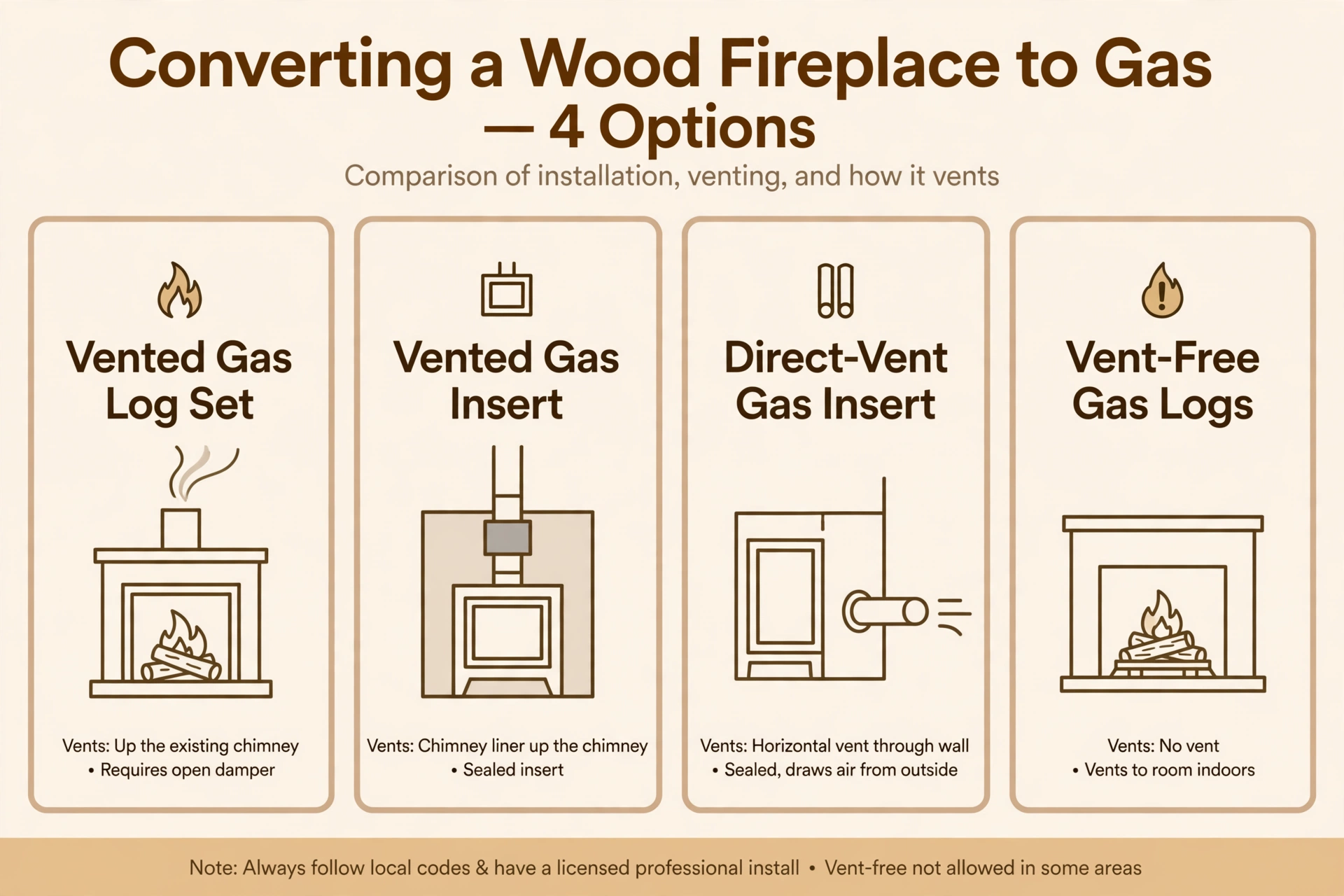
A vented gas log set sits in your open firebox and sends exhaust up the chimney with the damper open, while a vented insert is a sealed box that vents through a liner run up the chimney. A direct-vent insert is also sealed, and it draws combustion air from outside while venting through a wall or the chimney. Vented sets look most like an open wood fire, while sealed inserts send more heat into the room because less warm air escapes up the flue. Weigh looks against heat output before you talk prices, and read how vented and vent-free options differ before you decide.
Vent-free means combustion byproducts, including carbon monoxide and water vapor, enter the room. Some cities, states, and counties restrict or ban vent-free appliances, and bedrooms often have added limits. A vent-free set must have a working oxygen-depletion sensor, and your home still needs working CO alarms. Check your local codes before you spend money on this option.
Book a chimney inspection
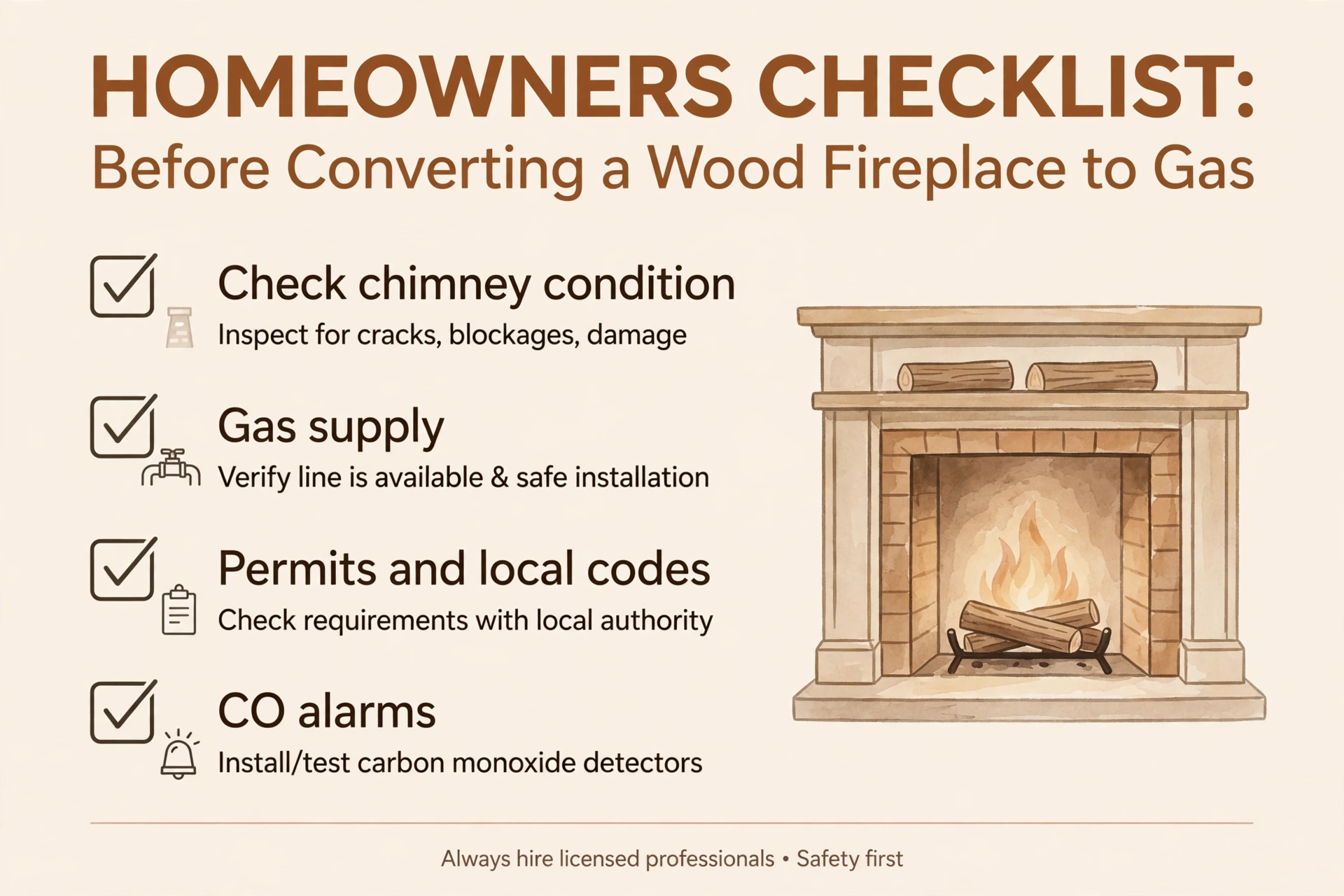
Ask a certified chimney sweep or qualified inspector to check the flue, liner, damper, and masonry before you choose a unit. Cracks, blockages, creosote buildup, or a damaged liner can rule out some options or add repair work first. Gas exhaust is cooler and wetter than wood smoke in some setups, so a flue that served wood well may still need a liner for gas. Get the findings in writing, since your installer will need them to size venting and confirm the plan.
Confirm your gas supply with a licensed professional
Tell your gas utility or licensed gas fitter where the fireplace sits and which fuel your home uses, natural gas or propane. They can confirm whether a line already reaches the fireplace area and whether it can serve a new appliance. Running a new line, moving a meter, or adding a propane tank all sit on the pro side of the line, and costs vary with distance and access. Never open a gas line or change a valve beyond the normal user controls in your appliance manual.
Check permits and local codes
Call your local building department or ask your installer which permits the job needs in your area. Some areas require a permit and inspection for gas work, venting changes, or a new gas line. Vent-free rules differ by area, and some homeowner associations add their own limits on top of city rules. Sorting this out before ordering avoids a unit that your area will not allow.
Get written quotes and choose your installer
Ask two or three licensed installers for written quotes that list the unit, venting parts, gas-line work, permits, and labor as separate lines. Quotes differ because homes differ: chimney height, gas-line distance, venting route, and the unit you pick all move the total, as our guide to the cost to install a gas fireplace explains. Ask each installer how they will test for leaks and check venting when the job is done, and what warranty covers the work. A clear written scope protects you if the finished job differs from what you were sold.
Photograph the rating plate and the installer’s paperwork before they leave. Those photos settle warranty questions fast and help the next technician who services the unit.
Test the finished fireplace with your installer
Stay home for the final visit and watch the installer light the unit, check the flame pattern, and test venting and safety controls. Ask them to show you the normal user controls, how to shut the unit off, and where the manual lives. Ask what signs should prompt a call back, such as soot marks, odd smells, or a pilot that will not stay lit, and ask whether your model can run without electricity during an outage if your area loses power often. Keep the manual and the installer’s number where you can find them, and test your CO alarms the same week.
- Ordering a unit before the chimney inspection. A flue problem found late can force a different unit or extra repair work.
- Choosing vent-free without checking local codes. Some areas restrict or ban vent-free appliances, and a unit you cannot legally use is money lost.
- Treating the job as a weekend project. Gas-line, venting, and conversion work belongs to a licensed professional, not a home toolkit.
- Skipping CO alarms. Every level and sleeping area needs a working alarm, tested monthly, before the new unit runs.
Questions people ask before converting
Can you convert a wood fireplace to gas?
Yes, in most cases. A vented gas log set, a vented insert, a direct-vent insert, or, where local codes allow it, a vent-free set can replace wood burning. A chimney inspection and a licensed gas professional confirm which option fits your fireplace.
Do you need a chimney for a gas fireplace conversion?
Vented options use your chimney, usually with a liner, while a direct-vent insert can vent through an outside wall. Only vent-free sets run without a vent, and they send combustion byproducts into the room. Your chimney condition and local codes narrow the choice.
How much does it cost to convert a wood fireplace to gas?
Total cost varies too much by home to quote one number here, and this guide gives no price figures for that reason. The unit, chimney and venting work, gas-line distance, permits, and labor all move the total. Written quotes from licensed installers give you the real number for your home.
Can you convert a wood fireplace to gas yourself?
No, not the gas and venting parts. Homeowners can measure, photograph, and choose between options, but gas-line, venting, installation, and conversion work must go to a licensed gas professional. That division keeps the job legal and safe.
Is a vent-free gas conversion safe?
Vent-free appliances release combustion byproducts, including carbon monoxide and water vapor, into the room, so they carry more indoor air risk than vented options. They must have a working oxygen-depletion sensor, and your home needs working CO alarms. Some areas restrict or ban them, so check local codes first.
Keep this card with your quotes. Check each line off as you finish it.
You need:- Tape measure, flashlight, phone camera, notebook
- Working CO alarms on every level
- Chimney inspection report and written installer quotes
- Measure the firebox and note the fireplace type
- Compare the four conversion options
- Book a chimney inspection
- Confirm gas supply with a licensed professional
- Check permits and local codes
- Get written quotes and choose your installer
- Test the finished fireplace with your installer
Can you convert a wood fireplace to gas? Yes, and now you know the path: measure, compare options, inspect the chimney, confirm gas supply, check codes, and hire a licensed pro for the gas work.
Start with the chimney inspection and the written quotes, since those two steps answer most of the cost and option questions. A careful conversion gives you fire at the push of a button, with the safety checks already in place.