Can a Gas Fireplace Run Without Electricity? What Your Ignition Type Means in a Power Outage
Yes — many gas fireplaces can run without electricity. When the power goes out on a cold night, the first question is always the same: can a gas fireplace run without electricity? The answer depends on your ignition system. Fireplaces with a standing pilot and millivolt ignition make their own power from the pilot flame, so they light and heat normally with no household current at all.
Fireplaces with electronic ignition need electricity — or a battery backup pack — to spark the pilot.
By the end of this guide, you will know which system your fireplace uses, how to check it in about fifteen minutes, and exactly what to do when the lights go out. No electrical knowledge is needed. You only need your owner’s manual, a flashlight, and a few quiet minutes before the next storm rolls in.
One caution: gas appliances deserve respect. I flag the safety rules as we go — especially carbon monoxide alarms and what to do if you ever smell gas. The safety part is short, and it matters.
⚠️ Gas Safety — Read First
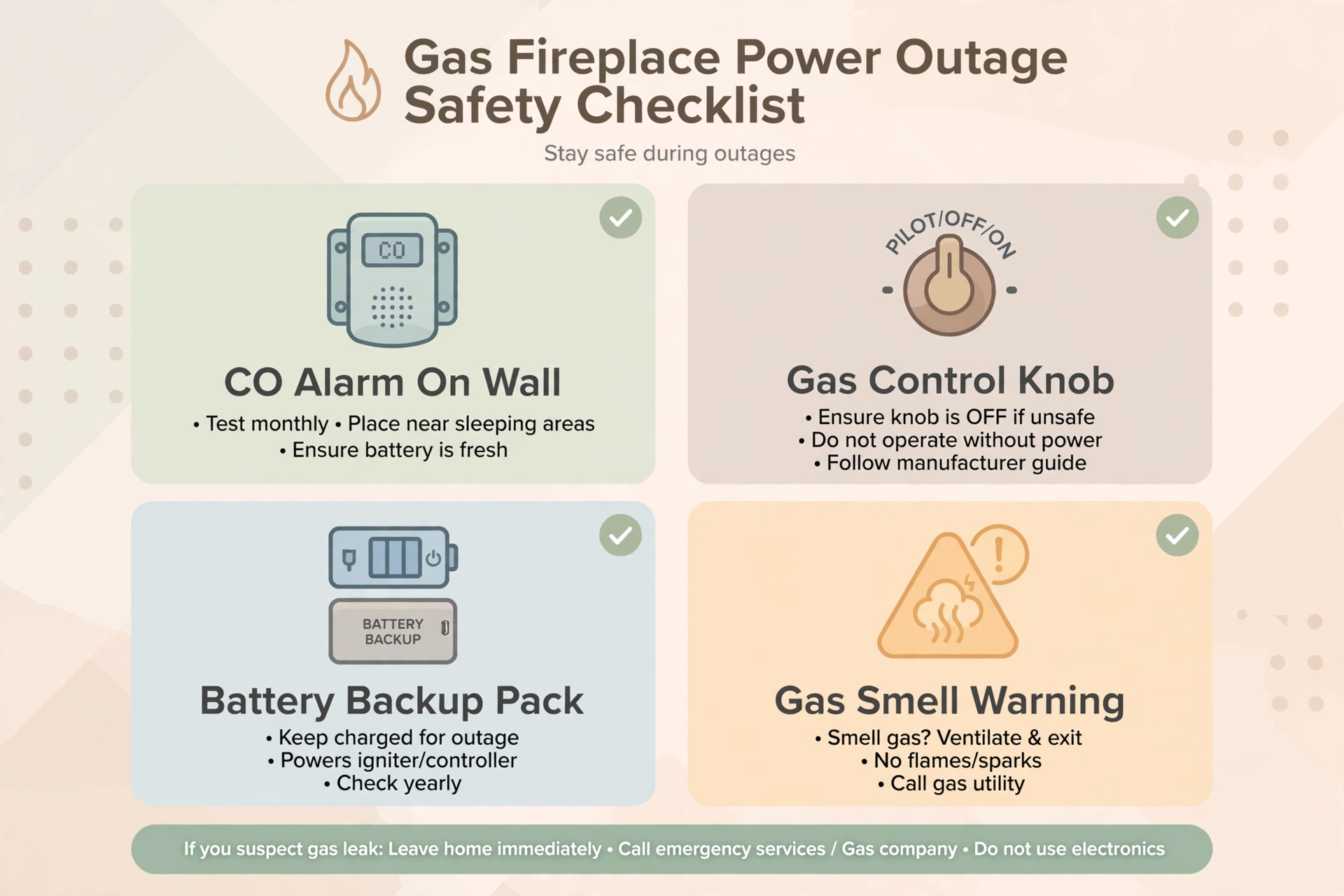
Carbon monoxide is colorless and odorless — you cannot see or smell it. Install working CO alarms on every level of your home and near sleeping areas, test them monthly, and replace them per the manufacturer.
If you ever smell gas (a rotten-egg odor): do not flip switches, light anything, or hunt for the leak. Leave the home at once with people and pets, then call your gas utility’s emergency line or 911 from outside.
Installation, gas-line work, and repairs belong to a licensed gas professional. Pets — birds especially — are more sensitive to CO than people.
Total time
~15 minutes
Active time
~10 minutes
Difficulty
Beginner
🧰 What You Need
- Your fireplace owner’s manual (or the metal instruction tag behind the lower grill)
- A flashlight
- Fresh AA and D-cell batteries (for electronic models with a backup pack)
- Working carbon monoxide alarms on every level
- Pen and paper to note down your ignition type
Millivolt vs Electronic Ignition: The Quick Breakdown
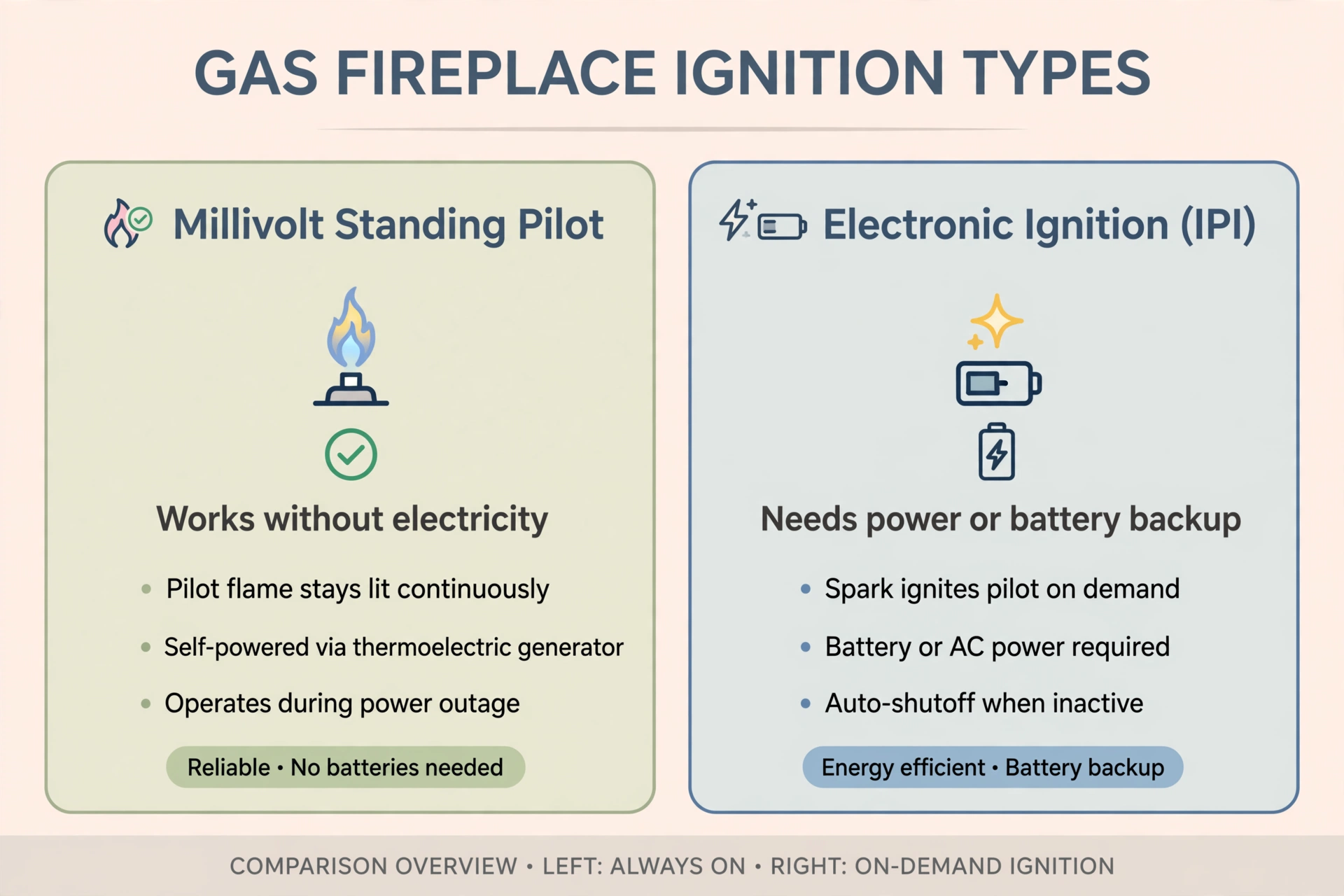
Everything comes down to how your fireplace creates its spark. There are two common ignition systems, and they behave very differently when the power fails. This table gives you the short version.
| Feature | Millivolt (Standing Pilot) | Electronic Ignition (IPI) |
|---|---|---|
| Pilot flame | Burns continuously | Lights only when needed |
| Power source | Self-made: the pilot heats a thermopile that generates millivolts | Household current, or batteries in the backup pack |
| Works in a power outage | Yes — lights and heats normally | Only with a battery backup pack |
| Gas use when idle | Small pilot burns year-round | No standing flame, so none |
📋 At a Glance
- Find your fireplace’s ignition type in the manual
- Look through the pilot viewing window
- Locate the battery backup pack (electronic models)
- Test every carbon monoxide alarm
- Light and run the fireplace during the outage
- Notice which extras stop working
- Switch back to normal power when it returns
Find your fireplace’s ignition type in the manual
Open your owner’s manual and look for the words “millivolt,” “standing pilot,” “IPI,” or “electronic ignition” in the specifications or lighting section. The manual settles the question faster than anything else. If you bought the house with the fireplace and never got a manual, search the manufacturer’s website with the model number from the rating plate.
No luck finding the manual? A gas vs electric fireplace comparison can also help you understand what kind of unit you own, since ignition types differ across fuel types. Write down what you find — you will need it in Step 5.
Look through the pilot viewing window
Open the lower grill or access panel at the base of the fireplace and find the small glass viewing window near the burner. If you see a tiny steady flame burning right now — even though the main burner is off — you have a standing pilot / millivolt system. That little flame is what makes your fireplace outage-proof.
No flame visible when the fireplace is off? You most likely have electronic ignition. The pilot only appears for a few seconds when the unit is turned on, created by an electric spark. This is the system that goes silent without power unless it has battery backup.
Locate the battery backup pack (electronic models)
On electronic ignition models, look behind the lower grill for a small black box with a wire harness — often labeled “battery backup” or “emergency power.” Many take 4 AA batteries, some take 2 D-cells. If the box is empty or the batteries are corroded, the backup will not save you during an outage.
💡 Pro Tip
Photograph the battery pack with your phone before touching it, so you remember exactly which way the batteries face. Check the pack every autumn when you test your smoke alarms — dead backup batteries are the most common reason an electronic ignition fireplace fails in a storm.
Test every carbon monoxide alarm
Press the test button on each CO alarm in the house and confirm it sounds. Alarms belong on every level and near sleeping areas. If any alarm is silent, replace its battery immediately — or replace the whole alarm if it is past the manufacturer’s replacement date.
Plug-in CO alarms go dead in a power outage unless they have battery backup, so this check matters double before a storm. Battery-only or battery-backup alarms keep protecting you when the grid is down. This is the single most important step in the whole guide — CDC carbon monoxide guidance stresses alarms on every floor and monthly testing.
Light and run the fireplace during the outage
For a millivolt fireplace, operate it exactly as you normally would: flip the wall switch or turn the control knob to ON. The pilot’s own millivolt current opens the gas valve, so the burner lights even with the whole house dark. Heat comes off the glass and firebox as radiant warmth.
For electronic ignition with a battery pack, switch the unit to battery mode if your manual describes one, then turn it on as usual. If the pilot was out before the outage, relight it only by following the steps printed on the metal tag behind the lower grill or in the owner’s manual. If you smell gas at any point, stop — leave the house and call for help from outside.
Curious about the mechanics behind the flame? Our guide to how a gas heater works explains the thermopile and valve in plain language. And if your unit refuses to light at all, the steps in why your gas fireplace won’t light still apply — just skip anything that needs wall power.
Notice which extras stop working
Without household current, the blower fan goes quiet. Expect radiant heat only, which warms the room around the fireplace rather than pushing air through the house. Accent lights, power vents, and most remote thermostats also stop.
This is normal and not a malfunction. Keep the area in front of the fireplace clear — typically 3 feet — and never hang laundry or blankets near it to “catch more heat.” For portable gas heat, the rules in our propane heater safety guide cover similar no-power situations.
Switch back to normal power when it returns
Once the lights are back, move electronic ignition models back to their normal AC setting if your manual describes a selector switch. Pull the backup batteries out and store them separately — heat and long storage inside the pack cause corrosion that kills the next backup when you need it.
Give the fireplace a quick once-over: normal flame color, no new smells, CO alarms still quiet. If anything seems off, shut the unit down and call a licensed gas professional before using it again.
Troubleshooting
| If This Happens | Try This |
|---|---|
| Pilot lights but dies when you release the knob | Hold the knob down 30–60 seconds longer. If it keeps dying, the thermocouple may need a professional’s attention. |
| Fireplace won’t light on battery backup | Install fresh batteries and check the pack’s plug. Still dead? Call a licensed gas professional. |
| Wall switch does nothing in an outage | The switch may run on household current. Use the manual control knob per your manual. |
| CO alarm sounds | Leave the house at once with people and pets. Call 911 from outside. |
| Strong gas smell | Leave immediately. Call the gas utility or 911 from outside. Do not relight anything. |
Frequently Asked Questions
Will my gas fireplace work if the power goes out?
If it has a standing pilot with millivolt ignition, yes — it lights and heats normally without household electricity. If it has electronic ignition, it will not light unless it has a battery backup pack with fresh batteries.
How do I know if my gas fireplace has millivolt or electronic ignition?
Check the owner’s manual or the rating plate behind the lower grill. A small flame that stays lit even when the fireplace is off means millivolt; no constant flame and an on-demand spark means electronic ignition.
Can I light my gas fireplace manually during a power outage?
On millivolt models you can relight the pilot by following the steps on the metal tag behind the lower grill or in the owner’s manual. Never relight anything if you smell gas — leave the house and call the gas utility or 911 from outside.
Will the blower fan on my gas fireplace work without electricity?
No. Blower fans, accent lights, and most remote thermostats run on household current and stop during an outage. The burner still gives off radiant heat, which warms the room around the fireplace.
Is it safe to run a gas fireplace during a power outage?
Yes, as long as the unit is in good working order, the room is ventilated per the manual, and you have working CO alarms on every level and near sleeping areas. Have the fireplace serviced by a licensed professional every year.
Do I need a carbon monoxide alarm if I have a gas fireplace?
Yes. Carbon monoxide is colorless and odorless. Install CO alarms on every level and near sleeping areas, test them monthly, and replace them per the manufacturer. Pets — birds especially — are more sensitive to CO than people.
⚡ Quick Reference Card
You need:
Manual · flashlight · fresh AA/D-cell batteries · working CO alarms · note of your ignition type
Steps:
- Find the ignition type in the manual
- Check the pilot viewing window
- Locate the battery backup pack
- Test every CO alarm
- Run the fireplace per the manual
- Expect radiant heat only — no fan
- Restore normal power mode after the outage
Remember: smell gas → leave → call 911 from outside.
You now know whether your gas fireplace can run without electricity — and you have the answer written down for the next storm. That fifteen-minute check buys real peace of mind on a freezing night.
Your natural next step: put fresh batteries in the backup pack and test your CO alarms this weekend, while the power is on and everything is easy. Stay warm, stay safe.