Do Gas Fireplaces Produce Carbon Monoxide? What Every Homeowner Should Know Before Lighting Up
Do gas fireplaces produce carbon monoxide? Yes. Every gas flame creates some carbon monoxide, called CO, as it burns fuel. That answer sounds alarming, yet it does not mean a gas fireplace is unsafe to own.
A fireplace that is installed well, vented well, and checked each year keeps CO out of your living space. This guide explains where CO comes from, which fireplace types handle it best, the warning signs that call for action, and the alarm setup that protects your whole household.
You will learn the difference between vented, direct-vent, and ventless models, and why that difference matters more than the brand on the box. You will also get a room-by-room alarm plan, a plain list of warning signs, and clear steps for the two moments that matter most: the CO alarm sounding, and the smell of gas. No part of this guide asks you to open a gas line or fix a burner. Work like that belongs to a licensed gas professional, and this guide says so wherever it applies.
Read the safety box below before you read the rest. It holds the two rules that protect your household every time the fireplace runs. Keep them in mind as you go.
Safety first: read this before you light the fire
Carbon monoxide is colorless and odorless. You cannot see it, smell it, or taste it. Only a CO alarm can warn you it is building up, so install CO alarms on every level of your home and outside each sleeping area. Test each alarm once a month and replace it when the maker says to.
If you smell gas (a rotten-egg odor): do not touch light switches, flames, or appliances. Leave the house at once with everyone and all pets. Call your gas utility emergency line or 911 from outside.
Never try to find or fix a gas leak on your own, and never relight a fireplace after a strong gas smell. That work is for the gas utility or a licensed gas fitter only.
Never open a gas line, adjust a gas valve beyond the normal user controls in your manual, bypass a safety device such as a thermocouple, oxygen-depletion sensor, or spill switch, block a vent, or disable a CO alarm. Installation, conversion, venting changes, and repairs beyond basic cleaning go to a licensed gas professional.
Pets breathe the same air you do, and birds react to CO and fumes sooner than people do. CO alarms protect the whole household, pets included.
What you need
- CO alarms: one for every level, plus one outside each sleeping area
- A flashlight, for checking the fireplace and vent opening
- Your fireplace manual, kept where you can reach it
- Your gas utility emergency number, saved in your phone
- The number of a licensed gas professional, saved in your phone
- Fresh batteries for battery-powered alarms
At a glance
- Do gas fireplaces produce carbon monoxide during normal use?
- Vented, direct-vent, and ventless: where the CO goes
- Warning signs your fireplace may be making too much CO
- Check your CO alarms the right way
- Keep the fireplace in safe shape
- Gas smell and carbon monoxide are not the same thing
- Should you run a gas fireplace while you sleep?
- Troubleshooting and frequently asked questions
Key takeaways
- Yes, all gas fireplaces produce some carbon monoxide when the burner is lit.
- Vented and direct-vent models send CO outside. Ventless models release combustion byproducts into the room.
- CO has no smell and no color. Only a CO alarm can warn you about it.
- Put a CO alarm on every level and outside each sleeping area, and test alarms once a month.
- If a CO alarm sounds, leave the house and call 911 from outside. If you smell gas, leave and call your gas utility or 911 from outside.
- Yearly service by a licensed gas professional keeps the burner, vent, and safety devices working as they should.
Do Gas Fireplaces Produce Carbon Monoxide During Normal Use?
Yes. A gas fireplace makes carbon monoxide whenever its burner is lit, because burning any fuel creates CO. In a fireplace that works as it should, most of that CO leaves through a vent or flue, and the amount left in the room stays low. Trouble starts when venting fails, a burner runs dirty, or a room has too little fresh air coming in.
Think of it this way: the flame turns gas and oxygen into heat, water vapor, carbon dioxide, and a small amount of CO. A clean burn makes very little CO. An incomplete burn makes more.
That is why the same fireplace can be safe one year and risky the next, if nobody cleans the burner or checks the vent. The gas itself has not changed. The condition of the appliance has.
Your CO alarm is the only tool that can tell you CO is building up. Your nose cannot help, because CO has no smell. Your eyes cannot help either, because CO has no color. The rest of this guide shows you how to keep CO out of the room, and how to know at once if that plan has failed.
Vented, Direct-Vent, and Ventless: Where the CO Goes
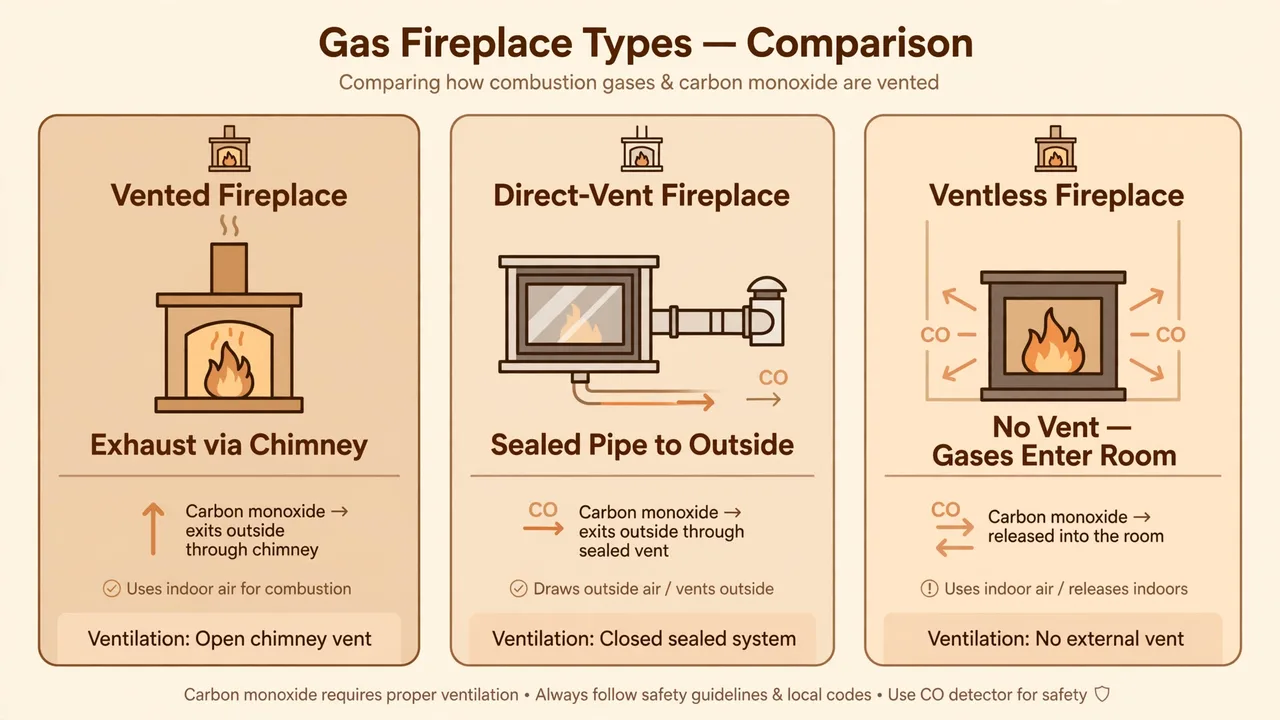
The single biggest factor in CO safety is the type of fireplace you own. Three designs dominate the market, and they handle combustion gases in three very different ways. The table below sums up the difference at a glance. Read the short notes under it for the detail that applies to your model.
| Fireplace type | Where do combustion gases go? | CO in your room | Venting | Safety parts that matter |
|---|---|---|---|---|
| Vented (B-vent) | Up a chimney or flue | Very little, when the flue is clear | Chimney or metal flue | Spill switch, CO alarm |
| Direct-vent | Sealed pipe straight outside | Very little, in normal use | Coaxial vent through a wall or roof | Sealed glass front, CO alarm |
| Ventless (vent-free) | Into the room | Combustion byproducts enter the room | None | Oxygen-depletion sensor, CO alarm |
These are broad patterns. The exact behavior of your model depends on its design, its age, and how well it has been kept up. Check your manual for the details of your unit.
If you are not sure which type you own, the manual or the rating plate inside the fireplace will name it. If you are choosing a new fireplace, our guide on how to choose a gas fireplace walks through the options in plain terms.
Vented gas fireplaces
A vented fireplace draws room air into the firebox and sends the exhaust up a chimney or metal flue. The design is simple and has served homes for decades. Its weak point is the flue itself.
A flue blocked by debris, a bird nest, or damage can push exhaust back into the room instead of carrying it out. That is why the CDC advises having chimneys checked or cleaned every year.
Most vented models carry a spill switch, a safety device that shuts the burner down if exhaust spills into the room. Never bypass it. If your fireplace shuts off on its own and you cannot see why, treat that as a warning, not a nuisance. Book a licensed gas professional and leave the unit off until it has been checked.
Direct-vent gas fireplaces
A direct-vent fireplace is a sealed box. It pulls combustion air from outside through one channel of a coaxial vent pipe and sends exhaust out through the other channel. Room air never mixes with the flame, which is why this design is the most common choice for new installs today. You can learn more about how the sealed system works in our guide to what a direct-vent gas fireplace is.
The sealed glass front is part of the safety design, not a decoration. If the glass is cracked, loose, or missing its seal, the fireplace can spill exhaust into the room. Do not run the unit in that state. Call a licensed gas professional for a new glass panel and a seal check.
Direct-vent models still need a CO alarm in the home. A vent can be damaged, a seal can fail, and other gas appliances in the house can also make CO. The alarm is your backup for all of them.
Ventless gas fireplaces
A ventless fireplace, also called vent-free, has no flue and no vent pipe. Its combustion byproducts, including CO and water vapor, enter the room by design. The burner is built to burn very cleanly, and an oxygen-depletion sensor shuts the burner down if oxygen in the room drops. Even so, a ventless unit is not risk-free, and it should never be sold or run as if it were.
Ventless fireplaces are restricted or banned in some states and cities, and many codes do not allow them in bedrooms or bathrooms. A working oxygen-depletion sensor and a CO alarm are both required, and the room needs fresh air while the unit runs. Check your local codes before you buy or run one. Our side-by-side guide to vented vs ventless gas fireplaces covers the trade-offs in more depth, including the rules that apply in many areas.
Warning Signs Your Fireplace May Be Making Too Much CO
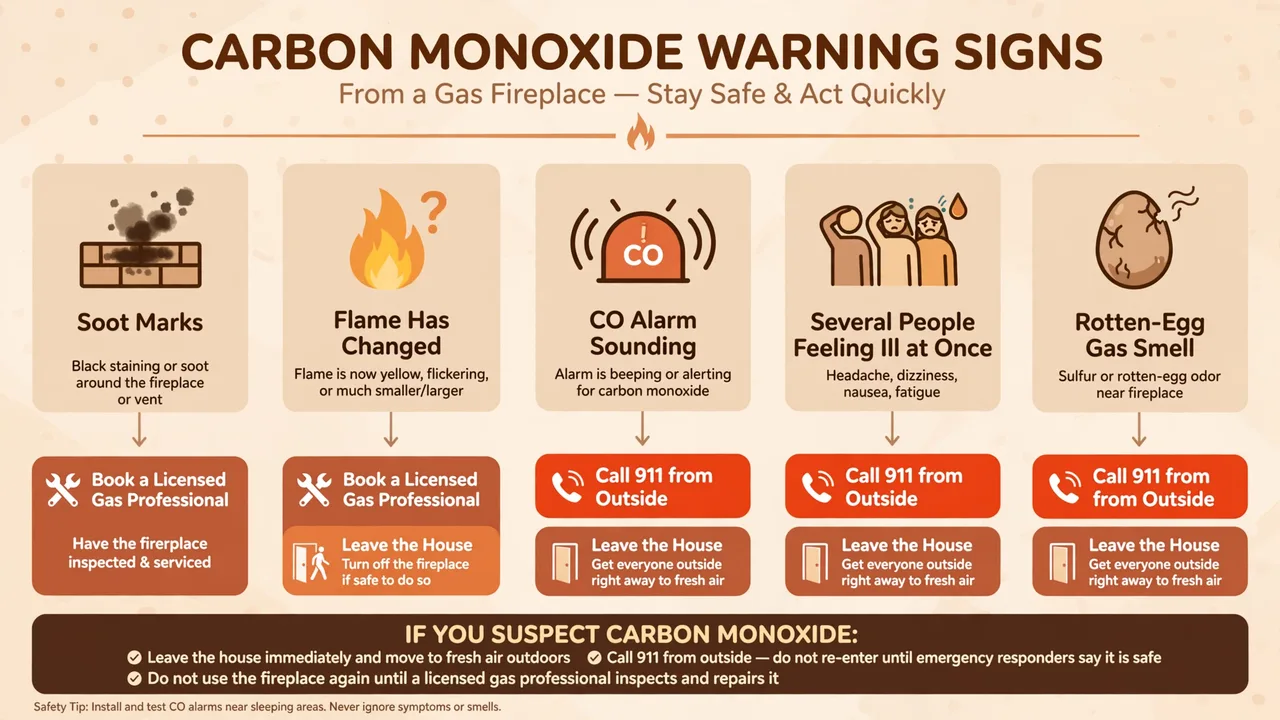
A fireplace that is making too much CO often leaves clues before an alarm ever sounds. Learn the signs below, and check your fireplace against them each time the heating season starts. One sign on its own may have a harmless cause, but two or more together call for a service visit, and any CO alarm sounding calls for leaving the house at once.
| Sign | What it may mean | What to do |
|---|---|---|
| Soot marks on the surround or above the opening | The burner or vent is not carrying exhaust away as it should | Stop using the fireplace and book a licensed gas professional |
| A flame that has changed color, height, or shape from its normal pattern | The burner needs cleaning or adjustment | Stop using it and book a service visit |
| A CO alarm sounds | CO has built up to the level the alarm is built to warn about | Leave the house and call 911 from outside |
| Several people or pets feel ill at the same time while the fireplace runs | CO may be present, though headache, nausea, and dizziness have many causes | Leave for fresh air at once and call 911 |
| A rotten-egg smell near the fireplace | A gas leak, not CO itself, since CO has no smell | Follow the gas-smell rule in the safety box at the top of this guide |
| Heavy condensation or a stuffy feel in the room with a ventless unit | Combustion byproducts and water vapor are building up | Turn the unit off, air the room, and have it checked |
Watch pets as well as people. The CPSC and CDC both note that CO symptoms in people include headache, dizziness, weakness, nausea, vomiting, sleepiness, and confusion, and that the signs often feel like flu. If several people in the house feel ill at once, or a pet acts dull or unsteady while the fireplace runs, do not sit and debate the cause. Leave for fresh air and call 911.
Check Your CO Alarms the Right Way
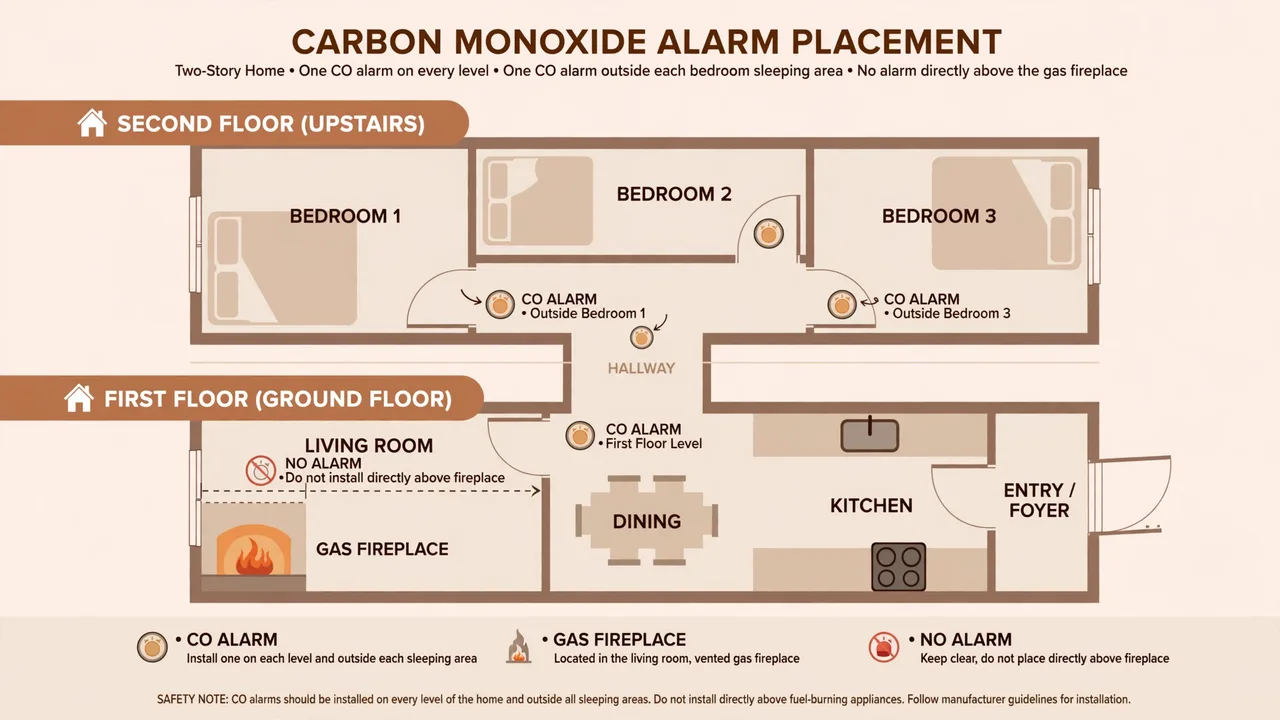
Alarms only protect you if they are in the right places and still working. The CPSC advises installing battery-operated CO alarms, or alarms with battery backup, on every level of the home and outside sleeping areas, and says interconnected alarms are best, so when one sounds, they all sound. The four checks below take about ten minutes and cover the whole plan.
Put an alarm on every level
Start at the basement and work up. Each level needs its own alarm, including the level where the fireplace sits and the level where people sleep. A single alarm by the front door does not cover a bedroom two floors up. If your home has a fireplace on the main floor and bedrooms upstairs, that means at least two alarms, plus one outside each sleeping area.
Place one outside each sleeping area
Bedrooms need coverage because people who are asleep cannot notice early signs of CO trouble. Put the alarm in the hallway outside the bedroom door, where it can wake sleepers. Do not place an alarm directly above the fireplace opening, where normal startup could trip it. Keep alarms clear of steam and cooking fumes as well, since those can cause false alarms.
Test each alarm once a month
Press the test button on every alarm and listen for the sound. A monthly test takes seconds, and it is the only way to know the alarm will speak up when it counts. Change batteries when the alarm chirps for a low battery, and change them at least once a year if your model uses replaceable batteries. Write the test date on a calendar so the habit sticks.
Write down the replace-by date
CO alarms wear out. Most makers list a service life on the back of the unit, and the CDC advises replacing detectors per the maker instructions. When you install a new alarm, write its replace-by date on a label stuck to the wall beside it, and add a phone reminder for that month. An alarm past its life may look fine and still fail to warn you.
Pro tip: buy alarms that talk to each other
Interconnected CO alarms sound together, so an alarm in the basement wakes the bedroom upstairs. If you are replacing old alarms, interconnected models are worth the small extra cost. Check that any model you buy carries the seal of a national testing agency.
Keep the Fireplace in Safe Shape
A gas fireplace is a gas appliance, and gas appliances need yearly care. The CDC advises having heating systems and gas appliances serviced by a qualified technician every year, and the same advice applies to your fireplace. A yearly visit is the single best way to keep CO low, because it catches the dirty burner, the blocked vent, and the tired safety device before they become a problem.
During a service visit, a licensed gas professional cleans the burner and logs, checks the vent or flue for blockages and damage, tests the safety devices, and checks the gas connections. Ask the technician to show you anything that looks worn, so you know what to watch for next year. Keep the service record with your manual.
Between visits, there is plenty you can do on your own. Keep the area around the fireplace clear of clutter, dust the exterior, and look at the glass and the logs each month during the heating season. Watch for soot, rust, or a flame that looks different from its normal pattern. Those are your cues to book a visit sooner than the yearly date.
Know where your own work stops. Never open a gas line, adjust a gas valve beyond the normal user controls in your manual, bypass a thermocouple, oxygen-depletion sensor, or spill switch, block a vent, or disable a CO alarm. If a repair goes past basic cleaning and the controls your manual describes, it belongs to a licensed gas professional. That line protects you, your household, and your pets.
Gas Smell and Carbon Monoxide Are Not the Same Thing
People often mix up the two risks, so here is the plain split. Carbon monoxide has no smell at all. The rotten-egg smell linked with gas comes from an odorant added to natural gas and propane, so people can detect a leak.
Smelling gas does not prove CO is present, and smelling nothing does not prove CO is absent. Only a CO alarm can warn you about CO.
That split is why the two rules are different. If you smell gas, the rule is: do not touch switches, flames, or appliances, leave the house at once with everyone and all pets, and call your gas utility emergency line or 911 from outside. Never try to find the leak, never relight anything, and never go back in until you are told it is safe. Our guide on why a gas fireplace smells like gas covers the causes in more detail, but the rule itself never changes.
If a CO alarm sounds, the rule is nearly the same: leave the house at once, call 911 from outside, and do not go back in until you get the all-clear. Do not open windows first, do not search for the source, and do not turn the fireplace off on your way out. Getting everyone, pets included, into fresh air comes first. The cause can wait until help arrives.
Should You Run a Gas Fireplace While You Sleep?
No. Turn the fireplace off before bed, and never run it while you sleep or while no one is home. A CO alarm is a backup, not a reason to leave a flame running with nobody awake to notice a problem. People who are asleep are the most at risk from CO, because they cannot notice early signs such as headache or dizziness.
The same rule applies to leaving the house. A fireplace left running in an empty home can develop a fault with nobody there to hear the alarm. Use a timer or a thermostat setting if your model offers one, and let the room hold its heat after the fire is out. If you want the full safety picture for indoor use, read our guide on whether gas fireplaces are safe to use indoors.
Troubleshooting: If This Happens, Try This
| If this happens | Try this |
|---|---|
| The CO alarm chirps now and then | Most alarms chirp for a low battery. Change the battery, press the test button, and check the replace-by date on the back. |
| The CO alarm sounds a full alarm | Leave the house with everyone and all pets. Call 911 from outside. Do not go back in until you get the all-clear. |
| The fireplace will not light | Follow the relight steps in your manual. If it fails twice, stop and call a licensed gas professional. |
| Soot appears on the logs, glass, or wall | Stop using the fireplace and book a service visit. Do not clean the burner yourself beyond what the manual allows. |
| You smell gas near the fireplace | Do not touch switches or appliances. Leave at once with everyone and all pets. Call your gas utility emergency line or 911 from outside. |
| The fireplace shuts off on its own | A safety device may have tripped. Leave the unit off and book a licensed gas professional. Never bypass a safety device. |
Frequently Asked Questions
Do gas fireplaces produce carbon monoxide?
Yes. Every gas flame makes some CO as it burns fuel. A fireplace that is vented well and kept up sends that CO outside, so levels in the room stay low. A blocked vent, a dirty burner, or a ventless unit with poor air flow can let CO build up, which is why CO alarms matter in every home with gas.
Is it safe to run a gas fireplace overnight?
No. Turn the fireplace off before bed and never run it while you sleep or while no one is home. A CO alarm still needs to be in place, but an alarm is a backup, not a reason to leave a flame running without anyone awake to notice a problem.
Do I need a CO alarm if my fireplace is vented?
Yes. Every home with a gas fireplace needs CO alarms, even with a vented or direct-vent model. Vents can block, parts can wear out, and other gas appliances in the home can also make CO. Put an alarm on every level and outside each sleeping area.
Can a gas fireplace set off a CO alarm?
Yes. An alarm sounds when CO in the air reaches the level the alarm is built to warn about. That can happen if a vent is blocked, a burner runs dirty, or a ventless unit runs in a room with too little fresh air. Treat every alarm as real: leave and call 911 from outside.
What does carbon monoxide smell like?
Nothing. CO is colorless and odorless, so you cannot detect it with your nose. The rotten-egg smell people link with gas comes from an odorant added to natural gas and propane, not from CO. Only a CO alarm can warn you about CO.
Are ventless gas fireplaces safe?
A ventless fireplace sends combustion byproducts, including CO and water vapor, into the room. That is how the design works, so it needs a working oxygen-depletion sensor and a CO alarm, and it needs fresh air in the room. Some states and cities restrict or ban ventless units, and many do not allow them in bedrooms. Check your local codes before you buy or run one.
How often should a gas fireplace be serviced?
Once a year, by a licensed gas professional. A yearly visit covers burner cleaning, a vent check, and a test of the safety devices. Between visits, keep the area clear and watch for soot, odd smells, or a flame that has changed.
Do gas fireplaces produce carbon monoxide when they are turned off?
No. With no flame, there is no combustion, so no CO is made. If you smell gas while the fireplace is off, that points to a gas leak, not CO. Leave the house with everyone and all pets, then call your gas utility emergency line or 911 from outside.
Can carbon monoxide harm pets?
Yes. Pets breathe the same air you do, and birds are more sensitive to CO and fumes than people are. A CO alarm on every level protects the whole household, pets included. If a pet acts dull or unsteady while the fireplace runs, leave for fresh air and call for help.
What should I do first if my CO alarm sounds?
Leave the house at once with everyone and all pets. Do not open windows, do not search for the source, and do not turn the fireplace off on your way out. Call 911 from outside and wait for the all-clear before you go back in.
Quick reference card
What you need: CO alarms on every level and outside each sleeping area, fresh batteries, your fireplace manual, your gas utility emergency number, a licensed gas professional on call.
The routine:
- Test every CO alarm once a month.
- Book a yearly service visit with a licensed gas professional.
- Watch for soot, odd smells, and a flame that has changed.
- Turn the fireplace off before bed and when you leave the house.
- If an alarm sounds, leave and call 911 from outside.
- If you smell gas, leave and call your gas utility or 911 from outside.
The Bottom Line
Do gas fireplaces produce carbon monoxide? Yes, they do, and that fact should shape how you run one, not scare you away from owning one. Vented and direct-vent models send CO outside, ventless models need more care and a check of local codes, and every type needs working CO alarms and a yearly service visit.
Your next step is a ten-minute check: test every CO alarm, write down each replace-by date, and book the yearly service visit if one is due. If you are still choosing a fireplace, read our guide on how to choose a gas fireplace and our vented vs ventless comparison before you buy.
Sources: U.S. Consumer Product Safety Commission, Carbon Monoxide Information Center. Also see the Centers for Disease Control and Prevention, Carbon Monoxide Poisoning Basics. This article is general guidance, not a substitute for your fireplace manual or the advice of a licensed gas professional.