Face Cord vs Full Cord of Wood: Size, Cost, Weight & How to Tell Them Apart
When a firewood seller has just sold you a cord of firewood and the pile in your driveway is smaller than you thought, you are not dreaming. It is likely that you did receive a face cord, rather than a full cord, and that the two terms are not interchangeable.
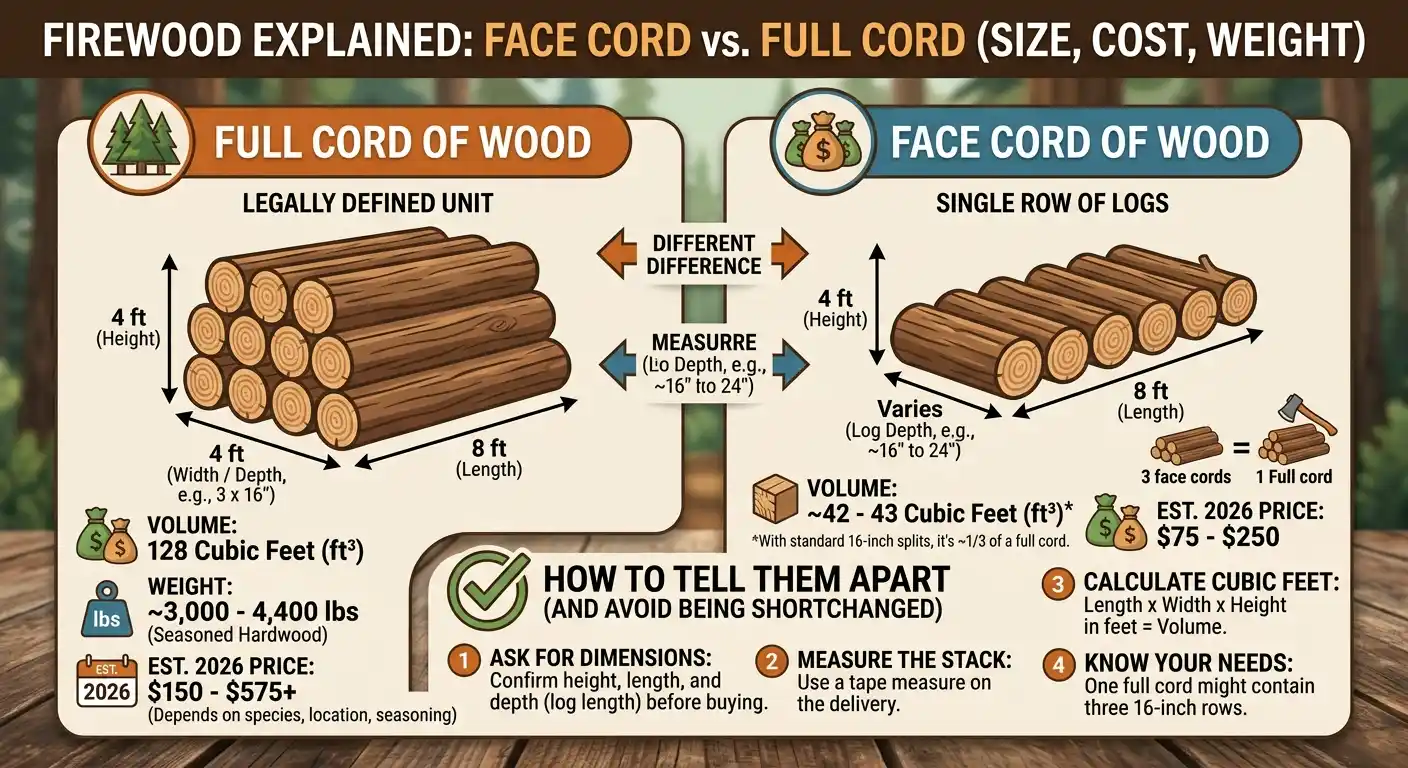
Short version: A full cord is a legally defined amount of wood with a height of 4 feet, a width of 4 feet, and a length of 8 feet that amounts to 128 cubic feet. A face cord (or rick) is not three rows, but one, and thus commonly contains about a third that, about 42 or 43 cubic feet. A face cord is as short as the logs are cut, and this is the very reason why the term is so confusing.
The actual sizes, weights, and 2026 prices of the two are listed below, and there is an easy method to check a delivery before you commit to it.
Key Takeaways
- A full cord is 128 cubic feet (4 ft x 4 ft x 8 ft). It is the only measure that has a legal definition in most of the U.S. states and the Canadian provinces.
- One row of logs, 4 ft x 8 ft., and as deep as your logs are long, is called a face cord. At 16-inch splits, which are standard, that amounts to about 42.7 cubic feet, or one-third of a full cord.
- 16-inch wood face cords are three times the length of a cord. A face cord would be half a cord rather than a third, assuming that the logs are cut to 24 inches.
- A cord of seasoned hardwood is about 3,000 to 4,400 pounds. A cord of the same wood to the face is about a third of that.
A full cord costs approximately 150 to 575 nationally based on species, seasoning and location, and a face cord costs 75 to 250. - The surest method of escaping a shortchanged delivery is to measure the stack personally and do the cubic-foot calculations, as cord alone is not enough to be a fair trade.
What Is a Full Cord of Wood?
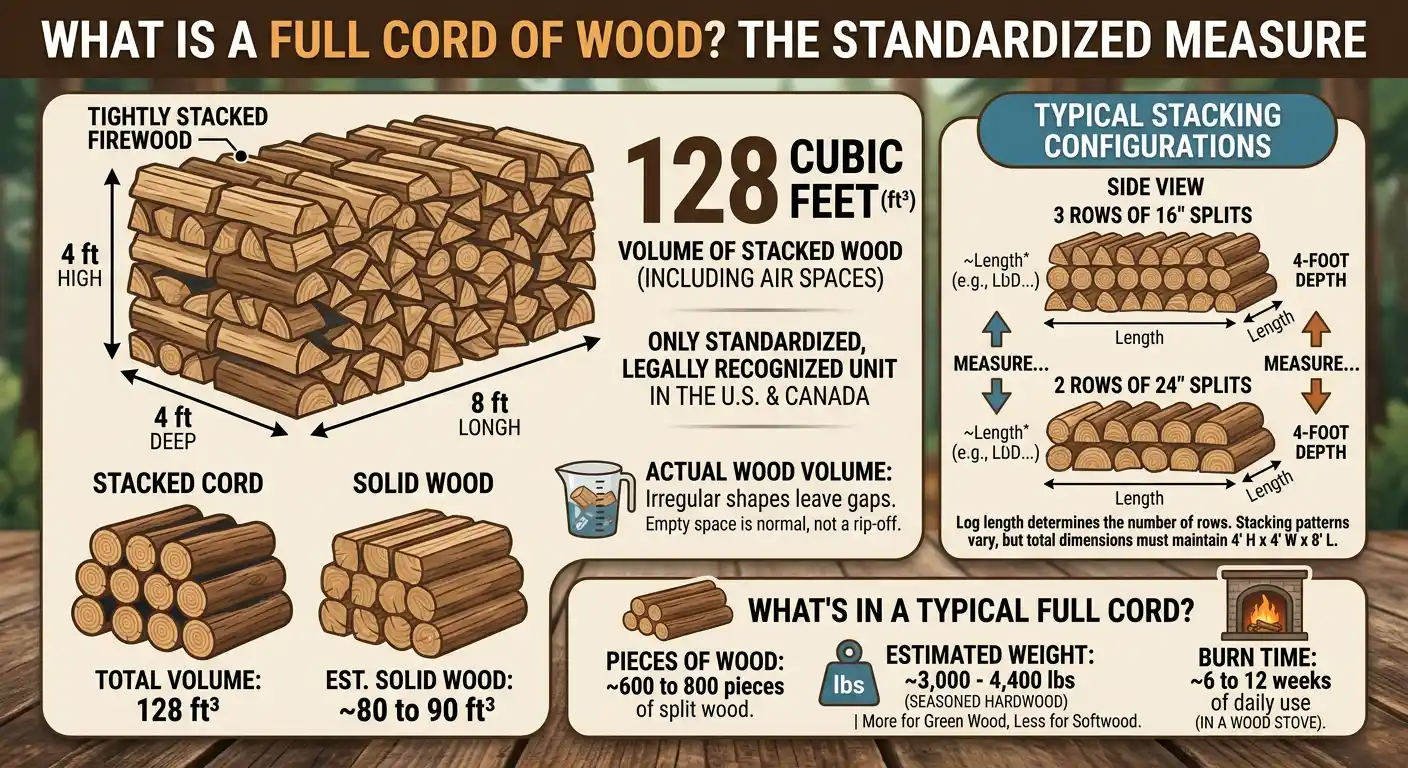
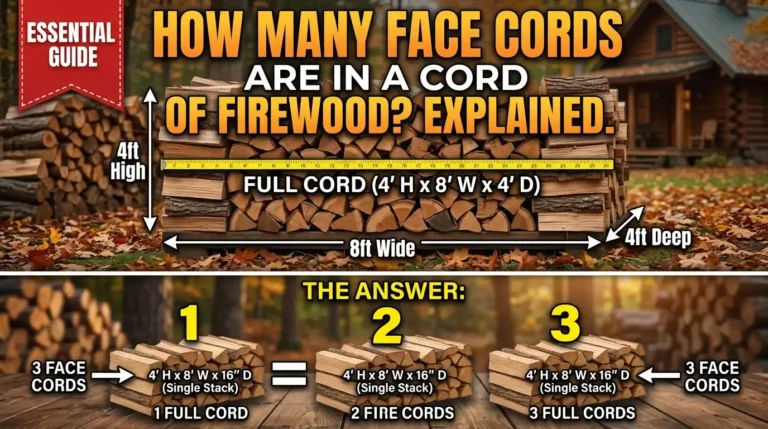
A full cord is the only standardized, legally recognized unit for selling firewood in the United States and most of Canada. It’s defined as a tightly stacked pile measuring 4 feet high, 4 feet wide, and 8 feet long, which comes out to 128 cubic feet of stacked wood. If you want to see exactly what that stack looks like once it’s piled up, it helps to picture it in person before you order.
The 128 cubic feet is the volume of the wood itself and the air between the logs. Due to the irregularity of split firewood, the actual solid wood of a full cord is nearer to 80 to 90 cubic feet. The remainder is blank space, which is not at all unusual, and does not indicate that you are being ripped off.
The stacking of a full cord is typically three rows deep. When the logs are sliced to the usual 16-inch length, you will find three rows of 16 inches each, which will make a total of the 4-foot depth. Instead, longer 24-inch splits are stacked two rows deep. In any case, the volume remains at 128 cubic feet, that is the portion which must be true to law.
A full cord typically contains:
- 600 to 800 pieces of split wood (individual pieces).
- 3,000 to 4,400 pounds of seasoned hardwood (more in the case of green wood, less in the case of softwood)
- Sufficient fuel to burn 6-12 weeks with daily use in a wood stove.
What Is a Face Cord of Wood?
A face cord or rick, as it is also known, is a stack of firewood, 4 feet high and 8 feet long, the same size as a full cord, but only a single row deep, rather than three. That row is as thick as your firewood is long, and that is why the size of face cord varies with the manner in which the wood has been cut.
A face cord with the most common split length of 16 inches is:
4 ft x 8 ft x 1.33 ft (16 in) = 42.7 cubic feet, or about one-third of a full cord.
Assuming that your logs are cut to 24 inches, then the calculations are different:
4 ft x 8 ft x 2 ft (24 in) = 64 cubic feet, or half of a full cord.
This is the single biggest source of firewood confusion. Unlike “cord,” which has one fixed legal meaning, “face cord” describes a shape, not a fixed volume. Two sellers can both sell you a “face cord” and hand over noticeably different amounts of wood, depending on log length. That’s not necessarily dishonest, but it does mean you should always ask for the split length before agreeing on a price. For a closer look at how those measurements are calculated, this breakdown of cord dimensions and how they’re figured walks through the math step by step.
You can also come across the following related regional terms:
- Rick: In most of the U.S. used interchangeably with face cord.
- Stove cord: A face cord that has been cut into shorter 12-inch sections, to fit smaller wood stoves.
- Bush cord: This is used in Canada, and is typically treated as an equal to a full cord (128 cubic feet), but varies by area.
- Sheldon cord: informal term to designate any stack bigger than a true cord. When you hear this on the part of a seller, consider it a red flag and not a unit.
Face Cord vs Full Cord of Wood: Side-by-Side Comparison
| Feature | Full Cord | Face Cord (Rick) |
| Height | 4 feet | 4 feet |
| Length | 8 feet | 8 feet |
| Depth | 4 feet | Log length (commonly 16-24 inches) |
| Total volume | 128 cubic feet | ~42.7 to 64 cubic feet |
| Solid wood volume | ~80-90 cubic feet | ~27-45 cubic feet |
| Rows of logs | 2 to 3 | 1 |
| Weight (seasoned hardwood) | 3,000-4,400 lbs | 1,000-1,700 lbs |
| Legal standard? | Yes, in most states/provinces | No, size varies by log length |
| Typical price (2026) | $150-$575 | $75-$250 |
| Burn time (daily use) | 6-12 weeks | 2-4 weeks |
| Best for | Primary heat source, large stoves, whole winter | Occasional fires, backup heat, small stoves |
How Much Does a Face Cord and Full Cord Weigh?
Firewood is not sold by weight but by volume since the weight varies drastically depending on the moisture content and species. Nevertheless, weight is important when you are going to carry wood by yourself or you should be aware of what your truck or trailer can carry.
A full cord of seasoned (dried) hardwood weighs approximately 3,000 to 4,400 pounds. Green, freshly cut wood can weigh 70 to 100 percent more because it’s still holding onto water. A face cord, being roughly a third of that volume, weighs roughly a third of that amount. For a deeper species-by-species and moisture-level breakdown, see this guide covering firewood weight variables in detail.
Average Weight by Species (seasoned, full cord)
| Species | Approx. Weight per Full Cord |
| Hickory | 4,500 lbs |
| White Oak | 4,200 lbs |
| Red Oak | 3,700 lbs |
| Sugar Maple | 3,800 lbs |
| White Ash | 3,500 lbs |
| Walnut | 3,200 lbs |
| Birch | 3,300 lbs |
| Elm | 3,000 lbs |
| Cherry | 2,900 lbs |
| Douglas Fir | 2,600 lbs |
| Yellow Pine | 2,600 lbs |
| White Pine | 2,100 lbs |
| Spruce | 2,100 lbs |
| Cedar | 1,800 lbs |
Expert advice: When you are carrying wood in a pickup, a full-size truck bed full of wood stacked flat to the top of the rails can hold about half a cord, or 64 cubic feet. A full seasoned hardwood cord will generally be larger than can be safely transported on a single trip by a typical pickup, another reason face cords or half cords are popular with DIY pickups.
Face Cord vs. Full Cord: Cost Comparison (2026)
The prices of firewood are extremely sensitive to the species, method of seasoning, location and distance of delivery. This is what buyers can expect in general this year.
| Volume | Cubic Feet | Average Price Range (2026) |
| Bundle | ~1 cu ft | $5-$15 |
| Quarter cord | 32 cu ft | $50-$125 |
| Face cord / rick | ~42.7 cu ft | $75-$250 |
| Half cord | 64 cu ft | $100-$300 |
| Full cord | 128 cu ft | $150-$575 |
The hardwood is usually more expensive than the softwood due to its longer burning time and more heat per log. You should pay at the upper end of these scales to have premium species, such as oak, hickory, or black locust, and at the lower end to have softwood, such as pine or fir. Kiln-dried wood that is dried more quickly and completely than air-seasoned wood can be priced at $100 or more premium to regular seasoned wood.
Price-per-cubic-foot tip: Do not directly compare a face cord price with a full cord price. Rather, take the overall price and divide it by the cubic feet that you are actually receiving. A $200 face cord (42.7 cu ft) works out to about $4.68 per cubic foot. A full cord (128 cu ft) costs approximately 2.34 per cubic foot, approximately half the price per cubic foot. It is nearly always cheaper per unit of wood to buy in bulk, provided you can store it.
How Many Face Cords Are in a Full Cord?
Using the standard 16 inch split length, three face cords are used to make one full cord. When the wood is split to 24 inches, it will only require two face cords to make a full cord, as each row is deeper.
This is why asking about split length matters just as much as asking about the cord type. “Three face cords” and “one full cord” should be roughly the same amount of wood, but only if everyone’s using the same 16-inch assumption. If you’re still working out how much to order overall, this full rundown on cord quantities and what to expect from your supplier can help you plan the purchase.
How to Check You’re Getting a Real Full Cord
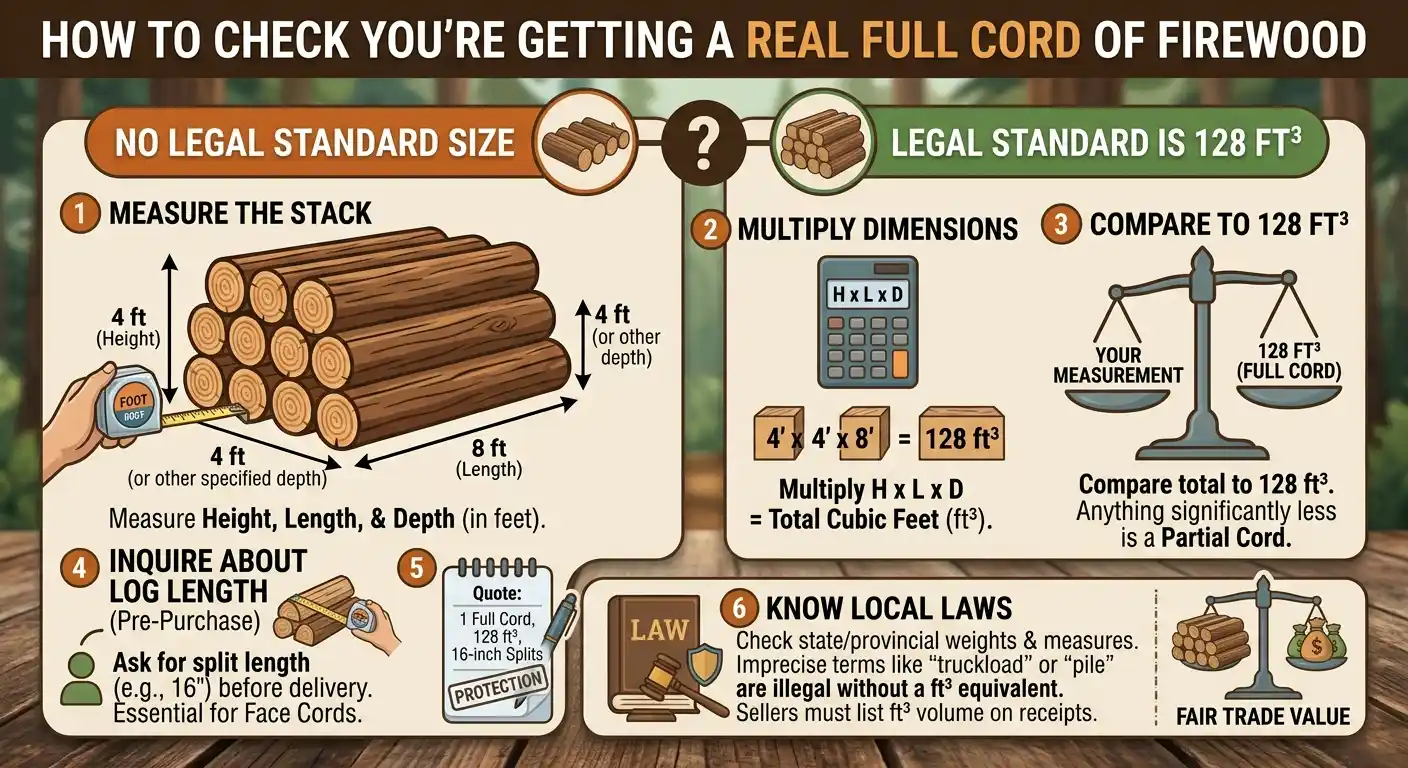
Since there is no standard legal size of face cord, and since even a full cord is abused by less scrupulous sellers, it is worthwhile to check a delivery yourself. The following is a basic procedure.
- Measure the stack. Measure height, length and depth in feet with a tape measure.
- Multiply height x length x depth. That is the total cubic feet.
- Compare to 128. The actual full cord is supposed to be 128 cubic feet or slightly less when stacked up. Anything significantly less than that is a partial cord, whatever the seller may have called it.
- Enquire about the length of the split before purchase and not after delivery. This is particularly necessary with face cord or rick orders.
- Have the volume written down. The quote to protect both sides is much more effective than 1 cord does, which is a quote that reads 1 full cord, 128 cubic feet, 16-inch splits.
- Examine weights and measures laws in your state. Most states legally insist that sellers indicate the volume of cord on the receipts and that they cannot sell firewood by imprecise such as truckload or pile without a cubic-foot equivalent.
Which One Should You Buy?
The correct decision will be determined by your intended purpose of the wood.
Buy a full cord if:
- The winter is your main heat source with wood.
- You have a large stove or furnace insert
- You have covered storage space with a large stack, which is dry.
- You desire the lowest price per cubic foot.
Buy a face cord if:
- You only use your fireplace occasionally
- You are trying a new supplier and are not committed to a larger order.
- You have very little storage area, such as a small deck or patio.
- You desire a backup heat not a complete winter supply.
Buy a half cord if:
- You desire an intermediate between the two.
- You have a wood stove as an alternative heat source but not used every day.
- You desire sufficient to have a season of fires once a week or two.
The typical wood-heating household burns two to four full cords of wood per winter, again depending on weather, house size and efficiency of the stove. When you are new to wood heat, first purchase a face cord or half cord so that you can determine your actual burn rate before making a bulk purchase.
Common Mistakes to Avoid
- 128 cubic feet is always assumed to be the cord. Other sellers take the term cord to refer to any big stack. Always verify the cubic foot.
- Failure to enquire about split length. A face cord of 24-inch logs contains half as much wood as a face cord of 16-inch logs, at the same name face cord.
- Purchasing green wood and hoping that it will burn like experienced wood. Green wood is also heavier, harder to light and leaves more creosote in your chimney.
- Comparison of prices without comparing volume. A low priced face cord may be more expensive than an expensive full cord.
- omitting a written quote. Short delivery is much more difficult to dispute when the agreement is made verbally.
Myth vs. Fact
Myth: The difference between a face cord and a full cord is nothing but a regional difference in name of the same quantity of wood.
Fact: When logs are cut to the standard length of 16 inches, a face cord is about a third of a full cord. They are not fungible sums.
Myth: When a seller claims “cord,” then you are entitled by law to 128 cubic feet.
Fact: This is regulated in most states, but not enforced, and face cord is not standardized at all. The best way to be sure is to check the stack yourself.
Myth: The more the cord of wood you pull, the more firewood you are getting.
Fact: Mostly weight is a measure of moisture content and species, not quantity. An unseasoned, green cord may weigh much more than a seasoned cord of the same kind and bulk, yet it may have no additional usable fuel in it.
FAQs
What is a face cord of wood?
A face cord is a layer of firewood that is 4 feet high and 8 feet long, a single row. It is as deep as the logs, which are usually 16 inches, and thus about a third the bulk of a full cord.
How much wood is a full cord?
A full cord is a standard volume of firewood, 4 feet high, 4 feet wide and 8 feet long, or 128 cubic feet. It is the sole legally established measurement of firewood in most states of the United States and in Canada, in the provinces.
What is the number of face cords to a full cord?
Three face cords are one full cord with standard 16 inch splits. The face cords are only two equal to one full cord with 24-inch splits.
Is a face cord a rick?
Yes. In most of the United States, the term face cord (or rick) is used interchangeably to refer to the same one-row-deep stack.
What is the weight of a face cord of wood?
The weight of a face cord of seasoned hardwood is usually 1,000-1,700 pounds, about one-third of the weight of a full cord of the same wood.
What is the amount of firewood required during winter?
The average number of full cords of wood used by most households that burn wood as a main heating fuel is two to four cords per season. Light users of the fireplace usually make do with a single face cord or half cord.
Is it possible to put a face cord in my pickup truck?
Yes. Most full-size pickup beds can accommodate a face cord (approximately 42.7 cubic feet). The length of a full cord (128 cubic feet) is usually beyond the capacity of a single pickup load.
What is the duration of a face cord of wood?
A face cord will last 2 to 4 weeks, burned nightly in a fireplace or stove. A full cord, in comparison, will last about 6 to 12 weeks with the same use.
Will the species of wood influence the quantity of wood I should purchase?
Yes. Harder woods such as oak and hickory last longer and give more heat per cord than soft woods such as pine or spruce, so you might have fewer cords of hardwoods to burn through the same winter.
What’s the difference between seasoned and green firewood?
Experienced wood is dried, typically 6-12 months or more, to approximately 20% moisture or less. Green wood is recently cut and may contain up to 45% or more water weight, which makes it heavier, more difficult to light, and smokier to burn.
Final Thoughts
The misunderstanding of a face cord and a full cord is not really a matter of bad math, but rather a matter of imprecise language. There is a legal definition of cord. A shape that varies in size according to the length of the logs cut is called face cord. When you have that, the entire subject ceases to perplex.
You must be a specific buyer: you must demand the cubic feet, you must demand the split length, and you must demand it in writing. You may either find yourself purchasing a face cord to put out the odd fire or a full cord to warm your house all winter, but, knowing the actual numbers, you will know just what will be in your driveway, and just how much it will be worth.