How Many Face Cords Are in a Cord of Firewood? The Math Behind What You’re Really Buying
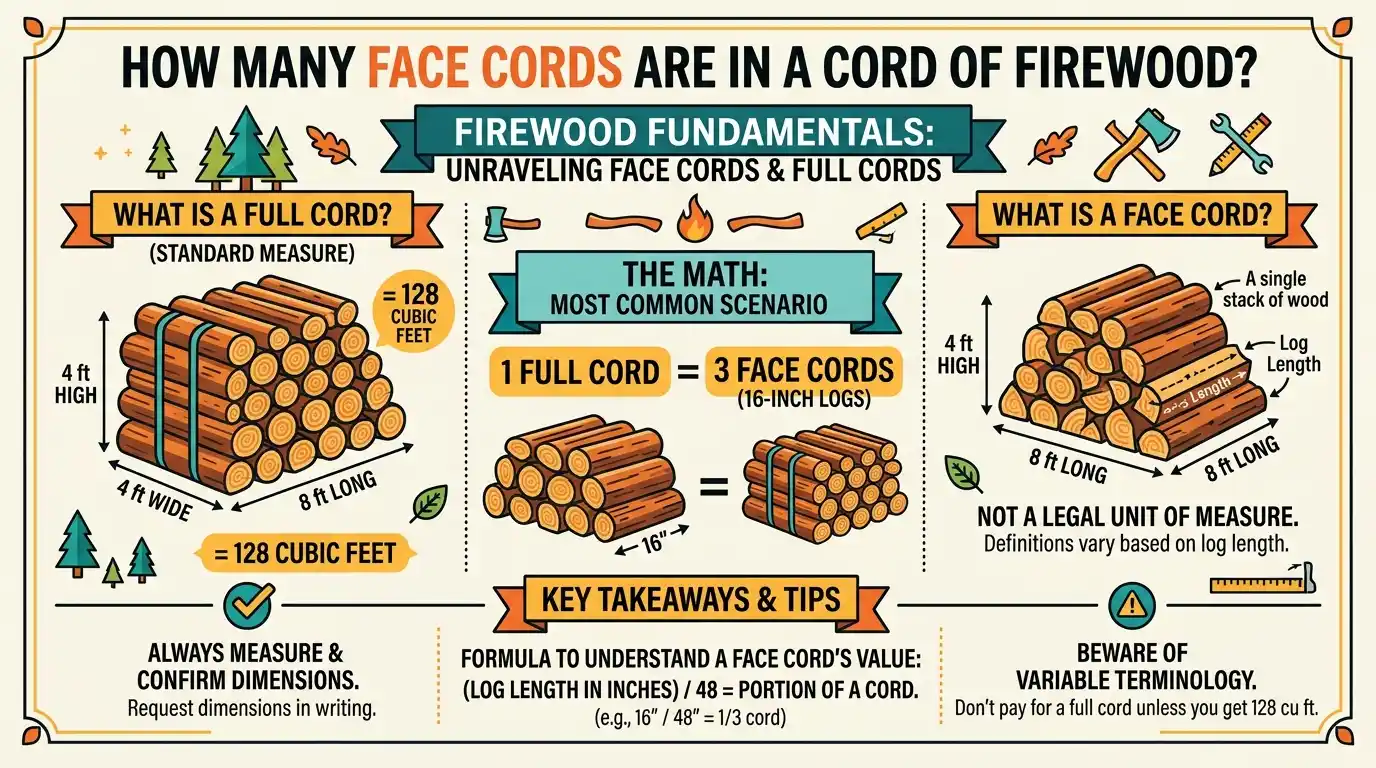
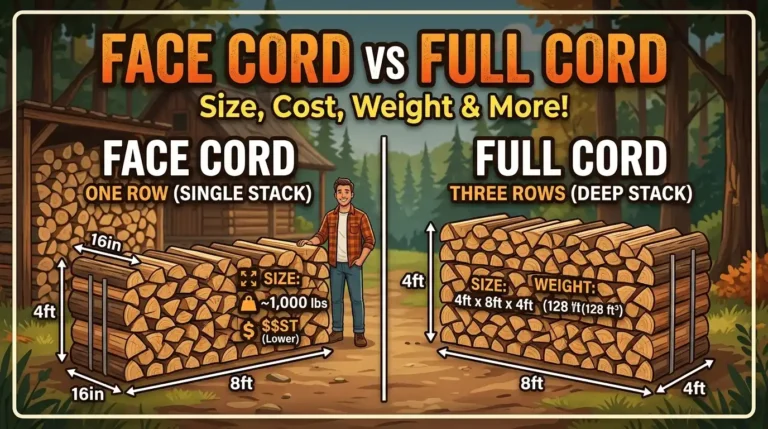
Most of the time, one full cord of firewood equals three face cords. That response presupposes 16 inch logs, the most popular length of logs being sold. When the logs are longer or shorter, the number varies, and it is where most of the buyers get lost.
This guide provides you with the precise formula, a conversion chart, and an easy method to check your delivery. You also will find out why face cord is such a slippery word and why you should not be charged a full cord when you are only carrying a partial load.
Key Takeaways
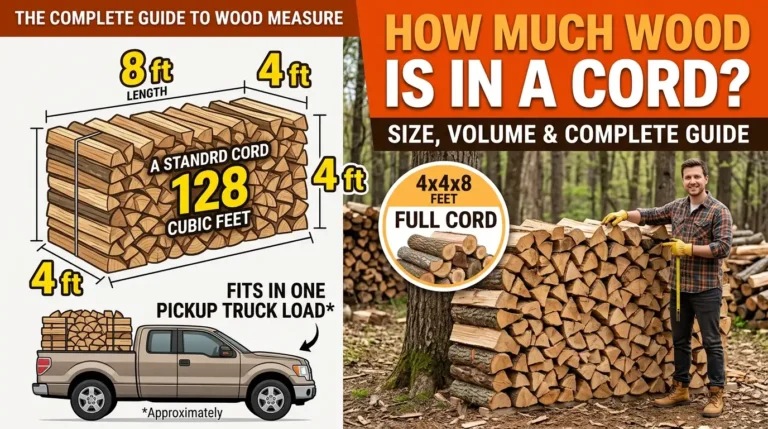
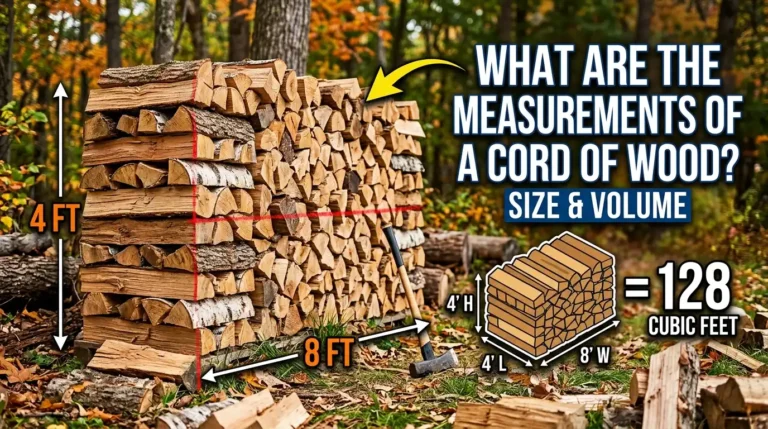
- One cord is 4 ft high, 4 ft wide, 8 ft long or 128 cubic feet of stacked wood.
- A face cord is 4 ft. high by 8 ft. long, and is deep by the length of one log.
- Divide the length of the log in inches by 48 to determine what portion of a cord one face cord is.
- There are 3 face cords to 1 full cord with 16 inch logs.
- The term face cord is not a legal unit of measure and therefore always request dimensions to be written.
Quick Answer: How Many Face Cords Are in a Cord of Firewood?
This is dependent on the length of the log, since a face cord has a depth of just one log.
| Log length | Face cord volume | Fraction of a full cord | Face cords per full cord |
|---|---|---|---|
| 12 inches | 32 cubic feet | 1/4 | 4 |
| 16 inches | About 42.7 cubic feet | 1/3 | 3 |
| 18 inches | 48 cubic feet | 3/8 | About 2.7 |
| 20 inches | About 53.3 cubic feet | 5/12 | 2.4 |
| 24 inches | 64 cubic feet | 1/2 | 2 |
Unless a seller informs you the length of the log, you cannot know what a face cord is in that sale.
What Is a Full Cord of Firewood?
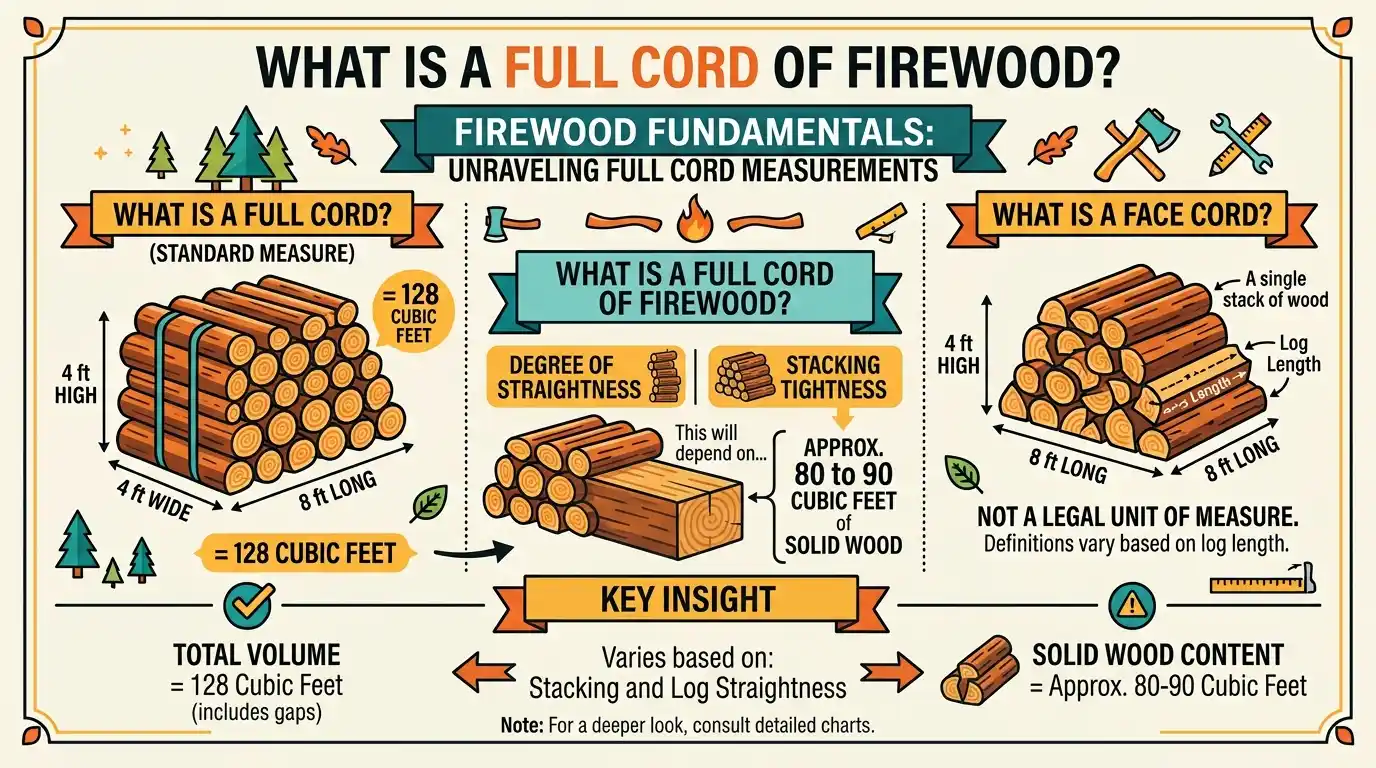
In the United States, the official size of firewood is a full cord. It is a stacked pile of neat size 4 feet high, 4 feet wide and 8 feet long. That amounts to 128 cubic feet including the air spaces between logs.
Due to such gaps, a cord contains approximately 80 to 90 cubic feet of solid wood. This will depend on the degree of straightness of the splits and the stacking tightness.
For a deeper look at the size, see this breakdown of how big a cord of wood is and the full list of cord of wood dimensions.
What Is a Face Cord?
A face cord is a stack 4 feet high, and 8 feet long, but single log deep. The front of the stack is the face that you see. It is not predetermined in depth and that is the source of all the confusion.
It can also be referred to as a rick, stove cord, furnace cord or fireplace cord. The use of these names varies regionally and do not always imply the same thing. If you want to explore that term, read this guide to a rick of firewood.
The Formula: Convert Face Cords to Full Cords
You only need one step.
Log length in inches ÷ 48 = the fraction of a full cord in one face cord
The number 48 comes from the 4 foot depth of a full cord.
Example 1: Your logs are 16 inches. 16 ÷ 48 = 1/3. You need 3 face cords for a full cord.
Example 2: Your logs are 24 inches. 24 ÷ 48 = 1/2. You need 2 face cords for a full cord.
Example 3: A seller offers 2 face cords of 12 inch wood. That is 2 × 1/4, or only half a cord.
Worked Example: Checking Your Delivery
Suppose you had ordered a face cord, and the pile is 4 feet high, 8 feet long.
- Measure the length of some logs. Suppose they are approximately 16 inches.
- Multiply the stack dimensions in feet: 4 × 8 × (16 ÷ 12) = about 42.7 cubic feet.
- Divide by 128. You have approximately 0.33, or a third of a cord.
When the pile is less than 8 feet in height or less than 4 feet in length, re-calculate with the actual height and length.
Why the Answer Changes From Seller to Seller
The variation is caused by three things:
- Log length. Sellers are cut to size to fit stoves or fireplaces or to fit their own equipment.
- Local habits. The word “cord” or “rick” can mean different things between regions.
- Stacking style. A loose, shaggy stack contains less wood than a stack of straight splits.
A model of state weights and measures rules, NIST Handbook 130, considers the cord to be the unit of measure at 128 cubic feet. It also deters the use of ambiguous words such as face cord and rick in sales. The rules apply in many states, although your local law might be different, so check with your state weights and measures office.
How Much Wood Is That in Weight?
Weight has much more to do with species and moisture than with the name of the unit. Dense seasoned hardwoods such as oak and hickory weigh much more per cord than softer woods, and green (freshly cut) wood weighs more than seasoned wood.
Due to the wide range of numbers by source, always verify the specifics of check before you plan to make a delivery or load a trailer. This weight guide by species and moisture covers it in detail.
How Much Does It Cost?
Single national price does not exist. Prices vary depending on the area, the time of the year, the type of wood, the distance of delivery, and the type of wood that is seasoned or kiln dried. The clever thing to do is to compare price per full cord equivalent, not the price of whatever unit the seller refers to.
Here is the method. Divide the price of the seller by the portion of a cord you obtain. One third of a local full cord price is a fair price of face cord of 16 inch logs. Anything much higher deserves a question. For typical ranges and savings ideas, see the cost of a cord of firewood, or the pages on a full cord price and a quarter cord.
How Many Face Cords Do You Need for the Winter?
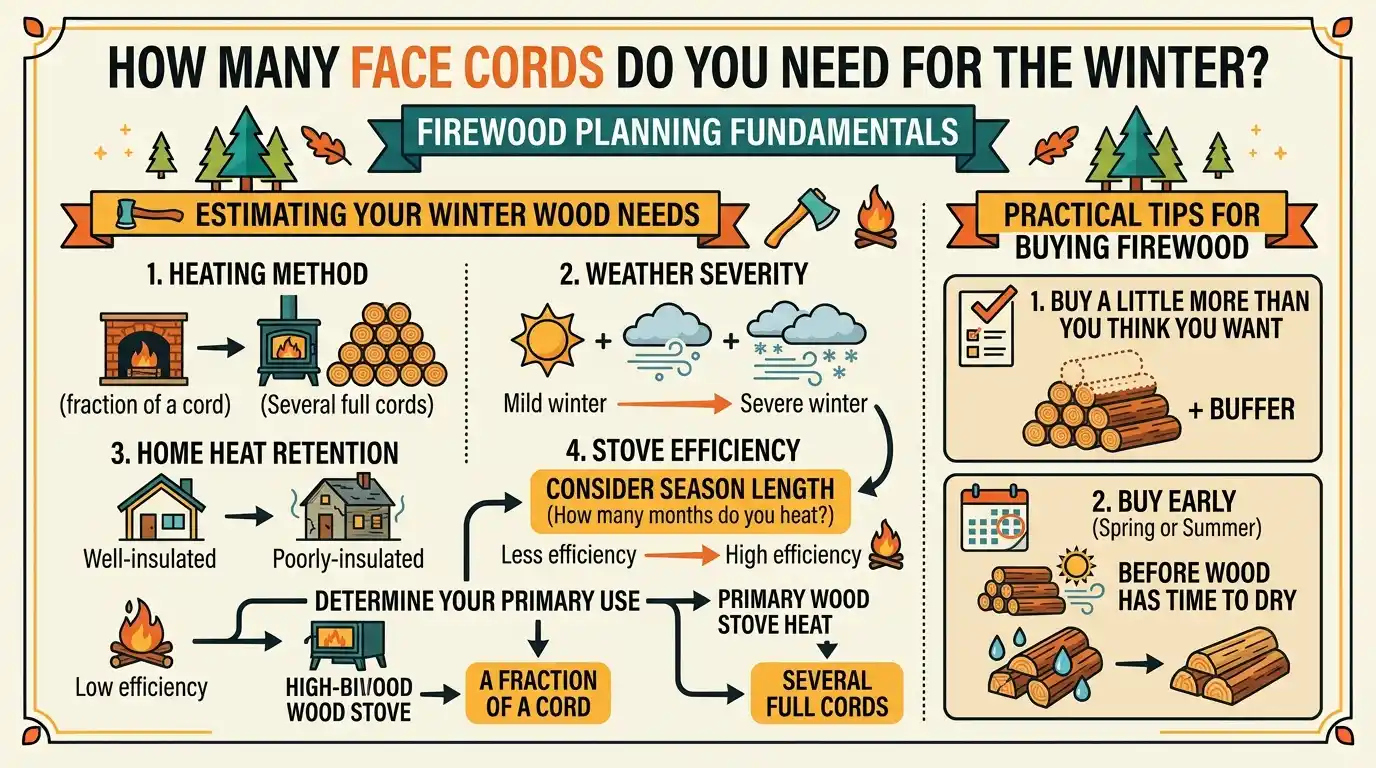
It is based on how you heat your house, your weather, how well your house retains heat and the efficiency of your stove. The size of a fireplace that is used on weekends might require a fraction of a cord of wood and the wood stove that is used as a primary source of heat might require several full cords. Use how long a cord of wood lasts to estimate your own season.
And remember one practical rule, which is, to buy a little more than you think you want, and to buy early, before the wood has time to dry.
Buying Checklist
- Request the length of the log and the size of the stack to be written out.
- Inquire whether the wood is seasoned, kiln dried or green.
- Request the price per full cord equivalent.
- When possible, stack the delivery and measure it, then pay.
- Retain the receipt, as it indicates what was promised.
- Be wary when the seller will not tell you the length of the logs.
Common Mistakes to Avoid
- It is assumed that a face cord is always a third of a cord.
- Measuring a loose pile, which exaggerates volume.
- Comparison of prices without the conversion into a unit.
- Green wood is burnt, and less heat and creosote are produced.
FAQs
What is the number of face cords in a cord of firewood?
The logs are generally three in case they are 16 inches. It is four with 12 inch logs, and two with 24 inch logs.
Is a face cord 1/3 of a cord?
When the logs are 16 inches. The fraction is log length (in inches) / 48.
What is the size of a full cord?
It is 4 feet high, 4 feet wide, and 8 feet long, or 128 cubic feet of stacked wood.
How big is a face cord?
It is 4 feet in height, 8 feet in length, and the same in depth, as length of log.
Is a rick a face cord?
Yes, often, but the dimensions depend on the region, and it is best to check with the seller.
What is a half cord? A face cord?
Only with 24 inch logs. Sixteen cubic feet is a half cord. Further of a half cord of wood.
Is a face cord a legal measure?
It is not a standard unit NIST Handbook 130. The standard is the cord, and request full cord equivalents.
What is the cubic feet of a face cord?
It depends on depth. With 16 inch logs it is approximately 42.7 cubic feet.
What is the procedure to measure a face cord myself?
Divide height by length by log length, all in feet, and divide it by 128 to obtain the fraction of a cord.
How much does a cord of wood weigh?
It depends on species and moisture and therefore look up a species based guide instead of using one number.
Which is the best firewood to purchase by the cord?
Thick mature hardwoods take the longest time to burn. Consult the manual on the best firewood to burn.
Is a pickup truck load a cord?
Rarely. The stacked volume is to be measured in most pickup beds which have less than a full cord of capacity.
What is the life of a cord of wood?
It depends on how often you burn and how efficient your appliance is. Planning guide is available above.
What is the reason why sellers use face cord rather than cord?
It is a smaller, less expensive unit which is easier to deliver yet requires clear dimensions to have any meaning.
Final Thoughts
The brief answer is that a complete cord is three face cords with 16 inch long logs, but the actual answer is a formula: length of logs/48. When you know that, you can put any seller on the same footing.
Order log length, stack size, and type of wood before your next order. Next, multiply the offer by a full cord and compare. That single habit will guard you through majority of pricing confusion. Second step: select your species, determine your season requirements and place an order early enough to allow the wood to season.