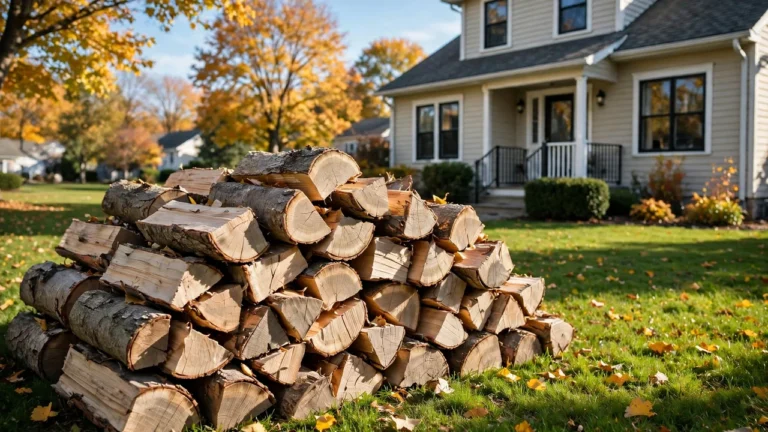
How Big Is a Cord of Wood? Exact Dimensions, Volume, and What It Looks Like
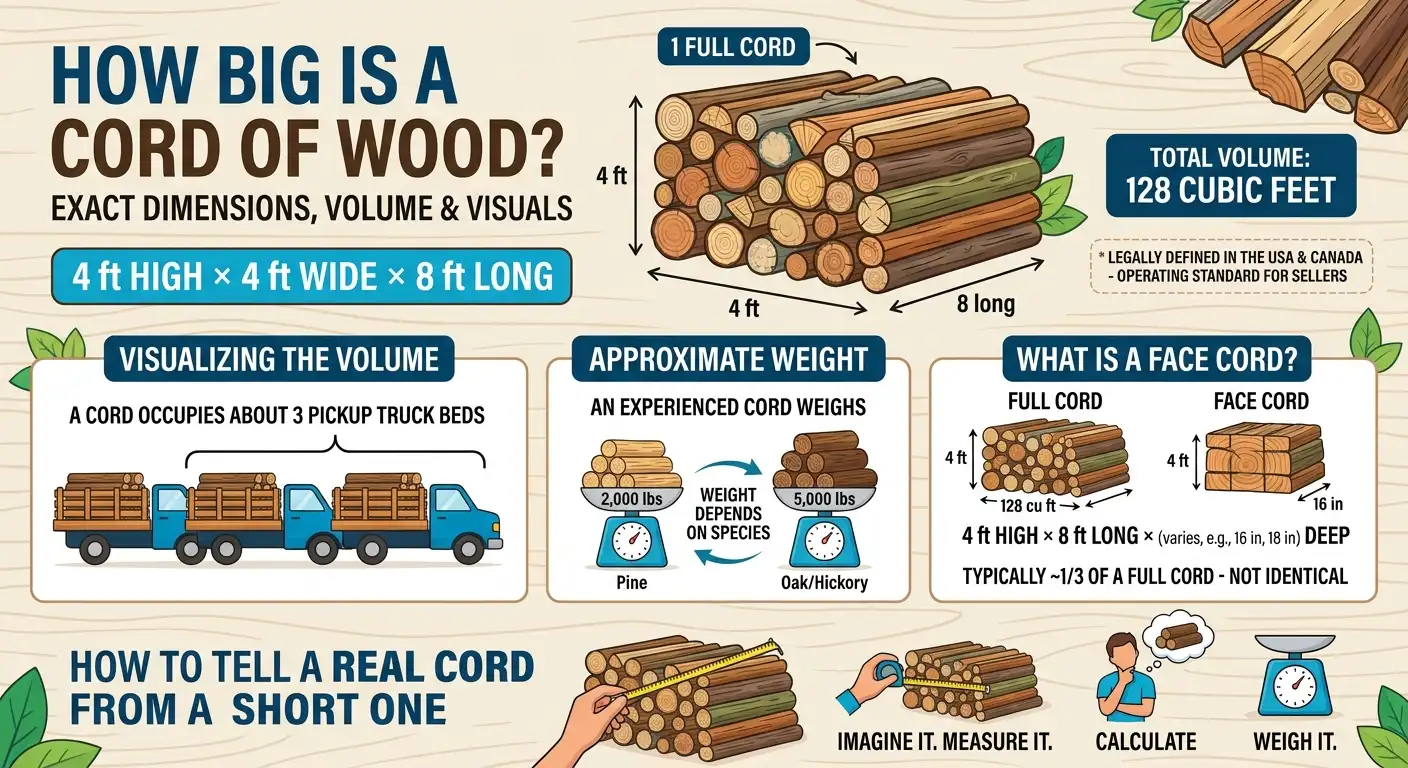
How Big Is a Cord of Wood? A stack of wood 4 feet high, 4 feet wide, and 8 feet long- 128 cubic feet- is known as a full cord of wood. That is what the law defines in all of the United States and Canada, and it is what every firewood seller needs to be operating off of.
But 128 cubic feet is a meaningless thing until you visualize it. Now then, how about just imagining it, and measuring it, and weighing it, and calculating how to distinguish a real cord and a short one.
Quick facts:
- 1 full cord = 128 cubic feet = 4 ft × 4 ft × 8 ft
- A cord occupies about 3 pickup truck beds.
- An experienced cord weighs between 2,000-5,000 lbs, depending on species.
- 1/3 of a full cord is typically called a face cord – not identical.
What Is a Cord of Wood?
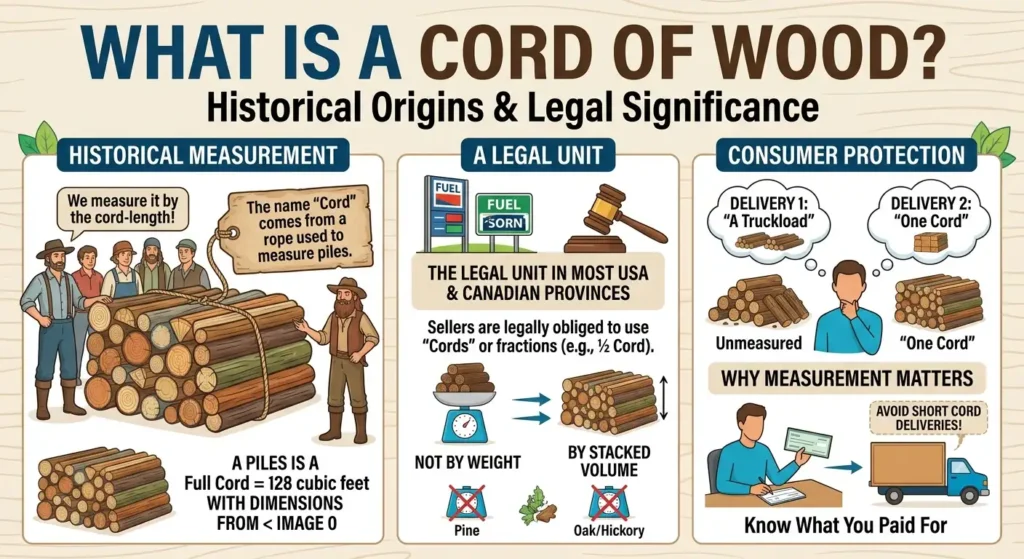
The typical volume of stacked firewood is a cord, not by weight or number of pieces. It is a legal unit in most states of the United States and Canadian provinces, and so the sellers are technically obliged to sell firewood in cords (or fractions of a cord) or other imprecise units such as a truckload or a pile.
The name is a historical one: piles of wood were measured by wrapping a cord (rope) round the pile.
Why it is important: Cord measurements save you as a consumer. When a seller is unable to inform you of the size of what he/she is delivering, then you have no chance of knowing that you are getting what you paid.
How Big Is a Cord of Wood, Exactly?
Standard Dimensions
The most typical, and classic, design is:
| Dimension | Measurement |
| Height | 4 feet |
| Width (depth) | 4 feet |
| Length | 8 feet |
| Total volume | 128 cubic feet |
Imagine a stack that is small enough to fit in a small shed wall, say, the height of a kitchen counter is not too large (4 feet), the length of a small car is 8 feet, and the depth is 4 feet.
It Doesn’t Have to Be 4x4x8
A lot of guides will omit this: any stack with a size of 128 cubic feet is a cord, no matter what the individual sizes are.
- 4 ft × 4 ft × 8 ft = 128 cubic ft ✅
- 2 ft × 4 ft × 16 ft = 128 cubic ft ✅
- 5 ft × 4 ft × 6.4 ft = 128 cubic ft ✅
In practice, nearly all suppliers operate on 4×4×8 since it is simple to construct a rack on and simple to measure with a tape measure. When your delivery is of a different shape, it is not necessarily a red flag, simply do the calculations (height x width x length 128) to check the volume.
How to Measure Your Stack
- Pile up the wood in a tight and even manner with the ends matching.
- Measure the height in feet.
- Measure width (depth) in feet.
- Measure the length in feet.
- Multiply height × width × length.
- Divide the number by 128 to obtain the number of cords.
Example: A stack that’s 4 ft tall, 3 ft deep, and 10 ft long = 120 cubic feet ÷ 128 = 0.94 cords — slightly short of a full cord.
When your stack is not completely uniform (sloping ends, irregular height) then measure a few points along the pile and average them, then do the calculation.
Cord vs. Face Cord vs. Rick vs. Half Cord: What’s the Difference?
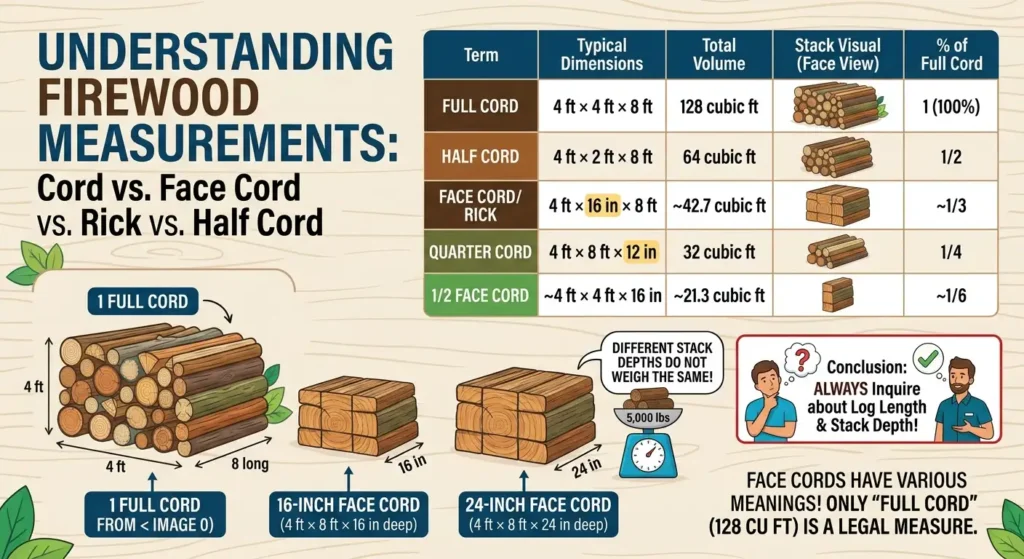
This is the point at which the majority of buyers become confused – and some of the sellers capitalize on that confusion. Face cord and rick are not legal measures of length; they are colloquial terms that have various meanings in different places.
| Term | Typical Dimensions | Volume | Fraction of Full Cord |
| Full cord | 4 ft × 4 ft × 8 ft | 128 cubic ft | 1 (100%) |
| Half cord | 4 ft × 2 ft × 8 ft (or 4×4×4) | 64 cubic ft | 1/2 |
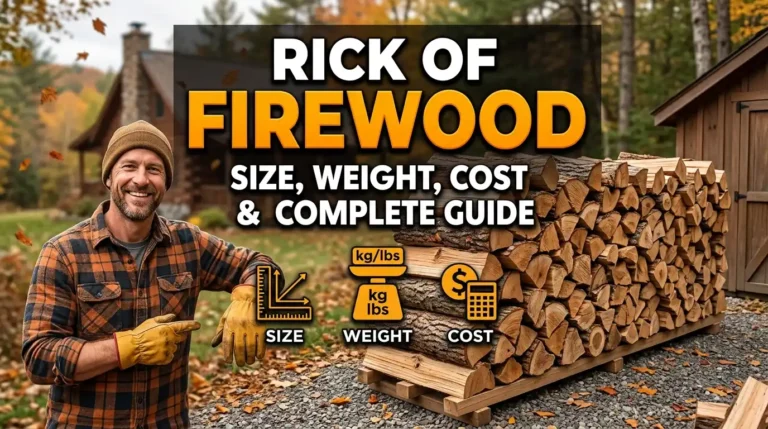
| Face cord / Rick | 4 ft × 16 in × 8 ft | ~42.7 cubic ft | ~1/3 |
| Quarter cord | 4 ft × 8 ft × 12 in | 32 cubic ft | 1/4 |
| 1/2 face cord | ~4 ft × 4 ft × 16 in | ~21.3 cubic ft | ~1/6 |
The point is that a face cord keeps the height of the stack (4 feet) and length of the stack (8 feet) the same (the dimensions of the face of a full cord), but the depth becomes the length of one log (usually 16 inches).
Conclusion: When you are quoted a price by a seller in terms of a rick or face cord, inquire of the length of the log and make sure the stack depth. A 16-inch face cord and a 24-inch face cord do not weigh the same amount of wood, though they all go by the same name.
How Much Solid Wood Is Actually in a Cord?
A 128 cubic-foot stack is not 128 cubic feet of solid wood. Split logs are not regular, and they do not fit together perfectly- there is always air between the pieces.
The amount of solid wood in the stack is estimated, but most sources estimate it at between two-thirds and three-quarters of the stack, with the rest being air gaps. The real solid wood in a well stacked cord is more in the range of 75 to 90 cubic feet.
Loose vs. stacked wood: When a pile of wood is dumped, the pieces will be more scattered about and thus will occupy more space than the same volume of wood in a stacked pile… a full cord of wood will occupy at least 180 cubic feet.
How Much Does a Cord of Wood Weigh?
Weight does not belong to the legal definition of a cord – volume does – but it is actually a really helpful piece of information because it helps you to calculate whether your car can carry it, and whether a delivery appears lightweight.
The weight is determined by two factors: species (density) and moisture (green vs. seasoned).
| Wood Type | Seasoned Weight (per cord) | Green Weight (per cord) |
| Softwoods (pine, spruce, fir) | ~2,000–3,000 lbs | ~3,500–4,500 lbs |
| Mixed hardwoods (birch, ash, maple) | ~3,000–4,000 lbs | ~4,000–5,000 lbs |
| Dense hardwoods (oak, hickory) | ~3,600–4,500 lbs | ~4,800–5,500+ lbs |
The weight of a full cord of dry hardwood (seasoned or kiln-dried) will range between 3,000 and 4,400 pounds depending on the specific species, length of the wood seasoning and the stacking density. Green, freshly cut hardwood weighs heavier, about 3,500 to 5,200 pounds, as it is still full of water. Pine is much lighter, ranging between 2,200 and 3,500 pounds, depending on the dryness of the timber.
The importance of moisture: Water is heavy and in green wood it can be nearly half-water. When wood is seasoned (usually 612 months of air-drying), it sheds that weight of water – without shedding any of its value as fuel. This is also what makes the green wood less efficient to burn: a part of the fire power is spent on boiling the water rather than warming up your house.
Will your truck hold a full cord? A cord of green, well-dried firewood is likely to weigh 2,000 to 3,000 pounds, and will exceed the payload capacity of most standard pickups – expect two trips, a trailer, or a higher-payload-rated truck.
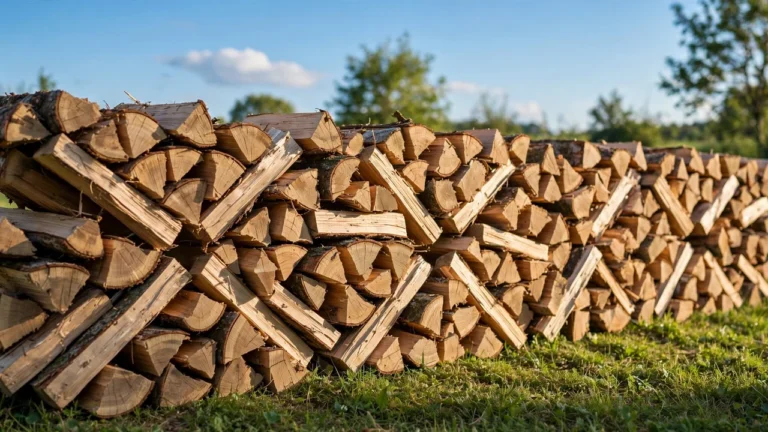
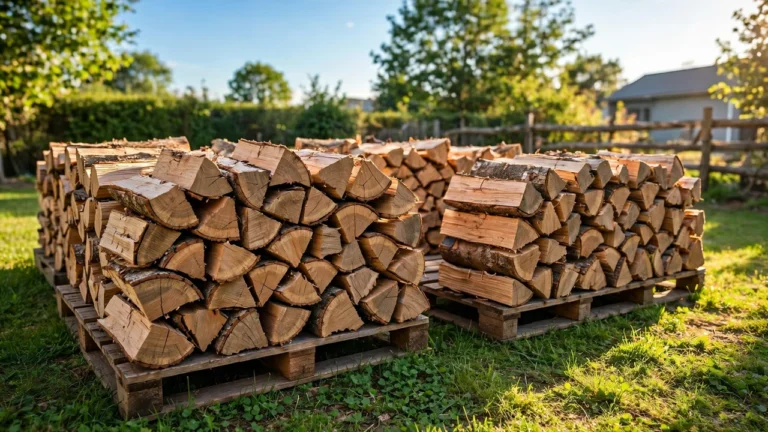
How Big Does a Cord of Wood Look? Visualizing the Size
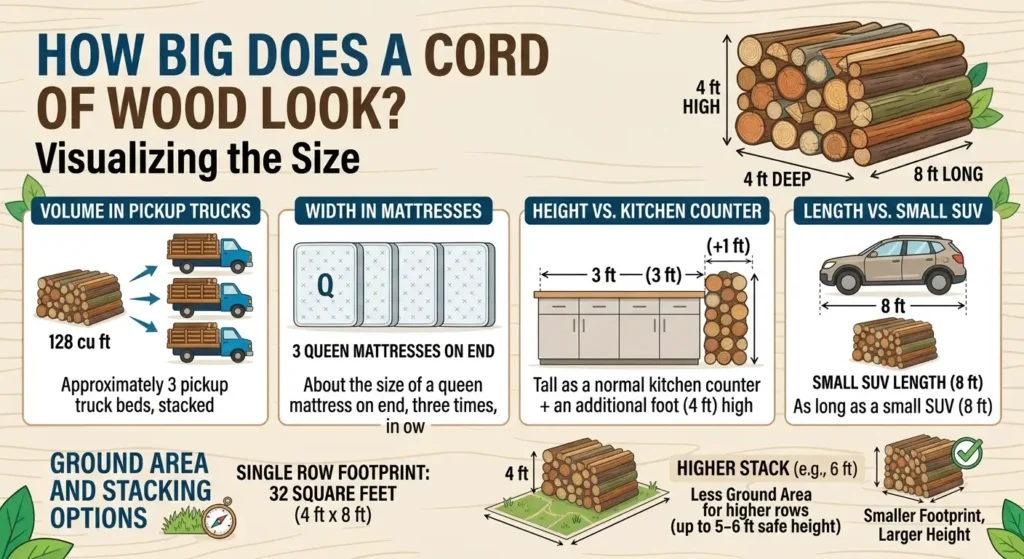
Words can do little. The length of a full cord, compared with things you are familiar with:
- Approximately 3 pickup truck bed loads of wood, stacked.
- about the size of a queen mattress on end, three times, in a row.
- Tall as a normal kitchen counter would be with an additional foot (4 ft) high.
- As long as a small SUV (8 ft)
When you think of where to place it: a full cord, stacked 4 feet high and 4 feet deep, requires approximately 32 square feet of ground area (4 ft × 8 ft footprint) to stack in a single row of 4 feet high, or less area to stack in higher rows (up to a safe height to maintain stability, typically not more than 56 feet without a rack).
How Many Cords Do You Need?
This greatly depends on your climate, frequency of burning, efficiency of your fireplace or stove and the type of wood. Roughly starting with:
| Usage Pattern | Estimated Cords per Season |
| Occasional weekend fires | 1/2 – 1 cord |
| Regular supplemental heat (a few nights/week) | 2 – 3 cords |
| Full-time wood heat, moderate climate | 3 – 5 cords |
| Full-time wood heat, cold climate | 5 – 8+ cords |
These are rough planning estimates, not a formula – an efficient EPA-certified wood stove will use less wood than an open fireplace to produce the same amount of heat, and a well-insulated house will use less than a drafty one.
How to Avoid Getting a Short Cord
Since in most states, a cord is a legal measure, the delivery of less than what is paid is a factual consumer protection concern in certain states. Some practical measures:
- Have the dimensions written down prior to delivery, height, width, length, or the amount of cord/fraction of a cord.
- Stack self-measurement, post-delivery, using the height × width × length 128 formula above.
- Inquire about the length of logs when purchasing a face cord or a rick, as it is not a standard term.
- Be aware of cross-stacking in the delivered pile – it should not be cross-stacked (alternating directions) because this introduces a lot of empty space to the stack, potentially making a shorted load appear fuller than it is.
- Review the regulations of your state. Numerous states have certain laws regulating the manner in which firewood should be advertised and sold – in some, the word cord or a definite fraction of a cord must appear on any invoice.
Cord of Wood: Quick Comparison Table
| Measurement | Height | Depth | Length | Cubic Feet | Notes |
| Full cord | 4 ft | 4 ft | 8 ft | 128 | The only legally standardized unit |
| Half cord | 4 ft | 2 ft | 8 ft | 64 | Exactly half the volume |
| Face cord (16″ logs) | 4 ft | 1.33 ft | 8 ft | ~42.7 | ~1/3 of a full cord; varies by log length |
| Quarter cord | 4 ft | 1 ft | 8 ft | 32 | ~1/4 of a full cord |
| Rick | Varies regionally | Varies | Varies | Varies | Often used interchangeably with “face cord” |
Common Mistakes When Buying or Measuring a Cord
- Assuming that face cord = 1/3 cord at all times. It is solely a matter of length of log – a 24 inch face cord is half a cord, not a third.
- Relying on the apparent size of a loose dump pile. The amount of actual wood in an unstacked pile occupies more space than a stacked pile.
- Mixing volume with weight. A cord is a measure of volume. A light cord is not always a short cord, but may be simply a well-seasoned cord or a lighter variety.
- Not measuring after delivery. The easiest method of ensuring that you got what you paid is by a five-minute tape-measure check.
- Purchasing green wood and thinking that it will burn like aged wood. Identical cord size, extremely varied burn quality and heat production.
Myth vs. Fact
| Myth | Fact |
| “A cord always weighs about the same.” | Weight varies by 2–3x depending on species and moisture content. |
| “A face cord is always 1/3 of a cord.” | Only true when logs are cut to 16 inches — it changes with log length. |
| “A cord has to be stacked 4x4x8.” | Any combination of dimensions totaling 128 cubic feet qualifies. |
| “More cross-stacking means a fuller-looking, better pile.” | Cross-stacking adds air space and can make a short load look bigger. |
You May Also Like to Read:
FAQs
How big is a cord of wood?
A cord of wood measures 128 cubic feet, which is normally piled up to 4 feet high, 4 feet wide and 8 feet long.
What is the difference between a cord and a face cord?
A cord is a measured, statutory amount (128 cubic feet). A stack 4 feet high and 8 feet long, but one log deep (typically 1/3 of a full cord, but again depending on the length of the logs), is an informal term known as a face cord.
What is the number of cubic feet of a cord of wood?
A full cord is 128 cubic feet. A half cord measures 64 cubic feet and a face cord measures about 32-64 cubic feet in accordance with the length of logs.
What is the weight of a cord of wood?
Experienced firewood normally weighs 2,000 to 4,500 pounds per cord, based on species. The green (unseasoned) wood may weigh 3,500 to 5,500+ pounds due to the presence of more water in it.
Will a full-size pickup truck carry a cord of wood?
Typically not on one journey. The pickup is usually a half-ton or three-quarter ton; it can carry approximately one-third to half a cord safely, that is, most cords will need two or more trips or a trailer.
Is a cord a rick of wood?
No. A rick is usually a face cord – approximately 1/3 of a full cord – but the term and quantity may be different in different places.
How many days does a cord of wood last?
It is determined by the frequency of burning, climate and the efficiency of your stove or fireplace. Frequent fires could be extending a cord a full season, and daily wood heat in a cold climate could burn through a few cords a season.
What is the area of a cord of wood?
Laid in the typical 4×4×8 pattern, a cord takes a footprint of approximately 32 square feet (4 ft × 8 ft) when stacked 4 feet high, or smaller footprint when stacked higher (with sufficient support).
Will 1/2 cord be sufficient during winter?
When wood is used as a secondary or occasional source of heat in most households, a half cord can be used in light, occasional use. With primary wood heat, typically a full winter is not sufficient – most full-time wood-heat houses require several cords per winter.
Final Thoughts
A cord of wood is not a difficult thing to understand when you strip it of the localisms, it is 128 cubic feet, and it is most usually in the form of a pile 4 feet high, 4 feet wide and 8 feet long. Face cords and ricks, and other colloquialisms, are the source of the confusion nearly always, and are not as standardized as the word cord.
The most effective defence as a purchaser is easy: be acquainted with the size, insist on the length of logs on anything offered as a face cord, and spend five minutes with a tape measure to check the delivery. That habit alone will help you not to have to ask yourself whether you received the wood you paid.