What Is an Oil-Filled Space Heater? How It Works, Key Benefits, and When It’s Worth Buying
You turn on a heater and ten minutes later the room remains cold. Then you turn it off, and the warmth lingers an hour. And that is the character of an oil-filled space heater.
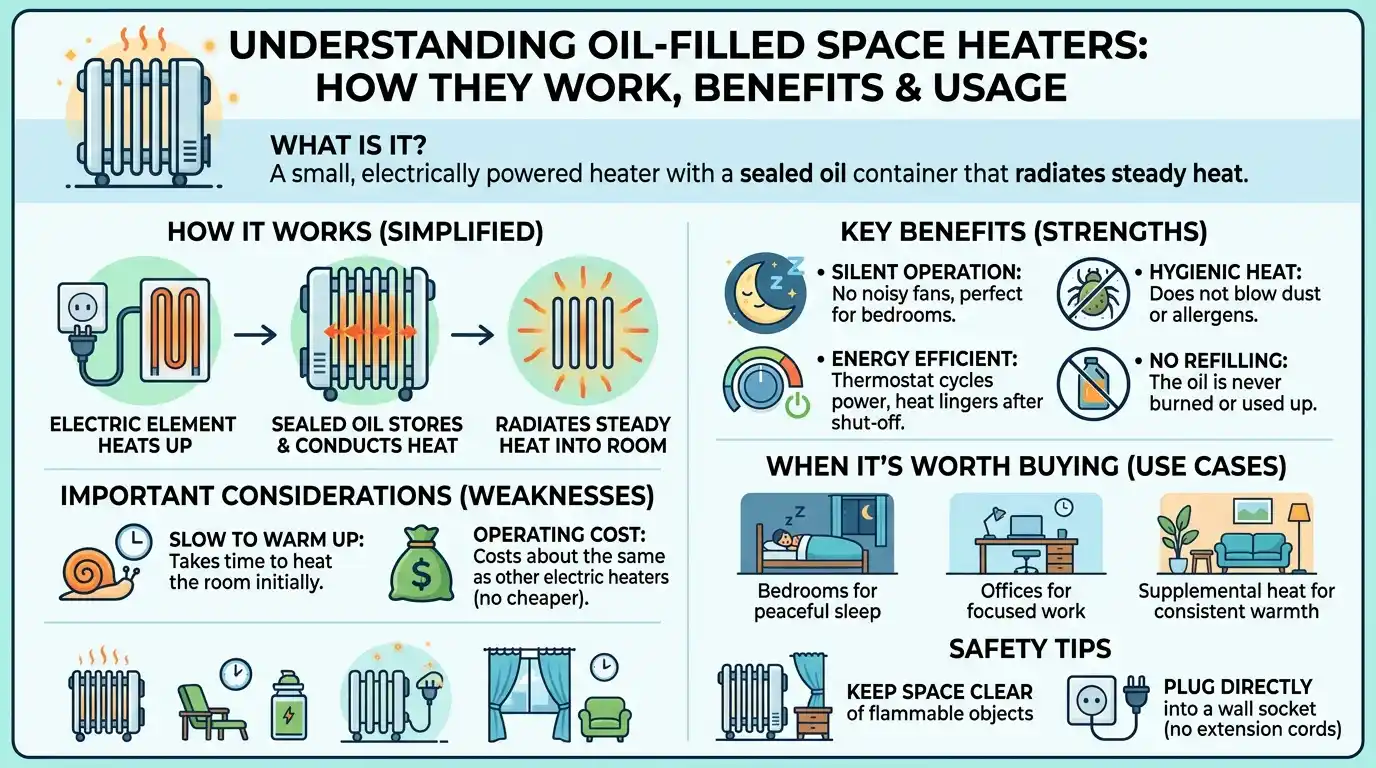
An oil-filled space heater is a small, electrically powered type of heater which warms a sealed container of oil, which is then used to radiate a steady, warm stream of heat into a room. It needs no fan, generates nearly no noise and does not require refilling. This is a guide on how it works, what it does well, where it fails and how to select the right one.
If you want the basics of the wider category first, this primer on the science behind portable room heaters is a good starting point.
Key takeaways
- The oil is closed in and serves as a heat store. It is never burned or used up.
- Oil-filled heaters are slow to warm, but continue to emit heat even when turned off.
- They are silent, do not spew dust and are appropriate in bedrooms and offices.
- They do not cost less to operate compared to other electric heaters, but the thermostat cycling can help save wasted energy.
- Store them in a flammable-free environment and directly place them in a wall socket.
What Is an Oil-Filled Space Heater?
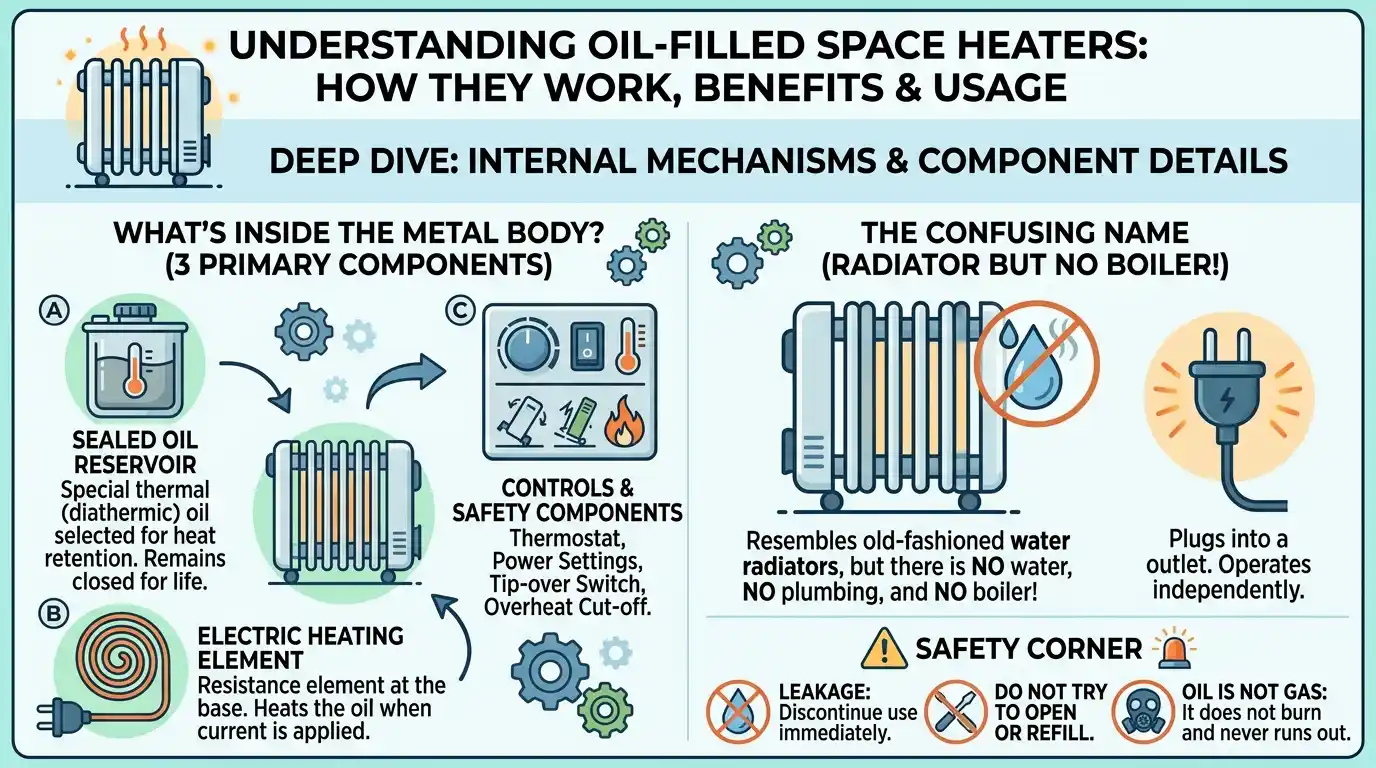
Oil-filled space heater is an electric heater that has a sealed metal body and is filled with thermal oil. A heating coil inside the oil heats the oil and the oil transfers the heat to the metal casing that emits warmth into the room. It is also referred to as an oil filled radiator, oil filled heater or oil column heater.
The name is confusing. It is referred to as a radiator as it resembles an old-fashioned hot water radiator with vertical fins or columns. Yet there is neither water nor plumbing nor boiler. It can be plugged in a normal outlet and it operates independently.
What Is Inside an Oil-Filled Heater?
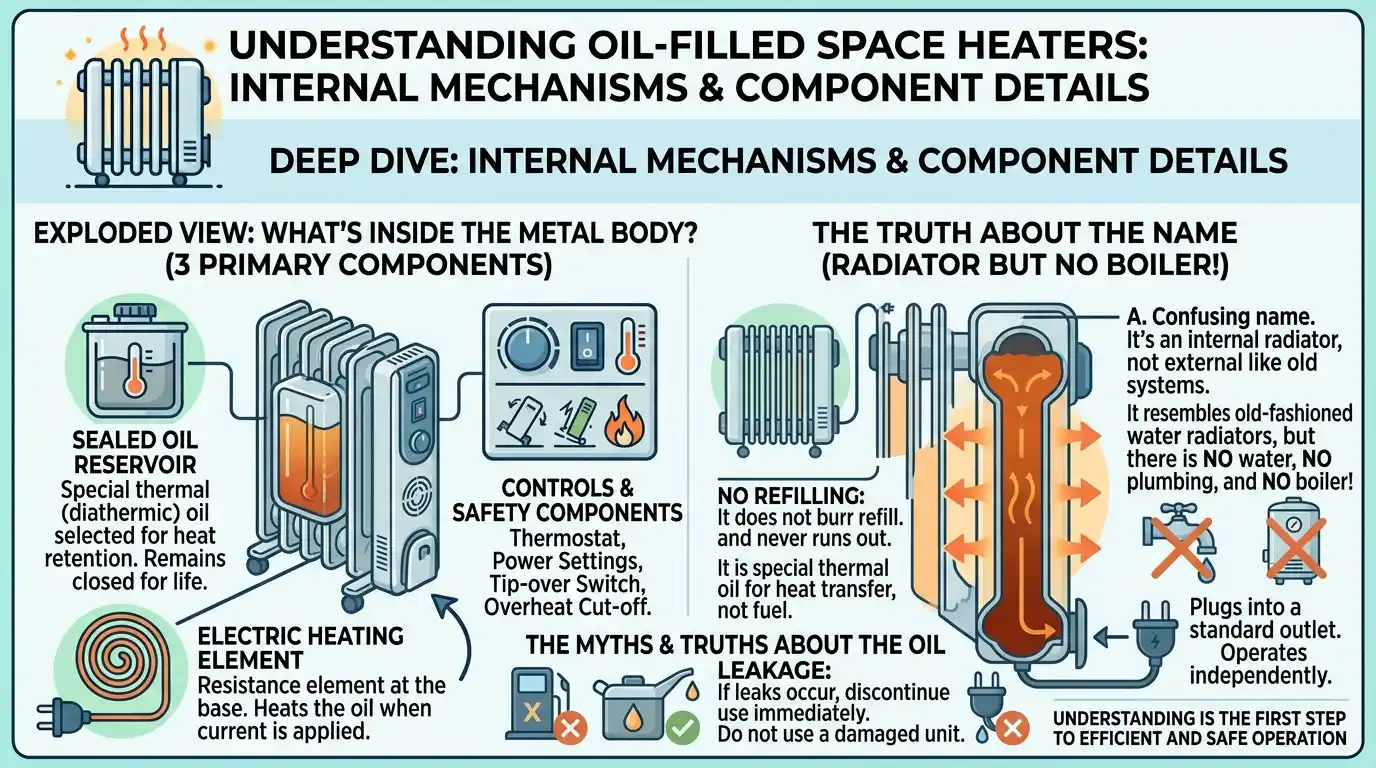
There are three primary components in the metal body.
- Sealed oil reservoir: Oil is a special thermal (diathermic) oil selected because of its capacity to retain heat. It remains closed as long as the heater lives.
- Electric heating element: A resistance element at the base heats the oil when current is applied to it.
- Controls and safety components: These consist of a thermostat, power settings, and typically a tip-over switch and overheat cut-off.
The oil is not gas. It does not burn and never runs out, that is why you do not fill it up. In case of leakage, discontinue the use of the unit. Do not try to open or refill it.
How Does an Oil-Filled Space Heater Work?
The heater works in four simple steps.
- The element is heated by power. By turning it on, the electricity heats the resistive element within the base.
- The element warms the oil. Hot oil ascends within the columns and cold oil descends. This natural flow is referred to as convection.
- The metal becomes hot. The metal fins are heated by the hot oil and distribute the heat over a large surface area.
- The room heats up. Heat is lost to the air by the fins both by radiant heat (heat you feel directly) and by convection (heat gained by rising and circulating air).
The thermostat then turns the element on and off to maintain your desired temperature. Since the oil remains hot between cycles, the heater continues to give out heat even when the element is not in use. For a closer look at the internal parts and the heat cycle, see this walkthrough of what happens inside an oil heater from switch on to steady warmth.
Why It Stays Warm After You Switch It Off
Oil is highly thermal mass, or has a lot of heat. When the element is terminated the hot metal and oil cool gradually. This is why the surface remains warm and continues to heat the room some time later. This is not wrong but is natural.
How Long Does It Take to Heat a Room?
Anticipate a slow beginning. It requires between 15 and 30 minutes before you feel a difference, and still more in a large or drafty room. Precise time is determined by the wattage of the heater, the size of the room, and your insulation. This is the greatest trade-off of the design.
Benefits of an Oil-Filled Space Heater
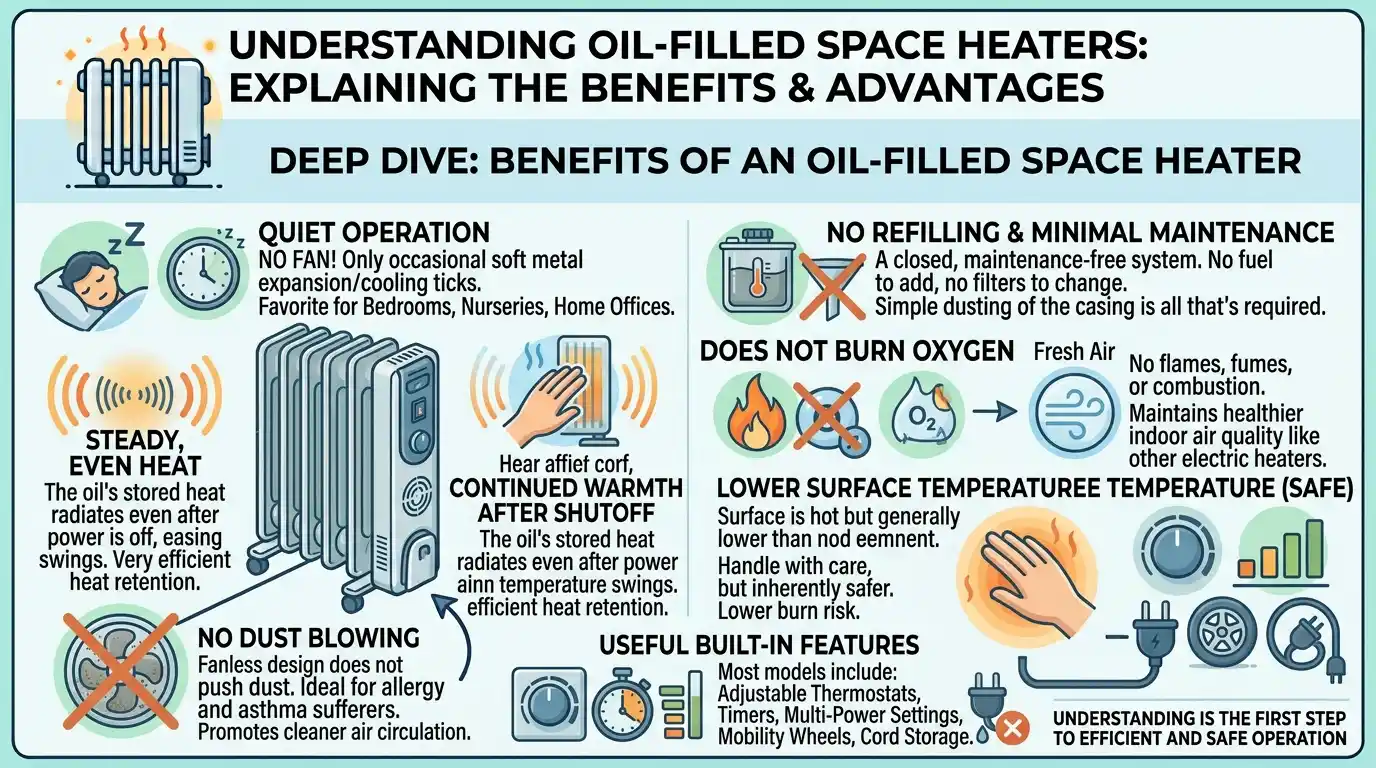
- Quiet operation. With no fan, the only sounds are an occasional soft tick as the metal expands or cools. It is a favorite in bedrooms, nurseries, and home offices.
- Steady, even heat. The warmth is soft and steady as heat is emitted over a large surface instead of a small hot coil.
- Continued warmth after shutoff. The fact that the stored heat continues to operate even when the element is off helps in even out temperature fluctuations.
- No dust blowing. Air and dust are pushed around by a fan heater. Many allergy sufferers like an oil-filled heater, which an oil-filled heater does not have.
- Refilling and maintenance not possible. The closed system implies no fuel, no filters and very little maintenance other than dusting the body.
- Does not burn oxygen. It does not generate any flame, fumes or combustion gases within the room like any other electric heater.
- Lower surface temperature than exposed element heaters. The body remains hot enough to burn skin, but is generally lower temperature than a glowing coil or bar. Nevertheless, handle it with care.
- Useful built-in features. Most of the models have adjustable thermostats, timers, various power options, wheels, and cord storage.
Limitations to Know Before You Buy
Proper purchasing counsel comprises the negatives.
- Slow warm up. The best choice is not the one that will allow you to get heat within minutes.
- Heavy and bulky. Oil and metal add weight, but most models have wheels.
- Not less costly to operate. Electric resistance heaters turn almost all the electricity they consume into heat, and there is no magic in making oil-filled heaters more efficient than others. Running cost is dependent on the wattage and the duration of time the element is on.
- Not good in large or open areas. One portable unit is not effective in large, drafty rooms.
- Hot surface. The casing may still burn even to the inquisitive children and pets.
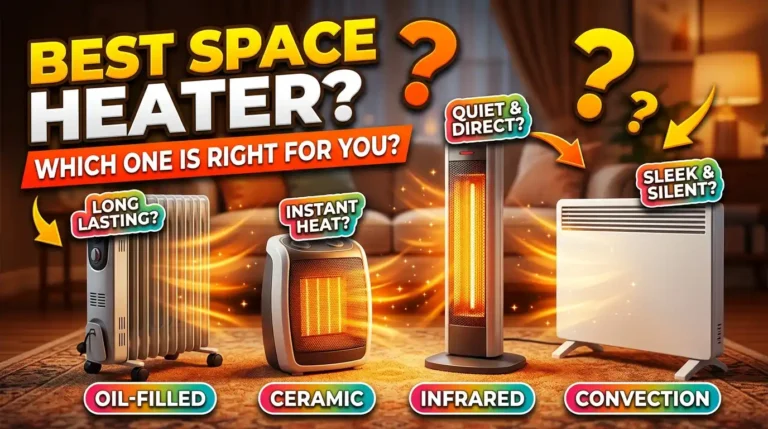
Oil-Filled Heater vs Other Space Heaters
| Feature | Oil-Filled | Ceramic (Fan) | Infrared / Radiant | Fan Heater |
|---|---|---|---|---|
| Heat style | Steady, radiant plus convection | Fast blown air | Direct radiant warmth | Fast blown air |
| Warm up speed | Slow | Fast | Immediate on nearby objects | Fast |
| Noise | Very quiet | Fan noise | Usually quiet | Fan noise |
| Heat after switch off | Yes | Minimal | Almost none | None |
| Dust movement | None | Some | Low | Some |
| Best for | Bedrooms, long use | Quick warm ups | Spot heating | Short bursts |
Want more numbers? This page on hourly and monthly power use for oil-filled radiators breaks the cost down further. You can also read what research and real-world use say about efficiency, and see whether oil heaters stay affordable at different wattages. If a fan heater is also on your shortlist, compare it with the running cost of a typical fan heater.
How Much Does It Cost to Run?
The amount of power consumed by an electric heater is the same as the wattage. In order to determine the cost, you need to multiply the kilowatts by the number of hours used and then by your electricity rate.
Example: A 1,500 watt heater is 1.5 kilowatts. One hour of full power consumption is 1.5 kWh. So at 0.16 per kWh, or 0.24 per hour.
Here, the thermostat is important. When the room has reached your desired temperature, the element switches off, meaning that the heater will not be fully loaded at all times. The actual cost is often less than operating at full blast. Get your own utility rate to have a correct figure.
What Size Oil-Filled Heater Do You Need?
One of the most popular rules of thumb is 10 watts of heating per square foot of floor area, with average insulation and normal ceiling height.
| Room Size | Suggested Wattage |
|---|---|
| Up to 100 sq ft | About 1,000 watts |
| Up to 150 sq ft | About 1,500 watts |
| Above 150 sq ft | Consider a larger room strategy or more than one heat source |
This is a guideline and not a guarantee. The need is increased by poor insulation, high ceilings and cold climates. Most portable models plateau at about 1,500 watts on a typical household 120 volt circuit and thus very large rooms might require an alternative.
How to Choose the Right Oil-Filled Heater
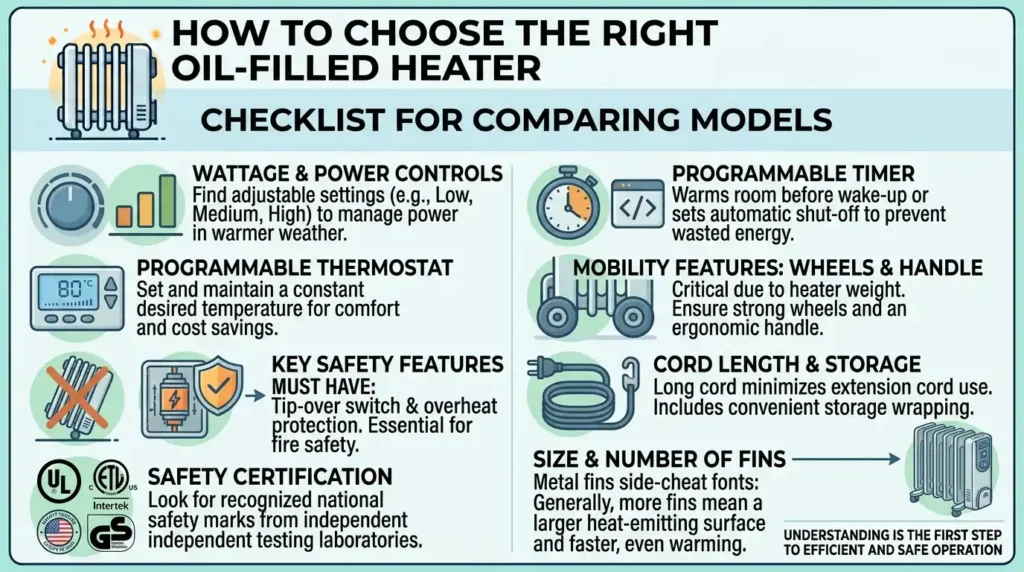
Checklist to use when comparing models.
- Wattage and power controls: Find adjustable settings to reduce power in warm weather.
- Thermostat: A programmable thermostat can maintain a constant temperature and save money.
- Safety: Find a tip-off switch and overheat shield.
- Safety certification: Find a known safety mark in a testing laboratory of your country.
- Timer: This can be handy in warming a room before you get up or turning off automatically.
- Wheels and handle: Significant due to the weight.
- Cord length and storage: A convenient cord minimizes the use of an extension cord.
- Size and number of fins: More fins tend to imply larger heat surface.
Oil-Filled Heater Safety Tips
When used improperly, space heaters are the most common cause of home heating fires. Follow these habits.
- Have a clear space. Keep an open area of three feet around the heater not in contact with curtains, bedding, furniture, and clothes.
- Do not dry clothes on it. Insulating the heater prevents heat and poses a fire hazard.
- Directly plugs into a wall socket. Use of extension cords and power strips, which become hot when using high wattage, should be avoided.
- Put it on a flat, stable surface. The tip-over switch is an insurance, not an excuse to be reckless.
- Do not leave it unattended over long periods of time, particularly in the presence of children and pets.
- Examine the cord and plug to determine whether damaged or abnormally warm.
- Do not use it when it leaks, smells strongly or appears damaged.
- Use the manual of your particular model.
Overnight safe? Oil-filled heaters may be used overnight due to safety features built-in, but the safest way is to refer to your manual and use a timer or thermostat. The general recommendation of fire safety agencies is not to leave any space heater on when you go to sleep or when you are away.
Common Mistakes to Avoid
- Purchasing a heater that is not powerful enough to heat the room.
- Expecting instant heat
- With an extension cord.
- Wearing garments around the fins.
- Sitting it next to a bed or curtains.
- Leaving it at maximum the whole day rather than the thermostat.
- Attempt to open or refill the closed body.
Who Should Buy an Oil-Filled Space Heater?
An oil-filled space heater is the appliance that fits you when you desire quiet, consistent warmth in a bedroom, study or home office, and you are willing to wait a few minutes before it warms. It is not so appropriate when you require quick heat, have to have a light and easy to carry unit, or when you have to warm a big open space.
Quick decision guide
- Require quietness and uniform warmth? Choose oil-filled.
- Require quick heat temporarily? Select fan or ceramic.
- Have one person that needs spot heating? Choose infrared.
FAQs
What is an oil-filled space heater?
It is a small electric heater that operates on a closed system of thermal oil that is heated by an internal coil. The hot oil warms a metal body which radiates the room.
What is the operation of an oil-filled heater?
One of the elements heats the oil, the oil circulates through convection, and the hot metal fins transfer heat to the room. A thermostat switches the element on and off to maintain the desired temperature.
Are oil-filled heaters to be refilled?
No. The oil is closed until the lifetime of the unit. In case it spills, do not refill the heater but turn it off.
Are oil-filled heaters energy efficient?
Similar to other electric resistance heaters, they convert virtually all electricity to heat. They do not do so more efficiently, but thermostat cycling and stored heat can minimize wasted energy.
Do oil-filled heaters use a lot of electricity?
They consume 1.5 kWh of power per hour at full power at 1,500 watts. The real consumption is typically less since the thermostat turns off the element when the room is warm.
Can oil-filled heaters be left overnight?
They have safety features and in general, safety agencies do not recommend the use of any space heater when you are asleep. Use a timer, refer to the manual, and maintain the area clean.
Why does my oil-filled heater continue to be hot even after I switch it off?
The oil is hot and slowly cools down. This accumulated heat is natural and a normal function of the heater.
What is the time taken by an oil-filled heater to heat a room?
Typically 15 to 30 minutes before the change is felt, and more in large or drafty rooms.
Which is superior, an oil-filled heater or a ceramic heater?
Oil-filled heaters are more suitable for quiet, constant, long-lasting warmth. Ceramic heaters generally warm up faster.
Is it possible to use an oil-filled heater in a bedroom?
Yes, they are a popular bedroom option since they are silent and do not produce dust. Keep bedding and curtains far away.
Do oil-filled heaters dry out the air?
Electric heaters do not remove moisture from the air. Oil-filled heat may feel gentler to some people because there is less moving air than with fan heaters.
Is it possible to use an extension cord with an oil-filled heater?
It is preferable to plug it directly into a wall outlet. High-wattage appliances have the potential to overheat power strips and extension cords.
What is the size of the oil-filled heater I need?
A rough estimate is 10 watts per square foot, and a 1,500-watt heater will be appropriate in a well-insulated room of 150 square feet.
Does an oil-filled heater warm up an entire house?
No. It is intended to be used in single rooms and is most effective in a closed and well-insulated room.
Final Thoughts
An oil-filled space heater is neither the lightest nor the fastest heater in the market, but it is one of the quietest. It warms gradually, retains warmth, is quiet, and demands very little in return. It is a good choice in bedrooms, offices, and any other place where one appreciates a consistent level of comfort rather than a burst of hot air.
Adjust the wattage to your room, set the thermostat and timer, provide it with ample clearance, and simply plug it directly into the wall. Do so you will have dependable heat without the racket and dust of a fan heater.