Why Does My Electric Fireplace Keep Shutting Off? 7 Fixes That Work
Your electric fireplace lights up, warms the room for a few minutes, and then goes dark on its own. You press the power button again, it runs for a while, and then it shuts off a second time. That pattern is frustrating, and it leaves you wondering whether the heater is broken or the house wiring is at fault. The good news is that most shutoffs come from a short list of common causes, and many of them take less than ten minutes to check.
This guide walks you through those causes in order, from the quickest checks to the ones that need a licensed electrician. By the end, you will know why your unit keeps cutting out, what fixed it, and when to stop and call a professional. The method works for wall-mounted units, inserts, freestanding stoves, and media-console models, because they all share the same basic parts: a heating element, a fan, a thermostat, and a safety cutoff.
Safety note: Unplug the fireplace before you open any panel, clean inside the vents, or touch the heating element. Never bypass a safety device, tape down a cutoff switch, or run the heater on a damaged cord. If you smell burning, see scorch marks, or the breaker trips more than once, leave the unit unplugged and call a licensed electrician. The steps in this guide stay on the safe side of that line, and the last step tells you exactly when to hand the job over.
What You Need
- Your fireplace remote and the manual (paper or a phone photo of the model plate)
- A flashlight for looking into vents and behind the unit
- A soft brush or vacuum with a hose attachment
- A dry cloth for wiping the inlet grille
- Access to your home breaker panel
- A phone timer for the cool-down wait
At a Glance — The 7 Checks
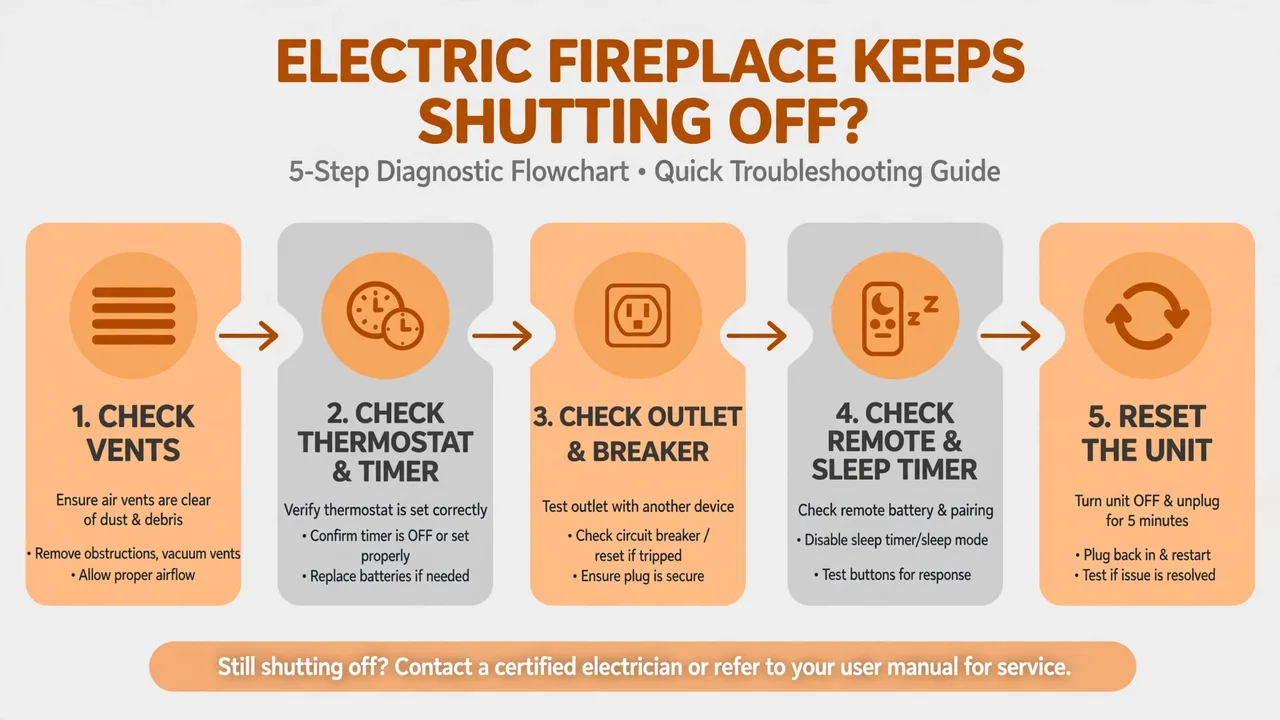
- Unplug the unit and let it cool down
- Clear the air vents and inlet grilles
- Check the thermostat setting and room temperature
- Turn off the timer and sleep settings
- Move the plug to a dedicated outlet
- Reset the overheat cutoff and the unit
- Check the breaker, then call a licensed electrician
Start With the Pattern, Not the Parts
Before you touch the fireplace, note when it shuts off. A unit that dies after two or three minutes points to heat buildup or a tripped safety cutoff. A unit that runs for an hour and then stops often points to a timer, a thermostat that reached its set temperature, or a shared circuit that overloaded when another appliance switched on.
Write down three facts: how long it runs before it stops, whether the flame effect stays on while the heat stops, and whether the whole unit goes dark or only the heater cuts out. Those three facts narrow the cause fast. If the flame effect keeps glowing while the heat stops, the heater side is shutting down and the flame side is fine. If everything goes dark at once, the problem is power, a timer, or a safety cutoff.
Step 1: Unplug the Unit and Let It Cool Down
Pull the plug from the wall outlet and leave the fireplace off for 30 minutes. Many electric fireplaces have a thermal cutoff that trips when the inside of the unit gets too hot, and that cutoff will not reset while the parts are still warm. A short wait of two minutes is not enough for the sensor to cool and reset.
While you wait, feel the wall around the outlet and the plug itself. A plug that feels hot to the touch signals a loose outlet or a worn plug, and that is a wiring problem, not a fireplace problem. Leave it unplugged and move to step 7 for the electrician call. If the plug feels normal, plug the unit back in after the full 30 minutes and run it on the low heat setting to see whether it stays on longer.
Step 2: Clear the Air Vents and Inlet Grilles
Blocked airflow is the most common reason an electric fireplace overheats and shuts off. The heater pulls cool room air in through an inlet grille, warms it, and pushes it back out. Dust, pet hair, curtains, or furniture pressed against the grille choke that flow, heat builds up inside, and the thermal cutoff trips.
Look at the front, sides, and bottom of the unit for slots or grilles, and check the back if you can reach it safely. Vacuum the grilles with a hose attachment, then brush out any dust that the vacuum missed. Keep at least 3 feet of clear space in front of the heater outlet, and move curtains, blankets, and books away from the sides. If your model sits inside a mantel or cabinet, confirm the manual’s clearance numbers, because a tight enclosure traps heat even when the grilles look clean.
Heads Up: Never cover an electric fireplace with a blanket, towel, or decorative cloth, even when it is off. Covers block the vents and can trap heat the next time the unit starts. Keep the top of the unit clear too, because some models pull air in from above.
Step 3: Check the Thermostat Setting and Room Temperature
An electric fireplace with a built-in thermostat shuts the heater off on purpose when the room reaches the set temperature. That is normal behavior, and it looks like a fault when the set temperature is low or the thermostat sensor sits in a warm spot. Check the display: if the set temperature is 68°F and the room is already 70°F, the heater has done its job.
Raise the set temperature by 5 degrees and watch whether the heater runs longer. Also check where the sensor reads from. A unit mounted above a heat vent, near a sunny window, or beside a lamp can read a room as warmer than it is. If the display shows a room temperature far above what the room feels like, the sensor may be faulty, and that is a repair call rather than a setting fix.
Step 4: Turn Off the Timer and Sleep Settings
Most modern electric fireplaces ship with a timer or sleep mode, and many owners switch one on by accident with the remote. A timer set to 1 hour or 2 hours shuts the whole unit off when the time runs out, and the fireplace will not restart until you press power again. Some remotes also have an auto-off after a set number of hours as a safety feature.
Press the timer button on the remote or the control panel until the display shows no timer, or reads 0H. Then check the sleep or eco mode and switch it off as well. Eco mode cycles the heater on and off to hold a temperature, which feels like random shutoffs. Run the fireplace for an hour with all timers off and note whether the problem repeats.
Pro Tip: Take a phone photo of the remote and the control panel display before you change any setting. If a fix does not work, the photo lets you put every setting back exactly where it was, and it helps a repair technician see what you already tried.
Step 5: Move the Plug to a Dedicated Outlet
An electric fireplace heater draws a lot of current, and sharing an outlet or a circuit with other appliances is a leading cause of shutoffs. A space heater, hair dryer, or microwave on the same circuit can push the total load past the breaker limit. The breaker may not trip right away, but the fireplace can still cut out if its own internal protection senses a voltage drop.
Plug the fireplace directly into a wall outlet on its own circuit, with no extension cord and no power strip. Extension cords add resistance, heat up, and starve the heater of power, and most fireplace manuals warn against them in plain terms. If the only nearby outlet already serves a TV, lamp, or charger, move those to a different outlet and test the fireplace alone on the circuit.
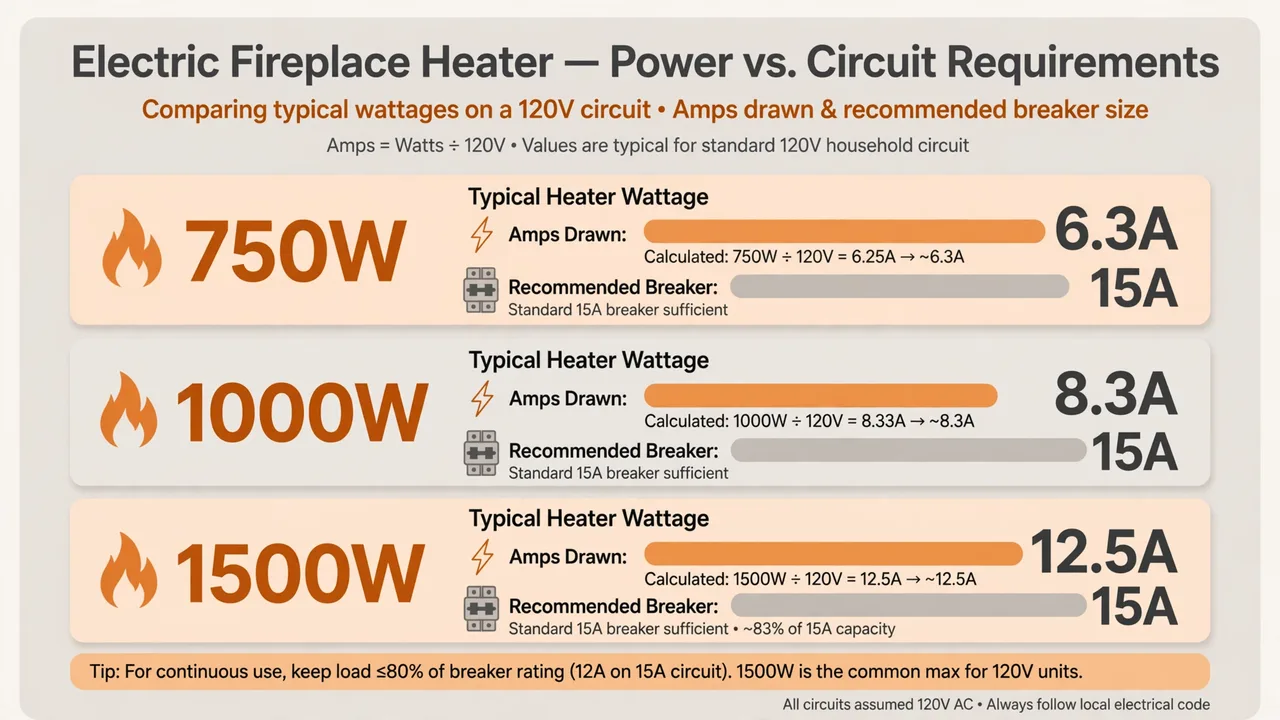
Typical heater sizes and the current they draw help explain why a shared circuit struggles. The table below uses 120 volts, the standard household voltage in the United States, and the figures are typical values that vary by model — check your model plate for the exact wattage.
| Heater Setting (typical) | Current Draw at 120V | Circuit Headroom on 15A Breaker |
|---|---|---|
| 750 watts (low) | About 6.3 amps | Plenty — leaves room for small loads |
| 1,000 watts (medium) | About 8.3 amps | Tight if anything else shares the circuit |
| 1,500 watts (high) | About 12.5 amps | Very little — a 15-amp circuit is nearly full |
Figures are typical and approximate. Electrical code treats a heater as a continuous load, so a 15-amp circuit should carry no more than 12 amps for three hours or longer — which is why a 1,500-watt heater on high belongs on a circuit of its own. Confirm your model wattage on the rating plate and your breaker size at the panel.
For the full picture on circuit sizing, see our guide to electric fireplace breaker requirements. If your home has a dedicated 20-amp circuit available, that is the safer home for a full-size heater, and an electrician can confirm whether your wiring supports one.
Step 6: Reset the Overheat Cutoff and the Unit
Once the vents are clear and the unit has cooled, reset it. Many models have a small manual reset button near the heater outlet or behind a front panel, often marked with a red dot or the word “reset.” Press it once, then plug the fireplace back in and switch it on. If your model has no visible reset button, the cutoff resets on its own after the cool-down period in step 1.
Some models also need a control-board reset after a cutoff trip. Our walkthrough of how to reset an electric fireplace covers the five methods used across brands, including the unplug-and-hold-power technique. Try the reset, then run the heater on low for 30 minutes and watch for another shutoff. If it trips again within minutes with clean vents, the cutoff sensor or the heating element itself may be failing.
Step 7: Check the Breaker, Then Call a Licensed Electrician
Open your breaker panel and find the breaker for the fireplace circuit. A tripped breaker sits in the middle position, between on and off. Flip it fully to off, then firmly back to on. If it trips again the moment the fireplace heater starts, stop: a breaker that trips right away signals a short circuit, a failing heating element, or a circuit that cannot carry the load.
Do not replace a breaker with a larger one, and do not hold a tripped breaker in the on position. Both moves hide the fault and create a fire risk. A licensed electrician can test the circuit, check the outlet wiring, and tell you whether the fireplace needs a dedicated circuit or a repair. If the fireplace is still under warranty, call the manufacturer first — opening the unit yourself can void the coverage. For guidance on finding the right help, see who can fix an electric fireplace.
When the Shutoff Is Not a Fault
Three shutoffs are normal and need no fix. The thermostat reaching its set temperature, a timer running out, and eco mode cycling the heater all switch the heat off by design. The flame effect often keeps running in these cases, which is the clue that the unit is working as intended. A shutoff is a problem when the whole unit goes dark, the breaker trips, or the heater stops after only a few minutes with a cool room.
Error codes point to the same split. A code on the display usually names the fault, such as an overheat sensor or a fan fault, and our guide to electric fireplace error codes E1 through E5 explains what each one means. If the fireplace shows no code and the heat stops, the thermostat and timer checks in steps 3 and 4 are the first place to look.
Quick Safety Checklist
Electric fireplaces are safer than open flames, but they still pull serious power and make real heat. Keep the area in front of the heater clear, never run the cord under a rug, and never plug the unit into an extension cord. Check the cord once a season for cracks, fraying, or a plug that feels loose in the outlet.
Our full set of electric fireplace safety tips covers clearances, child safety, and seasonal checks in more detail. If the fireplace will not turn on at all rather than shutting off mid-run, the causes differ, and our guide on why an electric fireplace is not turning on covers that side of the problem.
| If This Happens | Try This |
|---|---|
| Heater stops after 2–3 minutes, flames stay on | Clean the vents, let the unit cool 30 minutes, then reset the cutoff |
| Whole unit goes dark at the same time each evening | Turn off the timer and sleep mode, then test with all timers at 0H |
| Heater cycles on and off every few minutes | Raise the thermostat 5 degrees and switch off eco mode |
| Breaker trips when the heater starts | Move the fireplace to a dedicated outlet and call an electrician |
| Unit shuts off and shows an error code | Note the code, unplug the unit, and look up the code meaning |
| Plug or outlet feels hot | Leave it unplugged and call a licensed electrician |
Frequently Asked Questions
Why does my electric fireplace shut off after a few minutes?
The most common cause is the overheat cutoff tripping because dust or blocked vents choke the airflow. Clean the inlet and outlet grilles, let the unit cool for 30 minutes, reset it, and test it on the low heat setting.
Can a dirty vent make my electric fireplace shut off?
Yes. Dust and pet hair on the inlet grille restrict airflow, heat builds up inside the unit, and the thermal safety cutoff trips to protect the heater. Vacuum the grilles and keep 3 feet of clear space in front of the heater outlet.
Why does my electric fireplace keep tripping the breaker?
A 1,500-watt heater draws about 12.5 amps, which nearly fills a standard 15-amp circuit. If anything else shares that circuit, the total load trips the breaker. Move the fireplace to a dedicated outlet and ask a licensed electrician about a dedicated circuit.
Is it safe to keep using an electric fireplace that shuts off on its own?
A shutoff caused by the thermostat or a timer is normal and safe. A shutoff with a hot plug, scorch marks, a burning smell, or a breaker that trips more than once is not safe to keep using. Leave the unit unplugged and call a licensed electrician.
How do I reset an electric fireplace that keeps shutting off?
Unplug the unit, wait 30 minutes for it to cool, and press the manual reset button if your model has one. Then plug it back in and run it on low heat for 30 minutes to check whether the shutoff repeats.
Does the thermostat turn off an electric fireplace?
Yes. When the room reaches the set temperature, the thermostat switches the heater off while the flame effect often keeps running. Raise the set temperature by 5 degrees to check whether the thermostat is the cause.
Quick Reference Card — Why Your Electric Fireplace Keeps Shutting Off
What you need: remote and manual, flashlight, soft brush or vacuum, dry cloth, breaker panel access, phone timer.
- Unplug the unit and let it cool for 30 minutes.
- Clear the air vents and inlet grilles.
- Check the thermostat setting and room temperature.
- Turn off the timer and sleep settings.
- Move the plug to a dedicated outlet.
- Reset the overheat cutoff and the unit.
- Check the breaker, then call a licensed electrician.
Remember: hot plug, scorch marks, burning smell, or a breaker that trips twice means stop and call an electrician.
The Bottom Line
Most electric fireplaces that keep shutting off are not broken. A clogged vent, a low thermostat setting, an accidental timer, or a shared circuit explains the large share of cases, and each one takes minutes to rule out. Work through the seven checks in order, and you will either fix the problem or know exactly what to tell the electrician.
If your fireplace now runs without cutting out, keep the vents clean and the outlet dedicated, and it should stay that way. If it still trips after a full cool-down and a reset with clean vents, the fault sits inside the unit or the wiring, and that is the point to call a licensed electrician rather than keep testing it. Either way, you now know why your electric fireplace keeps shutting off — and what to do about it.