Are Electric Fireplaces Allowed in Apartments? What Renters Need to Know
In most cases, yes. Are electric fireplaces allowed in apartments? For most renters, the answer is yes, because an electric fireplace needs no chimney, no vent, and no fuel. It plugs into a standard wall outlet and the flame effect can run with the heat turned off. That makes it one of the few fireplace options that fits apartment life at all.
But “most cases” is not the same as “your case.” Your lease, your building rules, and your local codes have the final say. Some leases ban portable heaters outright. Some buildings allow them only with written permission. A few older buildings have wiring that cannot handle a heater on top of everything else you already plug in.
This guide walks you through the whole process in order: check your lease, get permission in writing, pick a renter-friendly unit, place it safely, and plug it in the right way. Follow the steps and you will know exactly where you stand before you spend a dollar.
Heads Up: Read This Before You Plug Anything In
An electric fireplace is a heater. Heaters draw a lot of power and can start a fire if they are used the wrong way. Never plug one into an extension cord or a power strip. Never run its cord under a rug. Keep anything that can burn at least 3 feet away on every side.
This article is general guidance, not legal advice. Lease terms, building rules, and local codes vary. Check your own lease and ask your landlord when you are unsure. If your wiring needs work, hire a licensed electrician.
TOTAL TIME
1 to 2 hours
research plus setup
ACTIVE TIME
About 30 minutes
measuring and placing
DIFFICULTY
Beginner friendly
with landlord permission
What You Need
- A copy of your lease and any building rulebook
- A tape measure
- A pen and paper, or your phone, for notes
- Your landlord’s email address or phone number
- A freestanding or wall-mounted electric fireplace with a safety listing (UL, ETL, or CSA mark)
- A level, if you plan to wall-mount with permission
- Wall anchors and screws, only if you wall-mount with permission
- A working smoke alarm in the room (check it while you are at it)
At a Glance: The 7 Steps
- Read your lease line by line
- Ask your landlord in writing
- Measure your space and check your outlets
- Pick a renter-friendly fireplace type
- Place the fireplace with safe clearances
- Plug it into a wall outlet the right way
- Run a first test and build a safe routine
Why Most Apartments Allow Electric Fireplaces
Real fireplaces are rare in apartments for a clear reason: they need a chimney, a flue, fuel storage, and regular cleaning. An electric fireplace needs none of that. It produces no smoke, no ash, and no carbon monoxide, because nothing burns. That removes the biggest worries a landlord has about fireplaces in a rental.
Most plug-in models are also portable. A freestanding unit sits on the floor and moves with you when your lease ends. Nothing is built into the wall, so there is no damage to repair and no deposit to lose over it. Landlords tend to view that very differently from a wall-mounted unit that needs screws and anchors.
That said, permission is never automatic. Some leases group electric fireplaces with space heaters and ban both. Some buildings ban any added heater because of old wiring. A few cities or housing programs have their own rules too. The steps below sort all of that out before you buy.
Which Type Fits a Rental Best?
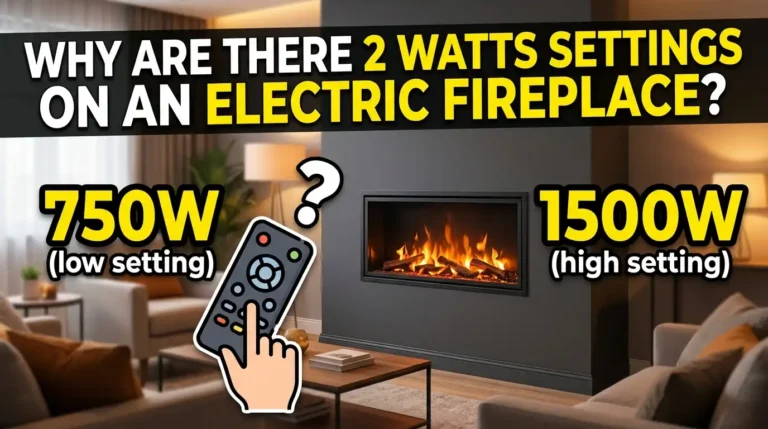
Not every electric fireplace suits a rental. The table below compares the four common types on the points that matter most to a renter: how it installs, whether the landlord usually needs to approve it, and how much power a plug-in model draws. Most plug-in models on a standard 120-volt outlet are rated up to 1,500 watts, which is 12.5 amps. Check the label on the exact model you buy, because ratings vary.
| Type | How It Installs | Landlord Approval | Typical Power | Best For |
|---|---|---|---|---|
| Freestanding / mantel | Sits on the floor, plugs in | General permission is often enough | Up to 1,500 watts | Renters who want zero wall changes |
| Wall-mounted | Screws and anchors into the wall | Usually needed in writing | Up to 1,500 watts plug-in; some 240-volt models need an electrician | Renters with a solid wall and written approval |
| Insert | Slides into an existing fireplace opening | Often needed | Up to 1,500 watts | Apartments that already have a fireplace opening |
| TV stand with fireplace | Furniture piece, plugs in | General permission is often enough | Up to 1,500 watts | Renters who want heat plus storage |
Power figures are for plug-in 120-volt models. Always check the rating label on the exact unit you buy.
Step 1: Read Your Lease Line by Line
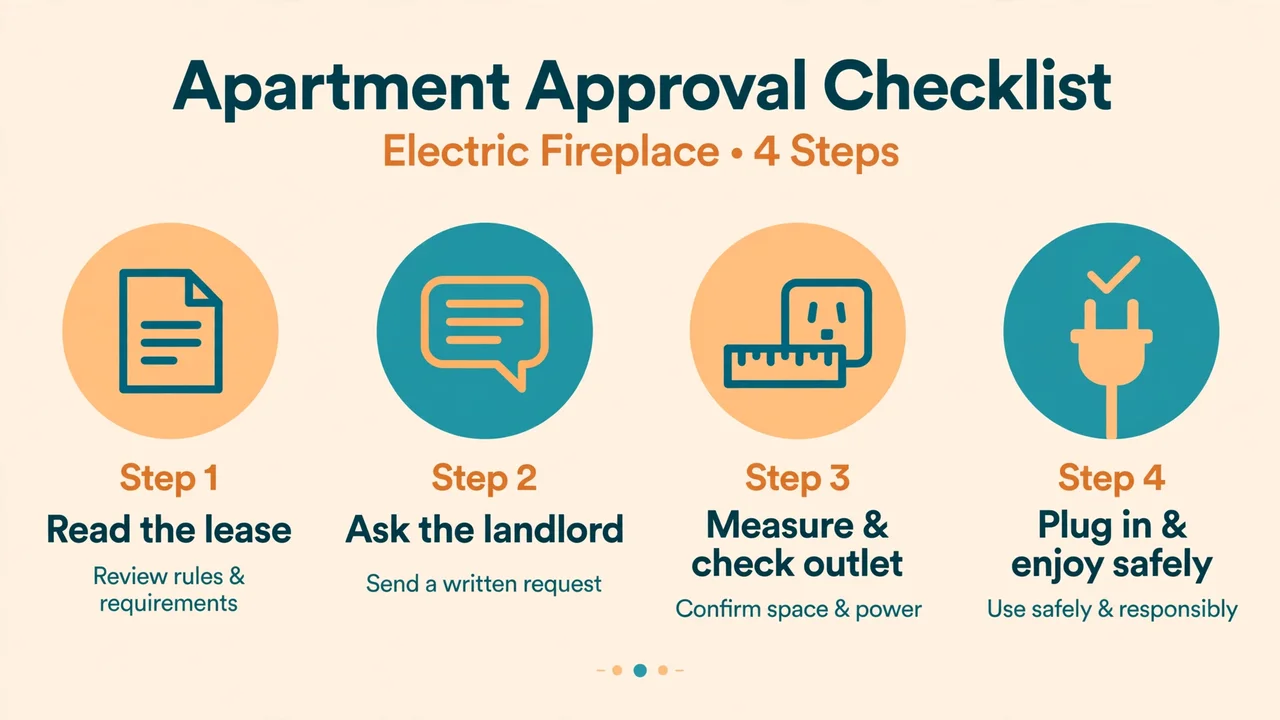
Open your lease and read the sections on appliances, alterations, and fire safety. Look for words like “space heater,” “portable heater,” “heating appliance,” “open flame,” and “fireplace.” Some leases name electric fireplaces directly. Others ban heaters in general, which can cover an electric fireplace even when the lease never says the word “fireplace.”
Pay close attention to the alterations clause too. That clause covers anything you attach to the walls or change in the unit. A freestanding model that plugs in rarely counts as an alteration. A wall-mounted model almost always does, because it leaves screw holes behind.
Write down the exact wording of any clause that seems relevant, with the section number. You will need those words when you ask your landlord, and a written record protects you if anyone disagrees later about what the lease said.
Step 2: Ask Your Landlord in Writing
Send an email or a message through your building’s tenant portal. Say the exact model you want, that it plugs into a standard outlet, that it needs no hardwiring, and whether it touches the wall at all. A short, specific request gets a faster and clearer answer than a vague one.
Ask for the answer in writing as well. A verbal “sure, go ahead” is hard to prove if a new property manager takes over or a dispute comes up at move-out. Save the reply with your lease papers. If the answer is no, ask what would change it, such as a different model or a freestanding unit instead of a wall-mounted one.
Pro Tip: Send a Photo With Your Request
Attach a photo or a link to the exact model when you ask. Landlords approve faster when they can see that the unit is a plug-in piece of furniture rather than a built-in heater. It also removes any doubt about which model you mean.
Step 3: Measure Your Space and Check Your Outlets
Measure the wall or floor space where the unit will sit, then compare it with the unit’s listed width, depth, and height. Leave room for the 3-foot clear zone in front of the heater outlet. A unit that fits the wall but blocks a walkway or sits against curtains is the wrong unit for that spot.
Look at the outlet you plan to use. It should be a grounded three-prong outlet on a wall, not a floor outlet under a rug. Check your breaker panel for labels that show which rooms share a circuit. A heater plus a microwave or a hair dryer on the same circuit is a common cause of tripped breakers, so plan for the heater to have its own circuit where possible. Our guide to electric fireplace breaker requirements explains how to size the circuit for your model.
If your outlets are old two-prong outlets, or the panel has no labels at all, tell your landlord before you buy. Adapters and guesswork are not a safe fix for old wiring.
Step 4: Pick a Renter-Friendly Fireplace Type
Freestanding and TV-stand models are the safest choice for most renters. They need no wall holes, no tools, and no extra permission beyond the general approval from Step 2. They also move with you, which matters when a lease ends.
Wall-mounted models look clean, but they need screws in the wall and a stud or solid anchor point. That means written permission, a repair plan at move-out, and a landlord who is comfortable with holes in the wall. Inserts only make sense if your apartment already has a fireplace opening to fit them into.
Whatever type you pick, look for a safety listing mark from a lab such as UL, ETL, or CSA, plus overheat protection and a tip-over shutoff. Check the manual for the clearance the maker requires, and follow the stricter of the manual and the 3-foot rule. For a full rundown of what to look for, see are electric fireplaces safe.
Step 5: Place the Fireplace With Safe Clearances
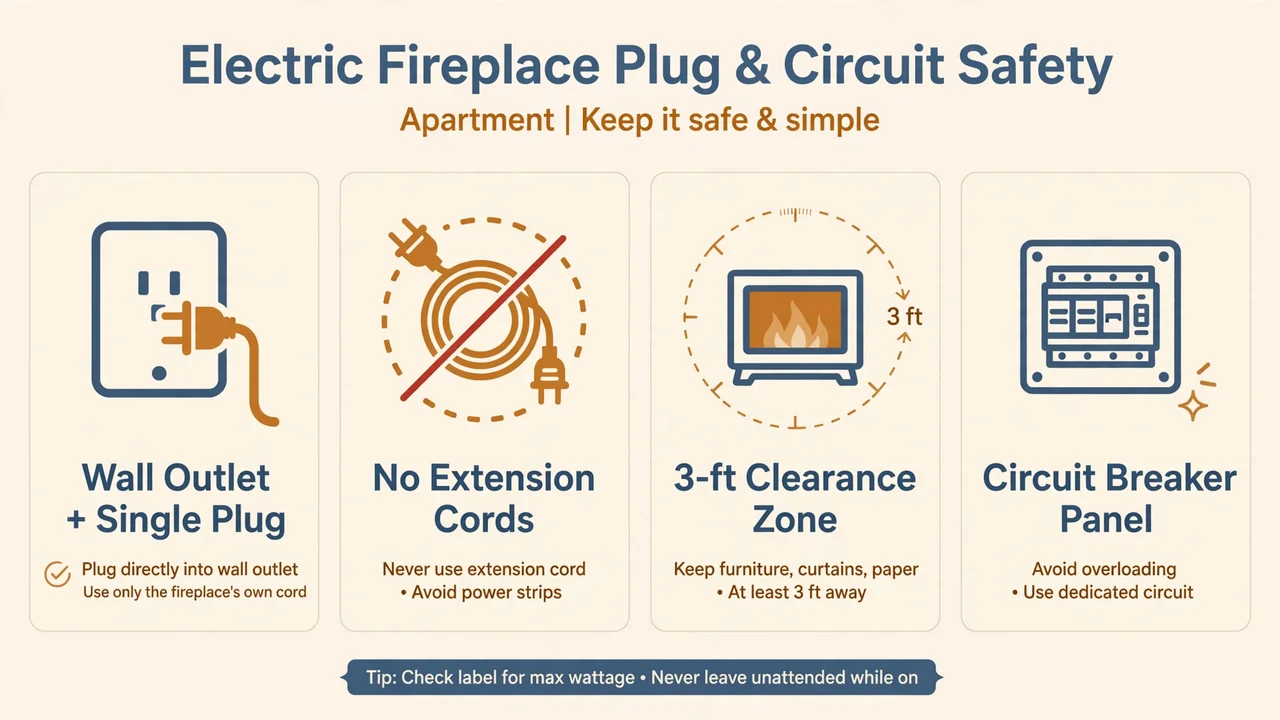
Set the unit on a hard, level floor or a flat, stable surface. Keep at least 3 feet of clear space in front of the heat outlet and on the sides, away from curtains, bedding, couches, clothes, and paper. The U.S. Consumer Product Safety Commission gives the same 3-foot guidance for portable heaters, and it reports that portable heaters were involved in an average of 1,600 fires a year from 2020 to 2022, with an average of 70 deaths and 150 injuries a year. Most of those fires start because something that can burn sits too close to the heat.
Keep the unit away from water, so never place it beside a bathroom door or a kitchen sink where splashes reach it. Do not block an exit path or a hallway with it. If the only spot that works is on carpet, check the manual first, because some makers allow it and some do not. See can you put an electric fireplace on carpet for the details that decide it.
Heads Up: Never Run the Cord Under a Rug
A cord under a rug traps heat and hides damage. Foot traffic wears the cord down where you cannot see it. If the outlet is too far away, move the fireplace closer to the outlet or pick a different spot. Never use an extension cord to close the gap.
Step 6: Plug It Into a Wall Outlet the Right Way
Plug the fireplace directly into a wall outlet. Never use an extension cord or a power strip, even a heavy-duty one. The U.S. Consumer Product Safety Commission states this plainly for electric space heaters, and the same rule applies to an electric fireplace with a heater. A high-wattage heater can overload a cord or a strip and start a fire.
Give the fireplace its own outlet. Do not share that outlet with another heater, a microwave, or a large appliance. If the plug or the outlet feels warm after the heater has run for a while, turn the heater off and tell your landlord, because a warm outlet can point to a wiring problem. For local rules that affect outlets and circuits, see electric fireplace code requirements.
Step 7: Run a First Test and Build a Safe Routine
Start with the flame effect only, with the heat off. Check that the flames, lights, and remote all work. Then switch the heat to its low setting and let it run for 15 to 20 minutes while you stay in the room. Listen for odd noises, watch for smells beyond a faint new-unit smell on the very first run, and check that the breaker holds.
Build a small routine around the heater from day one. Turn it off when you leave the room and before you sleep. Dust the vents once a month so airflow stays clear. Keep the manual where you can find it, and test the smoke alarm in the room every month too. If you want the fireplace in a bedroom, read can you put an electric fireplace in a bedroom before you move it there, because bedrooms have their own safety notes.
Fix Common Problems Fast
Most apartment fireplace problems have a plain cause. Work through the table below before you call your landlord or the maker.
| If This Happens | Try This |
|---|---|
| The breaker trips when the heat turns on | Unplug other items on the same circuit, run the heater on low, and ask your landlord about a dedicated circuit. Do not swap in a larger breaker yourself. |
| The unit will not turn on at all | Check that the outlet has power with another device, check the breaker panel, and check the unit’s own power switch and child lock. |
| The landlord says no | Ask what would change the answer, such as a freestanding model instead of a wall-mounted one, or a flame-only unit with no heater. |
| The room stays cold | Close doors to heat one room at a time, check for drafts at windows, and remember that a plug-in unit warms a room, not a whole apartment. |
| A smell appears on first use | A faint smell on the very first run is common as factory coatings burn off. Air the room out. If the smell stays or grows stronger, turn the unit off and contact the maker. |
| The plug or outlet feels warm | Turn the heater off, unplug it once it cools, and tell your landlord. Do not keep using a warm outlet. |
Frequently Asked Questions
Are electric fireplaces allowed in apartments?
In most cases, yes. Electric fireplaces need no chimney, vent, or fuel, so most leases and buildings allow them. Your lease and building rules still have the final say, so check both and get permission in writing before you buy.
Do I need landlord permission for an electric fireplace?
Yes, ask even when your lease seems to allow it. A written yes protects you if a manager changes or a dispute comes up. Wall-mounted units always need written permission because they leave holes in the wall.
Can I wall-mount an electric fireplace in a rental?
You can only if your landlord agrees in writing. Wall-mounting means screws and anchors in the wall, which counts as an alteration in most leases. A freestanding unit is the safer choice when permission is unclear.
Will an electric fireplace trip my apartment breaker?
It can if the circuit is shared with other heavy loads. Most plug-in models draw up to 1,500 watts, which is 12.5 amps on a 120-volt circuit. Give the fireplace its own circuit where possible and run it on low if the breaker trips.
Do electric fireplaces use a lot of electricity in an apartment?
A plug-in model on full heat uses up to 1,500 watts, about the same as a standard space heater. Running the flame effect with the heat off uses very little power. Your bill depends on how many hours a day you run the heat, so check your local electricity rate and your lease for any utility rules.
Quick Reference Card
You need: your lease, a tape measure, your landlord’s email, and a safety-listed plug-in unit.
Steps: 1. Read the lease. 2. Ask the landlord in writing. 3. Measure and check outlets. 4. Pick a renter-friendly type. 5. Place it with 3 feet of clearance. 6. Plug it straight into a wall outlet. 7. Test it and build a safe routine.
Remember: no extension cords, no power strips, no cord under a rug, and turn it off when you leave or sleep.
Warmth Without the Lease Headache
Are electric fireplaces allowed in apartments? For most renters, the answer is yes, with a written yes from the landlord and a safe setup. Read the lease, ask in writing, pick a freestanding unit, and plug it straight into a wall outlet with 3 feet of clear space around it.
Do those steps in order and you get the glow and the warmth without risking your deposit or your safety. When you are ready to shop, compare models in our guide to the best electric fireplaces and pick one that fits your room and your lease.