How to Measure for an Electric Fireplace Insert So It Fits the First Time
An insert that is half an inch too wide will not slide into your fireplace opening, and an insert that is two inches too small will leave a gap you stare at all winter. Learning how to measure for an electric fireplace insert takes about 20 minutes, one tape measure, and a pencil. This guide walks you through each measurement in order, shows you how much room to leave for a clean fit, and ends with a worked example you can copy.
By the time you finish, you will have six numbers written down: width at the top, middle, and bottom of the opening, height on both sides, and depth at the center. Those numbers tell you exactly which insert sizes fit your fireplace and which ones to skip. No guesswork, no return shipping, no trim pieces bought to hide a mistake.
Safety note: an electric fireplace insert plugs into a standard household outlet, and most models draw up to 1,500 watts on the heat setting. Before you measure, switch off power to the outlet you plan to use if you need to move it or check its wiring, and never run the cord under a rug or through a wall.
If your outlet is loose, scorched, or warm to the touch, call a licensed electrician before you buy anything. This guide covers measuring only. It does not cover wiring work.
What You Need
- Steel tape measure (25 ft) — a cloth tape sags and gives short readings
- Pencil and paper — or a phone note, kept open while you measure
- Flashlight — to see the back wall and corners of a dark firebox
- Step stool — only if the opening is above your shoulder height
- Level or straight edge (optional) — to spot a sloped hearth or lintel
- Your insert shortlist (optional) — the spec sheets of models you like, for side-by-side checks
At a Glance: The 8 Steps
- Clear the opening and switch off the power
- Measure the width at three spots
- Measure the height from hearth to lintel
- Measure the depth from front to back
- Check the back wall for taper and bumps
- Map the outlet and the cord path
- Write down every number and subtract the fitting gap
- Match your numbers to an insert size
What “Fits” Actually Means
A good fit is not the biggest insert you can wedge into the hole. It is an insert that slides in with about 1/2 inch of space on each side, leaves room for air to move around the heater, and sits level on the hearth. Most makers print a minimum opening size in the manual. Your opening must meet or beat every one of those numbers: width, height, and depth.
Three numbers decide the fit, and each one is measured a different way. Width is the trickiest, because old fireplaces are rarely square. Height depends on the lintel, the beam across the top of the opening.
Depth decides whether the insert sits flush or sticks out into the room. Get all three right and the rest of the project is trim and a plug.
Typical Electric Fireplace Insert Size Ranges
Common size bands seen across major brands. Sizes vary by model, so the manual for the insert you buy is the final word.
| Insert type | Width | Height | Depth | Best for |
|---|---|---|---|---|
| Compact | 23–25 in | 20–22 in | 6–8 in | Small masonry openings, bedrooms |
| Standard | 26–30 in | 20–24 in | 7–10 in | Most existing wood fireplaces |
| Large | 33–36 in | 22–26 in | 8–12 in | Wide living-room fireplaces |
| Linear / wall | 42–72+ in | 15–20 in | 4–6 in | New built-in walls, TV walls |
No single size is “standard.” One maker’s 30-inch insert may need a 30-inch opening, while another’s needs 31 inches. Measure your opening, then read the manual.
Step 1: Clear the Opening and Switch Off the Power
Pull out the grate, andirons, ash, and any old logs. Sweep the hearth and the floor of the firebox so the tape sits flat on brick instead of on ash piles. A half inch of ash under the tape is a half inch of error in your height number.
Look inside with the flashlight. Note anything bolted or mortared in place: a gas line stub, a damper handle, a raised firebrick ledge. Those stay, and your insert has to clear them. If a gas line is present and capped, do not touch it.
Heads up: never measure inside a fireplace that is warm. Wait until the firebox is fully cool to the touch. Hot brick burns skin, and a warm damper can close on your hand while you reach in.
Step 2: Measure the Width at Three Spots
Hook the tape on the left inside wall and pull it straight across to the right inside wall. Measure at the top of the opening, at the middle, and at the bottom. Measure inside the opening, not across the trim, and label each number.
Old fireplaces narrow toward the back and lean with age. The three numbers will often disagree by 1/4 to 1/2 inch. The smallest of the three is the number that counts. An insert sized to the widest reading will jam at the narrowest point.
Pro tip: hold the tape level and let the metal hook sit flat against the wall. A tape that droops in the middle reads long, and a long reading is the one that causes a return.
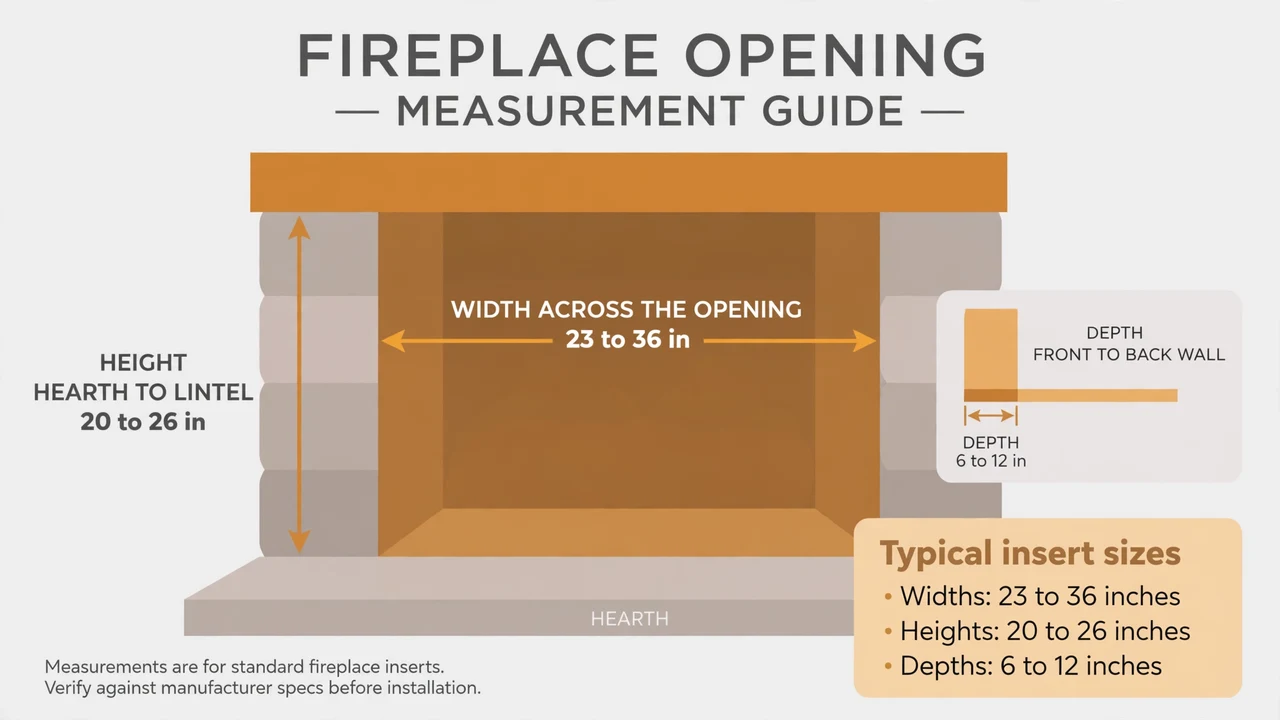
Width, height, and depth — the three numbers that decide whether an insert fits.
Step 3: Measure the Height from Hearth to Lintel
Stand the tape on the hearth floor at the front of the opening and run it up to the underside of the lintel, the beam or brick course across the top. Measure on the left side and again on the right side. Hearths slope and lintels sag, so the sides often differ.
Keep the smaller of the two heights. The insert has to pass under the lowest point of the lintel. A center-only reading can hide a low corner that catches the insert’s top edge on the way in. Note any raised brick in the insert’s path.
Step 4: Measure the Depth from Front to Back
Push the tape from the front face of the opening straight back to the rear wall of the firebox. Measure at the center and at both sides, because many fireboxes narrow toward the back. The shallowest reading is the one that matters.
Watch for anything that eats into the depth: a sloped back wall, a damper shelf, or a ledge of firebrick. Measure to the first obstruction, not to the wall behind it. Most electric inserts run 6 to 12 inches deep, so a firebox with 10 inches of clear depth fits most standard models.
Step 5: Check the Back Wall for Taper and Bumps
Shine the flashlight along the back wall from one side to the other. Look for mortar lumps, loose bricks, soot shelves, and places where the wall steps inward. Run your hand along the wall if you can reach it safely.
Measure the width again at the back of the firebox, at the depth where the rear of the insert will sit. In many older fireplaces the back is 2 to 4 inches narrower than the front. Write the back width next to the front width — an insert that fits the front opening can still wedge halfway in.
Step 6: Map the Outlet and the Cord Path
Measure from the center of the opening to the outlet you plan to use. Most insert cords run 5 to 6 feet long, and the cord has to reach without stretching across the hearth. A stretched cord pulls on the plug and works loose over time.
Note whether the outlet sits inside the firebox, on the wall beside the fireplace, or on the floor below. If the only outlet is across the room, plan for an electrician to add one nearby instead of running an extension cord. Extension cords are not rated for a 1,500-watt heater running for hours.
Step 7: Write Down Every Number and Subtract the Fitting Gap
Lay out all six numbers on one sheet: three widths, two heights, and the shallowest depth. Circle the smallest width, the smallest height, and the shallowest depth. Those three circled numbers are your opening size.
Subtract 1/2 inch from the smallest width and 1 inch from the smallest height. That gap lets the insert slide in without scraping the brick, and it leaves room for air to circulate around the heater. Keep this sheet — tape it to the wall or save a photo of it on your phone.

Measure twice, write it down once — the sheet is what you shop with.
Worked Example: A 30-Inch Opening
Real numbers from a common brick fireplace, worked all the way to a buying decision.
| Measurement | Readings | Use this one |
|---|---|---|
| Width | Top 30 in · Middle 29¾ in · Bottom 29½ in | 29½ in (smallest) |
| Height | Left 24 in · Right 23¾ in | 23¾ in (smallest) |
| Depth | Center 11 in · Sides 10½ in | 10½ in (shallowest) |
| Back width | 28 in at the rear wall | 28 in (check taper) |
Apply the fitting gap: 29½ in − ½ in = 29 in max width. 23¾ in − 1 in = 22¾ in max height. Depth stays 10½ in max.
Buy this: an insert up to 29 in wide × 22¾ in high × 10½ in deep. A 28-inch standard insert fits with room to spare. A 30-inch insert does not fit, even though the top of the opening measures 30 inches.
Step 8: Match Your Numbers to an Insert Size
Open the spec sheet for each insert you like and compare three numbers: the maker’s minimum opening width, height, and depth. Your circled opening numbers must meet or beat all three. One number short means the insert does not fit, even if the other two are fine.
When two sizes fit, the larger one looks better. A small insert in a wide opening leaves a dark gap, while a snug insert fills the opening. Before you order, check whether electric fireplace inserts are worth it and how much they cost so the size you pick also fits your budget.
Before and After: What Changes Once the Numbers Are Right
Before measuring
- Guessing from the trim size
- One width number, taken once
- No idea where the outlet sits
- Ordering on hope, returning on size
After measuring
- Six labeled numbers on one sheet
- A maximum insert size you can trust
- A cord path that reaches the outlet
- An order placed with confidence
Troubleshooting: When the Numbers Do Not Add Up
| If this happens | Try this |
|---|---|
| Width differs by more than 1 inch top to bottom | Re-measure with the tape level. If the gap is real, use the smallest number and ask the maker about trim kits for uneven openings. |
| Depth is under 8 inches | Shop slim inserts (4–6 in deep) or plan for the unit to sit partly proud of the opening with a trim frame. |
| Back wall is much narrower than the front | Measure the width at the depth where the insert’s rear will sit, and size to that number, not the front. |
| No outlet within cord reach | Do not use an extension cord. Have a licensed electrician add a grounded outlet near the fireplace. See also why an electric fireplace will not turn on — power problems often trace back to a weak outlet. |
| Opening is between two insert sizes | Pick the smaller insert and cover the gap with a trim kit. A forced fit can block airflow and void the warranty. |
| Lintel height is under 20 inches | Look at low-profile linear inserts (15–20 in high) or a wall-mounted unit instead of a retrofit insert. |
Common Mistakes to Avoid
Measuring the trim instead of the opening. The surround and mantel stick out past the hole. Numbers taken across the trim can run 2 to 4 inches long, and an insert ordered on those numbers will not go in.
Taking one width reading. A single reading hides taper and lean. Three readings take two extra minutes and catch the narrow spot that would have stopped the install.
Forgetting the depth. Width and height get all the attention, and depth gets skipped. A deep insert in a shallow firebox sticks out into the room and looks unfinished.
Rounding up. A reading of 29⅝ inches is not 30 inches. Round down when you shop. The fitting gap exists so the insert slides in, and rounding up spends that gap before you start.
Frequently Asked Questions
What size electric fireplace insert do I need?
Measure your opening’s smallest width, smallest height, and shallowest depth, then subtract 1/2 inch from the width and 1 inch from the height. Pick an insert at or under those three numbers. Most existing fireplaces take a standard insert 26 to 30 inches wide.
How much smaller should the insert be than the opening?
Leave at least 1/2 inch of space on the width and 1 inch on the height. That gap lets the insert slide in without scraping brick and leaves room for air to move around the heater. Check the manual, because some makers ask for more.
Do I measure the inside or outside of the fireplace opening?
Measure the inside of the opening, wall to wall, at the spot where the insert will sit. The trim and surround sit outside the hole and add inches that do not exist inside it.
What if my fireplace opening is not square?
Measure width at the top, middle, and bottom, and height on both sides. Use the smallest reading for each. If the numbers differ by more than 1 inch, use the smallest and ask the maker about trim kits for uneven openings.
Can an electric fireplace insert stick out past the opening?
It can, if the maker allows it and the unit is stable on the hearth. A shallow firebox under 8 inches deep often means a slim insert or a unit that sits partly proud with a trim frame. Never block the heater vents to make it sit flush.
Do I need an electrician before I measure?
No, measuring needs no wiring work. You need an electrician only if the outlet is damaged, ungrounded, or too far from the fireplace, or if you want a new outlet added. Test the outlet with a lamp while you measure.
Quick Reference Card
What you need: steel tape measure, pencil and paper, flashlight, step stool if the opening is high.
Measure: width at top, middle, bottom · height on left and right · depth at center and both sides · back width · outlet distance.
- Clear the opening and switch off the power.
- Measure the width at three spots.
- Measure the height from hearth to lintel.
- Measure the depth from front to back.
- Check the back wall for taper and bumps.
- Map the outlet and the cord path.
- Write down every number and subtract the fitting gap.
- Match your numbers to an insert size.
Fitting gap: width − ½ in · height − 1 in · depth as measured. Rule: smallest reading wins.
You have six numbers, a fitting gap, and a maximum insert size. That is the whole job, and it took less than half an hour. Now that you know how to measure for an electric fireplace insert, the tape measure has done the hard part.
Keep the sheet with your numbers and take it shopping. When you find an insert you like, check its spec sheet against your three numbers before you check the price. If it fits, the next step is making it look built in — see our guide on how to make an electric fireplace look built in. If you are still weighing electric heat against other options, our comparison of electric fireplaces and space heaters covers the safety side.