Can You Put a Kerosene Heater on Carpet? Here’s What’s Actually Safe
Can You Put a Kerosene Heater on Carpet?
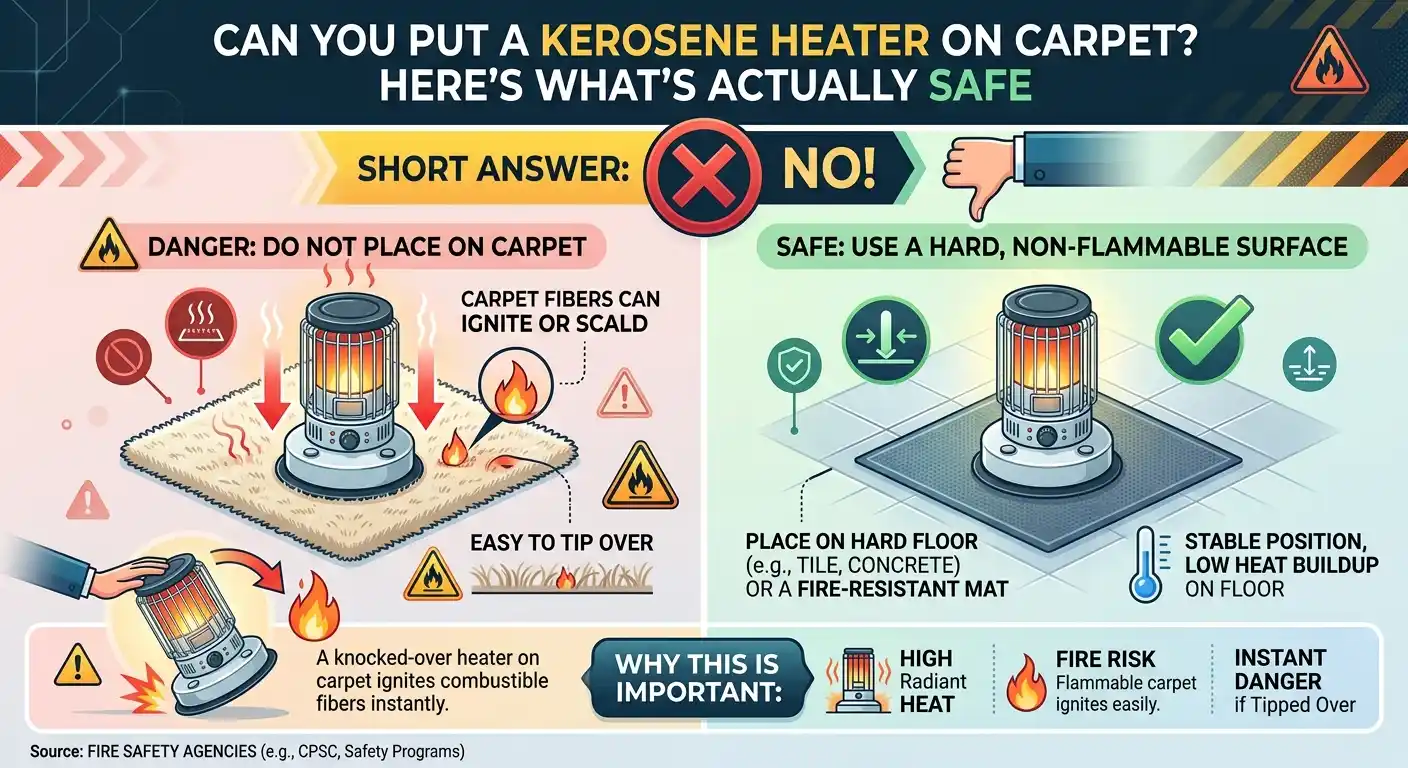
Short answer: No, you cannot put a kerosene heater on the carpet. Fire safety agencies, such as the Consumer Product Safety Commission and university extension safety programs, are unanimous in this regard: kerosene heaters should be placed on a hard, nonflammable surface, not on rug or carpet. Radiant heat can scald or ignite carpet fibers, and a knocked-over heater on carpet has practically no obstacle between the flame and a combustible.
That’s the short version. Everything you need to know about why this is important, what really goes wrong when it goes wrong and what to do when you only have carpet as a surface is below.
Why You Shouldn’t Put a Kerosene Heater on Carpet
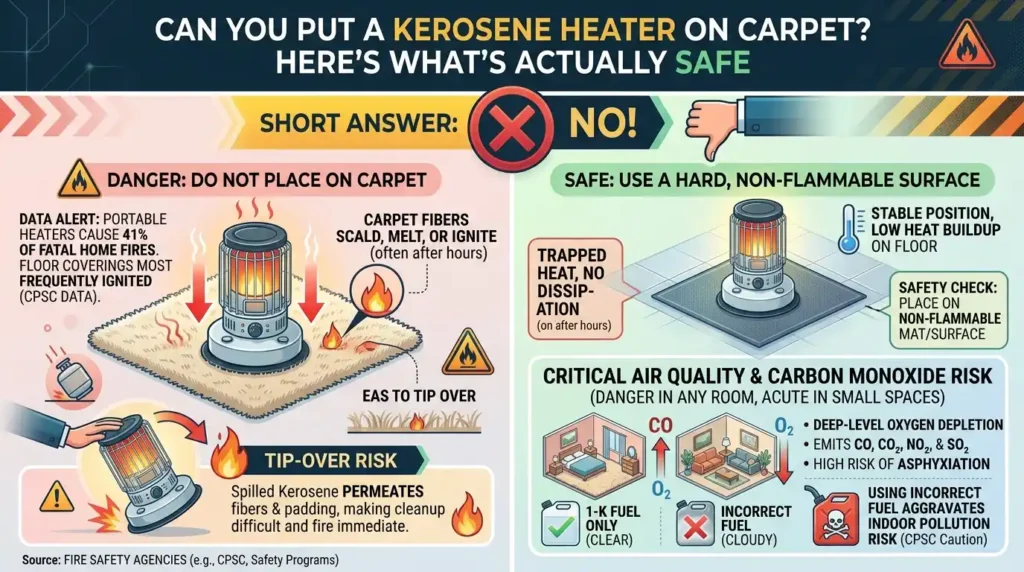
A kerosene heater is not like a space heater with a sealed heating coil. Most models burn fuel through an open wick and combustion chamber (here’s the full breakdown of that ignition process), and the metal base and grille around that flame get hot enough to ignite nearby materials. Carpet adds three separate problems at once.
The Fire Risk
The bottom of a kerosene heater emits heat in an outward and downward direction. On a hard floor, that heat is dissipated. The fibers on the carpet are nearer to the heat source, trap the heat, and do not give it up, and may scald, melt (when synthetic) or even ignite, particularly when a heater has been on hours. This is directly supported by federal fire data: portable heaters have caused 41 percent of fatal home heating fires in a recent multi-year study and the most frequently ignited item in such fires was floor coverings, including rugs and carpets.
This is aggravated by tip-off risk. Kerosene heaters contain liquid fuel. When one falls over on a hard floor, a spill is bad but at least visible and containable. Spilled kerosene on carpet permeates the fibers and padding, under furniture, and is much more difficult to mop up completely, and a tipped, still-lit device is directly against combustible material.
The Carbon Monoxide and Air Quality Risk
It is an independent risk of fire and it is equally serious. Kerosene heaters use fuel and burn oxygen in the room. When used in an inadequately ventilated or too small area, they may reduce the oxygen level in that room, resulting in a higher risk of asphyxiation, and emit carbon monoxide, carbon dioxide, nitrogen dioxide, and sulfur dioxide as byproducts.
This has nothing to do with what is on the floor but it is important here since a room that is small enough to trap carbon monoxide is also the small, carpeted bedroom or living room where people are tempted to put these heaters to keep warm.
The Consumer Product Safety Commission particularly cautions that indoor air pollution risk is aggravated by the use of incorrect grade of fuel. In certain states, there is a regulation of kerosene quality and other grades than the water-clear 1-K kerosene may emit more pollutants indoors and this presents a potential health hazard.
What Fire and Safety Agencies Actually Say
The directives of government and safety agencies are coherent and detailed:
- University extension safety guidelines are straightforward: the heater must be on a hard, smooth, nonflammable surface, and the heaters must not be set on rugs or carpets.
- Consumer protection advice cites the same federal standard: never put space heaters on the rugs or carpet, or even run the cord under a rug.
- Community health sources should provide kerosene-specific advice to reinforce clearance guidelines: maintain kerosene heaters at least three feet of furniture, curtains, papers, clothes, bedding and other combustible items.
Carpet-specific exception is not made in any of these sources. The teaching remains the same no matter the size of heater, wattage or fuel type: hard, level, nonflammable surface, full stop.
What Can Go Wrong: Real Scenarios
It aids in visualizing the real failure points rather than the rule.
- Long-term heat: A heater kept on hours on a carpet floor can burn the fibers under the base plate without an apparent flame, particularly with synthetic (nylon or polyester) carpet, which is lower melting than wool.
- Tip-off: Carpet, particularly plush or high-pile carpet, is a lumpy, fluffy surface. A heater will be more prone to rock or tip over in a carpet than a hard and flat floor. Space heaters and heating stoves were involved in nearly a third of recent home heating equipment fires, but accounted for nearly eight out of ten of the deaths and seven out of ten of the injuries from those fires, according to NFPA data.
- Fuel spill absorption: A spill on a hard floor can be wiped up. A spill on carpet absorbs, retains off-gassing kerosene fumes and remains a potential fire hazard until the carpet and padding are professionally washed or replaced.
- Pet and foot traffic: Carpeted rooms are typically living rooms and bedrooms, where children, pets, and bare feet are roaming around an open flamed appliance.
What Surface Should a Kerosene Heater Sit On Instead?
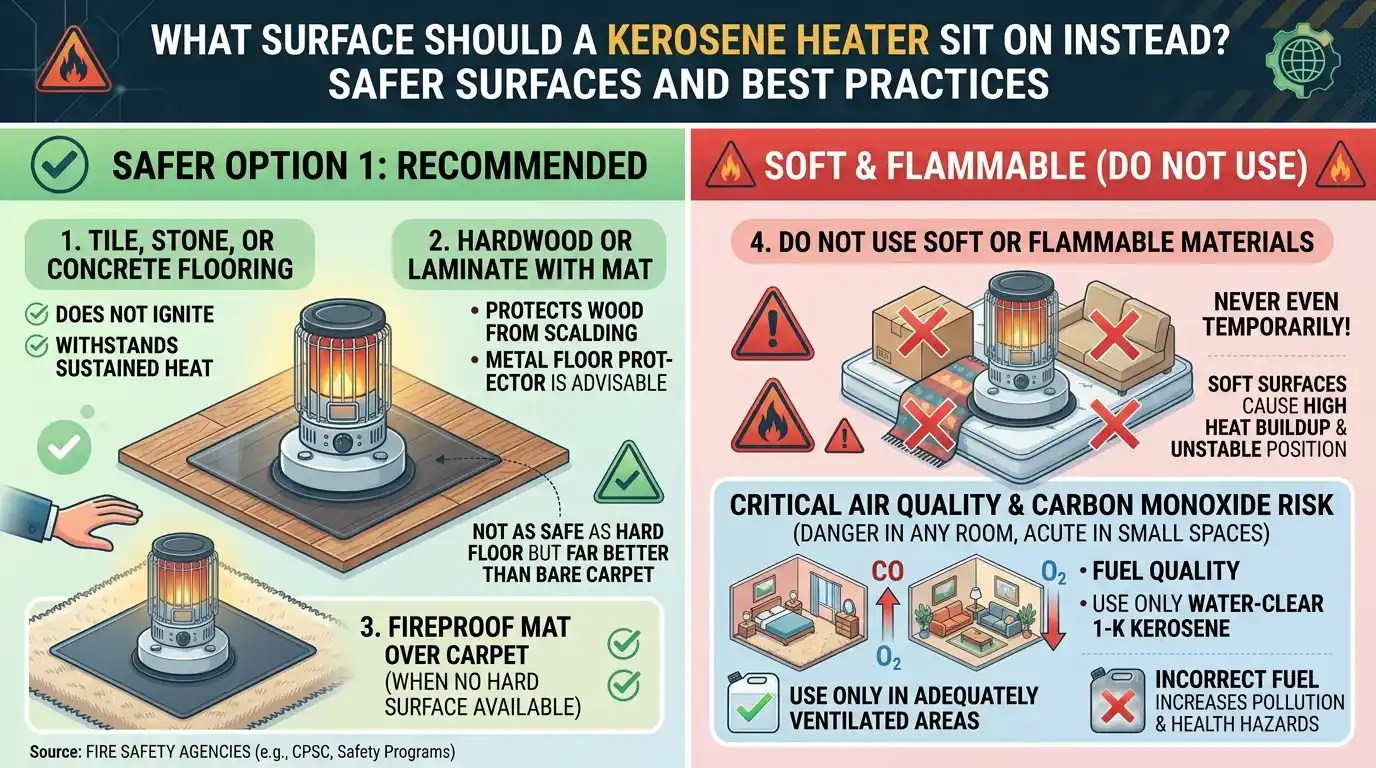
The safest surface is hard, flat and nonflammable. Preferably:
- Tile, stone, or concrete flooring. Ideal, since these materials don’t ignite and hold up to sustained heat.
- Hardwood or laminate, with a protective mat. Direct heat can scald wood, a UL-rated heat-resistant mat or metal floor protector is still advisable, even on hard flooring.
- A fireproof floor mat that is placed over carpet, again, when there is really no hard-surface space available. This is not as safe as a hard floor, but it is significantly safer than bare carpet fibers. More on this below.
Do not put a kerosene heater on a mattress, cushion, folded blanket, or cardboard or any other soft or flammable material, even temporarily.
If You Have No Other Option: How to Set Up More Safely on Carpet
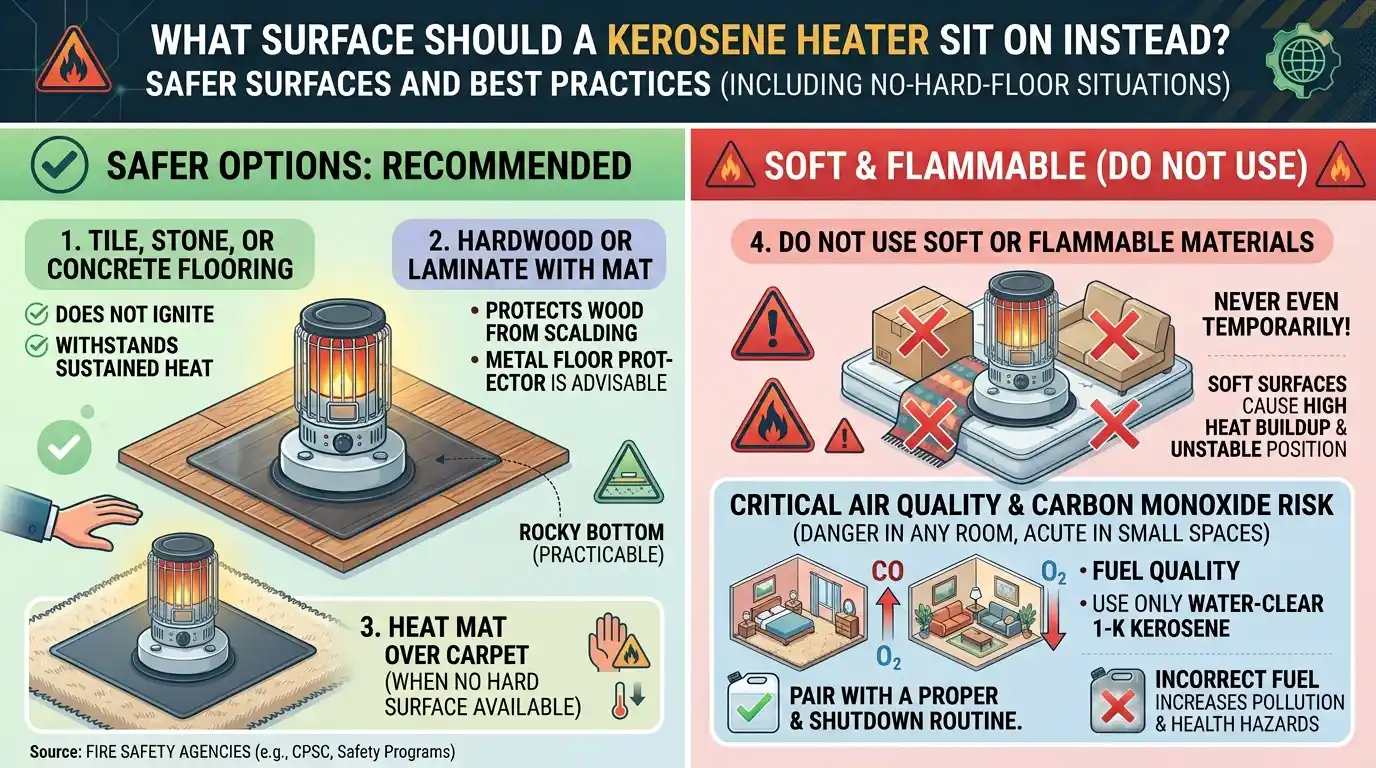
Some homes, apartments especially, are carpeted wall to wall with no tile or hardwood room available. If that’s your situation, don’t skip protection. Pairing this with a proper startup and shutdown routine matters just as much as the surface underneath it. Here’s how to reduce the risk as much as possible.
Choosing a Floor Protector or Mat
Find a mat that is specifically labeled as fire-resistant or heat-resistant, not a doormat or towel. Good options have the following characteristics:
- Noncombustible fabric: fiberglass, treated cotton or metal, not plain polyester or rubber-backed fabric.
- Complete coverage: the mat must be very much larger than the heater base on all sides. As a benchmark, typical recommendations regarding the placement of heating appliance floor protectors would be that the protector must be at least 18 inches on all sides of the heater, unless the manufacturer indicates otherwise.
- Flat and stable: the mat ought to be flat and not bunch or move, as an unstable base poses a greater risk of toppling.
- A rocky bottom, where practicable. A noncombustible board (sheet metal or mineral board) under a fire mat is more protective than a flexible mat alone, like hearth pads on a wood stove.
A mat will minimize the amount of heat that transfers to the carpet beneath it, but it does not eliminate the tip-over or open-flame hazard, and does nothing to ventilation and carbon monoxide exposure. Do not take it as green light, but as damage reduction.
Clearance Distances You Need to Follow
| Item | Minimum clearance |
|---|---|
| Furniture, curtains, bedding, clothing | At least 3 feet away from all furniture, curtains, papers, clothes, bedding, and other combustible materials |
| Walls and doorways (for airflow, not just fire) | Enough to keep the room’s door open while the heater runs |
| Foot traffic paths, kids, and pets | Placed where it won’t be bumped or knocked over |
| Floor protector mat overhang | At least 18 inches beyond the heater base on all sides |
Ventilation Rules
Ventilation cannot be compromised even with an ideal floor arrangement. When using kerosene heaters, there must be a supply of fresh air, there must be sufficient ventilation to other rooms, and there must be a supply of fresh outside air, like a window or door left open at least an inch, whenever the heater is on.
One of the most inexpensive and effective safety additions you can have is a carbon monoxide detector in the room that is in good working condition.
Are Kerosene Heaters Even Legal Where You Live?
This is something to check prior to purchasing or using one at all, particularly in an apartment or condo. In certain places, kerosene heaters remain illegal and therefore it is always good to consult your local fire department or fire marshal before purchasing or using one. A large number of leases, condo associations, and local fire codes prohibit or heavily limit the use of open-flame fuel heaters indoors, independent of any carpet-related issue.
This can be done in a few minutes by making a phone call to your local fire marshal or simply by checking your lease agreement than spending hours on internet forums.
Already Running Yours on Carpet? Do This Now
In case you were using a kerosene heater on carpet and are reading this after the incident, then do not panic but follow the following steps:
- Switch it off and allow it to cool down before handling it. Do not transport a lit or hot kerosene heater.
- Examine the carpet below, with a scorched, discolored or melted texture. When you do find any, quit using that spot altogether, and never again run the heater there even after it cools.
- Have an adequate floor protector mat next time, based on above sizing and material suggestions.
- Check your smoke and carbon monoxide detectors in that room not next week, but now.
- Ventilate more in the future, cracking a door or a window each time the heater is on.
Kerosene Heater Placement: Quick Comparison Table
| Surface | Fire risk | Recommended? |
|---|---|---|
| Tile, stone, or concrete | Lowest | Best option |
| Hardwood/laminate with a rated mat | Low | Good option |
| Carpet with a rated fire-resistant floor protector (18″+ overhang) | Moderate | Only if no hard floor is available |
| Bare carpet, no protection | High | Never |
| Carpet with a towel, blanket, or cardboard underneath | Highest | Never |
Common Mistakes to Avoid
- Having the heater near a wall outlet or extension cord that passes under a rug.
- Fill-up inside or when the heater is still hot.
- Adding anything to water-clear 1-K grade kerosene.
- Leaving the heater on overnight or leaving a room with the heater on.
- With a newer or more costly model, there is no necessity to clear and have a hard surface.
FAQs
Is it possible to place a kerosene heater on a carpet?
No. Fire safety officials advise that kerosene heaters should be put on a hard, flat, noninflammable surface, not on a rug or carpet, because of the risk of fire caused by radiant heat and tip-over.
Can I leave a kerosene heater on a carpet overnight?
No. Kerosene heaters must never be left unattended or when sleeping, no matter the surface. Carpet use overnight is a combination of two of the most dangerous factors.
On which surface should a kerosene heater be placed?
It should be tile, stone, concrete or some other hard, level, nonflammable surface. When the only available is carpet, then a rated fire-resistant floor protector that extends far beyond the base of the heater should be used.
Should kerosene heaters have a mat?
Yes, on carpet, a fire-resistant mat is highly suggested as a measure to decrease damage, but it does not render carpet as safe as a hard floor. A mat is also a good idea on a hard floor such as wood to avoid scorching.
Will a kerosene heater set carpet ablaze?
Yes. Constant radiant heat at the base may scald or burn carpet fibers and a tipped heater on carpet is in direct contact with combustible material.
Is it legal to have kerosene heaters inside the house?
It depends on your location. There are cities, states, and rental contracts that limit or ban the use of indoor kerosene heaters. Before you purchase or use one, check with your local fire marshal.
What is the distance between a kerosene heater and carpet or other combustibles?
At least 3 feet away from furniture, curtains, bedding and other combustible items, according to standard kerosene heater safety instructions.
Why must kerosene heaters be ventilated when the danger of fire is on the floor, and not on the air?
Ventilation is a solution to a different risk, carbon monoxide and low oxygen, rather than fire. The two risks must be handled simultaneously, as a room large enough to trap fumes is also the room where the greatest risk of fire is at the floor level.
Is it safe to use an electric space heater on a carpet, then?
Electric heaters remove the open-flame and fuel-spill risks (this walkthrough of the heating elements involved explains why), but the same “not on rugs or carpet” rule still applies for hot surfaces and cord placement. Electric units are not automatically carpet-safe. A flameless option like an oil-filled radiator or a properly vented propane unit, set up according to its own manufacturer safety steps, can also be worth comparing if carpet coverage is unavoidable in your home.
What type of mat will keep carpet safe with a kerosene heater?
Find a mat with the label fire-resistant or heat-resistant, of fiberglass, treated cotton, or metal, and large enough to project at least 18 inches on each side of the base of the heater.
Is it all right that the heater is touching the carpet side?
No. Partial contact with carpet fibers under the heat source is equally scalding and igniting. All the area of the heater, including clearance, must be not on bare carpet.
What would I do in case I discover scorch marks on my carpet beneath a heater?
Do not continue to use that place, even when the heater is cooled down. Scorching indicates that the carpet has already attained an unsafe temperature and a repetitive exposure increases the risk of fire even more.
Are there any differences in the fire risk of all kerosene heaters on carpet?
The fundamental risk (open flame, hot base, fuel tank) is common to almost all portable kerosene heater models, both convective and radiant. The variation in safety features such as tip-off shutoffs minimizes part of the risk but does not remove the surface risk.
Final Thoughts
The answer to the question in the short is the same at the end of this guide: kerosene heaters and bare carpet are not compatible, and all reputable sources of information on fire safety say so. Use a hard-surfaced room, should you have one. When carpet is actually all you have, a fire-resistant floor protector of the correct size, clearance distance, actual ventilation, and a functioning carbon monoxide detector are not luxuries, but the bare minimum.
And even before all that, it would be a good idea to check whether a kerosene heater is even permitted in your house in the first place. Several minutes of preparation is a minor price to pay to have a fire hazard out of the most flammable surface in the room.