How Do Kerosene Heaters Work? A Complete Guide to the Science, Types, and Safety
When the electricity goes off during a cold snap, a kerosene heater can warm a room using nothing but a wick, a tank of fuel and a match. No chains, no batteries, no fire. It is precisely that simplicity which makes people trust them, and it is also why so many people would like to know what is actually happening inside one even before they light it the first time.
This guide simplifies the mechanism into plain language, contrasts the two primary types of heaters and discusses the safety and maintenance considerations that most articles omit.
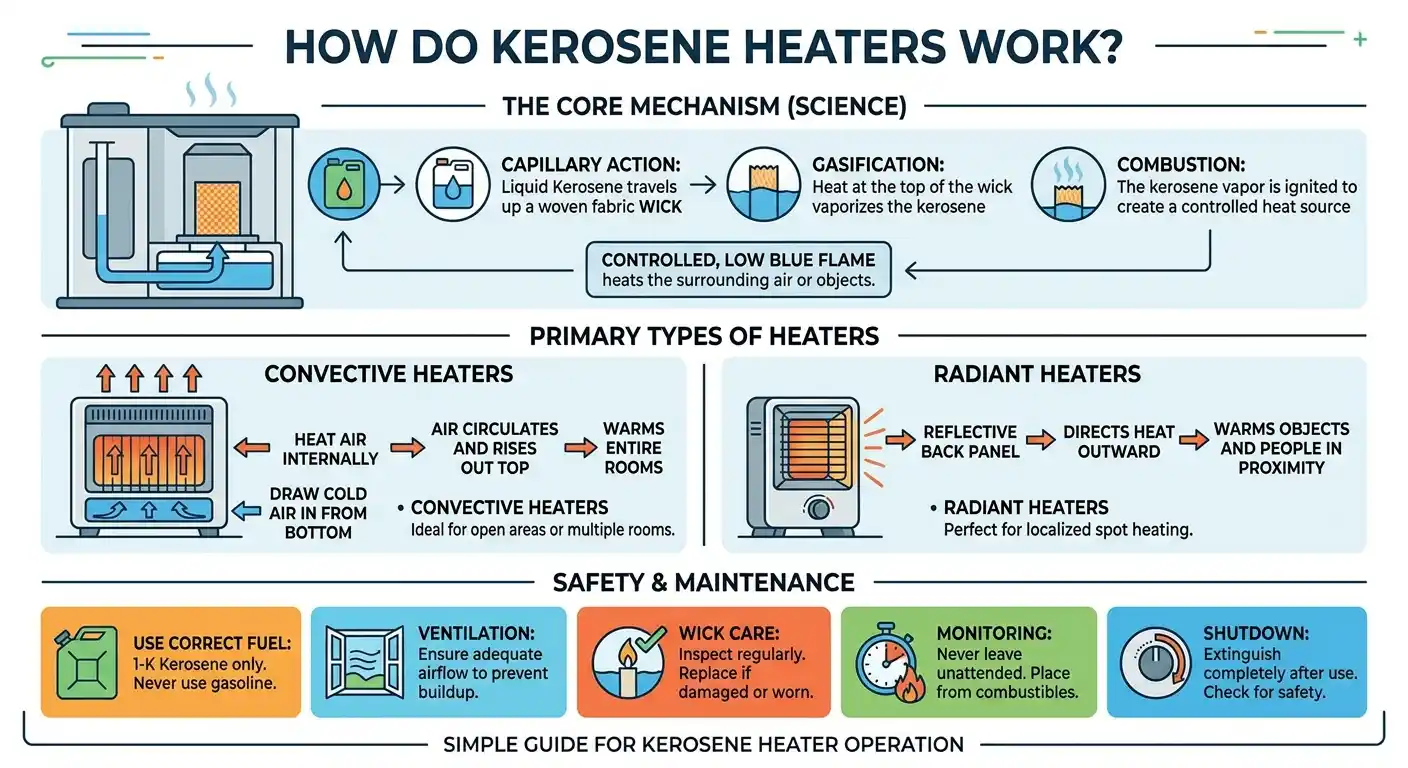
Important to note: The operation of a kerosene heater is by drawing the liquid kerosene up a wick by capillary action, converting it into a vapor via heat (gasification), and combusting the vapor to create a controlled, low blue flame that heats the surrounding air or objects in proximity.
What Is a Kerosene Heater? (Quick Definition)
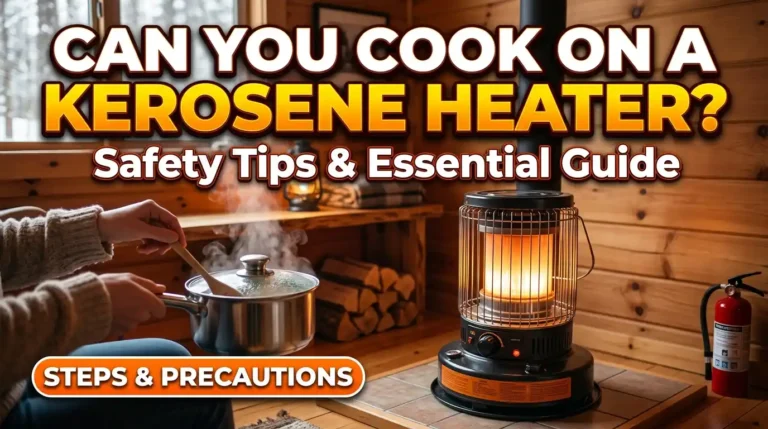
A kerosene heater is a small, fuel-burning device that heats by combusting vaporized kerosene, typically of 1-K grade fuel, using a wick-fed burner. It does not require an electrical connection to produce heat, unlike a furnace or an electric space heater, and is therefore popular during power outages, in garages, workshops and off-grid cabins.
There are more recent radiant models which burn a little electricity to start or a fan, but the heating is fuel burning and not electric resistance.
How Do Kerosene Heaters Work? The Short Answer
In brief: kerosene is stored in a fuel tank at the bottom of the heater. It is soaked in a wick just like a paper towel is soaked in water. When the wick is heated up close to the burner, the kerosene does not burn in the form of a liquid, but it is evaporated into a gas. That burns with a controlled blue flame with air. Depending on the design of the heater, the heat of that flame radiates to people and objects or it rises and circulates through the room by convection.
After being lit the wick heats the kerosene until it undergoes gasification to become a gas, which is then burned, and this burning heats air through convection or objects close by through radiation.If you’re still deciding between a combustion-based unit and something that plugs into the wall, this breakdown of how electric plug-in models generate warmth is a useful side-by-side read.
The Step-by-Step Process, From Tank to Flame
Step 1: Fuel Sits in the Font (Tank)
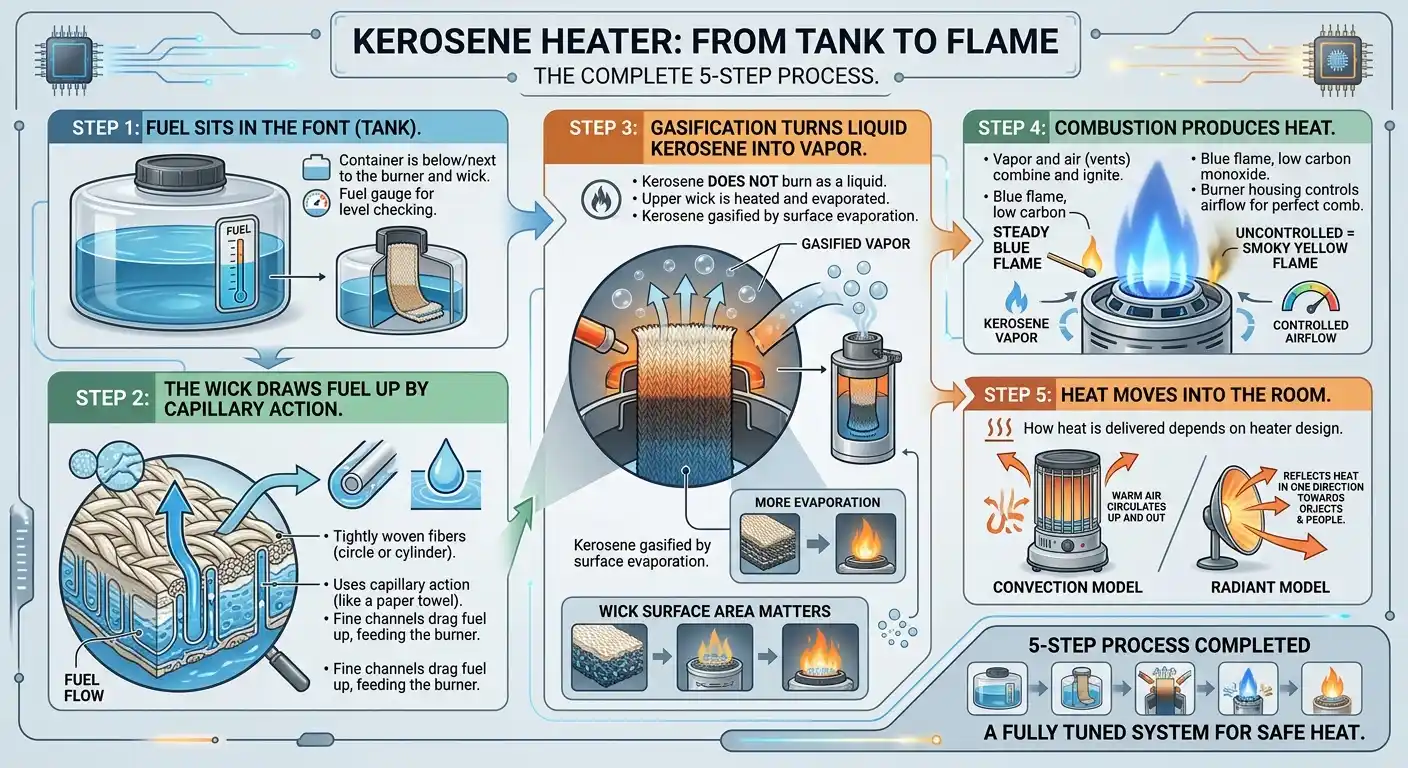
This container of the kerosene is referred to as the font. It is located below or next to the burner and wick on most heaters. There is a fuel gauge that allows one to check the fuel level without having to open the tank.
Step 2: The Wick Draws Fuel Up by Capillary Action
The wick is a band of fiberglass and cotton fibers, tightly woven into a circle or a cylinder. Kerosene is pulled up the wick into the tank through the same physical principle that allows a paper towel to wring up a spill. The thin fibers form thousands of fine channels which drag the liquid fuel upwards against gravity, and which feed the burner so long as the wick remains in contact with the fuel beneath.
Step 3: Gasification Turns Liquid Kerosene Into Vapor
This is the most unexpected step that most people will not anticipate: kerosene does not burn as a liquid in the heater. The burner assembly produces heat that evaporates the upper part of the wick that is wet with fuel, turning the liquid kerosene into a flammable vapor.
A kerosene heater is a device where the kerosene is gasified by surface evaporation followed by burning and the quantity of kerosene evaporated and heat produced can be directly proportional to the size of the contact surface between the kerosene and air. This is the reason why wicks are created with a big surface area, more exposed fiber results in more evaporation and a more powerful flame.
Step 4: Combustion Produces Heat
The kerosene gas is vaporized and combines with air that is pulled in by vents surrounding the burner and ignites. The heater is well-tuned and burns with a steady blue flame, like a propane stove, instead of a smoky yellow one. The burner housing is designed so that the airflow is controlled to the exact amount, as excess air leads to incomplete combustion (greater soot, greater odor, greater carbon monoxide) and excess air can lead to an unstable flame.
Step 5: Heat Moves Into the Room
The next step will depend on the design of the heater. A convection model expels the heat upwards and outwards in such a way that it diffuses through the room. A radiant model is a model that heats individuals and objects in its path by reflecting the heat in one direction. The following section divides the difference between each type.
Convection vs. Radiant Kerosene Heaters (Comparison Table)
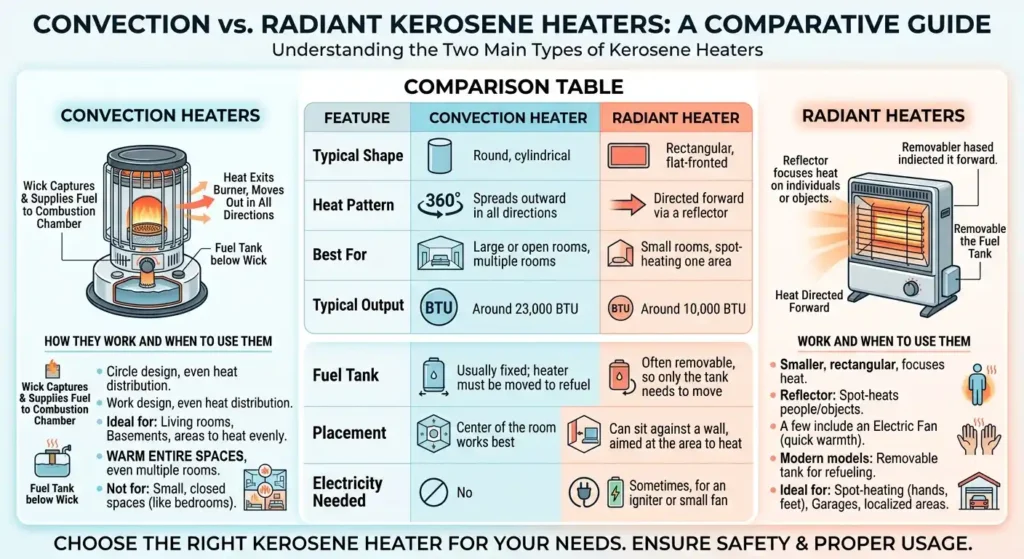
Almost all kerosene heaters available in the market are either of these two types.
| Feature | Convection Heater | Radiant Heater |
|---|---|---|
| Typical shape | Round, cylindrical | Rectangular, flat-fronted |
| Heat pattern | Spreads outward in all directions | Directed forward via a reflector |
| Best for | Large or open rooms, multiple rooms | Small rooms, spot-heating one area |
| Typical output | Around 23,000 BTU | Around 10,000 BTU |
| Fuel tank | Usually fixed; heater must be moved to refuel | Often removable, so only the tank needs to move |
| Placement | Center of the room works best | Can sit against a wall, aimed at the area to heat |
| Electricity needed | No | Sometimes, for an igniter or small fan |
Convection Heaters: How They Work and When to Use Them
A convection heater typically consists of a circle, with the fuel tank placed below the wick and combustion chamber, and the wick captures and supplies fuel to the combustion chamber. The heat exits the burner and moves out in all directions and this makes these units a good match in the living room, the basement, or any other area that you want to heat evenly. They are designed over large spaces, even multiple rooms, but not so much a small and closed space as a bedroom.
Radiant Heaters: How They Work and When to Use Them
Radiant heaters tend to be smaller and rectangular and on top of the wick and combustion chamber they have a reflector that focuses the heat on individuals or objects. A few bright models include an electric fan to move the warm air out more quickly, and most of the modern models have a removable fuel tank so the heater does not have to be relocated at the time of refueling. Radiant is typically preferable to warm your hands, your feet, or one side of a garage in a hurry.
What Parts Make Up a Kerosene Heater?
- Font (fuel tank): Cargo of the kerosene, frequently having an indicator of the amount visible.
- Wick: The strand which pulls up fuel. The top part which is in direct contact with the flame is usually fiberglass, as it can withstand heat much better than cotton, and the bottom part which is always wet with fuel is usually cotton.
- Burner assembly: This is where the process of gasification and combustion occurs; here, airflow is controlled around the flame.
- Wick adjuster: A dial or lever that is used to raise or lower the wick to regulate the height and heat output of the flames. The flame is then put out by completely withdrawing the wick into a hole beneath the burner, and extinguishing the flame.
- Ignition system: A match-lit wick or on most modern models, an electric igniter powered by a battery. On electric-ignition models, the igniter is merely a high-temperature electric arc between a pair of electrodes that are pressed into the wick, hot enough to ignite the kerosene.
- Reflector (radiant models only): A metal panel that is curved and sent forward to reflect radiant heat.
- Tip-over safety switch: A mechanical device that will cut off the flame in case of knocking over the heater.
- Grille or guard: A metal cage that surrounds the flame area and minimises the possibility of accidental contact or fire.
What Fuel Do Kerosene Heaters Use?
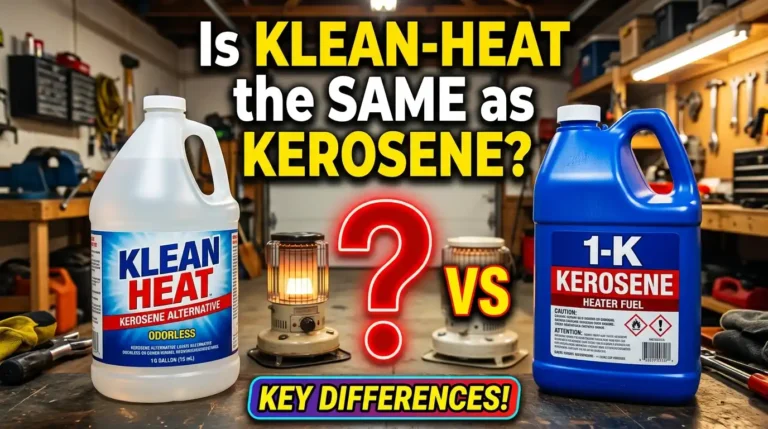
Kerosene heaters are designed for 1-K grade kerosene, sometimes labeled “water-clear” kerosene. It is a highly refined fuel having extremely low sulfur levels and this is important since the impurities of sulfur are burnt into sulfur dioxide, a very irritating gas that can be harmful. The Consumer Product Safety Commission recommends that only water-clear 1-K grade kerosene should be used, and never gasoline, as any small quantities of gasoline or other volatile fuels or solvents added to kerosene can significantly raise the chances of a fire or explosion.
Fun fact: 2-K kerosene is also available, although it contains more sulfur and is not intended to be used in indoor heaters (unless in the form of off-road diesel blending). Always read the label before filling the tank.
How Much Kerosene Does a Heater Use? (Cost Breakdown)
Running cost varies with the amount of BTU output of the heater and the height of the wick, but here is a general range of possible radiant heater fuel consumption. On pump kerosene, it is estimated that running a radiant kerosene heater in the evening would cost about $0.45 per hour. A bigger convection heater with full output will consume more fuel per hour than that, merely because it is generating more than twice the BTUs.
Two useful hints to consider before you purchase:
- It is actually more efficient to have a heater operating at or close to its nominal capacity than to have it operating on a very low flame over an extended period. Heaters that use kerosene do not work efficiently when the wick is too short and are therefore most efficient when operating at or close to their rated thermal output.
- When stored in a certified, closed, and non-exposed to direct sunlight and temperature variations, 1-K kerosene in a sealed container usually has a shelf life of one to two years, a long time compared to stored gasoline.
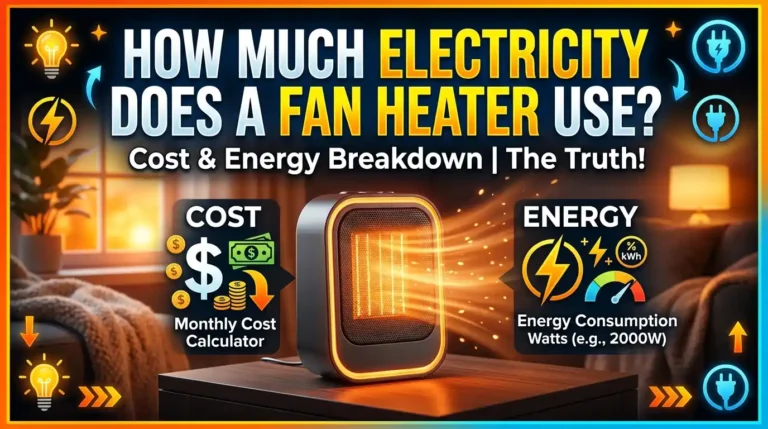
Weighing that hourly fuel cost against an electric alternative? Here’s what it actually costs to keep an oil-filled radiator running for a direct comparison.
Are Kerosene Heaters Safe? What the Data Says
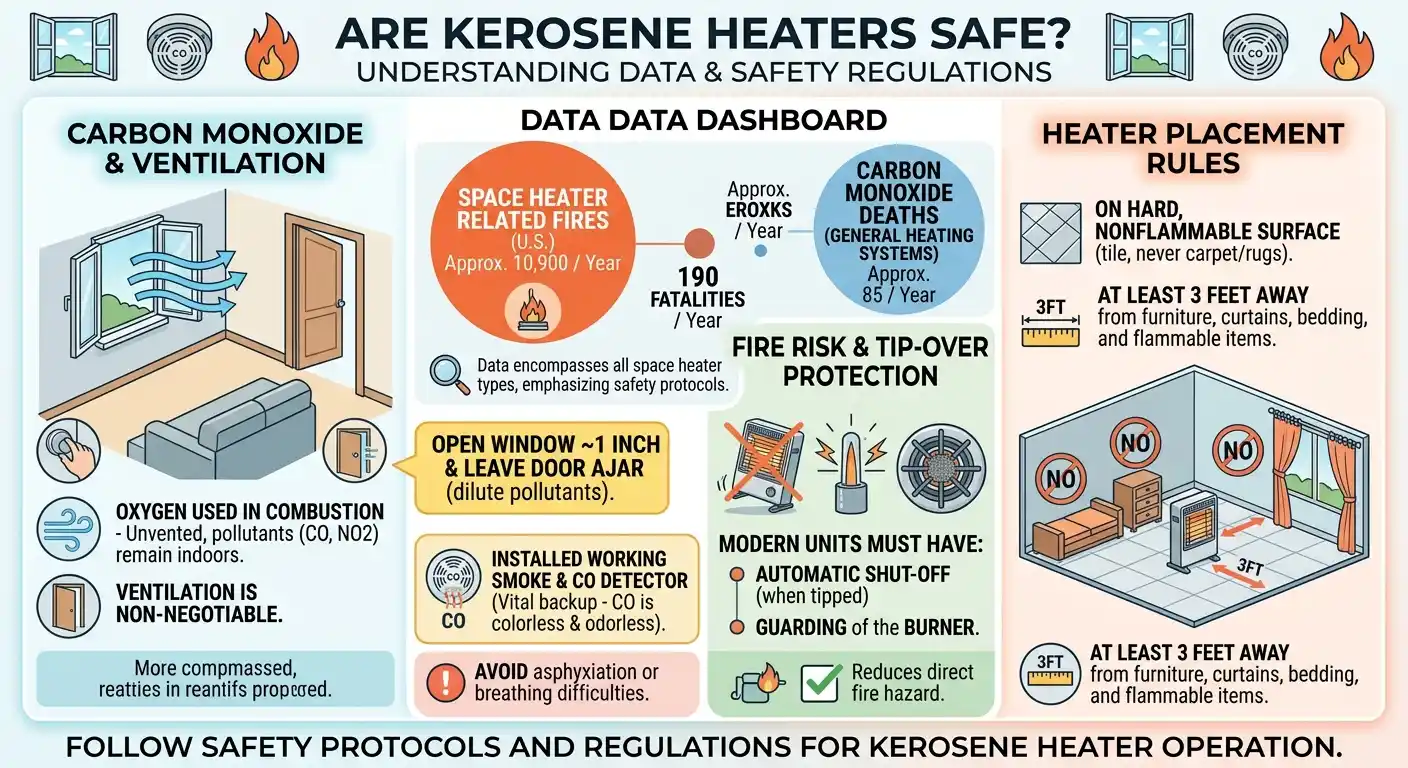
Kerosene heaters are not prohibited and are quite common but they do have actual dangers which are best not to brush over but to consider.
Carbon Monoxide and Ventilation
Oxygen is always used up in the combustion process and there are always byproducts and kerosene heaters are no exception. Any kerosene- or propane-powered space heater that is portable is considered to be unvented, that is, the pollutants it emits, such as carbon monoxide and nitrogen dioxide, are not piped out of the room. Since these fuels use oxygen during combustion, ventilation must be supplied to replenish this oxygen and to remove the gases, otherwise it may lead to asphyxiation or breathing difficulties.
The remedy is easy and not negotiable: run the heater in a room with an open door to the rest of the house and open an outside window about an inch to allow fresh air to dilute the pollutants, particularly in newer, tightly closed houses. An inexpensive, quick-to-install working smoke and carbon monoxide detector in the vicinity is a clever, cheap backup, as carbon monoxide is colorless and odorless and can be lethal in high amounts without any warning.
Fire Risk and Tip-Over Protection
In the U.S., modern kerosene heaters must have an automatic cut-off feature that will put out the flame in the event the unit is knocked over and guarding of the burner to minimize fire hazard. Still, placement matters. Place the heater on a hard, smooth, nonflammable surface, like tile, never on carpet or rugs, and at least three feet away from bedding, curtains, furniture and other flammable items.
Quick facts: Approximately 10,900 residential fires and approximately 190 fatalities in a single year were linked to portable or fixed space heaters of any type (not kerosene alone) and heating systems generally cause an average of approximately 85 deaths annually due to carbon monoxide. These figures encompass all types of space heaters, yet they emphasize the reason behind the existence of ventilation and clearance regulations.
Safety Checklist Before You Light One
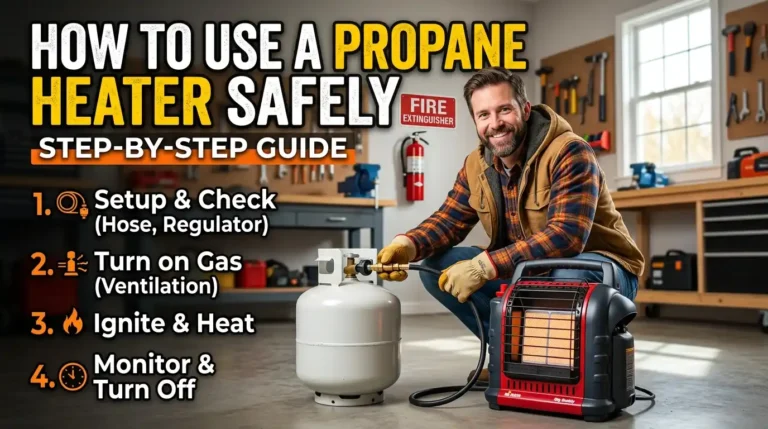
Many of these same precautions apply to other fuel-burning units too. Our walkthrough on operating a propane unit without the common hazards covers the overlap in more detail.
How to Light and Operate a Kerosene Heater Safely (Step-by-Step)
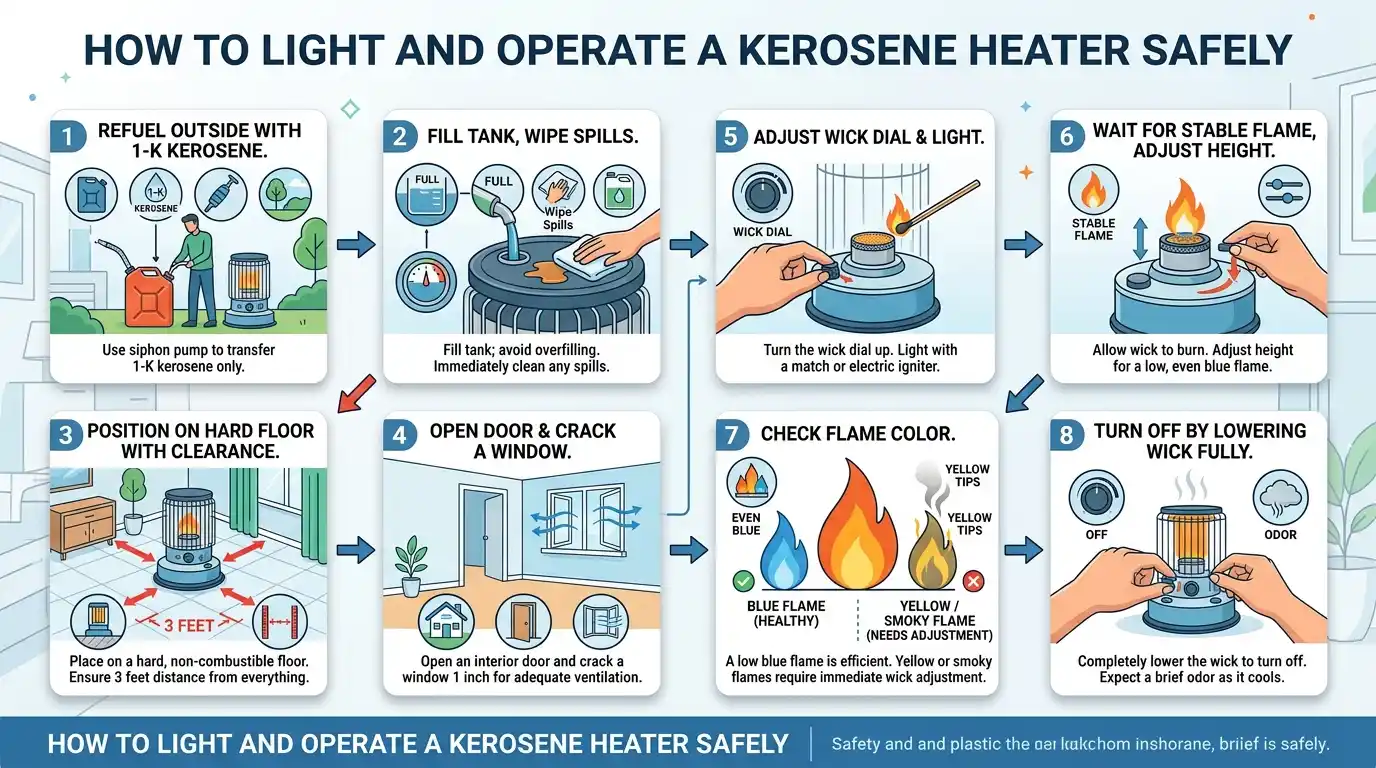
- Refuel the heater by taking it outside or to a well-ventilated garage. The refueling must never be done in the house or when the unit is hot.
- Fill the tank with clean 1-K kerosene, and wipe up any spills with a siphon pump (when the tank is not removable) before returning it to the inside.
- Position the heater permanently during the session: hard floor, three feet clearance, not in foot traffic.
- Leave door open to the rest of the house and crack a window before lighting.
- Turn up the wick with the adjustment dial, then light the wick with a match or the electric igniter.
- Wait a few minutes until the flame is stable, and note the level of the wick to the desired level of heat.
- Examine the color of the flame. A clean blue flame indicates a healthy burning flame; a yellow flickering flame or a smoky flame indicates that the wick requires re-alignment or cleaning.
- To switch it off, reduce the wick to the maximum until the flame is extinguished. During shutdown, expect a short-lived kerosene odor, this is normal.
How to Maintain a Kerosene Heater (Wick Care and Cleaning)
The largest cause of odor, soot and inefficient burning is a dirty or worn wick. The little ways add up:
- Periodically burn off the wick. Empty the tank as much as is possible, remove the heater to the outside or a well-ventilated place, light it and allow it to burn off all residue, which removes the tar and deposit build-up that accumulates in a season of use.
- Check the wick once it has been burned. A healthy wick appears rather white, with no heavy deposits, and it must feel fluffy on the top; otherwise, add fuel and do it again.
- Check the wick every now and then (only when the heater is cool). You will learn with time when it begins to be hard or stiff and then you know it needs cleaning or replacing.
- Clean your fuel. The bottom of the majority of wicks is cotton, which may clog when water enters the fuel, thus keep kerosene in a certified, sealed container.
- Cleaning will no longer restore performance, so replace the wick. Replacement wicks of a given size to a particular heater model are sold by most manufacturers.
Common Problems and What They Mean
| Symptom | Likely Cause | Fix |
|---|---|---|
| Strong odor while running (not just at startup/shutdown) | Wick improperly adjusted, or carbon buildup on the wick | Adjust the wick slightly; replace it if carbon buildup is present |
| Smoke or black soot | Burner unit not seated properly, or airflow around the flame is unstable | Reseat the burner assembly correctly; clean soot promptly |
| Weak or uneven flame | Clogged capillary channels in the wick | Check for viscous kerosene or dirt/dust clogging the wick’s capillary tubes |
| Heater won’t stay lit | Water-contaminated fuel or a worn-out wick | Drain and replace with clean 1-K kerosene; inspect wick |
| Smell only at startup or shutdown | Normal vaporization as the wick heats or cools | This is expected: as the wick lowers, residual heat continues drawing and vaporizing fuel briefly |
Kerosene Heaters vs. Propane Heaters vs. Electric Heaters
| Factor | Kerosene Heater | Propane Heater | Electric Space Heater |
|---|---|---|---|
| Needs electricity | No | Usually no | Yes |
| Works in a power outage | Yes | Yes | No |
| Indoor air quality concern | Yes, unvented models produce CO | Yes, unvented models produce CO | No combustion byproducts |
| Fuel storage | 1-K kerosene, up to 1-2 years shelf life | Propane cylinders, very long shelf life | None needed |
| Typical heat output | 10,000-23,000 BTU | Varies widely by model | Lower, typically under 5,000 BTU |
| Best use case | Whole-room or spot heating without power | Similar, often used outdoors or in garages | Small spaces with power available |
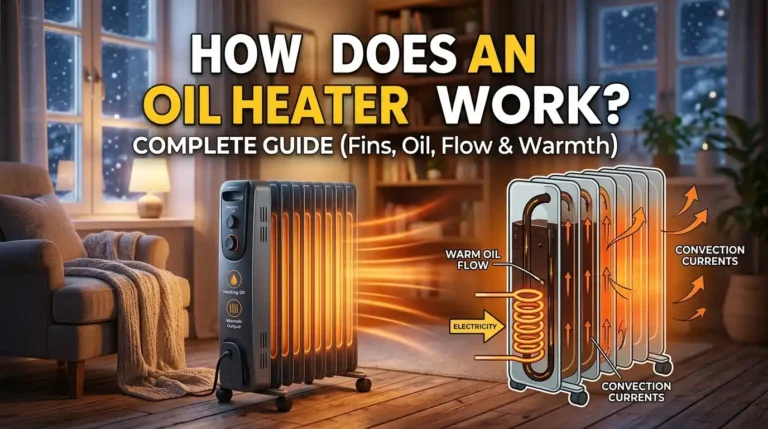
There’s also a fourth option that skips combustion entirely: an oil-filled column heater. This guide explains how that sealed, wickless design produces heat, which makes an interesting contrast to the gasification process covered above.
Myth vs. Fact
Myth: Kerosene heaters are not allowed to be used in the house.
Fact: They are legal in most states of the U.S. when well ventilated, but certain states, cities and rental contracts limit or prohibit them, so it is prudent to check local regulations before purchasing one.
Myth: A kerosene heater burns liquid fuel directly.
Fact: It burns evaporated fuel. The wick pulls up liquid kerosene, which is then converted to gas by the heat of the burner and then combustion occurs.
Myth: You can safely run one at night when everybody is sleeping.
Fact: This is explicitly discouraged by the fire safety organizations. A fire protection engineer notes that a kerosene heater needs to be watched, and if you’re asleep, you can’t watch it.
FAQs
What is a kerosene heater used for?
It can be used to warm a room or small building without the use of electricity, usually when there is a power outage, in garages and workshops, or in off-grid locations.
What is the working principle of a kerosene heater?
The wick pulls the fuel up by capillary action and the burner vaporizes it, and thus the entire operation is based on the physical characteristics of the fuel and wick, as opposed to an electrical circuit. Other models have a small battery to power the igniter only, not to produce heat.
Are kerosene heaters a source of carbon monoxide?
Yes, in small quantities, more when the combustion is not complete because of a dirty wick or inadequate ventilation. This is why ventilation and a functional carbon monoxide detector are not an option.
Can a kerosene heater be left on when sleeping?
This isn’t recommended. Fire safety experts recommend switching it off before going to sleep, as nobody is awake to monitor the flame and spot a malfunction.
What is the duration of a tank of kerosene?
The length of time it will last depends on the size of the heater and BTU output, however most radiant models will last about 12 to 15 hours on a full tank at a moderate setting; consult the manual of your particular model for its rated burn time.
Which type of kerosene to use?
Only 1-K, water-clear kerosene. Do not use gasoline or a fuel of unknown purity, as impurities and improper volatility may cause severe fire and explosion hazards.
Why does my kerosene heater smell when I turn it on or off?
This is normal. As the wick gets hot or cold, a small portion of unburned or leftover fuel evaporates temporarily, creating a momentary smell.
Is it possible to use a kerosene heater in a bedroom?
Small, closed rooms such as bedrooms are not usually suggested to be heated with convection heaters. When using any kerosene heater in a bedroom, even for a short time, ventilation is needed and it should be switched off before going to sleep.
What is the cleaning or replacement frequency of the wick?
Periodically, approximately once a season for normal users, burn off the wick and check it. Change it when cleaning will no longer restore a clean blue flame or remove the odor.
What’s the difference between convection and radiant kerosene heaters?
Convection heaters distribute warm air throughout a space and are applicable to bigger and open areas. Radiant heaters focus heat on individuals or objects with the help of a reflector and cover smaller areas for spot heating.
Does a chimney or vent exist in kerosene heaters?
Portable kerosene heaters are not vented; they emit combustion byproducts into the room directly, which is why indoor ventilation is important. There are larger fixed Japanese-style units with vented, piped exhaust systems, but these are not typical for domestic use in the United States.
How much does it cost to run a kerosene heater per hour?
Approximately $0.45 per hour for a radiant heater operating during the evening, depending on average kerosene prices; larger convection units are more expensive per hour because they use more fuel.
Which is the best between kerosene heaters and propane heaters?
Neither is universally better. Kerosene has a high capacity for storage, exceeding one to two years, and has a good BTU output per dollar, whereas propane cylinders have an almost unlimited storage capacity and are sometimes regarded as cleaner-burning. The correct choice depends on fuel availability and purpose.
What safety features do modern kerosene heaters have?
Modern heaters sold in the U.S. commonly have automatic tip-over shutoff switches and guarded burners, which greatly lowers the chances of fire compared with older, pre-regulation units.
Will a kerosene heater run out of oxygen and turn itself off?
Simple portable kerosene heaters usually lack an oxygen depletion sensor as a default feature; it is more often found on unvented gas heaters. This is precisely why manual ventilation, such as cracking a window or opening a door, is important when using kerosene units.
Final Thoughts
A kerosene heater is a very simple machine when you peel the flame: the wick draws fuel up, the heat causes the fuel to become gas, and the gas burns to generate warmth, which is then distributed either by convection or by radiant reflection. It is that simplicity that makes it all interesting in a power outage or in an off-grid area.
The price of that freedom of electricity is an actual burden of ventilation, fuel quality, and location. All the safety measures in this guide are not complex, but it is the accidents that occur when they are not taken. A kerosene heater is a reliable time-tested means of staying warm when used properly, with 1-K kerosene, a broken window, and a clean wick.
Next step: Find the manual of your model with its precise BTU rating and tank size before the first use and test the battery of your carbon monoxide detector. Both last five minutes and eliminate most of the guesswork prior to the arrival of winter.