Do Oil-Filled Space Heaters Use a Lot of Electricity? Real Running Costs and How to Cut Them
Your bedroom is chilly, your central heating is costly, and that oil-filled heater is an apparent simple solution. But will it silently add to your power bill? The solution is more encouraging than most individuals anticipate and it has some strings to the bow.
Do Oil-Filled Space Heaters Use a Lot of Electricity?
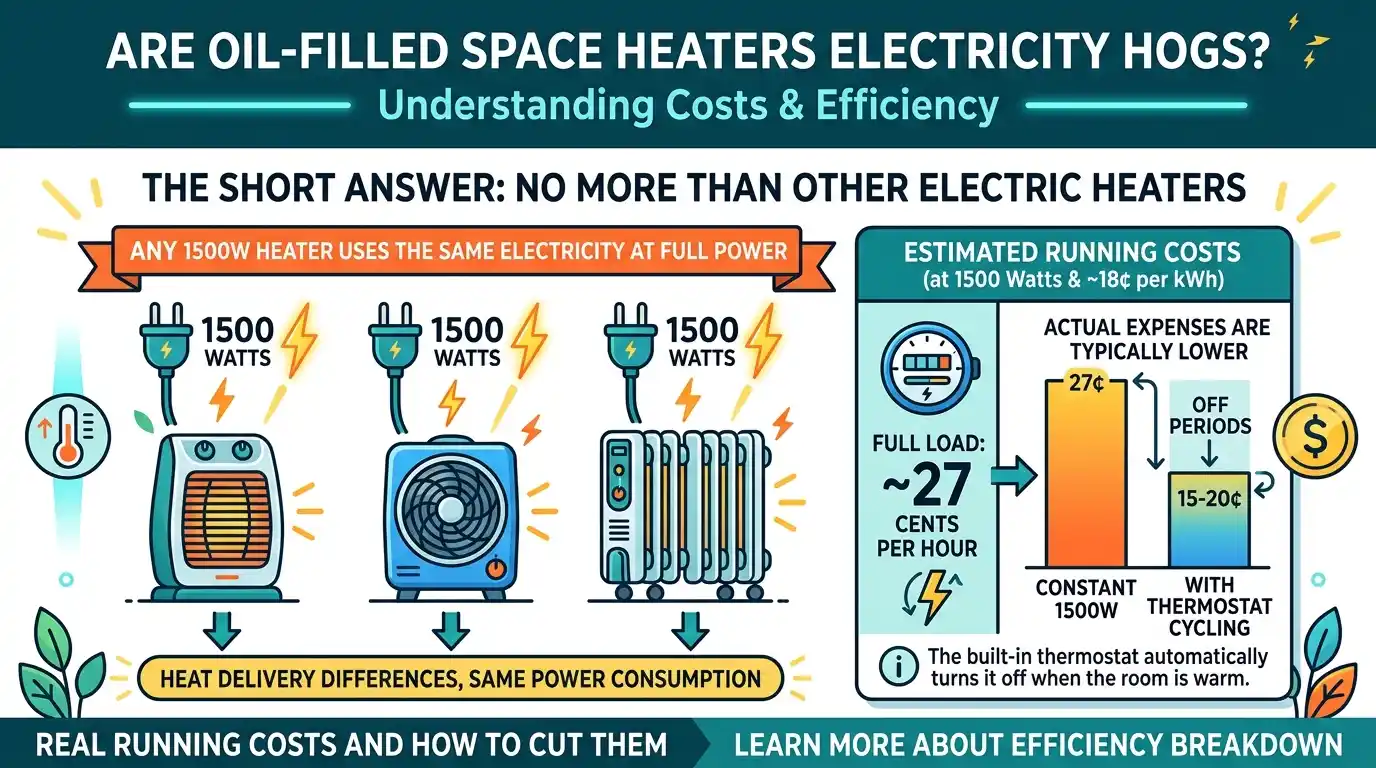
The amount of electricity consumed by oil-filled space heaters during the heating process is equal to that indicated by their wattage, which is usually 600 to 1,500 watts. A 1,500-watt model will cost up to about 27 cents per hour at full load, at about 18 cents per kWh. The inbuilt thermostat automatically turns it off when the room is hot hence the actual expenses tend to be less.
An oil-filled heater is not an unusual eater. It is a normal electric resistance heater. Any 1,500-watt heater, be it oil-filled, ceramic, or fan-driven, consumes the same amount of power at full blast. The difference is the mode of delivery of the heat and the frequency with which the heater needs to operate.
If you want the deeper efficiency breakdown, our guide on whether oil-filled heaters are energy efficient covers the science in detail.
How Much Electricity Does an Oil-Filled Space Heater Use?
Typical Wattage Ranges
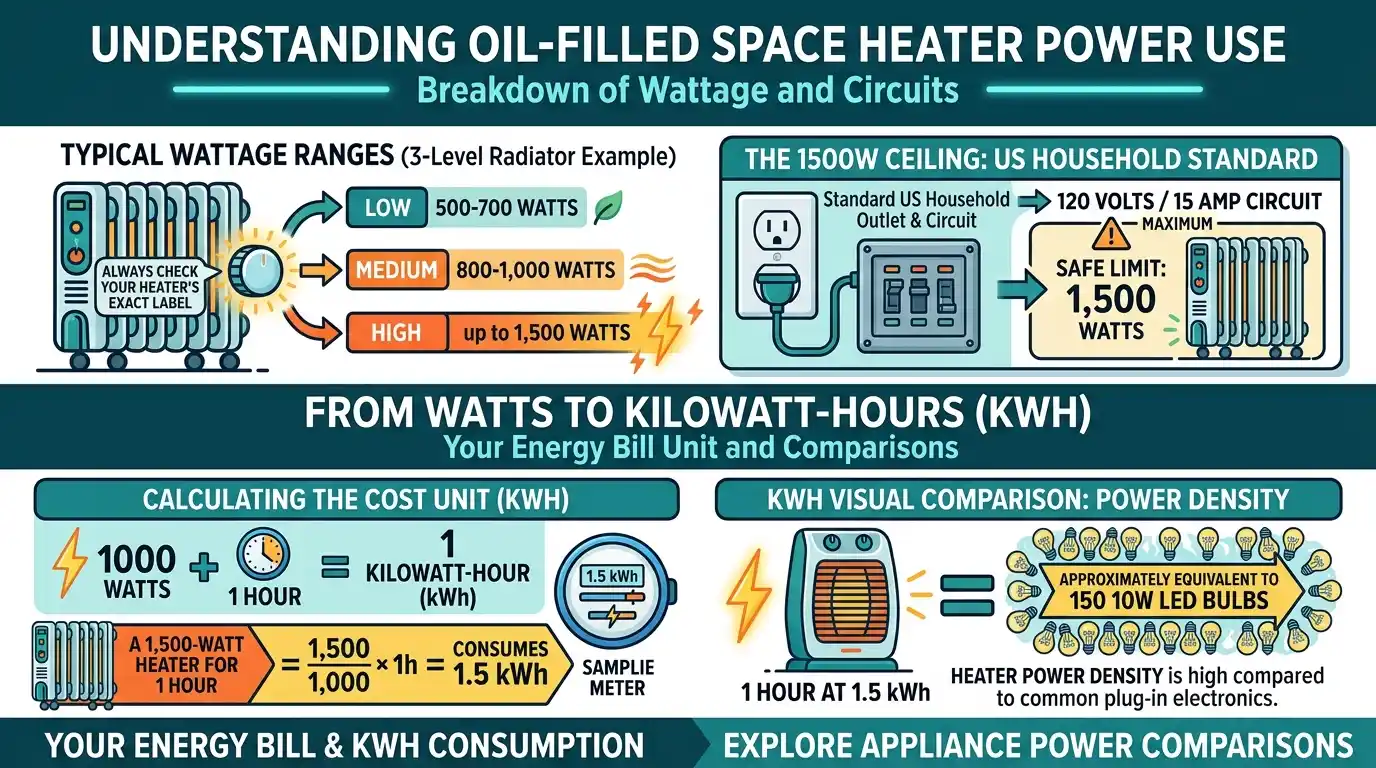
The majority of portable oil-filled radiators come with two or three power levels:
- Low: about 500 to 700 watts
- Medium: about 800 to 1,000 watts
- High: up to 1,500 watts
The 1,500 watt ceiling is not accidental. The typical household outlets in the United States operate at 120 volts and are typically on 15 amp circuits, hence most portable heaters have a maximum output of 1,500 watts. The label on your own heater is always worth checking to be sure of its exact rating.
Watts vs. Kilowatt-Hours
Your power company charges you on the kilowatt-hour (kWh). One kWh is 1000 watts of one hour.
One hour of a 1,500-watt heater consumes 1.5 kWh. Comparing that to something, it is approximately equivalent to 150 10 watt LED bulbs. This is why a heater seems costly compared to other plug-in appliances, although it is a simple technology.
How Much Does It Cost to Run an Oil-Filled Heater?
The Simple Formula
Watts ÷ 1,000 × hours × your rate per kWh = cost
Example: 1,500 watts ÷ 1,000 = 1.5 kW. Running for 8 hours gives 12 kWh. At 18 cents per kWh, that is $2.16 if it ran at full power the entire time.
On the rate, see your last bill. U.S. Energy Information Administration (EIA) estimates an average residential price of approximately 18 cents per kWh in 2026, yet varies across states. Hawaii and California are way up above that, and North Dakota is way down below that.
Cost Per Hour, Day, and Month
These numbers are based on 18 cents per kWh and the heater operating full time at full power. Not the average bill but the ceiling.
| Heater setting | Cost per hour | 8 hours (full power) | 30 days at 8 hours a day (full power) |
|---|---|---|---|
| 600 watts | $0.11 | $0.86 | $25.92 |
| 900 watts | $0.16 | $1.30 | $38.88 |
| 1,500 watts | $0.27 | $2.16 | $64.80 |
To calculate your rate, multiply the cost by your rate and then divide it by 18. Suppose, 30 cents per kWh, then multiply by approximately 1.67.
Why Your Real Bill Is Lower Than the Maximum
Those figures are based on the assumption that the heater does not switch off. In practice, the thermostat switches on and off as soon as the room has attained your predetermined temperature. When the heater is on half of the time, you cut the cost in half. A 1,500-watt heater running 8 hours a day with a 50 percent run time would increase approximately $32 in a month at 18 cents.
The size of your room, insulation, and the temperature outside also determine your actual runtime. No sincere source can suggest one general percentage, and so consider 50 percent as an example, not an assurance.
For a wattage-by-wattage view, see our real cost breakdown for oil-filled radicators and the full guide on whether oil heaters are expensive to run.
Why the Thermostat Matters More Than Wattage
Heater with oil does not directly heat the room. It warms closed diathermic oil in its fins. The oil then heats the metal and the metal heats the air. The oil is not burnt or consumed and hence you never refill it.
There is a side effect to this design. Oil is a good heat retainer, thus the metal remains warm longer even when the heating component is turned off. The heater will also run in longer cycles with a constant output, then shut off, rather than spurt hot air.
Practical implication: an efficient thermostat on a heater will be cheaper to operate than the same amount of power on a manual switch that does not turn off. If you want to understand the mechanics, read how oil-filled heaters work.
Oil-Filled Heaters vs. Other Space Heaters
All plug-in electric resistance heaters convert almost all the electricity they consume to heat. It indicates that a 1,500-watt oil-filled heater and a 1,500-watt ceramic heater generate virtually the same amount of heat per hour and cost the same to operate at full blast.
Comparison Table
| Heater type | Typical max watts | Heat feel | Warm-up speed | Noise | Best for |
|---|---|---|---|---|---|
| Oil-filled | 1,500 | Gentle, steady | Slow | Very quiet | Bedrooms, long periods |
| Ceramic fan | 1,500 | Fast, forced air | Fast | Fan noise | Quick warm-ups |
| Infrared | 1,500 | Warms people and objects | Instant on you | Quiet | Spot heating |
| Convection panel | 1,500 | Even, mild | Medium | Quiet | Small rooms |
For a fan-heater deep dive, see our cost guide for fan heaters. If you are choosing between several types, the best type of space heater guide walks through the options.
What Actually Beats an Oil-Filled Heater
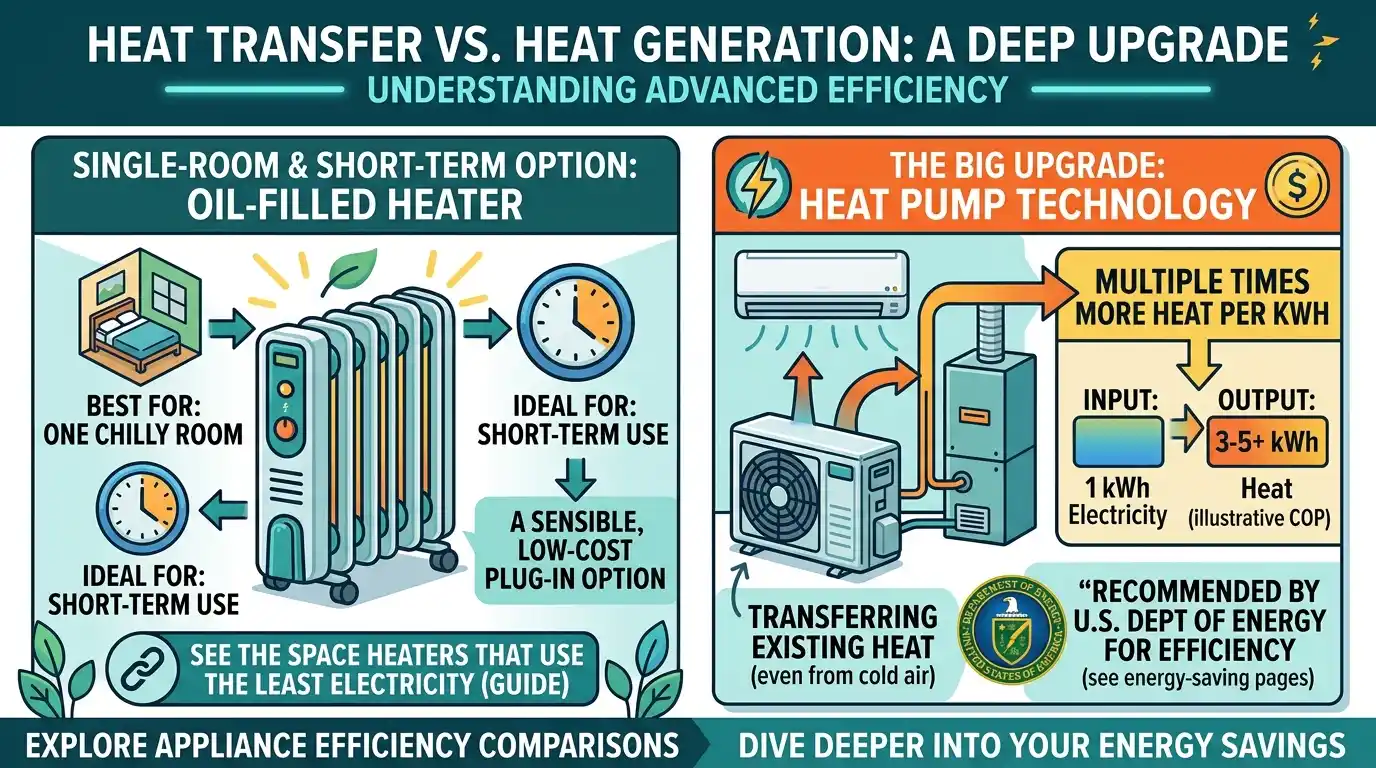
The big upgrade is not another plug-in heater, should you want to reduce your bill. It is another technology. A ductless mini-split or heat pump does not generate heat, but rather transfers it, thus it can provide multiple times as much heat per kWh as any resistance heater. The Department of Energy of the U.S. talks about this in its energy-saving pages.
For a single cold room or short-term use, an oil-filled heater is still a sensible, low-cost choice. Our guide to the space heaters that use the least electricity helps you pick the lowest-draw option.
What Changes Your Electricity Use
- Wattage setting: The more the wattage, the more expensive per hour.
- Room size: It is a crude guideline of approximately 10 watts per square foot, so 1500 watts would be adequate in approximately 150 square feet with typical ceilings. Take this as a rough estimate.
- Insulation and drafts: Leaky windows cause the heater to operate longer.
- Outdoor temperature: The lower the temperature the more the heater will be on.
- Thermostat control: Each additional degree will increase the runtime.
- Your electric bill: The identical heater is much more expensive in a high-rate state.
- Runtime: Hours of use are more important than any other single factor.
How to Lower Your Oil-Filled Heater’s Electricity Use
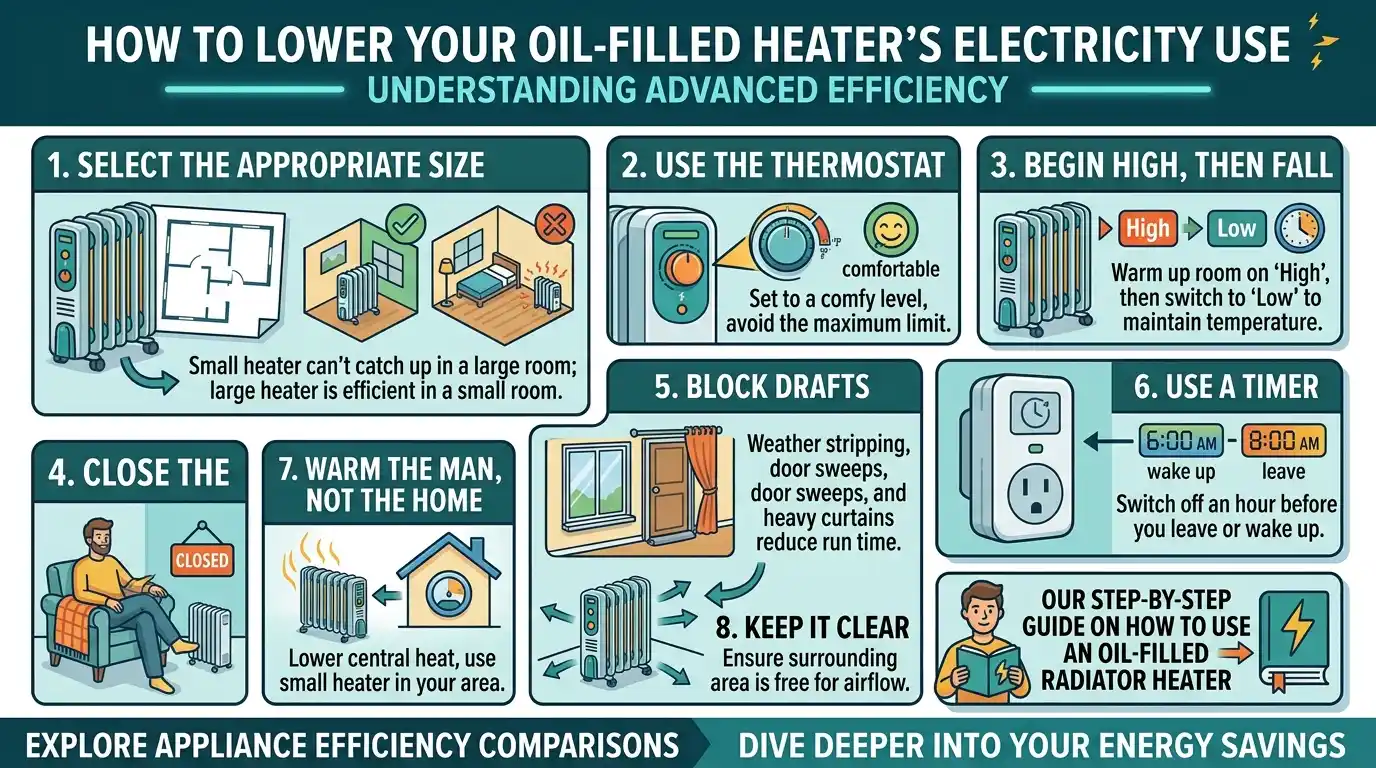
- Select the appropriate size. A large heater in a small room does not waste anything, in theory, but a small one operates 24/7 and never catches up.
- Use the thermostat. Adjust to a comfortable temperature without the highest limit.
- Begin high, then fall. Warm up on the highest setting and then change to low to maintain the temperature.
- Close the door. Turn on the heat in the room you are in.
- Block drafts. Door sweeps, weather stripping and heavy curtains reduce run time.
- Use a timer. Switch off an hour before you leave or wake up when the room has some heat.
- Warm the man, not the home. Turn down the central thermostat and operate the small heater in the area where you actually sit.
- Keep it clear. Keep the area surrounding the heater free to allow air to flow.
Our guide on how to use an oil-filled radiator heater covers the settings step by step.
Safety Basics for Power and Circuits
There is more than the bill to running a heater. Both the U.S. Consumer Product Safety Commission and the National Fire Protection Association caution that space heaters are the number one cause of home heating fires.
- Connect the heater to a wall outlet. Extend cords and power strips are to be avoided.
- Do not use the circuit with other high-draw appliances like a microwave or hair dryer.
- Maintain a minimum of 3 feet distance between it and curtains, bedding, and furniture.
- Do not cover it or hang laundry on it unless the manufacturer has indicated otherwise.
- Select a model that has a tip-over and overheat protection.
- Inspect cord and plug, look for damage or excessive heat.
Common Mistakes
- Leaving it running all night with the thermostat set to the fullest.
- Using it in a large, drafty room it cannot keep up with.
- Attaching it to a long, thin extension cord.
- Comparing wattage, rather than runtime and room size.
- Leaving out the local electricity rate when estimating costs.
Is an Oil-Filled Heater Worth It?
Yes, in case you would wish to have quiet, constant, supplemental heat to one room and you will use the thermostat. Take into consideration something other than:
- You need to heat a large open space.
- You desire almost instant heat. A fan or infrared heater is quicker.
- It will be your primary source of heat during the winter. A heat pump will conserve more.
For a fuller look at the value question, see whether oil heaters are economical.
FAQs
Do oil-filled heaters use a lot of electricity?
No more than other electric heaters of the same wattage. A 1,500-watt model consumes 1.5 kWh/h at full power, with an estimated cost of 27 cents at 18 cents/kWh. The thermostat minimizes real consumption.
How much does it cost to run an oil-filled heater for 24 hours?
At full power, a 1,500-watt heater would use 36 kWh, about $6.48 at 18 cents per kWh. In the case of thermostat cycling, the actual value is generally a lot less than that.
What is the wattage of an oil-filled space heater?
The majority use 600-1,500 watts according to the environment. The rating is printed on the label of your unit.
Do oil-filled heaters cost less to operate than fan heaters?
They were equally expensive to operate at full power per hour at the same wattage. Models that are filled with oil might turn off more frequently due to the fact that the oil retains heat, yet the outcomes are variable depending on the room.
Can an oil filled heater be left overnight?
Most of them have tip-over and overheat protection, although any space heater should be used with caution, according to safety agencies. Always follow your manual, maintain clearance and never use an extension cord.
Do oil-filled heaters use electricity when turned off?
If it is switched off or unplugged, it uses none. There are models that have digital displays, which attract a small standby when it is plugged in.
Does an oil filled heater consume more power when on high?
Yes. The higher the setting, the greater the wattage, hence greater cost per hour.
Which is cheaper a space heater or central heating?
It is less expensive when you turn on the heating of only one room in use and turn down the central thermostat. When you have multiple heaters operating in the entire house, it tends to be more costly.
What is my own heater cost?
Divide watts by 1000, multiply by hours used and multiply by your per kWh rate on your bill.
Are oil-filled heaters more energy-saving than electric baseboards?
They are both resistance heaters and are similar in effectiveness. The savings are due to zone heating and use of thermostat as opposed to the type of heater.
What is the size of an oil-filled heater that I require?
It is roughly 10 watts per square foot, or 1,500 watts in 150 square feet. The need is increased by poor insulation or high ceilings.
Why is my electric bill more with a space heater?
Heaters are high power appliances. A few hours a day will soon be noticed, particularly when the power is costly or the room is drafty.
Are oil-filled heaters required to have special circuit?
Not mandatory, but other heavy loads on the same circuit can be avoided, which reduces the probability of tripped breakers.
Final Thoughts
Oil-filled space heater is not a high consumer of electricity in comparison to other plug-in heaters. It consumes precisely what its wattage indicates, and no more, and it conserves money when the thermostat performs its task.
The actual levers of your bill are runtime, room size, drafts and your local electricity rate.