Do Radiant Heaters Use a Lot of Electricity? What They Really Cost to Run and How to Spend Less

Are radiant heaters energy consuming? Yes, a good deal, per hour. A 1,500 watt radiant heater would cost about 27 cents an hour with an electric rate of 18 cents per kWh. That is no little thing, and it is not a catastrophe, either. It depends on how long it lasts and what you are comparing it to that it will feel like a lot.
This guide provides you with the precise formula, actual cost figures, candid comparisons with other heaters, and viable means of keeping the bill down to earth.
Quick answer
An average radiant heater uses as much as 1,500 watts, the maximum safe current on a standard household outlet. A lamp or a TV can hardly compare to that amount of power per hour. But since it heats you and the objects around you directly, it can frequently replace the heating of an entire house and that is where the savings come in.
Key Takeaways
- The typical power of most plug-in radiant heaters is 300 to 1,500 watts.
- Running cost = kilowatts x hours x your rate per kWh.
- Radiant heaters convert virtually all electric power to heat, just like oil-filled and fan heaters. They do not work more effectively as marketing tends to imply.
- They will only save money when they allow you to heat a small space and set the central thermostat lower.
- Heat pumps consume minimal electricity compared to any plug-in electric heater to the same amount of warmth.
What Is a Radiant Heater?
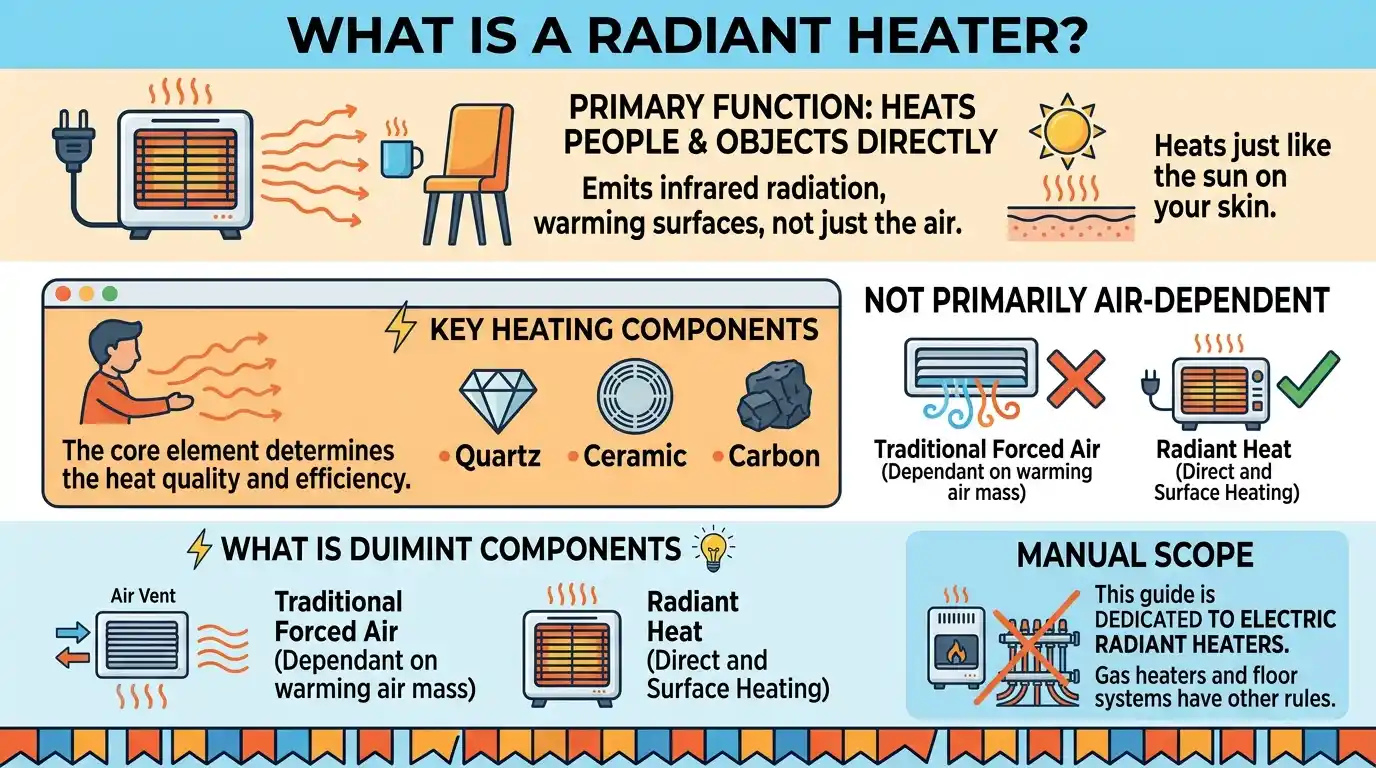
An infrared heater (also known as a radiant heater) is a device that heats people and objects with infrared radiation. It is not primarily dependent on heating the air. The heating component is typically quartz, ceramic or carbon and it heats just like the sun on your skin.
This manual is dedicated to the electric radiant heaters. Radiant floor systems and gas radiant heaters have other cost rules.
If you want a broader look at how these devices work, read our guide on how a space heater works.
How Much Electricity Does a Radiant Heater Use?
The majority of portable radiant heaters consume up to 1,500 watts when on high. Most of them have lower power of about 750 or 1,000 watts and small desk ones can consume 300 to 500 watts. Garage and workshop hardwired 240 V panels may have higher current limits, so be sure to look at the label on your unit.
The simple formula
Electricity cost is easy to work out:
Watts divided by 1,000, times hours used, times your rate per kWh.
On your electric bill, you can see your precise rate. The U.S. Energy Information Administration releases the average residential rates by state, and they are significantly different.
Why 1,500 watts is the usual ceiling
A typical 15 amp, 120 volt circuit can power approximately 1,800 watts at full load, although safety regulations consider long-run loads to be 80 percent of that.
That is around 1,440 watts, hence the reason why plug-in heaters have a maximum of 1,500. You can short the circuit of the breaker in case other devices are in the circuit.
How Much Does a Radiant Heater Cost to Run?
Three example rates of electricity per hour. Take the nearest one to yours.
| Heater power | At 12 cents per kWh | At 18 cents per kWh | At 30 cents per kWh |
|---|---|---|---|
| 500 watts | $0.06 | $0.09 | $0.15 |
| 1,000 watts | $0.12 | $0.18 | $0.30 |
| 1,500 watts | $0.18 | $0.27 | $0.45 |
The larger view of a 1,500 watt heater operating at full power all day:
| Usage | At 12 cents | At 18 cents | At 30 cents |
|---|---|---|---|
| 8 hours a day | $1.44 | $2.16 | $3.60 |
| 30 days at 8 hours a day | $43.20 | $64.80 | $108.00 |
These are maximum limits. The thermostat of most heaters switches the element off when the room is comfortable, reducing real usage. These are just examples of rates, not the official rates, so enter in your own.
Quick fact: Electric resistance heaters convert almost all the electricity they use into heat. Whatever the style, a watt in is a watt out.
Do Radiant Heaters Use More Electricity Than Other Heaters?
No. At the same wattage, a radiant heater uses the same electricity as an oil-filled radiator or a fan heater. This distinction lies in the method of delivery of the heat and its perception.
| Heater type | Typical max power | How it heats | Best for |
|---|---|---|---|
| Radiant (infrared) | Up to 1,500 W | Warms people and objects directly | Spot heating, drafty or open spaces |
| Oil-filled radiator | Up to 1,500 W | Warms air slowly, holds heat | Steady heat in closed rooms |
| Fan heater | Up to 1,500 W | Blows warm air fast | Quick burst of warmth |
| Heat pump (mini split) | Often 500 to 1,500 W input | Moves heat instead of making it | Regular heating at the lowest electric cost |
For deeper numbers on the others, see how much electricity an oil-filled radiator uses and what a fan heater costs per hour, day and month.
The plain and simple: any assertion that a radiant heater consumes much less electricity than any other electric heater with the same wattage is a misstatement. The only common one that actually consumes less power to provide the same amount of heat is a heat pump since it does not generate heat but transfers it.
Why a Radiant Heater Can Still Lower Your Bill
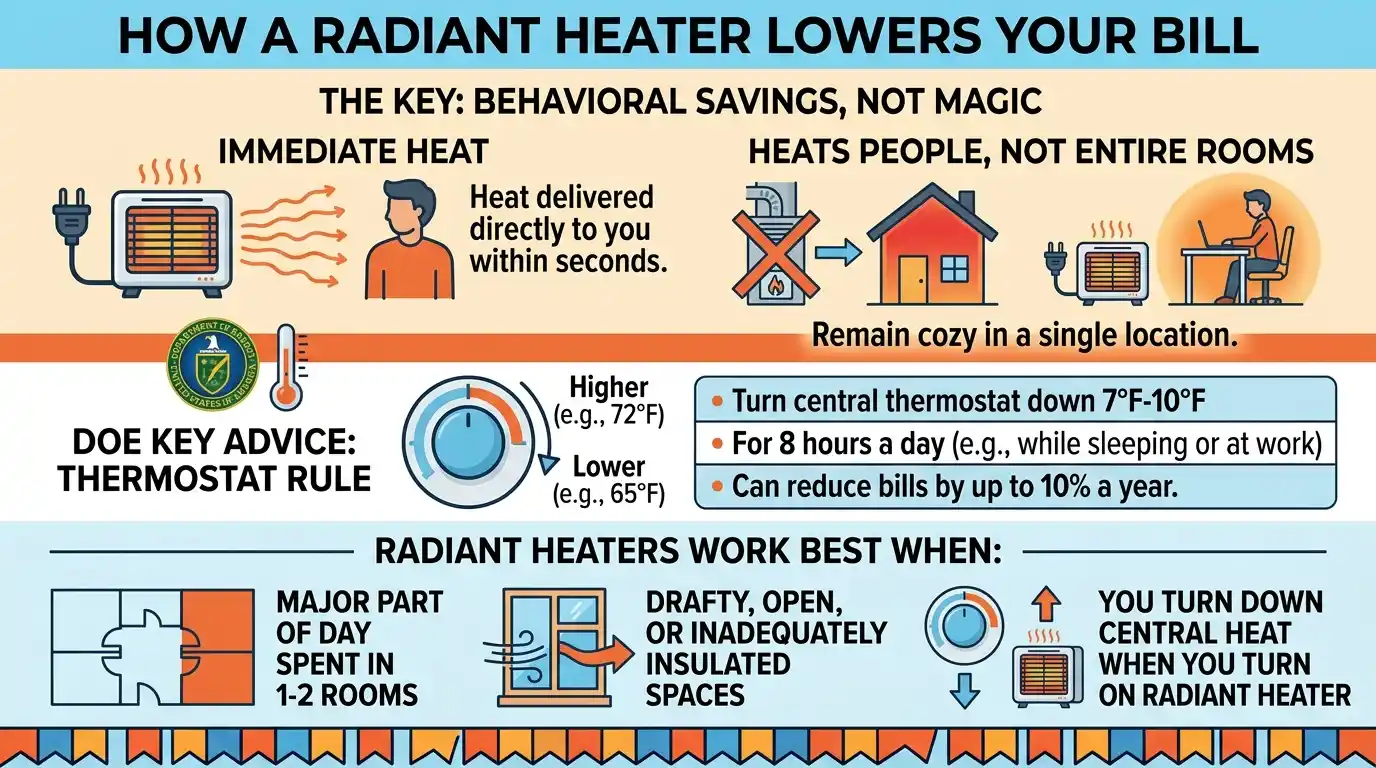
The magic is behavioral, not magic. The radiant heat is delivered to you within a few seconds, thus you are warm without the need to warm the entire room. It matters whether you sit at a desk or work in a garage.
According to the U.S. Department of Energy, you can reduce your heating bills by up to 10 percent a year by turning down your thermostat 7 to 10 degrees Fahrenheit 8 hours a day. A radiant heater simplifies that since you remain cozy in a single location as the remainder of the house remains cooler.
It works best when:
- You spend the major part of the day in one or two rooms.
- It is a drafty space, open or inadequately insulated, in which warm air would escape in any case.
- You are free to turn down the central thermostat when you turn on the heater.
When a Radiant Heater Costs More Than It Should
Radiant heaters are costly when they are requested to perform the incorrect task.
- Heating a large room or whole home. A single 1,500 watt unit is suitable to use in a spot or a small room.
- Running it all day with the central heat also on. You are charged twice the same warmness.
- Leaving it on in a room without any people. Radiant heat can be of help only so long as a person is in its way.
- Working in an open door room. The warmth you pay to fly away.
- Ignoring your rate. The same heater is twice as expensive in high rate areas.
The usual guideline is approximately 10 watts per square foot of a room with standard ceiling. That is, 1,500 watts would be appropriate to 150 square feet. Use it as a broad outline at best, as insulation and climate change the answer.
Not sure which heater type fits your space? Our guide to the best type of space heater walks through the options.
How to Estimate Your Own Radiant Heater Cost
- Determine the wattage on the label or in the manual.
- Divide it by 1,000 to get kilowatts.
- See your electric bill to see your rate per kWh.
- Determine the number of hours that you are going to use it per day.
- Multiply kilowatts, hours and rate. Divide by 30 to get a monthly amount.
- Minus a bit when the heater has a thermostat and switches off. Many do.
To be more accurate, a plug-in electricity usage monitor will display the actual consumption in a week.
How to Cut Radiant Heater Electricity Use
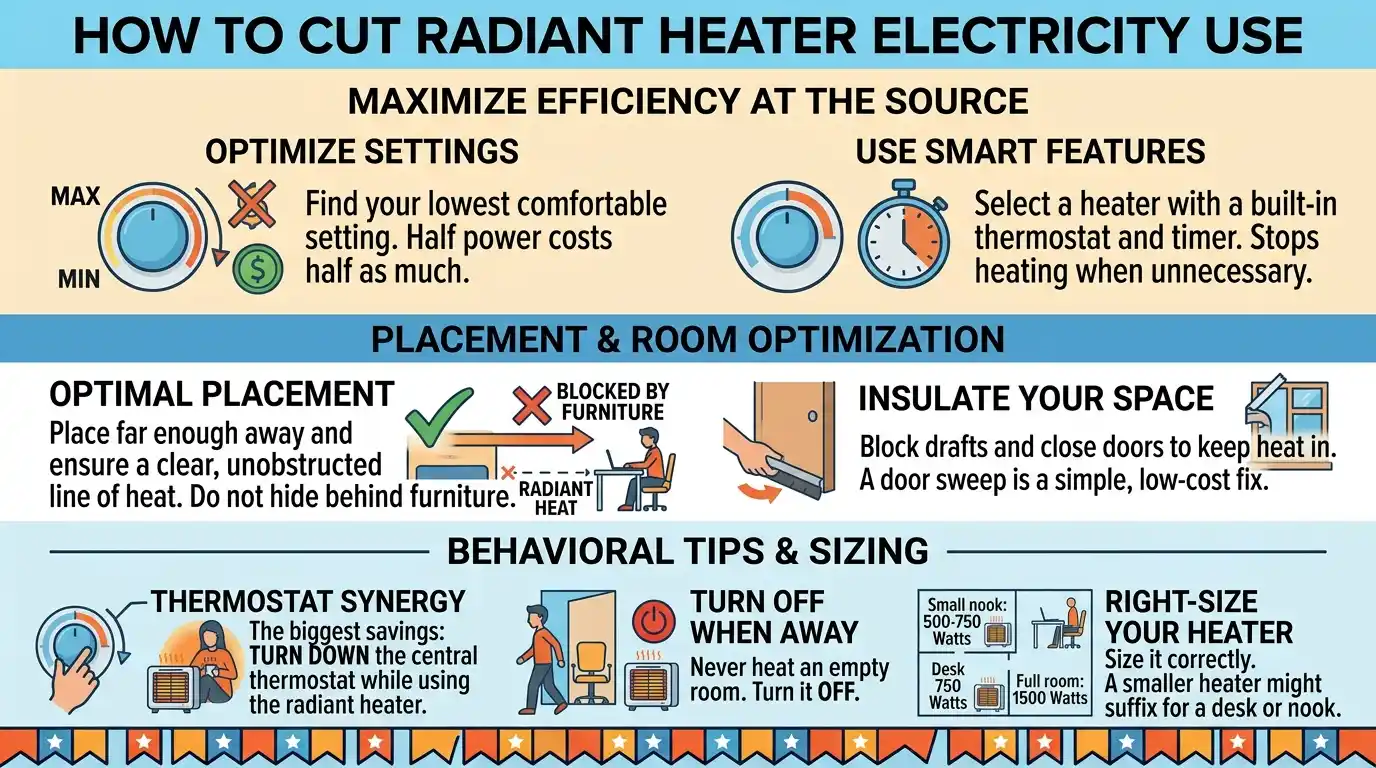
- Make the lowest setting comfortable to you. A half power will cost half as much.
- Select a heater that has a variable thermostat and timer. It ceases heating when you are hot.
- Place it far enough away so that you are not sitting near it. Radiant heat is most effective when there is a clear line to you, and is not obstructed by furniture.
- Block drafts and close doors. A door sweep is less expensive than additional heating time.
- Turn down the central thermostat while you use it. The real savings are found here.
- Switch off when away. There is no benefit to heating an empty space.
- Size it correctly. A 500 or 750 watt unit might suffice in a desk or small nook.
See more ideas in our guide on which space heaters use the least electricity.
Safety: Low Cost Is Not Low Risk
The National Fire Protection Association claims that portable heaters are the primary cause of house heating fires. Follow these basics:
- Store anything that can burn at least 3 feet away.
- Directly plug into a wall outlet. Do not use extension cords and power strips.
- Select a model that has tip-off and overheat features.
Never leave it on when you are asleep or away unless the manufacturer specifically permits it, and in that case exercise care. - Check the cord for damage before each season.
Common Mistakes to Avoid
- Purchasing on wattage without verifying your rate.
- Using a radiant heater as the only heat for a large area.
- Operation with central heat on high as well.
- Concealment behind furniture where the heat is not absorbed.
- Leaving it plugged in a common circuit with other high draw devices.
Is a Radiant Heater Right for You?
Select a radiant heater when you want to warm up one area quickly, you work in a drafty or an open area, or you intend to reduce your central thermostat.
Use something different when you require continuous heat in a closed room throughout the day (an oil-filled radiator can suit that, see are oil heaters expensive to run), or when you heat the same area multiple hours a day and can install a heat pump.
FAQs
Do radiant heaters use a lot of electricity?
A 1,500 watt model uses 1.5 kWh per hour, which costs about 27 cents at 18 cents per kWh. That is average per hour but accumulates when it is operating throughout the day.
How many watts does a radiant heater use?
The majority of portable models consume 300-1500 watts. See the label on your unit to get the exact figure.
How much does it cost to run a radiant heater per hour?
Multiply kilowatts by your rate. The cost of a 1,500 watt heater is 18 cents at 12 cents per kWh and 45 cents at 30 cents per kWh.
Are radiant heaters energy efficient?
They use almost all electricity to heat, as do other electric heaters. They can provide warmth well to an individual but are not less expensive than other electric ones.
Is it cheaper to operate radiant heaters than oil-filled heaters?
Not on the same wattage. Oil-filled units store heat and turn on and off, thus overall use may vary by room and habits.
Is a radiant heater less expensive than central heating?
You can tell whether you turn on one small section and turn down the thermostat in the middle. It tends to be more costly when it is used to substitute effective whole-home heating.
Is it possible to leave a radiant heater on overnight?
The majority of the safety advice is no. Use a purpose-made model, with timer and tip-over protection, and read the manual.
Are radiant heaters more electrically consuming than fan heaters?
No. At equal wattage they use the same amount.
What can I do to reduce my radiant heater bill?
Turn down your central heating, use a lower setting, a timer and thermostat, block drafts and use a lower setting.
How big a radiant heater do I need?
An average estimate is 10 watts per square foot. A 1,500 watt heater can be used in approximately 150 square feet, or less in cold or drafty areas.
Will a heater with a radiant bulb breaker?
It can when there are other devices on the circuit. A 1,500 watt heater alone requires nearly a 15 amp circuit.
What uses less electricity than a radiant heater?
A heat pump produces more heat per unit of electricity than any resistance heater.
Final Thoughts
Radiant heaters do require a lot of electricity per hour but not more than other plug-in electric heaters of the same power. The actual question is what you do with them. Spent a few hours in the room in which you really are, they may warm you as you turn the rest of the house off. They are used throughout the day to warm a big area and can be expensive in a short time.
Do the rough computation with your personal rate, select a size that suits your room, and observe the safety fundamentals. Next: Find your kWh rate on your last bill and calculate your heater today.