Is It Safe to Use a Kerosene Heater Indoors? A Complete Safety Guide
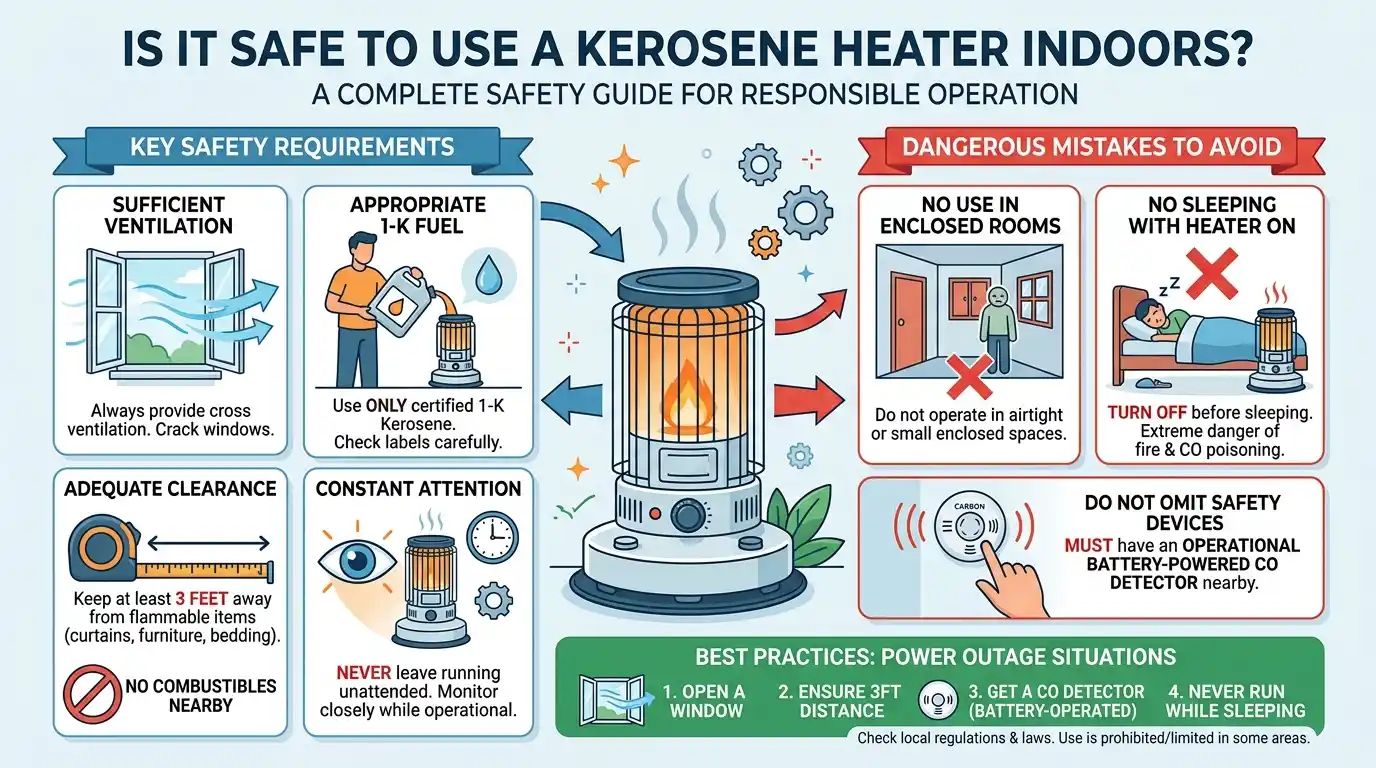
Before you read further, some quick facts: a kerosene heater is not necessarily safe because it is indoors, and has been turned on low. It is a question of whether or not it is actually safe depending on the ventilation, the type of fuel used, where it is located and how much attention you pay to it during its operation. Omit one of them and the risk alters rapidly.
The Quick Answer
Indoors: A kerosene heater may be operated safely, but under certain conditions: sufficient cross ventilation, appropriate 1-K kerosene fuel, adequate clearance between the heater and anything flammable, and constant attention. One should not operate it in an enclosed room, in a bedroom when sleeping or without an operational carbon monoxide detector in the vicinity. Indoor use is also prohibited or limited in some states and cities, and the legal response may be as important as the technical one.
When you have a power outage and are heating with a kerosene heater and you need heat now, the short of it is this: open a window, make sure the heater is at least three feet away from anything that can burn, never leave the heater running when you sleep, and get a battery-powered CO detector in the room before you light it.
How a Kerosene Heater Actually Works
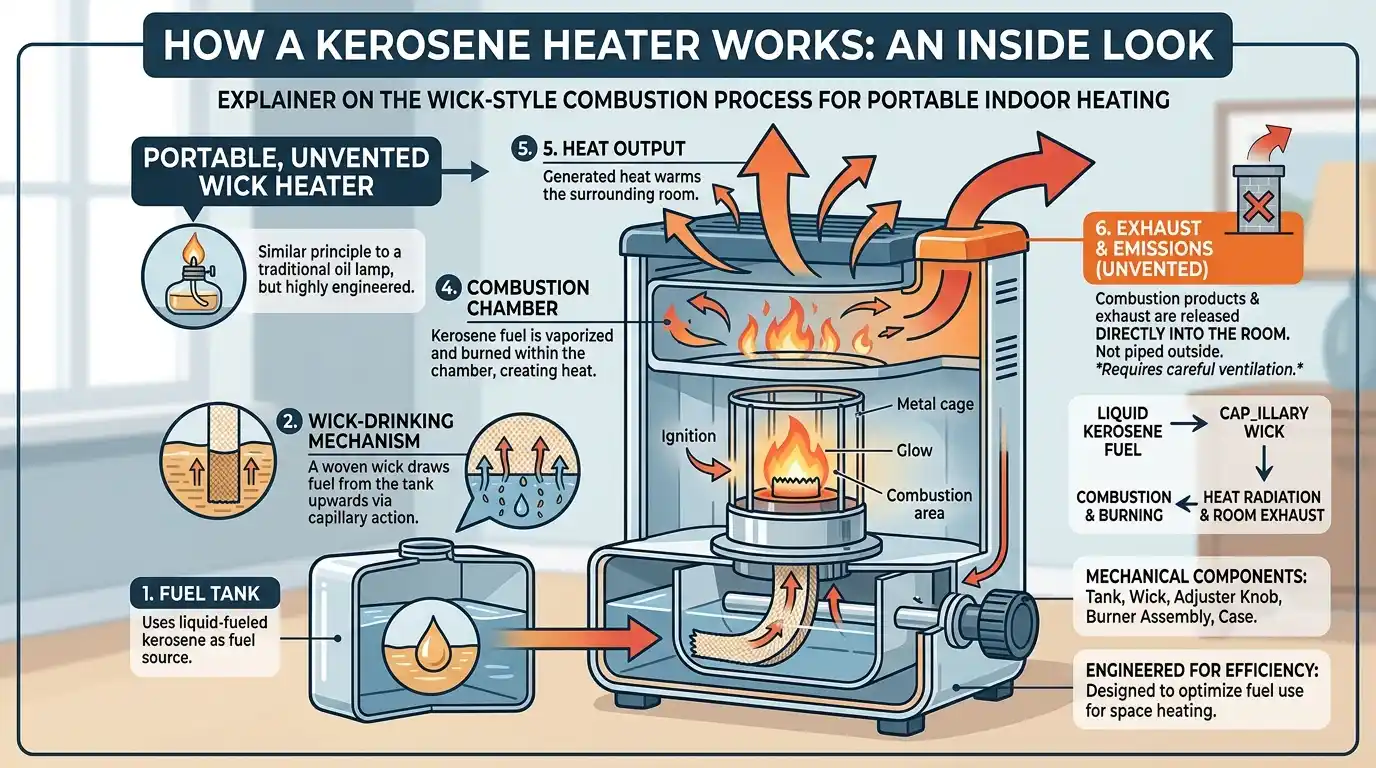
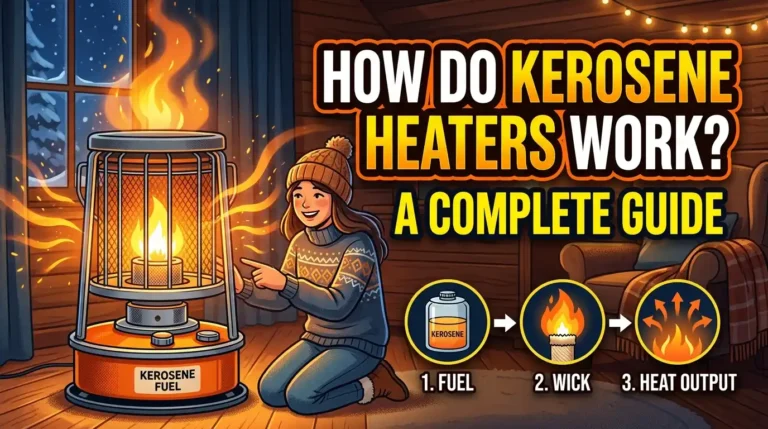
A kerosene heater is a type of liquid-fueled heater that uses a wick to burn kerosene fuel or a pressurized burner to burn liquid fuel in a burner, which is then used to heat a room, much like an oil lamp but engineered to do so.
Portable, unvented, wick-style heaters, or in other words, the exhaust produced during the combustion process is not piped outside of the room but directly released into the room, most residential units sold today. If you want the full mechanical breakdown before you buy, this explainer on the combustion process behind these units covers it in depth.
Wick heaters vs pressure-fed heaters
Wick heaters are used to pull fuel through a cotton or fiberglass wick and then burn. They are the most prevalent in houses and come in either radiant (heating the immediate area in front of them) or convection type (heating the air that circulates around a room). Pressure-fed heaters are forced through a nozzle, like a furnace burner, and are more prevalent in larger portable or job-site units.
Vented vs unvented designs
This is what is most important to safety. A vented heater vents combustion byproducts to the outside via a flue or chimney. Most consumer kerosene space heaters are unvented heaters, meaning that the exhaust, including carbon monoxide, is emitted directly into the living area.
That is why these units do not have ventilation as an option. It is the only thing that can prevent the normal operation and accumulation of hazardous gas.
The Real Risks of Using One Indoors
Carbon monoxide buildup
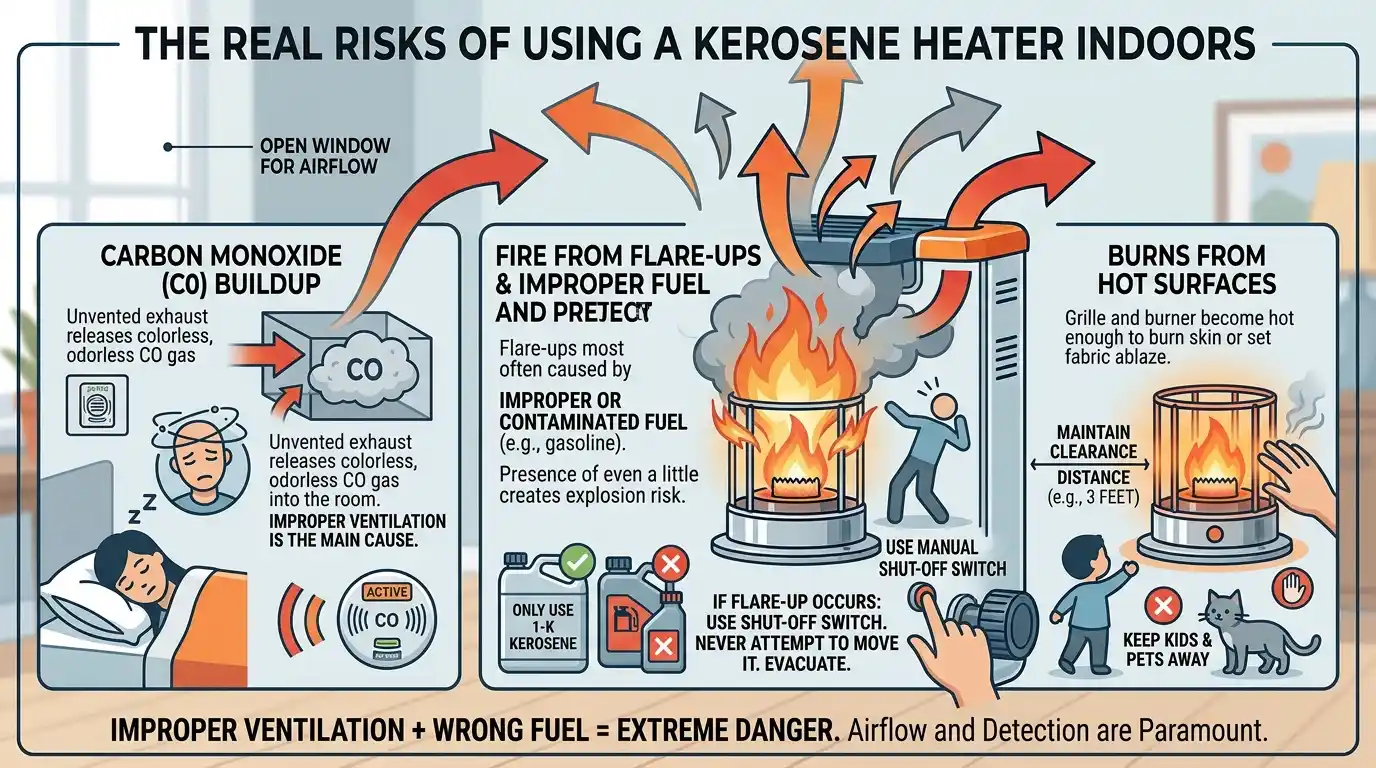
Kerosene burning also generates carbon monoxide, an odorless, colorless gas that is harmful because you cannot detect it without a machine. One of the known dangers of gas, wood, kerosene, and electric space heaters is carbon monoxide poisoning due to improper ventilation of fuel-burning equipment.
In an unvented heater, the gas can only escape to the room, which is why airflow and detection are more important than nearly anything on this list.
Fire from flare-ups and contact with fuel
A federal review of kerosene-related accidents found that uncontrolled flaming, known as flare-up, most often results from using improper or contaminated fuel. This risk is significantly increased by the use of gasoline, camp fuel or contaminated kerosene in place of the correct 1-K kerosene. The presence of even a little gasoline or other volatile fuels or solvents in kerosene can significantly enhance the likelihood of a fire or an explosion.
Should a flare-up occur, do not give in to the urge to pick up and relocate the heater. Any attempt to move or carry a flaring heater may only aggravate the fire; call the fire department by using the manual shut-off switch (where available) and where it does not extinguish the fire, leave the house.
Burns from hot surfaces
The metal grille and burner chamber become hot enough to set fabric ablaze or leave skin burns when touched, hence the presence of manufacturer clearance distances and the need to keep kids and pets away when using an operating unit.
Indoor air pollution beyond carbon monoxide
Carbon monoxide isn’t the only pollutant. Carbon dioxide, nitrogen dioxide and sulfur dioxide can also be emitted by kerosene heaters and this is especially dangerous to pregnant women, asthmatic individuals, individuals with cardiovascular disease, the elderly and young children. This is one of the reasons why wick height and ventilation are important even in cases where the levels of carbon monoxide appear low.
Is It Legal to Use a Kerosene Heater Indoors Where You Live?
This is the section that most safety guides do not cover, and it must not be. The use of unvented kerosene heaters indoors is limited or prohibited altogether in certain locations. The state law of Massachusetts, which forbids the use, the permissibility of the use, the sale, or the offer of sale of any unvented liquid-fired space heater, makes the use of kerosene heaters indoors illegal, and fire departments are actively warning residents against it when the weather is cold.
Similar restrictions on the use of unvented liquid-fuel heaters have been implemented in other states and individual cities over the years, and local fire codes may impose additional restrictions on top of the state law.
Before you buy or use one, check your state fire marshal’s office and your local municipal code. This is one step that is always overlooked and it is what makes a safety decision and a legal decision.
When a Kerosene Heater Can Be Used Indoors Safely
Ventilation requirements
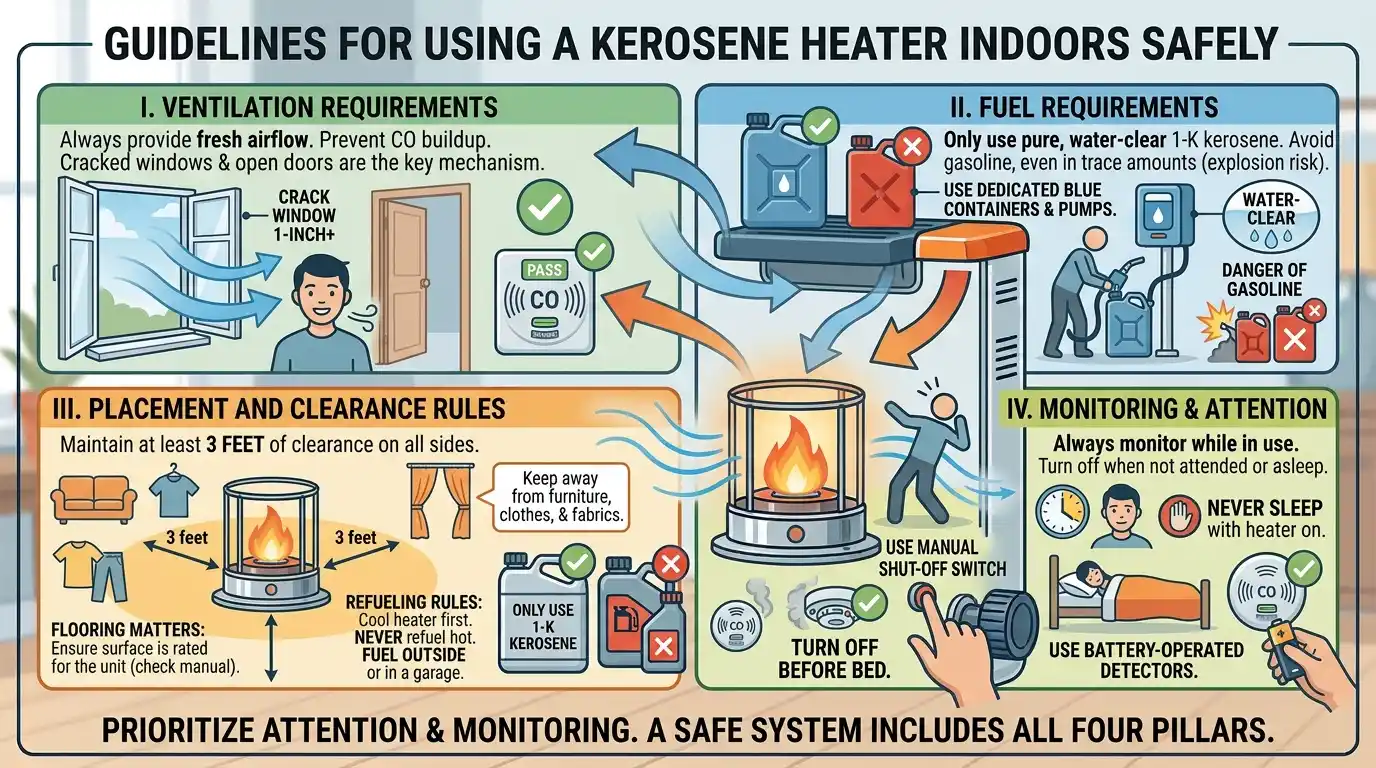
Always have the door to the room open when using the heater, and observe all relevant code requirements of the space being heated. It is advisable to have an outside window open with an inch or so to allow sufficient fresh air to enter the house as the heater operates. It is not a hint, but the mechanism that prevents the concentration of carbon monoxide in the room, a broken window or an open interior door.
Fuel requirements
Only water-clear 1-K grade kerosene should be used, and never gasoline, as gasoline is not the same fuel and even a few drops combined in the fire and explosion hazard increases significantly. Keep kerosene in a separate container, not a can that used to hold gasoline, and kerosene containers are usually blue whereas gasoline containers are usually red as a visual protection. When filling the pump, use the special kerosene pump and not a gasoline pump, as some stations store the two on different islands to prevent confusion.
Placement and clearance rules
Always maintain a distance of at least three feet between the heater and furniture or clothing and never refuel the heater when hot. Fuel up outside or in a garage, when it has cooled down, to prevent spilling fuel on a hot burner. Flooring matters too, and if your setup includes carpet, check what surfaces are actually rated for placement underneath the unit before you set it down for the season.
Monitoring while it runs
Always turn off a kerosene heater when not in use and never leave it on when all the people in the house are asleep. Placing at least one smoke detector in the vicinity of every sleeping area or on every level of the house is a minimum measure, and a plug-in or battery CO detector in the same room as the heater is equally necessary, although not always noted by fuel manufacturers.
Where You Should Never Use a Kerosene Heater
- In a bedroom when someone is sleeping.
- In the closet, camper, tent or any small airtight area.
- in a room that has neither window nor door that can be opened.
- In a room where a carbon monoxide detector is not functioning.
- Any state or city in which your state or city forbids unvented indoor heaters.
- Within three feet of the curtains, bedding, or stacked paper, or any flammable material.
Carbon Monoxide Poisoning: Symptoms to Watch For
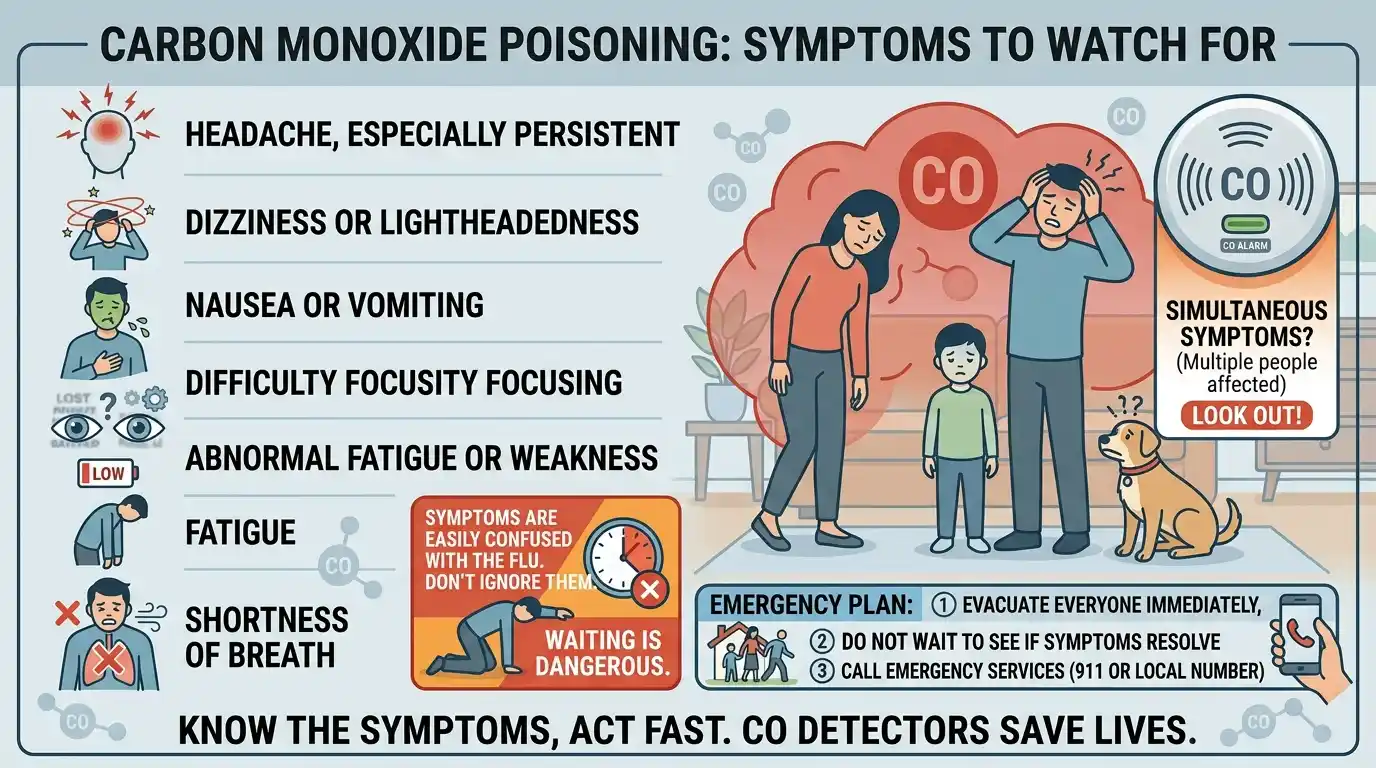
The symptoms of carbon monoxide are easily confused with the flu or even plain fatigue, and this is one of the reasons why low level exposure is dangerous. Watch for:
- Headache, especially one that doesn’t go away
- Dizziness or lightheadedness
- Nausea or vomiting
- Lost or difficulty focusing.
- Abnormal fatigue or weakness.
- Shortness of breath
In case the symptoms appear in more than one occupant of the home simultaneously, particularly when a fuel-burning heater is on, evacuate everyone and call emergency services. Waiting to see whether the symptoms will resolve on their own is not advisable.
Kerosene Heater Safety Checklist
- Make sure that it is not prohibited in your state and city to be used indoors.
- 1-K kerosene should be used, and kept in a separate, clearly labeled container.
- Have a window open or a door open so it can cross ventilate all the time it is running.
- Place a working carbon monoxide detector in the same room
- Have a minimum of three feet of space between furniture, bedding and curtains.
- Do not refuel with the heater on or hot.
- Do not leave it unattended or at night when sleeping.
- Do not leave kids and pets on the grille and hot surfaces.
- Before lighting the manual shut-off switch, know where it is.
- Have a functional smoke detector in all levels of the house.
New to these units? Walking through the correct lighting and shutdown sequence before your first use will make every point on this list easier to follow.
Common Mistakes People Make
Much of the danger of these heaters is due to a few common errors instead of the device itself. They are operated in closed bedrooms by people overnight. They substitute gasoline or contaminated fuel when they’re out of kerosene. They do not check the CO detector as the heater appears okay.
During a cold night, they put them too near to bed without considering the three-foot rule. All these transform a heater that can be safely used into one that cannot.
Kerosene Heater vs Other Portable Heater Types
| Heater type | Produces carbon monoxide indoors | Ventilation needed | Typical restrictions |
|---|---|---|---|
| Unvented kerosene heater | Yes | Constant fresh air exchange | Banned or restricted in some states and cities |
| Unvented propane heater | Yes | Constant fresh air exchange | Similar restrictions in many areas |
| Electric space heater | No | Not required for combustion gases | Mainly fire clearance rules, no CO risk |
| Vented gas heater (flued) | No, exhaust goes outside | Requires proper flue installation | Generally allowed with correct installation |
Electric heaters have the risk of clearance and electrical faults, but they do not generate combustion gases, the primary cause why many households switch to them to heat overnight or bedrooms and reserve kerosene units to be used under supervision and ventilation during daytime outages.
FAQs
Is it safe to use a kerosene heater indoors?
It may be employed indoors but under stringent requirements: it must be ventilated with fresh air the whole time it operates, it must use the correct amount of 1-K fuel, it must have a clearance of flammable substances, it must have a functional carbon monoxide detector, and it must be continuously monitored. Without all of these, it isn’t safe.
Will a kerosene heater be the death of you?
Yes. The primary reasons include carbon monoxide poisoning due to lack of ventilation and house fires due to flare-ups, contaminated fuel, or exposure to combustible materials.
Is it safe to leave a kerosene heater on at night when you sleep?
No. It is always recommended by manufacturers and safety agencies that no unvented combustion heater should be run when there are people asleep in the house because a problem can be created before anybody realizes.
Are kerosene heaters a source of carbon monoxide?
Yes. Almost all consumer kerosene space heaters are unvented, that is, the products of combustion, such as carbon monoxide, are released into the room, rather than outside.
What is the required amount of ventilation of a kerosene heater indoors?
At least make a window opening an inch or an interior door open during the whole time the heater operates, besides the room having a certain amount of airflow. This isn’t a one-time step, it needs to continue as long as the heater is on.
Is it safe to use a kerosene heater in a bedroom?
It is not advisable, particularly at night. Bedrooms tend to be smaller and more confined, and sleeping occupants are unable to react to the initial signs of exposure to CO.
What is the fuel to be used in a kerosene heater?
Only water-clear 1-K grade kerosene. Never substitute gasoline, camp fuel, or kerosene that’s been stored in a container that previously held another fuel.
Can kerosene heaters be used indoors?
It depends on your location. Indoor use of unvented liquid-fired space heaters is legally banned in some states, such as Massachusetts, and may be further restricted by cities. Before using one, check with your state fire marshal.
What will I do in case of a kerosene heater flare up?
Do not attempt to move, or carry it. Use the manual shut-off switch in case it exists. In case the fire does not subside, vacate the house and call the fire department outside the house.
What is the maximum distance between furniture and a kerosene heater?
Maintain a minimum of three feet distance between the heater and furniture, bedding, curtains or any other flammable material.
What are the effects of carbon monoxide poisoning?
Headache, dizziness, nausea, confusion, fatigue and shortness of breath. When these symptoms occur in more than one individual in the same area and a fuel heater is on, move out of the area and call for help.
Is it possible to refuel a kerosene heater when it is on?
No. Never keep it on and always allow it to cool down before refueling, and never refuel it inside or in a garage that is not well ventilated.
Should I have a carbon monoxide detector when I have a kerosene heater?
Yes, a battery or plug-in CO detector in an adjacent room is among the most crucial safety additions you can make, as carbon monoxide is colorless and odorless.
Should a kerosene heater be preferred or disliked to a propane heater to be used indoors?
They have similar risks. Both are normally unvented and both generate carbon monoxide, thus the same rules of ventilation and monitoring apply to both.
Is it safe to use kerosene heaters during a power outage?
Yes, with the same precautions: proper fuel, open window or door, no flammables in the area, a CO detector, and a person awake and watching it all the time.
Final Thoughts
A kerosene heater is not necessarily a dangerous device, however, it is not a set and forget device either. The danger is virtually all due to omissions: no ventilation, incorrect fuel, no detector, or operating it when nobody is paying attention. A kerosene heater can be a fairly safe backup heating system, provided you observe the ventilation, fuel, placement, and monitoring regulations each and every time, and you are sure that indoor use is legal in your locality.
In case you are not able to make all of those conditions regularly, an electric space heater eliminates the risk of carbon monoxide altogether and is also worth considering.