How to Attach a Mr. Heater to a Propane Tank the Right Way (No Guesswork)

Your Mr. Heater Buddy runs great on the little 1 lb bottles, until you realize you’re burning through one every few hours and it’s time to switch to a 20 lb tank. That’s usually where people get stuck, because the box doesn’t come with the hose you need, and half the advice online skips the one part that actually keeps the heater from clogging months down the road.
If you want a refresher on the science behind this kind of radiant warmth first, that’s worth a quick look, but here’s the exact hookup, in order, with nothing left out.
Key Takeaways
Mr. Heater Buddy and Big Buddy heaters already include a regulator, therefore you do not include a second regulator on the tank. What you require is a certified hose assembly, and an inline fuel filter. The filter is no mere ornament. It prevents the clogging of the heater by oil residue with time. The exact way the connection assembles, in sequence, and the safety checks that are important are listed below.
What You Need Before You Start
Prepare the following parts before handling a wrench. The most frequent cause of people being in the middle of the project is buying the wrong hose.
- A Mr. Heater Buddy, Big Buddy or Tough Buddy heater (Little Buddy heaters are designed to fit one 1 lb cylinder only, and do not support a bulk tank hookup).
- A 12 foot Mr. Heater hose assembly that is rated to this connection with a Type 1 (QCC1) acme fitting on the tank end, and a male disposable cylinder thread on the heater end.
- Mr. Heater fuel filter, which is sold separately of the hose.
- A typical 20 lb propane tank that has a modern OPD (overfill protection device) valve, nearly all refillable grill tank models sold in the US have had since 2002.
- A small spray bottle of dish soap and water, to check the leak.
- An adjustable wrench, which may be hand tight, is optional, but most of these fittings are hand tight.
The most popular option that is used to connect a 20 lb propane tank to a Big Buddy heater is a 12 foot hose with a regulator and quick connect that has its own regulator and acme nut and is easy to install. When you purchase a simple hose instead with no built in regulator, then the fuel filter is not optional but mandatory because a 20 lb or less tank requires a fuel filter whereas a 100 lb tank does not.
Step by Step: How to Attach a Mr. Heater to a Propane Tank
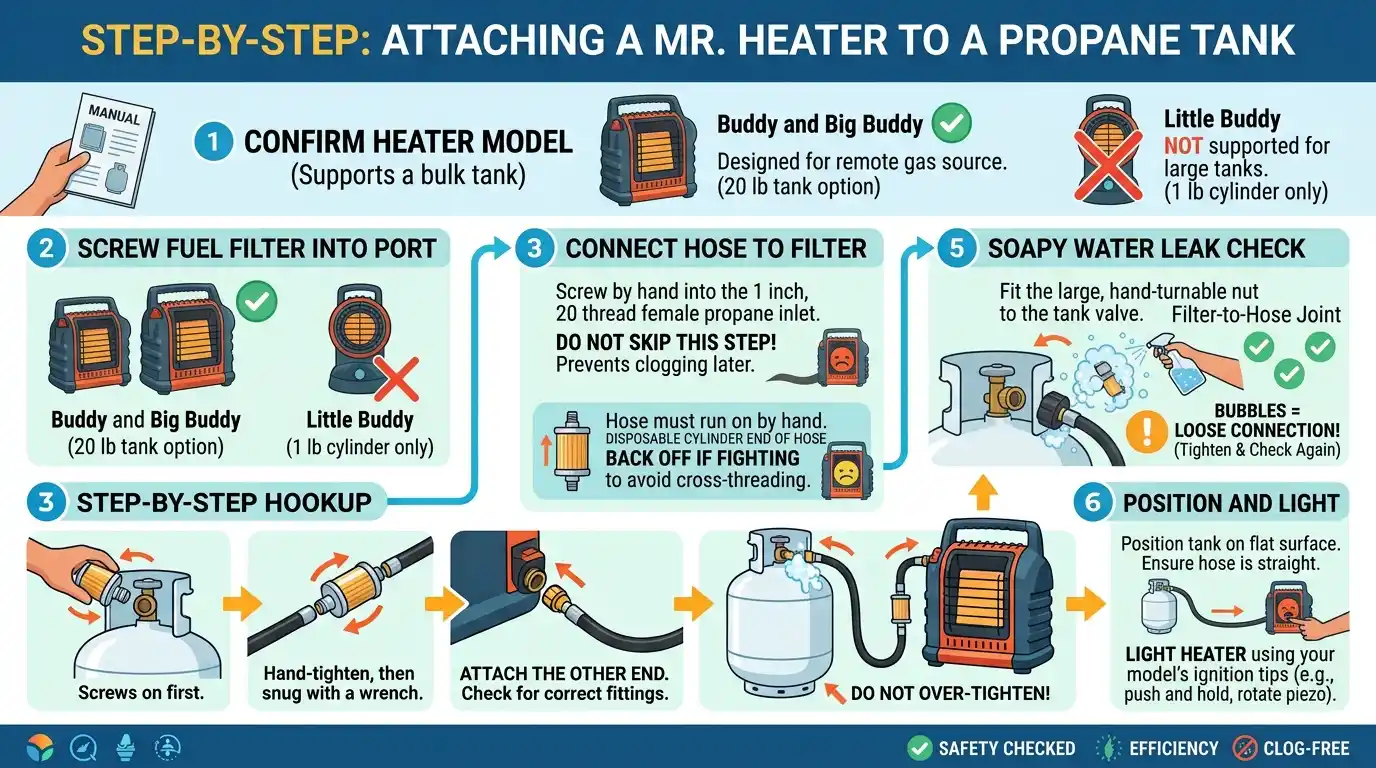
Step 1: Confirm your heater model supports a bulk tank
Look on the side of your heater or the manual. The models of Buddy and Big Buddy are designed to take a remote gas source. The Big Buddy has two 1 lb cylinders directly attached, and may be attached to a 20 lb cylinder with an optional hose, the hose and filter being sold separately of the heater itself.
Little Buddy heaters are only connected to one 1 lb cylinder and are not offered with a large tank that is supported by the manufacturer.
Step 2: Screw the fuel filter into the heater’s cylinder port
Find the threaded hole on the heater that a small bottle of 1 lb would screw into. Insert the fuel filter into the same port by hand until it fits. The filter is threaded into the 1 inch, 20 thread female propane inlet of the heater and the hose is attached to the filter and to the tank. The most frequent error in this entire process is to skip this step as the heater will initially work well only to clog a few weeks or months later.
Step 3: Connect the hose to the filter
Insert the disposable cylinder end of the hose into the filter that you just fitted. This end must run on by hand. When it is cross threading or fighting you, then back off and have another go at it instead of pushing it.
Step 4: Connect the other end of the hose to the tank
Fit the acme fitting (the large, hand turnable nut) to the valve of the tank. Such type 1 connections are made to be hand tight and therefore turn it until it ceases to move freely and attaches itself. On a regular 20 lb tank you should not require serious force or a wrench to do this connection.
Step 5: Do a soapy water leak check before lighting anything
Open the tank valve a little, spray a little of soapy water on both connection points (the filter to hose joint and the hose to tank joint) and observe the bubbles. Bubbles imply a loose association. Check and tighten and proceed. This thirty second check is what lies between a safe setup and a hazard.
Step 6: Position the tank safely, then light the heater
Place the tank on a flat surface. Ensure the hose is straight and not kinked when running between the tank and the heater. Use the lighting tips of your particular model, which generally involves pushing the control knob in, holding it there and rotating to ignite using the built in piezo sparker.
Do You Need a Regulator?
It is the question that stumbles almost everybody, and the brief answer is no, not in general. The Buddy heater system has the regulator on the heater and not the tank and a second regulator on the tank will over-regulate the gas supply. This is the reason the gas flowing in the hose is not the low pressure gas you would find down a regular appliance regulator.
This is important since when high pressure gas flows through rubber hose, oils and plasticizers can be forced out of the hose material during the flow, and they will be carried with the gas and accumulate in the heater, ultimately leading to flow issues. The fuel filter is there to ensure that the residue is filtered before it gets to the internal parts of the heater.
The only instance of a regulator coming into play is a 100 lb or more tank. Others operate their heaters with 100 lb tanks and observe that a regulator is then required at that size, whereas a 20 lb tank requires a fuel filter instead.
The Big Buddy has an approved remote source of up to 40 lb with the hose and filter accessory, so should you want something bigger, consult current Mr. Heater documentation and assume it to be an unsupported, DIY style system, not a factory-approved one.
Big Buddy vs Buddy vs Little Buddy: Which One Can Use a Bulk Tank
If you’re still deciding whether propane is even the right fuel for your space, this comparison of heater categories is a useful detour before you commit to a model.
| Model | Built-in fuel source | Bulk tank capable | Indoor rated with ODS |
|---|---|---|---|
| Little Buddy | One 1 lb cylinder | Not officially supported | Yes |
| Buddy / Portable Buddy | One 1 lb cylinder | Yes, with hose and filter | Yes |
| Big Buddy | Two 1 lb cylinders | Yes, connects to a 20 lb cylinder with optional hose | Yes, includes an Oxygen Depletion Sensor and accidental tip-over shut-off |
Safety Notes Worth Taking Seriously
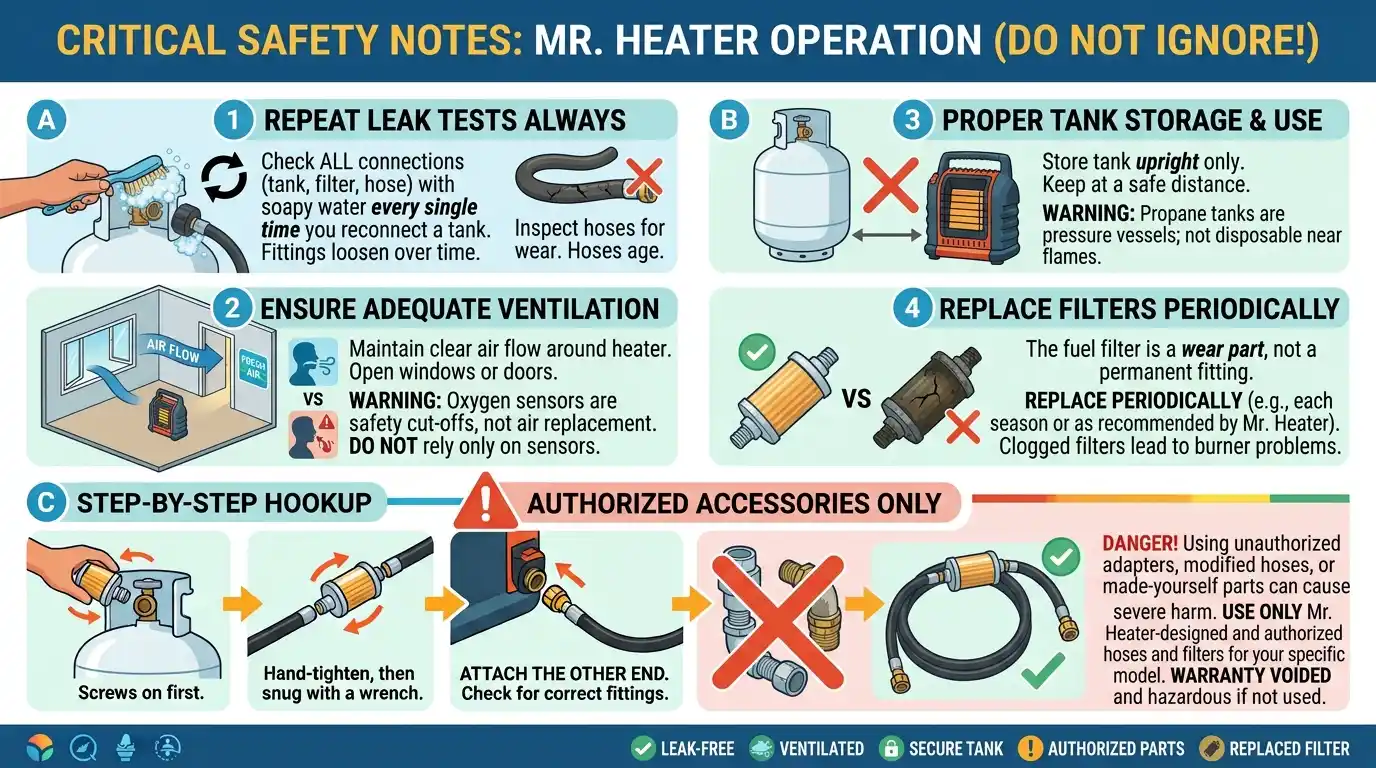
Propane heaters are simple to run correctly and genuinely dangerous to run carelessly. If you’re new to running one of these units at all, a broader safe-use walkthrough is worth reading alongside this guide. A few points below are worth repeating even though they sound obvious.
Always check the soapy water leak test whenever you reconnect a tank and not only the first time. Fittings become loose and hoses are old.
Ventilate the space around the heater and tank. Even those models that have an oxygen depletion sensor are still programmed to switch off in low oxygen conditions as a safety precaution not to replace fresh air. For more on how these sensors and airflow requirements actually work together indoors, it’s worth understanding before running any unit in a closed space.
Store the tank in an upright position and not in the direct heat of the heater. Propane tanks are pressure vessels and must not be considered as disposable when there is an open flame.
The Big Buddy documentation provided by manufacturers clearly indicates that it is not permissible to use unauthorized accessories or attachments with the heater, which can result in severe harm, and that this will invalidate the warranty, so do not use adapters that you have made yourself, use only those hose and filters designed to fit your specific model.
Periodically replace the fuel filter instead of considering it a one time purchase. It is not a permanent fitting but a wear part.
Common Mistakes to Avoid
The worst mistake is to buy a hose and forget to buy a filter, and the most expensive mistake as well, as the clogs of the heater due to neglecting filters may need to be professionally cleaned or repaired.
The second most prevalent mix up is to assume that you require a second regulator at the tank. The heater already has the regulator installed.
A hose used with another device, like a grill hose that does not have the proper thread pattern, may be connected, and may appear to be rated and sealed, but in fact is not.
Small leaks are not realized because we forget about the leak check since it was fine last time.
FAQs
Should I have a regulator to attach a Mr. Heater Buddy to a 20 lb propane tank?
No. The heater has the regulator inbuilt. You require proper hose and on a tank of this size a fuel filter.
Why does Mr. Heater need a filter to hook up a 20 lb tank?
Since the gas passing through the hose to the heater is of high pressure, and with time the pressure may cause the oils to be pulled out of the hose material. That residue is trapped by the filter before it gets to the heater.
Will a Mr. Heater Big Buddy run on a 100lb propane tank?
On record, the remote source capacity of Mr. Heater is limited to approximately 40 lb using the hose and filter accessory. Others have reported using bigger tanks with an added regulator, but that exceeds the specifications of the manufacturer, so consider it an unsupported configuration.
Will a Little Buddy heater fit a 20 lb tank?
Not with an accessory supported by a manufacturer. The Little Buddy is constructed on one 1 lb cylinder. Others construct home-made adapters, but that is not a recommended setup.
Which type of thread must the tank end of the hose have?
A typical 20 lb grill style tank has a Type 1 (QCC1) valve with an OPD, to which these acme style hose fittings are made to fit.
Is it normal that the connection is only hand tight?
Yes, on the tank end. Type 1 connections are made to be hand tightened. When a fitting will not fit by hand at all, look for cross threading, not bending it with a wrench.
What is the procedure to test a propane leak after attaching the hose?
Add dish detergent to water and spray each connection point with the tank valve slightly open and observe bubbles. Bubbles are a sign of a leak that should be sealed and re-sealed.
Can I operate my Mr. Heater indoors when it is attached to a bulk tank?
Oxygen Depletion Sensor models such as the Buddy and Big Buddy are designed to be used indoors and in a well-ventilated space. Always use the manual of your particular model to guide you in a confined space.
Will voiding my Mr. Heater warranty by connecting to a bulk tank?
It does not use the own hose and filter accessories of the manufacturer. The manufacturer of the product itself states in the product documentation that using unapproved or improvised attachments may result in the device becoming defective or in the event of a fire.
What is the run time of a 20 lb tank to power a Big Buddy heater?
The duration of run time will vary depending on the heat level you set, with the heater consuming less fuel in low compared to high. The small 1 lb cylinders have run times published by manufacturer literature; a 20 lb tank will have significantly longer run time scaled to that larger fuel quantity, but Mr. Heater does not provide a specific run time value of a bulk tank.
How large an area will a Big Buddy heat?
The adjustable 4,000 to 18,000 BTU per hour output of The Big Buddy can be used to serve up to approximately 450 square feet, or a small cabin, garage bay, or large tent.
Will I be required to purchase the hose and filter separately?
Yes. The heater itself is already connected to 1 lb cylinders, and the hose and filter required to run on a 20 lb tank are sold separately.
Final Thoughts
Installing a Mr. Heater on a propane tank is a simple task when you have the appropriate two items: an approved hose and a fuel filter. The actual steps are a couple of minutes. The real problem is not using a filter or not realizing that the heater already has that built in. Get the components correct, check the leakage periodically and the installation is actually easy to live with over the years.