
How Much Electricity Does an Oil-Filled Radiator Use? (Real Cost Breakdown)
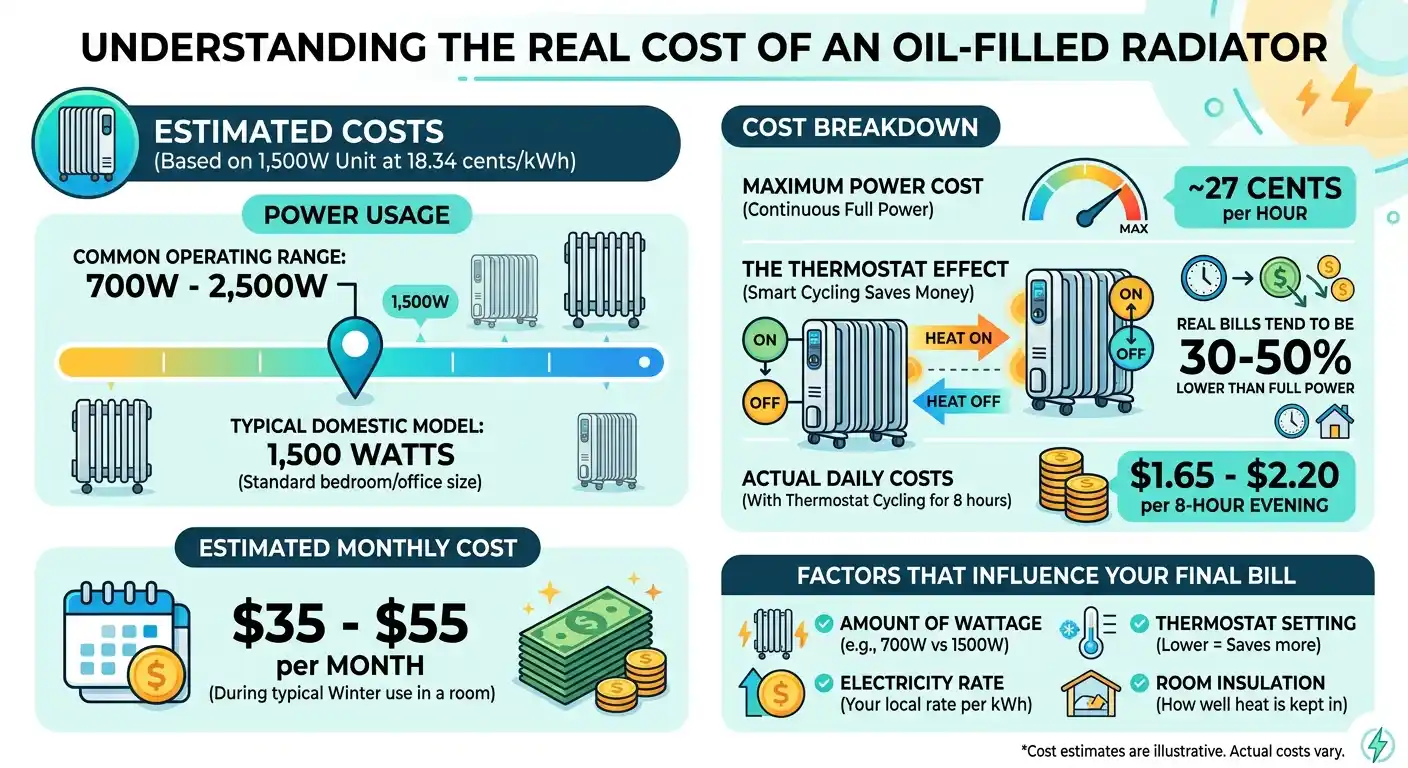
The average model that people purchase to place in a bedroom or home office has a power consumption of 1,500 watts and most oil-filled radiators consume between 700 and 2,500 watts. One hour of running it at full power would cost approximately 27 cents at the present U.S. average rate of 18.34 cents per kilowatt-hour.
However, this figure is not the true story since oil radiators do not operate at full capacity throughout the duration that they are on. The thermostat switches the heating element on and off when the room warms up, so your real bill will tend to be 30-50 percent lower than the full power figure would imply.
If you’ve ever had a roommate or partner insist your oil heater is quietly wrecking the electric bill, this guide gives you the actual math, not a guess.
Quick Answer: How Much Electricity Does an Oil-Filled Radiator Use?
A radiator filled with oil will usually consume 700 to 2500 watts with 1000 to 1500 being the most common range used in domestic units. A 1500W radiator would cost:
- About 27 cents per hour full power.
- Approximately between 1.65 and 2.20 to use in an 8-hour evening including the thermostat cycling.
- Approximately 35-55 a month to use in a typical room during winter.
The cost of your particular unit will depend on the amount of wattage, the rate of electricity in your area, the setting of your thermostat, and the insulation of the room.
How Much Wattage Does an Oil-Filled Radiator Actually Use?
Oil-filled radiators have watts ratings, as any other electric heater. The wattage informs you of the maximum amount of electricity the heating element pulls when it is actively heating, and not necessarily what it draws each minute it is connected to the power source.
Common Wattage Ratings by Radiator Size
| Radiator Size | Typical Wattage | Best Suited For |
|---|---|---|
| Small (5–7 fins) | 700–1,000W | Small bedroom, bathroom, home office |
| Medium (9–11 fins) | 1,200–1,500W | Standard bedroom or living room |
| Large (13+ fins) | 1,800–2,500W | Larger living room, open-plan space |
Manufacturers like De’Longhi observe that the highest draw rate that can be achieved is one unit of electricity per hour of all the kilowatts of heating capacity, so a 1500 watt heater can draw at most approximately 1.5 kWh/h. It is the ceiling, not the average, since the thermostat is always turning the element on and off.
Important lesson: Wattage will inform you of the highest draw that it can draw in one hour, not your actual cost. The size of the room and the insulation are equally important, as is the thermostat.
How to Calculate Your Oil Radiator’s Running Cost
The Formula
Cost = (Wattage ÷ 1,000) × Hours Used × Electricity Rate (per kWh)You need three numbers:
- Wattage: on the rating label of the radiator or in the manual.
- Hours used: the actual number of hours it actually runs, not the number of hours it is plugged in.
- Your power bill: look at a recent bill; it is in cents per kWh.
Worked Example
Assume that you have a 1,500W oil radiator and your rate is 18 cents per kWh:
- Convert watts to kilowatts: 1,500 ÷ 1,000 = 1.5 kW
- Multiply by hours: 1.5 kW × 1 hour = 1.5 kWh
- Multiply by rate: 1.5 kWh × $0.18 = $0.27 per hour at full power
Use it on a full 8-hour evening at full blast and it costs you $2.16. However, since the thermostat switches the element off when the room is warm, the actual cost in practice of an 8-hour session is usually around 1.30 to 1.80, depending on the size of the room and the external temperature.
Oil-Filled Radiator Cost Table (Hourly, Daily, Monthly)
Below costs are based on the U.S. average residential price of 18.34 cents per kWh (EIA, September 2026) and include full-power draw without considering thermostat cycling. The real bills are normally 30-50% less when cycling is considered.
| Wattage | Cost Per Hour (full power) | Cost for 8 Hours/Day | Cost for 30 Days (8 hrs/day) |
|---|---|---|---|
| 700W | $0.13 | $1.03 | $30.83 |
| 1,000W | $0.18 | $1.47 | $44.02 |
| 1,500W | $0.28 | $2.20 | $66.02 |
| 2,000W | $0.37 | $2.94 | $88.03 |
| 2,500W | $0.46 | $3.67 | $110.04 |
Unless your local rate matches the above, replace it in the formula above. Rates are astronomical depending on the state and country. U.S. residential electricity costs at September 2026 are between 13 cents per kilowatt-hour in Nevada and more than 52 cents per kilowatt-hour in Hawaii, so the same radiator may cost four times to operate depending on your location.
Note: these are the full-power ceiling. Your actual bill will be much less than this table, usually 30 to 50 per cent less as soon as your thermostat begins to turn the heater on and off.
Why Oil-Filled Radiators Use Less Electricity Than the Wattage Suggests
Thermal Mass and Duty Cycling
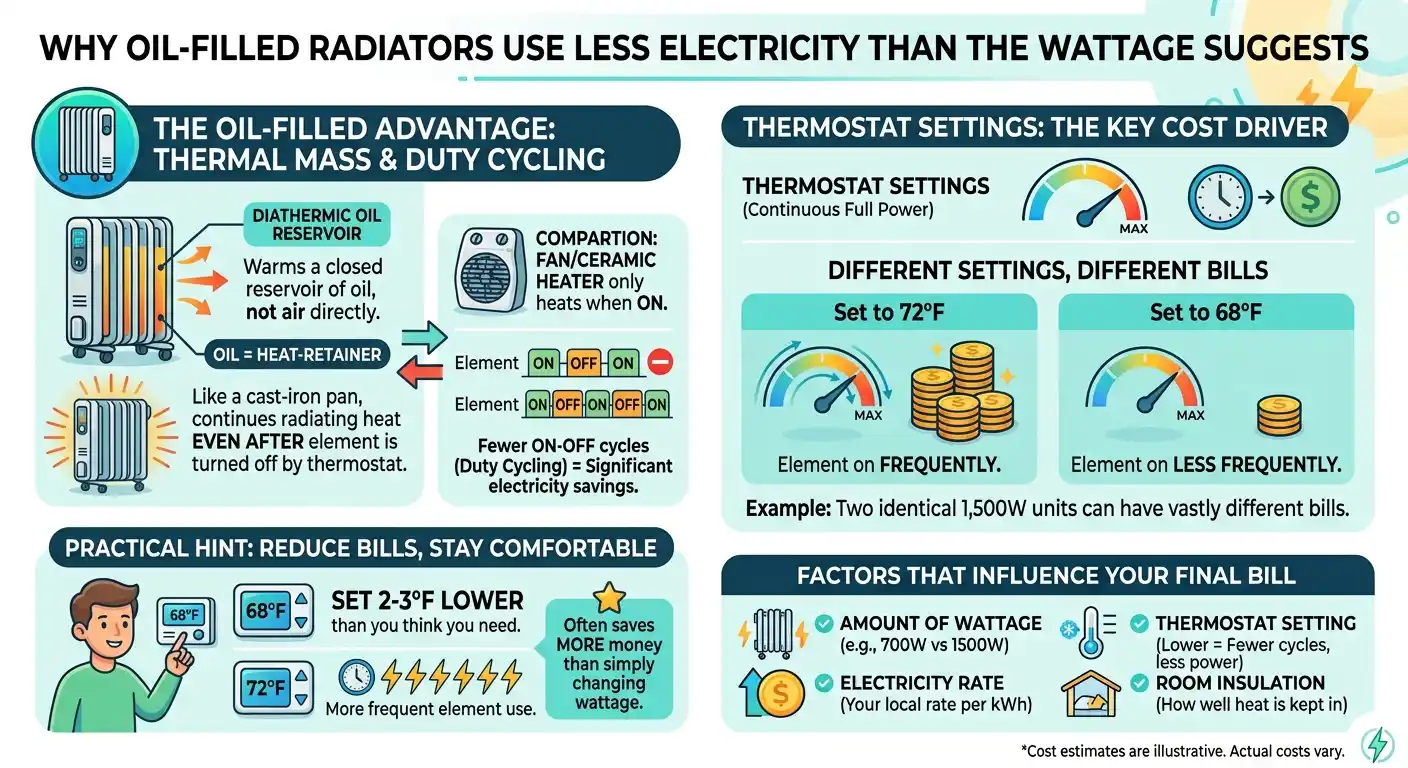
A radiator is an oil-filled device that warms a closed reservoir of diathermic oil, rather than air. That oil is a heat-retainer like a cast-iron pan is a heat-retainer once you turn off the stove. The radiator continues to radiate heat into the room even when the heating element has been turned off by the thermostat, once the oil is hot.
This matters for your electricity bill because the heating element only needs to switch back on periodically to top up the oil’s temperature, rather than running continuously. A fan heater or ceramic heater, by contrast, only produces heat while the element is actively powered, so it tends to cycle on and off more frequently to maintain the same room temperature. If you want what’s happening inside the sealed reservoir as it heats up, that breakdown covers the full mechanism in detail.
Thermostat Settings Matter More Than Wattage
The same 1,500W radiators can result in very different bills based on the setting on the thermostat. A radiator that is set to keep the room at 72 F will turn its element on much more frequently than the radiator that is set to keep the room at 68 F. You can make a significant reduction in your running cost by simply turning the thermostat down a couple of degrees, often more so than you would with a change of wattage.
Practical hint: When you want to reduce the bill but not compromise comfort, then set the thermostat at 2 or 3 degrees lower than you think you need a smaller radiator.
Oil-Filled Radiators vs Other Electric Heaters
| Heater Type | Typical Wattage | Heat-Up Speed | Heat Retention | Best For |
|---|---|---|---|---|
| Oil-filled radiator | 700–2,500W | Slow (10–15 min) | Excellent, stays warm after shutoff | Rooms used for hours at a time |
| Ceramic/fan heater | 750–1,500W | Fast (seconds) | Poor, cools instantly | Quick spot heating, short bursts |
| Infrared/radiant panel | 400–1,500W | Fast | Moderate | Heating people, not the whole room |
| Convection panel heater | 1,000–2,000W | Moderate | Low to moderate | Steady background heat in small rooms |
Oil radiators generally aren’t cheaper on paper. Their advantage is that once the room is warm, they need less electricity to keep it that way, which is where the real-world savings show up over several hours of use. For how other portable heater types generate and distribute warmth, it’s worth understanding the mechanics before comparing costs directly. And if you’re weighing gas-powered options as an alternative, this guide to safe setup and operation tips for propane alternatives is a good starting point.
What Actually Drives Your Real-World Cost
Wattage is just one input. These cause your real bill to move as much:
- Room size and ceiling height: the more air in a room, the longer it requires to be heated and the less efficient it is in retaining heat.
- Drafts and insulation: poorly insulated windows or doors make the thermostat to turn the element on and off more frequently.
- Outdoor temperature: the lower the outside temperatures, the more often the cycling to maintain the same indoor environment.
- Thermostat: every degree lower has a significant impact in reducing on-time.
- Hours of actual use: an 8-hour overnight session would be approximately eight times that of a 1-hour session, other things being equal.
- Your electricity rate: this depends on the state, utility, and even the time of the day in case you are on a time-of-use plan.
How to Run an Oil-Filled Radiator for Less
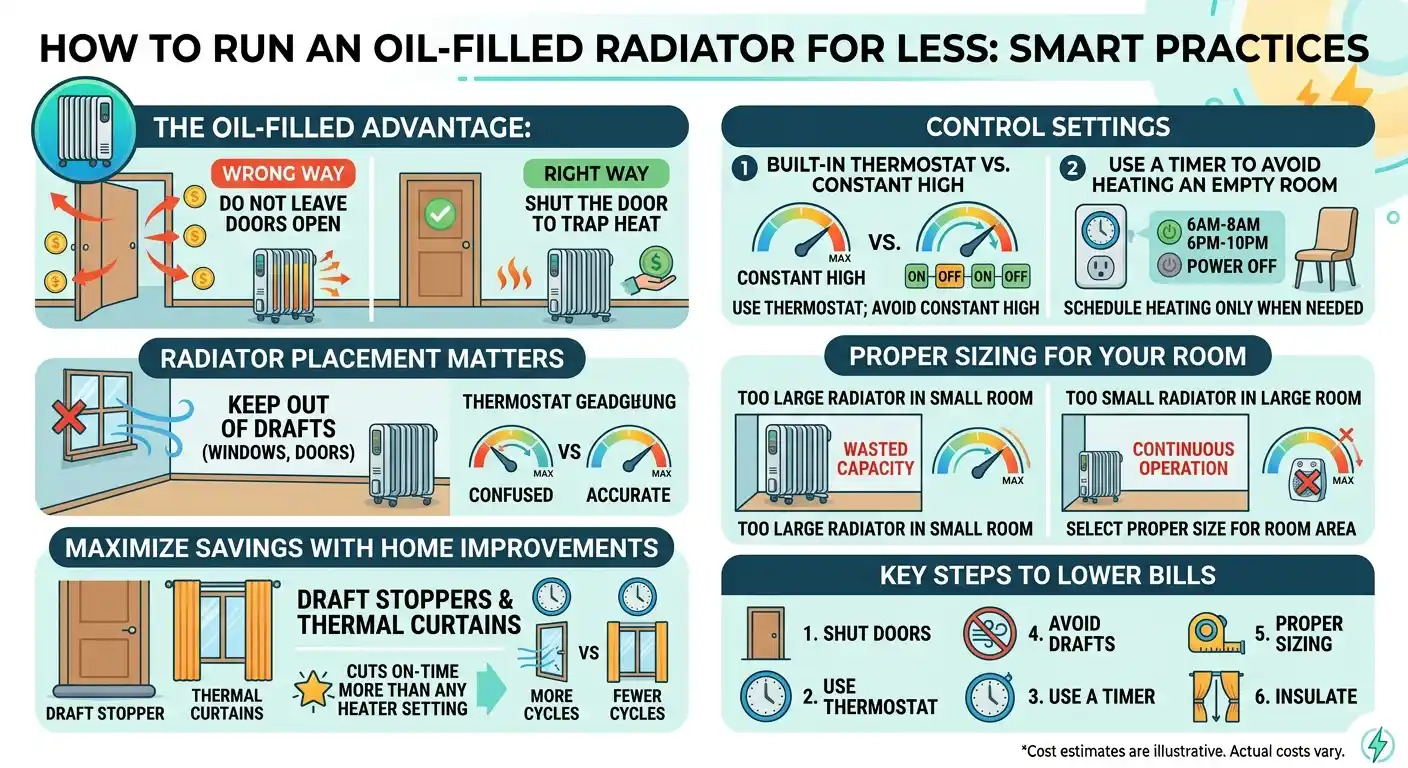
- Shut the door into the room you are heating to avoid having the radiator struggle to stop heat escaping to the rest of the house.
- Have the built-in thermostat instead of operating it on a constant high setting; allow it to alternate.
- Have a timer on, to avoid heating an empty room.
- Keep it out of drafts (windows, exterior doors) to ensure that the thermostat is not fooled into operating longer than necessary.
- Select the proper size of the room. A radiator that is too large in a small room is wasting energy on capacity that it does not need; a too small radiator operates continuously and will never get the thermostat to the desired temperature.
- Combine it with more insulation such as draft stoppers or thermal curtains, which will cut on-time more than any heater setting will.
For a full walkthrough on dialing in the eco mode, timer, and frost-watch settings on your specific unit, see setting up the timer, dial, and eco mode correctly.
Is It Safe to Leave an Oil-Filled Radiator On All Night?
Oil-filled radiators are typically regarded as one of the less risky types of space heater to leave unattended long, since they do not have an exposed heating element and the outer casing is cooler to the touch than a fan or a ceramic heater. The majority of the models nowadays have tip-off shutoff and overheat protection.
That being said, no manufacturer of space heaters suggests that you leave any heater unattended or running at all when all the people are asleep in another room, and you should not keep the heater near bedding, curtains, or clutter, or use it with an extension cord or a cord that is not rated to handle the load. See the manual of your particular model, as not all brands have the same safety features.
Myth vs Fact
| Myth | Fact |
|---|---|
| “Oil radiators are always cheaper to run than other heaters.” | Not necessarily. They have similar wattage to other heater types; their advantage is holding heat between cycles, not lower wattage. |
| “A higher wattage number means a worse bill no matter what.” | Actual cost depends on hours of use and thermostat cycling just as much as wattage. |
| “Leaving it on low all day uses less power than cycling it on demand.” | Continuous low-level heating can use more total energy than heating only when the room is occupied. |
| “Bigger rooms need proportionally more watts.” | Insulation quality often matters more than square footage alone. |
FAQs
What is the amount of watts consumed by an oil-filled radiator?
The average consumption of most oil-filled radiators is 700 to 2,500 watts, of which 1,000 to 1,500 watts is the most popular rating in a single room.
How much does it cost to run an oil-filled radiator for 24 hours?
Using a 1,500W radiator, the U.S. average price of 18.34 cents per kilowatt hour, and operating 24 hours at full power, the cost of a 1,500W radiator is approximately $6.60. Under regular thermostat cycling, the actual amount will be nearer to $3.50 to $5.00.
Are oil-filled radiators a lot of electricity compared to central heating?
It will rely on the number of rooms you are heating. A single oil radiator in a room that is occupied is often less expensive than central heating of the whole house, although multiple radiators in a room can be more expensive than central heating in a well-insulated house.
Are radiators that are filled with oil energy efficient?
Almost all electric resistance heaters transform virtually 100 percent of the power they consume into heat, and thus oil-filled radiators are not technically more efficient than a ceramic or fan heater. Their practical benefit is that they are good at retaining heat and this may decrease the frequency at which the element must operate.
Is it possible to leave an oil-filled radiator overnight?
Numerous models have safety features that allow them to be used overnight more frequently than other types of heater, although it is always advisable to consult the guidance of the manufacturer, ensure the space around it is clear and never use a damaged unit or cord.
Would it be more economical to have a single oil radiator on all day or switch it on and off as required?
Turning on a room when you are in it is nearly always less expensive than turning on a radiator all day long, because you are not paying to heat an empty room.
Do oil-filled radiators use more electricity than they used to?
The radiators themselves haven’t become less efficient. Any rise in your bill can far better be attributed to the rising rates of electricity, which are higher than in the U.S. by more than 30 percent over the last five years, than to the appliance itself.
Final Thoughts
An oil-filled radiator is not necessarily a cheapie or a deal. It consumes about the same amount of wattage as most other portable electric heaters and the electricity it consumes is nearly all converted to heat, just as any resistance heater. The difference is in the fact that it retains such heat later, which may lower the frequency of its power consumption after a room is heated.
To find out what yours really costs, find the wattage on the rating label, find your electricity rate on a recent bill and do the calculations using the formula above. That is a much more practical solution than a conjecture, and it is generally the quickest method of deciding a dispute as to whose heater is actually running up the bill.