Are Oil Heaters Economical? The Honest Cost, Efficiency & Energy Guide
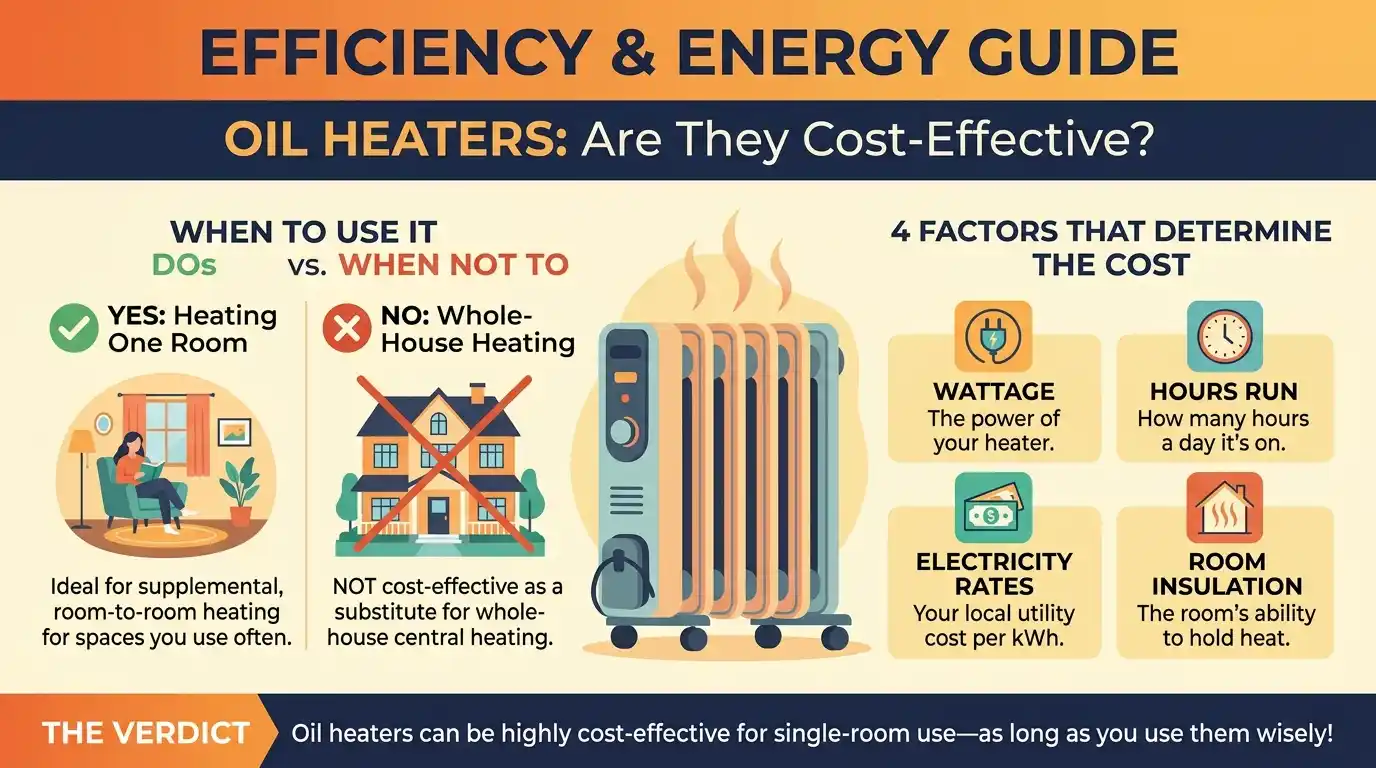
A heater that uses oil is also cost-effective when it heats your room at a cheaper cost than the other system you are actually comparing the one that is actually in use, another portable heater, a larger bill that would be paid to the central heating, or just the fact that you can heat only a room when you need it.
That distinction matters. There are no inexpensive or expensive oil heaters. Their price varies based on their wattage, the number of hours it runs, your local rate of electricity and the ability of the room to hold heat. Get them correct and an oil heater can be among the most cost effective methods to warm a single room. Get them wrong and it will cost you more than you thought, like any other electric heater.
At a glance: Oil heaters are cheap to supplemental, room to room heating, particularly in rooms that you may use several hours a day. They are not cost-effective as a substitute to central heating of the entire house.
How Oil Heaters Work (And Why That Matters for Cost)
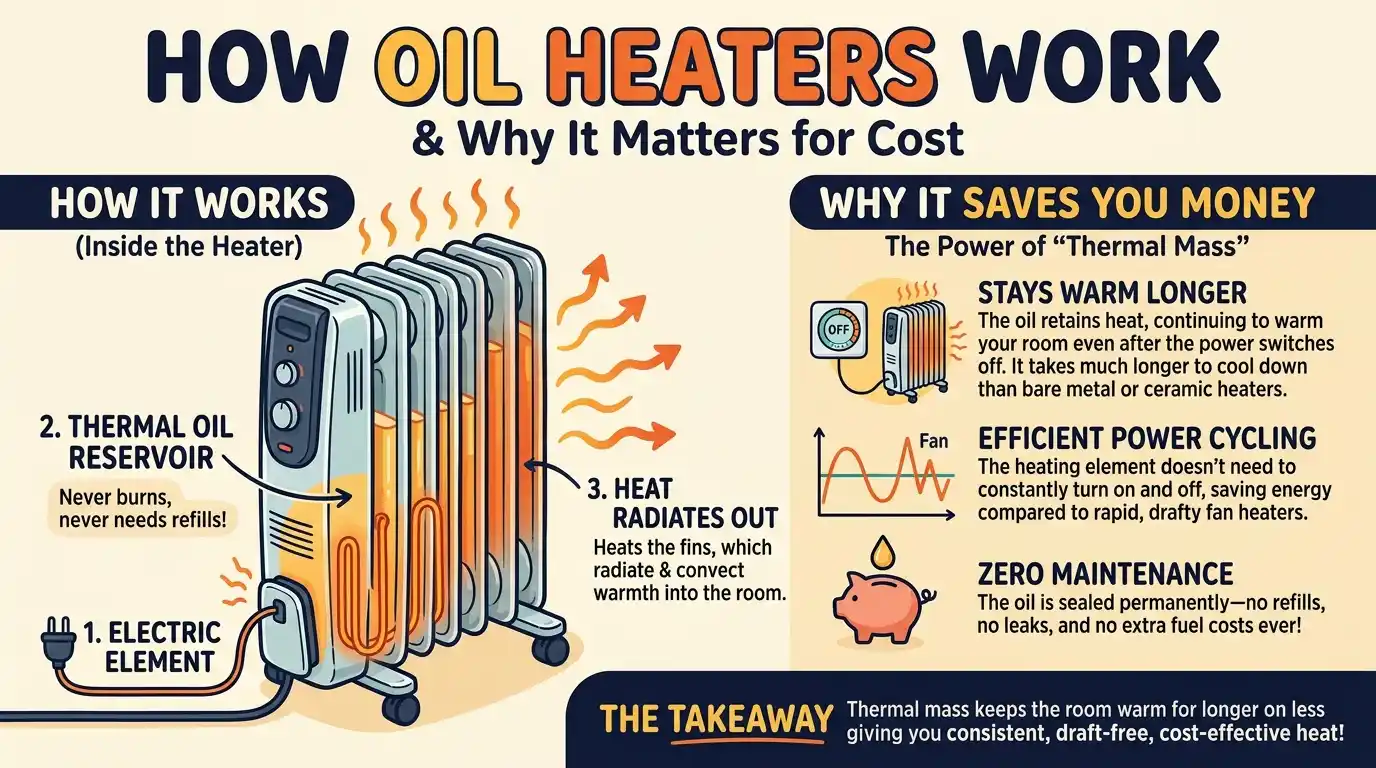
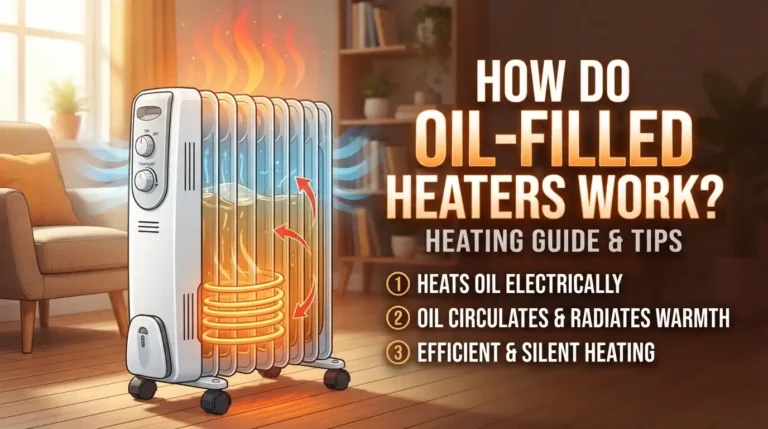
A radiator is an oil-filled sealed container that warms a reservoir of thermal oil with an electric element on the inside. The oil does not burn and does not require refill. It is merely a reservoir of heat: it takes in the electrical heat, then radiates and convects it into the room via the fins on the outside of the unit. If you want the full mechanics behind that sealed reservoir, we’ve broken down exactly what happens inside the unit.
It is that thermal mass that makes oil heaters have a reputation of being economical. Since the oil retains heat, the heater continues to give out warmth some time after the thermostat has switched off the power, and it will take a longer time to cool than a bare metal or ceramic element would.
In practice, it does not require the heating element to turn on and off as suddenly as the fan heater, which most of its owners feel as a more consistent, draft-free warmth.
Are Oil Heaters Economical? The Short Answer
Yes, with conditions. Oil heaters are cost effective when:
- You are warming one room not a house.
- The size of the room is reasonable in relation to the wattage of the heater.
- You get a heater and a thermostat together rather than turn the heater on all day long.
- You do not use it 24/7 but specific hours.
They are not so economical when you are trying to heat a big, poorly insulated room, when you are operating a large-wattage unit day and night, or when you are heating with electric heat and it is cold outside and you are not using any outside heating.
In the latter, a properly maintained gas or heat pump system will tend to outcompete any electric resistance heater, oil-filled or otherwise, in terms of overall cost.
How Much Does It Cost to Run an Oil Heater?
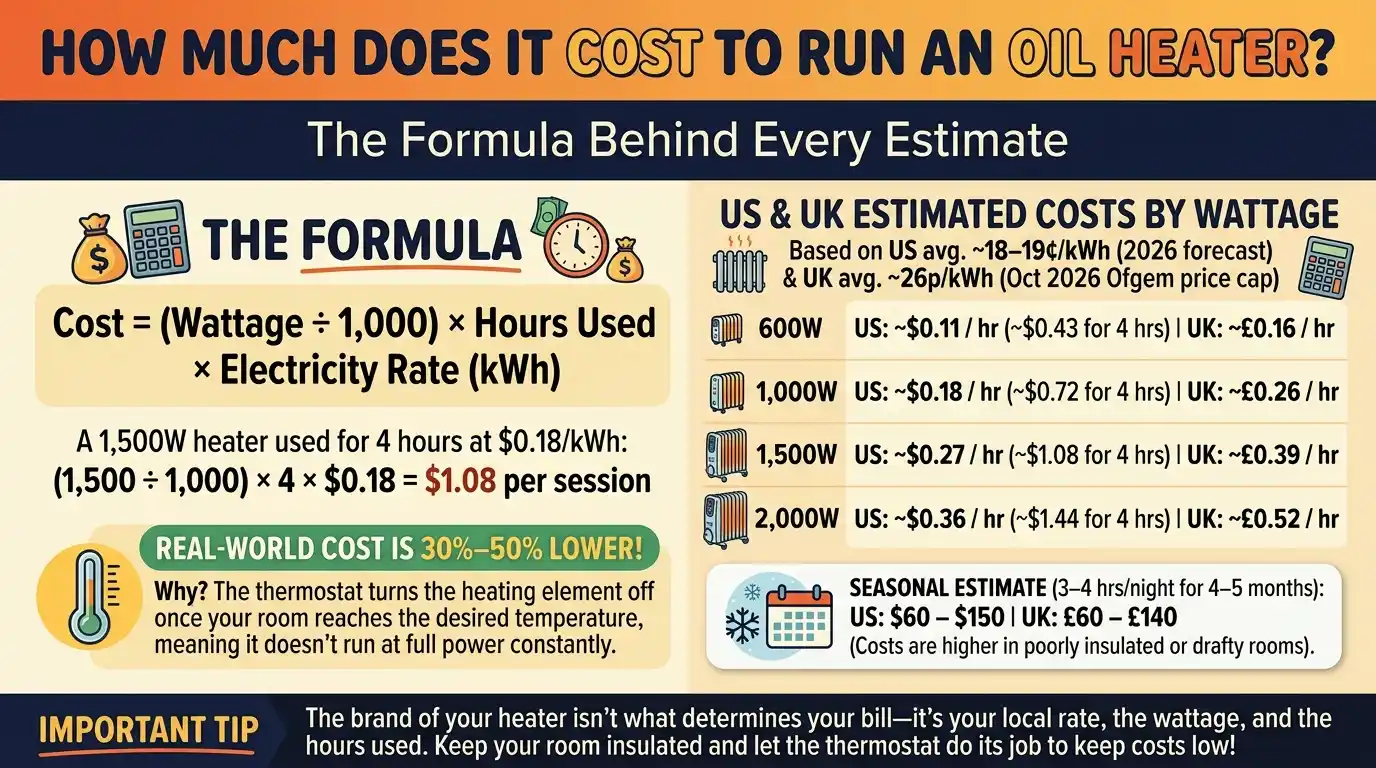
The Formula Behind Every Estimate
All of the running-cost numbers that you will see of an oil heater (or any other electric heater) are the result of the same simple formula:
Cost = (Wattage ÷ 1000) × Hours Used × Electricity Rate per kWh
To illustrate, a 1,500 watt oil heater that is operated 4 hours at a price of 0.18 kWh costs:
(1500 ÷ 1000) × 4 × 0.18 = $1.08 for that session
Theoretical maximum with the heater operating full power all the time. In the real world, a thermostat will switch the element on and off when the room has reached the desired temperature, thus the real costs will generally be lower than this worst case figure, usually by 30-50% depending on insulation and the temperature outside.
For a model-by-model breakdown of exact electricity draw, this guide walks through the numbers in more detail.
US Running Costs by Wattage
According to the average residential electricity rate of about 18 to 19 cents per kWh in the US (according to the 2026 US forecasts), it would cost the following to operate various sizes of oil heaters, at full blast:
| Wattage | Cost per hour | Cost for 4 hrs/day | Cost for 8 hrs/day (monthly) |
|---|---|---|---|
| 600W | ~$0.11 | ~$0.43 | ~$26/month |
| 1,000W | ~$0.18 | ~$0.72 | ~$43/month |
| 1,500W | ~$0.27 | ~$1.08 | ~$65/month |
| 2,000W | ~$0.36 | ~$1.44 | ~$86/month |
These are full power estimates. Actual bills tend to be less with a thermostat turning the unit on and off. The rates are quite different across the states, with an approximate of 12 cents per kWh in North Dakota, and more than 40 cents in Hawaii, so look at the utility rates in your own state to get an exact rate.
UK Running Costs by Wattage
With the current price target of about 26 pence per kWh in the October 2026 Ofgem price cap, common prices of oil-filled radiators appear as follows:
| Wattage | Cost per hour | Cost for 4 hrs/day |
|---|---|---|
| 600W | ~£0.16 | ~£1.17-1.20 |
| 1,000W | ~£0.26 | ~£1.05-1.30 |
| 1,500W | ~£0.39 | ~£1.95 |
| 2,000W | ~£0.52 | ~£2.65 |
Monthly and Seasonal Cost Estimates
To illustrate, a standard 1,000-1,500W oil heater used 3-4 hours a night on cold evenings through a heating season (about 4-5 months), most households spend between 60 and 150 US dollars in the United States or 60 and 140 UK pounds on that one heater.
Poorly insulated rooms, drafty windows, high ceilings, and so on will push those numbers up since the heater must work harder to maintain the temperature.
Important tip: The heater brand and model is not the single most important lever on your bill. Your local rate times your hours times its wattage. A room that is well insulated and has a heater that is the appropriate size and controlled by a thermostat will never be expensive as compared to an oversized unit in a drafty room.
Oil Heater Efficiency vs. Ceramic, Fan, and Infrared Heaters
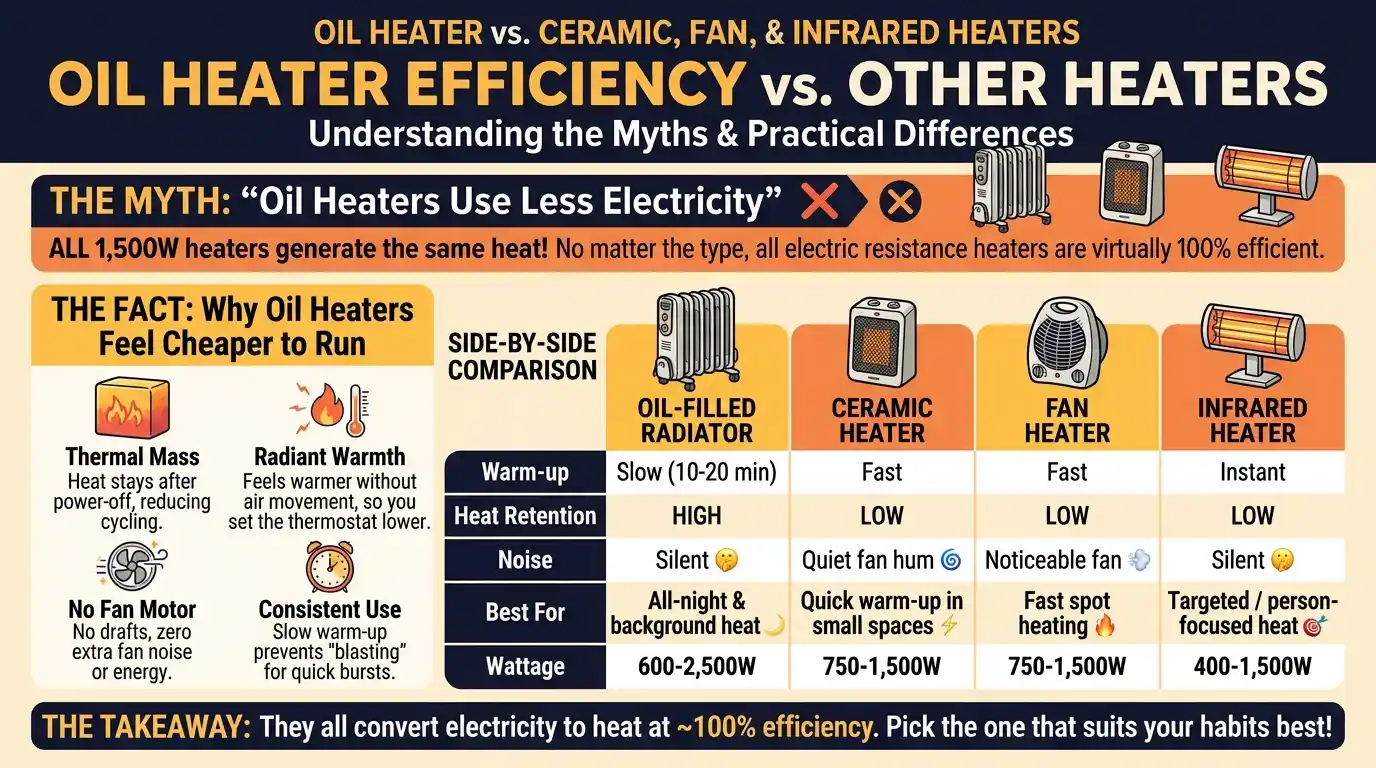
The Myth: “Oil Heaters Use Less Electricity”
You will find lots of articles that will tell you that oil heaters are more energy efficient than ceramic, fan or infrared heaters. That’s misleading. All plug-in electric resistance heating systems, oil-filled, ceramic, fan-forced, or radiant infrared, use virtually 100 percent of the electricity they consume to heat. It is not a marketing statement, it is mere physics.
Any 1,500 watt heater consumes 1,500 watts and generates the same amount of heat energy as any other 1,500 watt heater. No more energy-efficient resistance heater at the same wattage exists, as they all waste energy as anything other than heat. We’ve dug into this claim in much more depth elsewhere, including where the “efficiency” marketing language actually comes from.
The Fact: Why Oil Heaters Still Feel Cheaper to Run
When the conversion of raw energy is the same, why are oil heaters known to be cost effective? Some practical, real reasons:
- Thermal mass levels the cycling. The oil continues to emit heat following the shutdown of the element, thus the thermostat does not need to start the element again as frequently as a heater would with a heater that cools immediately.
- Warmer air temperature makes even, radiant heat feel warmer. Since oil heaters warm objects and individuals directly, as well as the air, users tend to be comfortable at a lower thermostat setting than those using a fan heater that blows warm air, which quickly disperses.
- No fan motor. Fan and ceramic heaters only need additional little power to operate the fan, and the fan can also make the drafts seem more pronounced, leading an individual to turn the thermostat up higher to compensate.
- Reduced response rate deters overuse. Since oil heaters require more time to heat, individuals are more apt to leave them on a consistent, moderate temperature instead of having to turn them to full blast several times to get a quick burst of heat as it is common to use fan heaters.
The savings of an oil heater are therefore typically the result of action and heat distribution and not some magical efficiency benefit in the way electricity is turned into heat. Curious how that stacks up against a fan model specifically? Here’s the hourly and monthly math for fan heaters so you can compare them side by side.
Side-by-Side Comparison Table
| Feature | Oil-Filled Radiator | Ceramic Heater | Fan Heater | Infrared Heater |
|---|---|---|---|---|
| Energy conversion efficiency | ~100% | ~100% | ~100% | ~100% |
| Warm-up speed | Slow (10-20 min) | Fast | Fast | Instant |
| Heat retention after shutoff | High | Low | Low | Low |
| Noise | Silent | Quiet fan hum | Noticeable fan | Silent |
| Surface temperature | Warm, not hot | Can get hot | Moderate | Hot near element |
| Best for | All-night/background heat in one room | Quick warm-up in small spaces | Fast spot heating | Targeted heat for a person or small zone |
| Typical wattage range | 600-2,500W | 750-1,500W | 750-1,500W | 400-1,500W |
When an Oil Heater Is the Economical Choice (and When It Isn’t)
Oil heaters make the most economic sense when:
- You have a bedroom, home office, or living room being heated multiple hours at a time.
- You need low and constant background heat (bedrooms overnight, e.g.)
- The room is fairly insulated and draft closed.
- You will combine it with an in-built or external thermostat.
Oil heaters are a poor economic fit when:
- You require quick heat to warm up (a fan or infrared heater will be a winner here)
- You are attempting to heat a big, unenclosed, or poorly insulated area.
- You are making it a full time substitution of central heating all through a winter.
- Light weight and mobility are important; oil heaters are one of the heavier types of the space heaters.
8 Ways to Make an Oil Heater More Economical
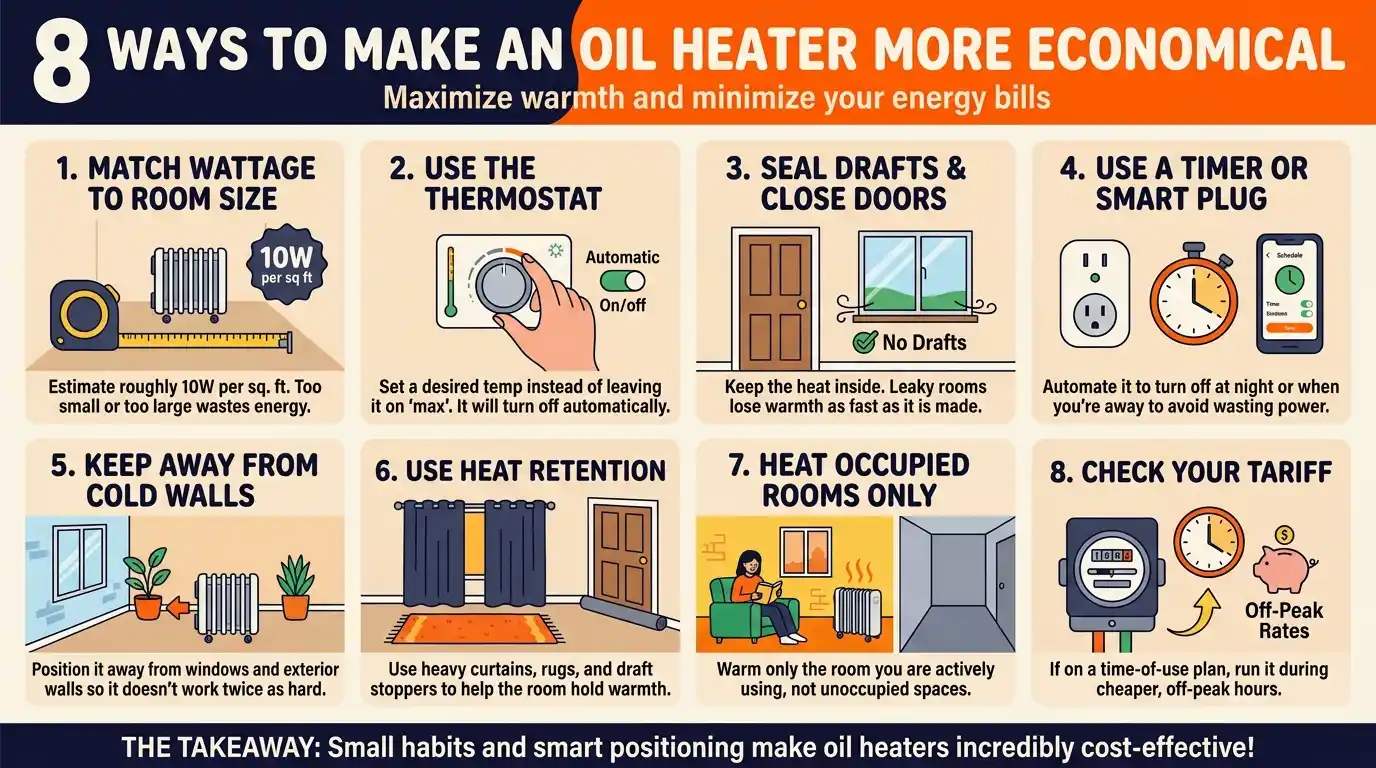
- Adjust wattage to room size. A small heater is turned on continuously and never really reaches its goal; a large one squanders power trying to reach the desired temperature. To estimate the amount of energy required to light a typical room with average insulation, assign 10 watts per square foot as a rough estimate.
- Do not use the power dial but the built-in thermostat. Have a set temperature rather than leave it on max. The heater will switch off as soon as the room is heated to that temperature.
- Seal drafts and close the doors of the room you are heating. In leaky rooms, oil heaters are most rapidly neutralized because the heat is lost as rapidly as it is generated by the radiator.
- Smart plug or timer. Set it to turn off at night or when you are away, instead of having to remember.
- Keep it out of the window and out of the exterior walls. The closer it is to a cold surface, the more the heater has to work to achieve the same room temperature.
- Overlay it with other heat retention practices. Curtains, draft stoppers, and rugs all minimize the effort that any heater must put in.
- Avoid running it in unoccupied rooms. Warm the room you are in rather than the entire house should the central heating take care of the rest.
- Check your electricity tariff. On a time-of-use plan, the cost of running the heater during off-peak hours can have a significant reduction, although the amount of time and the wattage will remain the same.
Are Oil Heaters Safe? What to Know Before You Buy
A heater is enjoyable to use and not merely cheap on paper but safety also comes with it. Home fires are one of the most common causes of fires, and space heaters take up a large portion of such fires, so safety features are not a luxury.
There are a few safety benefits to oil-filled radiators:
- Cooler surface temperature. Since the heat is produced by warm oil, as opposed to an open glowing component, the outer case is usually relatively cool to the touch compared to ceramic or coil heaters, reducing the risk of burns in children and pets.
- No bare heating element or fan. It has a reduced chance of dust accumulation leading to ignition or small objects being drawn into a fan.
- Find tip-off and overheat protection. Whatever electric heater you purchase, whether it is oil-filled or not, must have an automatic cut-off in case it is knocked over or overheats. This should be normal on reputable UL- or ETL-listed models.
Whichever type of heater you use, ensure a minimum distance of 3 feet between the heater and the curtains, furniture, and bedding, never use one on an extension cord more than temporarily, and do not leave one unattended, unless certified with auto-shutoff safety.
How to Choose the Right Wattage for Your Room
| Room size | Suggested wattage |
|---|---|
| Small bedroom or office (up to 100 sq ft) | 600-1,000W |
| Medium bedroom or living room (100-200 sq ft) | 1,000-1,500W |
| Large living room (200-300 sq ft) | 1,500-2,000W |
| Very large or open-plan room (300+ sq ft) | 2,000-2,500W, or two smaller units |
These are initial points. The height of the ceiling, insulation and the temperature of the outdoors will bring the right wattage either higher or lower.
Oil Heaters vs. Central Heating: Which Is Cheaper?
This all depends on the amount of space you need to be heated. When you have one or two rooms in constant use, an oil heater can usually be cheaper than a furnace or a boiler, to heat a whole house, since you are not spending money to warm rooms you are not using.
When heating a entire house over several months, central heating, particularly gas or a heat pump, will tend to be economical at scale. In fact, heat pumps, especially, can produce more heat per unit of electricity than any resistance heater (oil, ceramic, fan, etc.), since they pump heat, but do not produce it directly, and thus have an efficiency advantage that resistive space heaters can never match.
Rule of thumb: An oil heater can be used to zone-heat or supplement one or two rooms. It will not be economical to replace whole-home heating during a full winter.
FAQs
Do oil heaters cost effective?
Yes, to warm one room at a time a few hours. The cost to run does not rely on whether the heater is oil-filled in particular, but on the wattage and the number of hours you use in a given year with your electric rate.
Are oil heaters energy consuming?
They consume precisely the same amount of electricity as any other resistance heater with the same wattage. An oil heater of 1,500W and a ceramic heater of 1,500W consume the same power.
Are oil filled radiators economical to operate?
They may be, particularly when a thermostat is used and reasonably sized rooms. A standard 1,000-1,500W device which is used over a few hours a day is about 25-65 in the US or about 30-60 in the UK depending on your rate and usage.
Are oil heater cheaper to operate compared to fan heater?
Both are essentially the same in their efficiency in converting electricity to heat at the same wattage. Practically, most individuals consider oil heaters to be less expensive than alternatives in the long run since the heat that is stored means that the thermostat does not have to switch the element on and off as often.
Which is the lowest cost heater to leave on 24/7?
No handheld resistance heater is really inexpensive to operate over several months. A heat pump or a well-maintained central heating system will be nearly always cheaper than any plug-in space heater, in case you actually require 24/7 heating.
Is it more economical to have an oil heater on low all day or to turn it off and on?
With most properly-insulated rooms it is often cheaper to heat the room when you are actually using it, instead of keeping the background at a low temperature throughout the day. Exceptions are made in very cold climates where a room that has been fully cooled consumes much energy to heat up again.
How many watts does an oil heater use?
The majority of oil-filled radiators in homes are between 600W and 2,500W, with 1,000-1,500W being an average size of a single bedroom or living room.
Is it safe to leave oil heaters unattended?
It should be placed with adequate clearance between the bedding, curtains, and furniture and certified tip-off and overheat shut-off protection must be available on the model. Always follow the instructions of the manufacturer when leaving any space heater unattended.
Do oil heaters dry out the air like other heaters?
Radiators filled with oil will not remove moisture in the air as actively as a fan-forced heater, as they do not actively circulate air over a hot surface, but any source of heat will lower the relative humidity of a closed room some.
Are the oil heaters cheaper than the infrared heaters?
They are both nearly as efficient at every percentage of converting electricity to heat, although neither is necessarily cheap. Infrared heaters heat individuals and items directly and are instant, which is appropriate in brief periods of use, whereas oil heaters are appropriate in the longer, more continuous heating processes.
What is the lifetime of oil heaters?
An oil-filled radiator is typically 10-20 years in good condition, as the closed oil tank does not require any refill and an exposed heating element does not burn out as in other less expensive fan heaters.
Will I require a special outlet to have an oil heater?
No. Oil heaters used in the home are connected to a standard 120 V (US) or 230 V (UK) power outlet. Anything over approximately 1,000W should not be plugged into extension cords or power strips; a high-wattage heater should not be plugged into an outlet that is used by other high-current appliances.
Will an oil heater warm up a whole house?
Not economically. Oil heaters are intended to be used in a single room or zone. An attempt to warm up several rooms or the whole house using portable oil heaters will nearly always be more expensive than a central heating system sized to warm the entire house.
Final Thoughts
Oil heaters are cheap, not due to some efficiency gimmick. They are cheap as any heater is: when the wattage equals the room, the thermostat does the job rather than somebody guessing, and the heater is heated to the size it is designed to be.
When you only need to heat a room or two a few hours a day, a thermostat-controlled oil heater of the right size is one of the less expensive, less maintenance-intensive methods to do so, and it can feel more stable and less noisy than fan-heated or ceramic ones. When you need to warm an entire house in a cold winter no portable resistance heater, be it oil filled or otherwise, will be cheaper than a properly sized central heating system.
Understand what it is you are actually asking the heater to do and the “is it economical” question answers itself.