Are Oil Heaters Efficient? What They Really Cost to Run and When They Are Worth It
You put an oil heater in and 20 minutes later the room is finally warm. Even an hour after turning it off, the radiator continues to radiate heat. That makes it seem the smartest, the most efficient heater you could ever have.
Then, are oil heaters efficient? Yes, when it comes to converting electricity to heat, but not any more than any other electric heater. In what way an oil heater makes its living is the way it provides its heat. This guide describes what this means to your bill, how you can calculate your own running cost and when a different heater would be more reasonable.
Key Takeaways
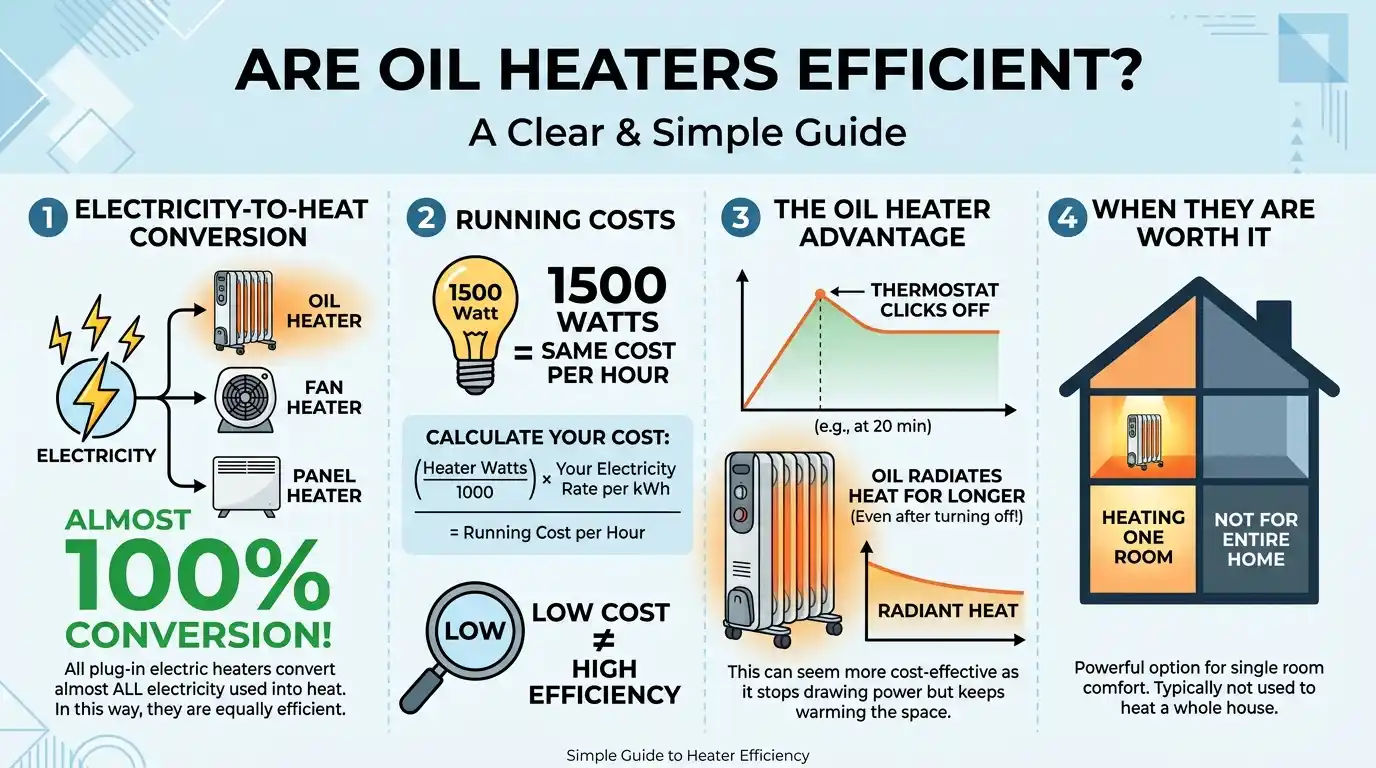
- An oil heater converts almost all the electricity it uses into heat. So does all the other plug-in electric heaters.
- Low cost is not efficiency. Whatever kind of heater it is, a 1,500 watt heater costs the same amount per hour when running full.
- Oil heaters may seem more cost-effective since the thermostat switches them off at a time when the oil continues to radiate heat.
- They are a powerful option when heating one room. They are typically not used to heat an entire home.
Quick Solution: Do Oil-Filled Heaters Save Energy?
Oil-filled heaters are technically efficient: almost all the watts they consume are heat in your room. They do not outperform ceramic, infrared, or baseboard heaters which also transform nearly 100 percent of their electricity into heat. Their benefit is constant, low-key heat, which remains even when the heater is turned off.
What Is an Oil Heater?
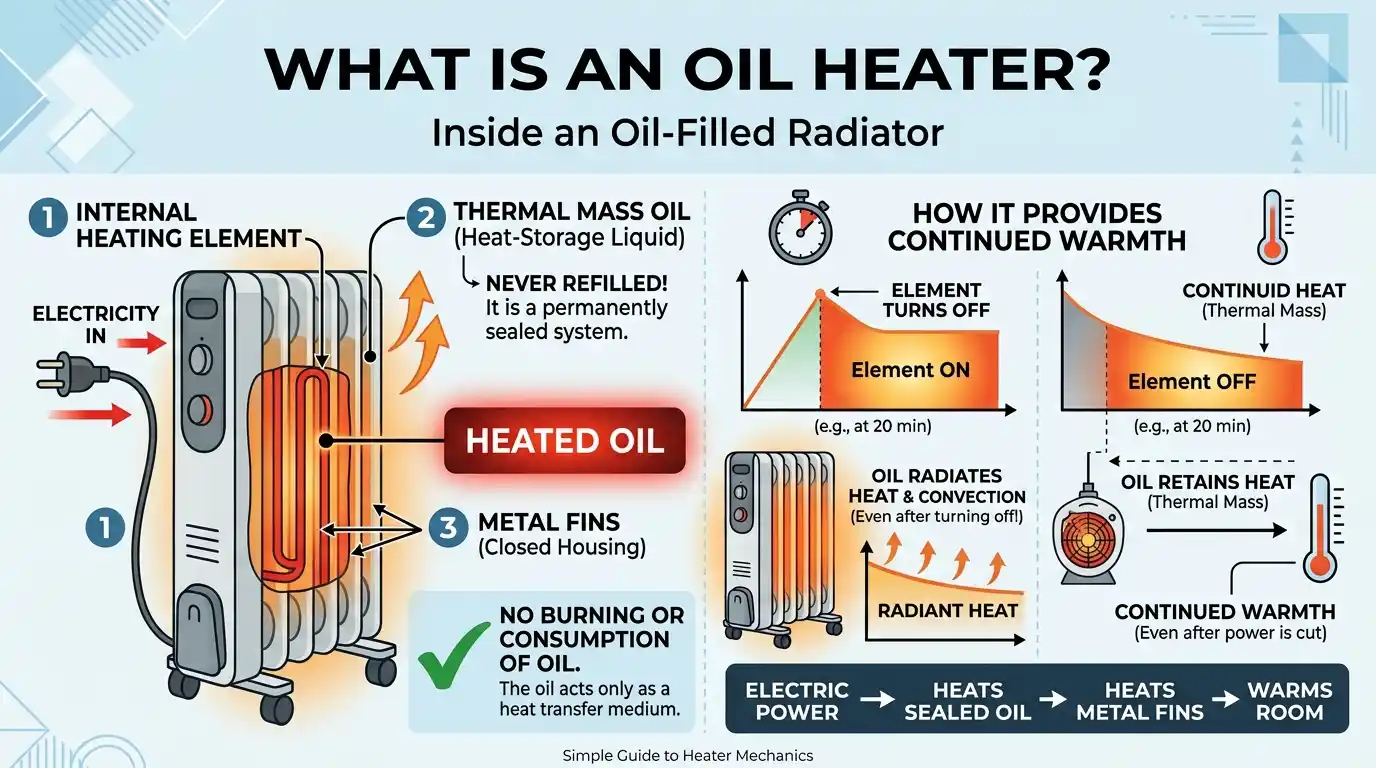
An oil heater, also known as an oil-filled radiator, is an electric heater with a closed metal housing that is filled with thermal oil. A heating element within it heats the oil, which heats the metal fins, which heats the air surrounding them. If you want a closer look at the mechanics behind that heat transfer, there is a step-by-step breakdown available.
There are two points to be known:
- No burning or consumption of the oil. It is a closed heat-storage liquid, and is never refilled.
- it is the oil that provides the heater with its “thermal mass” which is the ability to retain some heat even after the element is turned off.
That is why the heater is not blasting, but warm. It heats the room by natural convection and radiant heat, without using a fan.
Are Oil Heaters Efficient?
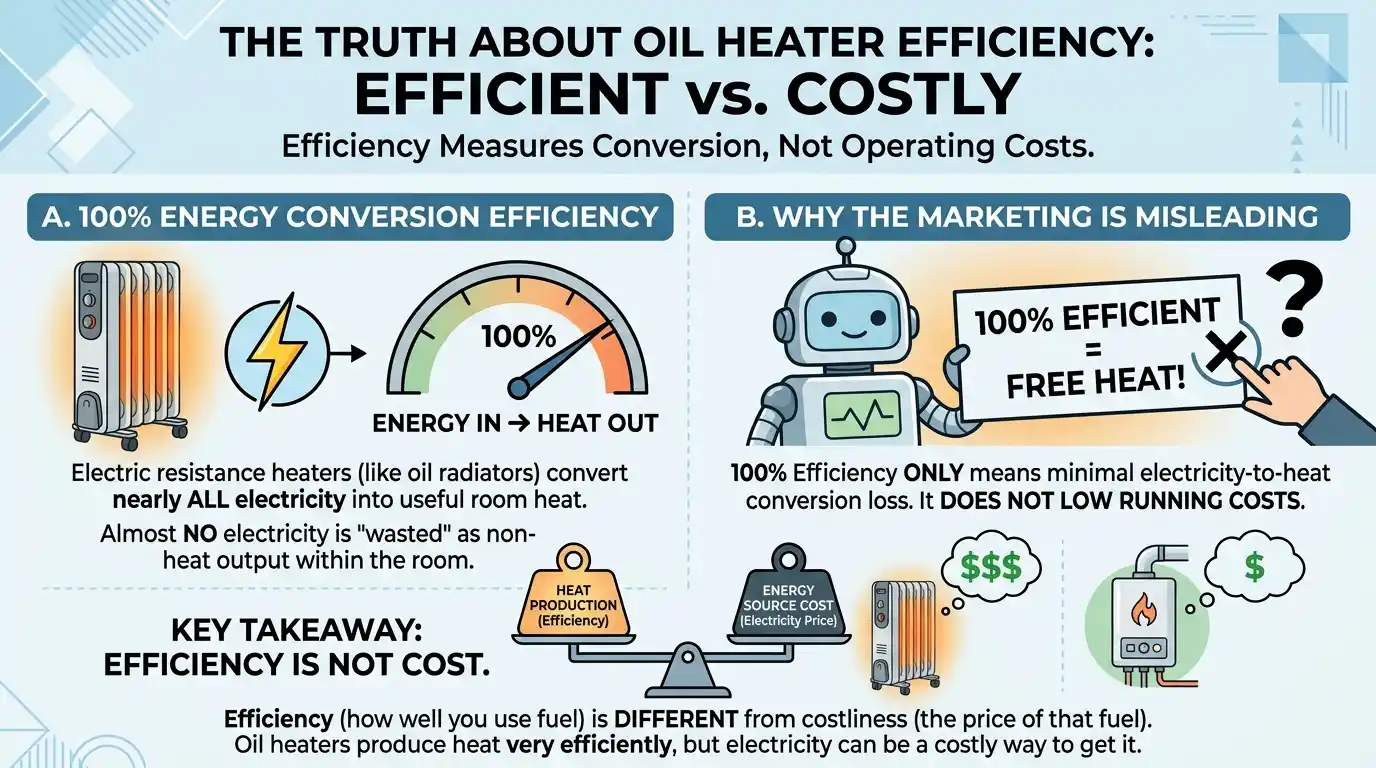
The term efficiency is used to describe the proportion of the energy input that is output as useful heat. Close to 100 percent efficient by that measure are electric resistance heaters, such as oil-filled radiators. Within a room, very little electricity is used up as heat.
This is also the reason why the marketing is misleading. One hundred percent efficient sounds like a bargain, but it does not tell you anything except that nothing is wasted as electricity is converted into heat. It does not say anything about the costliness of that heat relative to other methods of obtaining it.
Efficiency vs. Cost: The Difference That Matters
Consider it in this manner. Even two heaters can be 100 percent efficient and have very different prices when one uses more watts or runs longer. Your bill is only set by:
- Wattage of the heater.
- The number of hours it runs.
- How much you pay per kilowatt-hour (kWH).
In the United States, most oil heaters have a maximum of 1,500 watts on a typical household circuit. A 1,500 watt oil heater at full power is precisely the same price to operate as a 1,500 watt ceramic heater. A 1,500 watt heater generates approximately 5,100 BTU of heat per hour, a handy figure when comparing heaters in terms of BTU.
Why Oil Heaters Can Still Feel More Economical
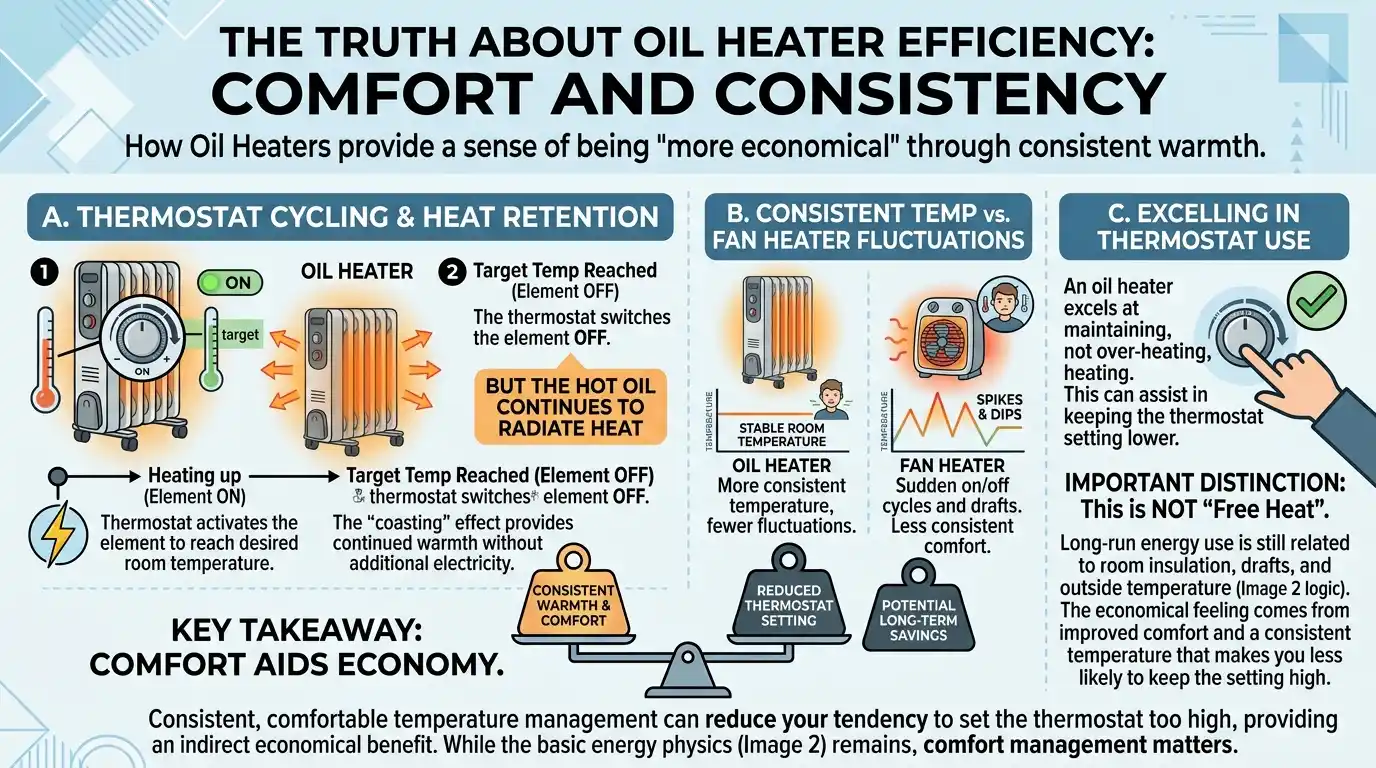
Your thermostat is working. When the room has reached the temperature that you have set, the heater will turn off its element but the hot oil will continue to give off heat. The element then operates at a reduced proportion of the time and you have a more consistent temperature without the fluctuations you may experience with a fan heater.
This does not produce free heat. In the long-run, the power required to maintain a room at a desired temperature is related to the amount of heat that the room radiates, i.e. its insulation, drafts and the temperature outside the room. What an oil heater excels is not to go too far and that can assist you in keeping the thermostat down and feel comfortable.
How Much Does It Cost to Run an Oil Heater?
Use this formula:
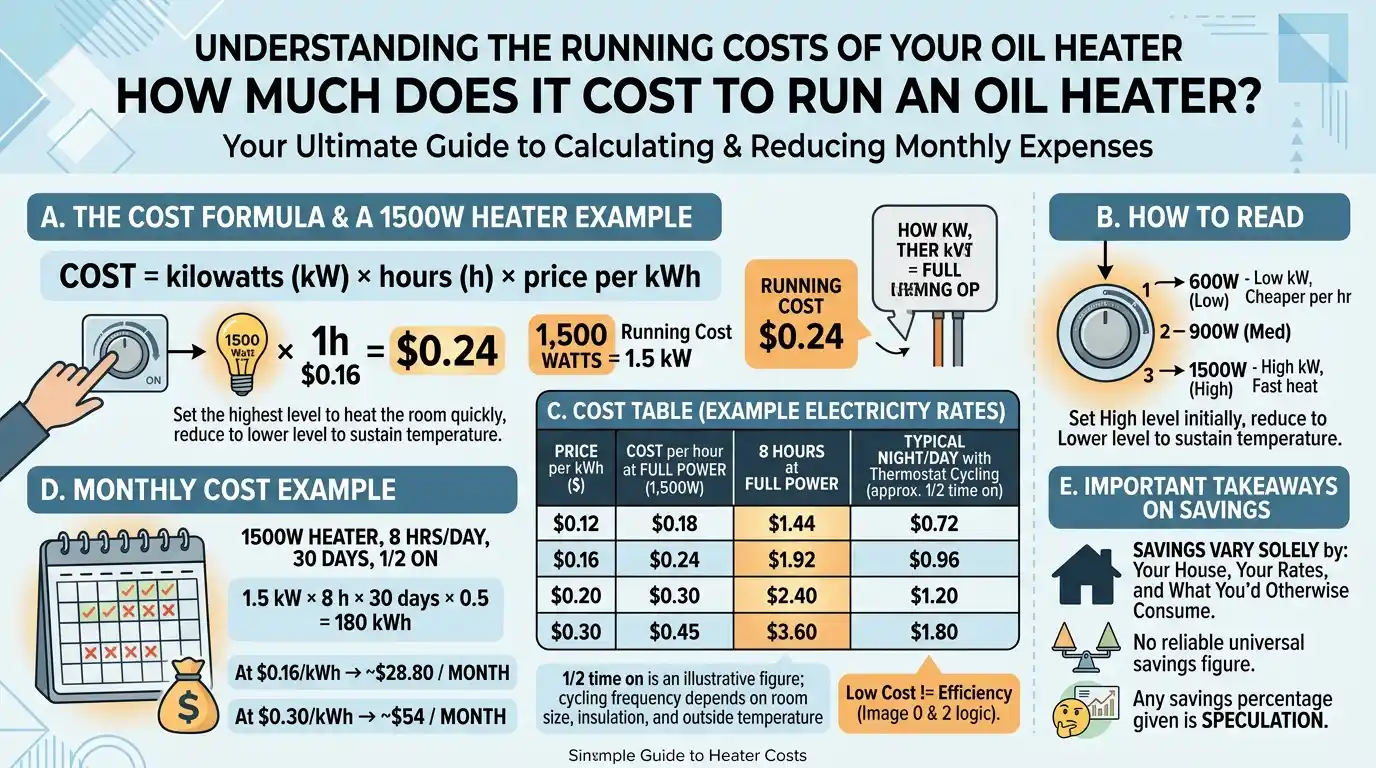
Cost = kilowatts × hours × price per kWh
A 1,500 watt heater is 1.5 kW. If your electricity costs $0.16 per kWh, running it at full power for one hour costs 1.5 × 1 × $0.16 = $0.24.
The table below involves the use of example rates. On your electricity bill is your own rate.
| Price per kWh | Cost per hour at full power (1,500 W) | 8 hours at full power | Typical night or day with thermostat cycling (about half the time on) |
|---|---|---|---|
| $0.12 | $0.18 | $1.44 | $0.72 |
| $0.16 | $0.24 | $1.92 | $0.96 |
| $0.20 | $0.30 | $2.40 | $1.20 |
| $0.30 | $0.45 | $3.60 | $1.80 |
The half the time on is a figure assumed to illustrate. The frequency at which your heater does turn on and off will be determined by the size of the room, insulation, and the temperature outside. It can operate less than half the time in a small, well-sealed room. It can be almost continuously used in a drafty room on a cold snap. For a wattage-by-wattage view, this cost breakdown by heater size is a handy companion.
Monthly Cost Example
Suppose you have a 1,500 watt oil heater that operates 8 hours/day, 30 days a year, and it is turned on half the time. That is 1.5 kW × 8 hours × 30 days × 0.5 = 180 kWh. At $0.16 per kWh, that is about $28.80 a month. At $0.30 per kWh, it is $54.
No dependable, universal figure on how much the average household can save by using an oil heater, since savings depend solely on your house, your rates and what you would otherwise consume. Any person who gives one percent of savings is speculating. If you want more hourly, daily, and monthly figures, see how many kilowatt-hours a radiator-style unit pulls.
How to Read the Wattage Setting
The majority of oil heaters have three power settings, commonly 600, 900 and 1,500 watts. Set the highest level to heat the room in a short time, and reduce to the lower level to sustain the temperature. The bottom setting is less attractive to kilowatts, thus cheaper per hour. A separate guide covers getting the most from those dial and thermostat settings in more detail.
Oil Heater vs. Other Heaters
It is not a question of which one is more efficient but which one fits how I will use it.
| Heater type | Efficiency at making heat | Warm-up speed | Noise | Heat after switching off | Best for |
|---|---|---|---|---|---|
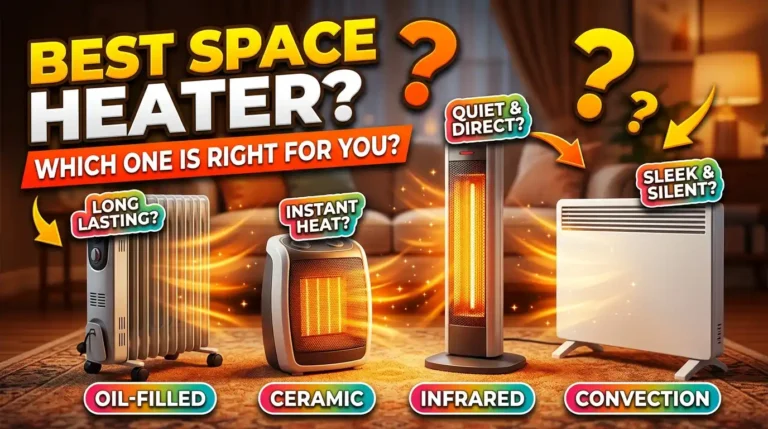
| Oil-filled radiator | About 100% | Slow (15 to 30 minutes is common) | Very quiet | Yes, lingers | Bedrooms, offices, long steady use |
| Ceramic fan heater | About 100% | Fast | Fan noise | Almost none | Quick top-ups, small spaces |
| Infrared radiant heater | About 100% | Instant on the person | Quiet | None | Heating a person or a seating spot |
| Heat pump or mini-split | Around 200% to 400% or more (varies by model and temperature) | Moderate | Low | Not applicable | Whole rooms or homes, lowest running cost |
Heat pumps are capable of defeating 100 percent since they do not generate heat but transfer it. The U.S. Department of Energy estimates that under the right conditions, heat pumps can produce up to approximately three times the amount of heat energy that they use in electricity and this is why they are the cost leader when it comes to regular heating.
Oil Heater vs. Ceramic Heater
They both consume the same power and at the same wattage. The ceramic heater heats the air within a short time and ceases when it goes off. The oil heater is slower to turn on yet continues to radiate and works noiselessly. Ceramic is the winner in case you need to get warm in 20 minutes.
Oil is the winner should you desire hours of quiet heat. To see the other side of the numbers, check what a fan-driven model costs to operate.
Oil Heater vs. Infrared Heater
IR heaters do not heat the air, but rather people and objects directly. That makes them handy in drafty rooms or when you sit in the same place. They do not heat a room as evenly as an oil heater and the heat ceases when they are turned off.
Oil Heater vs. Central Heating
It is here that most individuals make money. Electric resistance heat can be more costly per unit of heat than gas or a heat pump. You can check with a quick calculation. Approximately 29.3 kWh of energy is contained in one therm of natural gas.
If gas costs $1.50 per therm and your furnace is 90 percent efficient, each kWh of heat costs about $1.50 ÷ (29.3 × 0.9) = $0.057. That is compared to 0.16 per kWh of electricity. The following are sample prices, use your own.
According to the Department of Energy, portable heaters are the most reasonable as supplemental, zone heating. The concept is to warm the room you are in and to lower the central thermostat in other rooms.
Benefits of Oil Heaters
- Quiet operation. No fan is no noise and this is appropriate in bedrooms and offices.
- Steady, even warmth. The warmth is not intense and does not dry the air like other fan heaters may do to those who are sensitive.
- Retained heat. After the element cycles off the oil continues to radiate.
- Refills and no maintenance. The oil is permanently sealed.
- No glowing element. No exposed red-hot coil, and most models do not have a strong smell of burnt-dust.
- Portable. The majority of them are on wheels and have a carry handle.
Drawbacks of Oil Heaters
- Slow to warm up. Wait before the room feels different.
- Unsuitable in large or drafty areas. A unit of 1,500 watts can do but so much. One of the general rules of thumb is about 10 watts per square foot of a reasonably insulated room, and thus a 1,500 watt unit would be appropriate in a room of about 150 square feet.
- Heavy and bulky. They are heavy with oil and metal, and thus difficult to carry up the stairs.
- Hot surface. The fins may be hot to the point of burning skin when touched, an issue near young children and pets.
- Not less expensive than other electric heaters. This is efficiency, and do not purchase one hoping to pay a smaller wattage bill.
Are Oil Heaters Safe to Leave On Overnight?
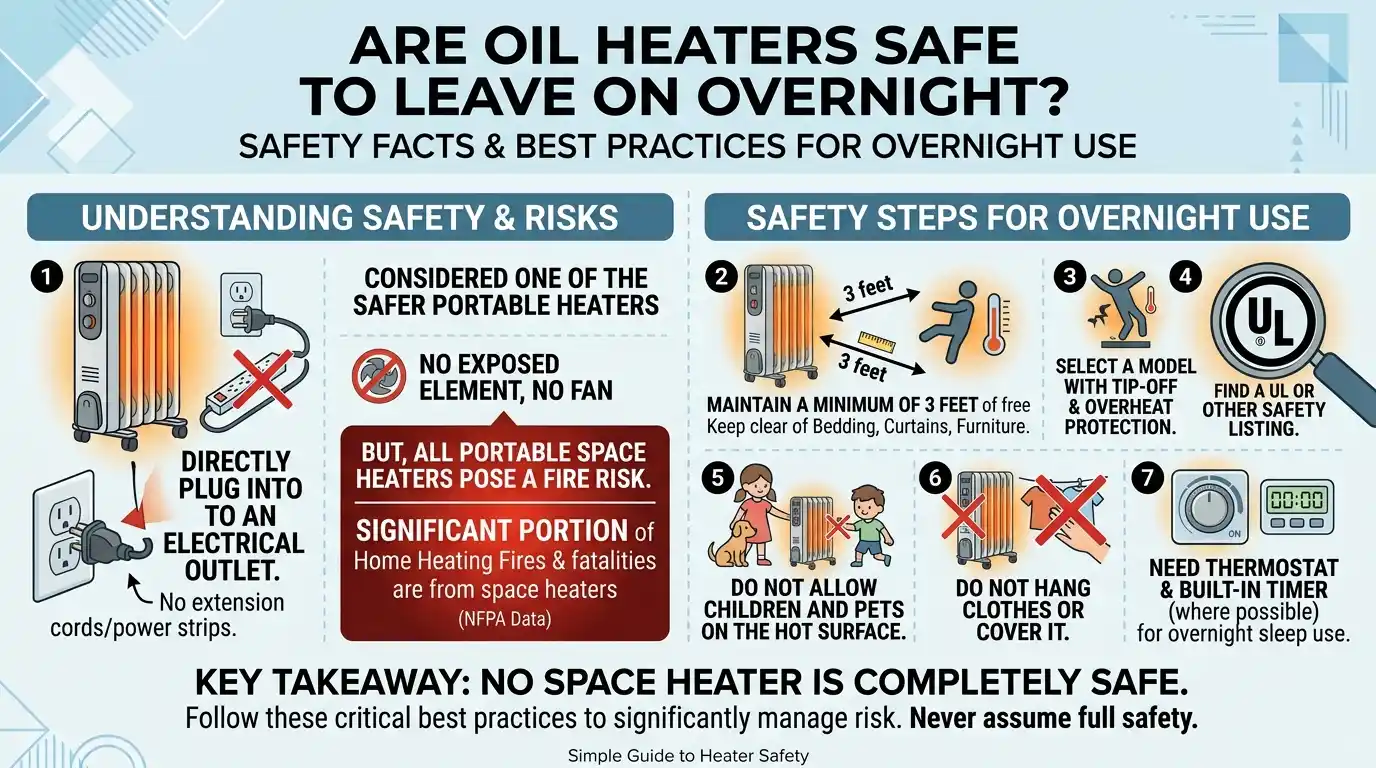
Oil heaters are often considered to be one of the safer types of portable heaters since they contain no exposed element and no fan, although no space heater is safe. According to National Fire Protection Association, a significant portion of home heating fires and the majority of heating-related fire fatalities are associated with space heaters.
Follow these steps:
- Directly plug heater into an electrical outlet. Do not use extension cords and power strips.
- Maintain a minimum of 3 feet of free space around it, not in contact with bedding, curtains, and furniture.
- Select a model that has tip-off and overheat protection.
- Find a UL or other safety listing.
- Do not allow children and pets on the hot surface.
- Do not hang clothes or cover it.
When you intend to use it when you are asleep, you will need the thermostat and a built-in timer (where possible).
How to Lower Your Oil Heater Costs
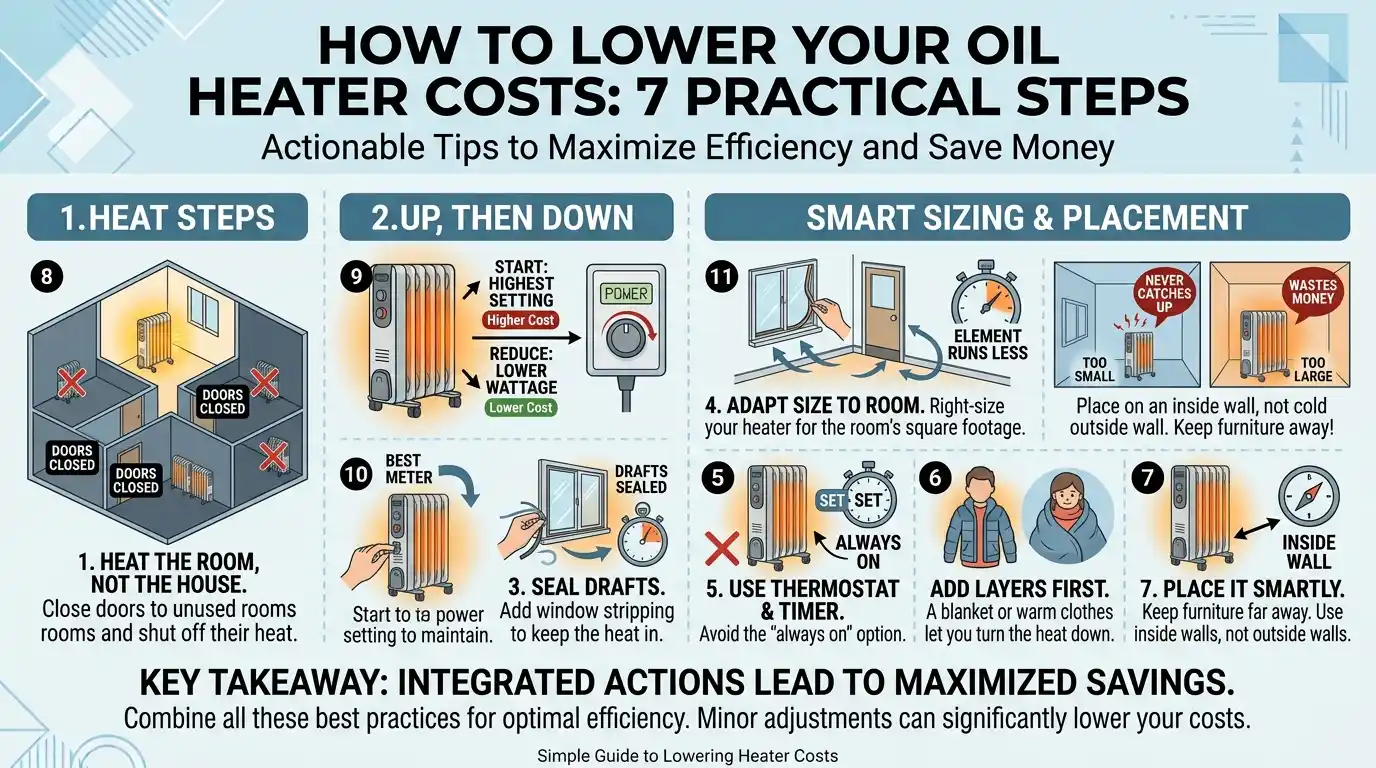
- Heat the room, not the house. Close the door and shut off the heat in the rooms that are not used.
- Up, then down. Start with the highest setting then reduce to a lower wattage.
- Seal drafts. Door and window weatherstripping minimizes the frequency of the running of the element.
- Adapt the size to the room. Too small and it never catches up. Too large wastes money on a room that doesn’t need it.
- Operate the thermostat and timer. Do not use the always on option.
- Add layers first. A blanket or warm clothes will allow you to turn the heater down.
- Place it smartly. Place it on an inside wall of the room, not directly against a cold outside wall, and make it furniture free.
Common Mistakes to Avoid
- It is assumed that energy saving labels imply less wattage.
- Leaving the heater on the highest level all day.
- Placing it in a big open-plan area and wondering why it does not get warm.
- Plugging it in an extension cord.
- Comparison of only purchase price, not running cost.
Who Should Buy an Oil Heater? A Quick Guide
Answer these in order:
- Would you like to warm an entire house? Yes, then consider a heat pump, mini-split or your central system. If no, continue.
- Would you like to be warm in a few seconds? If yes, consider a ceramic or infrared heater. If no, continue.
- Will you spend hours in a small or medium room, e.g. a bedroom or home office? In case yes, an oil heater is a good fit.
- Does it have noise issues? If yes, oil wins.
- Do you have small children or pets who could touch it? Yes, be careful with placement or select a model that is modeled to that.
FAQs
Do oil heaters work?
Yes, they turn almost all electricity into heat. So are other electric heaters, so efficiency is not their distinguishing feature.
Do oil heaters cost less to operate than other electric heaters?
Not at the same wattage. They can be less expensive since the thermostat turns them off and the oil continues to heat the room.
What is the electricity consumption of an oil heater?
The majority of them consume up to 1,500 watts, or 1.5 kWh/h at full load. Less energy is consumed in lower settings.
What is the price of an oil heater per hour?
Multiply kilowatts by your rate. At $0.16 per kWh, a 1,500 watt heater costs about $0.24 an hour at full power.
Does it cost less to leave an oil heater on at night?
Not automatically. It has a thermostat that switches it on and off, so the actual cost is typically less than the full-power cost, yet it is still a charge to your bill.
Which is better, oil or ceramic heaters?
It depends. Oil heaters are less noisy and retain heat. Ceramic heaters heat quicker.
Why is it that oil heaters take so long to warm a room?
The component has to warm the oil and metal initially. It is also that thermal mass which keeps the heat going on afterwards.
Do oil heaters dry out the air?
They do not dry out the air, but any heating will make indoor air drier during winter. It can be assisted with the help of a humidifier.
Can oil heaters be left on overnight?
They are one of the safer portable types, but they use a thermostat, maintain clearances, and are plugged directly into a wall outlet.
Does an oil heater have the capacity to heat a full house?
Not practically. It is constructed for one room.
How big an oil heater do I require?
Approximately 10 watts per square foot of a fairly insulated room. More power may be needed when insulation is poor.
Are oil heaters less expensive than central heating?
Usually not. Heat pumps or gas can be more affordable per unit of heat, but the cost varies depending on the region.
Are oil heaters maintained?
Very little. Wipe off dust and never open the sealed body.
What could be more economical than an oil heater?
A heat pump or mini-split is more efficient in delivering heat per kWh than any resistance heater.
Do oil heaters emit fumes?
No. The oil is sealed and not burned. The initial smell is often a faint odor that results from manufacturing residue being burned off.
Final Thoughts
Oil heaters are also rather effective in converting electricity to heat but they are not a shortcut to a smaller bill. Their promise is a quiet, consistent, no-fuss warmth that is at home in bedrooms, home offices, and any room you will spend hours in. When you warm the air in the room you are in, close the door, and leave the thermostat to its task, it may be a reasonable, comfortable aspect of a cheaper winter.
A heat pump is a good option in terms of the lowest running cost. An oil-filled radiator is difficult to fault if you are in need of a reliable room heater without noise or fuss.