Hickory Wood: The Complete Guide to Its Uses, Benefits, Burning Performance and Firewood Value
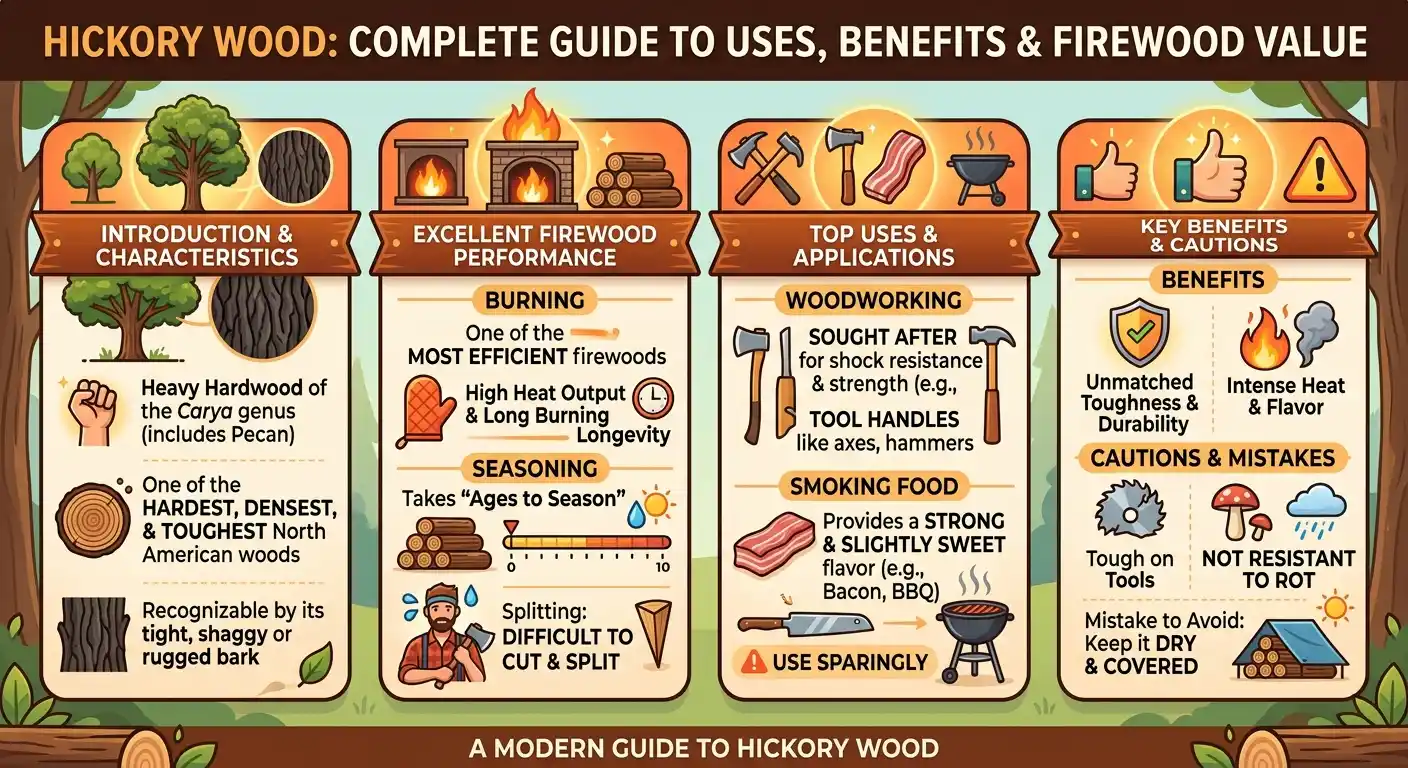
You need not be told that hickory has a right to its name, when you have ever swung an axe with a hickory handle, or eaten hickory smoked bacon, or burnt a stove with split hickory logs. Hickory wood is one of the hardest, densest and toughest North American hardwoods. It is hot, smokes food with a daring taste, and shrugs off hits that would shatter weaker species.
All in a single guide, this is what hickory is, how to recognize it, how to burn it, how to season it, how to cook with it, what it is used in, and the mistakes to avoid. If you are still comparing options, this roundup of the top firewoods for heat and long burns shows where hickory fits.
Key takeaways
Hickory is a heavy hardwood of the genus Carya; and pecan belongs to the family.
- It is one of the most efficient firewoods in terms of heat and longevity of burning, although it takes ages to season, and it is difficult to cut.
- As smoking wood it is strong and slightly sweet. Use sparingly.
- It is tough on tools, but in woodworking, it is sought after due to its shock resistance and strength.
- It is not resistant to rot, therefore, keep it dry and covered.
What Is Hickory Wood?
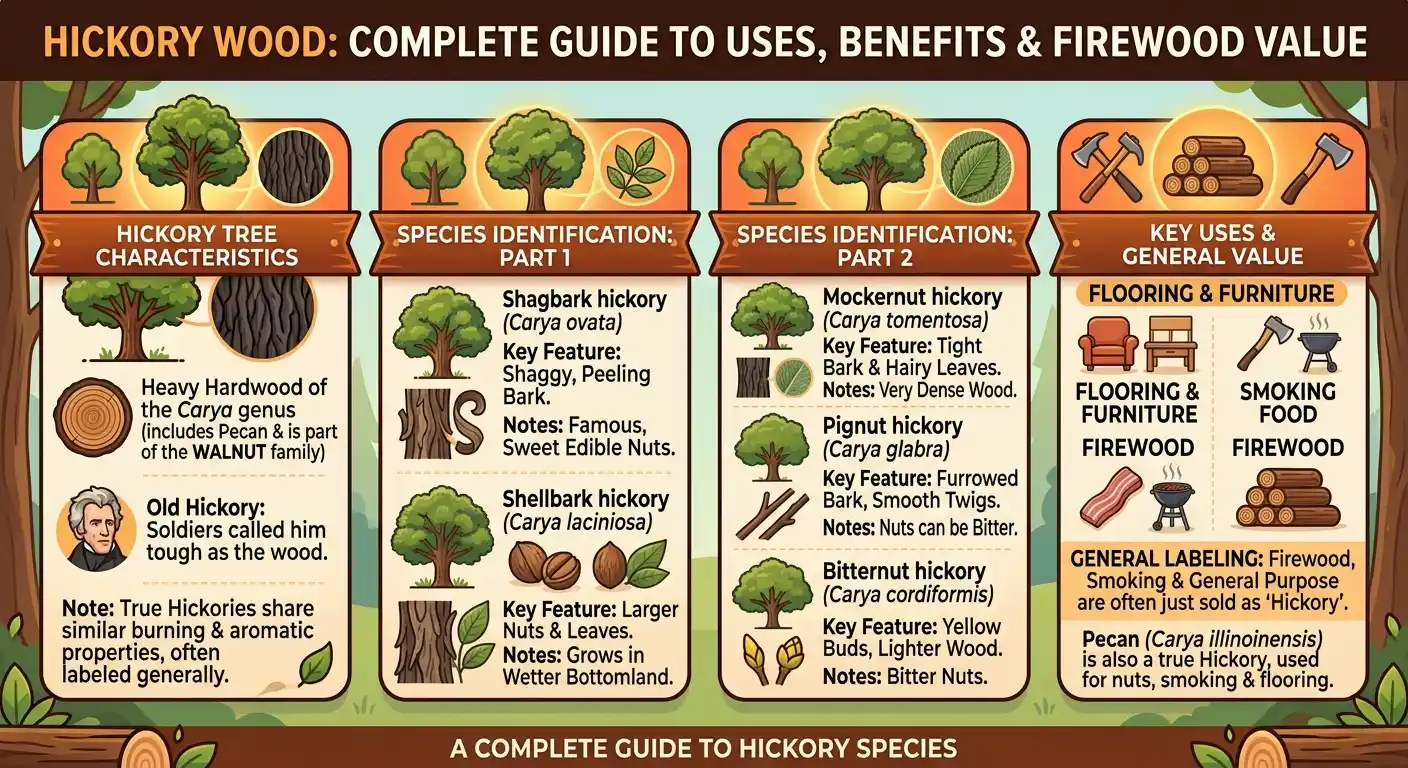
The wood of trees belonging to the genus Carya, or the walnut family (Juglandaceae), is hickory wood. It is a very tough, dense, shock absorbing hardwood that can be used as tool handles, flooring, furniture, smoking food and firewood.
The number of species native to North America is about a dozen and in East Asia a few more. Pecan trees are real hickories, too, and that is why pecan and hickory wood act and smell alike.
Hickory is a part of the American history too. Andrew Jackson was known as Old Hickory since his soldiers claimed that he was tough as the wood.
Common Hickory Species
| Species | Key features | Notes |
|---|---|---|
| Shagbark hickory (Carya ovata) | Long, curling, peeling bark plates; usually 5 leaflets | The most famous species; sweet edible nuts |
| Shellbark hickory (Carya laciniosa) | Similar shaggy bark, larger nuts and leaves | Grows in wetter bottomland soils |
| Mockernut hickory (Carya tomentosa) | Tight bark, hairy leaf parts, 7 to 9 leaflets | Very dense wood |
| Pignut hickory (Carya glabra) | Tighter, furrowed bark, smooth twigs | Nuts can taste bitter |
| Bitternut hickory (Carya cordiformis) | Yellow buds, lighter and slightly less dense wood | Nuts are too bitter to eat |
| Pecan (Carya illinoinensis) | Cultivated widely for nuts | Also sold as smoking wood and flooring |
In the case of firewood, smoking and general purpose, most sellers just label all as hickory. The true hickories are all good burners.
How to Identify Hickory Trees and Wood
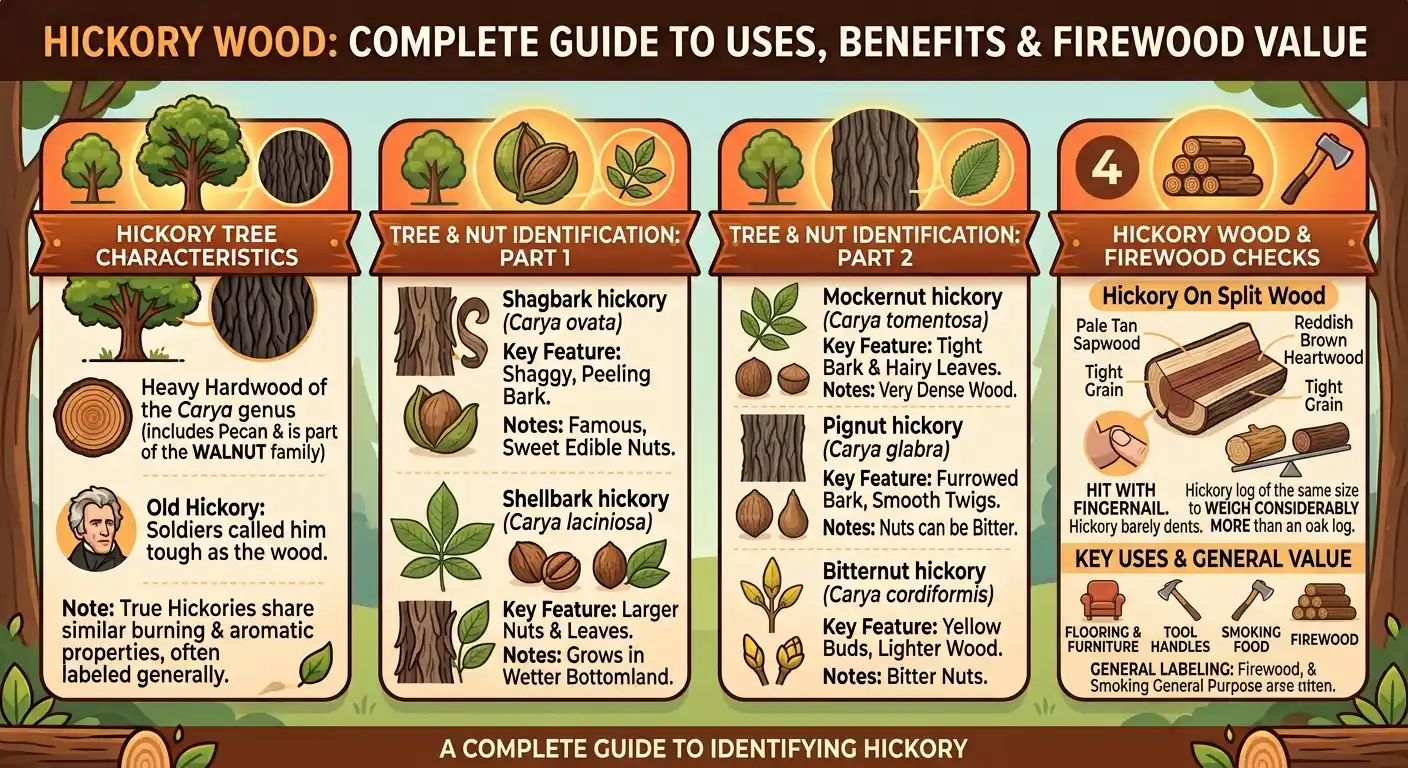
Hickory can be checked in three quick checks usually.
- Leaves: The leaves are compound i.e. multiple leaflets are attached to the same stem. The majority of hickories bear 5-9 leaflets.
- Bark: Bark Shagbark is distinctive with long strips which are curled outward of the trunk. The bark of other species is tighter and ridged.
- Nuts: Find round to oval nuts in a husk that divides into four parts.
Hickory On split wood, hickory tends to exhibit a pale tan sapwood and reddish brown heartwood, tight grain, and severe weight. A hickory log of the same size seems to weigh considerably more than an oak log. When you are in doubt, hit the split face with a fingernail. Hickory barely dents.
Hickory Wood Properties at a Glance
- Hardness: Shagbark and mockernut are typically rated at about 1,880 lbf on the Janka scale, with pecan and pignut at about 1,820 lbf. Comparatively, red oak is approximately 1,290 lbf.
- Density: Extremely dense as a domestic hardwood, about 50 pounds per cubic foot when dry.
- Strength: Good shock resistance and bending strength.
- Workability: Difficult. It hardens blades, it is nail resistant and it requires pre drilling.
- Durability outdoors: Poor. It is not resistant to rot and insects attack it easily.
The Benefits of Hickory Wood
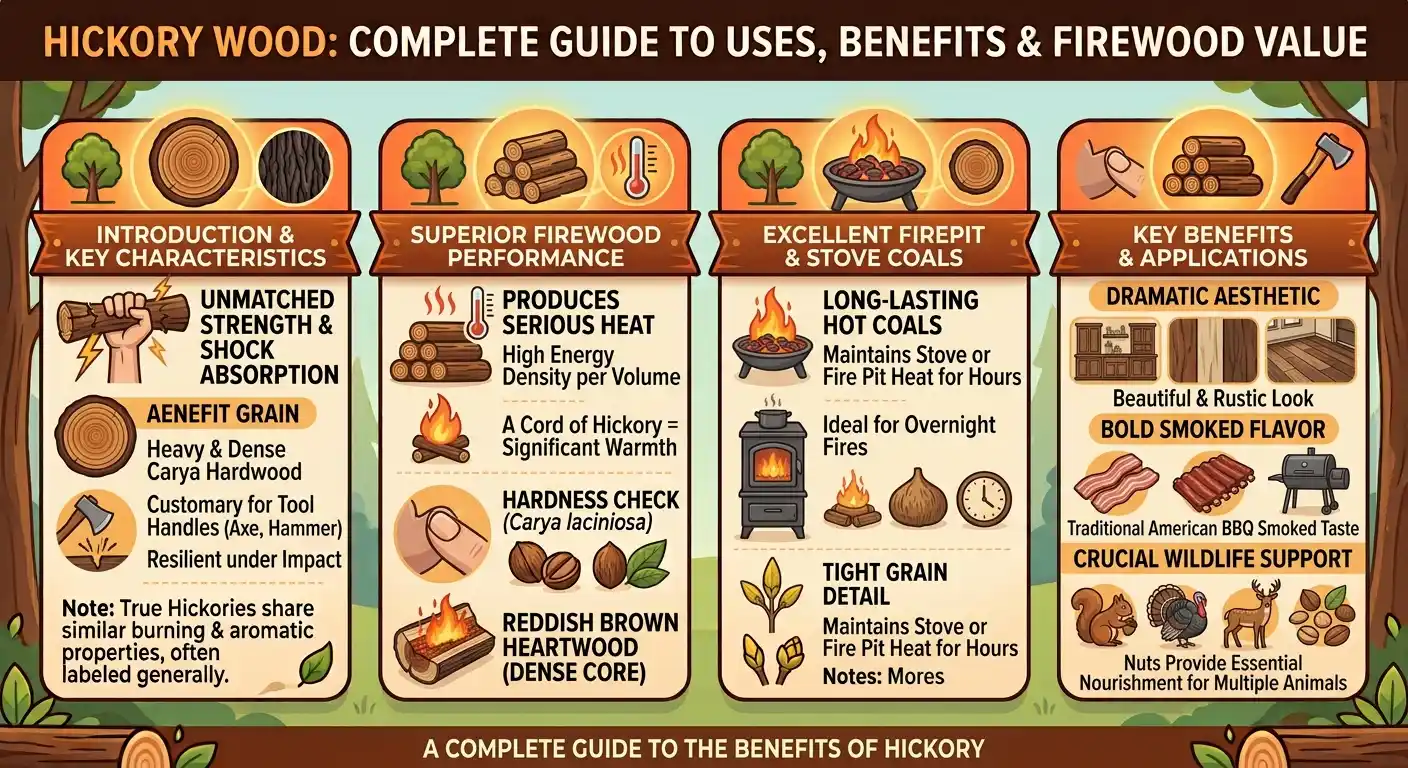
- It is extremely strong. Hickory is shock absorbent. It is the reason why it was the customary one to use as the axe, hammer and pick handles.
- It produces serious heat. The thicker wood will hold more energy in a given volume and thus a cord of hickory will give a lot of warmth.
- It produces coals that are long lasting. Hickory is burnt to a bed of hot coals that maintains a stove or fire pit.
- It gives food a bold taste. One of the traditional American barbecue flavors is its smoke.
- It looks good. Hickory lumber is very dramatic in color, ranging between cream and chocolate, and is appropriate in rustic cabinets and floors.
- It supports wildlife. The nuts provide nourishment to the squirrels, turkeys, deer and numerous other animals.
Is Hickory Good Firewood?
Yes. Hickory is generally regarded to be one of the best firewoods in North America. It produces a lot of heat, burns slowly and produces coals that are long lasting.
Hickory Firewood Heat Output
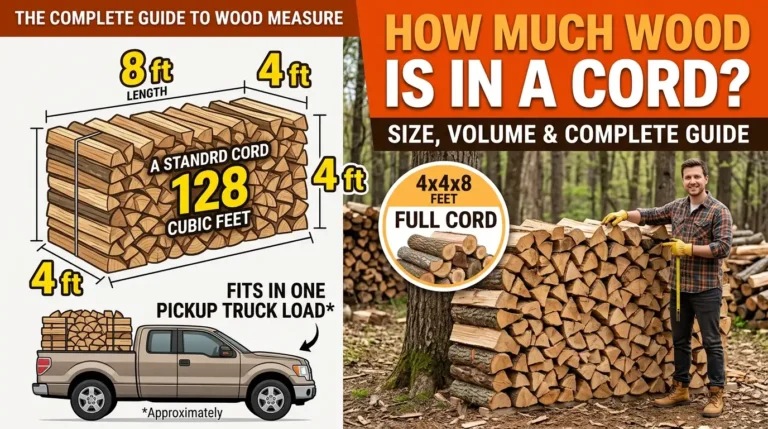
Heat is measured in BTUs per cord. If you are new to the term, this explainer on the exact size and volume of a cord covers the 4 by 4 by 8 foot stack (128 cubic feet). Heat is calculated in BTUs per cord (a cord is 4 by 4 by 8 feet pile or 128 cubic feet). Published values depend on the source and moisture of wood, thus consider them as a range of values of well seasoned wood.
| Wood | Approx. million BTU per cord | Burn quality |
|---|---|---|
| Shagbark hickory | About 25 to 28 | Excellent heat, long burn |
| White oak | About 24 to 29 | Excellent, slower to season |
| Red oak | About 22 to 25 | Very good |
| Sugar maple | About 22 to 25 | Very good |
| White ash | About 20 to 24 | Very good, seasons fast |
| Pine and spruce | About 15 to 20 | Fast burn, more sparks and resin |
Hickory and white oak switch the first place based on the source. Either one will heat a home well.
Hickory vs Oak Firewood
Hickory is generally a little heavier and burns a little easier when seasoned. In most places, oak is more common and is a little easier to split. They both require extended drying periods. When you can obtain either at a reasonable price, purchase the one which is the cheaper and drier.
If you want the oak side of the story, this breakdown of burning oak and its seasoning needs is a helpful companion, and the red oak burning tips cover the most common variety. If you can get either at a fair price, buy whichever is cheaper and drier.
Hickory vs Maple and Ash
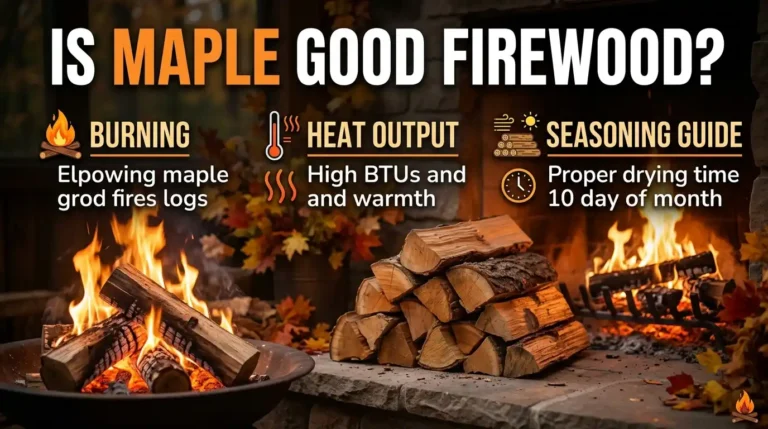
Sugar maple gives steady, long lasting heat and is a bit easier to handle, as explained in this look at how sugar maple performs in a stove. Ash splits easily and dries faster, which you can read about in this guide to burning ash logs. Hickory beats both on raw heat, but they can be easier choices when you need wood ready sooner.
How Long to Season Hickory Firewood
Allow at least 12 months on split hickory, and in humid climates, or on large rounds, allow nearer 18 months. Thick wood is also slow to dry, and hickory is not as quick to lose moisture as most.
A moisture meter is a reliable test. Divide a piece, insert the pins into the new face, and find a reading of less than 20 percent. Even old wood is light of its size, and has cracks at the ends, and when two pieces strike each other they make a sharp clack.
Step by Step: Preparing Hickory Firewood
- Cut to length. Use logs that are a little shorter than your firebox.
- Split immediately. Green hickory is much easier to split than dry hickory. A maul or hydraulic splitter helps.
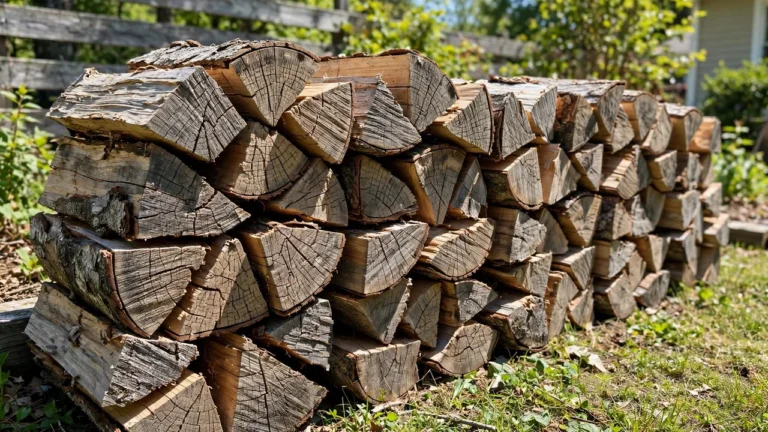
- Lie on the ground. Provide pallets or rails to allow air to pass through.
- Leave gaps. Single row stack with interspersed pieces.
- Only cover the top. Open sides to allow moisture to escape.
- Test before burning. Test with moisture meter.
Burning Tips
- Start with small kindling and some of the softer split pieces, and add hickory when the fire is started.
- Hickory is slow to catch. Add a piece or two at a time.
- Do not burn green or wet wood. It lowers the heat, generates a lot of smoke, and causes creosote to accumulate in the chimney.
- Check your chimney and have it cleaned. The Chimney Safety Institute of America suggests that it should be inspected annually.
- Do not burn painted, treated or glued wood.
Hickory Wood for Smoking and Cooking
Hickory is a very popular smoking wood in the world. It has a powerful smoke, sweet and savory, which has been said to taste of bacon.
Foods that are best to hickory smoke: pork shoulder, ribs, ham, bacon, sausages, beef brisket (usually combined with oak), and dark meat poultry.
Overwhelmed foods: fish, delicate vegetables, and light poultry cuts when hickory is heavily used.
Smoking Tips
- Use sparingly. Excess hickory smoke is bitter. Begin with a small number of chunks, not a box.
- Blend it. Combine hickory with apple or cherry to give it a lighter, sweeter flavor.
- Strive to thin, clean smoke. Thin blue smoke is good compared to thick white smoke.
- Select the appropriate format. Chunks take the longest time in a smoker, chips are ideal in quick grill sessions and pellets are ideal in pellet grills.
- Skip the soaking. Wet wood primarily steams and then smolders, and will not add additional smoke flavor.
Hickory vs Other Smoking Woods
| Wood | Flavor | Strength | Good with |
|---|---|---|---|
| Hickory | Bold, smoky, bacon like | Strong | Pork, ribs, ham, bacon |
| Pecan | Sweeter, nutty | Medium to strong | Pork, poultry, brisket |
| Oak | Balanced, classic | Medium | Beef, lamb, almost anything |
| Apple | Mild, fruity | Light | Poultry, pork, fish |
| Mesquite | Sharp, earthy | Very strong | Quick sear cooking, beef |
Hickory is too heavy, so you can replace it with pecan.
A health note: any food that is cooked on wood smoke and open fire creates compounds that researchers investigate with potential health impacts. Smoked foods should be consumed sparingly and meat should not be over charred.
Hickory Wood Uses
Tools and Handles
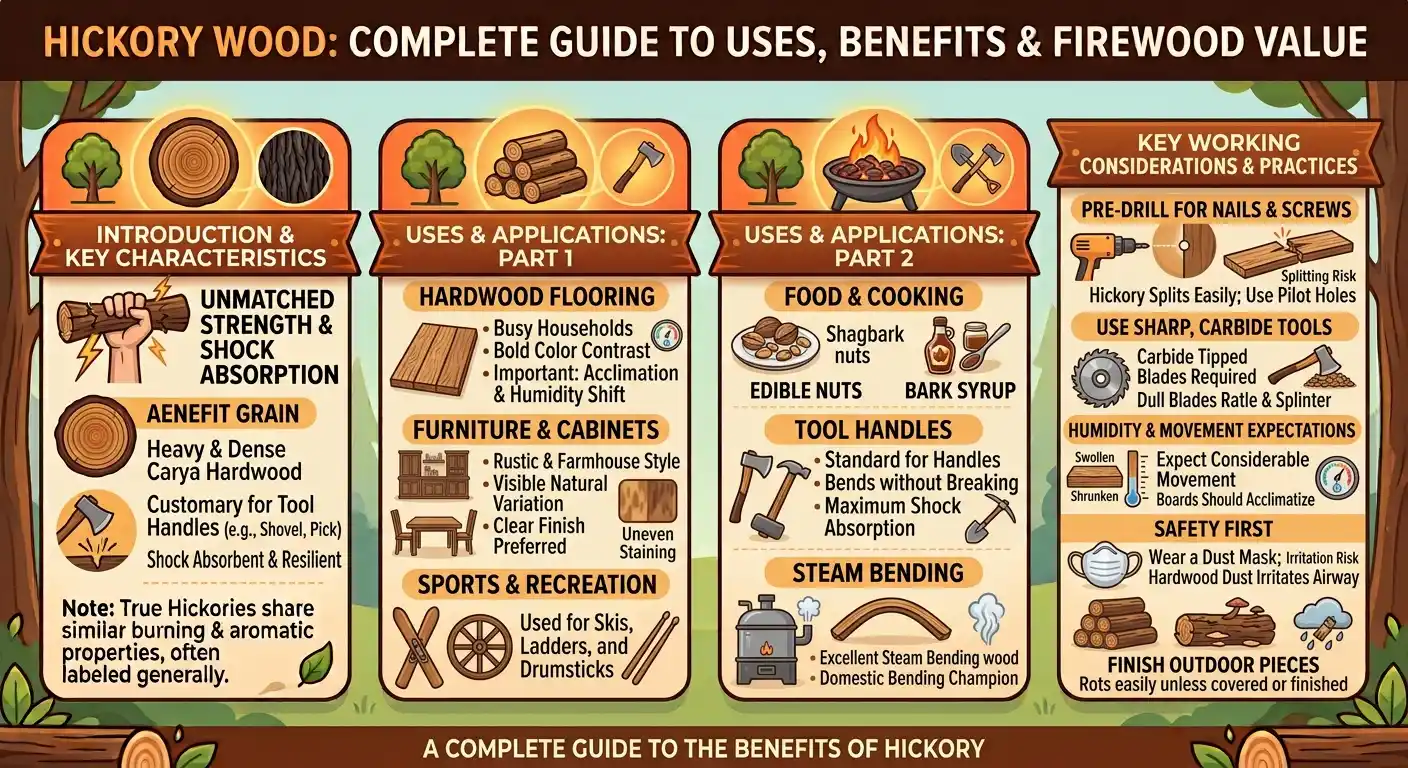
Hickory has been the standard of axe, hammer, sledge, shovel and pick handles since time immemorial. It bends and shocks are absorbed rather than breaking.
Flooring
Hickory and pecan flooring is one of the toughest domestic. It is appropriate in busy households, but the intense color contrast is an appearance you must admire. It is also capable of shifting more with humidity changes compared to certain woods and hence acclimation and installation are important.
Furniture and Cabinets
Hickory is popular in rustic and farmhouse cabinets, tables, chairs and stairs. It stains unevenly and thus many prefer to use a clear finish that reveals the natural variation.
Sports and Recreation
In the past, hickory has been utilized in skis, wagon parts, ladder rungs and drumsticks. It is still used today in some sporting goods and drumsticks.
Food and Cooking
In addition to smoking, shagbark hickory nuts are also edible and delicious, and manufacturers of hickory bark syrup.
Working With Hickory Lumber
- Pre drill all nail or screw holes. Hickory is split when nailed without a pilot hole.
- sharp, carbide tipped tools. Sharp blades cut and rattle.
- Expect movement. Hickory will shrink and swell considerably with the changes in humidity, and boards should be allowed to acclimatize.
- Steam bending is good. It is a good domestic bending wood.
- Protect yourself. Wear a dust mask. Dust of hardwood may cause irritation of the airways.
- Finish outdoor pieces. Hickory rots easily in the open air unless covered.
Pros and Cons of Hickory Wood
| Pros | Cons |
|---|---|
| Very hard and strong | Difficult to cut, nail and plane |
| Excellent firewood heat | Slow to season |
| Long lasting coals | Hard to split when dry |
| Iconic BBQ flavor | Can taste bitter if oversmoked |
| Great shock resistance | Not rot resistant |
| Attractive natural color variation | Insect prone if stored damp |
Common Mistakes to Avoid
- Smoking green hickory and wondering why it smokes.
- Division of dry rounds, when you would have divided them green.
- Smoking too much hickory, which causes bitter food.
- Piling the wood directly on the ground or a tarp which is sealed.
- Nailing boards of hickory.
- Hickory used out of doors without a finish or sealant.
- Purchasing firewood that has been used without verifying moisture content.
FAQs
What is the best use of hickory wood?
Hickory wood is commonly used for firewood, smoking food, tool handles, flooring, cabinets, and furniture.
Does hickory make a hardwood?
Yes. Hickory is a dense hardwood and is one of the hardest native hardwoods in North America.
Can hickory be a good firewood?
Yes. Hickory produces a lot of heat, burns for a long time, and leaves behind long-lasting coals.
What is the length of time of hickory?
Hickory should generally be seasoned for at least 12 months after splitting. In humid regions, 18 months may be preferable. Properly seasoned firewood should have less than 20 percent moisture content.
Is hickory harder than oak?
Generally, yes. Hickory is normally around 1,820 to 1,880 lbf on the Janka hardness scale, compared with approximately 1,290 lbf for red oak and 1,360 lbf for white oak.
Does hickory smoke a lot?
Well-seasoned hickory can burn relatively cleanly. Wet or green hickory produces considerably more smoke.
What does hickory taste like when smoking?
Hickory smoke has a powerful, savory, slightly sweet flavor that is commonly compared with bacon.
Is hickory too tough for chicken or fish?
It can be quite strong for chicken or fish. Use a smaller amount or mix hickory with milder woods such as apple or cherry.
Will hickory burn in a fireplace or a wood stove?
Yes. Properly seasoned hickory can be burned in a fireplace or wood stove, provided the appliance is suitable and the chimney is clean and properly inspected.
Are hickory chips to be soaked?
No. Soaking wood chips is generally unnecessary and can delay ignition and clean burning.
Is hickory pecan?
Pecan is one type of hickory. It generally produces a milder and somewhat sweeter smoke flavor than many other hickory varieties.
Does hickory wood cost a lot?
Hickory wood prices vary by region, supply, and format, such as firewood, chunks, lumber, or flooring. Local suppliers can provide the most accurate price per cord or board foot.
Does hickory make good furniture?
Yes. Hickory is suitable for durable, solid furniture, although its coarse grain can make staining and machining less predictable.
Is hickory easily rotted?
Hickory is relatively perishable when exposed to outdoor conditions and should be properly protected from moisture and prolonged weather exposure.
Are you able to eat hickory nuts?
Yes. Shagbark and shellbark hickory nuts are edible, while bitternut hickory nuts are generally considered too bitter to eat.
Final Thoughts
Hickory is that kind of a wood that once you know it, it does its work with a minimum of noise. It will warm your house better than most alternatives, because it should be seasoned, cut green when you can, and it will warm your home. Put it sparingly in the smoker and you will have a taste that will make barbecue to many.
Hold it gently in the shop, and it will provide you with decades-long handles, floors and furniture.