Do Oil Lamps Produce Heat? How Much Warmth to Expect and How to Use Them Safely
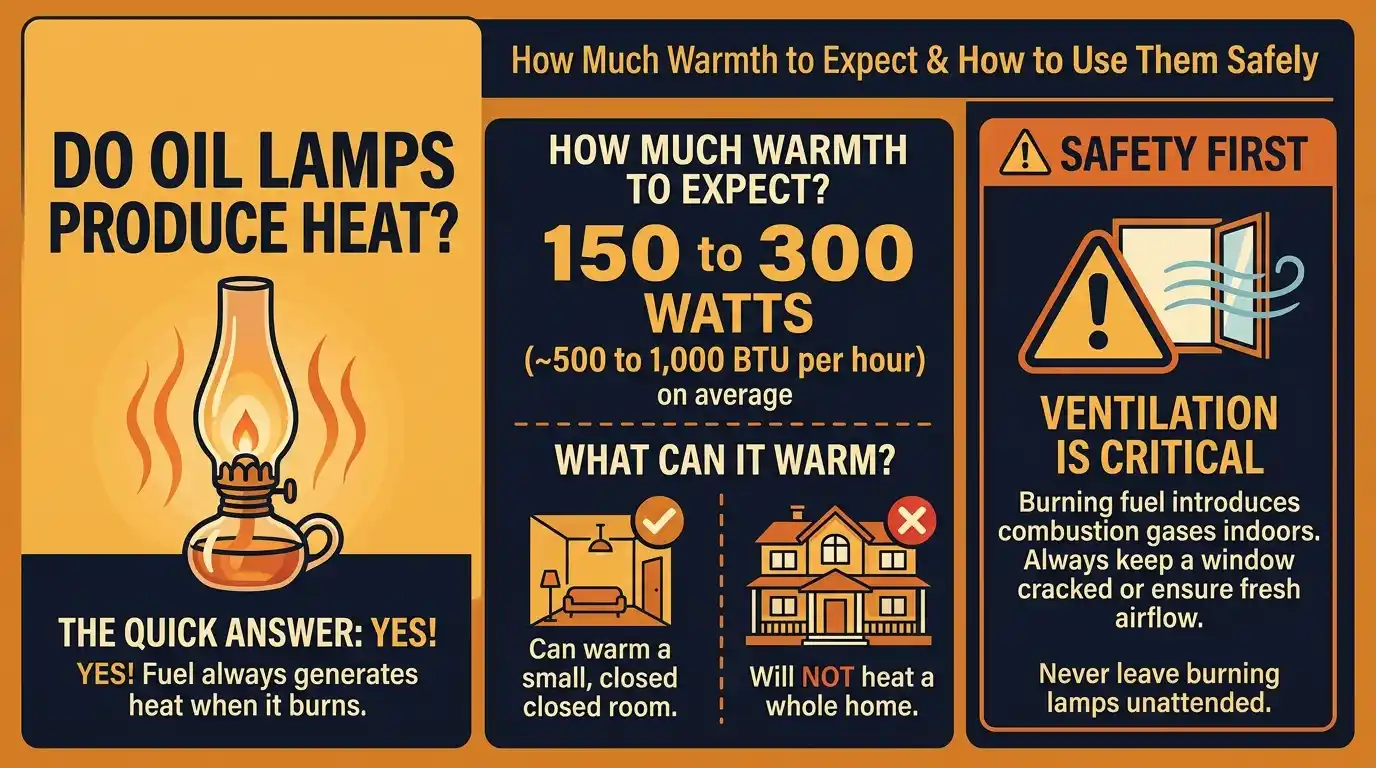
Quick answer: Yes, oil lamps generate heat, as fuel always generates heat when it burns. The average lamp produces about 150 to 300 watts (approximately 500 to 1,000 BTU per hour) of heat, depending on the amount of fuel it burns. That will cool a small, closed room, but not a home. It also introduces combustion gases in the house hence ventilation is important.
When the power goes off in winter you might think that that lamp on the shelf can serve two purposes. I will tell you the truth, and the math will be displayed so that you can verify it yourself.
How Do Oil Lamps Produce Heat?
The oil lamp burns fuel that is pulled up a wick. The fire has two functions: it illuminates and it heats. Only a minor portion of the energy is visible light. The majority of it turns into heat and this is why the glass chimney becomes warm.
The heat travels in two ways:
- Radiant heat: the warmth that you experience when sitting near the flame.
- Convection: the hot air that is coming out of the chimney and gradually heating the room.
How Much Heat Does an Oil Lamp Produce?
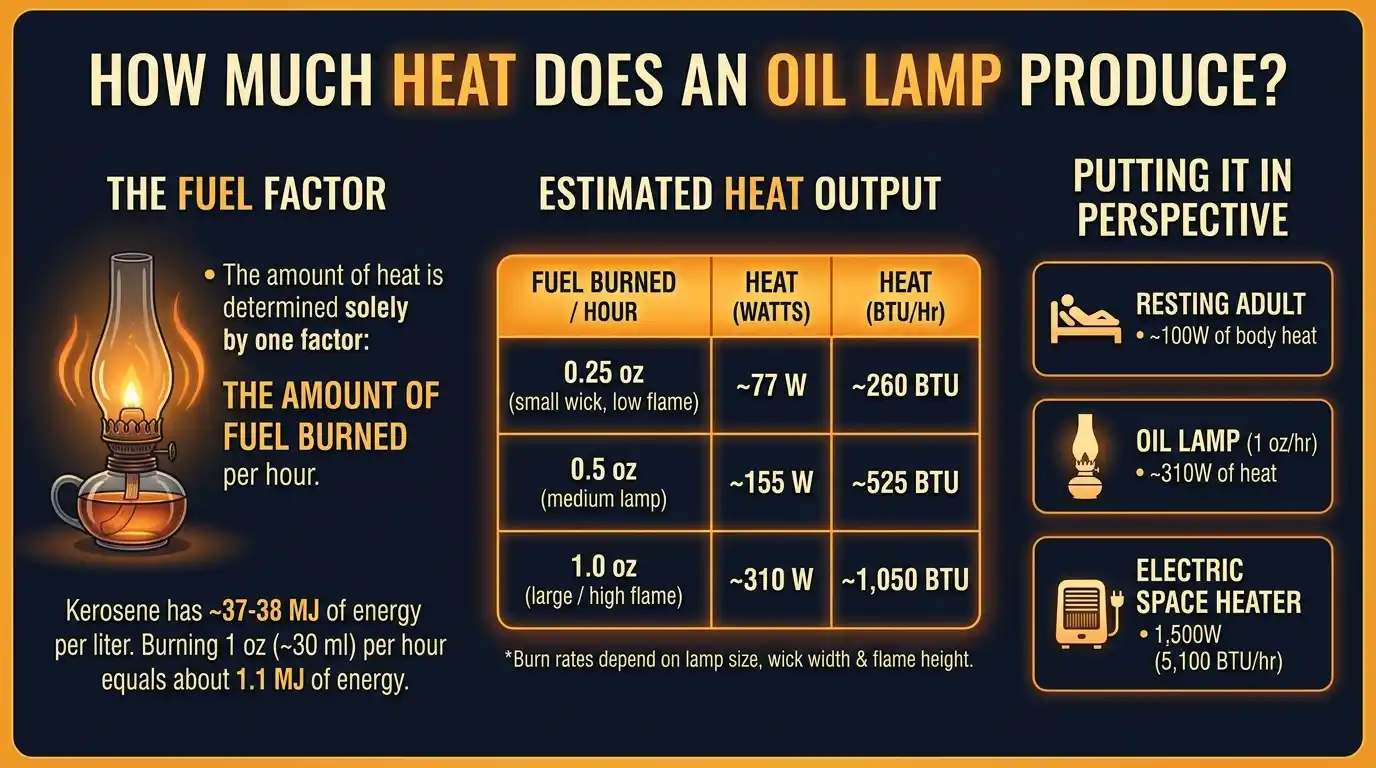
The amount of heat it produces is determined by only one factor, the amount of fuel that the lamp burns each hour. The normal figure of the energy content of kerosene is approximately 37 to 38 megajoules of energy per liter.
The math of one fluid ounce (approximately 30 mL) of fluid burned per hour is as follows:
- 1 oz of kerosene contains energy: about 1.1 MJ.
- 3,600 seconds divided: approximately 310 watts.
- In BTU: about 1,050 BTU per hour (1 watt equals 3.412 BTU/hr)
Notable limits: Fuel burn rates are highly dependent on the lamp size, wick width and flame height. Tested heat values of certain lamps are not very common in print, and I was unable to locate any reliable manufacturer data on most of the models, so consider this table as an approximation, not a spec.
| Fuel burned per hour | Approx. heat (watts) | Approx. heat (BTU/hr) |
|---|---|---|
| 0.25 oz (small flat wick, low flame) | ~77 W | ~260 BTU |
| 0.5 oz (medium lamp) | ~155 W | ~525 BTU |
| 1 oz (large or high flame) | ~310 W | ~1,050 BTU |
To put it into perspective, an adult lying down produces about 100 watts of body heat. An average electric space heater operating at high power is 1,500 watts, or 5,100 BTU per hour.
Can an Oil Lamp Heat a Room?
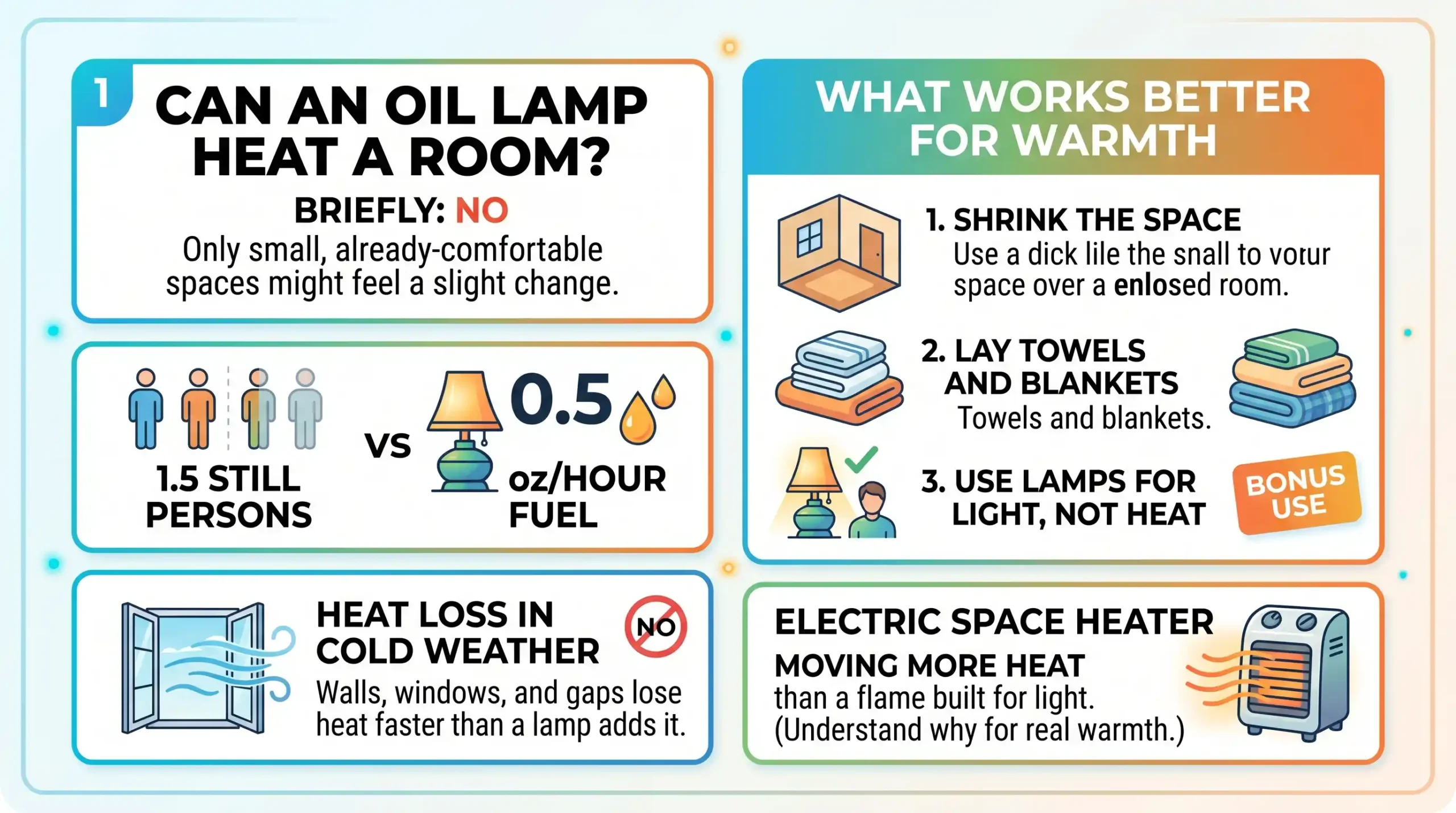
Briefly: No. A single lamp may provide a little warmth to a tiny, closed, insulated room, and only when the room is already nearly comfortable.
A lamp that uses 0.5 oz/hours of energy produces approximately the same amount of heat as 1.5 individuals sitting still. During cold weather, the heat is lost by the walls, windows and gaps in rooms far quicker than in warm weather.
What works better if you want warmth from lamps:
- Shrink the space. Lock up in a little room.
- Lay towels and blankets.
- Bonus, not plan, use lamps.
If you need real warmth, it helps to understand what happens inside an electric space heater and why it moves so much more heat than a flame built for light.
Oil Lamp vs. Candle vs. Space Heater
| Source | Approx. heat output | Light | Heating a room? |
|---|---|---|---|
| Candle | ~40 to 80 W | Dim | No |
| Oil lamp | ~75 to 300 W (estimate) | Moderate | Barely, small spaces only |
| Kerosene heater | Around 10,000 BTU/hr or more (model dependent) | Minimal | Yes, if used per instructions |
| Electric space heater | 1,500 W (~5,100 BTU/hr) | None | Yes |
A dedicated heater is built to move heat into a room. A lamp is built to make light. If you are shopping for a backup, this breakdown of choosing the right heater type for your space can help you match a heater to your room size and situation.
For a fuel-burning option, read about the wick and combustion science behind kerosene heaters to see how they differ from a simple lamp.
Do Oil Lamps Produce Carbon Monoxide?
Short answer: Yes, any open flame has the potential to produce carbon monoxide (CO), particularly when it is not burning well or when the room is not ventilated.
CO is a gas which is colorless and has no smell. The CDC cautions that the use of fuel-burning units can lead to CO poisoning when the units are used in enclosed spaces. Carbon dioxide, water vapor, and soot are also emitted by lamps.
Warning signs: headache, dizziness, nausea, confusion. In case you experience them, rush to the open air and consult a doctor.
Oil Lamp Safety Guide
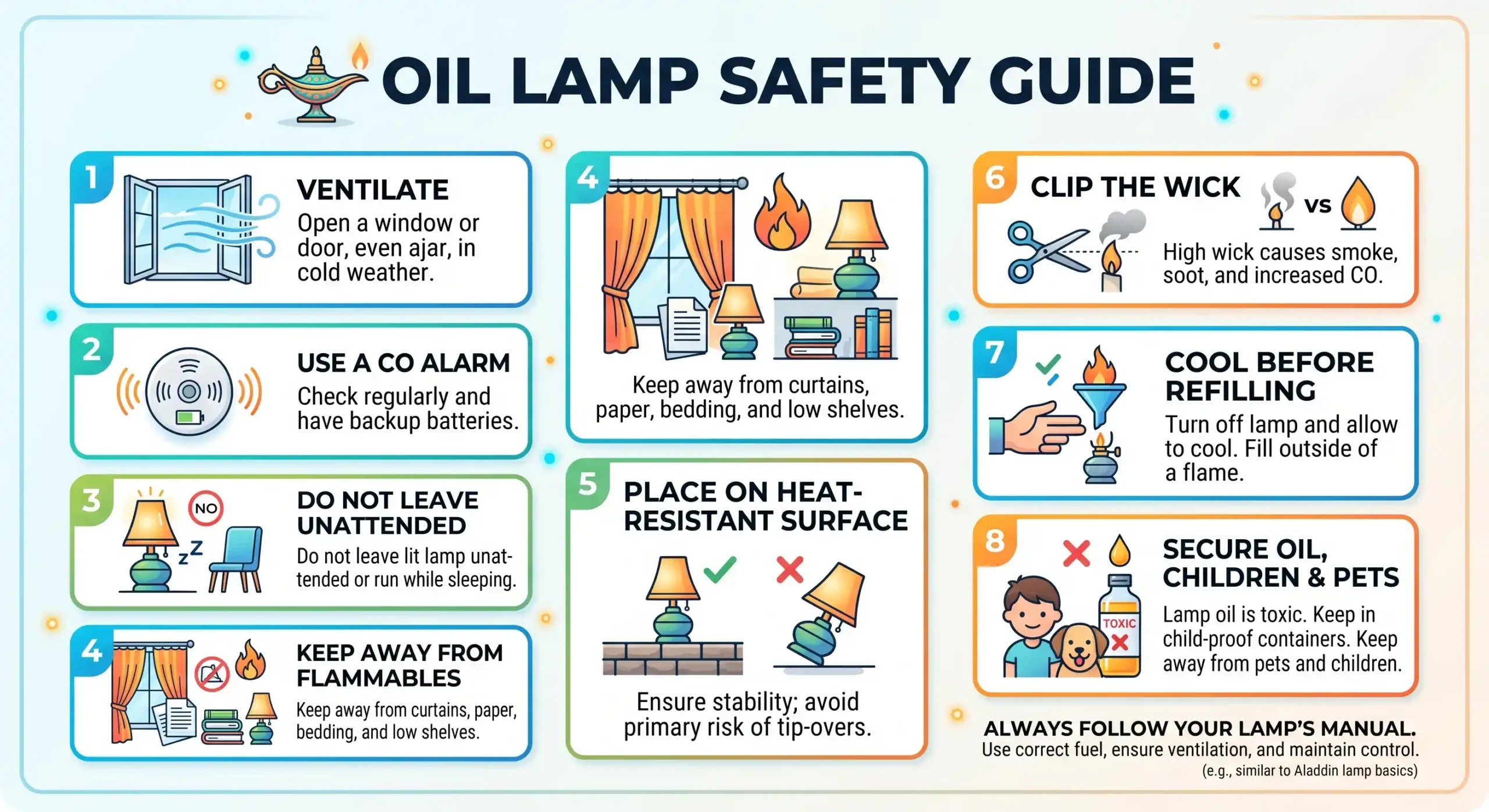
- Ventilate. Open a window or door, even in cold, ajar.
- Use a CO alarm. Check it when you have time, and have backup batteries.
- Do not leave a lit lamp unattended or run one when sleeping.
- Keep it away from flammables. Common fire starters include curtains, paper, bedding and low shelves.
- Place it on a heat-resistant surface. One of the primary risks is tip-overs.
- Clip the wick. One with too high a wick causes smoke, soot and increased CO.
- Turn off the lamp and allow to cool before refilling. Fill it outside of a flame.
- Do not leave children and pets. Lamp oil is toxic when ingested and it can seriously damage children. Keep it in its child-proof container.
The same basics are discussed by Aladdin (a lamp manufacturer, one of the references you provided), which includes the correct use of fuel, ventilation, and control. Always follow your own lamp’s manual.
Common Mistakes
- Burning gasoline, alcohol, or other fuel not designed to burn in a lamp. This is extremely dangerous.
- increasing flame to get more heat. This normally results in smoke and soot.
- A lamp used in a tent, camper or bathroom which is sealed.
- Omission of the CO alarm.
What Fuel Should You Use?
- Paraffin lamp oil (liquid paraffin): Cleaner, less odorous. Widely used as decorative and everyday items.
- Kerosene (K-1): Inexpensive and readily available. Burns more fiercely and gives off more smell unless highly refined. Only use what your lamp is intended to do.
- Do not use gasoline, or anything not marked not to be used in lamps.
Some people also wonder about branded blends. This explainer on how a premium fuel blend differs from regular kerosene is useful if you burn fuel in heaters as well as lamps.
Consult the manual to your lamp, as certain models (such as mantle lamps) have a special fuel need.
FAQs
Do oil lamps give off heat?
Yes. The burning of fuel generates heat and the majority of the energy of a lamp goes to heat and not light.
What is the amount of heat produced by an oil lamp?
Approximately 75 to 300 watts (260 to 1,050 BTU/hr), depending on the amount of fuel it burns.
Does an oil lamp heat a room?
Very little, and in a very little, well-insulated place.
What is the temperature of an oil lamp?
The fire is quite hot and chimney and metal components are capable of burning skin. Always consider the entire lamp to be hot when it is on.
Can oil lamps be used indoors?
They are capable of, with ventilation, supervision, a CO alarm and the appropriate fuel.
Are carbon monoxide lamps made by oil lamps?
Yes, any open fire can, particularly when burning sluggishly or having little fresh air.
Does an oil lamp outshine an oil candle?
Typically, as lamps can generally consume more fuel per hour, but the output can vary.
Is it possible to leave an oil lamp on at night?
No. Do not leave one burning unattended or when asleep.
What is the difference between lamp oil and kerosene?
No. Lamp oil is typically paraffin that is refined. Another fuel is kerosene. Use the fuel your lamp requires.
Does an oil lamp use up oxygen?
Oxygen burns in any flame. This is important in a confined area such as a room, hence the need to have ventilation.
What is emergency heat safer?
Have a heater with an indoor use rating and instructions, and a CO alarm. The first source of light is a lamp.
Why does my lamp smoke?
Usually the wick is too high or needs trimming. Turn it off and cut it.
Final Thoughts
Even oil lamps produce some heat, although not a lot, and not safely enough to be your primary plan. Consider the warmth a little extra on top of pleasant light. Prepare your winter emergency based on an adequate heater, clothing, and a small insulated room, and leave your lamp to do what it does best.