1/2 Cord of Wood: How Much Is It? Size, Weight and Cost Explained
You have a half cord of firewood ordered. A truck dumps a pile in your driveway, and you have no idea if that’s what you paid for.
It always occurs, as half cord is tossed about. This is what a half cord is, and how large and heavy it ought to be, and what a fair price is.
Key takeaways
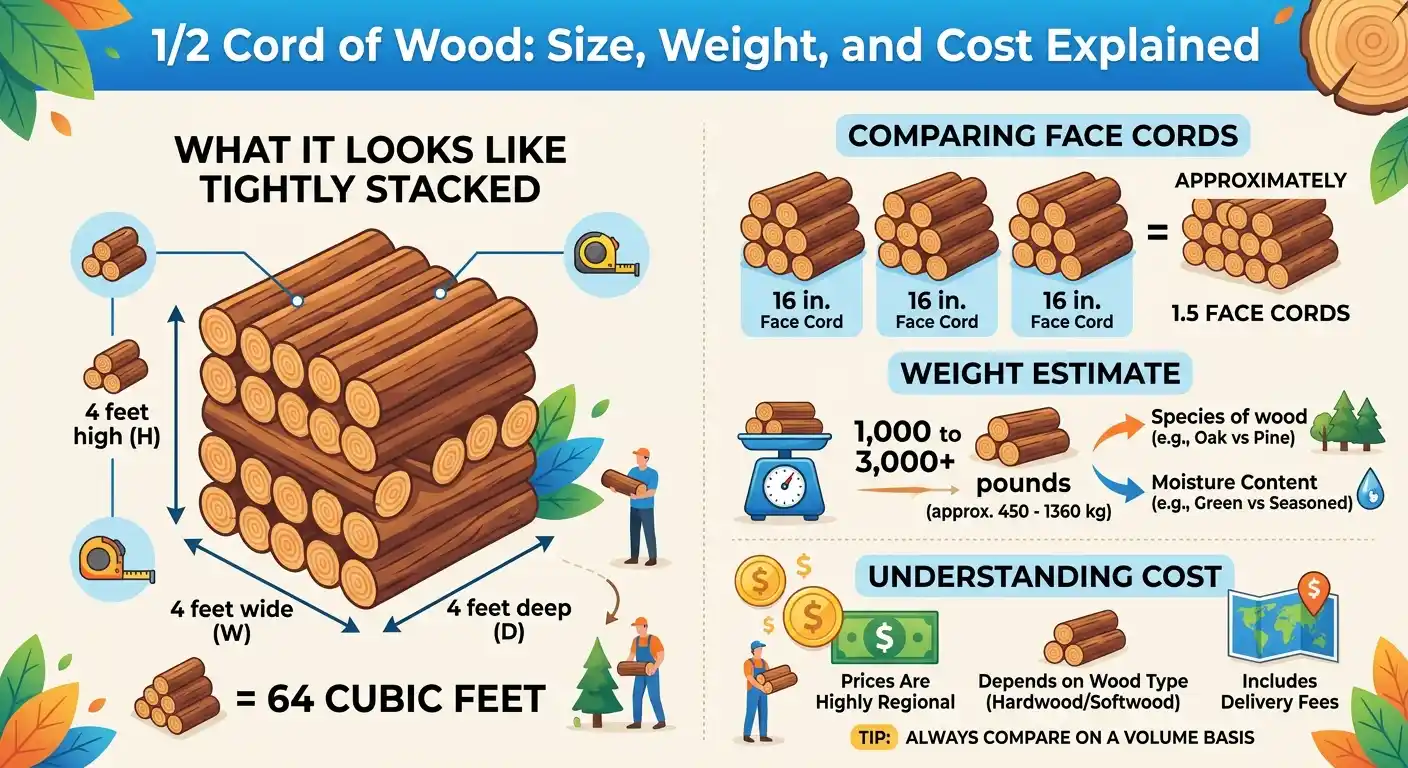
- 64 cubic feet of tightly packed firewood is a half cord of wood.
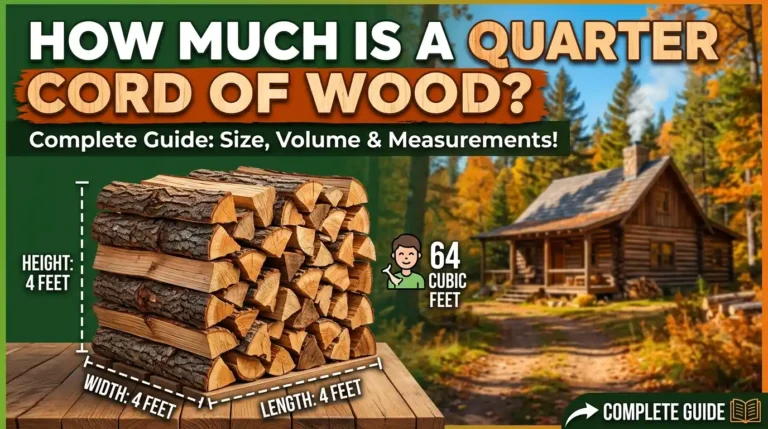
- The shape is often 4 feet high, 4 feet wide and 4 feet deep.
- It has a weight of about 1,000 to 3,000 pounds or even more, depending on the species and moisture.
- With 16 inch logs, it is approximately one and a half face cords, when used by your seller.
- Prices are highly regional, wood type, and delivery, and should always be compared on a volume basis.
What Is a Half Cord of Wood?
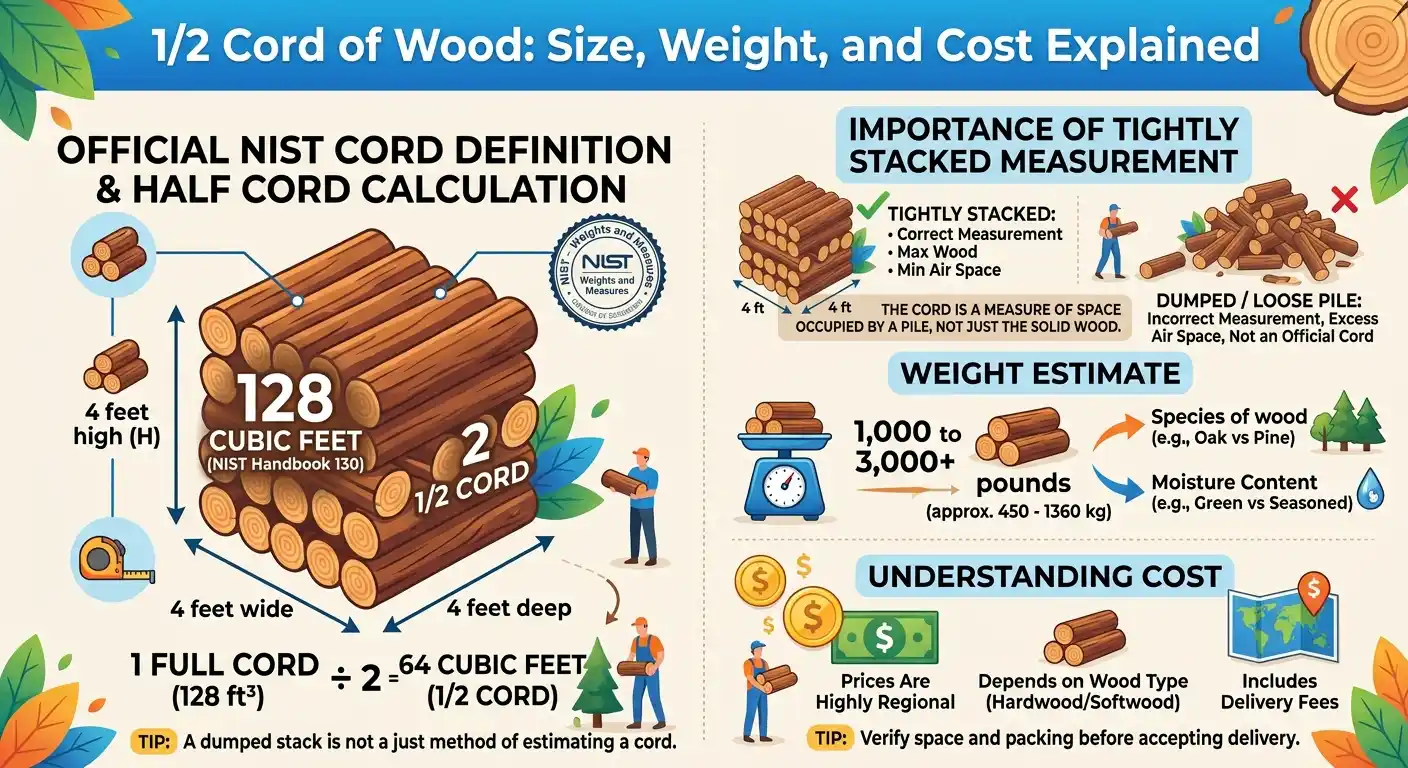
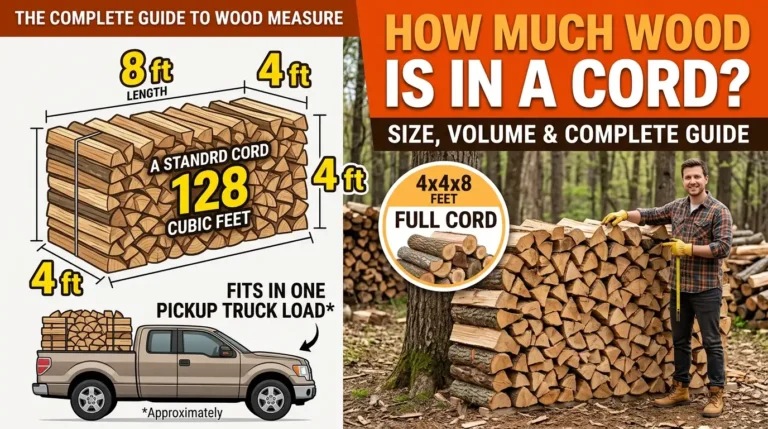
A half cord of wood is 64 cubic feet of firewood, arranged in a pile with a minimum of space between them. It is half a cord, technically speaking in the United States 128 cubic feet of stacked wood, including the area between the logs. This definition is published by the National Institute of Standards and Technology (NIST) as Handbook 130 on weights and measures.
If you want to see how the full-size unit is laid out, this guide to the measurements behind a standard cord walks through it.
The key word is piled up. The space occupied by the pile is measured by a cord, not the solid wood within the pile. Scattered, loose wood occupies more space and thus a dumped stack is not a just method of estimating a cord.
How Big Is a Half Cord? Dimensions and Stack Shapes
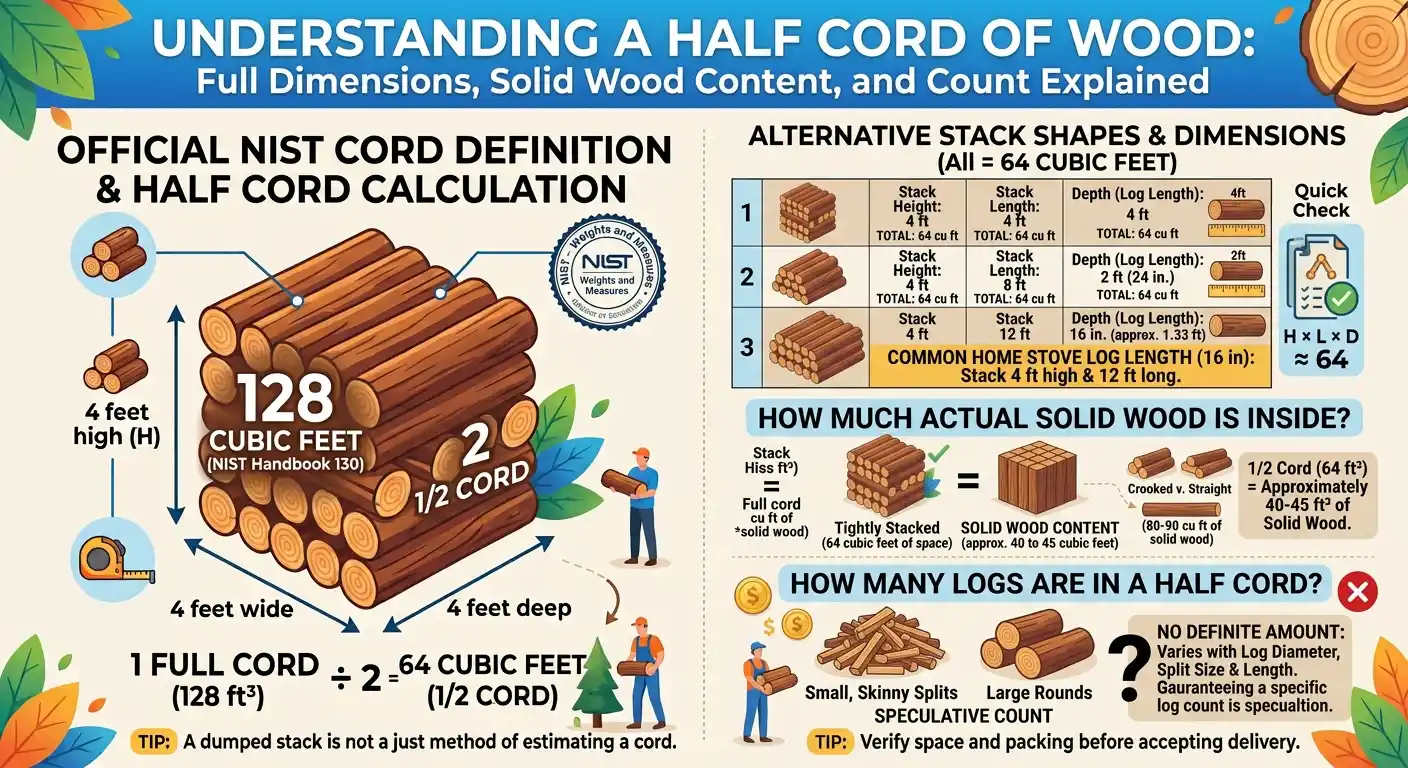
A half cord takes up 64 cubic feet. Any stack which multiplies to 64 cubic feet is counted, provided the logs are stacked close together and in a straight line. For a closer look at the full-cord version of these shapes, see the breakdown of how wide, tall, and deep a cord should be.
| Log length | Stack height | Stack length | Depth (log length) | Total |
|---|---|---|---|---|
| 4 ft | 4 ft | 4 ft | 4 ft | 64 cu ft |
| 2 ft (24 in) | 4 ft | 8 ft | 2 ft | 64 cu ft |
| 16 in (about 1.33 ft) | 4 ft | 12 ft | 1.33 ft | 64 cu ft |
The majority of firewood used in home stoves is cut to 16 inches and this is why the third row is important. A stack of logs 16 inch in diameter should be approximately 4 feet high and 12 feet long.
Quick check: Multiply height x length x depth, all in feet. The answer should be about 64.
How Much Actual Wood Is Inside?
The measurement includes air gaps, and the solid wood in a cord is less than 128 cubic feet. A full cord is usually estimated to be between 80 and 90 cubic feet of solid wood, depending upon the straightness and evenness of the splits. In the case of a half cord, it would be about 40 to 45 cubic feet of real wood. Crooked is more space-consuming, hence the different outcomes.
How Many Logs Are in a Half Cord?
It has no definite amount. The count varies with log diameter, split size and length. A half cord of small, skinny splits may have several hundred pieces in it, and one of large rounds has much less. Sellers that guarantee a certain number of logs are speculating.
Half Cord vs Face Cord vs Full Cord
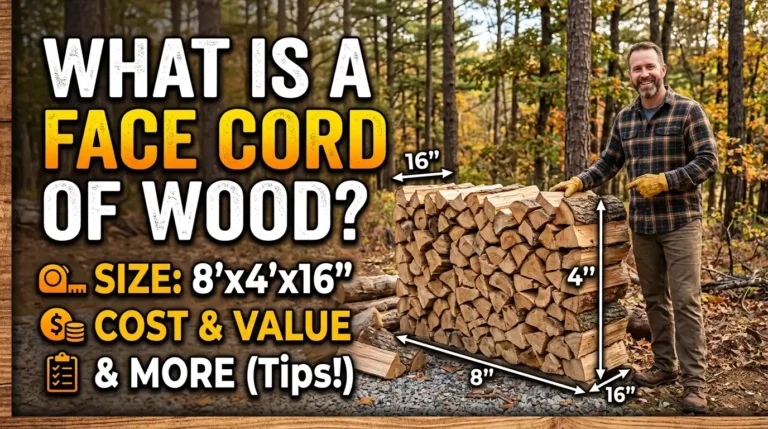
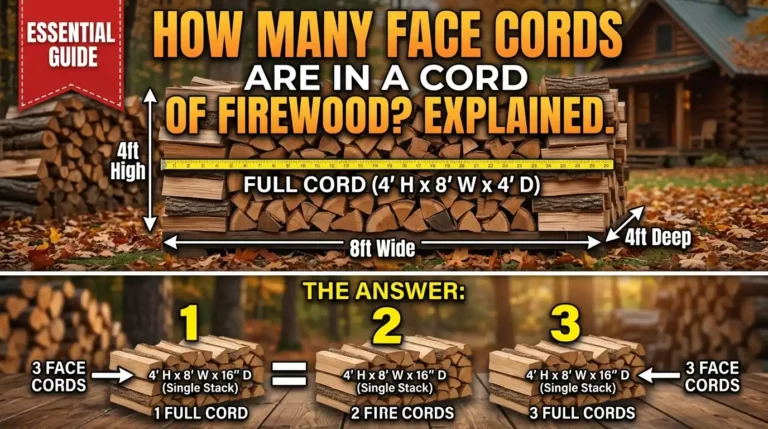
Most of the confusion is caused by face cord, rick and stove cord which are not standardized like a cord is. A face cord is usually 4 feet high and 8 feet long, but the depth is whatever the log length is. A detailed comparison of face cords and full cords shows how the sizes and prices differ, and the same goes for the regional term explained in this piece on what a rick of firewood actually means.
| Term | Typical size | Volume |
|---|---|---|
| Full cord | 4 x 4 x 8 ft | 128 cu ft |
| Half cord | 4 x 4 x 4 ft | 64 cu ft |
| Face cord (16 in logs) | 4 x 8 ft x 16 in | about 42.7 cu ft |
| Face cord (12 in logs) | 4 x 8 ft x 12 in | 32 cu ft |
The length of the logs is 16 inches, a half cord is approximately 1.5 face cords. When a seller sells you a half cord, and gives you one face cord, you received a third of a cord, not half.
The term is ambiguous and in some states, it is prohibited or discouraged to sell by the face cord. Your local rules are available at the weights and measures office of your state.
How Much Does a Half Cord of Wood Weigh?
Most experienced species weigh approximately 1,000-3,000 pounds of a half cord of wood and heavy green hardwood may weigh more. The weight varies tremendously depending on the wood and the amount of water in it.
The following are approximate values of seasoned (dried) wood. Precise figures are a factor of moisture and stacking and should be used as ball-park figures. For a deeper look at how species and moisture shift the numbers, check this full cord weight breakdown by species and dryness and the companion page on hardwood cord weights.
| Wood type | Full cord (approx.) | Half cord (approx.) |
|---|---|---|
| Pine, spruce, fir (softwood) | 2,000 to 2,500 lb | 1,000 to 1,250 lb |
| Ash, maple, birch | 3,000 to 3,800 lb | 1,500 to 1,900 lb |
| Oak, hickory, locust | 4,000 to 5,000 lb | 2,000 to 2,500 lb |
Green (freshly cut) wood may be three times or half as heavy as seasoned wood of the same kind, since so much of the weight is water.
The importance of weight: When loading a trailer, driving a pickup, or piling up on a deck, weight tells you what your vehicle or structure must be able to manage. Before loading your truck, check its payload rating.
How Much Does a Half Cord of Wood Cost?
It does not have a national price. The price of firewood is determined by your area, the type of wood, the degree to which the wood is dry and whether it is delivered. In the United States, the cost of a full cord would typically be between 200 and 400 or more and a half cord would cost a little less than half the full cord since the sellers consider delivery time.
Check local listings and get quotes where you live to get the correct number, as I cannot check the current prices in your area. For more context on budgeting, read up on what buyers usually pay for a full cord and how to save.
What Changes the Price
- Species: Thick hardwoods, such as oak and hickory, are more expensive than pine.
- Seasoning: Kiln dried or seasoned wood is more expensive than green wood, but burns better.
- Delivery and stacking: The cost of delivery depends on the distance, and stacking is usually optional.
- Season: The prices tend to increase during fall and early winter.
- Splitting and cutting: Pre-split wood is more expensive than rounds.
A Smart Way to Compare Prices
Divide the price by the cubic feet you’re getting. The half cord is 64 cubic feet and a half cord that is 150 will cost approximately 2.34 per cubic foot. Compare that number with full cord and face cord offers.
Half Cord of Firewood: Will It Fit in a Truck?
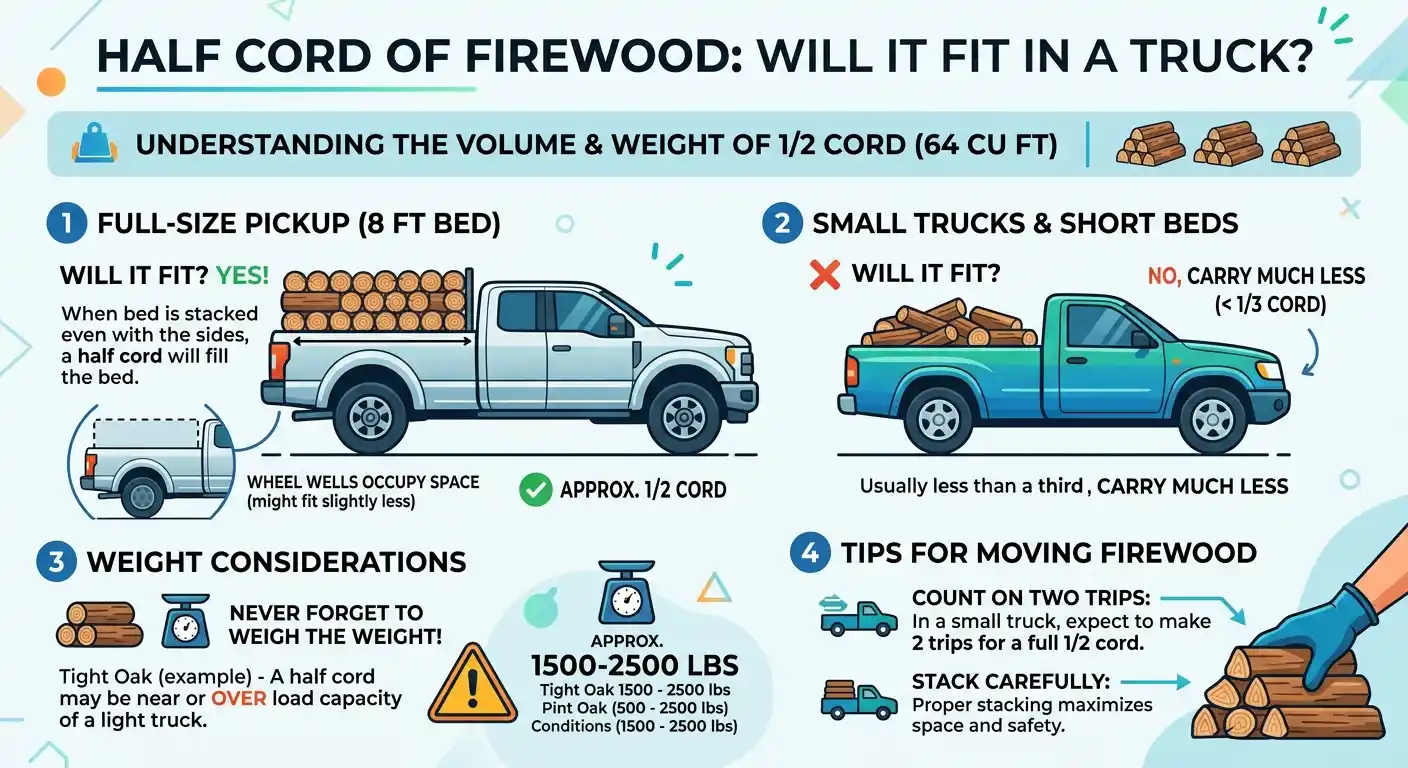
When the bed is stacked even with the sides, a half cord will fill the bed of a full size pickup with an 8 foot bed. Wheel wells occupy space, thus you might fit slightly less. Small trucks and short beds carry much less, usually less than a third of a cord.
When you have to carry it yourself, you can count on two trips of a small truck. And never forget to weigh the weight, as a half cord of tight oak may well be near or even over the load capacity of a light truck.
How Long Does a Half Cord Last?
It will be determined by your stove or fireplace, the frequency of burning, and the coldness. A half cord could be a few weeks of weekly evening fires, or an entire season when you light fires on weekends just to create the atmosphere. Homes whose primary heating method is wood tend to burn a few cords of wood during a winter, making a half cord an addition rather than a supply.
Thick woods are more flammable and generate more heat per volume. Oak, hickory and locust provide greater heat as compared to pine and spruce. This is calculated in BTUs and both the U.S. Department of Energy and the EPA have guidance on efficient choice and burning of wood.
Seasoned vs Green Wood: Why It Matters
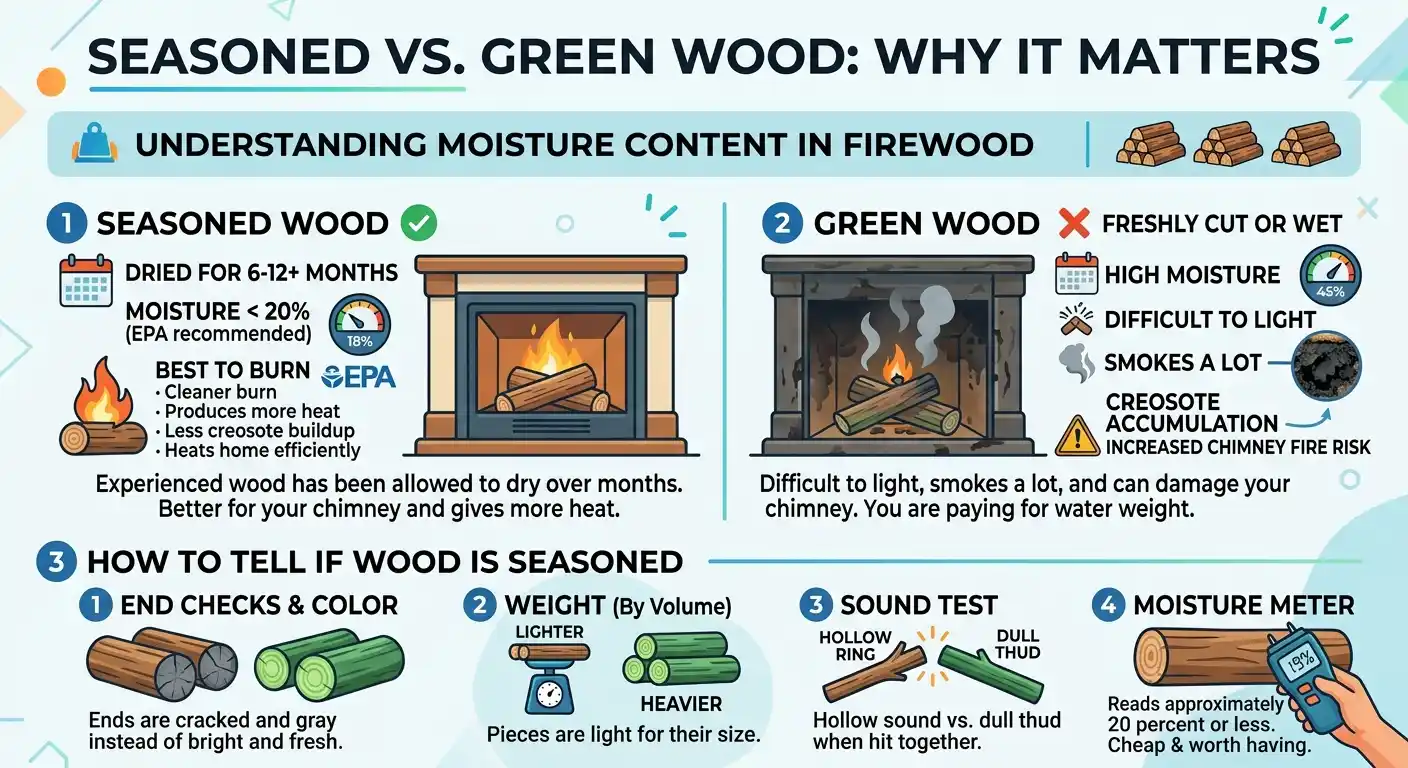
Experienced firewood has been allowed to dry over months (typically six to twelve months or more, depending on species and climate) until its moisture content is low, typically about 20 percent or less. According to the EPA, Burn Wise program, dry wood is the best wood to burn since it is cleaner and it gives out more heat.
Green wood is difficult to light, smokes a lot and creosote can accumulate in your chimney, increasing the risk of chimney fire. It is also heavier thus you are paying the water.
How to Tell If Wood Is Seasoned
- Ends are cracked and gray instead of bright and fresh.
- Pieces are light in their size.
- Two sticks hit together do not make a dull thud, but a hollow sound.
- Moisture meter reads approximately 20 percent or less. These are cheap, and worth having.
How to Check You Got a Real Half Cord
- Determine the stack height, length and depth in feet.
- Multiply them together. You want about 64.
- ensure the wood is stacked closely with the logs parallel.
- Measure the moisture using a meter.
- request a receipt that contains the volume, species, and price.
In the event that it is short, request the seller to rectify it prior to full payment.
Common Mistakes When Buying Firewood
- Paying a price of a “rick” or face cord when you had intended to purchase a half cord.
- Measuring a stack by a loose pile.
- Ordering hardwood and getting mixed wood.
- Omission of moisture check.
- Failing to enquire about delivery and stacking charges initially.
Expert Tips for Getting the Most From a Half Cord
- Buy early, preferably during spring or summer, when prices are lower and the wood drier.
- Stack on the ground, but the top covered and the sides open to air.
- Store wood outside your home to minimize pest and fire issues.
- Only bring in a small amount of supply at a time.
- Alternate wood contents: softwood to begin fires, hardwood to burn long.
FAQs
What is the volume of 1/2 cord of wood?
A half cord is 64 cubic feet of stacked firewood, half of 128 cubic feet full cord.
How big is half cord of wood?
A typical size is 4 feet high, 4 feet wide and 4 feet deep. Any stack of 64 cubic feet is counted.
What is the weight of a half cord of wood?
About 1,000 to 1,250 pounds of experienced softwood and 2,000 to 2,500 pounds of thick experienced hardwood such as oak. Green wood weighs more.
What is the price of a half cord of firewood?
It varies by region, species, and delivery. Get local quotes, and compare cubic foot prices.
Is a half cord a face cord?
No. A 16 inch face cord consists of 16 inch logs and the volume of a face cord is approximately 42.7 cubic feet and a half cord is approximately 1.5 face cords.
In a half cord how many face cords?
Approximately 1.5 when the logs are 16 inches long. The change with length of logs.
Will a half cord fit in a pickup truck?
A half cord of bed is nearly equivalent to a full size 8 foot bed when stacked level. Smaller beds contain less.
What will be the length of a half cord of wood?
Depending on how frequently you burn and your heating system, anywhere between a few weeks and a complete season.
What are the number of logs in half cord?
No specific number. It is based on the size of the splits.
Is a half cord less expensive than a full cord?
The quantity is less, though the cost per cubic foot is usually a little more. Full cords tend to be more valuable in case you can save them.
Which is the best wood to purchase?
Hardwoods such as oak, hickory, maple, and ash are experienced and burn the longest, providing the most heat. Softwoods are good kindling and shoulder season fires.
What do I do with a half cord?
Place it on the ground and out of the wind and wrap the top only, and make sure it is well out of the way of your house.
Final Thoughts
A half cord of wood is 64 cubic feet of tightly stacked firewood, usually a 4 by 4 by 4 foot stack. The only number that counts is that volume, since words such as face cord and rick might mean something different to one peddler and something different to another.
Measure the stack, check the moisture and compare prices by cubic feet before you buy. Do it and you’ll see just what you bought and whether it will make you warm.