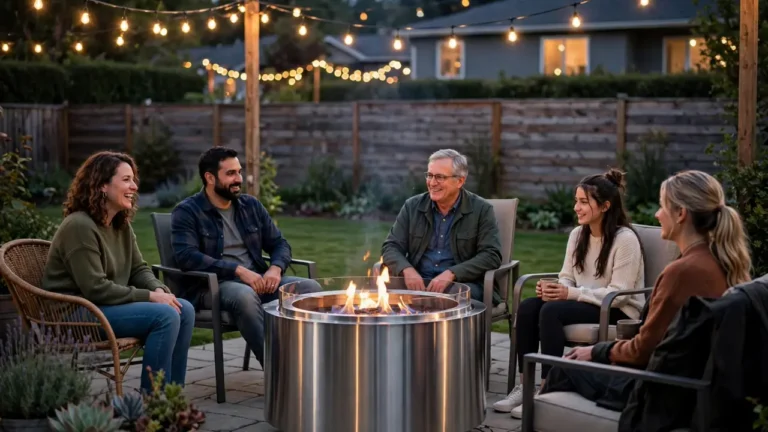
Can a Fire Pit Go Under a Pergola or Covered Patio? How to Do It Safely
Can a fire pit go under a pergola or covered patio? Yes, in many cases, but only when three things line up: the right fire pit type, enough space above the flame, and open sides that let heat and smoke escape. Get one of those wrong and a cozy evening can turn into scorched wood or a smoke-filled patio.
I have seen plenty of setups that work well, and a few that scared me. A low gas fire table under a tall, open pergola can be a great match. A big wood fire under a low solid roof is a bad match. The gap between those two setups is what this guide covers.
By the end you will know how to measure your space, pick a pit that fits under cover, test the airflow, and run a first fire without damage. The whole check takes about an hour, and most of it is measuring and reading labels.
⚠️ Heads Up: Read This Before You Light Anything Under a Roof
Fire under a roof is riskier than fire in the open yard. Heat, smoke, and sparks rise straight into wood, fabric, or a low ceiling. Never leave a fire unattended under cover, and keep children and pets at least 3 feet back from the pit at all times.
Gas and propane pits give off carbon monoxide, a gas you cannot see or smell. Never run one in a closed or nearly closed space. If anyone feels dizzy, sick, or headachy near the fire, move to fresh air at once and call emergency services. A battery CO detector near the patio adds a useful layer of warning.
Your fire pit manual and your local fire code outrank this guide. Check both before you buy or build anything. For gas line work, hire a licensed pro. This article is general guidance, not a substitute for local rules or maker instructions.
Total Time
About 1 hour
Measuring plus a test fire
Active Time
30 minutes
Hands-on measuring and setup
Difficulty
Beginner-friendly
No tools beyond a tape measure
What You Need
▪ Tape measure (25 feet or longer)
▪ Step ladder
▪ Your fire pit manual
▪ Pencil and notepad
▪ Heat-resistant gloves
▪ Fireproof mat, pavers, or stone slab
▪ Metal spark screen (for wood fires)
▪ Bucket of water or garden hose
▪ Outdoor-rated fire extinguisher
▪ Battery CO detector (for gas pits)
Answer the Question First: Can a Fire Pit Go Under a Pergola or Covered Patio?
Yes, a fire pit can go under a pergola or covered patio when the setup passes four tests. The pit type must suit covered use, the overhead clearance must meet the maker minimum, at least two sides must stay open for airflow, and the pit must sit on a surface that cannot catch fire.
Gas and propane fire tables pass these tests most often because their flames stay low and steady and they throw no sparks. Electric patio heaters pass even more often because they make no flame at all. Wood-burning pits usually fail the test under a roof because sparks, smoke, and tall flames need far more room above them than most pergolas offer.
If your patio fails even one of the four tests, move the pit into the open yard. A fire pit in the open with chairs pulled close beats a fire pit under a roof that scorches beams or fills the patio with smoke. The rest of this guide walks you through each test in order.
How Much Clearance Does a Fire Pit Need Under a Roof?
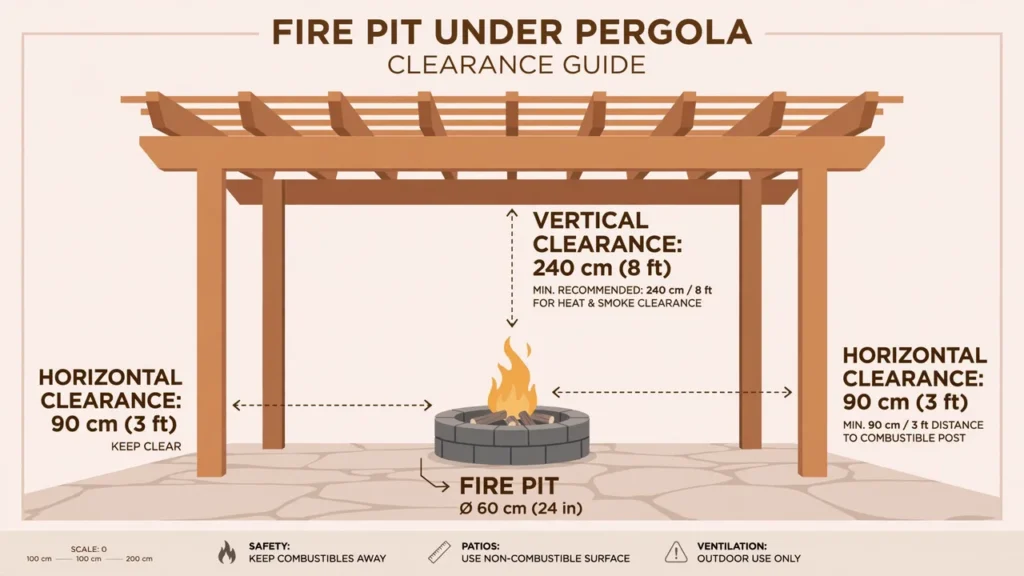
Clearance is the space between the flame and anything that can burn. Measure it from the top of the burner or the top of the flame, not from the ground. That one detail trips up more people than any other, because a tall fire table eats a foot or two of your headroom before the flame even starts.
The U.S. Fire Administration advises keeping fire pits at least 10 feet away from your home or anything that can burn. That rule covers open yards.
Under a roof, the overhead gap matters even more, because heat has nowhere to go but up into the structure. The table below pulls together the clearance figures that show up most often in maker manuals and safety guidance.
| Measurement | Gas or Propane Pit | Wood-Burning Pit |
|---|---|---|
| Overhead clearance, flame top to lowest beam | 6 to 8 feet minimum in most maker manuals, 10 feet preferred | 21 feet in NFPA-based guidance, which rules out most pergolas |
| Side clearance, pit edge to anything that can burn | 36 inches (3 feet) minimum to posts, rails, and furniture | 36 inches (3 feet) minimum, more in wind or dry weather |
| Distance from the house wall | 10 feet per U.S. Fire Administration guidance | 10 feet minimum, 15 to 25 feet often advised |
| Open sides needed for airflow | At least 2 fully open sides | At least 2 fully open sides, plus open roof slats |
| Kid and pet zone | 3 feet clear ring around the pit | 3 feet clear ring around the pit |
These numbers are starting points, not a green light. Your fire pit manual may demand more space than the table shows, and your local code may demand more still. When two sources disagree, follow the stricter one. If your pergola is shorter than the minimum for your pit type, the answer is no, and no heat shield changes that.
Gas and Propane Fire Pits
Most gas fire pit makers list a minimum vertical clearance of 6 to 8 feet from the burner to the lowest point overhead. One major maker, The Outdoor GreatRoom Company, lists 6 feet above the burner for its gas units. Other makers list 7 or 8 feet. Aiming for 10 feet gives you a wider margin for taller flames on high settings and for heat buildup on a still night.
Gas flames stay short and steady, which is why gas pits work under cover at all. They make no sparks and little smoke. The risk that remains is heat rising into the beams and carbon monoxide pooling under a roof that blocks airflow. That is why the open-sides test matters as much as the height test.
Wood-Burning Fire Pits
Wood fires are a poor fit under any roof. Flames jump higher than you expect, sparks ride the hot air upward, and smoke stains and dries out wood above. NFPA-based guidance calls for 21 feet of overhead clearance for wood-burning fires. Almost no backyard pergola or patio roof reaches that height.
A spark screen helps, but it does not fix the clearance problem. It catches large embers and lets fine ones through, and it does nothing about the heat column rising into the beams. If you love a wood fire, keep it in the open yard and use the pergola for seating and shade instead. Our guide to fire pit clearance from houses, trees, and fences shows how to place a wood pit safely in the open.
What Makes a Pergola Different From a Solid Roof?
A pergola and a solid patio roof look alike from the chairs, but they behave very differently over a fire. A pergola has open slats with gaps between them, so hot air and smoke rise through the roof and out. A solid roof traps that heat and smoke under it and pushes them sideways toward walls, curtains, and the house.
That gap pattern is why a gas pit can work under a tall open pergola and fail under a low solid roof of the same height. The open slats act like a chimney with a leaky top. A solid roof acts like a lid. If your covered patio has a solid roof, treat it as a harder test: you need more height, more open sides, and a smaller flame.
Roof material matters too. Metal and stone handle stray heat better than wood, vinyl, or fabric.
A fabric canopy or shade sail over a fire pit is a hard no, because fabric can catch fire from radiant heat long before a flame touches it. Never run a fire pit under a canopy, umbrella, or retractable awning unless the maker manual for both the pit and the canopy says it is safe. For anything that feels like an indoor space, read our guide on whether you can use a fire pit indoors first, because the same carbon monoxide rules apply.
At a Glance: The 7 Steps
- Check your local rules and HOA first
- Measure the space above the flame
- Pick a fire pit type that fits under cover
- Test the airflow on all four sides
- Set the pit on a heat-proof surface
- Light a small test fire and watch the roof
- Build your shut-down routine
Step 1: Check Your Local Rules and HOA First
Call your city or county fire department and ask two questions: are recreational fires allowed at your address, and what setbacks apply under a roof structure? Some towns ban open flames under any cover. Others allow gas pits but not wood. A five-minute call saves you from buying a pit you cannot legally light.
Check your HOA rules next, since HOAs often set stricter limits than the city. Ask about fuel types, pit size, hours of use, and whether a permit is needed for a permanent gas line. Read our guide to whether backyard fire pits are legal for the questions to ask and the paperwork to expect. Write down the answers with the name of the person you spoke to.
Step 2: Measure the Space Above the Flame
Stand a step ladder beside the spot where the pit will sit and measure from the patio floor up to the lowest beam, rafter, or slat. Write that number down. Then subtract the height of your fire pit plus the height of its flame on a normal setting. A table-height gas pit can eat 2 feet before the flame even starts, so a 10-foot pergola may leave only 6 feet of true clearance.
Compare your true clearance with the table above. Gas pits need at least 6 to 8 feet from the burner to the lowest point overhead, and 10 feet is the safer target. Measure side clearance too: 36 inches from the pit edge to posts, rails, curtains, and chair backs. If any number falls short, move the pit or pick a lower unit.
Pro Tip: Measure Twice, From the Right Spot
Measure overhead clearance from the top of the burner, not from the patio floor. Makers list their minimums from the burner up, so a floor measurement flatters the gap by the full height of the pit. Do the same for side clearance: measure from the outer edge of the pit, not from its center.
Step 3: Pick a Fire Pit Type That Fits Under Cover
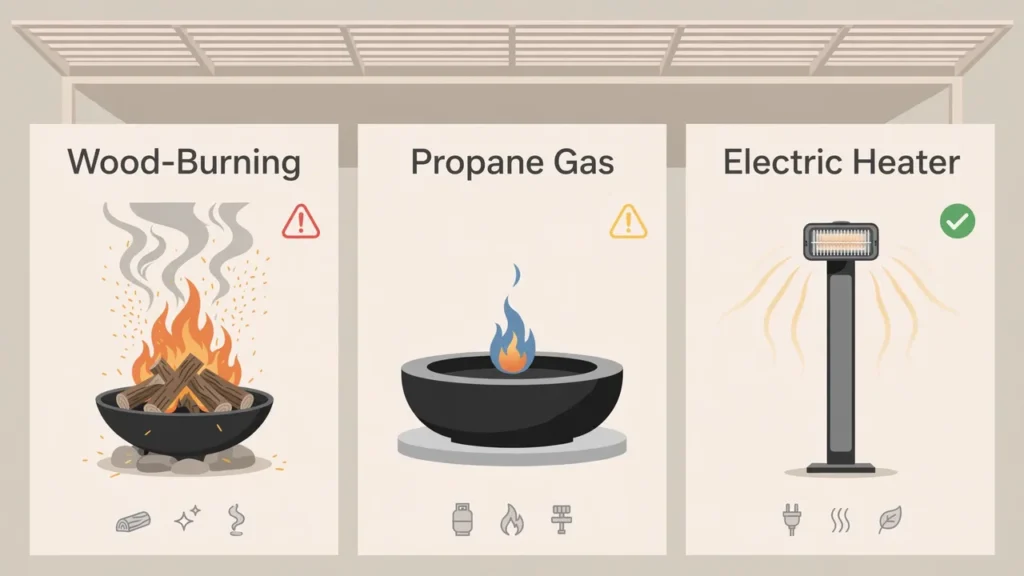
Match the pit to the roof, not the other way around. A low, wide gas fire table with a steady flame suits a covered patio. A tall chiminea or a deep wood bowl does not, because both push flames and sparks upward. Electric patio heaters suit covered spaces best of all, since they make heat with no flame, no smoke, and no carbon monoxide.
Read the manual for the exact model you own or plan to buy. The manual lists tested clearances for that unit, and those numbers beat any general guide, including this one. Look for CSA or UL certification on a gas unit, which shows it passed independent safety testing. The table below sums up how the three main types compare under a roof.
| Fire Pit Type | Works Under Cover? | Overhead Clearance | Smoke and Sparks |
|---|---|---|---|
| Gas or propane fire table | Yes, if clearance and airflow pass | 6 to 8 feet minimum, 10 feet preferred | Almost none, steady low flame |
| Wood-burning pit | No, in nearly all home setups | 21 feet per NFPA-based guidance | Heavy smoke and flying sparks |
| Electric patio heater | Yes, the safest choice under cover | Follow the maker manual, usually 3 feet or more | None, no flame and no smoke |
| Smokeless wood pit | Still no, smoke is lower but sparks and heat remain | 21 feet per NFPA-based guidance | Less smoke, sparks still possible |
⚠️ Heads Up: Wood Fires and Roofs Do Not Mix
Never burn wood under a solid roof, a low pergola, or a fabric canopy. A single gust can lift embers into dry beams, and a spark screen will not catch them all. If the manual for your wood pit says outdoor open-air use only, believe it. Move the pit to open ground.
Step 4: Test the Airflow on All Four Sides
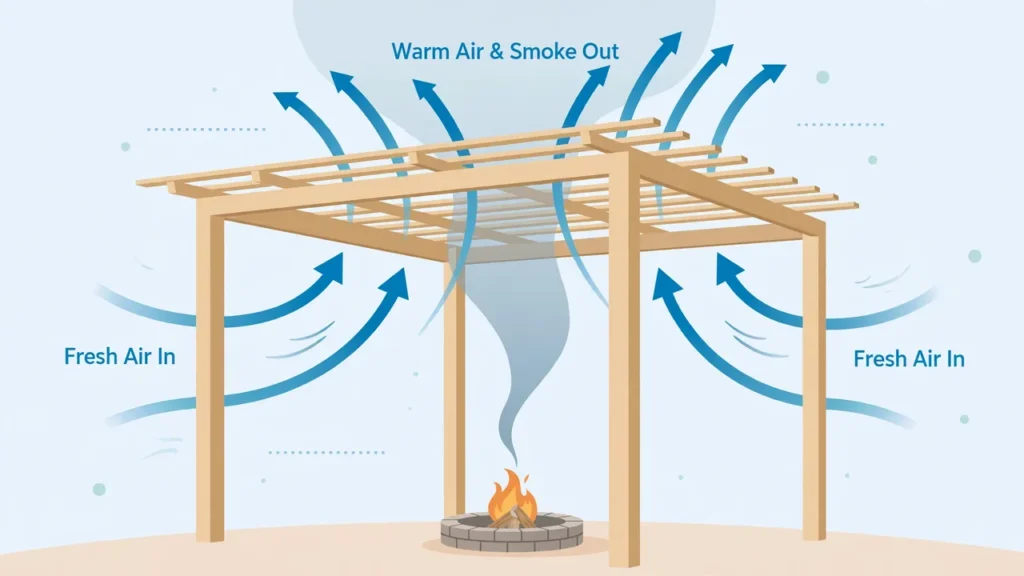
Walk around the patio and count how many sides are fully open to the sky and the wind. A safe covered setup needs at least 2 fully open sides. Safety guidance often calls for 50 percent or more of the wall area to stay open so heat and gas can escape. Curtains, privacy screens, and lattice panels count as closed sides, even when they look airy.
On a calm day, light a stick of incense at the spot where the pit will sit and watch the smoke. It should rise and drift out through the roof or an open side without pooling under the cover. Smoke that hangs in a cloud or slides sideways toward the house means the space is too closed for a gas flame. Open the sides up or move the pit out before you light a real fire.
Step 5: Set the Pit on a Heat-Proof Surface
Put the pit on stone, concrete, brick, or pavers. Those surfaces take heat without damage and will not catch fire. A fireproof mat rated for fire pit use adds a second layer of protection on pavers. Wood decking, composite decking, dry grass, and rugs are not safe bases for a fire pit, even a gas one, because radiant heat builds up in the floor below.
Level the spot before the pit goes down, since a tilted pit spills fuel or tips a flame toward one side. Keep the propane tank outside the pit base and away from the flame, exactly as the manual shows. If your patio is a wood deck, read our guide to whether you can put a fire pit on a wood deck and our guide to whether a fire pit can go on grass before you place anything.
Step 6: Light a Small Test Fire and Watch the Roof
Light the pit on its lowest setting and let it run for 15 minutes while you watch the roof. Stand on the ladder and hold your hand near the lowest beam, without touching it. Warm is fine.
Hot enough that you pull your hand back means the flame is too high or the roof is too low. Turn the pit down or move it out.
Watch the smoke path at the same time. It should rise cleanly and leave through the slats or an open side. Smoke that curls back down or spreads across the ceiling tells you the airflow fails under a real fire, even if the incense test looked fine. Note the flame height that works and mark it on the control knob with a small dot of paint so you can find it again.
Step 7: Build Your Shut-Down Routine
Decide the shut-down steps before the first guest night, and write them on a card near the pit. Turn the gas off at the tank valve first, then at the pit control. Let the pit cool fully before you cover it. For a wood fire in the open yard, drown the embers with water, stir the ash, and drown it again until nothing hisses.
Check the pit and the beams above it once the fire is out. Look for scorch marks, warped wood, or a smell of hot timber. Keep the CO detector battery fresh and store matches and lighters out of reach of children. A short routine that you follow every time beats a perfect setup that you rush past once.
How to Protect Pergola Wood From Heat and Smoke
Even a passing setup leaves marks over time. Heat dries out the wood above a fire, and smoke stains it. A metal heat shield mounted above the flame, with an air gap behind it, cuts the heat that reaches the beams. Ask your pit maker whether a shield is approved for your model, since some shields trap heat around the burner instead.
Seal exposed pergola wood with an exterior-rated finish and reapply it on the schedule the finish maker lists. Sealed wood resists soot stains and dries out more slowly. Clean soot off beams with warm water and mild soap while the stain is fresh, since old soot sets into the grain and needs sanding. Inspect the beams each spring for cracks, charring, or soft spots, and replace any piece that shows heat damage.
Pets add one more check to the list. Dogs lie close to warm pits and can burn a nose or tail on hot metal. Keep a 3-foot ring clear and teach pets that the ring is off limits. Our guide to whether fire pits are safe around dogs and pets covers barriers, training, and first aid for minor burns.
Before and After: What Changes When You Do This Right
Before: Guessing
The pit sits where it looks nice. Nobody measured the gap to the beams. Smoke hangs under the roof, guests cough, and the wood above the fire slowly dries and darkens. Each fire feels like a small gamble.
After: Measured and Tested
Clearances are written down and pass the manual. Two sides stand open, the pit sits on stone, and a test fire proved the smoke leaves cleanly. Evenings under the pergola feel calm, and the beams stay cool to the touch.
4 Common Mistakes to Avoid
1. Measuring from the ground instead of the burner. A table-height pit steals a foot or two of headroom. Measure from the burner top to the lowest beam, or your clearance math will flatter the real gap.
2. Burning wood under a solid roof. Sparks, smoke, and tall flames need far more room than a patio roof gives. Wood fires belong in the open yard, even with a spark screen on top.
3. Closing the sides with curtains or screens. Privacy panels turn a ventilated pergola into a closed room. Gas flames in a closed space can pool carbon monoxide where people sit and breathe.
4. Skipping the test fire. A full-size fire on night one hides problems until the beams are already hot. A 15-minute test on low tells you everything before guests arrive.
Frequently Asked Questions
Can you put a wood-burning fire pit under a pergola?
No, not in nearly all home setups. Wood fires throw sparks and tall flames, and NFPA-based guidance calls for 21 feet of overhead clearance. Keep wood fires in the open yard instead.
How high does a pergola need to be over a gas fire pit?
Most gas fire pit makers list 6 to 8 feet of vertical clearance from the burner to the lowest point overhead. Aim for 10 feet when you can, since a taller gap gives heat and smoke more room to escape.
Can a propane fire pit go under a covered patio?
Yes, if the patio passes all four tests: the right pit type, enough overhead clearance, at least two fully open sides, and a surface that cannot catch fire. Check your local code and your pit manual first.
Will smoke damage a pergola roof?
Yes, over time. Smoke stains wood and dries it out, and trapped heat can scorch beams. Gas pits make far less smoke than wood, and a heat shield plus sealed wood slows the damage.
Do I need a permit for a fire pit under a pergola?
It depends on where you live and whether the pit is portable or permanent. Portable gas tables rarely need a permit, while a permanent gas line almost always does. Ask your local fire department before you build.
Can I use a fire pit under a pergola with a fabric canopy?
No. Fabric can catch fire from radiant heat before a flame ever touches it. Never run a fire pit under a canopy, shade sail, umbrella, or retractable awning unless both manuals say it is safe.
Quick Reference Card: Fire Pit Under a Pergola
Print this card and keep it near the pit.
What You Need
Tape measure, step ladder, pit manual, fireproof mat or pavers, spark screen for wood, water or hose, fire extinguisher, CO detector for gas pits.
The 7 Steps
- Check local rules and HOA first.
- Measure space above the flame: 6 to 8 feet gas minimum, 10 feet preferred, 21 feet wood.
- Pick a fire pit type that fits under cover.
- Test airflow on all four sides: at least 2 fully open.
- Set the pit on a heat-proof surface.
- Light a small test fire and watch the roof for 15 minutes.
- Build your shut-down routine and follow it every time.
Remember: manual and local code win. Never leave a fire unattended. Keep kids and pets 3 feet back.
Enjoy Your Pergola Evenings, the Safe Way
Can a fire pit go under a pergola or covered patio? Yes, when the numbers check out and the air can move. A low gas fire table under a tall open pergola, sitting on stone with two sides open, is a setup you can relax around.
Measure first, test with a small fire, and keep the shut-down routine every single time. That hour of care buys you seasons of evenings under the roof.
If your patio fails the clearance or airflow test, the open yard still waits. And if you want more ways to stay warm out there, read our guide to how to heat a covered patio in winter for heaters that suit a roofed space with no flame at all.
Sources: U.S. Fire Administration outdoor fire safety guidance (usfa.fema.gov), which advises keeping fire pits at least 10 feet from your home or anything that can burn. Clearance figures for gas units reflect common maker manual minimums, including The Outdoor GreatRoom Company at 6 feet above the burner. Your pit manual and local fire code are the final word for your setup.