What Is an Oil Heater? How It Works, What It Costs, and Whether It Fits Your Home
You turn on a heater, and after ten minutes the room is not hot. Then you switch it off and an hour later the room is still hot. Such a strange action is the mark of an oil heater.
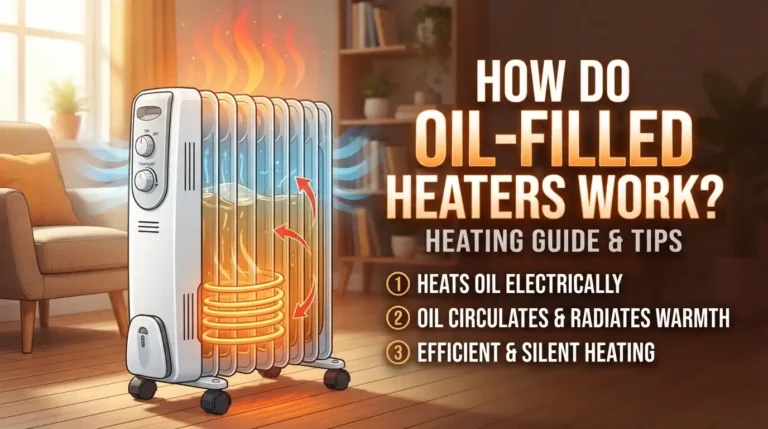
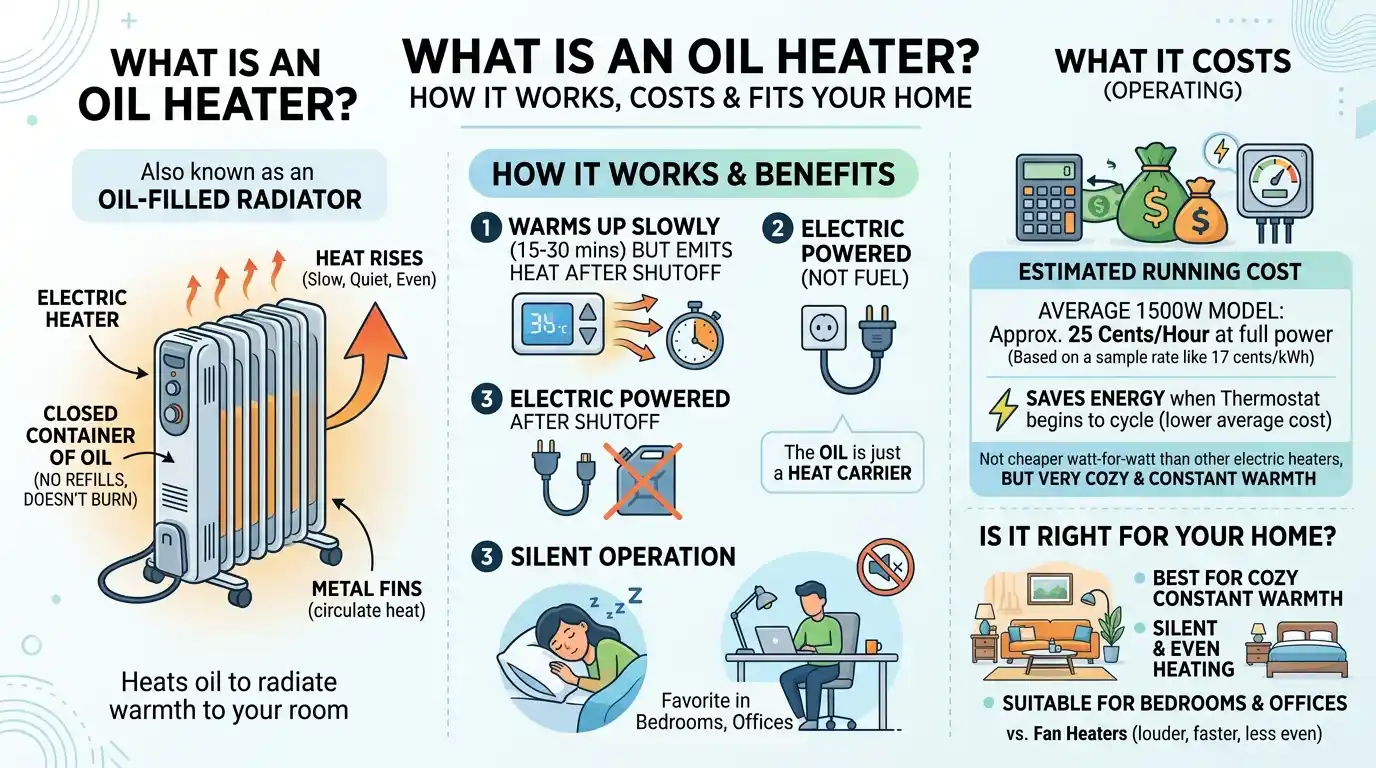
Short answer: An oil heater (also known as an oil-filled radiator) is an electric heater which heats a closed container of oil. The hot oil circulates heat to your room using metal fins, which heat the air in your room slowly, quietly and evenly. The oil does not burn and does not have to be refilled.
Key Takeaways
- An oil heater does not consume fuel, but electricity. The oil is merely a heat carrier.
- The temperature needs 15-30 minutes to warm up, but it continues to emit heat after the thermostat has turned it off.
- An average 1500W model is estimated to be 25 cents/hour at full power at a sample rate of 17 cents/kWh, and even less when the thermostat begins to cycle.
- It is silent in operation, thus a favorite in bedrooms and home offices.
- It does not operate cheaper than other watt-to-watt electric heaters. Its benefit is coziness and constant warmth.
What Does “Oil Heater” Mean?
The term is two-fold and this brings about actual confusion.
Oil-filled electric heater: An electric radiator that is a plug-in radiator filled with sealed thermal oil. This is the meaning that is most commonly used and this is what this guide is all about.
Oil-burning heater: A heater or furnace that burns fuel oil, kerosene or diesel to make heat. These require fuel storage and ventilation and they operate quite differently. If you are curious about that type, read our guide on how kerosene heaters work.
All of the following are the electric oil-filled type unless otherwise.
How Does an Oil Heater Work?
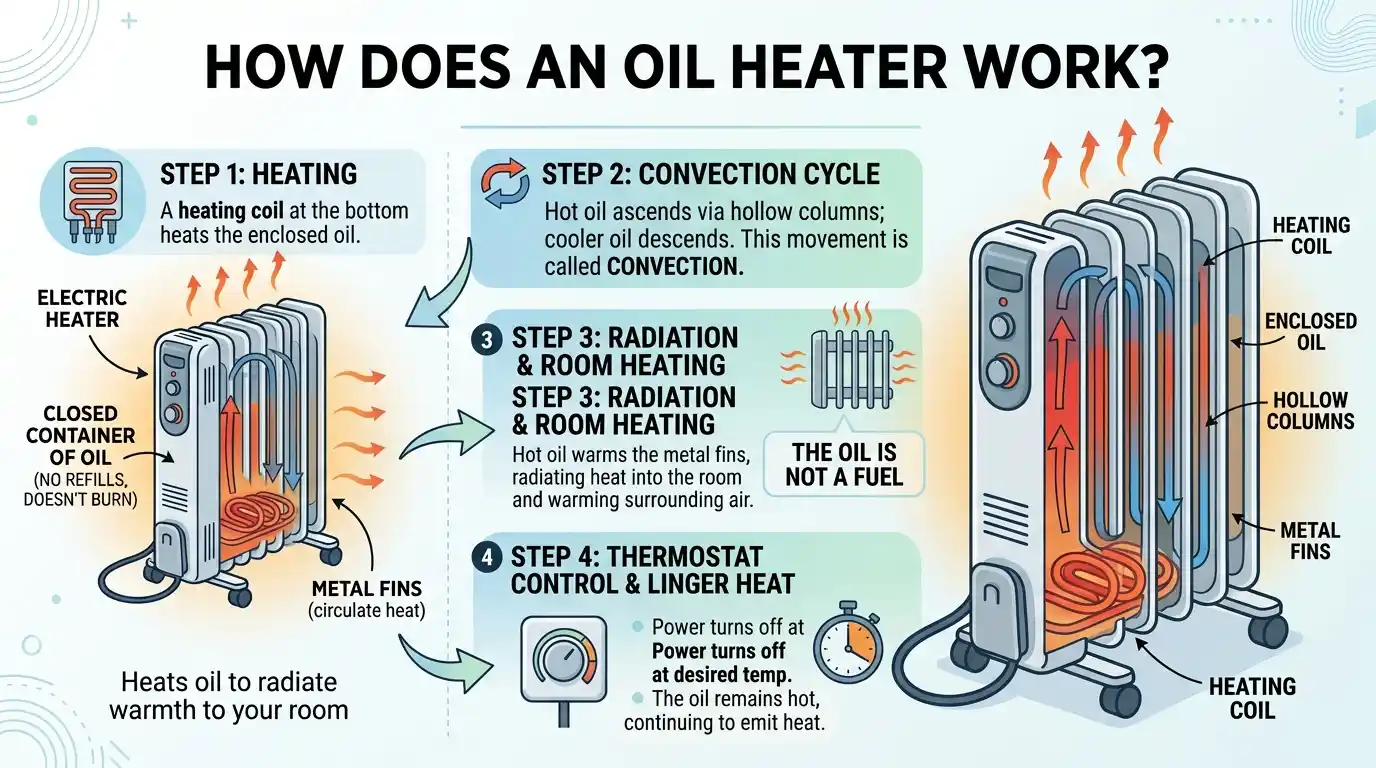
The operation of an oil heater is in four easy steps:
- A heating coil at the bottom heats the oil that is enclosed.
- The hot oil ascends via the hollow columns and cooler oil descends to take its place. This movement is referred to as convection.
- The hot oil warms the metal fins that radiate heat into the room and warm the surrounding air.
- The thermostat turns off power when the room reaches your desired temperature. The oil remains hot and continues to emit heat.
The oil is not a fuel. It is selected as it retains heat and it does not boil at normal operating temperatures. It is that stored heat that makes the room warm even after the element is turned off.
For a deeper walk through the parts and process, see our step-by-step guide to how an oil heater works.
Does the Oil Ever Need to Be Refilled?
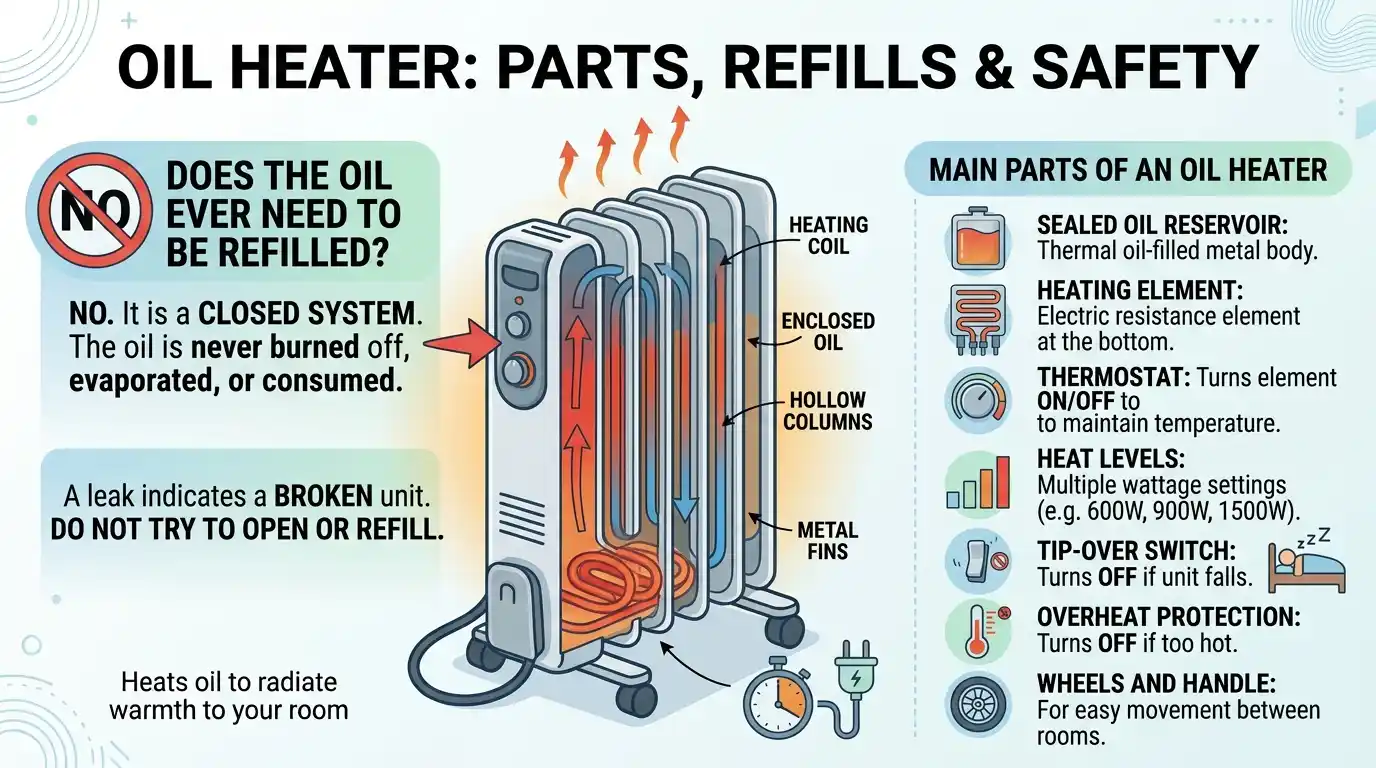
No. The oil is contained in a closed system and is not burned off, evaporated or consumed. When an oil heater leaks, it is an indication that the unit has broken down and needs to be changed. Do not try to open or refill it.
Main Parts of an Oil Heater
- Sealed oil reservoir: The thermal oil-filled metal body.
- Heating element: Typically an electric resistance element on the bottom.
- Thermostat: Turns the element on and off to maintain the temperature you prefer.
- Heat levels: The majority of the models have two or three levels of wattage, e.g. 600W, 900W and 1500W.
- Tip-over switch: Turns off when the unit falls.
- Overheat protection: Turns off the heater when it becomes too hot.
- Wheels and handle: Most models are constructed to be moved between rooms.
How Much Does an Oil Heater Cost?
One has to consider two expenses: the purchase and operation cost.
Purchase price: Small models range in price between about $40 and $80, mid-size models and feature-rich models (digital thermostat, timer, remote) will cost between $100 and $200 or more. Prices differ depending on brand, location and retailer, and should be checked.
Running cost: You may figure it out yourself. Multiply the kilowatts of the heater and the hours of use and by your electricity rate. The following table assumes a rate of 17 cents per kWh. Your own rate, found on your electricity bill, will differ.
| Heater setting | Cost per hour at full power | Cost for 8 hours at full power |
|---|---|---|
| 600W | about $0.10 | about $0.82 |
| 900W | about $0.15 | about $1.22 |
| 1500W | about $0.26 | about $2.04 |
The thermostat effect: A heater does not run on full power throughout the day. When the room is heated, the thermostat switches the element on and off. A 1500W unit in a well-insulated room may only be on half the time, so the actual cost of 8 hours may be nearer to $1.
The size of the room, insulation and outside temperature determine your actual results.
For a more detailed breakdown, read how much electricity an oil-filled radiator uses and whether oil heaters are expensive to run.
Are Oil Heaters Energy Efficient?
This is the truth of the matter. All of the electric resistance heaters transform almost all of the electricity they consume into heat. So an oil heater is not more efficient than a fan heater or a ceramic heater in terms of raw conversion.
The difference is in the method of the delivery of the heat. Oil heaters are more comfortable and turn off frequently, and this may actually lower the energy consumption in a closed, insulated room. The full science is in our guide on whether oil-filled heaters are energy efficient.
Oil Heater vs Other Space Heaters
| Feature | Oil heater | Fan heater | Ceramic heater | Infrared heater |
|---|---|---|---|---|
| Warm-up speed | Slow | Fast | Fast | Instant on you |
| Noise | Silent | Fan noise | Some fan noise | Quiet |
| Heat after switch-off | Yes, for a while | No | Little | No |
| Best for | Bedrooms, offices, long use | Quick boosts | Small spaces | Spot heating a person |
| Even room heat | Very good | Moderate | Moderate | Direct only |
If you are still comparing options, our guide to the best type of space heater can help you decide.
Pros and Cons of Oil Heaters
Pros
- Silent operation
- Constant, smooth heat with no explosions.
- Continues to emit heat when off.
- No fan, therefore, it does not blow dust about.
- No gas, smoke or fumes.
- Portable and user friendly.
Cons
- Slow to warm up
- Bulky and heavy in comparison to fan heaters.
- Not ideal for quickly heating a large or drafty room
- Surfaces become hot and may burn skin.
- Costly to operate as compared to other electric heaters.
What Size Oil Heater Do You Need?
One of the general guidelines is 10 watts per square foot of floor area of a room with standard insulation and ceiling height. This is an approximate guide.
| Room size | Suggested wattage |
|---|---|
| Up to 60 sq ft (small bathroom, nook) | 600W |
| 60 to 90 sq ft (small bedroom) | 900W |
| 100 to 150 sq ft (average bedroom or office) | 1500W |
| Over 150 sq ft | Consider a second heater or a different heating method |
Drafty rooms, high ceilings and cold climates call for more power. Well-insulated rooms may need less.
How to Use an Oil Heater Safely
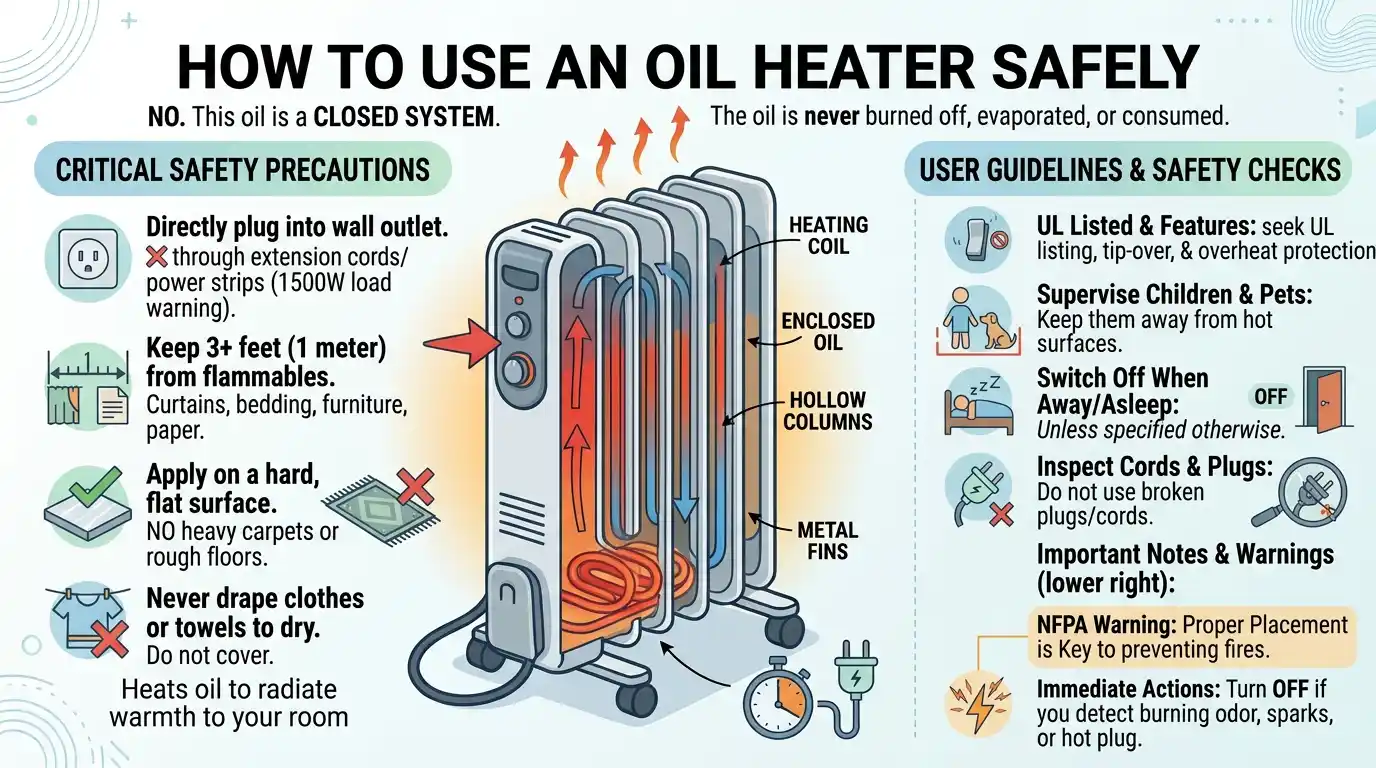
The safest type of portable heater is oil heaters as they do not have an exposed glowing part or flame, yet they are electrical devices that become hot. Follow these rules:
- Directly plug into a wall outlet. Use no extension cords or power strips which may overheat with a 1500W load.
- Keep it at least 3 feet away from anything flammable, such as curtains, bedding, furniture and paper.
- Apply it on a hard surface. Do not place it on a heavy carpet or on a rough floor.
- Never drape clothes or towels over it to dry them.
- Seek a known safety listing, like UL, and tip-over and overheat protection.
- Avoid leaving children and pets on hot surfaces.
- Switch it off when you are out of the house or when you are asleep unless the maker specifies otherwise.
- Do not play with a broken plug or cord.
According to the National Fire Protection Association (NFPA), space heaters are a significant portion of home heating fires and therefore placement is important. Always turn off a heater when you observe a burning odor, sparks or a hot plug.
For setup tips and thermostat advice, see our guide on how to use an oil-filled radiator heater.
Can You Leave an Oil Heater On Overnight?
Most manufacturers do not recommend unattended use, and a few permit it with a thermostat set appropriately and the device on a clear floor. Never forget to consult the manual of your model. Should you run one overnight, set it to a low setting, and make sure the area is clear and never use an extension cord.
Common Mistakes to Avoid
- Purchasing a heater that is not large enough and operating it on a 24/7 basis.
- Placing it behind furniture or next to curtains.
- Using a thin extension cord
- Waiting to have instant heat and turning it up to the maximum.
- Transporting it when hot or in the plug.
- Leaving the thermostat on the highest level all day.
Is an Oil Heater Right for You? A Quick Checklist
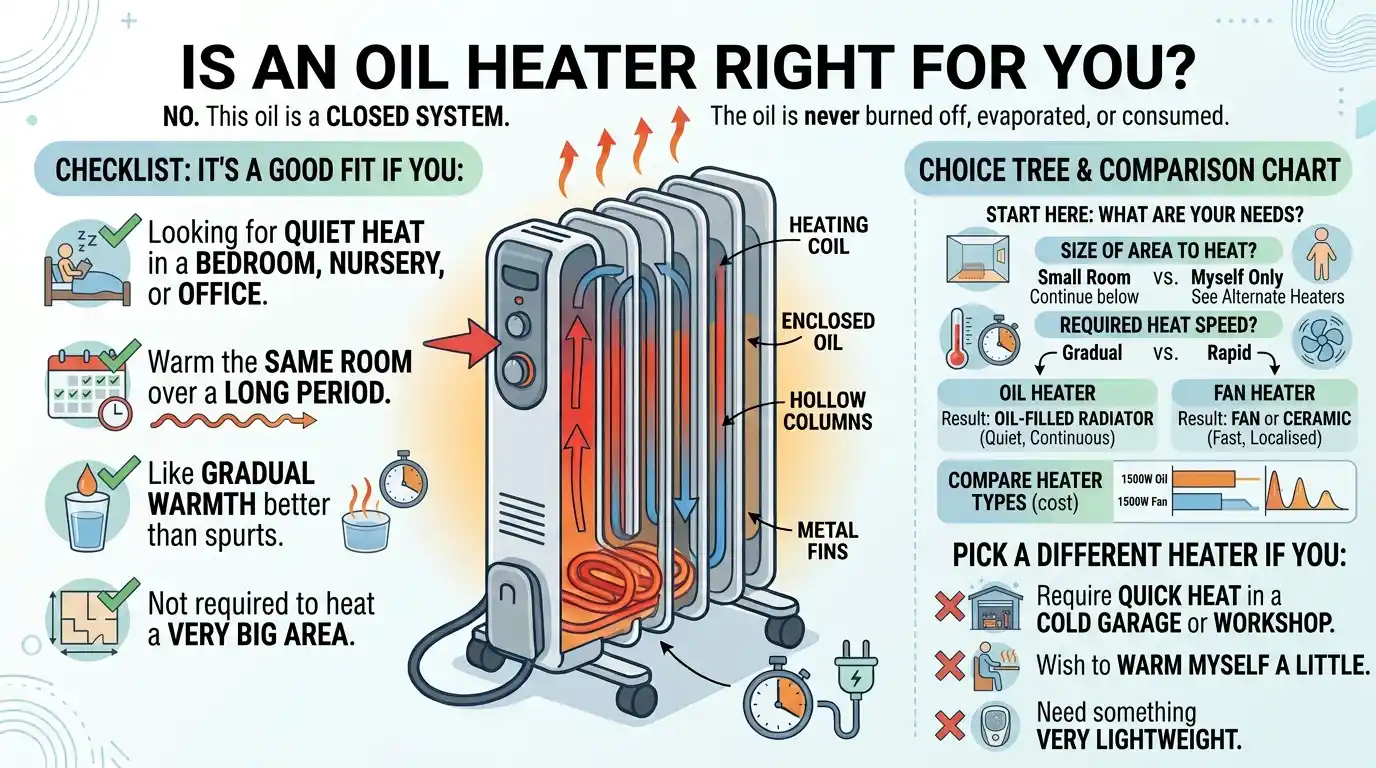
An oil heater is a good fit if you:
- Looking to have quiet heat in a bedroom, nursery or office.
- Warm the same room over a long period of time.
- Like gradual warmth better than spurts.
- Not required to heat a very big area.
Pick a different heater if you:
- Require quick heat in a cold garage or workshop.
- Wish to warm myself a little.
- Need something very lightweight
Suggested Visuals for Designers
- Infographic: Cutaway of an oil heater with the element, arrows of circulating oil and heat exiting the fins.
- Chart concept: A bar chart of hourly running cost versus wattage at three sample electricity rates.
- Choice tree: What is the size of your room? Do you require rapid heat? resulting in suggested types of heaters.
- Concepts of image alt text: an oil heater in a bedroom, diagram of how an oil heater works, oil-filled radiator with thermostat dial.
FAQs
What is an oil heater?
An oil heater is an electric heater that heats a sealed oil-filled reservoir, which transfers heat to metal fins and warms the room.
Does an oil heater consume oil?
No. The oil does not get consumed. It stores and transfers heat, while electricity powers the heating element.
Do oil heaters use a lot of electricity?
A 1500W oil heater uses 1.5 kWh of electricity per hour when operating at full power. However, the thermostat can switch the heater off when the desired temperature is reached.
How long does an oil heater take to heat a room?
Most oil heaters take around 15 to 30 minutes to produce a noticeable increase in room temperature, depending on the room size, insulation and heater model.
Can oil heaters be left on overnight?
Always follow the manufacturer’s instructions. If overnight use is permitted, keep the heater on a stable surface, away from flammable materials, and plug it directly into a suitable wall outlet.
Do oil heaters need to be refilled?
No. Oil heaters are sealed at the factory and normally do not need to be refilled during their service life.
Which is better, an oil heater or a fan heater?
An oil heater provides quiet, steady and longer-lasting heat, while a fan heater can warm a room more quickly. The better choice depends on your heating needs.
Can an oil heater warm an entire house?
An oil heater is generally designed to heat an individual room rather than an entire house. Heating a whole home may require multiple heaters or a central heating system.
What is the best wattage for an oil heater?
A 1500W model is a common choice for bedrooms, offices and other medium-sized rooms. Smaller rooms may only need a 600W or 900W heater.
Why is my oil heater hot but the room is still cold?
The room may be drafty, poorly insulated or too large for the heater. Closing doors and windows, improving insulation and using a properly sized heater can help.
Can an oil heater be used in a bathroom?
Only use an oil heater in a bathroom if the manufacturer specifically rates it for bathroom or wet-area use. Keep the heater safely away from water and follow all safety instructions.
Do oil heaters dry out the air?
No. Oil heaters do not add or remove moisture from the air. Because they do not use a fan to circulate air, they may feel less drying than some fan heaters.
What is the lifespan of an oil heater?
An oil heater can last for several years with normal use and proper care. Its lifespan depends on the brand, construction, usage and maintenance.
Can an oil heater be placed on a carpet?
Follow the manufacturer’s instructions. A heater should be placed on a stable, level surface with adequate clearance, and thick or unstable carpeting should generally be avoided unless the manual specifically permits it.
Final Thoughts
No one will win any races with an oil heater. It heats gradually and it does not miraculously reduce your power bill. But quiet, steady, hands-off warmth in one room is difficult to rival.
When you need a reliable bedroom or home office heater, be sure to select a model that fits your room size, has a good thermostat and has a known safety listing. Place it reasonably, leave it some room and leave the thermostat to work.