Are Fire Pit Tables Worth It? Costs, Pros, Cons, and Who Should Buy One
A fire pit table looks like the best of both worlds: a warm fire in the middle and a tabletop for drinks, plates, and phones around the edge. Then you see the price tag, and the picture gets less clear. If you have priced one and paused at the number, you have already asked the right question: are fire pit tables worth it?
This guide gives you a straight answer. You will see what fire pit tables cost to buy and run, what they do better than a regular fire pit, where they fall short, and who gets real value from one. By the end, you will know whether one fits your patio, your habits, and your budget, or whether a plain fire pit or a patio heater would serve you better.
⚠ Heads Up: Fire and Gas Safety First
A fire pit table is a real flame on your patio. Keep it at least 10 feet from your house, fences, and low tree branches, and never use it under a covered roof or inside a screened porch unless the maker and your local code both allow it. For gas models, check every connection for leaks with soapy water before the first light, and shut the gas off at the tank when you finish.
Never leave a lit fire pit table alone, keep kids and pets at arm’s length, and check your local burn rules and HOA rules before you buy. If you smell gas, turn the gas off, move away, and call your gas company or emergency services from outside. When in doubt, call a licensed gas fitter.
The Short Version
Typical price range
$300 – $2,500+
Time to decide
About 30 minutes
Best for
Small patios, gas fans
Prices are 2026 retail estimates. Real prices vary by size, material, and store.
The Short Answer: Are Fire Pit Tables Worth It?
For many patio owners, the answer is yes, with one condition: you will use it often. A fire pit table earns its price when it becomes your regular evening spot. It gives you heat, light, and a place to set things down in one piece of furniture. That mix is hard to match with a separate fire pit and a side table.
The answer turns to no when the table would sit covered most of the year. If you host outside a few times each summer and rarely sit out after dark, a lower-cost fire pit or a patio heater gives you the same glow for less money. The tabletop is the part you pay extra for, so ask how much you will use it.
Think of it this way: the fire is the fun, and the table is the function. If you eat, drink, or play cards outside, the table earns its keep. If you want a fire to stare at and little else, a standard fire pit does that job for less.
What Is a Fire Pit Table?
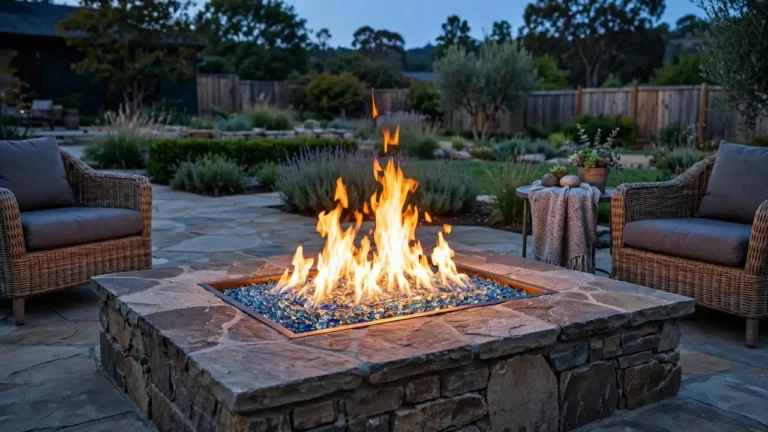
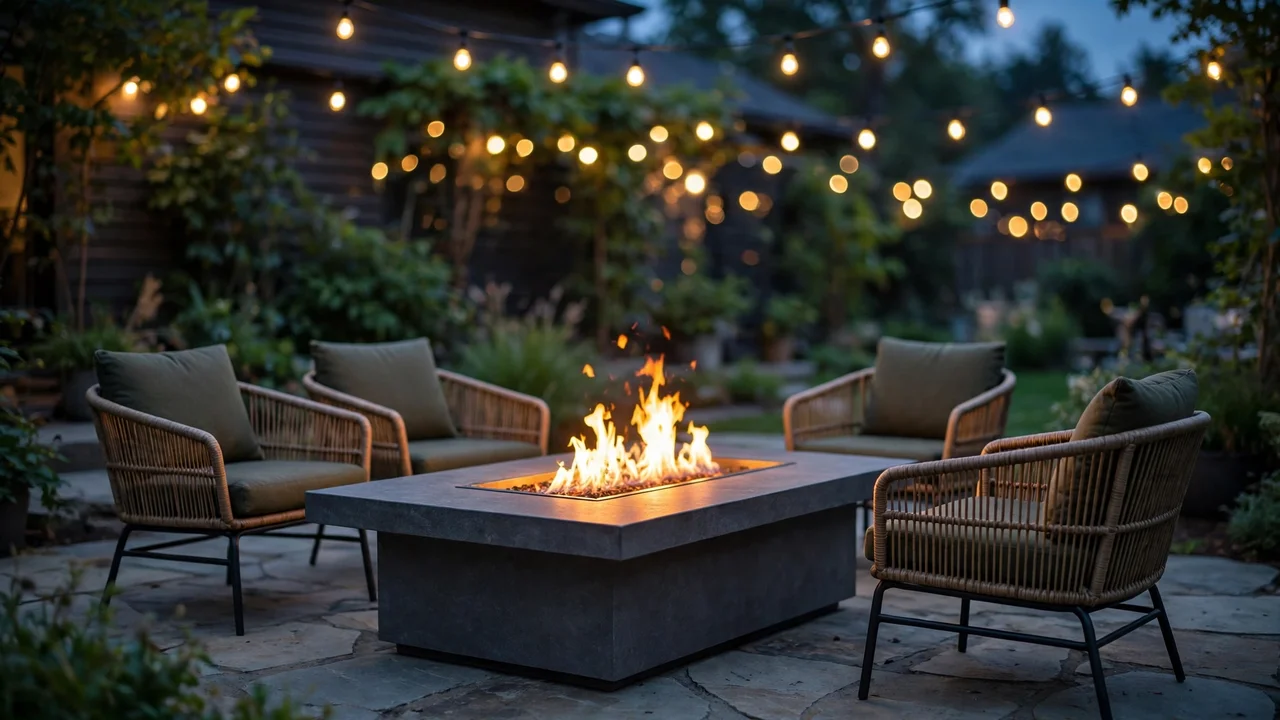
A fire pit table is a low outdoor table with a fire burner built into the center. Most run on propane or natural gas, with a push-button spark start and a knob that sets the flame high or low. A ring of fire glass, lava rock, or ceramic logs covers the burner. A lid often covers the burner so the table works as a plain table when the fire is off.
Wood-burning models exist too, with a metal bowl or firebox set into the tabletop. They cost less to buy and give off a wood-fire smell, but they need tending, ash cleanup, and dry wood. Gas models cost more up front and less effort per use, which is why most buyers pick gas.
Sizes run from small 28-inch square tables for two people to long 60-inch rectangle tables that seat eight. The burner size tracks the table size. A bigger table warms more seats, but it also burns more gas and needs more patio space.
How Much Does a Fire Pit Table Cost?
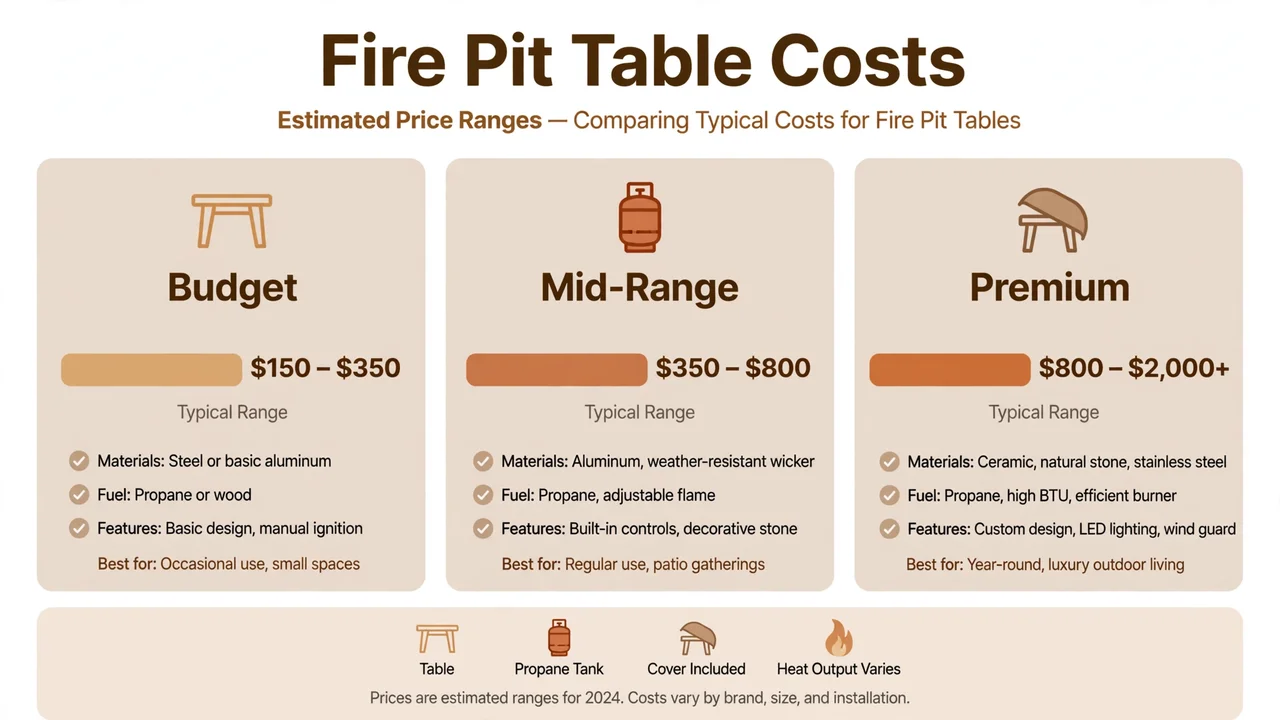
The price spread is wide, and the material drives most of it. Steel tables with a basic burner sit at the low end. Aluminum, stone, and concrete tables with larger burners sit at the high end. The table below shows typical 2026 retail ranges for gas models, before delivery, cover, and fuel.
| Price band | Typical range (2026 est.) | What you usually get |
|---|---|---|
| Budget | $300 – $600 | Steel frame, 40,000–50,000 BTU burner, basic fire glass, vinyl cover extra |
| Mid-range | $600 – $1,200 | Aluminum or stone-look top, 50,000–65,000 BTU burner, burner lid, cover often included |
| Premium | $1,200 – $2,500+ | Concrete, teak, or stone top, 65,000+ BTU burner, push-button start, wind guard, full cover |
Add $50 – $150 for the extras most buyers need: a fitted cover, a propane tank if one is not included, and fire glass top-ups. A natural gas hookup is a separate job, and a licensed fitter often charges $200 – $500 for a patio gas line, based on distance and local rates. Get a quote before you buy, so the hookup cost does not surprise you.
Wood-burning fire pit tables cost less, often $150 – $500. They skip the gas parts, but they add the cost of firewood and your time spent tending the fire. Over a season of steady use, the gap narrows.
What You Get for the Money: The Pros
The tabletop is the main win. Drinks, plates, books, and phones have a home within reach, and the raised edge around the burner keeps cups away from the flame. A regular fire pit leaves you holding your drink or balancing it on the ground.
Gas models light in seconds. You turn a knob, press the starter, and the fire is going. There is no kindling, no smoke in your face, and no ash to scoop out the next morning. That low effort is why gas table owners use them more often than wood fire owners use theirs.
The table also works when the fire is off. Put the burner lid on, and it becomes a coffee table or a dining table. On a small patio, one piece that does two jobs saves space that two pieces would eat up.
Heat spreads well for a group. A 50,000 BTU burner warms the seats around it on a mild evening, and the low height puts the heat near laps and hands. For four to six people sitting close, it feels warmer than a tall patio heater standing off to one side. If you are weighing a heater instead, read our guide on whether a patio heater is worth it before you decide.
Where Fire Pit Tables Fall Short: The Cons
Heat drops fast with distance and wind. A fire pit table warms the people right next to it, and far less beyond that ring. On a cold or breezy night, the far side of the table can feel cool while the near side feels warm. A wind guard helps, but it does not fix a cold night.
The burner takes the middle of the table. You gain a fire and lose the center space where a board game, a serving dish, or a laptop would sit. Large rectangle tables handle this better than small square ones, because they leave more ledge on each side.
Gas tables need fuel planning. A propane tank runs out mid-evening if you do not track it, and a spare tank takes storage space. Natural gas ends that chore, but it ties the table to one spot and needs a pro to install the line. Wood tables need dry wood on hand and time to tend.
Weight and weather are real limits. Concrete and stone tables can weigh 100 pounds or more, so moving one takes two people and a dolly. Steel tables rust if the cover stays off through rain, and any table left uncovered through winter ages faster. A fitted cover is not a nice extra. It is part of the purchase.
Fire Pit Table vs. Regular Fire Pit
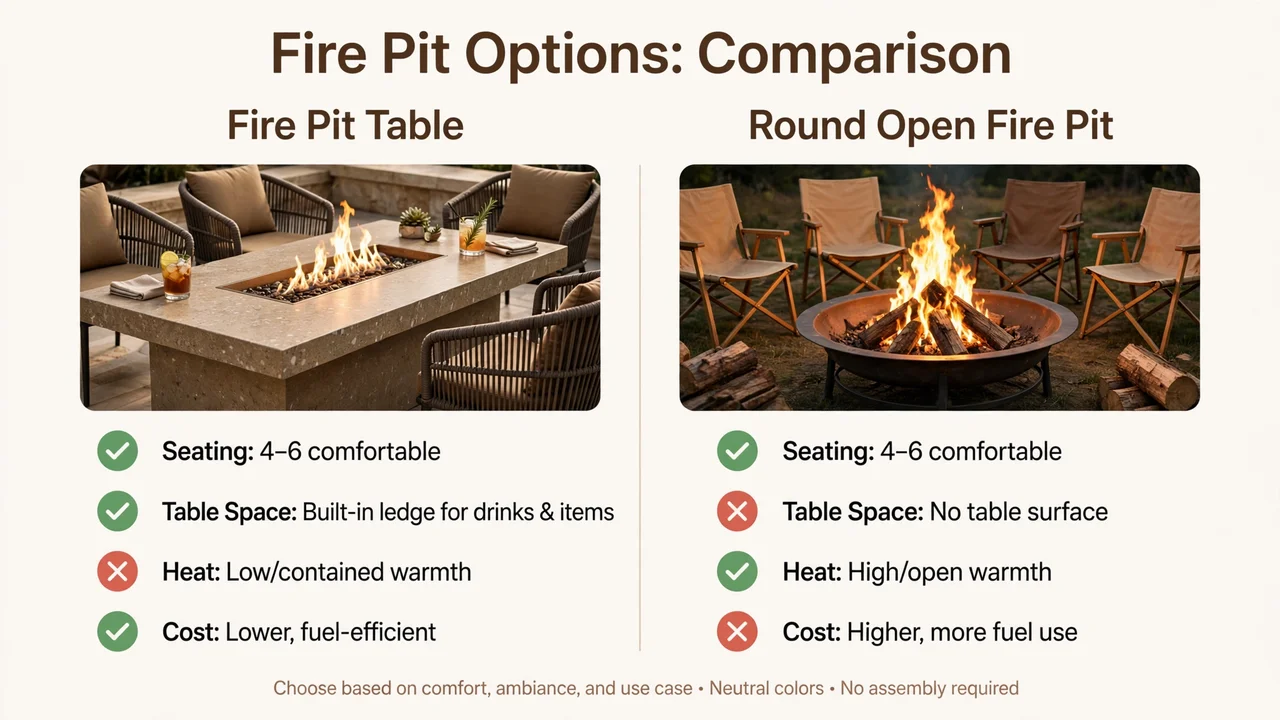
The choice comes down to how you spend time outside. A fire pit table suits eating, talking, and sitting in chairs. A regular fire pit suits standing around a fire, roasting food on sticks, and watching flames from a camp chair. Neither is better in every case. The table below lays out the trade-offs.
| Fire pit table | Regular fire pit | |
|---|---|---|
| Typical cost | $300 – $2,500+ (2026 est.) | $100 – $800 (2026 est.) |
| Table space | Yes, built in | No, needs side tables |
| Start time | Seconds (gas) | 10–20 minutes (wood) |
| Smoke | None (gas) | Yes, with wood |
| Heat feel | Warm close in, cool farther out | Strong radiant heat, wider ring |
| Cleanup | Almost none (gas) | Ash after each use |
| Best for | Meals, drinks, small patios | Campfire feel, big groups, roasting |
If you already own a fire pit and love it, a table is a sidegrade, not an upgrade. You pay for the tabletop and the push-button start. If you are starting from nothing and you eat outside often, the table is the smarter first buy, because it replaces two pieces at once.
Surface choice matters for either option. A table needs a flat, level, fire-safe base, and a regular fire pit does too. Our guide to whether a fire pit can go on grass explains which surfaces are safe and which ones scorch or catch. If you plan a full seating area, see our guide on how to build a fire pit area in your backyard for layout and clearance ideas that work for tables as well as pits.
Propane, Natural Gas, or Wood?
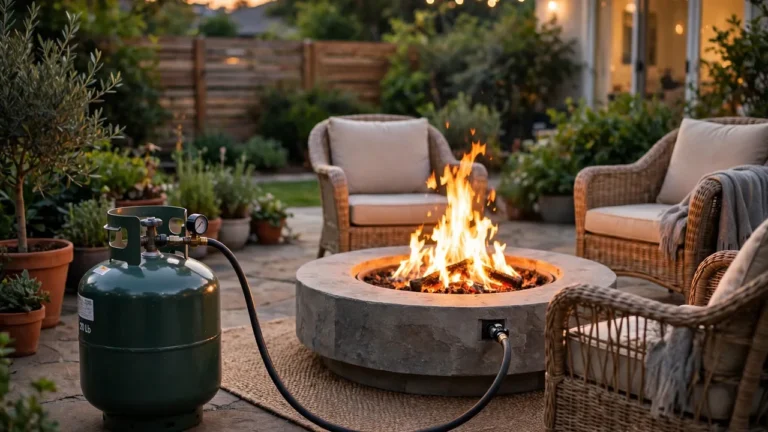
Propane is the most common choice, and the most flexible. The tank hides inside the table base, and you can move the table around the patio. The trade-off is the tank itself: you refill or swap it, and you keep a spare if you host often. Learn the hookup steps in our guide on how to connect a propane tank to a fire pit before your first use.
Natural gas costs less per hour to run and never runs out mid-evening. The catch is the install. A licensed fitter runs a gas line to the patio, which adds cost and pins the table to one spot. It suits owners who plan to stay put and use the table often.
Wood gives the crackle and smell that gas cannot match, and the fuel can be cheap if you have a wood supply. The cost is effort: you build the fire, feed it, watch it, and clean the ash. Wood tables also throw sparks, so a spark screen and a clear zone matter more. For wood fire skills, our guide on how to keep a fire going in a fire pit covers the airflow and stacking basics that apply here too.
What It Costs to Run One
The buy price is only half the math. A gas table burns fuel every hour it runs, and the cost adds up across a season. The worked example below uses stated assumptions, so you can swap in your own numbers.
A standard 20-pound propane tank holds about 4.6 gallons of propane. Propane holds about 91,500 BTU per gallon, so a full tank holds roughly 420,000 BTU of heat energy. A table rated at 50,000 BTU per hour on full flame would use that tank in about 8 hours at full blast. Turn the flame down to half, and the same tank lasts about 16 hours.
At a 2026 refill or swap price of about $20 – $25 per tank, a full-flame evening of 3 hours costs roughly $7 – $9 in propane. A half-flame evening of the same length costs roughly $4 – $5. Use the table twice a week through a 20-week season, and the season total lands near $160 – $360 in propane, based on flame height and local tank prices.
Worked Example: One Season of Evenings
- Use: 2 evenings a week, 3 hours each, 20 weeks
- Flame: half flame most nights, full flame on cold nights
- Propane: about 8–10 tanks for the season
- Fuel cost: about $160 – $250 (2026 estimate)
- Cover and upkeep: about $0 – $50 a year after year one
These are estimates with stated assumptions, not metered test results. Your numbers will shift with burner size, flame height, and local propane prices.
Natural gas usually costs less per hour than propane, because pipeline gas is cheaper per BTU than tank gas in most areas. The exact gap depends on your local gas rate, so check your utility bill for the per-therm price and divide by the burner rating. Wood is the wild card: free if you cut your own, or $200 – $400 a cord bought split and delivered, based on 2026 local prices.
Who Should Buy One, and Who Should Skip It
Buy one if you:
- Eat or drink outside at least once a week
- Have a small or mid-size patio
- Want fire without smoke, ash, or tending
- Host small groups of 2–6 people
- Will use the tabletop with the fire off
Skip it if you:
- Go outside a few times a year
- Want a big campfire feel or roasting fire
- Have a large open yard and no patio
- Cannot store a propane tank safely
- Need heat on cold, windy nights
Renters should check the lease and the patio rules before buying. Many rentals ban open flame on balconies and wood decks, and a heavy table is hard to move out later. If your patio is covered, check the maker guidance and local code first, and read our guide on how to heat a covered patio in winter for options that fit under a roof.
Pet owners need a plan too. Dogs are drawn to the warmth and can burn a nose or tail on the burner edge. Keep pets behind the chairs, not between them, and never leave the fire lit with pets loose nearby. Our guide on whether fire pits are safe around dogs and pets covers safe distances and burn signs to watch for.
5 Questions to Ask Before You Buy
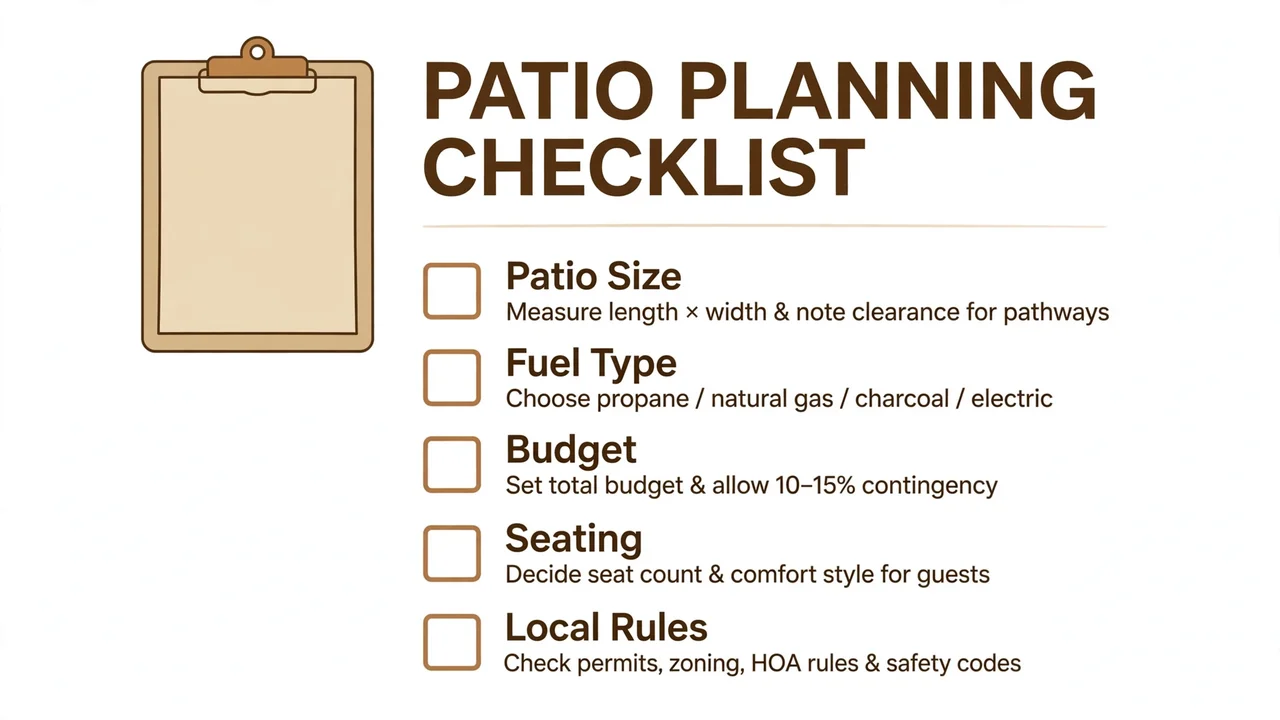
Run through this list with your tape measure in hand. It takes ten minutes and stops the most common regret: a table that is too big, too small, or wrong for the fuel you can get.
- Does it fit with chairs pulled out? Measure the patio, then add 24 inches of chair space on each side. A 42-inch table needs a patio at least 8 feet across to seat four without crowding.
- Where will the tank live? Check that the base fits a standard 20-pound tank with room for the hose, and that you have a ventilated spot to store a spare tank outside, upright, away from the house.
- What is the burner rating? Match the BTU rating to your climate. Mild evenings suit 40,000–50,000 BTU. Cool nights call for 60,000 BTU or more, plus a wind guard.
- Does it include the lid and cover? A burner lid turns it into a table, and a cover keeps rain out of the burner. If neither is included, add their cost to the price before you compare models.
- What do the rules allow? Check local fire rules, HOA rules, and deck or balcony rules. Some areas limit gas fire features on wood decks or near lot lines.
Mistakes to Avoid
Common Mistakes With Fire Pit Tables
- Buying for looks, not for seats. A table that seats two will frustrate a family of five. Count your usual group first, then pick the size.
- Skipping the cover. Rain in the burner rusts parts and clogs the starter. A cover costs far less than a repair.
- Placing it too close to the house. Heat and flame need clear space. Keep the 10-foot gap, and move cushions and curtains clear.
- Running the tank dry mid-party. Keep a spare tank full, or check the gauge before guests arrive.
- Ignoring wind. A table on an open, windy corner loses heat fast. A wind guard or a sheltered spot makes a real difference.
Frequently Asked Questions
Fire Pit Table FAQs
Are fire pit tables worth it?
Yes, if you sit outside often and will use the tabletop for food and drinks. They are less good value if you go outside rarely or want a big wood campfire, because a plain fire pit costs less for that job.
Do fire pit tables give off good heat?
They give off good heat for the people seated right around them, mostly on mild evenings. Heat drops with distance and wind, so they warm a small group well and a large or cold patio less well.
How long does a propane tank last on a fire pit table?
A standard 20-pound tank lasts about 8 hours on full flame with a 50,000 BTU burner, and about 16 hours on half flame. These are estimates from the tank energy and burner rating, not metered test results.
Can a fire pit table go on a wood deck?
Some gas models are rated for decks, but many areas and HOAs limit or ban them on wood decks. Check the maker guidance, your local fire rules, and your HOA rules, and use a fireproof mat under the table.
Can you use a fire pit table as a normal table?
Yes, when it has a burner lid. The lid covers the burner and gives you a flat top for food and drinks. Tables without a lid leave the burner open and work less well as a plain table.
Are fire pit tables safe around kids and pets?
They can be safe with rules in place: keep kids and pets at arm’s length, never leave a lit table alone, and turn the gas off when you finish. The burner edge and fire glass stay hot after the flame goes out.
Quick Reference Card: Fire Pit Tables
Verdict: Worth it for regular outdoor eaters and small patios; skip it for rare use or big campfire nights.
Price: $300 – $2,500+ (2026 est.); extras $50 – $150; season propane about $160 – $360.
Fuel: Propane for flexibility, natural gas for steady use, wood for campfire feel.
Tank life: 20-lb tank lasts about 8 hours full flame, 16 hours half flame (50,000 BTU).
Clearance: At least 10 feet from house, fences, and branches.
Before you buy: Measure patio plus chair space; check tank storage; confirm lid and cover; check local rules.
After you buy: Leak-test gas connections, keep a spare tank, cover the table when not in use.
Final Word
Are fire pit tables worth it? For the right patio, yes. They turn an evening outside into a meal, a talk, and a warm seat in one piece of furniture. For a rare-use patio or a big campfire crowd, the money buys more joy in a plain fire pit.
Measure your space, count your usual group, and run the fuel math for one season. If the numbers fit and the table would get used week after week, buy it with confidence. Your next step is to pick a size and fuel type, then check the rules for your patio before you order.