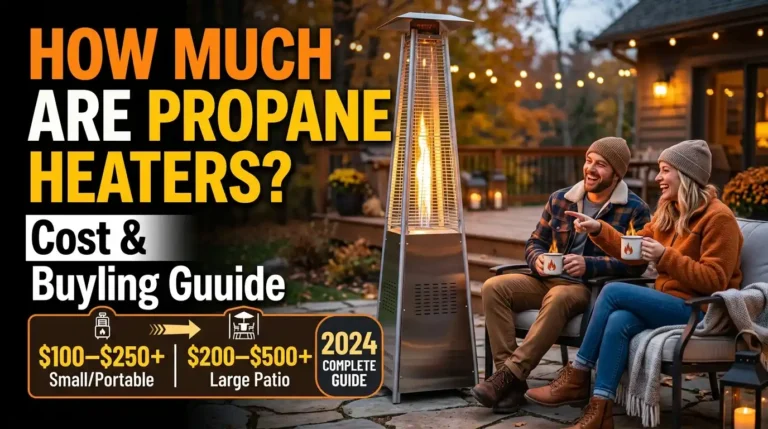
Is a Patio Heater Worth It? A Clear Answer Before You Buy
A patio heater can turn a chilly evening into a good one, but it is a real purchase, and the running costs add up over a season. Is a patio heater worth it? The short answer is yes for many homes, and no for some. It comes down to how often you sit outside, how cold your evenings get, and which fuel type fits your patio.
This guide walks you through the choice in six clear steps. You will measure your space, count your real use, compare fuel types, work out the cost of one evening, and check safety rules. By the end, you will know if a patio heater earns its place on your patio, and which type to buy if it does.
Heads Up: Read This Before You Buy a Fuel Heater
Propane and natural gas heaters burn fuel and make carbon monoxide. Never use them in a garage, a closed porch, a tent, or any room without open airflow. Keep a working carbon monoxide alarm in your home, and learn the signs of carbon monoxide poisoning: headache, dizziness, nausea, and confusion. If anyone feels these signs near a heater, move to fresh air at once and call emergency services.
Keep every heater clear of walls, railings, furniture, plants, and overhead coverings. Follow the clearances in your model’s manual, and never leave a lit heater running while no one is outside. When in doubt, ask a licensed gas fitter or your local fire department.
Total Time
About 1 hour
Research and measuring
Active Time
20 minutes
Measuring and counting use
Difficulty
Beginner
No tools beyond a tape measure
What You Need
- A tape measure
- A pen and paper, or your phone, for notes
- Your last few power and gas bills, if you want exact local rates
- The model manual for any heater you already own
- A quick look at your local fire code or HOA rules for outdoor heaters
At a Glance: The Six Steps
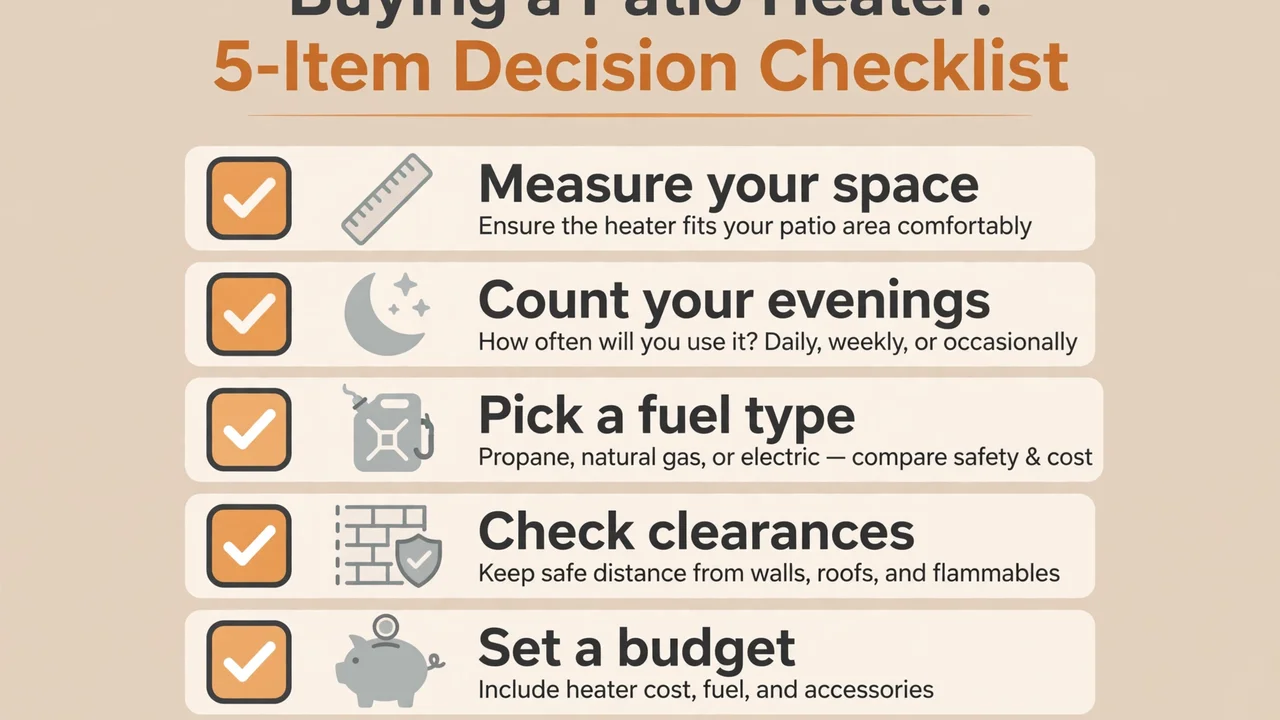
- Measure your patio and seating area
- Count the evenings you will use it
- Compare propane, electric, and natural gas
- Work out the running cost for one evening
- Check clearances, wind, and local rules
- Decide: Is a patio heater worth it for you?
The Short Answer: When a Patio Heater Pays Off
A patio heater is worth it when you sit outside at least two or three evenings a week during the cool months. At that pace, a heater adds many warm evenings to your year, and the cost per evening stays low. It is also worth it when your patio has a seating area that a single heater can cover, and when you have a safe spot to place it with clear space around it.
A patio heater is harder to defend when you sit outside only a few times a year, or when your patio is wide open to wind. Wind steals heat fast, and a heater in a windy spot warms the air more than it warms you. In that case, a wind screen, a sheltered corner, or a warm blanket may serve you better than a heater.
Renters should weigh one more point. A freestanding propane heater moves with you, while a natural gas heater needs a fixed gas line and a plumber. If you may move soon, a portable model protects your money. Keep reading to run the numbers for your own patio.
Step 1: Measure Your Patio and Seating Area
Grab your tape measure and walk to the spot where people actually sit. Measure the length and width of that seating area, not the whole patio. A heater warms people, not pavement, so the chairs and the table set the size you need.
Write down the numbers. A seating area of about 10 feet by 10 feet suits one full-size standing heater. A larger area, or two separate seating groups, may need two heaters or one strong model placed between the groups.
Measure the height above the spot too. Look for tree branches, pergola beams, umbrellas, and awnings overhead. Most freestanding heaters stand about 7 feet tall and need open space above the heat reflector. If your cover is low, a wall-mounted electric heater may fit better.
Step 2: Count the Evenings You Will Use It
Think back over the last cool season. How many evenings did you sit outside, or wish you could? Count the evenings per week, then multiply by the number of cool weeks in your year. This number drives the whole choice.
Two evenings a week for 20 weeks gives 40 evenings a year. At that pace, even a mid-priced heater costs only a few dollars per evening across its life. One evening a month gives about 12 evenings a year, and the same heater costs far more per use.
Be honest with yourself here. A heater does not create a habit on its own. If your family eats outside often and hosts friends on cool nights, the count will be high. If the patio chairs sat empty last fall, a heater is unlikely to change that.
Pro Tip: Mark your calendar for the first cool week of fall and the last cool week of spring. Those two dates frame your real heating season, and they make the evening count in this step far more accurate than a guess.
Step 3: Compare Propane, Electric, and Natural Gas
Three fuel types cover nearly every patio heater on the market. Propane heaters stand on their own and move where you need them. Electric heaters plug in and give off steady heat with no flame. Natural gas heaters connect to a home gas line and run at a low cost per hour, but they stay in one place.
Heat output is the first thing to compare. Full-size freestanding propane models are commonly rated at 40,000 to 48,000 BTU per hour, while tabletop propane models run near 10,000 to 11,000 BTU. Electric infrared heaters are commonly rated at 1,500 watts, with larger wall or ceiling models at 2,000 to 3,000 watts. Check the label on the exact model you buy, since ratings vary.
Heat style matters as much as raw output. Gas heaters warm the air around them, so wind cuts their reach. Electric infrared heaters warm people and surfaces in their path, so they hold up better in a light breeze. For a full rundown of how each type holds up over time, see our guide on how long patio heaters last.
Patio Heater Types at a Glance
| Fuel type | Common heat rating | Heat style | Best for | Watch out for |
|---|---|---|---|---|
| Propane | 40,000 to 48,000 BTU per hour (full-size) | Warms the air | Large open patios, renters, no outlet nearby | Tank refills, wind cuts heat, open flame |
| Electric infrared | 1,500 watts (common); 2,000 to 3,000 watts (large wall models) | Warms people and surfaces | Covered patios, small spaces, balconies | Needs an outdoor outlet, shorter reach |
| Natural gas | About 40,000 BTU per hour (common) | Warms the air | Frequent use, fixed patio setup | Needs a gas line and a licensed installer |
| Tabletop propane | 10,000 to 11,000 BTU per hour | Warms the air close by | Small tables, two to four people | Small heat zone, needs a stable table |
Ratings are common manufacturer figures. Always check the label on the exact model you buy.
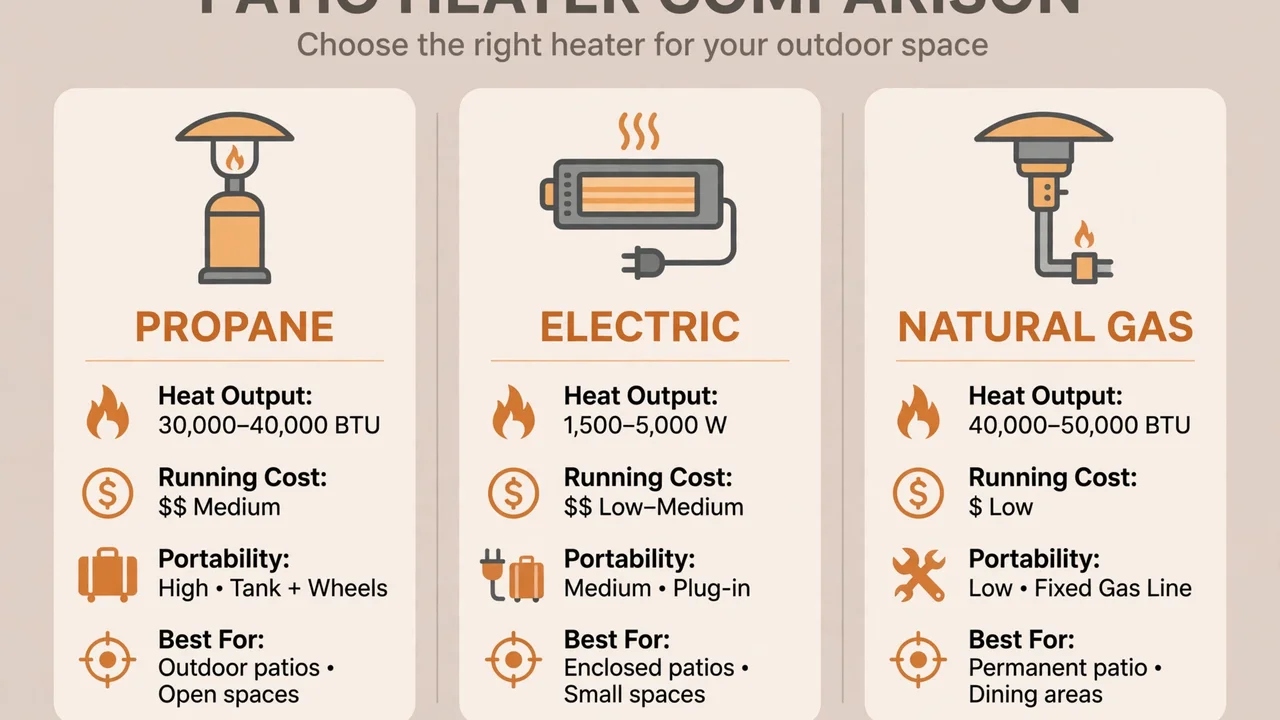
Portability is the next split. A propane heater rolls across the patio on wheels and stores in a shed for winter. An electric heater needs an outlet within cord reach, and a natural gas heater never moves once it is installed. If you already own a propane model and want a fixed setup, read our guide on converting a propane patio heater to natural gas before you buy parts.
Step 4: Work Out the Running Cost for One Evening
Running cost is where the choice gets clear. A heater that costs little to buy can cost a lot to run, and the reverse is also true. Work out the cost of one three-hour evening for each fuel type, using your local prices.
Start with propane. A standard 20-pound tank holds about 4.6 gallons of propane. One gallon of propane holds about 91,500 BTU, so a full tank holds about 421,000 BTU.
A heater rated at 40,000 BTU per hour burns through that tank in about 10.5 hours. If a refill costs 20 dollars, one hour costs about 1.90 dollars, and a three-hour evening costs about 5.70 dollars.
Electric heat is a simpler sum. A 1,500-watt heater uses 1.5 kilowatt-hours each hour. Over three hours, that is 4.5 kilowatt-hours.
At a power rate of 17 cents per kilowatt-hour, one evening costs about 77 cents. Check your own power bill for your true rate, since rates vary widely by area and by time of day.
Natural gas falls between the two on running cost. A heater rated at 40,000 BTU per hour uses about 0.4 therms each hour, since one therm holds 100,000 BTU. At a gas rate of 1.50 dollars per therm, one hour costs about 60 cents, and a three-hour evening costs about 1.80 dollars. Add the one-time cost of the gas line and install, which can run into hundreds of dollars, before you compare totals.
Worked Example: Cost of One 3-Hour Evening
| Fuel type | Use per evening | Price used in this example | Cost per evening |
|---|---|---|---|
| Propane, 40,000 BTU heater | About 0.29 of a 20-pound tank | 20 dollars per tank refill | About 5.70 dollars |
| Electric, 1,500 watts | 4.5 kilowatt-hours | 17 cents per kilowatt-hour | About 0.77 dollars |
| Natural gas, 40,000 BTU heater | About 1.2 therms | 1.50 dollars per therm | About 1.80 dollars |
These are worked examples with stated prices, not quotes. Fuel and power prices vary by area and season, so swap in your local rates for your true cost.
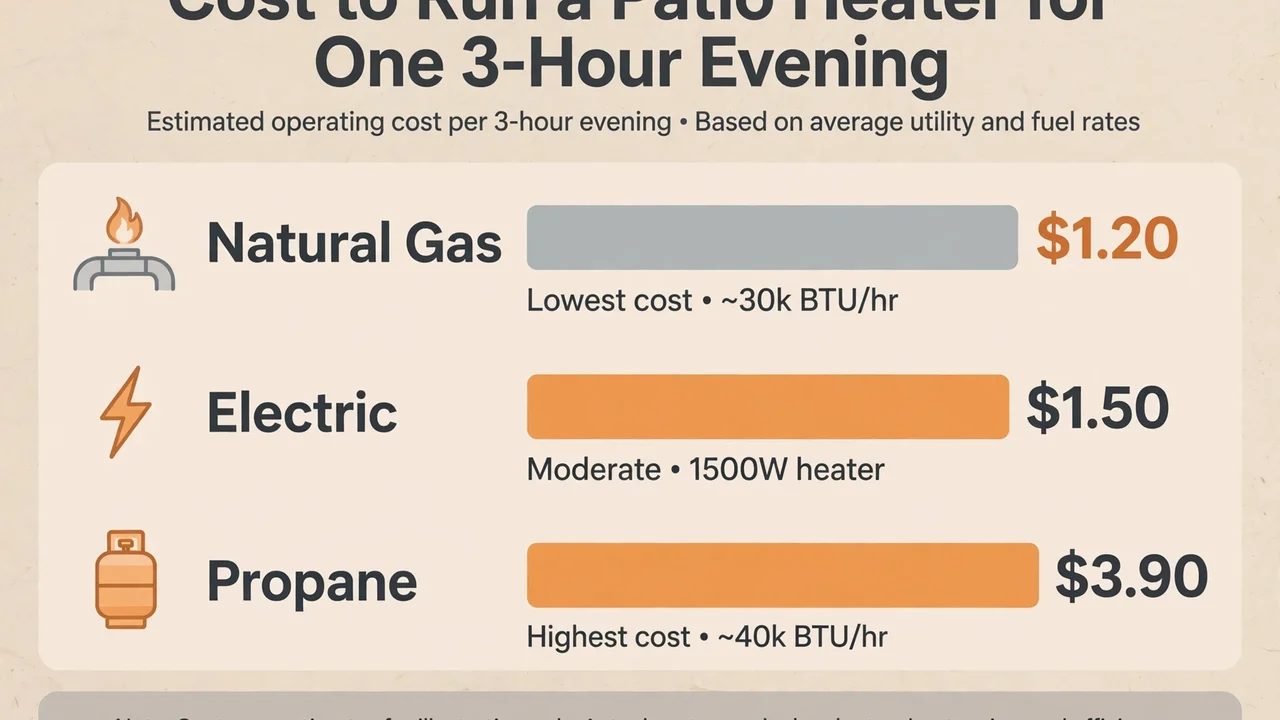
Now stretch the evening cost across your season. Forty evenings at 5.70 dollars costs about 228 dollars a year on propane. The same forty evenings cost about 31 dollars on electric and about 72 dollars on natural gas, before install costs. This is why heavy users often favor electric or natural gas, while light users favor propane for its low upfront cost and portability.
Step 5: Check Clearances, Wind, and Local Rules
Place the heater on flat, level ground where it cannot tip. Keep the clearances listed in your model’s manual, and treat them as minimums, not targets. A common rule is 3 feet of clear space on all sides and open air above the heater, but your manual may ask for more.
Wind changes everything outdoors. A heater that feels strong on a calm night can feel weak in a steady breeze. Set the heater on the side the wind blows from, so the heat drifts toward your chairs. A wind screen, a fence, or a wall behind the seating area helps more than turning the heater up.
Check your local rules before you buy. Some towns, condos, and HOAs limit open flame heaters on decks and balconies. Others require a permit for a natural gas line.
A quick call to your fire department or HOA office settles the question in minutes. If you plan to place a heater on a wood deck, read our guide on putting a patio heater on a wood deck first.
Heads Up: Never use a propane or natural gas patio heater indoors, in a garage, or under a low cover with poor airflow. Carbon monoxide has no smell and no color, and it can build to dangerous levels fast in a closed space. If your patio has a roof, check the manual for the minimum open sides and height before you light the heater.
Step 6: Decide: Is a Patio Heater Worth It for You?
Pull your numbers together. You have your seating area size, your evening count, your fuel choice, and your cost per evening. Multiply the evening cost by your evening count to get your yearly running cost.
Add the heater price and any install cost, then divide by your evening count. That is your true cost per warm evening.
A result under 10 dollars per evening is a good deal for most households, since a restaurant patio meal or a night out costs far more. A result over 20 dollars per evening deserves a second thought, unless those evenings matter a lot to you. The math is a guide, not a verdict, and a heater that hosts family birthdays and quiet fall nights can be worth more than the numbers show.
Buy the size your measurements call for, not the biggest model on the shelf. A heater rated for your seating area warms people well and sips fuel. An oversized heater wastes fuel and crowds a small patio. If you want a second view on the choice, our comparison of heated outdoor furniture vs patio heaters covers the main rival to a standalone heater.
Before and After: What Changes With a Heater
Before: No Heater
- Evenings end when the sun sets and the air cools
- Guests drift inside after an hour
- The patio sits unused for months each year
After: Right Heater, Right Spot
- Seating stays warm for two to three more hours
- Guests stay outside and relax
- The patio earns use in spring and fall
Common Mistakes to Avoid
Five Mistakes That Waste Money or Heat
1. Buying the biggest heater first. A heater rated far above your seating area burns more fuel for no gain. Match the rating to the space you measured in Step 1.
2. Ignoring the wind. An open, windy patio can cut a heater’s reach in half. Place the heater upwind and add a screen or use a sheltered corner.
3. Skipping the cover. Rain and dust wear out burners and electric parts. A cover costs little and adds seasons to a heater’s life.
Learn how water affects your model in our guide on whether patio heaters can get wet.
4. Forgetting the running cost. A cheap heater with a high fuel cost can pass a pricey efficient model in one season. Run the evening cost math in Step 4 before you buy.
5. Placing it too close to coverings. Heat rises, and fabric, leaves, and wood near the top of a heater are a fire risk. Keep the clearances in your manual on every side, including above.
Frequently Asked Questions
Questions Readers Ask Before Buying
How much does it cost to run a patio heater for one evening?
It depends on the fuel and the size of the heater. A full-size propane heater at 40,000 BTU per hour uses about one tenth of a 20-pound tank each hour, so a three-hour evening costs around 6 dollars when a tank refill costs 20 dollars. A 1,500-watt electric heater uses 4.5 kilowatt-hours in three hours, which costs about 77 cents at 17 cents per kilowatt-hour. Prices vary by area, so check your local fuel and power prices before you buy.
Do patio heaters work in cold weather?
They work best in mild cool weather, from about 50 to 65 degrees Fahrenheit. Below 40 degrees, the warm zone shrinks and wind steals heat fast. A wind screen or a sheltered corner helps more than a bigger heater in cold air.
Are patio heaters safe on a wood deck?
Many models are safe on a wood deck when you follow the manual and keep the clearances it lists. Keep the heater away from railings, furniture, and overhead coverings, and never leave it running while no one is outside. Check your local fire code first, since some towns limit open flame heaters on decks.
How long do patio heaters last?
A well-built heater can last many seasons with basic care. Stainless steel parts, a cover, and dry storage stretch its life. Rust, clogged burners, and torn covers are the most common reasons heaters fail early.
Can a patio heater get wet?
Most patio heaters can handle light rain, but standing water and heavy rain can damage burners and electric parts. Cover the heater when it is not in use and store it under cover in wet months. Never run a wet electric heater until it is fully dry.
Is a patio heater worth it for a small patio?
A small patio often suits a tabletop propane heater or a wall-mounted electric heater better than a tall standing model. Measure your seating area first and pick a heater rated for that space. A heater that is too large for a small patio wastes fuel and crowds the space.
Quick Reference Card: Is a Patio Heater Worth It?
What you need: tape measure, pen and paper, local power and gas rates, your heater manual, local fire code or HOA rules.
Steps:
- Measure your patio and seating area.
- Count the evenings you will use it.
- Compare propane, electric, and natural gas.
- Work out the running cost for one evening.
- Check clearances, wind, and local rules.
- Decide: Is a patio heater worth it for you?
Rule of thumb: two or three evenings a week in the cool months, a heater sized to your seating area, and a cost under 10 dollars per evening means yes. Keep fuel heaters outdoors with open airflow, and never leave a lit heater running with no one outside.
Conclusion
You now have a clear answer to the question: is a patio heater worth it? Measure your space, count your evenings, and run the cost math. If the numbers land under about 10 dollars per warm evening, and you have a safe spot with clear space, a patio heater is a sound buy.
Pick the fuel that fits your patio and your habits. Propane suits renters and open patios. Electric suits covered patios and light breezes. Natural gas suits heavy users with a fixed patio and a gas line.
Whichever you pick, buy a cover, keep the clearances, and store it dry.
Your next step is a tape measure and ten minutes on your patio. Once you know your seating area and your evening count, the choice makes itself. For more help with care and setup, see our guides on cleaning a patio heater and assembling and installing a patio heater.