How Long Do Patio Heaters Last? Lifespan by Heater Type and How to Make Yours Last Longer
How long do patio heaters last? Most patio heaters last 5 to 10 years with regular care, and a well-built model that lives under a cover can last longer. The exact number depends on the fuel type, the build quality, how often you run it, and how much weather it has to face.
A cheap powder-coated heater left out in rain all winter may give up after two or three seasons. A stainless steel propane tower that gets cleaned, covered, and stored through the worst months can still be warming a patio a decade later. The gap between those two outcomes comes down to care, not luck.
This guide gives you the lifespan you can expect from each heater type, the six things that wear a heater out fastest, and a short care routine that adds years to any model. You will also find the signs that tell you when to repair a part and when to replace the whole heater.
⚠️ Safety first — read this before you light anything
Fuel-burning patio heaters are for outdoor use only. Never run a propane or natural gas patio heater inside a house, garage, tent, or any unvented space. Burning fuel indoors can build up carbon monoxide, a gas you cannot see or smell, and it can kill.
Keep a working carbon monoxide detector in any room next to an open door or window where a heater runs outside, and learn the signs of carbon monoxide poisoning: headache, dizziness, nausea, and confusion. If anyone feels those signs, move them to fresh air at once and call emergency services.
If you ever smell gas, do not light the heater and do not hunt for the leak with a flame. Turn the gas off if it is safe to do so, leave the area, and call your gas utility or 911 from outside. Always follow your heater manual and keep the clearances it lists.
Short answer
5–10 years
With top care
10–15 years
Care routine
About 30 min / season
Difficulty
Beginner
The Short Answer: How Long Do Patio Heaters Last?
A typical patio heater lasts 5 to 10 years. That is the range most published guides agree on, and it covers the common freestanding propane and electric models that most people buy.
High-quality heaters with stainless steel bodies and regular care often reach the top of that range and beyond. Infrared models tend to last longest, at 10 to 15 years, because they have fewer moving parts and no burner to clog. At the other end, a budget heater with a thin powder-coated frame that sits uncovered through rain and snow may last only 2 to 3 seasons.
There is no single official lifespan figure. Makers rarely publish one, and the number shifts with build quality, climate, and care. Treat the ranges in this guide as planning figures from published guides, not promises from a maker.
Patio Heater Lifespan by Heater Type
Fuel type is the biggest single factor in how long a patio heater lasts. Gas models have burners, regulators, and gas lines that wear. Electric models have heating elements and bulbs that burn out. Infrared models heat with lamps that carry rated hour lives.
The table below pulls together the ranges reported across several published patio heater guides. Where guides disagree, the table shows the full spread so you can see the range instead of a false single number.
| Heater type | Typical lifespan | Part that usually wears out first | Main threat |
|---|---|---|---|
| Propane freestanding | 5–10 years | Burner, emitter grid, regulator | Rust, clogged burner, gas leaks |
| Natural gas | 8–10 years | Burner, gas valve | Weather exposure, lack of inspection |
| Electric freestanding | 3–10 years | Heating element (often near 5 years or ~5,000 hours) | Moisture in the element, cord damage |
| Infrared | 10–15 years | Infrared lamp (often rated 5,000–10,000 hours) | Lamp failure, housing corrosion |
| Tabletop propane | 3–5 years | Small burner, thin frame | Knocks, rain, light build |
Ranges compiled from published patio heater guides (Posh Living, MyBackyardLife, MyGardenPlans, Everything Backyard). Figures vary by brand, model, and care, and makers rarely publish an official lifespan.
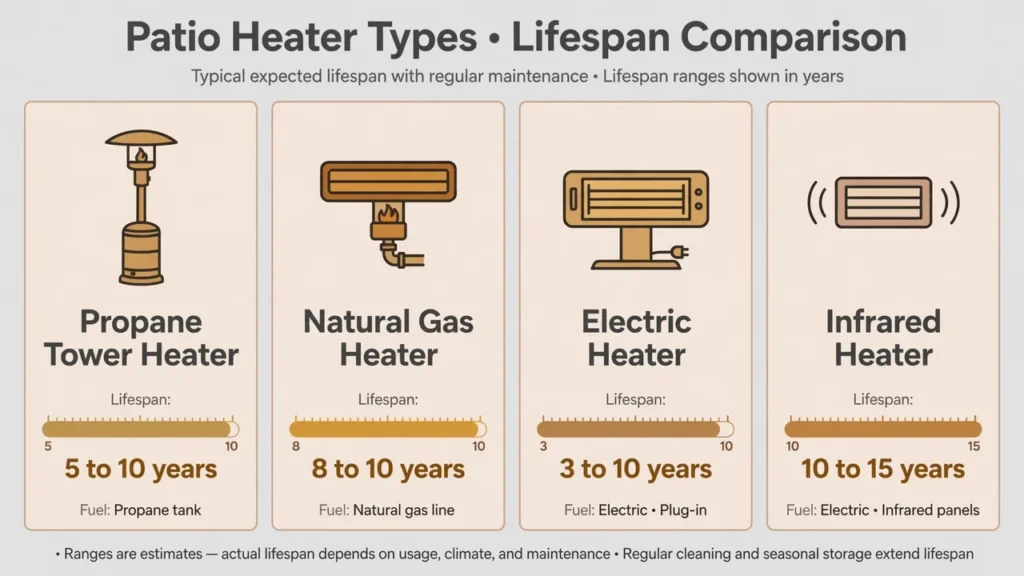
Two notes on the table are worth a closer look. First, electric heaters show the widest range, from 3 to 10 years, because guides split on them: some report short element life, others report long housing life with one element swap in the middle. An element swap can add years to an electric heater for the price of one part.
Second, a 20 lb propane tank is a fuel question, not a heater-life question. On a standard patio heater it runs about 9 to 10 hours on a typical setting, and closer to 7 to 8 hours on high for a 40,000–50,000 BTU model. If you want the full math, see our guide to how long a propane tank lasts on a patio heater.
What Cuts a Patio Heater’s Life Short
Six factors do most of the damage. If your heater died young, one of these is almost always the cause.
1. Weather left to do its work
Rain, snow, and salty coastal air attack metal from the outside in. Water pools in the base, sits in the burner, and starts rust on steel frames. A heater left uncovered through a wet winter ages faster in four months than a covered one does in two years.
2. Rust on the frame and burner
Rust is the most common killer of gas patio heaters. It starts as surface spots on the pole and base, then eats into the burner and the gas line fittings. Once rust reaches the burner or the frame joints, heat output drops and the heater can become unsafe to run.
3. A clogged burner or emitter grid
Spiders, dust, leaves, and soot block the small holes in a burner. A clogged burner burns yellow instead of blue, gives off less heat, and uses more fuel. Left alone, it can overheat one side of the emitter grid and crack it.
4. Hard use with no rest
Running a heater on high for eight hours a day, every day, wears parts far faster than a few evenings a week on medium. One guide found heavy daily use can cut a propane heater’s life to 5 to 10 years, while light use of two hours a day can stretch the same type of heater toward 15 to 20 years. Hours on the burner matter more than calendar years.
5. Cheap build quality
Thin powder-coated steel costs less up front and rusts sooner. Stainless steel bodies, brass fittings, and heavier bases hold up far better outdoors. The price gap at the store often shows up as a lifespan gap of several years.
6. Skipped maintenance
A heater that is never cleaned, never inspected, and never covered fails in small ways that add up: a loose fitting becomes a gas leak, a dirty pilot will not light, a wobbly base tips in wind. Each missed check lets a cheap fix turn into a dead heater.
What Makes a Patio Heater Last Longer
The good news is that every factor above has a counter-move, and none of them takes much time. A cover, a dry storage spot, and a seasonal clean are the three moves that matter most.
Buy for the outdoors you actually have. If your patio faces the sea or sits uncovered in a rainy climate, pay for stainless steel. If the heater will live on a covered porch and come inside for winter, a mid-range model can last as long as a premium one.
Run the heater on medium when medium is warm enough. High heat burns more fuel, stresses the burner, and shortens the life of the emitter grid. Medium also keeps the tank going longer between fills.
Store the heater right. A fitted cover keeps rain off the burner and the base. A garage or shed for the off-season beats a cover alone. If you must leave it outside, tip the base so water drains and keep the cover tied down so wind cannot peel it off.
✅ The three habits that add the most years
- Cover it every time it cools down, not only in winter.
- Clean the burner and emitter grid at the start of each season.
- Store it dry in the off-season, with the tank removed and stored upright outdoors.
How Long Each Part Lasts
A patio heater rarely dies all at once. Parts wear out on their own schedules, and knowing them helps you decide whether a repair is worth it.
| Part | Typical service life | Replace or repair? |
|---|---|---|
| Electric heating element | About 5,000 hours of use | Replace the element; the housing often outlives it |
| Infrared lamp / bulb | 5,000–10,000 hours | Replace the lamp; a common spare part |
| Gas burner / emitter grid | 3–5 years before parts often need attention | Clean first; replace the grid if cracked or warped |
| Regulator and hose | 5–7 years; check each season | Replace at the first sign of cracks or leaks |
| Igniter / pilot assembly | Varies widely; often the first failure | Clean the pilot; replace the igniter if it will not spark |
| Frame, pole, and base | Lasts as long as rust is kept off it | Treat rust early; replace the heater if the frame is weak |
Hour ratings come from maker specs and published guides; they vary by model. Check your manual for the rating on your heater.
If a single part has failed and the frame is solid, a repair usually wins. If two or three parts have failed at once, or the frame itself is rusted through, replacement is usually the better call. The next section walks through the care routine that keeps those parts alive.
The Care Routine That Adds Years
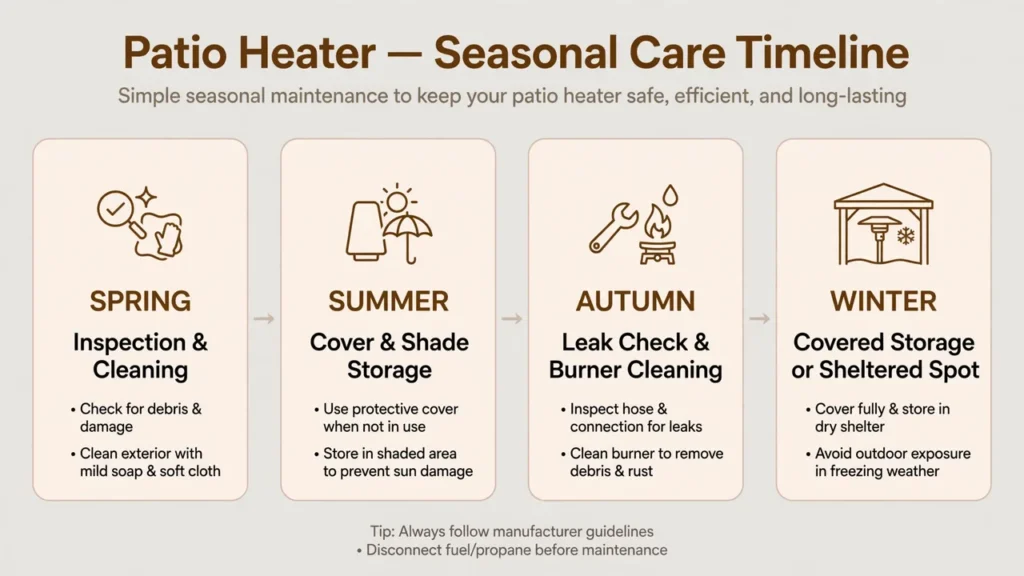
These six steps take about 30 minutes at the start of the season and a few minutes after that. Do them in order, and do them with the heater off and cool.
At a glance — the six care steps
- Inspect the frame, base, and gas line for rust and damage.
- Clean the burner and emitter grid.
- Check the gas line and regulator for leaks.
- Tighten loose bolts and check the tilt switch.
- Cover the heater after every use.
- Store it dry for the off-season.
Step 1: Inspect the frame, base, and gas line for rust and damage
Walk around the heater with a torch and look at the base, the pole joints, and the reflector. Surface rust shows up as orange spots and rough patches. Push gently on the pole: it should feel solid, with no wobble at the joints.
Look at the gas hose and regulator too. Cracks, stiff or brittle rubber, and green corrosion on brass fittings all mean the part is past its best. A cracked hose is a gas leak waiting to happen, so mark it for replacement before you light the heater.
Heads up: if the frame is rusted through, the pole bends, or the base is cracked, stop. A weak frame can tip a lit heater over. Do not run it — replace the heater or the failed part first.
Step 2: Clean the burner and emitter grid
Brush loose dust and cobwebs off the burner and the emitter grid with a soft brush. Blow out the burner holes with short bursts from a can of compressed air, holding the can upright so no liquid sprays out.
Wipe the reflector with a damp cloth and a drop of mild dish soap, then dry it. A clean reflector throws more heat downward, so the heater warms people instead of the sky. For the full cleaning method, see our guide on how to clean a patio heater.
Step 3: Check the gas line and regulator for leaks
Mix a little dish soap with water and brush it over every gas joint: tank valve, regulator, hose ends, and the burner inlet. Open the tank valve slowly and watch for bubbles.
Bubbles mean gas is escaping at that joint. Close the valve, tighten the joint by hand, and test again. If bubbles keep coming, close the valve and replace the hose or regulator. Never test for a leak with a flame, and never light a heater that is leaking.
Step 4: Tighten loose bolts and check the tilt switch
Wind and moving the heater shake bolts loose over a season. Go over the base bolts, the pole collar, and the reflector screws with the right spanner and snug each one. Do not over-tighten — firm is enough.
Tip the heater gently to one side and listen for the tilt switch click. That switch cuts the gas if the heater falls over, and it is one of the parts that keeps a tipped heater from becoming a fire. If it does not click or the heater keeps running while tilted, stop using the heater and get the switch checked.
Step 5: Cover the heater after every use
Wait until the heater is fully cool, then pull the cover over the top and fasten it at the base. A fitted cover keeps rain off the burner, keeps dust out of the pilot, and slows rust on the frame.
This one habit does more for lifespan than any other. Heaters that live under a cover between uses stay drier, cleaner, and rust-free far longer than heaters left bare. Keep the cover itself clean and dry so it does not trap damp against the metal.
Step 6: Store it dry for the off-season
At the end of the season, take the propane tank off and store it upright outdoors, away from the house and out of direct sun. Never store a propane tank indoors or in a closed garage.
Move the heater into a garage or shed if you have the space, with its cover on. If it must stay outside, set it on a dry spot where water cannot pool around the base, tie the cover down, and check it after storms. A heater stored dry starts the next season with no rust surprises.
Signs It Is Time to Repair or Replace
A patio heater gives clear warnings before it fails. Watch for these five signs, and act on them early.
Less heat than before. If the heater runs on high and the warm circle around it has shrunk, the burner, emitter grid, or heating element is wearing out. Clean it first — a clogged burner is the most common cause — and if heat does not come back, the part is likely done.
Yellow, lazy, or uneven flame. A healthy gas flame burns mostly blue with a steady shape. Yellow tips, flickering, or a flame that favors one side points to a blocked burner or a failing regulator.
Hard to light, or it will not stay lit. A pilot that takes many tries, or a flame that dies when you let go of the knob, usually means a dirty pilot, a weak thermocouple, or a dying igniter. These are cheap parts, and replacing one can add years.
Rust you can poke through. Surface rust can be sanded and painted. Rust that flakes away in chunks, holes in the base, or a pole that flexes means the structure is going. Do not run a heater with a weak frame.
Repairs that keep coming. One repair is normal. A second repair in the same season, then a third, means the heater is at the end of its service life. Add up the part costs and the weekends lost, and a new heater often costs less than keeping the old one going.
Repair it or replace it? A quick check
- Repair: one part has failed, the frame is solid, and the heater is under 7 years old.
- Repair: the igniter, pilot, or lamp is the only problem and the spare part is still made and sold.
- Replace: the frame, base, or pole is rusted through or bent.
- Replace: two or more major parts failed in the same season.
- Replace: the model is no longer made and parts are hard to find.
Does a Patio Heater’s Location Change How Long It Lasts?
Yes, and more than most people expect. A heater on a covered porch in a dry climate can outlast the same model on an open deck by the sea by several years.
Coastal air carries salt that speeds rust on steel and corrodes brass fittings. Rain that hits the heater every week keeps the burner damp and the base wet. Wind knocks a tall heater over, and one hard fall can bend the pole or crack the emitter grid.
Pick the spot with care. A sheltered corner near a wall cuts wind and rain. A deck is fine if the heater stands on a level, stable surface — see our guide on whether you can put a patio heater on a wood deck. Keep the heater clear of walls, ceilings, and anything that can burn, using the clearances in your manual; our patio heater clearance guide explains the distances in plain terms.
Electric vs Propane: Which Lasts Longer?
Gas patio heaters usually last a bit longer than electric ones, and the reason is the heating element. Electric elements sit out in the weather and wear with every heat cycle, while a gas burner has fewer parts that age from heat alone. Published guides put gas models at 5 to 10 years and electric models at 3 to 10 years, with the element often needing a swap near the middle of that range.
That does not settle which one to buy. Electric heaters cost less to run per hour in many areas, need no tank swaps, and light with a switch. Propane heaters give more heat, work anywhere, and keep running in a power cut. The full trade-off is in our electric vs propane patio heater comparison.
If you have not bought a heater yet, our guide on how to choose a patio heater walks through size, fuel, and build quality before you spend anything.
Troubleshooting: Common Problems and Fixes
| If this happens | Try this |
|---|---|
| Heater will not light | Check the tank has fuel and the valve is open. Clean the pilot and check the igniter sparks. Check the tilt switch is upright. |
| Flame lights, then dies | Hold the knob in longer to warm the thermocouple. Clean the pilot jet. Replace the thermocouple if the flame still dies. |
| Yellow or weak flame | Clean the burner holes and emitter grid. Check the regulator and hose for kinks or damage. |
| Less heat than last year | Clean the reflector and emitter grid. Check the tank is full and the regulator is not failing. |
| Rust spots on the frame | Sand the spot, wipe it clean, and paint with heat-rated paint. Cover the heater between uses. |
| Smell of gas | Do not light the heater. Turn the gas off if safe, leave the area, and call your gas utility or 911 from outside. |
Frequently Asked Questions
How long do patio heaters last on average?
Most patio heaters last 5 to 10 years with regular care. Infrared models can last 10 to 15 years, while budget models left uncovered may last only 2 to 3 seasons.
Do propane patio heaters last longer than electric ones?
Usually, yes. Gas patio heaters typically last 5 to 10 years, while electric models last 3 to 10 years. The heating element in an electric heater is often the first part to wear out, though replacing it can add years.
How long does a 20 lb propane tank last on a patio heater?
A 20 lb propane tank runs a standard patio heater for about 9 to 10 hours on a typical setting, and about 7 to 8 hours on high for a 40,000 to 50,000 BTU model.
What makes a patio heater wear out fastest?
Weather exposure is the biggest factor, followed by rust, a clogged burner, and heavy daily use on high. A heater left uncovered in rain and snow ages far faster than one that is covered and stored dry.
Can you repair a patio heater, or should you replace it?
Repair it when one part has failed and the frame is solid. Replace it when the frame is rusted through, two or more major parts failed in the same season, or spare parts are no longer made.
How do I make my patio heater last longer?
Cover it after every use, clean the burner and emitter grid each season, check the gas line for leaks, and store it dry in the off-season. Running it on medium instead of high also helps.
Is it safe to leave a patio heater outside all winter?
It can survive winter outside with a fitted cover and a dry spot, but a garage or shed is better. Remove the propane tank and store it upright outdoors, and check the heater after storms.
When should I replace my patio heater?
Replace it when heat output has dropped and cleaning does not bring it back, when the frame is rusted through, when it will not light after a pilot and igniter check, or when repairs keep coming in the same season.
Quick Reference Card — How Long Do Patio Heaters Last?
Expected life: 5–10 years typical; 10–15 years for infrared; 3–5 years for tabletop models.
Top killers: weather, rust, clogged burner, heavy daily use on high.
Care kit: soft brush, compressed air, mild dish soap, soapy water for leak checks, spanner, fitted cover.
Season routine:
- Inspect frame and gas line.
- Clean burner and emitter grid.
- Leak-check gas joints with soapy water.
- Tighten bolts; test tilt switch.
- Cover after every use.
- Store dry for the off-season.
Replace when: frame rusted through, heat does not return after cleaning, or repairs keep coming.
Conclusion
Most patio heaters last 5 to 10 years, and the ones that reach the top of that range share the same story: a cover, a seasonal clean, and dry storage. The heater itself does not decide its lifespan. The care it gets does.
Check your heater this weekend. Clean the burner, test for leaks, and put the cover on when it cools. Those thirty minutes are the cheapest years you will ever add to a patio heater.
For your next read, see our guide on how to choose a patio heater if you are buying new, or our patio heater cleaning guide if your current heater needs a fresh start.
Sources: Posh Living, “How Long Does a Patio Heater Last?”; MyBackyardLife, “How Long Do Patio Heaters Last? (The Expected Lifespan)”; MyGardenPlans, “Warming Up Your Outdoor Space: How Long Does a Patio Heater Last?” and “Warmth that Lasts: The Lifespan of Propane Patio Heaters”; Everything Backyard, “How Long Do Patio Heaters Last”. Lifespan figures are ranges reported by these guides and vary by brand, model, and care; makers rarely publish an official lifespan. Prices are not listed because they vary by model and year — check current retailer listings before buying parts.