Are Space Heaters Safe to Leave On Overnight? The Honest Answer
Cold bedrooms make for long nights. You climb under the covers, the room feels like a fridge, and the space heater in the corner looks like the one thing standing between you and a decent night of sleep. So you ask the question plenty of people ask every winter: are space heaters safe to leave on overnight?
The short answer is no. Safety agencies in the United States are clear on this point, and this guide explains why they take that position, what the real risks look like while you sleep, which heater types carry more risk than others, and what you can do instead to stay warm through the night. You will also find a step-by-step safe setup checklist for the hours before bed, so the room is warm when you climb in and the heater is off when you drift off.
Safety disclaimer
This article shares general safety information only. It is not a substitute for your heater manual, local fire codes, or advice from a licensed electrician. Space heaters can start fires and cause burns. If your heater smells of burning, sparks, trips a breaker, or has a hot or damaged cord, turn it off, unplug it, and stop using it. Call a licensed electrician or the heater maker for help. Never use a fuel-burning heater indoors unless it is rated for indoor use, and keep working smoke alarms and carbon monoxide alarms in your home.
Heads up: the three dangers that cause most overnight problems
A heater left running while you sleep can tip over onto bedding or carpet with no one awake to notice. Bedding, curtains, clothes, and paper can slide or fall within 3 feet of a hot heater during the night. And a heater plugged into an extension cord or power strip can overheat the cord while the house is quiet. Each of these has started real house fires. Keep the heater off while you sleep, and the three risks above drop away.
Risk at a glance
Short answer
Turn it off before you sleep
Clearance
3 feet on every side
Power
Wall outlet only, no cords or strips
Warm room instead
Heat before bed, then switch off
The Short Answer: Turn It Off Before You Sleep
The U.S. Consumer Product Safety Commission (CPSC) tells people to turn off heaters when sleeping and never to leave a portable heater running while it is unattended. The National Fire Protection Association (NFPA) gives the same advice: turn portable heaters off and unplug them when you leave the room or go to bed. The U.S. Fire Administration agrees.
That advice holds even for newer heaters with tip-over shutoff and overheat protection. Those features cut power in a fault, and they lower the risk, but they do not make an unattended heater safe all night. A safety switch can fail. A blanket can still land on a hot surface. A cord can still overheat. The agencies that track these fires still say to switch the heater off.
Does that mean a space heater can never run at night? It means the heater should not run while you are asleep and unable to watch it. Warm the room in the evening, switch the heater off at bedtime, and use blankets and bedding to hold the warmth. The rest of this guide shows how to do that well, so you stay warm without the overnight risk.
Why Sleeping Changes the Risk
A space heater is far more dangerous at 2 a.m. than at 2 p.m. for one plain reason: no one is awake to catch a problem early. During the day you smell smoke, hear a crackle, see a curtain drift too close, or feel the cord getting hot. At night you are asleep, and a small problem can grow for hours before a smoke alarm wakes you.
The numbers back this up. The CPSC estimates that portable heaters, including electric space heaters, were involved in an average of about 1,600 fires per year, with an average of 70 deaths and 150 injuries a year, using 2020 to 2022 annual averages. The NFPA reports that space heaters and heating stoves account for about 30 percent of home heating fires but 73 percent of the deaths in those fires, based on 2020 to 2024 averages. Heating fires cluster in the cold months, and a large share of the deaths happen at night, when people are asleep and slow to react.
Sleep also changes the room itself. Blankets slide off beds. A pillow falls to the floor. A pet curls up against the heater. A child gets up in the dark and trips over the cord. None of these need a faulty heater to turn into trouble. They only need a hot surface, something that can burn, and hours with no one watching.
What makes overnight use different from daytime use
During the day, you are the safety system. You notice the smell, you move the laundry basket, you switch the heater off when you leave the room. At night, that safety system is asleep. Smoke alarms help, and every bedroom needs a working one, but an alarm only warns you after a fire has started. The goal is to keep a fire from starting at all.
There is also the question of time. A heater that runs for two hours in the evening has two hours to cause a problem. A heater that runs for eight hours overnight has eight hours, and the room around it changes while you sleep. That longer window, paired with no one watching, is why the safety agencies draw a firm line at bedtime.
Heater Types Compared: Which Ones Carry More Risk Overnight
Not every space heater carries the same level of risk, but none of them is rated safe to run while you sleep. If you want to know what space heaters are and how the main types differ, the comparison below covers the four types you will see most in bedrooms. It rates each one on the features that matter most at night.
Oil-filled radiators tend to be the calmest choice for evening use because their sealed oil holds heat and their surface runs cooler than an open coil. Ceramic fan heaters warm a room fast and are common in bedrooms, but their exposed hot elements and fans need clear space. Infrared heaters warm people and objects in their path rather than the air, which makes nearby bedding a real concern. Radiant coil heaters with glowing elements carry the highest risk of the four and are the worst pick for a bedroom.
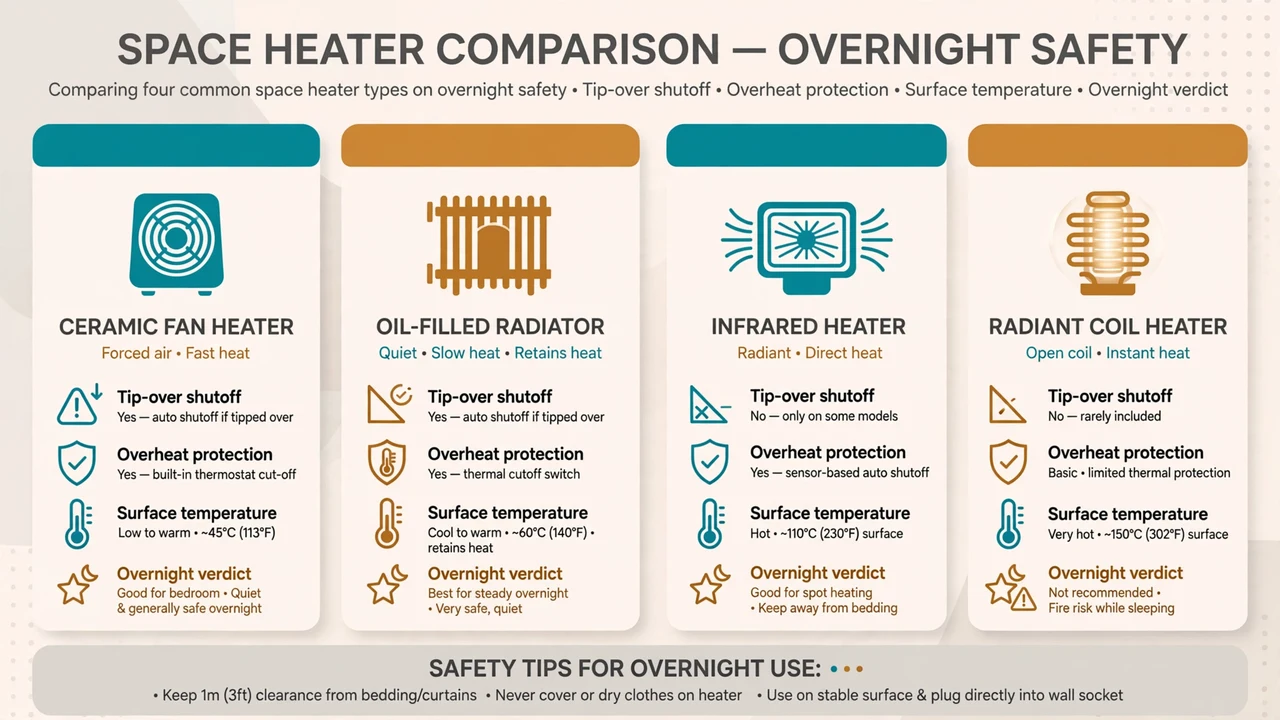
| Heater type | How it heats | Surface heat | Tip-over shutoff | Overnight verdict |
|---|---|---|---|---|
| Ceramic fan | Heated ceramic plates plus a fan | Hot grille, cools fast when off | Common on newer models | Off at bedtime. Good for warming the room before sleep. |
| Oil-filled radiator | Sealed oil heated by an element | Warm, not glowing. Stays warm after switch-off. | Common on newer models | Off at bedtime. Holds warmth longest after switch-off, which helps. |
| Infrared | Radiant heat aimed at people and objects | Hot element behind a guard | Varies by model | Off at bedtime. Keep bedding and clothes out of its path. |
| Radiant coil | Glowing exposed heating coils | Very hot, open element | Often missing on older models | Highest risk. Avoid in bedrooms. Never run overnight. |
Two notes on this table. First, safety features vary by model, so check your own heater rather than trusting the type alone. Look for a tip-over switch, overheat shutoff, and a mark from a testing lab such as UL or ETL on the label. Second, an oil-filled radiator is often the best pick for evening bedroom use because it keeps giving off warmth for a while after you switch it off. If you want a closer look at that type, read our guide on whether oil-filled heaters are safe to leave unattended.
To see how the heat gets from the element to the room, our explainer on how a space heater works walks through each type in plain terms. The short version is that every type turns electricity into heat, and every type can set nearby fabric alight if the clearance is wrong.
The 5 Risk Factors That Matter Most Overnight
Five factors decide how much risk a heater adds to a bedroom at night. You can control all five, and the checklist later in this guide covers each one in order. The table below sums them up so you can spot a weak link fast.
| Risk factor | Why it matters at night | What to do |
|---|---|---|
| Too close to bedding | Blankets and pillows move while you sleep | Keep 3 feet clear on all sides |
| Tip-over | A fall can press a hot face onto carpet or bedding | Hard, level floor. Tip-over shutoff. Out of walk paths. |
| Extension cord or power strip | Cords overheat out of sight for hours | Plug straight into a wall outlet only |
| Old or damaged heater | Worn cords and missing guards fail without warning | Check for recalls. Replace damaged units. |
| No working smoke alarm | A fire can grow before anyone wakes | Test alarms monthly. Replace dead batteries at once. |
Placement deserves a special note. A heater on carpet, on a bed, or on a wobbly table can tip or sink into soft fabric and trap heat. A heater near a door can block your way out. Put it on a hard, flat floor, away from foot traffic and away from the door, and the risk drops a lot before you even switch it on.
Your Safe Overnight Setup Checklist
The safest overnight plan is a warm room and a heater that is off. The seven steps below run in order, from picking the heater to switching it off at bedtime. Follow them each night and the routine becomes habit in a week.
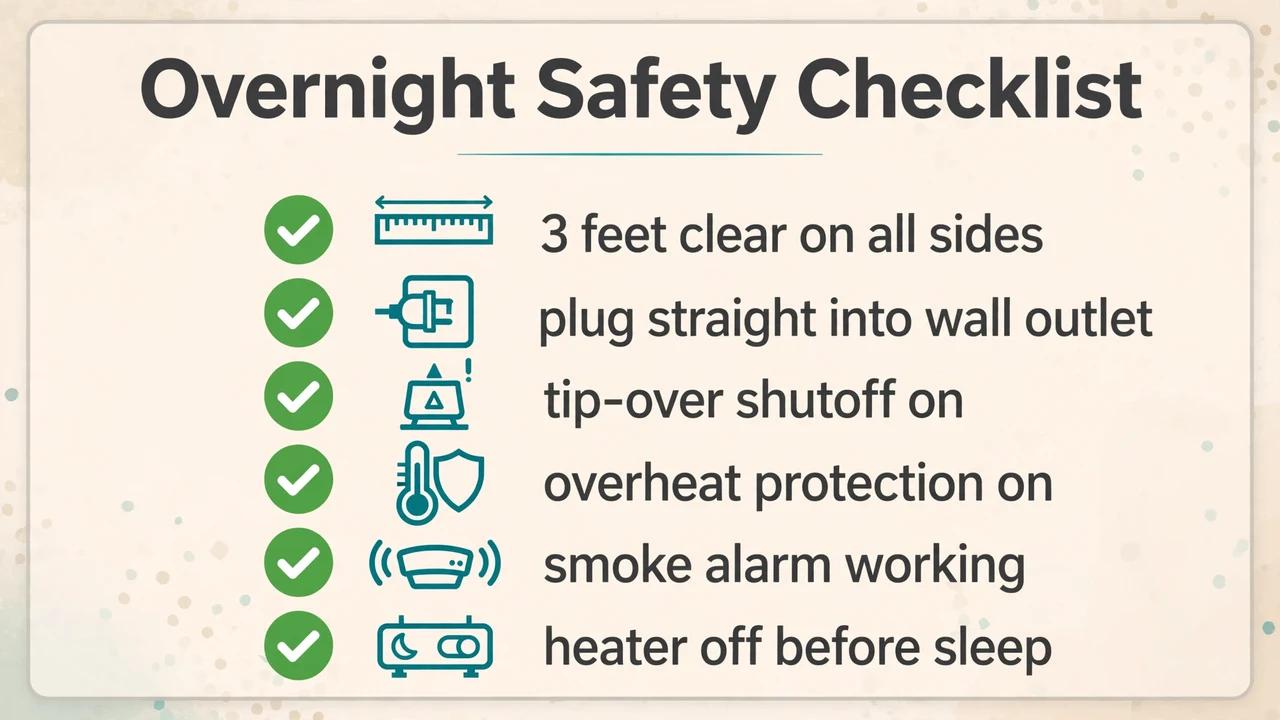
Safe overnight setup checklist
- Pick a heater with tip-over shutoff, overheat protection, and a UL or ETL mark
- Place it on a hard, level floor with 3 feet clear on every side
- Plug it straight into a wall outlet, never into a cord or strip
- Warm the room for 1 to 2 hours before bed
- Set the built-in timer so it switches off by bedtime
- Test the smoke alarm and keep the exit path clear
- Turn the heater off and unplug it before you fall asleep
Pick a Heater With Tip-Over Shutoff and Overheat Protection
Start with the heater itself, because no checklist can fix a bad unit. Look for three things on the box or label: a tip-over switch that cuts power if the heater falls, an overheat shutoff that cuts power if the inside gets too hot, and a mark from a testing lab such as UL or ETL. The CPSC advises buying a heater that carries the seal of a recognized testing laboratory.
Check the cord and plug before each winter. If the cord is frayed, cracked, or stiff, or the plug feels loose in the outlet, stop using the heater. Check the CPSC recall list at SaferProducts.gov to see whether your model has been recalled. An old heater with no safety features belongs in the recycling pile, not in a bedroom.
Place It on a Hard, Level Floor
Set the heater on a hard, flat floor where it cannot be knocked over. Tile, wood, or a flat hearth all work. Carpet, rugs, beds, and tables do not. A soft surface lets the heater sink, lean, or trap heat underneath, and a table puts it at face height for a child or a pet.
Keep it out of walk paths and away from the door. A heater in the middle of the route to the bathroom gets kicked in the dark. A heater near the door can block your way out if something goes wrong. Pick a quiet corner of the room with a clear path around it.
Clear 3 Feet on Every Side
Measure 3 feet from the front, sides, and back of the heater and keep that space empty. Beds, curtains, clothes, papers, laundry baskets, and pet beds all count as things that can burn. This is the single rule the CPSC, the NFPA, and the U.S. Fire Administration all repeat, and it is the one people break most often in a small bedroom.
Think about what moves at night. A blanket can slide off the bed and land within a foot of the heater. A curtain can billow when the heat rises. A drying rack can tip. Clear the full 3 feet before you switch the heater on, and check the space again at bedtime, when the room looks different from how it looked at dinner.
Pro tip: measure once, mark the spot
Use a tape measure once and put a small piece of painter tape on the floor 3 feet out from the heater on each side. The tape marks your clear zone, so anyone in the house can see where bedding and laundry must stay. Move the tape if you move the heater.
Plug It Straight Into the Wall
Plug the heater directly into a wall outlet. Never use an extension cord or a power strip, and never run the cord under a rug or carpet. Space heaters draw a lot of current, and a cord or strip not built for that load can overheat and start a fire. The CPSC states this rule plainly, and our guide on plugging a space heater into an extension cord or power strip explains the wiring reasons in full.
Use a tight-fitting outlet, and plug nothing else into the same outlet. If the plug feels warm after the heater has run for a while, or the outlet looks scorched or loose, switch the heater off and call a licensed electrician. A warm outlet is a warning sign, not a quirk to live with.
Warm the Room Before Bed, Then Let the Timer Switch It Off
Run the heater for 1 to 2 hours before bed with the bedroom door closed. That is enough to take the chill off the room and warm the bedding and walls. Close the curtains to hold the heat in, and put an extra blanket on the bed before you switch the heater on, so the bed is warm when you climb in.
Set the heater built-in timer so it switches off at bedtime, and treat the timer as a backup, not as permission to fall asleep with the heater running. Switch the heater off yourself when you get into bed. If your heater has no timer, set a phone alarm for bedtime and switch it off by hand. A right-size heater warms the room faster and needs less run time, so check our guide on what size space heater you need if your room takes too long to warm up.
Test the Smoke Alarm and Keep the Exit Clear
Press the test button on the bedroom smoke alarm each month and replace the battery at once if the sound is weak or missing. A smoke alarm only helps if it works, and a bedroom with a heater in it needs one that works. If your home has fuel-burning heat as well, keep a working carbon monoxide alarm near the sleeping area and test it the same way.
Walk the path from the bed to the door in the dark, or picture it with your eyes closed. The path must be clear of cords, shoes, laundry, and furniture. A heater cord across the walk path is a trip risk at night and a fire risk if it gets pinched or damaged. Run the cord along the wall, away from feet.
Turn It Off Before You Fall Asleep
This is the step the whole guide builds toward. When you get into bed, reach over and switch the heater off. Unplug it as well, as the NFPA advises. The room will hold its warmth for a while, and the blankets will do the rest. An oil-filled radiator keeps giving off warmth for some time after switch-off, which is one more reason it suits a bedroom.
If you wake up cold at 3 a.m., do not switch the heater back on and drift off again. Pull on a warm layer, add a blanket, and wait until morning. The cold will pass. The risk of a heater running while you sleep does not.
What to Do Instead of Running a Heater All Night
Turning the heater off does not mean shivering until morning. A few changes to the room and the bed keep you warm for far less risk, and most of them cost little or nothing.
Start with the bed itself. Flannel sheets, a thick duvet, and a warm pair of socks do more than most people expect. A hot water bottle or a microwave heat pack warms the bed before you climb in, and a heated mattress pad or electric blanket made for overnight use is built for sleeping, unlike a space heater. Follow the maker instructions for any heated bedding, and replace it if the cord or fabric is damaged.
Next, look at the room. Draft stoppers under the door, heavy curtains over the windows, and a rug on a cold floor all cut heat loss. Close the bedroom door while the heater runs in the evening so the warmth stays in the room. If the whole house runs cold at night, check the central heat settings before adding a space heater to the bedroom.
Some readers compare heaters with other heat sources for the bedroom. If you are weighing the options, our comparison of whether electric fireplaces are safer than space heaters covers the differences, including the fact that a fixed electric fireplace is not a portable heater running on the floor. For running costs, see which space heaters use the least electricity, since a heater that runs all night also runs up the power bill.
Troubleshooting: If This Happens, Try This
Most heater problems have a safe, plain fix. The table below covers the ones that show up most in bedrooms. If a problem keeps coming back, stop using the heater and call a licensed electrician or the maker.
| If this happens | Try this |
|---|---|
| The room stays cold after an hour | Close the door and curtains. Check the heater size for the room. Look for drafts around windows. |
| The heater keeps shutting off | Clear the vents and the 3-foot zone. Check that the thermostat is set above room temperature. If it still cuts out, stop using it and call the maker. |
| The plug or outlet feels warm | Switch the heater off and unplug it. Do not use that outlet again until a licensed electrician has checked it. |
| You smell burning or see sparks | Switch it off and unplug it if it is safe to do so. Leave the room if smoke builds. Call emergency services if there is fire or heavy smoke. |
| The heater tips over often | Move it to a hard, level floor away from walk paths, pets, and children. Replace it if the tip-over switch does not cut power. |
| The breaker trips when the heater runs | Unplug other items on the same circuit. Do not keep resetting the breaker. Call a licensed electrician. |
Myths vs Facts
A lot of folk wisdom about space heaters sounds reassuring and is wrong. Here is the short version of the claims you will hear most.
Myth: A heater with tip-over shutoff is safe to run all night. Fact: The shutoff is a backup for a fault, not permission to sleep with the heater on. The CPSC still says to turn heaters off when sleeping.
Myth: Oil-filled radiators are safe overnight because they have no open flame. Fact: They run cooler and hold heat well, but they are still high-wattage heaters, and the same 3-foot rule and switch-off rule apply. See our guide on oil-filled heaters left unattended for the details.
Myth: A low setting is safe for all-night use. Fact: A low setting lowers the heat output, but the heater still draws power, still has a hot surface, and still sits near bedding for hours with no one watching.
Myth: A heavy-duty extension cord is fine for one night. Fact: The CPSC says never to power a heater with an extension cord or power strip, whatever the cord rating. Plug straight into the wall.
Frequently Asked Questions
Frequently asked questions
Are space heaters safe to leave on overnight?
No. The CPSC says to turn heaters off when sleeping and never to leave a portable heater running while unattended. The NFPA and the U.S. Fire Administration give the same advice. Warm the room before bed, then switch the heater off.
Can I leave a space heater on low overnight?
No. A low setting still leaves a hot surface and a powered cord near bedding for hours while you sleep. The safety agencies make no exception for low heat. Use extra blankets or heated bedding made for overnight use instead.
Is an oil-filled radiator safe to leave on overnight?
No. Oil-filled radiators run cooler and hold heat after switch-off, which makes them a good pick for warming a room before bed, but the same rule applies: switch it off before you fall asleep and keep 3 feet clear on all sides.
Can I use a timer so the heater turns off after I fall asleep?
A built-in timer is a useful backup, but it is not a safe plan on its own. Set the timer to switch the heater off by bedtime, and switch it off yourself when you get into bed. Do not use an external plug-in timer to run a heater while you sleep.
How far should a space heater be from a bed?
Keep at least 3 feet between the heater and the bed, on every side. The same 3-foot rule covers curtains, clothes, papers, and furniture. Measure it once and mark the clear zone so bedding stays out of it.
What should I do if my space heater smells like burning?
Switch it off and unplug it if it is safe to do so, and stop using it. If smoke builds or you see flames, leave the room and call emergency services. Do not keep using a heater that smells of burning.
Quick reference card: space heaters overnight
Rule: Turn the heater off before you sleep. Warm the room first, then switch off.
Clearance: 3 feet on every side, on a hard, level floor, away from doors and walk paths.
Power: Wall outlet only. No extension cords, no power strips, no cords under rugs.
Features: Tip-over shutoff, overheat protection, UL or ETL mark.
Before bed: Heat 1 to 2 hours, set the timer, test the smoke alarm, clear the exit path.
Instead: Extra blankets, heated bedding made for sleep, draft stoppers, heavy curtains.
The Bottom Line on Leaving a Space Heater On Overnight
Are space heaters safe to leave on overnight? No, and the answer does not change with a newer model, a lower setting, or a heavy-duty cord. The CPSC, the NFPA, and the U.S. Fire Administration all say the same thing: switch the heater off when you go to sleep.
The good news is that you do not need an all-night heater to sleep warm. Heat the room for an hour or two before bed, switch the heater off when you climb in, and let blankets and bedding hold the warmth. That routine keeps the room warm and the risk low, night after night.
If your bedroom stays cold even with the evening warm-up, look at drafts, curtains, and heater size before you reach for an overnight run. And if your heater is old, damaged, or missing safety features, replace it with a newer model that carries tip-over shutoff, overheat protection, and a UL or ETL mark. Your sleep will be warmer, and far safer, for it.
Sources
U.S. Consumer Product Safety Commission, “Keep Warm and Safe This Winter: Tips for Using Generators, Furnaces and Space Heaters,” Release 26-217, January 23, 2026: cpsc.gov. National Fire Protection Association, home heating safety guidance. U.S. Fire Administration, heating fire safety guidance.