How Does a Ventless Propane Heater Work? The Complete Breakdown
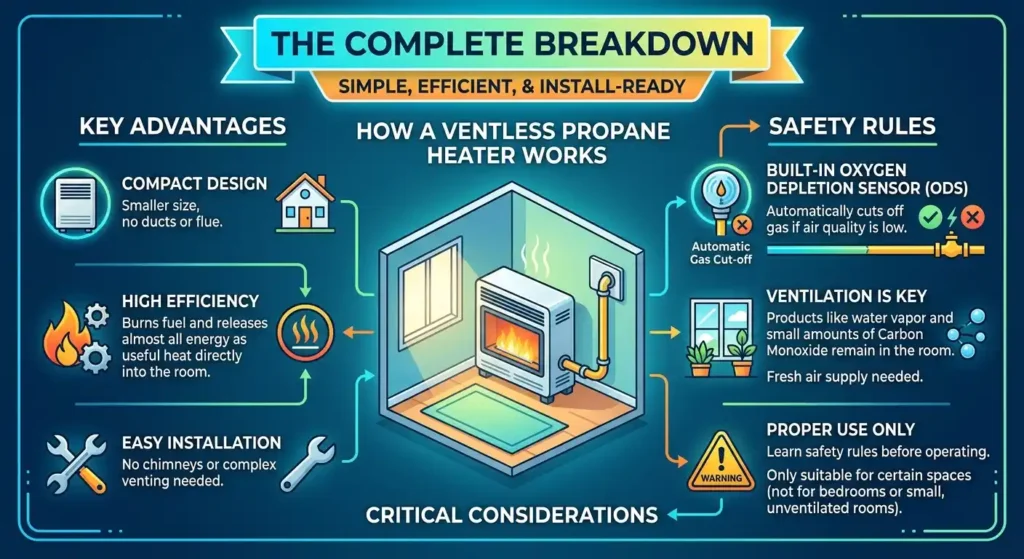
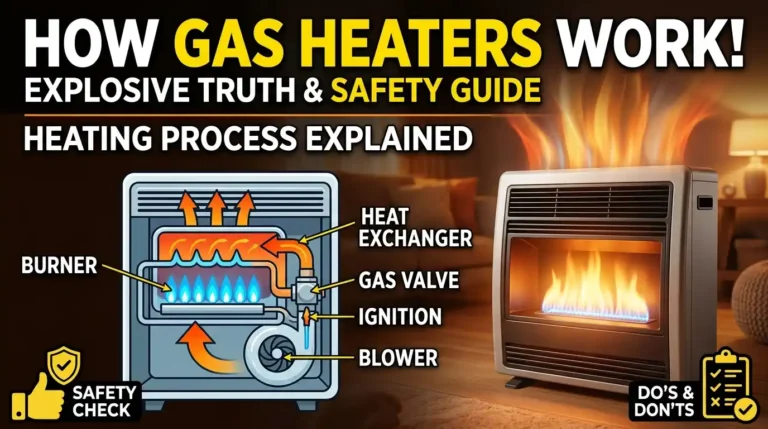
A ventless propane heater burns fuel and the heat is then released into the room without a chimney, duct or flue taking anything away. It is that one design choice that makes these heaters small, efficient, and simple to install, and it is also what makes them come with a set of safety rules that you must learn before you can use one. If you want the broader picture first, our breakdown of gas-fired heating appliances covers the parts and process that ventless models share with their vented cousins.
Here is precisely how they operate, what the safety features actually accomplish and when a ventless heater is (or is not) the correct choice.
Important point to note: A ventless propane heater burns propane in the living room, turns nearly all of the energy in the fuel into useful heat, and uses an inbuilt oxygen depletion sensor (ODS) to automatically cut off the gas in the event of too low air quality. Since there is no flue, all the products of combustion, such as water vapor, and small quantities of carbon monoxide, remain in the room until you supply fresh air.
What is a Ventless Propane Heater?
A ventless propane heater (sometimes known as a vent-free or unvented heater) is a gas appliance that burns liquid propane and vents 99 to 100 percent of the resulting heat into the room in which it is located. In contrast, vented heaters exhaust some of the combustion gases externally through a pipe or chimney which also removes some heat along with it.
Since nothing is wasted up a flue, ventless heaters are claimed to be nearly 99.9 percent efficient on paper. That figure refers to fuel-to-heat conversion, rather than indoor air quality, which is a significant difference that we will revisit.
How Does a Ventless Propane Heater Work?, Step by Step
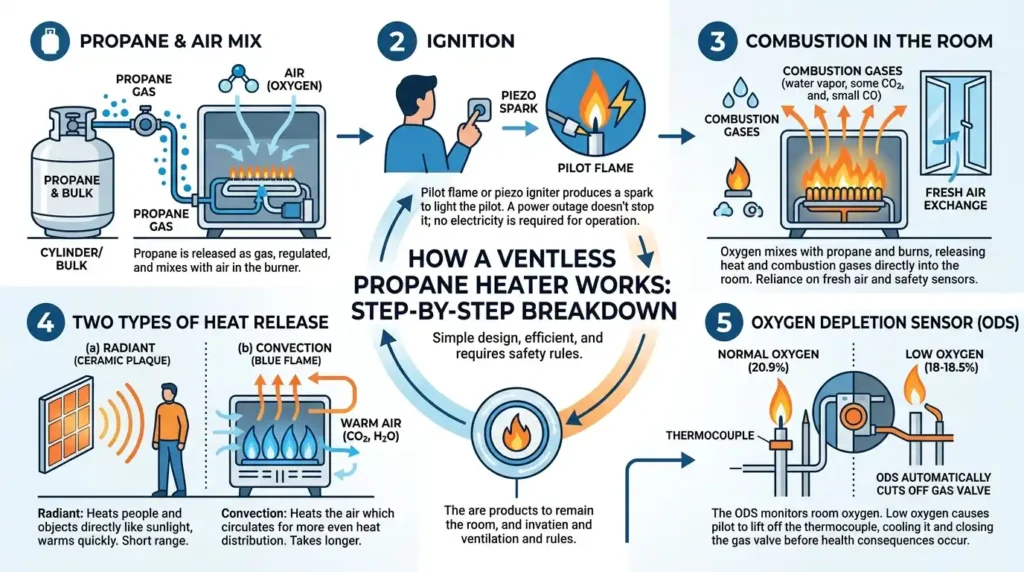
Step 1: Propane Is Released and Mixed with Air
Propane is kept in a compressed liquid in a cylinder or attached to a bigger bulk tank. As you open the valve, it gets out as a gas and passes through a regulator that regulates the pressure and then flows into the burner assembly of the heater, where it combines with the oxygen already in the air of the room.
Step 2: Ignition Through the Pilot Light or Piezo Igniter
The majority of ventless propane heaters are equipped with a standing pilot light or piezo spark igniter (the same click-to-spark system as gas grills). The igniter is pressed to produce a spark that ignites a small pilot flame. The pilot flame remains lit and when you switch the main control knob, it lights the main burner.
This is the reason also that ventless propane heaters continue to operate in case of a power outage: a standing-pilot ventless heater requires no household electricity to operate, unlike a furnace with an electric igniter and blower.
Step 3: Combustion Happens Right in the Room
After lighting the burner, the oxygen in the room is mixed with propane and burned to produce heat, light, carbon dioxide, water vapor and a small amount of carbon monoxide. Those combustion gases would be removed through a flue in a vented appliance. They remain in the room in a ventless heater, and that is the reason why the design relies so much on its safety sensors and on you to bring in a little fresh air exchange.
Step 4: The Heat Is Released Two Ways: Radiant or Convection
Ventless heaters introduce heat into the room in either of two primary manners:
- Radiant heat: A ceramic plaque or metal grille heats and radiates infrared heat to people and objects directly in its path, much like the sunlight heats your skin before it heats the air. This warms the occupants in a short time but does not reach all parts of a room.
- Convection (blue flame) heat: Air circulates past a burner and a heat exchanger, gets heated and ascends, drawing in cooler air behind it to form a natural circulation loop. This distributes heat more evenly within a room but it takes slightly longer to feel.
Step 5: The Oxygen Depletion Sensor Constantly Monitors the Air
All ANSI-certified ventless heaters sold in the U.S. since 1980 have an oxygen depletion sensor (ODS). The ODS is a miniature pilot unit which is placed in such a way that the shape of the flame varies with the decrease in the oxygen concentration in the room.
Oxygen occupies an average of 20.9 percent in normal air. When it drops, about 18 to 18.5 percent, the pilot flame is pushed off a thermocouple. The thermocouple cools and this automatically closes the gas valve and turns the pilot and burner off automatically without the need to press a button.
That limit is set far higher than the level that would lead to observable health consequences due to low oxygen alone. The actual idea behind the ODS is to intercept a room that is becoming too airtight, before the accumulation of other combustion gases becomes an even greater issue than the oxygen concentration itself.
Blue Flame vs. Infrared Ventless Heaters: What’s the Difference?
| Feature | Blue Flame (Convection) | Infrared (Radiant) |
|---|---|---|
| How it heats | Warms the air, which circulates | Warms people and objects directly |
| Best for | Enclosed rooms, whole-room warmth | Open or drafty spaces, garages, workshops |
| Speed of warmth | Slower, more even | Feels warm almost instantly |
| Humidity feel | Can feel slightly more humid | Feels drier since air itself heats less |
| Typical placement | Wall-mounted in living areas | Floor or wall units in larger, draftier spaces |
Ventless vs. Vented (Direct Vent) Propane Heaters
The difference in essence lies in the disposal of the byproducts of combustion.
A direct vent (vented) heater receives combustion air externally via a closed pipe and forces exhaust gases out via the same (or a similar) pipe. There is nothing in the combustion process that contributes to your indoor air. Direct vent units are the safer long-term option in spaces you spend many hours a day in, and many building codes mandate that because of that reason.
A ventless heater does not use that pipe, and instead burns room air and emits the exhaust into the same room. That is what makes it possible to install it easily and cheaply without penetrating the wall, yet it also implies that moisture, carbon dioxide, and trace carbon monoxide will remain inside the house.
Comparison Table: Ventless vs. Vented
| Factor | Ventless Propane Heater | Vented (Direct Vent) Propane Heater |
|---|---|---|
| Installation | No wall/roof penetration needed | Requires a vent pipe through a wall or roof |
| Upfront cost | Lower | Higher (venting materials + labor) |
| Fuel efficiency | Near 99.9% (nothing lost to a flue) | Typically 80-90%, some heat exits with exhaust |
| Indoor air impact | Adds moisture, CO2, trace CO to the room | Byproducts vented outside, minimal indoor impact |
| Best use case | Occasional or supplemental heat, well-ventilated rooms | Primary, continuous, or bedroom/overnight heating |
| Code restrictions | Banned or limited in several states and in bedrooms in many codes | Generally allowed with proper permitting |
| Power outage use | Usually works without electricity | Often needs power for blower/igniter |
What Comes Out of a Ventless Propane Heater? (Combustion Byproducts)
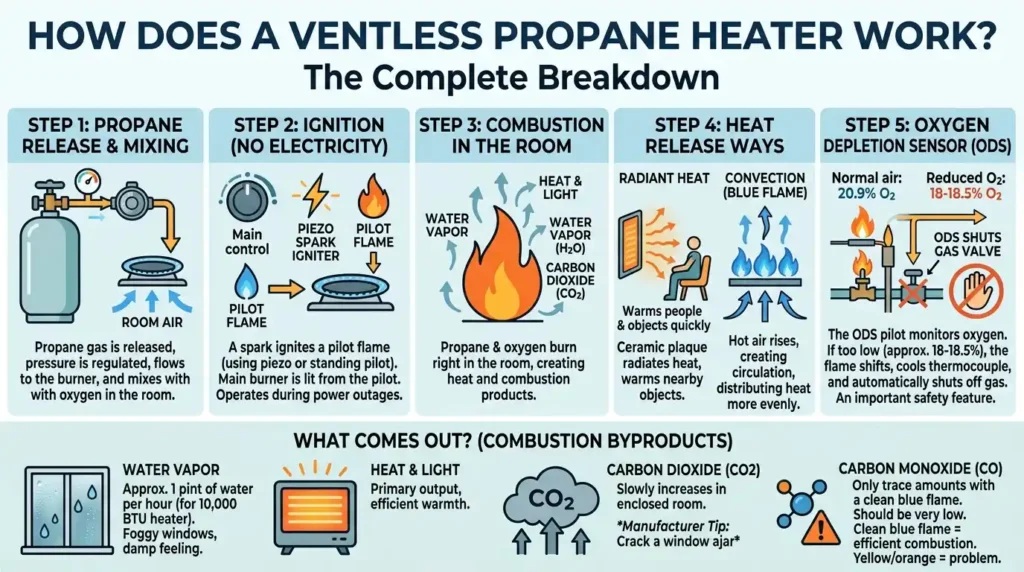
The chemical reaction of propane is simple: propane and oxygen give heat, carbon dioxide, and water vapor and trace levels of carbon monoxide when the combustion is not so clean. None of that is peculiar to propane. It’s true of every fuel-burning appliance, including a gas stove, a wood fireplace, or even a liquid-fuel heating unit like an oil burner. The distinction between a ventless heater and these is that these byproducts have no place to escape but in your room.
Quick facts:
- A well-adjusted ventless heater with about 10,000 BTU per hour of power output yields approximately a pint of water vapor each hour.
- It is that dampness that causes the windows to fog up and that makes fabric around a running ventless heater a little bit damp in cold weather.
- The amount of carbon dioxide increases slowly in an enclosed room, which is one of the reasons why manufacturers and fire officials suggest cracking a window ajar when using it over long periods of time.
- Trace carbon monoxide is normal in any combustion process, but must remain at very low background levels when the heater is in proper condition and the flame is burning a clean blue color instead of yellow or orange.
Is a Ventless Propane Heater Safe? What the Safety Features Actually Do
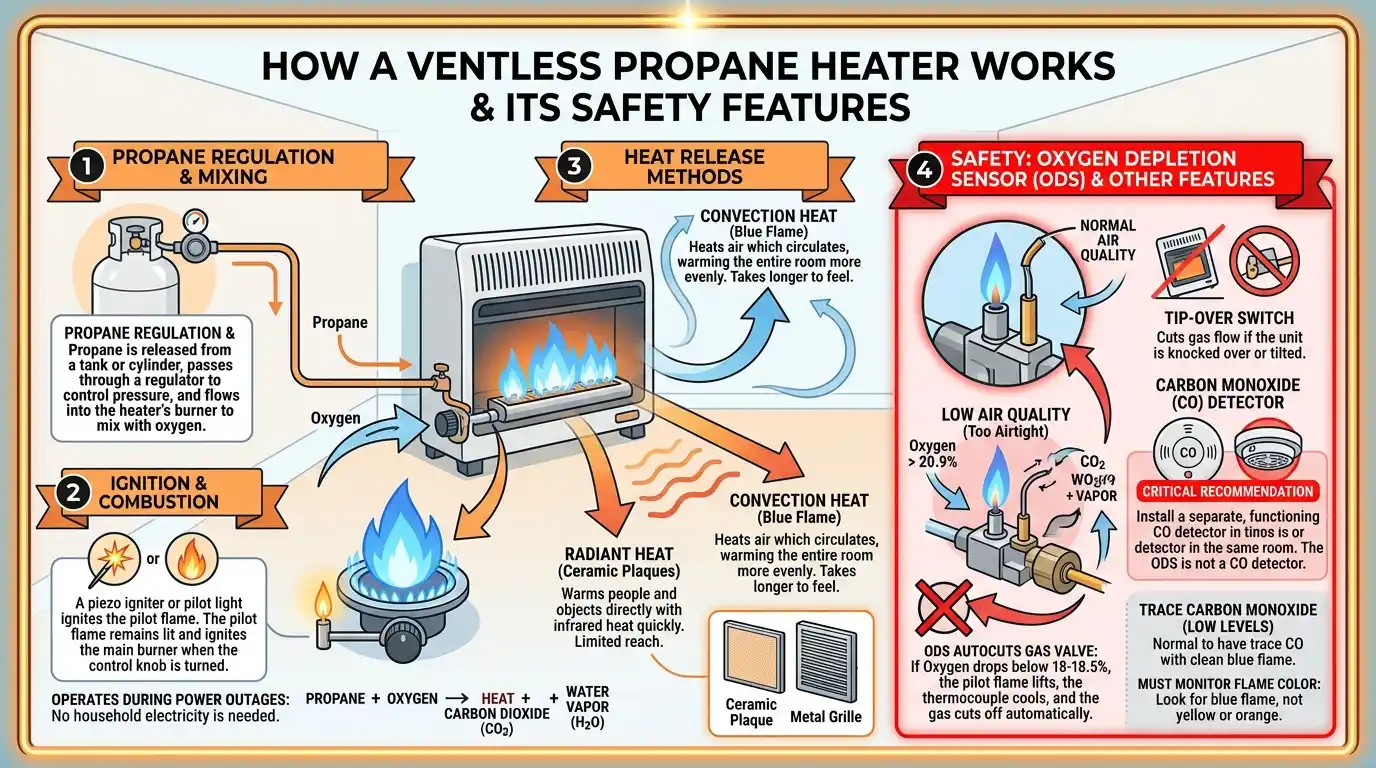
Ventless heaters are legal, ANSI-certified equipment and manufacturers cite a good safety record when they are properly installed and operated. Safe here is safe when you do as you are told, and not safe to run about in an airtight room forever.
Oxygen Depletion Sensor (ODS)
The ODS, as described in the above paragraphs, automatically switches off the heater when the oxygen concentration in the room decreases to about 18 to 18.5 percent. It is an engineered article of engineering, but it should be remembered that its actual limitation is that an ODS responds to the falling oxygen, not to carbon monoxide itself. In the very largest majority of practical applications the two things tend to move together, but the ODS is not, in itself, a carbon monoxide detector.
Tip-Over Switch
The majority of portable ventless heaters have a tip-over switch that shuts off gas flow the moment the unit is knocked over or tilted beyond a specific angle. This helps to avoid a burning flame or hot surface further burning against a floor or fabric.
Why You Still Need a Carbon Monoxide Detector
Since an ODS is not a carbon monoxide sensor, all fire safety agencies and all major manufacturers of heaters suggest that a separate, functioning carbon monoxide alarm be installed in any room in which a ventless heater is in use, and that a simple smoke detector be installed. This is not a recommendation, it is the one and the most important safety measure you can undertake other than just owning a heater with an ODS.
Where Are Ventless Propane Heaters Legal? (Codes and Restrictions)
Different states and even cities have different rules, and therefore, before installing or using one, it is always best to check the local requirements. There are several patterns that appear to be common in U.S. building and fire codes:
- A number of states, such as California, Massachusetts, and Alaska, severely limit or prohibit unvented gas heaters in homes.
- A number of local codes forbid the installation of a ventless heater in a bedroom or bathroom in particular, where whole-home operation is permitted, due to the lengthy, unmonitored exposure duration.
- All codes have a minimum room volume and a supply of combustion air, usually a slightly open window or a code approved air vent, on any ventless unit exceeding a set BTU rating.
- There are separate restrictions on unvented heaters on manufactured/mobile homes.
Due to this highly varying by jurisdiction, consult your local building department or fire marshal, and consult the specific installation manual to your model, before you install or run one. For a broader rundown of which appliances are approved for indoor use and which aren’t, see our guide to choosing an indoor-safe gas heater.
How to Size a Ventless Propane Heater for Your Space
Under-sizing causes a room to become cold; oversizing causes the heater to short cycle and pumps to add moisture and CO2 to the room at a rate that exceeds its ability to dissipate. An approximate starting point most manufacturers use:
| Room Size | Suggested BTU Output (moderate climate) |
|---|---|
| Up to 150 sq ft | 5,000-10,000 BTU |
| 150-400 sq ft | 10,000-20,000 BTU |
| 400-700 sq ft | 20,000-30,000 BTU |
| 700-1,000+ sq ft | 30,000 BTU (check local maximum limits) |
Lower temperatures, taller ceilings and rooms that are not well insulated all push you further up the scale. The majority of codes limit ventless heaters to 30,000 BTU in residential applications and therefore large areas generally require a vented system instead.
How Much Propane Does a Ventless Heater Use?
Propane holds about 91,500 BTU of energy per gallon. A 10,000 BTU per hour heater on its lowest setting uses approximately 0.11 gallons of propane per hour, or a typical 20 pound cylinder (approximately 4.7 gallons) will run that heater about 40 hours on low settings. Actual runtime drops with a higher thermostat setting, larger BTU output, cold outdoor temperatures, and elevation. Heating is just one job propane does around the house; see our rundown of everyday household propane applications if you’re weighing whether to add a whole-home tank.
Common Mistakes People Make with Ventless Propane Heaters
- Operating one in a room that is completely sealed and does not allow any fresh air exchange.
- As a main, all-night heat source in a bedroom, which many codes expressly forbid.
- Not having the annual check-up and allowing dust or pet-hair to settle on the burner or ODS.
- Not to notice a yellow flickering or sooty flame, an indication of incomplete combustion and increased carbon monoxide production; a normal flame burns a steady blue.
- Failure to install a specifically designed carbon monoxide alarm in the same room.
- Locating the heater too near curtains, bedding, or furniture in its heating field.
FAQs
What is an oxygen depletion sensor on a propane heater?
An oxygen depletion sensor (ODS) is a miniature pilot device that senses a decrease in oxygen levels in a room and closes the gas valve, usually when oxygen levels drop to approximately 18 to 18.5 percent, long before it becomes hazardous by itself.
Are ventless propane heaters a source of carbon monoxide?
Yes, in small quantities, like any appliance that burns fuels. A well-maintained heater with a clean blue flame has a very low carbon monoxide production and that is why a functional CO detector in the same room is imperative.
Is it possible to leave a ventless propane heater overnight?
The majority of manufacturers and many local codes recommend against unattended overnight operation, and some codes outright ban ventless heaters in bedrooms. Never do this without consulting the manual of the manufacturer and your local code.
Why does my propane heater without a vent keep turning off?
The most frequent reason is the oxygen depletion sensor is doing its job in a room that is too airtight. It is normally solved by cracking a window or door to allow fresh air to pass through. More frequent shutoffs can also be caused by dirty pilot assembly or heater that is operating on high elevation.
What is the amount of propane consumed per hour by a 20,000 BTU ventless heater?
A 20,000 BTU heater uses approximately 0.22 gallons of propane per hour at full blast, so a typical 20 pound cylinder of propane lasts about 20 hours of full blast use.
Is it legal to use ventless propane heaters in California?
The state of California has some of the strictest restrictions on unvented gas heaters in residential buildings compared to the majority of states. Check with your local building department before buying or installing one.
What is the frequency of servicing a ventless propane heater?
The majority of manufacturers suggest that an inspection should be conducted annually, prior to every heating season: the color of the flame, the removal of dust on the burner and ODS, and ensuring that the gas connections are tight and free of leaks.
Will a propane heater without a vent cause mold?
Yes, indirectly, when it is operated long without an exchange of air. Its water vapor may condense on cold windows and walls and prolonged moisture may over time lead to the development of mold.
Which is cheaper to install ventless or vented propane heater?
Ventless heaters are less expensive to install, because they do not require a vent pipe to penetrate the wall or roof. Vented heaters are more expensive initially but eliminate combustion byproducts in your home.
How big a room can a 30,000 BTU ventless heater serve?
The average insulated area of 700 to 1,000 square feet, but most jurisdictions limit ventless heaters to 30,000 BTU, and thus larger spaces would usually require a vented system instead.
Final Thoughts
The ventless propane heater is a very simple engineering device: propane combines with the air in the room, burns, and almost all that energy is emitted as heat, and an oxygen depletion sensor monitors the quality of the air constantly and automatically switches off the gas when something goes wrong. That is precisely what makes these heaters so popular as a supplemental heat source, cabin, garage and power outages.
The trade-off is equally easy to comprehend: all that the combustion generates, heat, moisture, carbon dioxide and trace carbon monoxide, remains in the room with you. Trade-off respectfully by selecting the appropriate size of your space, opening a window to get some air, putting in a carbon monoxide detector, and obeying your local code, and a ventless propane heater is a safe and effective appliance. Ignore it and you have one sensor that has to do all the work catching a problem that it was not well-designed to catch.
When you are choosing between a ventless and vented model to use in a room you will be spending hours in at a time, particularly a bedroom, then lean more towards a vented, direct-vent heater. Use the ventless option as a supplement, well-ventilated, or occasional use, which is just what it is best at.