Electric Fireplace Flame Is on But Not Working? Here is Why & How to Reduce it
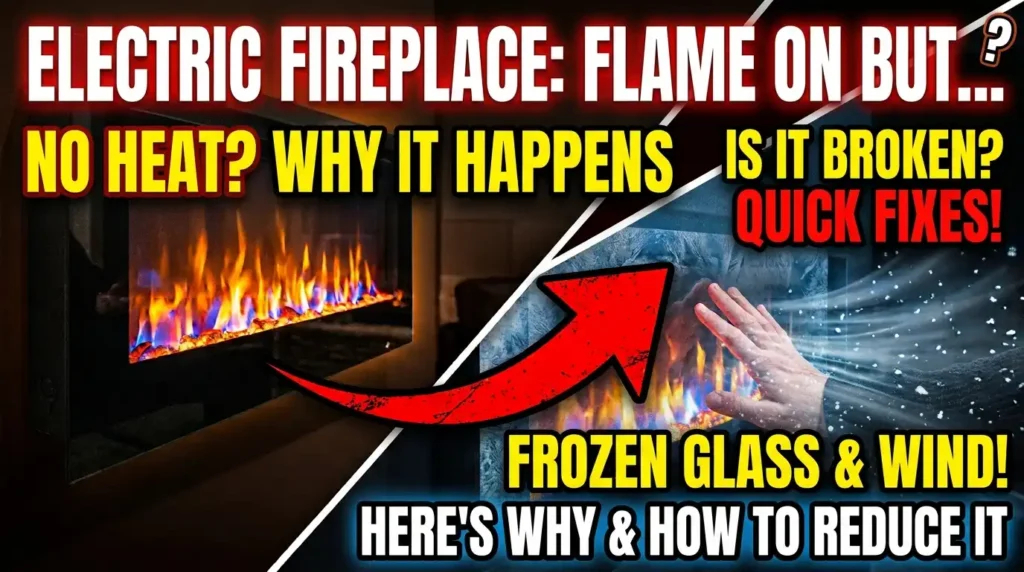
Electric Fireplace Flame Is on But Not Working? Quick answer: Electric fireplaces operate the flame effect and the heater as two independent units. In cases where the flame is operable, but no heat is emitted, it is nearly always the heat setting, a tripped breaker, a safety shut-off, plugged ventilation, or a broken-wearing blower motor or heating element, rather than the flame mechanism itself.
Why the Flame Effect and the Heater Are Two Separate Systems
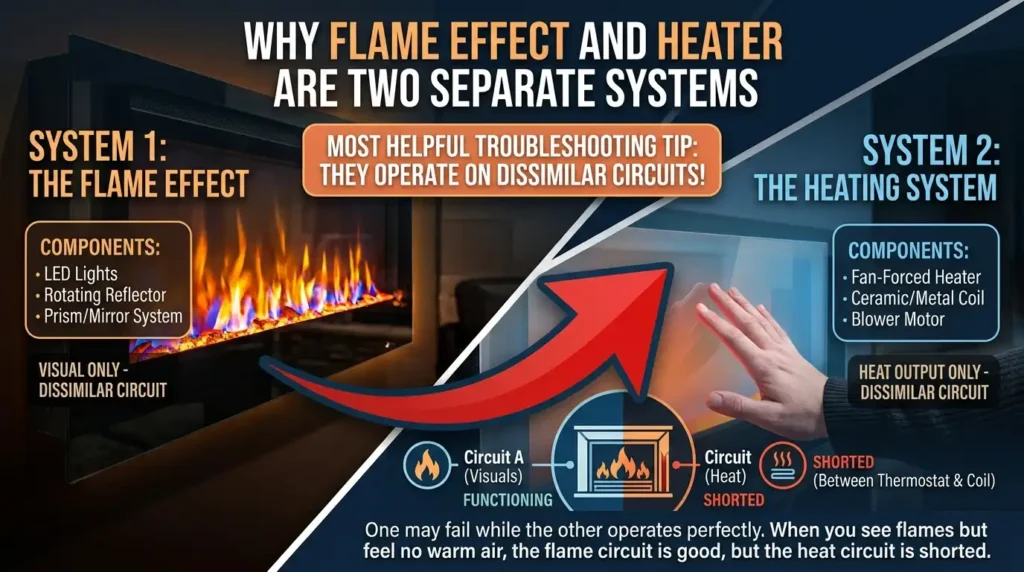
It is the most helpful thing you should know before you start to troubleshoot anything.
There are in fact two separate systems in an electric fireplace that just coincidentally have a single control panel:
- The flame effect system: LED lights, a rotating or oscillating reflector and occasionally a mist or mirror system to produce the visual effect of flames and embers.
- The heating system: A fan forced heating component (typically a ceramic or metal-coil heating component) combined with a blower motor that forces warm air out via a front or top vent.
The two systems are using dissimilar circuits within the unit and therefore one of them may fail completely as the other continues to operate with perfection. And that is what is going on when you look at the flames and touch no warm air, the circuit of the flame is good, but between the thermostat and the heating coil, the circuit of heat is shorted.
Electric Fireplace Flame Is on But Not Working? Symptom-to-Cause Quick Reference
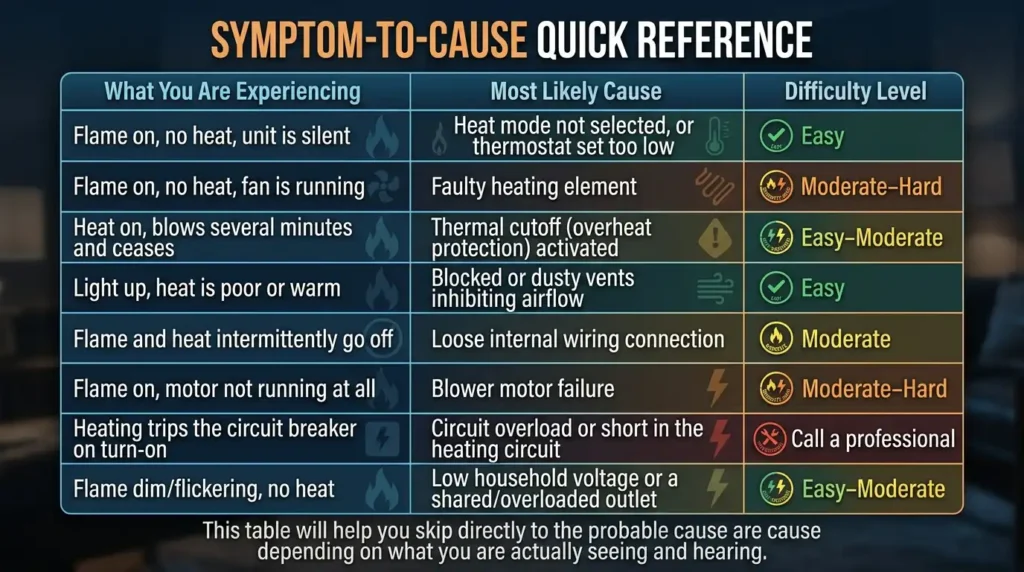
This table will help you skip directly to the probable cause depending on what you are actually seeing and hearing.
| What You Are Experiencing | Most Likely Cause | Difficulty Level |
| Flame on, no heat, unit is silent | Heat mode not selected, or thermostat set too low | Easy |
| Flame on, no heat, fan is running | Faulty heating element | Moderate–Hard |
| Heat on, blows several minutes and ceases | Thermal cutoff (overheat protection) activated | Easy–Moderate |
| Light up, heat is poor or warm | Blocked or dusty vents inhibiting airflow | Easy |
| Flame and heat intermittently go off | Loose internal wiring connection | Moderate |
| Flame on, motor not running at all | Blower motor failure | Moderate–Hard |
| Heating trips the circuit breaker on turn-on | Circuit overload or short in the heating circuit | Call a professional |
| Flame dim/flickering, no heat | Low household voltage or a shared/overloaded outlet | Easy–Moderate |
The 8 Real Reasons Your Electric Fireplace Flame Works but the Heat Doesn’t
1. The Unit Isn’t Actually Set to “Heat” Mode
This may seem like a given but it is the most frequent complaint people make about a broken heater. The majority of electric fireplaces include at least three options: flame, heat and flame or off. When your remote or control panel is programmed to burn flame only, or in ambiance mode, the flame will burn continuously with a zero heat output – not a defect, but to function.
How to Fix: Test the mode button on the unit and remote independently (they may become out of sync). Go through the settings and ensure that what is displayed is a heat or temperature icon, not a flame icon.
2. The Thermostat Is Set Too Low
When your thermostat is set lower than the room temperature (or in Fahrenheit when reading Celsius, and vice versa) the fireplace does not need to turn on the heater, the room is already heated, according to it.
How to Fix: Adjust the thermostat dial, or digital setting to the maximum and allow 3-5 minutes. Should the heat come on, set it back to a pleasant level. When nothing occurs after five minutes then proceed to the next cause.
3. A Physical Heat Switch Is Turned Off
Numerous inserts and mantel-style units include a separate rocker or toggle switch usually found to the side or back panel that switches off the heating element without involving the remote and thermostat. One can easily bump this switch when cleaning or moving furniture without noticing.
How to Fix: Make sure that you have followed your owner’s manual on the exact location of the switch and ensure that it has been flipped too full on. It is sometimes possible to release a stuck switch with a dry cotton swipe with caution.
4. A Tripped Breaker or Blown Fuse Is Limiting Power
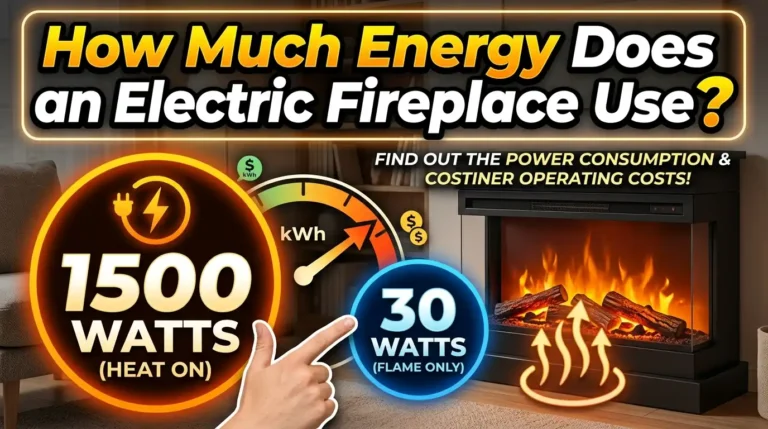
The electric fireplace heaters consume a lot more current than the flame-only LEDs- on the high heat option, they can be 1,500 watts. In case one or both of the breakers have partially tripped, or a fuse within the unit has blown, it is possible that there is just enough power getting to the flame circuit to continue running the lights as the higher-drawing heating circuit receives none of it.
How to Fix: Make sure that your home has a tripped switch in your breaker panel and that you reset it (off-on). In case your fireplace has its internal fuse (see the manual) check and replace it when it is blown. Check another power outlet as well, it is never safe to use an extension cord or power strip with an electric fireplace heater as they may not be able to handle the load.
5. The Overheat Protection (Thermal Cutoff) Has Triggered
Nearly all electric fireplaces have an inbuilt safety sensor that automatically cuts the heating element when the device becomes overheated typically due to blocked vents, a blanket or curtain in the room, or the fireplace is pushed too near a wall. Importantly, this safety feature normally just shuts the heater, and the flame effect continues to operate normally, which is precisely the symptom you are experiencing.
How to Fix: Turn fireplace off and unplug it thoroughly. Keep at least a few inches of open space around all vents. Allow this unit to cool, 20-30 minutes and re-insert the plug and re-test the heat setting.
6. Vents Are Blocked or Clogged With Dust
Limited airflow does not merely activate the safety cutoff above, it can merely suffocate just enough air flow that the heat you do experience is feeble, cool, or even nonexistent, without even a complete shutoff.
How to Fix: Use a soft brush attachment to suck the front grille and any intake vents that are visible. In case you feel comfortable enough to take off the back panel (always read the manual first) then carefully blow off dust using compressed air on the fan blades and the heating element.
7. The Blower Motor Has Failed
When the flame is on, and you can neither hear nor feel any fan movement whatever, the blower motor itself could be burned out or frozen. This usually occurs in older units or fireplaces which have been operating on long periods.
How to Fix: Be able to hear at the vent with the unit on the heat mode. Absence of airflow and the absence of fan sound are very strong indicators of a dead motor. This usually involves a new component ordered by the manufacturer, or a visit by a technician in case you are not sure of dismantling the housing.
8. The Heating Element Has Burned Out
When the fan is obviously operating (you can hear and feel airflow), but that air remains cold, then the heating coil itself has probably broken. Heating elements are wear and tear parts – the type of components that wear out as they become old and worn out, just as a light bulb.
How to Fix: It is not a fast DIY fix in the majority of instances. Before proceeding to open the unit, make sure that the unit is still in warranty as it can be canceled once the housing is opened. In the case that it is out of warranty, call the manufacturer to replace an element or book a technician.
Step-by-Step Troubleshooting Checklist Electric Fireplace Flame Is on But Not Working?
Go through these one at a time – each step requires a minute or two, and most flame-but-no-heat issues can be solved in the first four.
- Confirm mode: Ensure that Heat or Flame + Heat is turned on both on the unit and remote.
- Set the thermostat as high as possible and wait five minutes.
- Examine the physical heat switch: Check a separate on/off toggle, as per your manual.
- Check the breaker panel: Trip any breaker completely off, and back on.
- Test a direct wall outlet: No extension cords or power strips.
- Hard reset it: Turn off the unit by removing the plug and leaving it off at least 15-30 minutes.
- Clear the vents: Take out of the area any furniture, curtains, or debris within several inches of openings.
- Hear the fan: Turn off the fan, the motor will make a sound; Turn on the fan, cold air in the element will make a sound.
- Clear front grille dust visible dust.
- Nothing helps, quit: Repeated restarts without investigating the cause may be stressful on internal parts – proceed to professional level.
Flame Works, Motor Is Silent: What That Specific Combination Means
In the event that you have narrowed the problem to flame effect works perfectly, but the motor will not even turn, then you can eliminate the thermostat and heat-mode settings – they do not only turn on the fan, but the entire heating circuit. A working-flame-effect silent motor typically reduces to:
- The blower motor is physically broken (probably when you hear a slight humming sound but not turning, or not turning at all)
- A wiring connection feed to the motor has become loose, usually through vibration or by moving the unit.
- The overheat switch has been thrown and has not yet returned to the on position (allow the device at least 30 minutes to cool before concluding that it is the motor)
The motor being positioned in the rear of the flame mechanism in most models, installation is often an easy task of replacing it, often at the expense of the back panel, but before you do that, you need to confirm whether your warranty will cover the cost of a replacement or not, otherwise it could be costly.
Electric Fireplace Flame Is on But Not Working? DIY Fix vs. Calling a Professional
| Situation | Recommended Approach |
| Wrong mode, low thermostat, blocked vents, broken breaker | DIY – no tools required |
| Still under warranty of the unit | Opening the housing is not allowed |
| Fan operates but no air (element issue) | Replacement element by the manufacturer, or a technician |
| Silent fan (motor problem) | Technician, but then you must be familiar with some basic electronics servicing |
| Breaker trips each time heat is turned on | Licensed electrician – this may signify a short |
| Smell of burning, sparking or visible scorch marks | Cease use and seek professional assistance |
Safety Notes Worth Repeating
- Never disconnect the unit without first dismounting any panel or coming close to the heating part.
- Do not use an electric fireplace heater on an extension cord or power strip.
- When you smell burning plastic, you can see scorch marks, or see sparking, then cease using the unit, and have it checked out before you plug it in again – do not attempt a home repair on possible wiring damage.
- Maintain at least the recommended clearance (usually a few feet, check your manual) around all vents.
Myth vs Fact
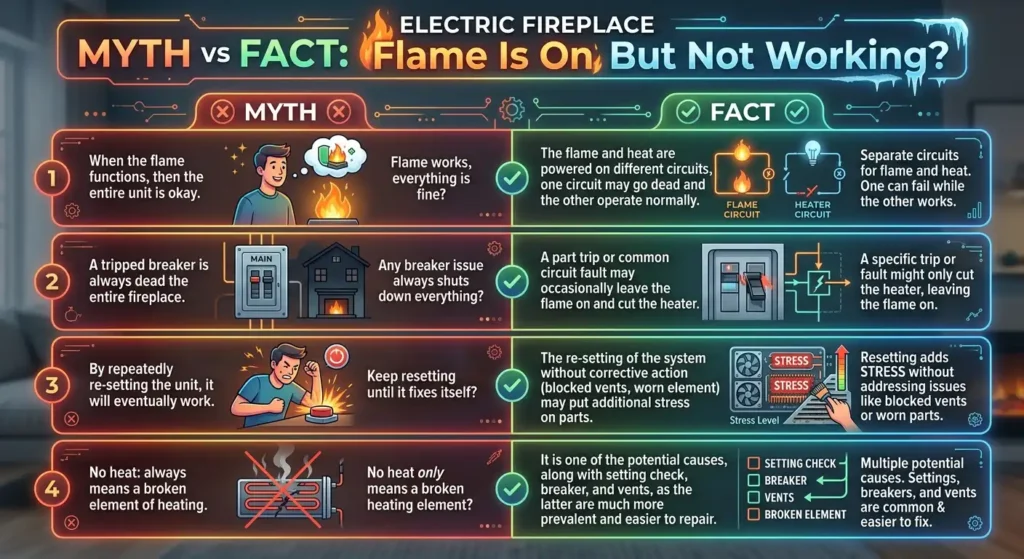
Electric Fireplace Flame Is on But Not Working?
| Myth | Fact |
| When the flame functions, then the entire unit is okay. | The flame and heat are powered on different circuits, one circuit may go dead and the other operate normally. |
| A tripped breaker is always dead the entire fireplace. | A part trip or common circuit fault may occasionally leave the flame on and cut the heater. |
| By repeatedly re-setting the unit, it will eventually work. | The re-setting of the system without corrective action (blocked vents, worn element) may put additional stress on parts. |
| No heat: always means a broken element of heating. | It is one of the potential causes, along with setting check, breaker, and vents, as the latter are much more prevalent and easier to repair. |
Preventing This From Happening Again
- Have all the front vents and grilles vacuumed once in a few weeks or more frequently when you have pets or in a dusty environment.
- Always maintain a minimum of several inches of empty space around all vents, at all times – do not move furniture, curtains or decor up against the unit.
- Do not keep the heater on during very long periods of time; provide the unit with some breaks, particularly older models.
- Directly connect to a wall outlet with the correct wattage of the unit, never a common power strip.
- Remember to keep the manual (or a photo of the model number) somewhere convenient, so that next time you need to troubleshoot a particular switch and error code, it will be quicker.
Key Takeaways
Electric Fireplace Flame Is on But Not Working? Here are the following points
- Flame and heat are distinct systems – a burning flame does not imply that the entire unit is in good health, and a heater that is dead does not imply that the entire unit requires replacement.
- Begin with the free, instant checks: heat mode, thermostat, physical switch, and breaker panel.
- A fan which operates using cold air is directed at the heating element; a fan which does not operate at all is directed at the motor.
- Safety feature: overheat protection is not a malfunction – clear the vents and allow it to cool before thinking anything is wrong.
- Doubtful, consult your warranty and do not open the unit and not afraid to call a professional in case you smell burning or see a tripped breaker each time you turn on the heat.
You May Also Read:
FAQs:
Why does my electric fireplace light not turn off but not heat?
This is nearly always an indication of a problem with the heat setting, thermostat or heat circuit rather than the flame mechanism. Check by confirming that the thermostat is indeed on heat mode, then the thermostat and breaker panel.
Is it possible to turn an electric fireplace on with no heat deliberately?
Yes, A majority of the units have a special, so-called flame only or ambiance mode, which keeps the visual effect on but disables the heater, which can be handy during warm seasons.
My electric fireplace heater will stop heating after a few minutes, why?
This trend indicates the overheat protection cutoff which switches heater off automatically when internal temperatures become excessively high, usually because of blocked vents. Allow to cool and remove any blockages and restart.
Is it expected that an electric fireplace blows cold air when it has a flame on?
No, when the fan is on, but the air is cold instead of cool, it is generally a sign that the heating element is broken and should be replaced.
What do I do to tell whether it is the blower motor or the heating element?
Listen at the vent. There is no movement or sound of a fan indicating the motor. An operating fan expelling cold air directs to the heating component.
Will turning off my electric fireplace resolve a heat-no problem?
Sometimes. Complete 1530 minute break will give the internal thermal cutoff time to reset and clear most temporary faults but will not cure a truly burnt-out element or motor.
Is it possible to use an extension cord with an electric fireplace heater?
It’s not recommended. Fireplace heaters consume lots of power and most of the extension cords and power strips have not been designed to handle that level of power safely which may cause breakers to trip or activate safety shutoffs.
Are heating components of electric fireplaces worn out with time?
Yes, as most heating components they are a consumable component, which wears out over time and usage, and must eventually be replaced, just as a light bulb must eventually expire.
Is it safe to continue using a flame electric fireplace but no heat?
Yes, usually, because the heater just is not turning on, but discontinue use at once when you can smell burning or see any scorch marks or sparking and a breaker that keeps on tripping.
Otherwise, will cleaning the vents really restore the heat?
Yes. Obstructed or clogged vents inhibit airflow that may reduce the strength of the heat production or activate the overheat safety cutoff completely, and thus, frequent cleaning is among the most practical preventive measures.