Can you have Two fireplaces on one chimney? This is What Really Works.
Can you have Two fireplaces on one chimney?
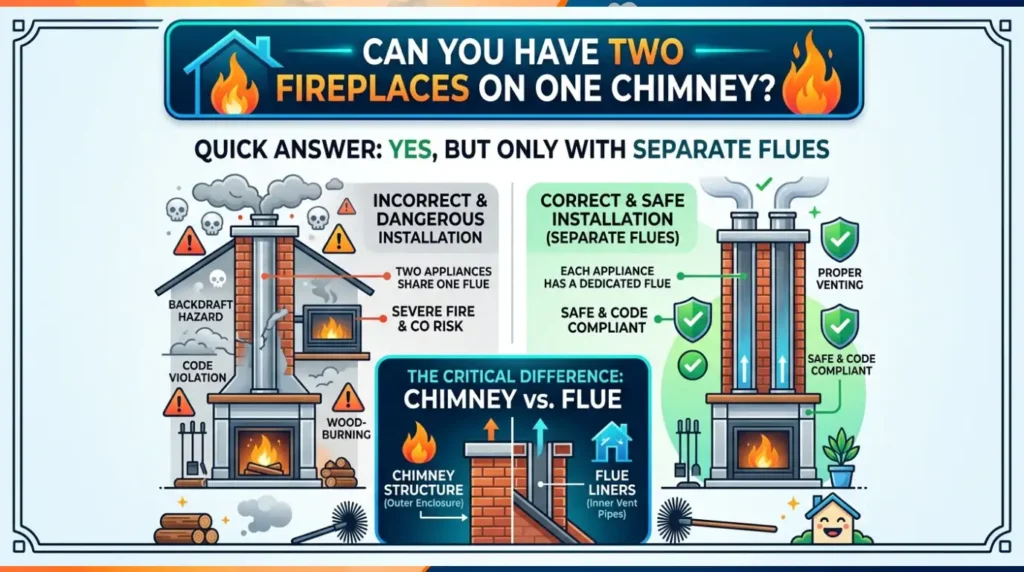
Can you have Two fireplaces on one chimney? Quick Answer: Yes, first, as you have come to ask, because that is what you are going to ask: yes, there is such a thing as a common chimney structure to two fireplaces, but only in the case that the two fireplaces are to be vented by separate flues. The difference between a code-compliant installation and a severe fire and carbon monoxide hazard is that single difference chimney versus flue.
You may be looking at an old farmhouse with a fat center chimney to serve two rooms, or you may be dreaming about adding a fireplace to a second living space without constructing a complete chimney, so this guide takes you through the specifics of how shared chimneys work, what the building code actually says, what the building code costs, and when you should say to yourself, hire a mason and do not do anything at all.
Key Takeaways
- There may be as many as two or more appliances in a single chimney (the outer masonry or metal structure) that may legally be considered a separate flue.
Two fireplaces can by no means have one flue together. Each has its passage required between firebox and the top of the chimney. - Chapter 10 of the International Residential Code (IRC) provides that there must be at least a minimum of 4-inch masonry wythe between adjoining flue liners, with the joints of the liners spaced at least 4 inches apart.
- It is permissible to have a mixture of fuel types (wood and gas) in the same chimney structure, but not in the same flue.
- Expect 3,000 -12,000+ to incorporate a second flue-and-fireplace system into a pre-existing chimney, based on materials and accessibility.
- Before mixing or adding fireplaces on a common chimney, have a Level 2 chimney inspection done and a local permit review.
Chimney vs. Flue: The Distinction That Answers Everything
The misunderstanding surrounding this subject is all reduced to a confused couple of words.
The whole building, the brick, block or metal chase that extends down through the house, is called a chimney. Imagine it to be the building.
The real canal within that construction that takes smoke and combustion gases out is called a flue. Imagine it is the hallway within the building.
Flues may be side by side or stacked, with one chimney serving a number of appliances. That’s the entire concept behind two fireplaces “sharing” a chimney: they’re sharing the outer structure and the footprint, not the airway.
Quick fact: The chimney stacks in the UK and elsewhere in Europe often accommodate four, six or more flues, each serving different rooms and different floors, and all of which end in their own “pot” in the top. This idea is not that unusual, but is less prevalent in typical U.S. single-flue residential construction.
So, Can You Actually Install Two Fireplaces on One Chimney?
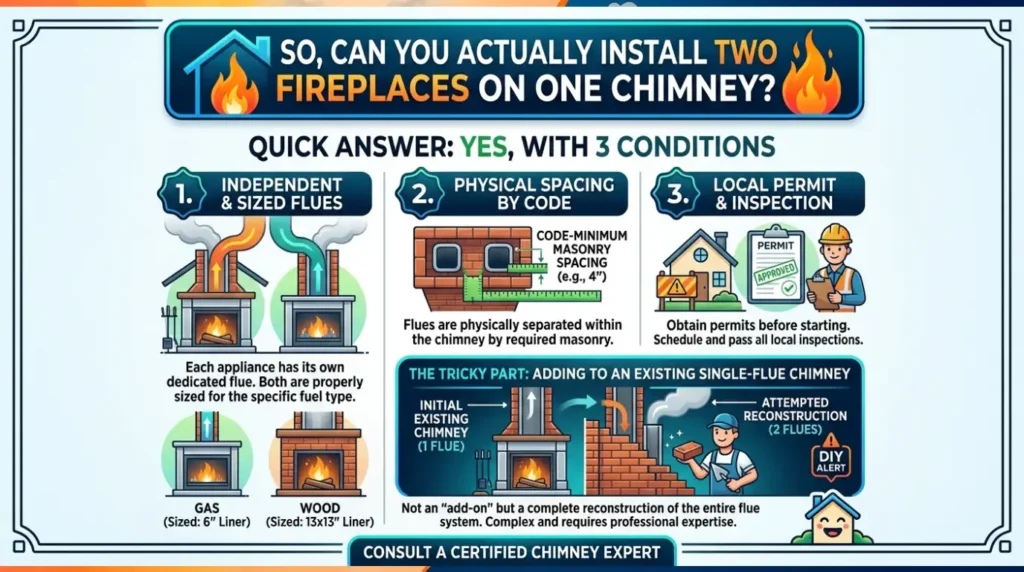
Yes, so in most jurisdictions, so long as the design satisfies three conditions:
- The individual flue of each fireplace is independent, and of the size which is appropriate to each appliance.
- The flues are physically spaced, within the chimney, by code-minimum masonry (or, in the case of factory-built chimneys, by a listed multi-flue system certified to operate that way).
- Your local building department has inspected and approved the installation, as chimney and fireplace work virtually always needs a permit.
This is made tricky where somebody is attempting to add a second fireplace to a chimney that was initially constructed with a single flue. This is not an add-on, it is a complete reconstruction of the flue system, and this is where many DIY plans fail.
Building Code Requirements for Multiple Flues in One Chimney
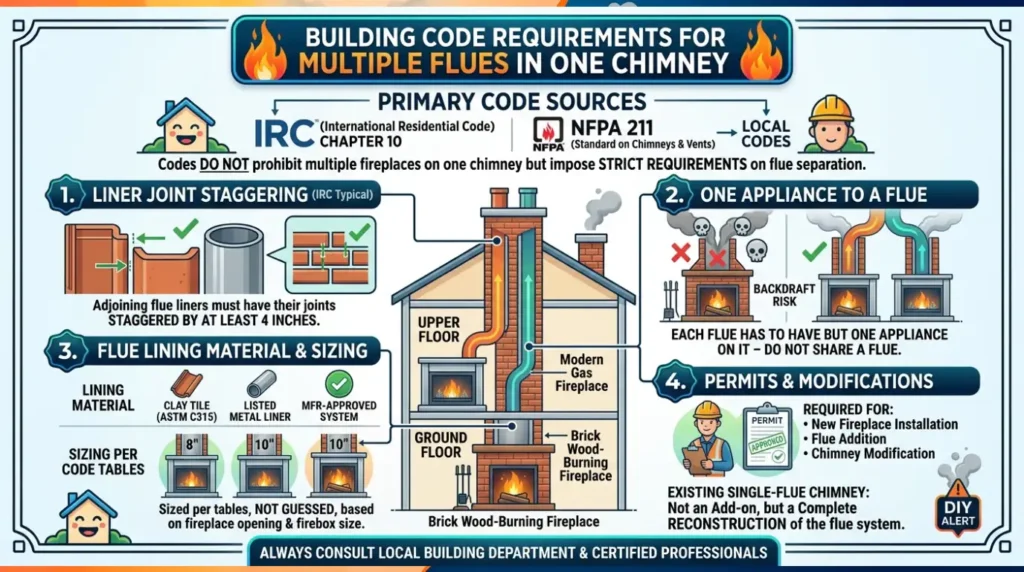
Building codes do not prohibit having more than one fireplace on a single chimney but impose strict requirements on the separation of the flues. Two are most important: the International Residential Code (IRC), Chapter 10 – Chimneys and Fireplaces, and the NFPA 211, the standard on chimneys, fireplaces, vents, and solid-fuel appliances of the National Fire Protection Association. One or both are generally the basis of local codes.
The following is what they usually need:
| Code Rule (Standard IRC typical) | Requirement Detail |
| Liner joint staggering | Stagger joints at least 4 inches between adjoining flue liners. |
| One appliance to a flue | Each flue serves only one appliance (e.g., cannot share a single flue between two fireplaces). |
| Flue lining material | Must use clay tile (ASTM C315), listed metal liner, or a manufacturer-approved system based on fuel type. |
| Flue Sizing | Sized according to code tables (based on fireplace opening/firebox size), never estimated. |
| Permits | Required in almost all jurisdictions for new fireplace installations, flue additions, or chimney modifications. |
There is a thin exception in certain codes: In some code versions, where a chimney serves only one appliance, two flues may be installed directly opposite each other, with the liner material directly between them, and no masonry wythe is needed. The exception is not applicable where two separate fireplaces are actively venting at the same time – then the full wythe separation is in force.
Note: It is always a good idea to verify your local building code with your local building department as codes are adopted and modified jurisdiction-by-jurisdiction and do not follow the national model code.
Why You Can Never Share One Flue Between Two Fireplaces
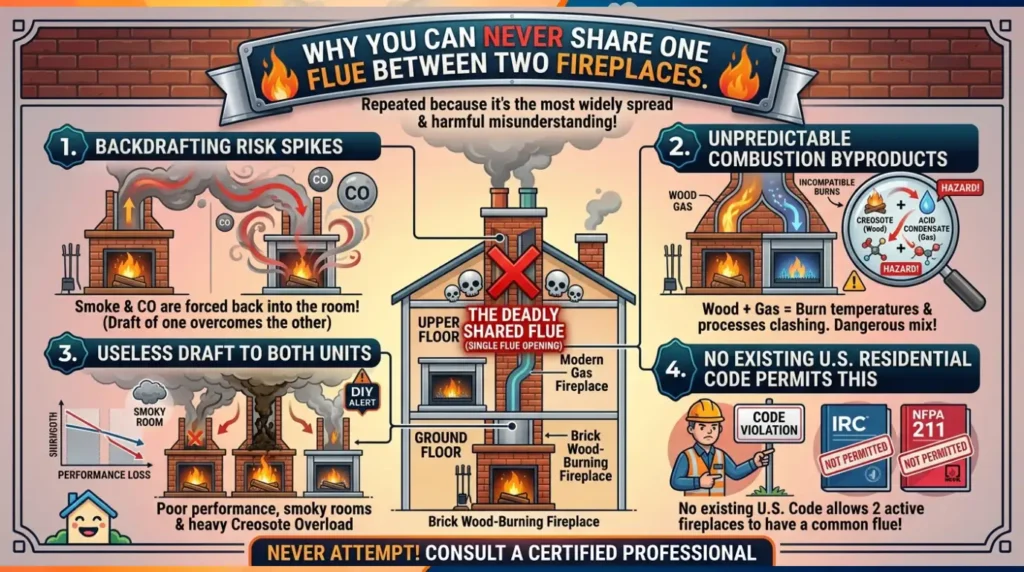
It is the thing to be repeated, as it is the one most widely spread and the most harmful misunderstanding on the subject.
In case of two fireplaces opening into the same flue:
- Backdrafting risk spikes. The draft of one fireplace may overwhelm the other, resulting in smoke and carbon monoxide being forced back into the room rather than by the flue.
- Combustion byproducts are not predictable, particularly when a wood-burning appliance and a gas-burning appliance are used together in the same airway – the burn temperatures and byproducts of each process are not compatible.
- Draft is useless to both units and results in smoky rooms, poor performance and overload of creosote.
- It goes against code all over. No existing U.S. residential code permits two active fireplaces to have a common flue.
In case you have inherited a house where this seems to be the arrangement, then quit using both fireplaces and get a certified chimney sweep to do Level 2 inspection as soon as possible.
Wood, Gas, or Both? Fuel Type Matters
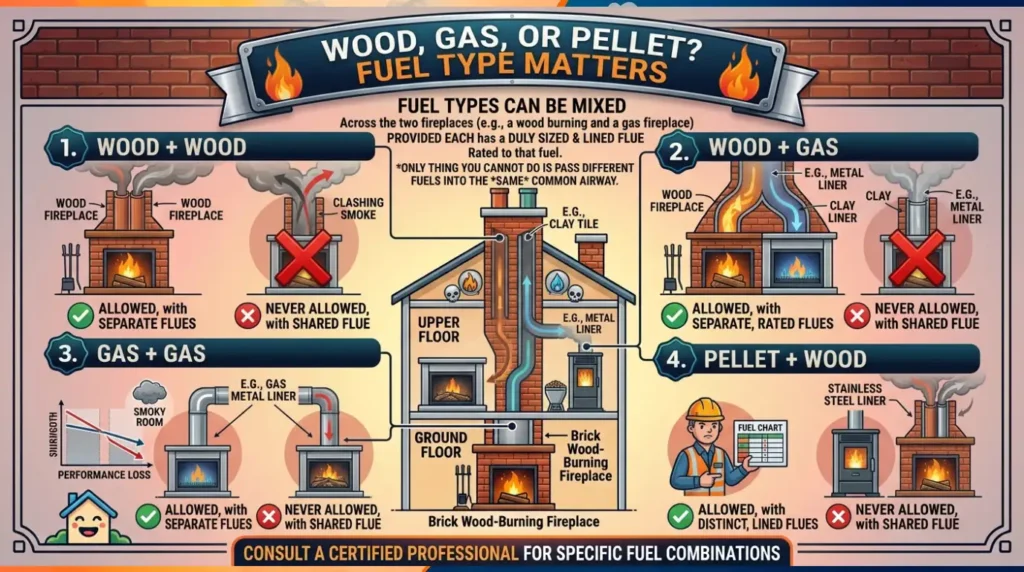
Fuel types can be mixed across the two fireplaces (a wood burning fireplace and a gas fireplace) provided each of the two has a duly sized and lined flue rated to that fuel. The only thing you cannot do is to pass different types of fuels into the same common airway.
| Fuel Combination | Shared Chimney Structure | Shared Flue |
|---|---|---|
| Wood + Wood | Allowed, but separate flues | Never allowed |
| Wood + Gas | Allowed, with separate flues | Never allowed |
| Gas + Gas | Allowed, with separate flues | Never allowed |
| Pellet + Wood | Allowed, with distinct, lined, flues | Never allowed |
Particularly gas appliances may require a certain type of liner (many manufacturers insist on a listed metal liner instead of plain clay tile), and so should be matched to the installation instructions of the appliance manufacturer, and not to the general masonry code.
Two Fireplaces, One Chimney: Pros and Cons
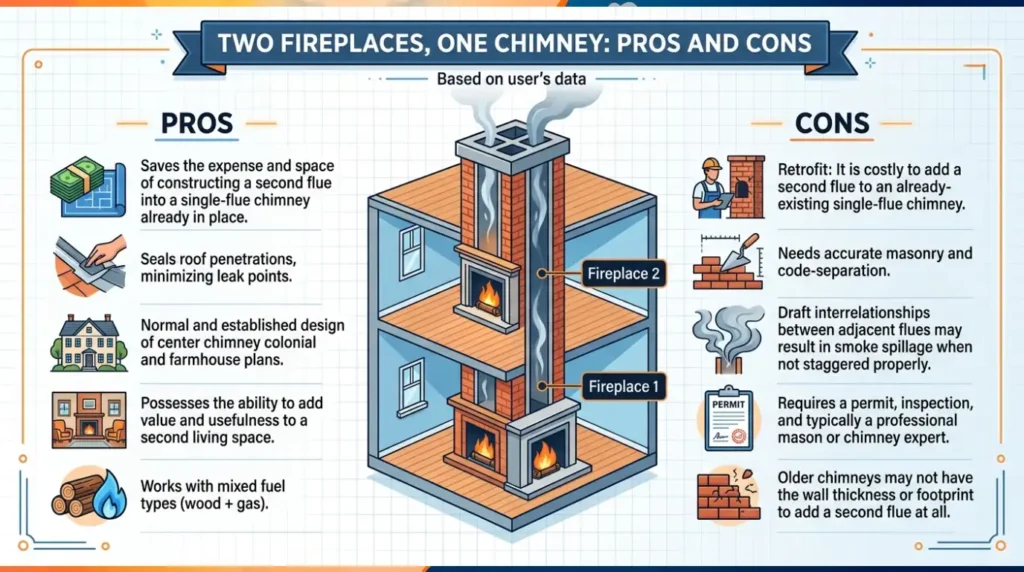
| Pros | Cons |
| Saves the expense and space of constructing a second flue into a single-flue chimney already in place | Retrofit: It is costly to add a second flue to an already-existing single-flue chimney. |
| Seals roof penetrations, minimizing leak points | Needs accurate masonry and code-separation. |
| Normal and established design of center chimney colonial and farmhouse plans | Draft interrelationships between adjacent flues may result in smoke spillage when not staggered properly. |
| Possesses the ability to add value and usefulness to a second living space | Requires a permit, inspection, and typically a professional mason or chimney expert. |
| Works with mixed fuel types (wood + gas) | Older chimneys may not have the wall thickness or footprint to add a second flue at all. |
Step-by-Step: Adding a Second Fireplace to an Existing Chimney.
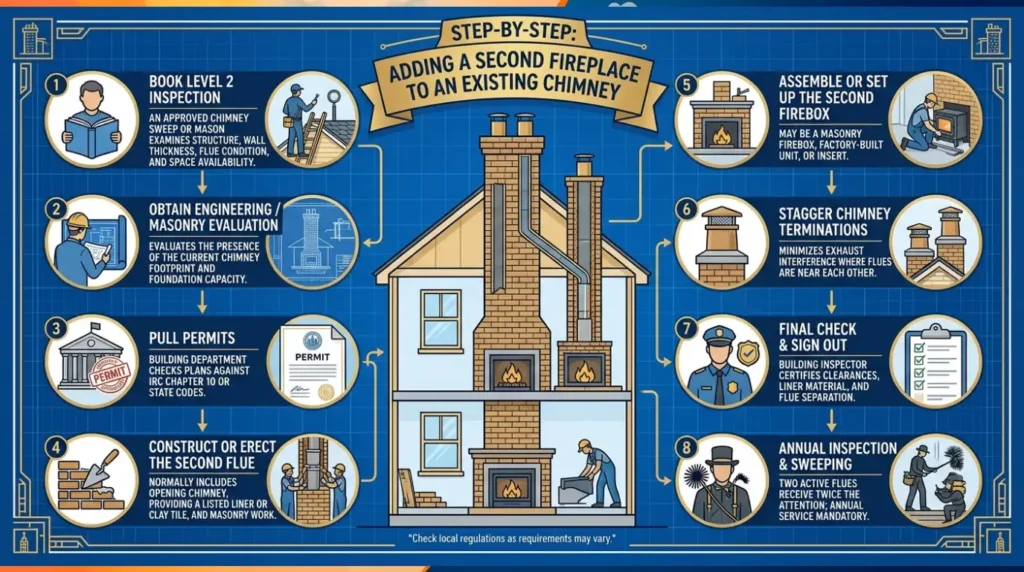
- Book Level 2 chimney inspection. An approved chimney sweep or mason will examine the structure, test the thickness of the walls, the condition of the flue and the existence of space to fit a second flue.
- Obtain an engineering or masonry evaluation. This gives the presence of the current chimney footprint and foundation is enough to accommodate another flue and firebox.
- Pull permits. The plan is checked against IRC Chapter 10 or the residential code in your state by your building department.
- Construct or erect the second flue. This normally includes open chimney, providing a listed liner or clay tile flue and constructing the necessary masonry between flues.
- Assemble or set up the second fire box. Depending on design, this may be a new masonry firebox, a factory-built (zero-clearance) unit, or an insert.
- Stagger chimney terminations where flues are very near each other. This minimizes the possibility of exhaust of one flue interfering with the draft of the other.
- Final check and sign out. Before you use the new fireplace, the building inspector certifies clearances, liner material and flue separation.
- Annual inspection and sweeping of both flues, as two active flues in a building must receive twice the attention.
What It Costs to Add a Second Fireplace to an Existing Chimney
Prices are all over the place depending on location, material used in chimney, and access, but here is a price range depending on the general prices of the fireplace and chimney industry:
| Scope of Work | Typical Cost Range |
| Level 2 chimney inspection | $200–$600 |
| Install new flue liner (single flue, existing chimney) | $2,500–$7,000 |
| Masonry wythe/rebuild work (to separate flues) | $1,500–$5,000+ |
| New factory-built (zero-clearance) fireplace and connector | $3,000–$8,000 installed |
| Masonry fireboxes (new construction) | $5,000–$15,000+ |
| Application fees | $0–$100 (depending on locality) |
These are not quotes, these are general industry ranges. It is always a good idea to request at least two or three written estimates of the cost of a project by licensed, insured chimney or masons in your neighborhood before you are ready to budget an undertaking.
Signs Your Shared Chimney Needs Professional Attention
Look, before you think a two-fireplace, one-chimney set-up is functioning properly:
- Smoke coming into the room in either of the fire places, particularly in cases where both fire places are on.
- When using the other appliance only, a lingering smoky odor with the other flue.
- Existing cracks, gaps or loss of mortar between flue sections in the roofline or the attic.
- Staining of an exterior wall between two openings of flues with soot or creosote.
- A carbon monoxide detector alarm in any of the following places: in any of the fire places.
Any of these reasons will warrant ceasing use of either fireplace or hiring a Certified Chimney Sweep (seek CSIA certification) to have their chimneys inspected.
Myth vs Fact
| Myth | Fact |
| Myth: Since the chimney is large enough, two fireplaces can simply open into the same open space. | Fact: Size does not solve the problem. Without a separate, isolated flue per fireplace, backdrafting and code violations will occur regardless of chimney size. |
| Myth: It is impossible to have a gas and a wood fireplace on the same chimney structure. | Fact: You can have both, provided each appliance has its own dedicated, properly lined, and separated flue suitable for that fuel type. |
| Myth: Two flues that terminate close to each other will always interfere with each other’s draft. | Fact: Properly sized flues with correctly designed terminations operate independently. Interference is typically the result of a design or installation flaw, not an inherent trait of shared chimneys. |
You May Also Read:
- What is Thermal Cutoff in Electric Fireplace? 5 Powerful Safety Tips
- What is Electric Fireplace Lifespan? 7 Amazing Facts You Need to Know
FAQs:
Is it possible to place two fireplaces on the same chimney?
Yes, provided there are separate, properly sized flues to every fireplace. There can never be two fireplaces which share the same flue.
Is it possible to have two flues in a chimney?
Yes, Multiple flues in chimneys can be constructed or remodeled, each serving a single appliance, separated by masonry per local code (typically a 4-inch wythe with staggered liner joints).
Are two wood stoves compatible in a chimney?
Yes, provided there is a dedicated flue on each wood stove, which is sized and clearance-permitted to that particular stove.
Is it possible to have a gas fireplace and a wood fireplace have the same chimney structure?
Yes, provided everyone has a separate flue lined suitably to its fuel. They are not able to share a single flue.
How costly is it to install a second fireplace in an existing chimney?
Usually between $3,000 and 12,000 and more, with or without a complete flue liner installation, masonry rebuilding, and new firebox or insert.
Should I obtain a permission to install a second fireplace on my chimney?
Almost always, yes. The work on chimneys and fireplaces is controlled by your local building department under residential code sections on chimneys and fireplaces.
How will I be able to tell whether my current chimney with a double flue is safe to use?
Get a certified chimney sweep to carry out Level 2 inspection, particularly when you have never used the two fireplaces simultaneously or when you have recently purchased the house.
What would be the effect in case two fireplaces open into the same flue?
It is possible to force smoke and carbon monoxide back into the house, drafts are no longer reliable, and the installation is against residential building code. This ought to be rectified.
Is it possible to have two flues on a factory-built (prefab) chimney?
A few of the multi-flue factory-built systems are listed, though most of the standard prefab chimneys are built to suit one appliance only. Do not assume that a factory-built chimney may be adapted to a second flue: check with the manufacturer before assuming so.
Am I able to DIY a second flue?
This isn’t a recommended DIY project. Flue sizing, the liner material, separation of masonry, and structural support all necessitate professional expertise and usually a permit and inspection.
Will two fireplaces on one chimney, as well as two independent chimneys?
Yes, in most good fittings. Problems experienced in drafting of shared chimneys are generally due to under sizing of the flues, improper termination design or problems with house pressurization and not due to the shared-chimney concept.
My Final Thought:
There can be two fireplaces sharing a chimney structure and not airway. Its secret lies in a duly isolated, independently sized flue per fireplace, constructed and checked to your local residential code. The danger lies in attempting to use two fireplaces with a single common flue, combining the type of fuel used in that common flue or neglecting to take out the permit and inspection in order to save time.
You should make a Level 2 inspection of your chimney with a CSIA-certified chimney sweep, not a contractor, if you are thinking of this project. Such an inspection tells you whether your current chimney could even accommodate a second flue, which will inform all decisions and cost projections that follow.