How Much Firewood Do I Need for Winter? A Full-Season Planning Guide
How much firewood do I need for winter? The short answer is that most homes need between half a cord and six cords for one heating season. A home that lights a fire now and then can get through winter on a cord or less. A home that heats with wood as its main heat source often needs three to six cords. Your exact number depends on four things: the size of the space you heat, your climate, how often you burn, and the kind of wood you buy.
This guide walks you through the math in seven steps. You will measure the space you heat, pick your burn pattern, work out a cord count, adjust it for your wood species, check what a cord really is before you order, and plan your burn month by month. By the end you will have a number you can hand to a supplier with confidence, plus a small reserve so a cold snap never catches you short.
One warning before you start. The numbers in this guide are planning ranges drawn from extension services and industry guidance. They are a starting point, not a promise. Insulation, stove efficiency, and the weather in a given year all move the real figure. Keep a log of what you burn this winter, and next year your number will be exact.
Heads up: fire and carbon monoxide safety
Burn wood only in a vented fireplace, stove, or insert that is built for it. Never burn in an unvented indoor space. Keep working carbon monoxide detectors in your home and test them each month. Have your chimney inspected and swept each year by a certified chimney sweep. Never burn treated, painted, or stained wood, plywood, or household trash. The fumes are toxic. If you smell gas, feel dizzy, or feel sick near a fire, get outside and call emergency services. Check local burn bans and firewood transport rules before you buy or move wood.
TOTAL TIME
About 1 hour
Measuring, math, and ordering
ACTIVE TIME
About 20 minutes
The rest is calls and delivery
DIFFICULTY
Beginner
No tools beyond a tape measure
What you need
- A tape measure for room sizes and your wood stack
- Last winter’s heating bills, if you have them
- A moisture meter, or a supplier who tests moisture for you
- A notebook or phone note to track cords burned
- A covered, raised spot to stack wood off the ground
- A phone number for two or three local firewood suppliers
At a glance: the seven steps
- Measure the space you heat with wood
- Pick your burn pattern for the season
- Work out your cord count with the estimator
- Adjust the number for your wood species
- Check what a cord really is before you order
- Plan your month-by-month burn
- Order early and stack the wood for dry burning
Measure the Space You Heat With Wood
Start with the rooms your stove or fireplace actually warms, not the size of your whole house. Walk through your home and note each room that feels warm when a fire is going. Measure the length and width of each room in feet, multiply the two numbers, and write down the square footage. Add the rooms together for your heated total.
Many homes heat 1,000 to 2,000 square feet with wood while the rest of the house stays on another system. That heated total is the number that drives every estimate in this guide. A stove in a living room with open doors to a kitchen warms both rooms, so count both. A closed-off bedroom at the far end of the hall does not count.
Write the number down where you will find it again, because you will use it in Step 3. If you heat the whole house with wood, use the full floor area of the rooms you keep warm through winter. If you only heat one room for evening fires, use that room alone.
Pick Your Burn Pattern for the Season
Your burn pattern changes your cord count more than any other single factor. There are three common patterns. Occasional fires mean one or two fires a week, mostly for mood and a little warmth. Regular fires mean most evenings, or heating one or two rooms through the cold months. Primary heat means wood is your main source of warmth all winter.
Be honest about which pattern fits your life. A household that plans occasional fires but ends up burning most nights will run out of wood in February. Look at last winter if you can. Count how many evenings a week you lit a fire, and how many hours each fire ran.
Guidance from the Chimney Safety Institute of America lines up with what suppliers see in practice. A home that uses wood as its main heat often burns three to six cords in a season, while occasional fires use a cord or less. That range is your first sanity check. If your math in Step 3 lands far outside it, recheck your inputs.
Work Out Your Cord Count With the Estimator
Here is the working rule that extension services and suppliers use as a starting point. In a cold climate, plan on two to three cords per 1,000 square feet of heated space when wood is your main heat. In a mild climate, plan on one to two cords per 1,000 square feet. Multiply your heated area by the rate for your climate, and you have a first estimate.
A 1,500 square foot home in a cold climate, heated mainly with wood, lands at about three to four and a half cords. The same home in a mild climate lands at about one and a half to three cords. A University of Maryland Extension fuel comparison for a 2,000 square foot Maryland home heated by a wood stove works out to about five cords for the season, which sits inside the same range.
Use the table below to find your row, then read across to your climate and burn pattern. Supplemental burning, where wood backs up a furnace, needs roughly 40 percent of the primary-heat figure. Occasional fires need about half a cord to one cord for the whole season, whatever the house size.
Winter firewood estimator: cords per season
Heated space is the area your wood fire actually warms. Figures are planning ranges for seasoned hardwood.
| Heated space | Cold climate, main heat | Mild climate, main heat | Supplemental heat | Occasional fires |
|---|---|---|---|---|
| Under 1,000 sq ft | 2 to 3 cords | 1 to 2 cords | 1 to 1.5 cords | 0.5 to 1 cord |
| 1,000 to 1,500 sq ft | 3 to 4.5 cords | 1.5 to 3 cords | 1.5 to 2 cords | 0.5 to 1 cord |
| 1,500 to 2,000 sq ft | 3.5 to 5 cords | 2 to 3.5 cords | 2 to 2.5 cords | 0.5 to 1 cord |
| Over 2,000 sq ft | 4 to 6 cords | 3 to 4 cords | 2 to 3 cords | 0.5 to 1 cord |
| Large or drafty home | 6 cords or more | 4 to 5 cords | 3 cords or more | 1 cord |
Sources: cold and mild climate rates per 1,000 sq ft and the 3 to 6 cord primary-heat range reflect widely used extension and industry guidance. Your stove efficiency, insulation, and winter severity move the real number.

Pro tip: round up, not down
Leftover seasoned wood keeps for next winter if it stays dry and covered, so an extra half cord costs little and buys peace of mind. Running short in February costs far more, because midwinter wood is harder to find, often wetter, and usually priced higher. Order your estimate plus a half cord as a reserve.
Adjust the Number for Your Wood Species
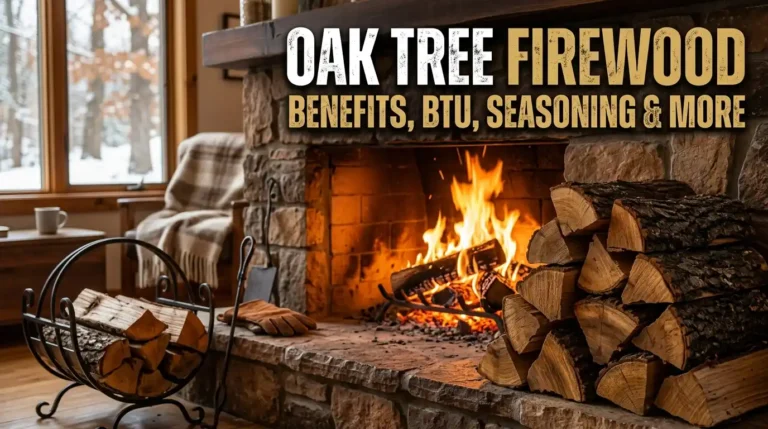
Not all cords hold the same heat. Dense hardwoods pack more heat into the same stack than light softwoods, so the species you burn changes how many cords you need. A cord of white oak holds about 29.1 million BTU when air dried, according to Utah State University Extension. A cord of ponderosa pine holds about 16.2 million BTU. That is nearly half the heat for the same stacked volume.
To adjust your estimate, find your species in the table below. If you burn mostly pine or another softwood, add about one extra cord for every three cords of hardwood in your estimate. If you burn mostly oak, maple, or hickory, your estimate from Step 3 stands as it is. Mixed loads fall in between, so split the difference.
The U.S. Energy Information Administration uses 20 million BTU as a general figure for an average cord, which is a handy check. A load that averages well below that figure will burn through faster than the table suggests. Ask your supplier which species are in the load before you order, and get it in writing on the receipt.
Heat per cord by species: seasoned wood at about 20 percent moisture
Figures are per full cord of air-dried wood. Source: Utah State University Extension, Wood Heating.
| Species | Heat per cord | Dry weight per cord | What it means for your order |
|---|---|---|---|
| White oak | 29.1 million BTU | About 4,200 lb | Top heat, slow coals, order the base estimate |
| Bur oak | 26.2 million BTU | About 3,768 lb | Strong heat, order the base estimate |
| Other maples | 25.5 million BTU | About 3,680 lb | Strong heat, order the base estimate |
| Red oak | 24.6 million BTU | About 3,528 lb | Strong heat, order the base estimate |
| Silver maple | 19.0 million BTU | About 2,752 lb | Mid heat, add about a quarter cord per three |
| Ponderosa pine | 16.2 million BTU | About 2,336 lb | Low heat, add about one cord per three, best for kindling and shoulder season |
The University of Maryland Extension lists about 25.3 million BTU per cord for oak and 19.0 million for white pine, which points the same way: pine gives roughly a quarter less heat than oak.
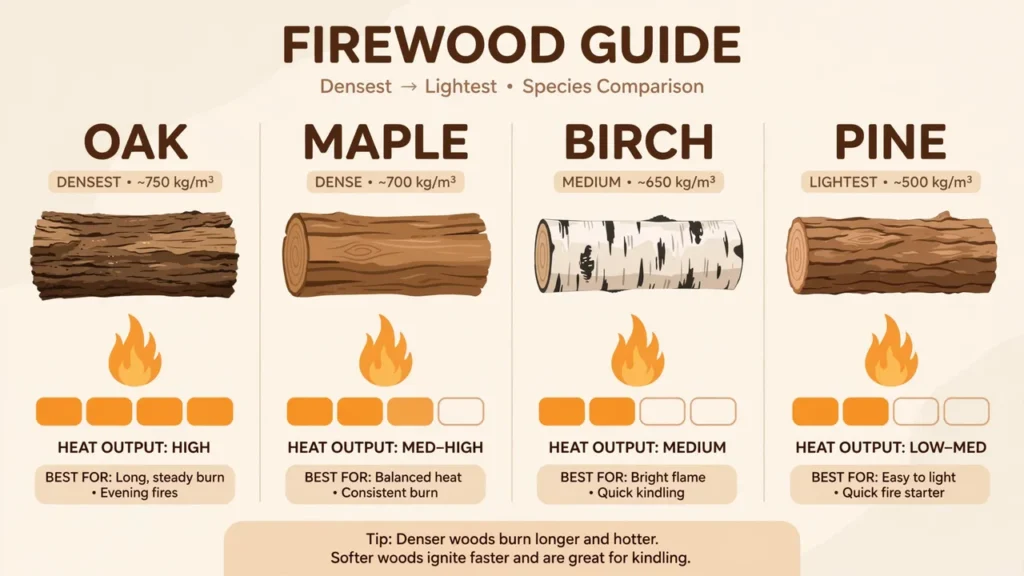
Species also affects how the wood burns in your stove. Oak and maple leave long-lasting coals that hold heat overnight. Pine lights fast and burns fast, which suits kindling and mild-weather fires. A mixed load gives you both: pine to start the fire, hardwood to keep it going. For a closer look at which woods burn best, read our guide to the best firewood to burn.
Check What a Cord Really Is Before You Order
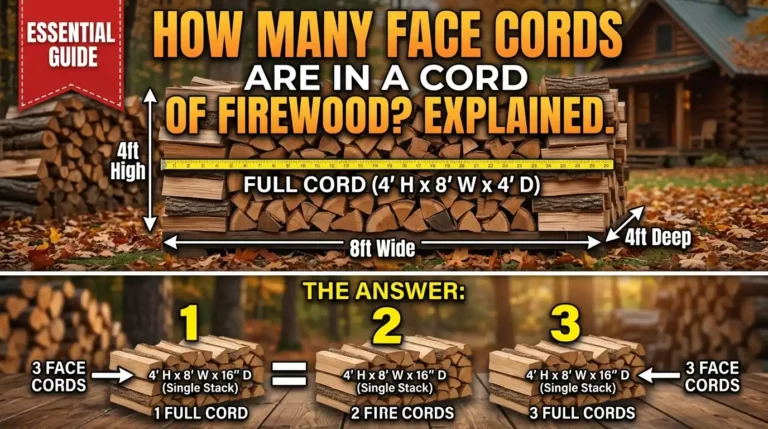
A cord is a legal measure, not a loose guess. Under NIST Handbook 130, a full cord is a stack 4 feet high, 4 feet deep, and 8 feet long, which totals 128 cubic feet of stacked wood, air gaps included. That definition is the one weights and measures rules use across the United States. If a seller quotes you a price per cord, this is the volume you should receive.
The trap is the face cord, also called a rick. A face cord is a stack 4 feet high and 8 feet long but only one piece deep. With 16 inch pieces it holds about 42.7 cubic feet, which is one third of a full cord. With 12 inch pieces it holds about 32 cubic feet, or one quarter. With 24 inch pieces it holds about 64 cubic feet, or one half.
Before you pay, ask the seller for the stack dimensions in writing and work out the volume yourself. Multiply length by height by depth in feet, then divide by 128. That gives you the true cord count. A delivery that looks big in a loose pile can shrink a lot once it is stacked tight. For the full breakdown, see our guide to how big a cord of wood is and the difference between a face cord and a full cord.
Cord and face cord volumes at a glance
A face cord is one row deep. Its volume depends on the length of the pieces.
| Unit | Stack size | Volume | Share of a full cord |
|---|---|---|---|
| Full cord | 4 ft high, 4 ft deep, 8 ft long | 128 cu ft | 1 full cord |
| Half cord | 4 ft high, 2 ft deep, 8 ft long | 64 cu ft | 1/2 cord |
| Quarter cord | 4 ft high, 1 ft deep, 8 ft long | 32 cu ft | 1/4 cord |
| Face cord, 12 in pieces | 4 ft high, 8 ft long, one row | About 32 cu ft | 1/4 cord |
| Face cord, 16 in pieces | 4 ft high, 8 ft long, one row | About 42.7 cu ft | 1/3 cord |
| Face cord, 24 in pieces | 4 ft high, 8 ft long, one row | About 64 cu ft | 1/2 cord |
Source: NIST Handbook 130 cord definition and standard face cord conversions.

Measure the delivery after it is stacked, not while it is still in a loose pile. A loose pile looks larger than the cord it stacks into, because air takes up more room before the pieces settle tight. Stack it in neat rows, measure the finished stack, and compare it with what you paid for. If the stack comes up short, call the supplier while the wood is still fresh in your mind.
Plan Your Month-by-Month Burn
A season total is hard to picture, so break it into months. Most heating seasons run about five months, from November through March, with January as the coldest month. Spread your cords across those months with more wood in the coldest weeks and less at the edges. The plan below shows a worked example for a four cord winter, so you can see the shape of it.
Count your burn rate each month and write it down. A household that burns about three quarters to one cord a month in steady cold will use four cords across a four month stretch of real winter. Check your stack at the end of each month. If you have burned more than the plan by mid January, order more wood right away, while suppliers still have dry stock.
The edges of the season are where most people waste wood. Mild November and March days need small fires or none at all. Save your best hardwood for the deep cold, and burn softer wood and smaller loads in the shoulder months. That habit alone can save you half a cord across the season.
Monthly burn plan: a worked example for a 4 cord winter
This is an example, not a rule. Scale each month up or down to match your own season total.
| Month | Cords burned | Cords left | Notes |
|---|---|---|---|
| November | 0.6 cords | 3.4 cords | Shoulder month, evening fires, softer wood is fine |
| December | 1.0 cord | 2.4 cords | Steady cold sets in, daily fires begin |
| January | 1.1 cords | 1.3 cords | Coldest month, burn your best hardwood here |
| February | 0.9 cords | 0.4 cords | Still cold, check the stack and reorder if short |
| March | 0.4 cords | 0 cords | Shoulder month, small fires, season ends |
Total: 4.0 cords. If your season is longer or colder, add a month at the same monthly rate and raise the total.
Keep a simple log on the fridge or in your phone. Each week, note how many wheelbarrow loads or how many rows of the stack you burned. After one winter you will know your true monthly rate, and you will never have to guess again. For a closer look at how long a cord lasts in real use, see our guide to how long a cord of wood lasts.
Order Early and Stack the Wood for Dry Burning
Order your wood in spring or summer, months before the heating season starts. Green wood that is already split needs six to nine months stacked and covered to dry properly, according to the University of Maryland Extension. Wood bought in October has not had that time, and wet wood burns poorly.
Wet wood wastes heat in a way you can feel. The Maine Forest Service warns that you can lose up to half of the wood’s energy trying to burn it green, because heat goes into boiling off water instead of warming your home. Wet wood also makes more smoke and more creosote in the chimney, which raises the risk of a chimney fire. The U.S. EPA recommends burning wood at a moisture content below 20 percent, so test a fresh split face with a moisture meter before you burn.
Stack the wood off the ground on pallets or rails, in a sunny spot with airflow, and cover only the top so rain stays off while the sides breathe. Split pieces dry faster than rounds, so split anything thicker than about six inches. Learn the full method in our guide to how to season firewood and our guide to how to store firewood outside. For current local prices, check our guide to the cost of a cord of firewood before you call suppliers.
Heads up: wet wood is a safety problem, not a small flaw
Burning wet or green wood builds creosote in the chimney faster than dry wood does. Creosote is flammable, and a heavy buildup can catch fire inside the chimney. If your fires smoke a lot, hiss, or leave black glass on the stove door, stop and check the moisture of your wood. Have the chimney swept before the season starts and again if you burn a lot of wet wood.
What to Do If You Run Short in Midwinter
Even a good plan can miss. A cold snap, a house guest, or a stove that runs longer than expected can eat through a stack fast. The table below covers the most common midwinter problems and the fix for each one. Act early, because the fix gets harder the later in the season it happens.
Troubleshooting: running short or burning too fast
| If this happens | Try this |
|---|---|
| You are a cord short by mid January | Order at once from two suppliers, and ask for the driest seasoned wood they have, even at a higher price |
| Fires burn through wood faster than planned | Test moisture with a meter. Wood above 20 percent moisture burns fast and gives little heat. Switch to dry wood. |
| The house feels cold even with a full firebox | Check for drafts around doors and windows, and close off rooms you do not use, so the fire heats less space |
| Smoke fills the room when you open the door | Open the damper fully first, crack a window near the stove, and have the chimney checked for blockage or creosote |
| The delivered stack looks smaller than ordered | Stack it tight, measure length by height by depth, divide by 128, and call the supplier with the numbers |
A backup plan helps too. Keep a small reserve of dry wood in a garage or shed, separate from the main stack, so a storm or a late delivery never leaves you with nothing to burn. Two cords of seasoned wood, stored dry, is stored heat that needs no power and no delivery truck.
Frequently Asked Questions
How much firewood do I need for winter? Your questions answered
How many cords of firewood do I need for winter?
Most homes need half a cord to six cords for the season. Occasional fires need about half a cord to one cord. Regular evening fires need one to three cords. A home heated mainly with wood needs three to six cords, based on house size and climate.
How much firewood do I need for a 1,500 square foot home?
A 1,500 square foot home heated mainly with wood needs about three to four and a half cords in a cold climate, and about one and a half to three cords in a mild climate. If wood is only a backup heat source, plan on about 40 percent of those figures.
How many face cords are in a full cord?
Three face cords of 16 inch pieces make one full cord. A face cord of 16 inch pieces holds about 42.7 cubic feet, which is one third of a 128 cubic foot full cord. Face cords with shorter pieces hold less, so always ask for the piece length.
How much firewood do I need per month in winter?
A home heating mainly with wood in a cold climate burns about three quarters to one cord a month in steady cold. January is usually the heaviest month at about 1.1 cords in a four cord winter, while November and March are lighter at about half a cord each.
Does the type of wood change how much I need?
Yes. A cord of white oak holds about 29.1 million BTU, while a cord of ponderosa pine holds about 16.2 million BTU, according to Utah State University Extension. If you burn mostly softwood, add about one extra cord for every three cords of hardwood in your estimate.
When should I order firewood for winter?
Order in spring or summer. Split green wood needs six to nine months stacked and covered to dry, according to the University of Maryland Extension. Wood ordered in autumn is often still wet, burns poorly, and makes more creosote.
Quick reference card: how much firewood do I need for winter?
What you need
Tape measure, last winter’s heating bills, moisture meter, notebook, covered stacking spot, two or three supplier numbers.
Steps
- Measure the space you heat with wood.
- Pick your burn pattern: occasional, regular, or main heat.
- Work out cords: cold climate 2 to 3 cords per 1,000 sq ft, mild climate 1 to 2 cords.
- Adjust for species: add about one cord per three if you burn mostly softwood.
- Check the cord: full cord is 4 by 4 by 8 ft, 128 cubic feet.
- Plan month by month, heaviest in January.
- Order in spring or summer and stack for dry burning below 20 percent moisture.
Rule of thumb: occasional fires 0.5 to 1 cord, regular fires 1 to 3 cords, main heat 3 to 6 cords. Round up and keep a half cord reserve.
You now have a real number for your winter, not a guess. You measured the space you heat, picked your burn pattern, ran the estimator, adjusted for your species, and checked what a cord really is. Order early, stack the wood dry, and keep a small reserve for the coldest weeks.
Keep a burn log this winter and compare it with your estimate in spring. That one habit turns next year into a five minute job. For your next step, read our guide to how to tell if firewood is seasoned before your first delivery arrives, so you know the wood you paid for is ready to burn.
Disclaimer: This guide is general information for planning only. Firewood needs vary with your home, stove, climate, and winter weather. Prices and local rules change, so check current rates and local burn rules with suppliers and your local authority. For chimney, stove, or safety concerns, contact a certified chimney sweep or licensed professional.