Why Does My Gas Fireplace Make a Popping Noise? 7 Causes, Safe Checks, and When to Call a Pro
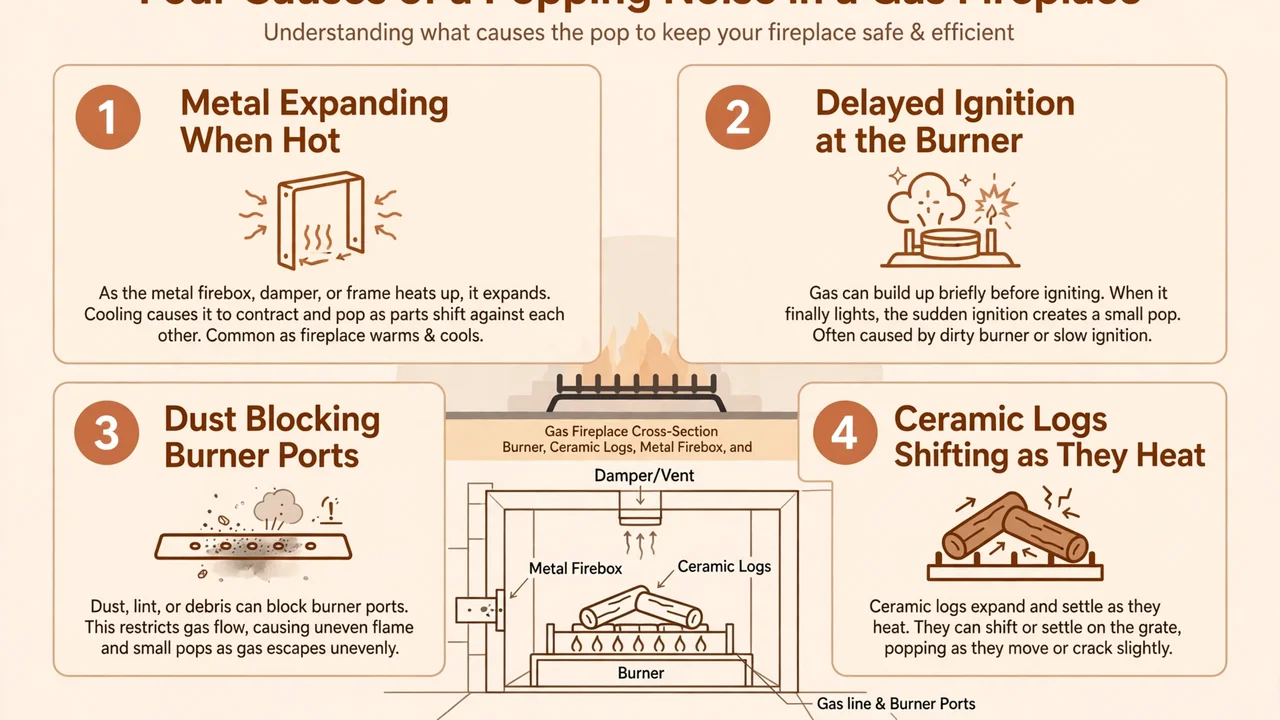
A popping noise from your gas fireplace can stop you mid-sentence. One minute the room is quiet, the next minute a sharp pop or a slow series of ticks comes from the firebox. If you searched for “Why Does My Gas Fireplace Make a Popping Noise?” you are in the right place. Most pops come from metal parts that grow as they heat and shrink as they cool, and those sounds are normal.
Some pops point to a dirty burner or a slow ignition, and those need attention. A loud bang at startup is a different matter, and it means you should stop using the fireplace and call a licensed gas professional. This guide walks you through seven checks in order, from the sounds you can sort out on your own to the signs that belong to a pro.
By the end you will know what each kind of pop means, which safe checks you can do with the fireplace off and cool, and when to pick up the phone. The whole process takes about 30 minutes of your time, and you need no special tools.
Safety First: Read This Before You Touch Anything
Gas fireplaces burn fuel inside your home, and that brings two risks you must respect: carbon monoxide (CO) and gas leaks. CO is colorless and odorless, so you cannot see it or smell it. Install CO alarms on every level of your home and near sleeping areas, test them each month, and replace them as the maker directs. Pets, and birds in particular, react to CO and fumes sooner than people do, so an alarm protects the whole household. The CDC carbon monoxide guidance explains the warning signs and why alarms matter.
If you smell gas (a rotten-egg odor), do not touch any switch, flame, or appliance. Leave the home at once with everyone and every pet, then call your gas utility emergency line or 911 from outside. Never try to find or fix a leak, open a gas line, or relight the fireplace after a strong gas smell. That work belongs to the gas utility or a licensed gas fitter. Learn more in our guide on why a gas fireplace smells like gas and our guide on whether gas fireplaces produce carbon monoxide.
All checks in this guide use the normal user controls in your manual, with the fireplace off and cool. Never open a gas line, change a gas valve past its normal settings, bypass a safety device such as a thermocouple or oxygen-depletion sensor, block a vent, or turn off a CO alarm. Gas-line, venting, and repair work goes to a licensed gas professional.
Total Time
About 30 minutes
Active Time
About 15 minutes
Difficulty
Beginner
What You Need
- A flashlight or a phone light
- A soft brush, such as a clean paintbrush
- A vacuum with a hose and a brush head
- A notebook and a pen, or your phone, to note when the pops happen
- Your fireplace manual, if you still have it
- A working CO alarm in the room (check it before you start)
No gas tools are needed for this guide. If a step calls for gas work, it tells you to call a pro instead.
At a Glance: The 7 Checks
- Trace why your gas fireplace makes a popping noise
- Watch the flame color and shape
- Check the burner ports for dust and debris
- Look at the ceramic logs and embers
- Watch how the fireplace lights
- Press the panels and listen for the blower
- Call a licensed gas professional when the signs point that way
Trace Why Your Gas Fireplace Makes a Popping Noise
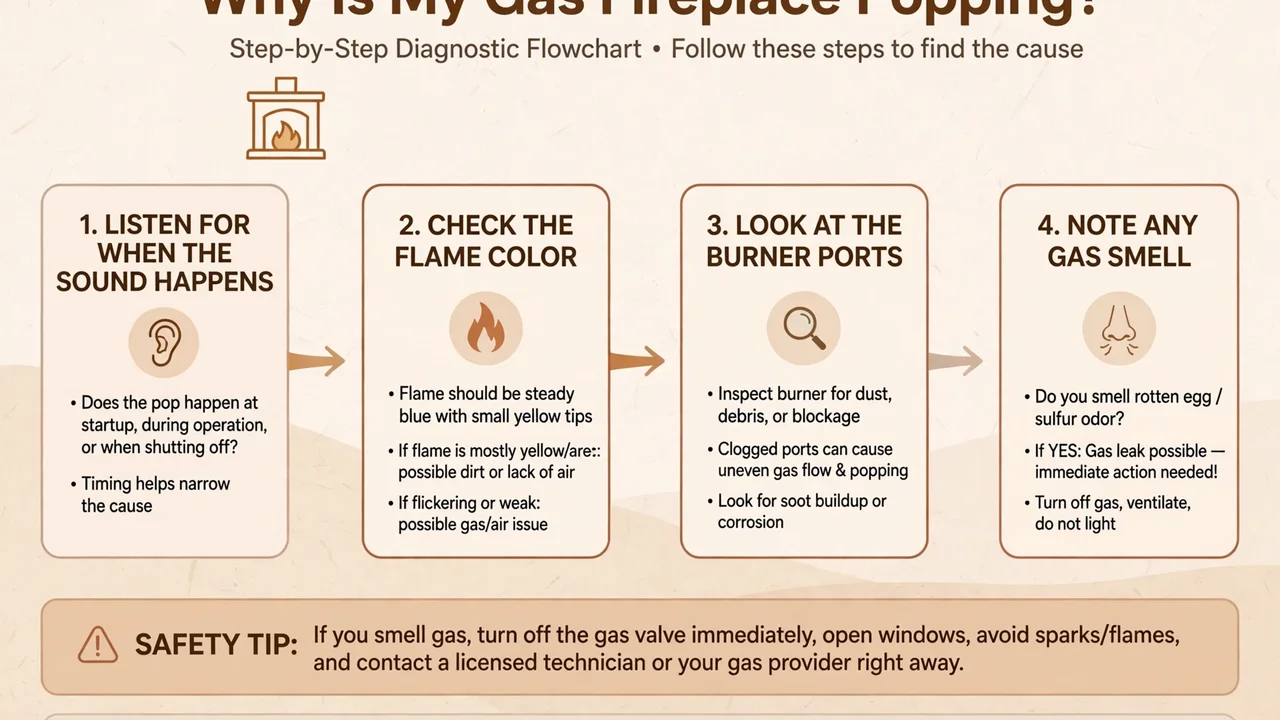
Timing tells you more than volume does. A pop in the first few minutes after you turn the fireplace on often means metal parts are warming and growing. A pop hours after you turn it off often means the same parts are cooling and shrinking back. Write down when each pop happens, how loud it is, and whether it comes from the firebox, the glass, or the vent area.
Run the fireplace for one full cycle and listen with care. Note the exact minute the first pop arrives after startup, and note whether pops keep coming while the flame burns or stop after the unit warms up. This log turns a vague worry into a clear pattern, and a technician will thank you for it if you end up calling one.
Watch the Flame Color and Shape
A healthy gas flame burns mostly blue at its base with soft yellow tips that dance above the logs. Stand back and watch the flame for a full minute. Tall yellow flames that look lazy, flames that lift off the burner, or flames that flicker hard to one side all point to a burner or air problem that can feed popping sounds.
Compare what you see with the flame picture in your manual if it has one. A flame that stays steady and blue after warm-up, with pops that fade in the first few minutes, points to normal metal movement. A flame that stays yellow and uneven while pops keep coming points to the burner checks in the next steps.
Check the Burner Ports for Dust and Debris
Turn the fireplace off and wait until every part feels cool to the touch. Open the glass front the way your manual shows, and shine your flashlight along the burner tube. Look for dust, pet hair, lint, and small bits of debris sitting on or near the tiny holes, called burner ports, where the flame comes out.
Brush the burner gently with a soft brush, then vacuum the loose dust with the hose and brush head. Keep the brush light, and never poke anything into the ports. A blocked port can delay the flame as it spreads across the burner, and that delay can make a sharp pop. Our full guide to cleaning a gas fireplace walks through the whole cleaning routine if this is your first time.
Look at the Ceramic Logs and Embers
Gas fireplaces use ceramic logs, not real wood, and those logs shift a little as they heat. Lift each log with care and set it down in the exact spot your manual shows. A log that sits off its pins or rests on a burner port can block the flame and make the fire pop as gas finds a new path.
Check the embers and the small lava rock or glass pieces under the logs, too. Spread them in a thin, even layer and keep them clear of the burner ports. A thick pile in one spot can smother part of the flame, and that uneven burn can pop and sputter. If a log is cracked or a piece has broken off, set it aside and order the exact replacement part for your model.
Watch How the Fireplace Lights
Stand to the side and watch a cold start from the moment you press the ignition control. A normal start gives a soft whoosh as the burner lights across its full length within a second or two. A loud bang, a deep thud, or a flame that takes several seconds to catch means gas built up before it lit, and that is called delayed ignition.
Delayed ignition often starts with a weak pilot flame, a dirty pilot assembly, or dust in the burner ports. Do not keep lighting the fireplace to test it if the bang repeats. Turn it off, leave the pilot alone, and book a licensed gas professional.
Repeated delayed ignition strains the metal parts and can crack them over time. If your pilot flame looks weak or keeps going out, read our guide on whether to leave the pilot light on in a gas fireplace for background, then call a pro for the repair itself.
Heads Up: A Loud Bang Is Not a Normal Pop
A soft tick or a light pop as metal warms is normal. A loud bang or boom at startup is not. Stop using the fireplace, do not try to relight it, and call a licensed gas professional. If you smell gas at any point, leave the home and call your gas utility or 911 from outside.
Press the Panels and Listen for the Blower
Loose panels and trim can rattle and pop as heat moves through them. With the fireplace off and cool, press each access panel and trim piece in turn and feel for movement. Tighten any loose screws with the right screwdriver, and note any panel that still moves after you tighten it.
Turn the blower on by itself if your model allows it, and listen for a hum, a rattle, or a click that repeats with each fan turn. A blower that rattles often has dust on its blades or a loose mount, and a technician can clean or refasten it during a service visit. A blower fault will not cause flame pops, so if the pops track the flame rather than the fan, the burner is still your prime suspect.
Call a Licensed Gas Professional When the Signs Point That Way
Some causes sit past the line where a homeowner should stop. Call a licensed gas professional if pops come with a loud bang at startup, a strong gas smell, a yellow flame that never turns blue, soot on the glass or logs, or a CO alarm that sounds. These signs point to combustion or venting trouble that needs tools and training you should not improvise.
Ask the technician to check the gas pressure, the pilot assembly, the burner, and the venting in one visit. Bring your timing log and your flame notes, and tell them exactly when each sound happens. A clear log cuts the diagnosis time and helps the tech find the fault on the first visit. Gas fireplaces last for years with steady care, and our guide on how long gas fireplaces last shows what to expect from each part over time.
Know the Normal Sounds of a Gas Fireplace
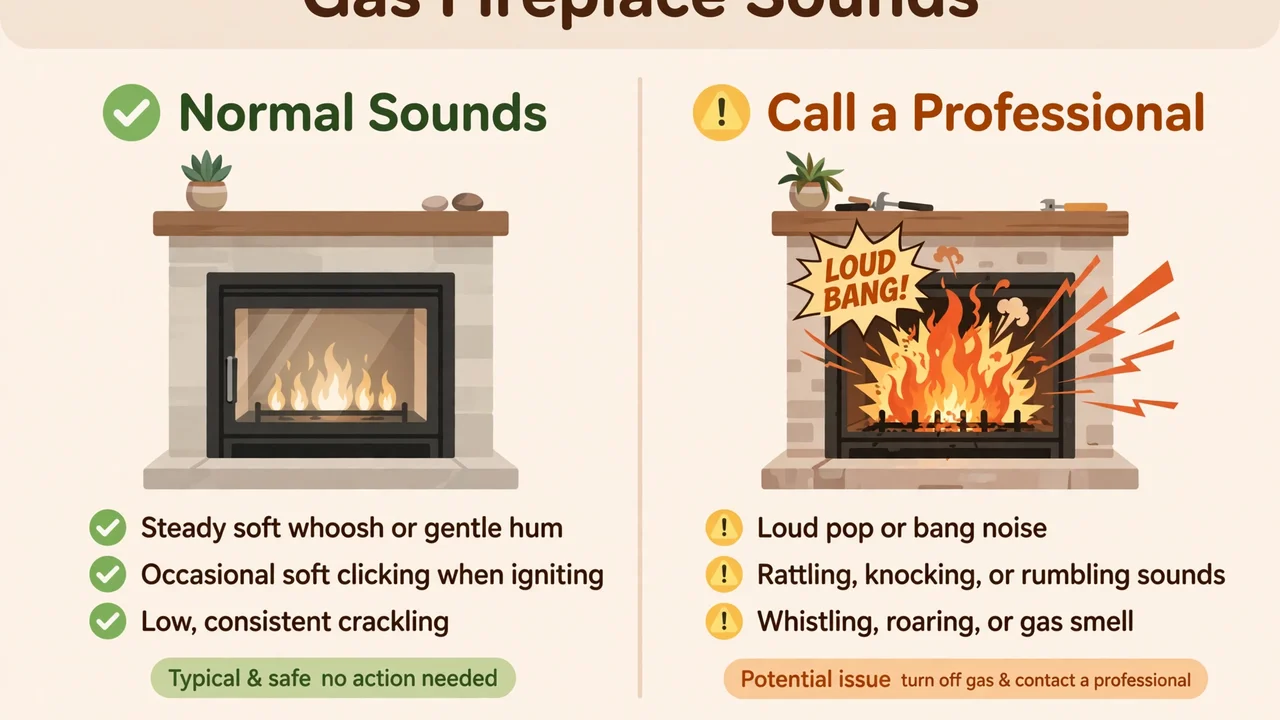
Not every sound means trouble, and knowing the normal set keeps you from worrying over nothing. A soft whoosh at ignition, faint ticking in the first minutes as metal warms, a quiet click when the unit shuts off, and a low hum from the blower are all part of everyday use. These sounds fade as the unit reaches a steady temperature.
The sounds that deserve a call are the ones that break the pattern. A sharp crack that repeats all through the burn, a bang at startup, a whistle that was not there last week, or any pop paired with a gas smell or a CO alarm all sit outside the normal set. When in doubt, turn the unit off and ask a pro. A short service call costs far less than a repair that waited too long.
Popping Sound Decoder: Match the Sound to the Cause
| When You Hear It | What It Often Means | How Urgent | What to Do |
|---|---|---|---|
| First minutes after startup, then fades | Metal firebox and vent parts warming and growing | Low, usually normal | Log the timing, watch the flame, carry on |
| Hours after shutoff | Metal parts cooling and shrinking back | Low, usually normal | No action needed if the flame was steady |
| Light pops through the whole burn | Dust or debris in the burner ports, or logs sitting off their marks | Medium | Clean the burner and reset the logs when cool |
| Sharp pop right at ignition | Flame spreading slowly across a dirty burner | Medium | Clean the ports, then watch the next start |
| Loud bang or boom at startup | Delayed ignition, gas built up before lighting | High | Stop using it, call a licensed gas pro |
| Popping with a gas smell | Possible gas leak | Emergency | Leave at once, call the gas utility or 911 from outside |
| Popping with a CO alarm sounding | Possible CO or venting trouble | Emergency | Leave at once, call 911 from outside |
This table covers the most common patterns. If your sound does not match any row, note the timing and describe it to a technician.
Troubleshooting: If This Happens, Try This
| If This Happens | Try This |
|---|---|
| Pops only in the first few minutes, then silence | Nothing to fix. This is metal warming up. Keep your timing log for a week to confirm the pattern holds. |
| Pops keep coming through the whole burn | Clean the burner ports and reset the logs when the unit is cool. If pops stay after cleaning, book a service visit. |
| Flame stays yellow and lazy | Clean the burner and check that logs and embers sit clear of the ports. A yellow flame that will not turn blue needs a pro. |
| Fireplace will not light after cleaning | Check that the gas control is on and the pilot is lit, following your manual. Our guide on why a gas fireplace will not light covers the safe checks. Do not force the valve. |
| A loud bang happens at startup | Turn the unit off and do not relight it. Call a licensed gas professional and describe the bang and the delay. |
| You smell gas or the CO alarm sounds | Leave the home with everyone and every pet. Call the gas utility or 911 from outside. Do not go back in to check the fireplace. |
Frequently Asked Questions
Is a popping noise in a gas fireplace normal?
Often yes. Light pops and ticks in the first minutes after startup, and again as the unit cools, usually come from metal parts growing and shrinking with heat. Pops that repeat through the whole burn, or a loud bang at startup, are not normal and need a closer look.
Why does my gas fireplace pop when I turn it on?
The metal firebox, casing, and vent parts heat fast and grow a little, and that movement makes popping and ticking sounds. Dust in the burner ports can also slow the flame as it spreads, which adds a sharper pop at ignition.
Why does my gas fireplace pop after I turn it off?
The same metal parts cool and shrink back to their normal size, and that movement can pop and tick for an hour or more after shutoff. This cooling noise is normal when the flame burned steady and blue while the unit ran.
Can a popping gas fireplace be dangerous?
A soft pop from warming metal is not dangerous on its own. A loud bang at startup can mean delayed ignition, which is a real hazard, and any pop paired with a gas smell or a sounding CO alarm is an emergency. Leave the home and call for help from outside in those cases.
How do I stop my gas fireplace from popping?
Start with the safe checks: clean dust from the burner ports, reset the ceramic logs to their marked spots, and spread embers in a thin, even layer. If pops stay after cleaning, or the flame stays yellow, book a licensed gas professional to check the burner, pilot, and gas pressure.
Should I call a professional for a popping gas fireplace?
Call one when pops come with a loud bang, a gas smell, a CO alarm, soot on the glass, or a flame that stays yellow. A yearly service visit also keeps the burner clean and the ignition sharp, which stops most popping before it starts.
Quick Reference Card: Popping Gas Fireplace
You need: flashlight, soft brush, vacuum with hose, notebook, fireplace manual, working CO alarm.
Steps:
- Log when each pop happens
- Watch the flame color and shape
- Clean dust from the burner ports when cool
- Reset the ceramic logs and embers
- Watch how the fireplace lights
- Press panels and listen for the blower
- Call a licensed gas pro for bangs, smells, or alarms
Gas smell or CO alarm: leave at once, call the gas utility or 911 from outside.
Most popping noises turn out to be nothing more than metal doing what metal does as it warms and cools. That is the short answer to “Why Does My Gas Fireplace Make a Popping Noise?” for most homes. Now you know how to tell the harmless ticks from the sounds that need a pro, and you have a timing log to prove the pattern either way.
Keep the burner clean, keep the logs in their marked spots, and keep a working CO alarm in the room. If the pops stay after your checks, or the flame will not burn blue and steady, book that service visit and enjoy the quiet fire you paid for.