How Long Do Gas Fireplaces Last? Lifespans by Type, Wear Signs, and When to Replace Yours
How Long Do Gas Fireplaces Last? Most gas fireplaces last 15 to 25 years with regular care, though the exact number depends on the type you own, how often you run it, and how well it has been looked after. A direct-vent fireplace that gets a yearly service can reach the top of that range, while a vent-free log set in a damp room may wear out years sooner.
That spread matters when you are weighing a repair bill against a new unit, or when you are buying a home and the fireplace looks old. This guide gives you the typical lifespan for each type, the parts that wear out first, a care routine that adds years, and the warning signs that say replacement time has come. By the end, you will know where your fireplace stands and what to do next.
⚠️ Safety First: Carbon Monoxide and Gas Leaks
Gas fireplaces burn fuel indoors, so carbon monoxide (CO) is a real risk if a unit is damaged, blocked, or poorly vented. CO is colorless and odorless, and you cannot see or smell it. The CDC and the U.S. Consumer Product Safety Commission advise every home with a fuel-burning appliance to have working CO alarms on every level and near sleeping areas. Test them monthly and replace them as the maker directs.
If you smell gas (a rotten-egg odor): do not touch light switches, flames, or appliances. Leave the home at once with everyone and all pets. Call your gas utility emergency line or 911 from outside. Never try to find or fix a leak, open a gas line, or relight the fireplace after a strong gas smell. That work belongs to the gas utility or a licensed gas professional.
Pets, and birds in particular, react to CO and combustion fumes sooner than people do, so CO alarms protect the whole household. Never open a gas line, adjust a gas valve past the normal user controls in your manual, bypass a safety device such as a thermocouple or oxygen-depletion sensor, block a vent, or switch off a CO alarm. Fitting, venting changes, conversion, and repairs past basic cleaning go to a licensed gas professional.
TOTAL TIME
About 1 hour
to check and record
ACTIVE TIME
30 minutes
hands-on checks
DIFFICULTY
Beginner
no tools needed
What You Need
- Your fireplace manual (or the brand and model number from the rating plate)
- A flashlight for looking inside the firebox
- A notebook or phone to record the age, model, and any faults
- A soft cloth and a vacuum with a brush head for light cleaning
- Fresh batteries for CO alarms, if yours take them
- The phone number of a licensed gas technician, in case you find a fault
At a Glance
- Check the age and model of your fireplace
- Compare your type against the lifespan table
- Inspect the parts that wear out first
- Test the flame, glass, and controls each month
- Book a yearly professional service
- Track repair costs against replacement cost
- Spot the signs that point to replacement
- Decide repair or replace with a licensed pro
The Short Answer: 15 to 25 Years for Most Units
For a well-kept direct-vent gas fireplace or gas insert, 15 to 25 years is the range most makers and hearth retailers quote. Vent-free models and simple gas log sets tend to sit lower, at 10 to 20 years and 10 to 15 years. Outdoor units face rain, frost, and insects, so they often land at 10 to 20 years even with a cover.
These are typical ranges, not promises. A fireplace that runs every cold evening in a large home will wear sooner than one that runs a few weekends a year. A unit that misses yearly service will wear sooner than one that gets it. Treat the numbers as a guide for planning, and let the state of your own unit have the last word.
Check the Age and Model of Your Fireplace
Open the lower front panel or the access door below the firebox and look for a metal rating plate. It lists the brand, model, serial number, and often the year it was made. Write all four down, and take a photo of the plate so you have it when you call a technician or order a part.
If you cannot find a plate, check the manual that came with the home or the fireplace, or search the maker site with the model name printed on the remote or the glass frame. Homes change hands and manuals go missing, so a photo of the whole unit helps a dealer pin down the model from its shape and trim.
Age alone does not settle the question. A 22-year-old direct-vent unit with a clean service record can still run well, while a 9-year-old vent-free set that never had a service may already show soot and weak flames. Age tells you where to look, and the checks below tell you what you have.
How Long Do Gas Fireplaces Last by Type?
The table below pulls the typical ranges together so you can see your type at a glance. The ranges come from figures commonly cited by makers and hearth retailers, and they assume normal home use with yearly service. Heavy use, damp air, dust, and missed service all pull a unit toward the low end.
| Fireplace type | Typical lifespan | What usually ends its life |
|---|---|---|
| Direct-vent gas fireplace | 15-25 years | Firebox rust, failed valve, worn blower |
| Gas fireplace insert | 15-25 years | Heat exchanger wear, control failure |
| Vent-free (ventless) gas fireplace | 10-20 years | Burner and sensor wear, soot build-up |
| Gas log set | 10-15 years | Burner corrosion, cracked logs, valve wear |
| Outdoor gas fireplace or fire table | 10-20 years | Weather damage, rust, burner blockage |
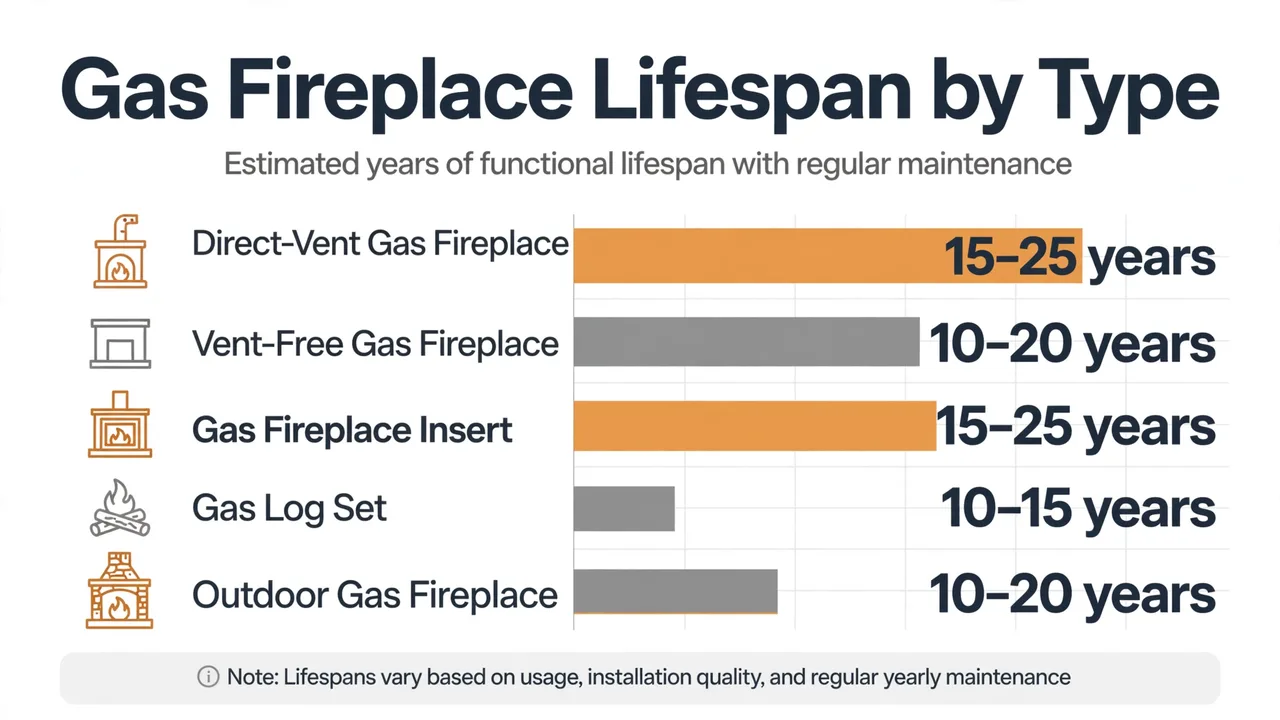
Direct-vent units last longest because they are sealed, draw air from outside, and keep room dust and moisture out of the firebox. Vent-free units sit in the open room, so dust, pet hair, and humidity reach the burner more often. That extra dirt is one reason their range starts lower.
Gas log sets have the shortest range because they are the simplest build: an open burner in an old masonry firebox, with logs that crack and a burner that corrodes over time. They still give good years when the chimney is sound and the burner is cleaned, but the open design works against them.
Fuel type plays a part too. A natural gas vs propane fireplace comparison shows the two fuels burn a little differently, and propane can leave more residue on burners when the tank runs low. Either fuel can serve a unit for its full span, yet propane owners should keep the tank above the low mark and have the burner cleaned on schedule.
Inspect the Parts That Wear Out First
Most gas fireplaces do not fail all at once. One part gives up, then another, and the repair bills start to stack up. Knowing the weak points lets you spot trouble early, when a fix is still cheap.
The pilot assembly and thermocouple go first in many units. The pilot lights the main burner, and the thermocouple is the safety sensor that shuts the gas off if the pilot goes out. When the pilot will not stay lit, or the flame looks weak and yellow, this pair is the first place a technician looks. Dust on the pilot orifice is a common cause, and a yearly clean often clears it.
Gas valves and controls come next. The valve opens and closes the gas flow each time you switch the unit on, and its seals harden with heat and age. A valve that sticks, hums, or leaks gas needs a licensed gas professional at once, and a valve fault on a unit past 20 years often tips the balance toward replacement.
Glass gaskets, burner ports, and the blower round out the list. Gaskets dry out and let room air into the firebox, which changes the flame and can leave soot on the glass. Burner ports clog with dust and rust flakes, which makes the flame patchy. The blower motor wears with use, and a noisy or seized blower is a sign the unit is nearing the end of its later years. If you are still choosing a gas fireplace, look for models with clear access to these parts, since that access keeps service bills lower over the life of the unit.
What wears out first, in order
The order below holds for most home units, though any single part can fail early. Use it as a check list when you look inside the firebox with the unit cool and off.
- Pilot and thermocouple: weak pilot, pilot that will not stay lit.
- Glass gaskets: gaps, fraying, soot creeping onto the glass.
- Burner ports: clogged or rusted holes, uneven or yellow flame.
- Igniter and batteries: slow starts, clicking with no flame.
- Gas valve: sticking, humming, or a smell of gas near the unit.
- Blower motor: grinding noise, weak airflow, or no airflow.
- Firebox and logs: rust spots, flaking metal, cracked ceramic logs.
Pro tip: Photograph the burner and the glass each autumn before the first fire of the season. A yearly photo set shows soot, rust, and flame change far better than memory does, and it gives a technician clear proof of how fast a fault is growing.
Test the Flame, Glass, and Controls Each Month
A monthly check takes about five minutes while the unit is running, and it catches most faults before they turn into a breakdown. Stand back from the glass and watch the flame. A healthy gas flame is mostly blue with small yellow tips, steady, and spread evenly across the burner.
A flame that is tall, yellow, lazy, or lifting off the burner points to dirty ports, low gas pressure, or poor air mix. Soot on the glass, black marks above the firebox, or a smell when the unit runs are stronger warnings. Switch the unit off with the normal user control, let it cool, and call a licensed gas professional. Do not poke at burner ports with wire or open any gas fitting.
While you are there, test the wall switch or remote, and listen to the blower. A remote that needs fresh batteries each month may have a failing receiver, and a blower that rattles or takes minutes to start is wearing out. Wipe the glass with a cloth made for fireplace glass once it is fully cool, and vacuum dust from the lower vents with a brush head.
Test your CO alarms on the same day each month so the habit sticks. Press the test button, note the result, and change batteries when the unit chirps. If an alarm ever sounds, treat it as real: leave the home with people and pets, and call 911 or your gas utility from outside. For the full picture on why these alarms matter, read do gas fireplaces produce carbon monoxide.
Book a Yearly Professional Service
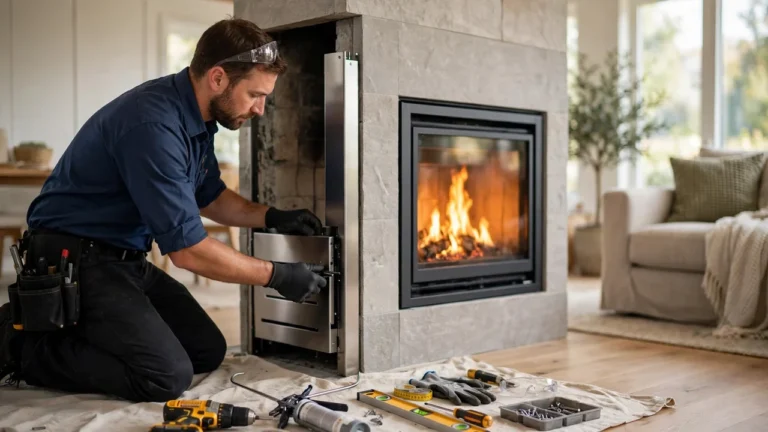
A yearly service is the single best way to push a gas fireplace toward the top of its lifespan range. Book it in early autumn, before the heating season, so any part that needs ordering arrives before cold weather. A standard service covers cleaning the burner and pilot, checking the valve and connections, testing the safety shut-off, checking the vent, and looking for rust or cracks in the firebox.
The technician should also check the vent path and the cap outside. Birds nest in vent caps, leaves block flues, and a blocked vent can push combustion fumes back into the room. Vent-free units need extra care here: they release combustion byproducts, including CO and water vapor, into the room, so they need a working oxygen-depletion sensor and a CO alarm, and some local codes restrict or ban them in bedrooms. Check your local code before you fit or keep a vent-free unit.
Between services, keep the area around the fireplace clear. Dust, pet hair, and lint drift into the burner and the pilot, and a cluttered hearth blocks airflow. A quick vacuum of the vents each month, plus a wipe of the glass when cool, keeps the unit breathing well.
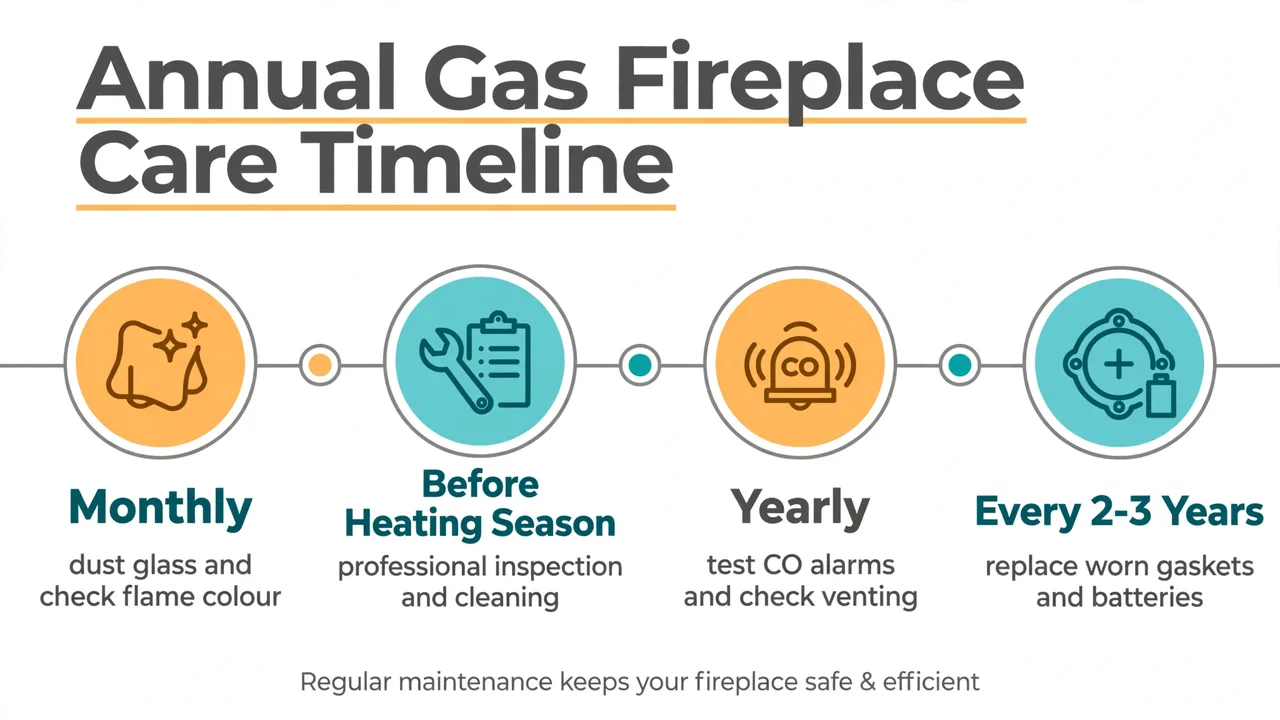
A care routine that adds years
- Monthly: watch the flame, test CO alarms, vacuum the vents, wipe cool glass.
- Before heating season: book the yearly professional service and check the vent cap outside.
- Yearly: have the burner, pilot, valve, and safety shut-off checked and cleaned.
- Every 2 to 3 years: ask the technician about gaskets, batteries, and any part showing wear.
Track Repair Costs Against Replacement Cost
Repairs make sense while they are small and rare. A thermocouple, a set of batteries, or a new gasket costs far less than a new fireplace, and a unit under 15 years old is usually worth fixing. The math changes when repairs come every season, or when one repair costs a large share of a new unit.
A plain rule many owners use is this: if a single repair costs more than about a third of a new unit, or if yearly repairs add up to that much, get a replacement quote before you pay for the fix. Parts also matter. Makers stop making parts for old models, so a 20-year-old valve may be hard to find, and a long wait for a part in midwinter is a cost of its own.
Write each repair down with its date and cost. A short log shows the trend at a glance, and it helps a technician judge whether the unit is wearing out in one place or failing all over. A unit with one fault in five years is aging well. A unit with three faults in two years is telling you its time is near.
Spot the Signs That Point to Replacement
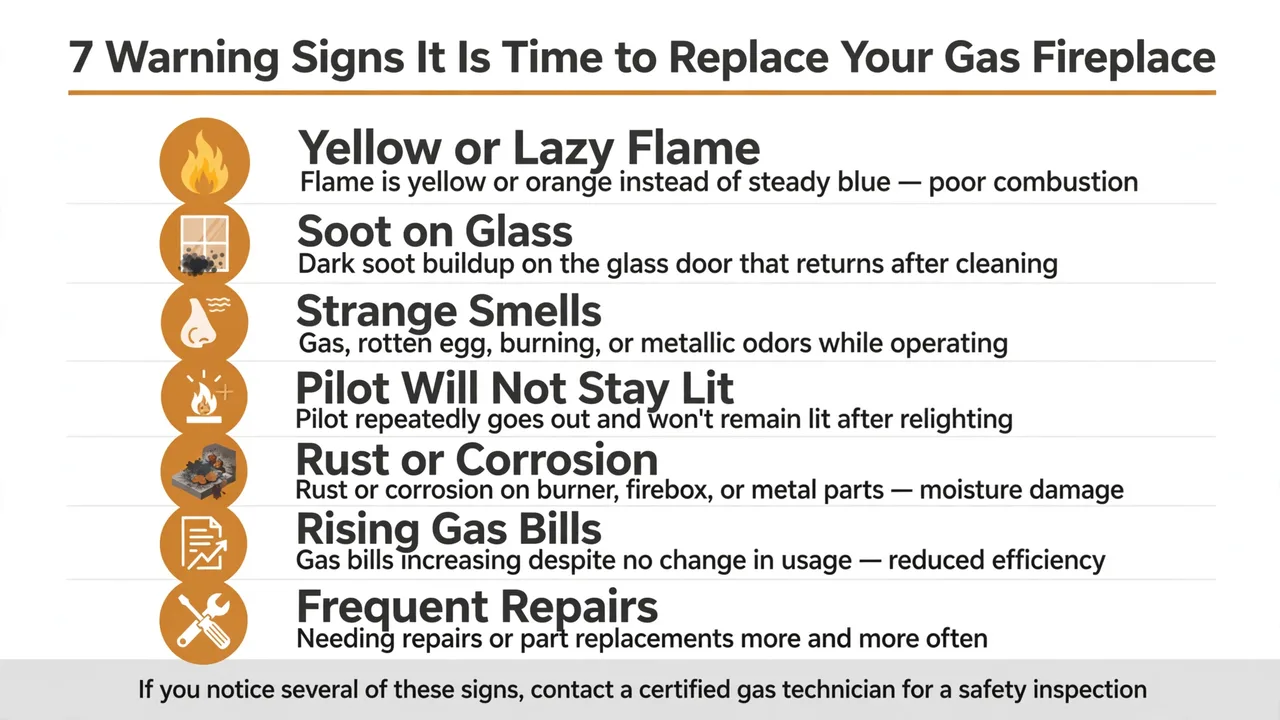
Some faults are a clear call to replace, and some are a nudge to get a professional view. The list below covers the signs owners see most, and the image after it sums them up for a quick check.
Yellow or lazy flames that stay yellow after a service point to burner or vent trouble that cleaning cannot fix. Soot on the glass or on the wall above the fireplace points to poor combustion, which can raise CO risk. A pilot that will not stay lit after the thermocouple has been changed points to a failing valve or control board.
Rust or corrosion inside the firebox is a structural warning. Surface rust on a trim piece is cosmetic, but rust that flakes, pits the metal, or eats through a panel means the firebox itself is failing. Cracks in the firebox or in ceramic logs also belong on the replace list, since heat escapes through them and the unit no longer burns as it was made to.
Rising gas bills with the same use, a smell of gas near the unit, or a CO alarm that has sounded are safety signs, not repair signs. Switch the unit off with the normal user control, leave the home if you smell gas or an alarm sounds, and call for help from outside. If you have ever wondered why a gas fireplace smells like gas, the causes range from a dusty burner to a leak, and only a professional should sort out which one it is.
Decide Repair or Replace With a Licensed Pro
Take your notes, your photos, and your repair log to a licensed gas technician and ask for a straight answer: repair, or replace? A good technician will test the valve, the safety shut-off, and the vent, then tell you whether the fix will hold for years or only for one season.
Ask three questions before you agree to either path. First, are parts still made for this model, and how long would they take to arrive? Second, will the repair restore the flame and the safety shut-off to full working order, or only patch the fault? Third, what would a new unit of the same size cost, fitted, and how does that compare with the repair?
If you do replace, keep the same checks in mind for the new unit. A new direct-vent model with a sealed firebox, a clear manual, and clear access to the burner and pilot will be cheaper to own over 20 years than a cheap unit that is hard to service. Record the install date and the model on day one, so the next owner, or you in 15 years, can answer the lifespan question in a minute.
What Shortens a Gas Fireplace’s Life
Missed service is the biggest shortener. Dust builds on the burner, the pilot orifice narrows, and the flame turns yellow. Soot then coats the glass and the firebox, and the unit works harder for less heat. A year or two of missed service rarely kills a unit, but five years of it often does.
Damp air and poor venting run close behind. A vent that leaks rain, a room that stays humid, or a vent-free unit in a small sealed room will rust the firebox and the burner sooner. Outdoor units face the same wear from weather, which is why a fitted cover and a dry store for the remote and batteries help them last.
Running the unit at full heat for very long stretches also adds wear, though it is less harmful than dirt and damp. Short, steady burns with the blower on keep heat moving and the firebox at an even temperature. If you light your fireplace the same way each time, follow the steps in how to light a gas fireplace so the pilot and burner get a clean start every time.
What Makes One Last Longer
Yearly service, monthly flame checks, and a clean room around the unit are the three habits that add the most years. They cost little, they take minutes, and they catch the small faults that turn into big bills. Keep CO alarms tested and in date, since they guard the household while the unit ages.
Good fitting matters as much as good care. A unit fitted by a licensed gas professional, with the right vent size and a sound gas supply, starts life without the strains that wear a poorly fitted unit out early. If your unit was fitted before you moved in, a first service visit can check the venting and the gas line and flag any fitting fault while it is still fixable.
| If this happens | Try this |
|---|---|
| Pilot will not stay lit | Book a service. The pilot or thermocouple may need cleaning or a new part. |
| Flame is yellow and lazy | Switch off with the normal control. Call a licensed gas professional. Do not adjust the gas supply. |
| Soot on the glass | Let the glass cool, wipe it, and book a service to check combustion and venting. |
| Remote will not start the fire | Change the batteries in the remote and the receiver. If it still fails, book a service. |
| Smell of gas near the unit | Do not touch switches or flames. Leave at once with people and pets. Call the gas utility or 911 from outside. |
| Blower is noisy or weak | Vacuum the vents, then ask a technician to check the motor and bearings. |
| CO alarm sounds | Leave the home at once. Call 911 or the gas utility from outside. Do not re-enter until cleared. |
Frequently Asked Questions
How long does a gas fireplace last?
Most gas fireplaces last 15 to 25 years with yearly service. Vent-free models usually last 10 to 20 years, and gas log sets usually last 10 to 15 years.
Can a gas fireplace last 30 years?
Some direct-vent units reach 30 years with steady service and light use, but that is past the typical range. Parts become hard to find at that age, so a safety check matters more than the year count.
What part of a gas fireplace wears out first?
The pilot assembly and thermocouple usually wear out first, followed by glass gaskets and burner ports. A pilot that will not stay lit is the most common early sign.
Is it worth repairing a 20-year-old gas fireplace?
A small repair can still be worth it if the firebox is sound and parts are still made. If one repair costs more than about a third of a new unit, or repairs keep coming each season, get a replacement quote first.
How often should a gas fireplace be serviced?
Have it serviced once a year by a licensed gas professional, ideally in early autumn before the heating season. Test CO alarms monthly between services.
Do vent-free gas fireplaces last as long as direct-vent models?
No, vent-free models usually last 10 to 20 years, while direct-vent models usually last 15 to 25 years. Vent-free units release combustion byproducts into the room, so they need a working oxygen-depletion sensor, a CO alarm, and a check of local codes.
What are the signs a gas fireplace needs replacing?
Yellow or lazy flames, soot on the glass, a pilot that will not stay lit, rust or cracks in the firebox, rising gas bills, and repairs every season all point to replacement. A gas smell or a CO alarm sounding needs help at once, not a repair booking.
Does a gas fireplace add life to a home or lose value with age?
A working, serviced gas fireplace is a plus for a home, while an old unit with no service record can put buyers off. Keep the service log and the install date, since both help a buyer judge the unit.
Quick Reference Card
Typical lifespans: direct-vent 15-25 years; insert 15-25 years; vent-free 10-20 years; log set 10-15 years; outdoor 10-20 years.
You need: model number, flashlight, notebook, cloth, vacuum brush head, fresh CO alarm batteries.
Steps: 1. Check age and model. 2. Compare type to the table. 3. Inspect wear parts. 4. Test flame, glass, and controls monthly. 5. Book yearly service. 6. Track repair costs. 7. Spot replacement signs. 8. Decide with a licensed pro.
Safety: CO alarms on every level, tested monthly. Smell gas? Leave at once, call the gas utility or 911 from outside.
Conclusion
How Long Do Gas Fireplaces Last? For most homes the answer is 15 to 25 years, with the type, the use, and the care setting the final number. Check the age and model, compare your type to the table, and watch the flame each month.
Yearly service and a short repair log will tell you when a fix is worth it and when a new unit is the better call. If you find a warning sign, or if your fireplace is past 20 years with no service record, book a licensed gas professional and get a straight answer before the cold sets in.