Can You Install a Gas Fireplace Yourself? What You Can Do and What a Pro Must Do
Can You Install a Gas Fireplace Yourself? The short answer is part yes and part no. You can handle a lot of the work around the edges: pick the unit, measure the space, prep the wall, and hire the right pro. The gas hookup, the venting, and the final safety checks belong to a licensed gas professional, and in most places the law says so too.
This guide walks you through the whole project in order, from first measurement to first fire. You will know exactly which parts are yours, which parts are the pro’s, and what to check at each stage so the job ends safe and warm. Read the safety box below before you start. It covers the two risks that matter most with gas heat: carbon monoxide and gas leaks.
Read this first: gas safety
Carbon monoxide (CO) is a colorless, odorless gas that gas appliances can produce. A vented fireplace sends combustion gases outside through a vent. A vent-free unit releases those gases into the room, so it needs a working oxygen-depletion sensor and a CO alarm nearby. Put a working CO alarm on every level of your home and near each sleeping area. Test alarms once a month and replace them on the maker’s schedule.
If you smell gas (a rotten-egg odor), act at once. Do not touch light switches, flames, or appliances. Leave the home at once with everyone, pets included. Call your gas utility emergency line or 911 from outside. Never try to find or fix a leak, and never relight anything after a strong gas smell. That work belongs to the gas utility and a licensed gas fitter.
Pets react to CO and fumes sooner than people do, and birds are the most sensitive of all. CO alarms protect the whole household, people and animals alike. If anyone feels dizzy, sick, or confused near a gas appliance, get fresh air and call emergency services.
Total time
2 to 4 weeks
Mostly permits and scheduling
Your active time
6 to 10 hours
Measuring, prep, and calls
Difficulty
Moderate
Pro required for gas and venting
What you need
✓ Tape measure and pencil
✓ Stud finder and level
✓ Painter’s tape for marking the outline
✓ The fireplace manual for your chosen unit
✓ Permit forms from your local building office
✓ Phone numbers for the gas utility and building office
✓ A short list of licensed gas installers
✓ Noncombustible surround materials, per the manual
✓ Working CO alarms for every level
✓ A fire extinguisher rated for home use
The Short Answer: You Do the Prep, a Licensed Pro Does the Gas
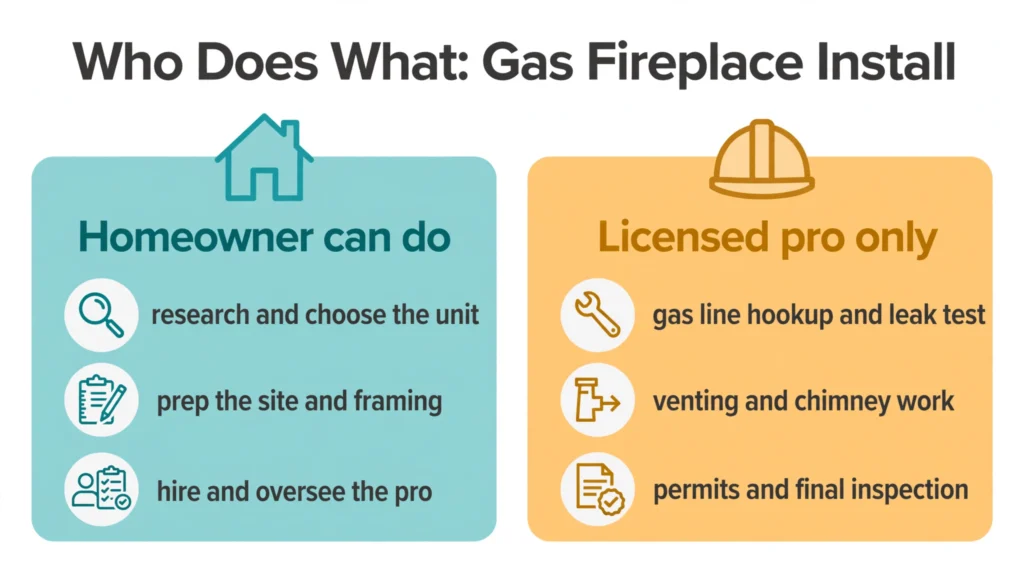
A gas fireplace install has two halves. The first half is planning and prep, and that half is yours. You choose the unit, measure the wall, check the rules, and get the site ready. The second half is gas, venting, and inspection, and that half belongs to a licensed gas professional. The line between the two is not a matter of skill or courage. Gas lines, vent runs, and leak tests carry real risk, and most local codes require a licensed pro to do them.
Think of it like a kitchen remodel. You can pick the cabinets, paint the walls, and clear the room. You would not rewire the panel yourself. A gas fireplace works the same way. Your prep work saves time and money, and the pro’s work keeps the house safe. The image below shows the split at a glance.
At a glance: your 8 steps
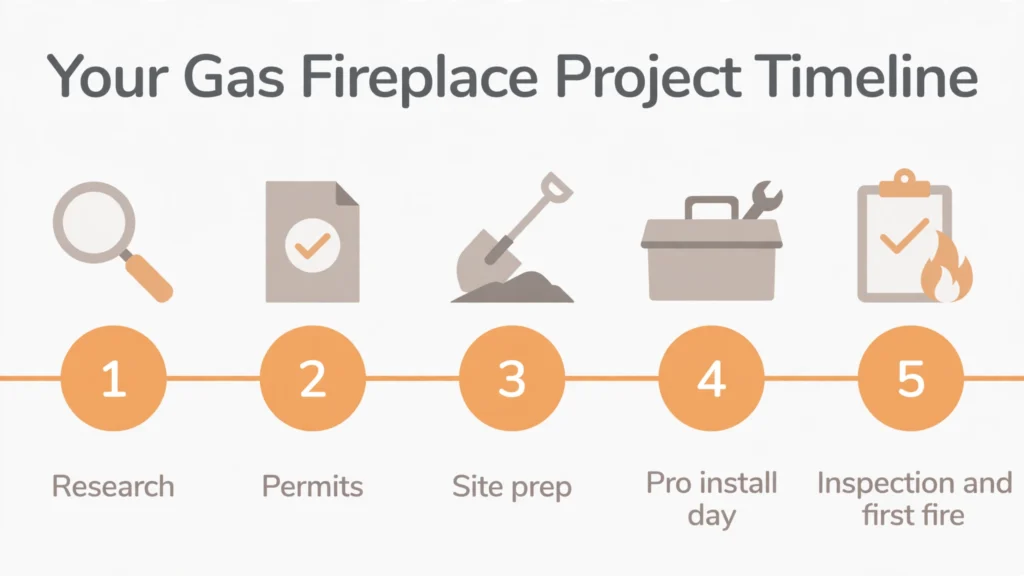
- Pick the gas fireplace type that fits your home
- Measure your space and check clearances
- Check permits and local codes before you buy
- Compare natural gas and propane for your home
- Get quotes and hire a licensed gas installer
- Prep the site and frame the opening
- Watch the pro connect gas, venting, and power
- Pass inspection and light your first fire
Step 1: Pick the Gas Fireplace Type That Fits Your Home
Four main types cover most homes. A direct-vent fireplace pulls fresh air from outside and sends exhaust back out through a sealed vent, which makes it a common pick for living rooms and bedrooms. A vent-free (ventless) unit needs no chimney or vent, but it releases combustion byproducts into the room, so many areas restrict it or ban it in bedrooms. An insert slides into an old wood fireplace opening and uses the old chimney with a liner. A gas log set sits inside an open fireplace and gives you flames with less heat.
Match the type to your room before you shop. A home with no chimney leans toward direct vent or vent-free. A home with a sound masonry fireplace leans toward an insert or a log set. Read our guide on how to choose a gas fireplace to compare sizes, heat output, and looks side by side. Then read vented vs ventless gas fireplaces so you know the trade-offs before you fall in love with one style.
Step 2: Measure Your Space and Check Clearances
Grab the tape measure and the manual for the unit you like. Measure the width, height, and depth of the spot where the fireplace will go, and write each number down. Then find the clearance numbers in the manual: the minimum gap to wood trim, to the mantel, to the floor, and to the TV above. Those gaps are set by the maker for fire safety, and the inspector will check them.
Mark the outline on the wall and floor with painter’s tape. Stand back and look at it from the sofa. Check the view from the doorway too. A taped outline costs nothing and catches a too-big or too-small unit before you spend a cent. Measure twice, then measure the doorway and the hall as well, so the unit can reach the room on install day.
Step 3: Check Permits and Local Codes Before You Buy
Call your local building office before you order anything. Ask three questions: do I need a permit for a gas fireplace, does my area allow vent-free units, and who must pull the permit, me or the installer? Write down the answers with the name of the person you spoke to. Rules change from town to town, and a neighbor’s advice is no substitute for the office that signs the permit.
Some areas also require a gas permit on top of the building permit, and some require the installer to hold a gas license. If your home sits in a condo or a homeowners association, check those rules too. A permit costs time, often 1 to 3 weeks to receive, so start this step early. Buying the unit first and asking later is the most common way this project stalls.
Heads up: skipping the permit can cost you the fireplace
An unpermitted gas install can void part of your home insurance, fail a future home sale inspection, and force a tear-out. The permit is also your proof that a licensed pro did the gas work and that an inspector checked it. Keep the signed permit card with your home records.
Step 4: Compare Natural Gas and Propane for Your Home
Your fuel choice depends on what already reaches your house. Homes on a city gas line use natural gas, which arrives by pipe and needs no tank. Homes off the gas grid use propane, which lives in a tank outside and needs refills. The fireplace burner and gas valve differ between the two fuels, so the unit must match the fuel you will burn. A natural gas unit cannot run on propane without a conversion kit and a pro to fit it.
Ask your gas utility or propane supplier what a new fireplace line will need. Propane users should ask about tank size and refill timing, since a fireplace adds to winter use. If you are weighing the two fuels, read natural gas vs propane fireplaces for a plain side-by-side look at cost drivers, heat, and upkeep. Settle the fuel question now, because it shapes the quote in the next step.
Step 5: Get Quotes and Hire a Licensed Gas Installer
Call 3 licensed installers and ask each for a written quote. A sound quote lists the unit, the gas line run, the vent run, the permit fee, and the inspection. Ask each installer to show a current gas license and proof of insurance. Ask who pulls the permit, who schedules the inspection, and what leak test they run after the hookup. A pro who dodges those questions is a pro to skip.
Compare the quotes line by line, not the bottom number alone. The lowest bid may leave out the vent kit or the permit. Tell each installer your fuel type, your fireplace type, and the measurements from Step 2, so all three quotes cover the same job. Pick the installer who explains the work in plain words and puts the scope in writing. Book the install date only after the permit is in hand.
Pro tip: ask about the leak test by name
After the gas line is connected, the installer should pressure-test the line and check every joint for leaks. Ask how they test and what reading counts as a pass. A clear answer tells you the installer takes the gas side seriously, and it gives you a fact to check on install day.
Step 6: Prep the Site and Frame the Opening
This is the step where your own hands do the most work. Clear the room and cover the floor with drop cloths. If the plan calls for a framed opening, build it to the rough opening size in the manual, and check that the opening is square by measuring both diagonals. A frame that is out of square by even a small amount can leave gaps around the unit that show for years.
Keep the wall open until the pro has run the gas line and vent. Do not close drywall over a gas line or a vent that has not been inspected. Take photos of the framing, the studs, and the wall cavity before anything is covered. Those photos help the inspector and help you later if you hang a mantel or a TV. If your project swaps a wood fireplace for gas, read can you convert a wood fireplace to gas to see what the opening needs before the pro arrives.
Step 7: Watch the Pro Connect Gas, Venting, and Power
On install day, your job is to watch, ask, and keep the area clear. The pro runs the gas line, fits the shutoff valve, connects the vent, and wires the controls. Watch for the leak test after the hookup, and ask to see the result. Check that the vent run follows the manual: sealed joints, the right slope, and the right clearance to wood. Do not touch gas fittings, valves, or vent parts yourself, even to help.
Keep kids and pets out of the room while the pro works. Note the location of the gas shutoff valve and ask the pro to show you how to turn the fireplace off with its normal user controls. That short lesson matters, because the shutoff valve and the user controls are the only gas parts you should ever touch. Anything past that point is a call to the pro.
Step 8: Pass Inspection and Light Your First Fire
Do not light the fireplace until the inspector has signed off. The inspector checks the gas line, the vent, the clearances, and the CO alarm placement. If the inspector flags a fix, let the installer make it and book a re-check. A failed first inspection is common and it is not a disaster. It means the system worked.
After the pass, the installer lights the pilot and runs the unit with you in the room. Ask what a healthy flame looks like on your model, and ask how to clean the glass and the burner. New units often need a short break-in burn to clear factory smells, so open a window for that first run. Then start the habit that keeps the unit safe: read the gas fireplace maintenance annual checklist and book the yearly service.
What a Gas Fireplace Install Costs
The total cost moves with four things: the unit you pick, the length of the gas line run, the vent route, and the permit fee in your town. A short gas run to a direct-vent unit on an outside wall costs less than a long run through a finished house with a new chimney liner. An insert that reuses a sound chimney costs less on venting than a brand-new vent through a roof. No two homes land on the same number, so treat any single price you hear as a guess until a licensed installer has seen your house.
Get your three written quotes from Step 5 and compare them the same way: unit, gas line, vent, permit, inspection. Ask each installer what would add cost if the wall hides a surprise, such as a pipe or a wire in the vent path. For a full breakdown of what drives the price, read how much it costs to install a gas fireplace. Budget for the permit and the yearly service too, not only the unit.
Before and after: what to expect
Before
A cold wall or an unused wood fireplace. No gas line, no vent, and no clear plan for who does what. Questions about permits, fuel, and cost with no firm answers yet.
After
A permitted fireplace with a tested gas line, a sealed vent, and a signed inspection. Working CO alarms on every level. A first fire you lit with the installer beside you, and a yearly service date on the calendar.
4 mistakes that derail a gas fireplace install
1. Buying the unit before checking codes. A vent-free unit may be banned in your town or in bedrooms. A unit that fits the room may fail the clearance rules. Check the codes first, then buy.
2. Skipping the permit to save time. The permit is your proof of a legal, inspected install. Without it, insurance and resale can both turn against you, and a tear-out costs far more than the wait.
3. Hiring on price alone. The cheapest bid often drops the vent kit, the permit, or the leak test. Compare written quotes line by line, and check the license and insurance before you sign.
4. Closing the wall before inspection. Drywall over an uninspected gas line or vent hides the very parts the inspector must see. Keep the wall open until the inspection passes.
Frequently asked questions
Can I install a gas fireplace myself without a license?
You can do the planning, measuring, site prep, and framing yourself. The gas line hookup, venting work, and leak test must go to a licensed gas professional, and most local codes require it.
Do I need a permit to install a gas fireplace?
In most areas, yes. Call your local building office before you buy, ask what permits apply, and find out who must pull them. Some areas also require a separate gas permit.
How long does a gas fireplace install take?
The pro install itself often takes one day. The full project usually takes 2 to 4 weeks, because permits take 1 to 3 weeks and installers book ahead.
Can I install a gas fireplace in a bedroom?
It depends on your local code and the unit type. Vent-free units are restricted or banned in bedrooms in many areas. Check your local code and the manual before you buy.
What should I do if I smell gas after the install?
Do not touch switches, flames, or appliances. Leave the home at once with everyone, pets included. Call your gas utility emergency line or 911 from outside. Never try to find or fix the leak yourself.
Quick reference card
You need: tape measure, stud finder, level, painter’s tape, fireplace manual, permit forms, installer list, CO alarms.
Remember: CO alarm on every level and near sleeping areas. Smell gas? Leave at once and call from outside.
- Pick the fireplace type that fits your home
- Measure your space and check clearances
- Check permits and local codes before you buy
- Compare natural gas and propane
- Get 3 quotes and hire a licensed gas installer
- Prep the site and frame the opening
- Watch the pro connect gas, venting, and power
- Pass inspection and light your first fire
You did the part that was yours, and a licensed pro did the part that keeps the house safe. That split is the whole answer to the question in the title. A gas fireplace is a project you can lead without touching a gas line.
Your next step is upkeep. Book the yearly service, test the CO alarms once a month, and keep the manual where you can find it. Read do gas fireplaces need a carbon monoxide detector to check that your alarm placement matches the guidance for your home. Then enjoy the fire.