Ceramic vs Oil-Filled Heater: Which Should You Buy for Your Room?
The ceramic vs oil-filled heater choice starts in the heater aisle, with two boxes in front of you. One box holds a small ceramic heater with a fan. The other holds a tall oil-filled radiator with metal fins.
Both promise a warm room. Both cost about the same to run at the same wattage. Which one you should buy comes down to how fast you want heat, how long you need it, and how much noise you can live with.
This guide walks through that choice in plain terms. You will learn how each heater works, how they compare on speed, noise, safety, and cost, and which one fits a bedroom, a home office, or a living room. By the end you will know exactly which box to carry home.
One fact shapes the whole comparison. Both heaters are electric resistance heaters. That means both turn nearly all of the electricity they use into heat.
Neither type cheats physics. What differs is how the heat reaches you and how long it lingers after you switch the heater off.
Safety first: read this before you plug anything in
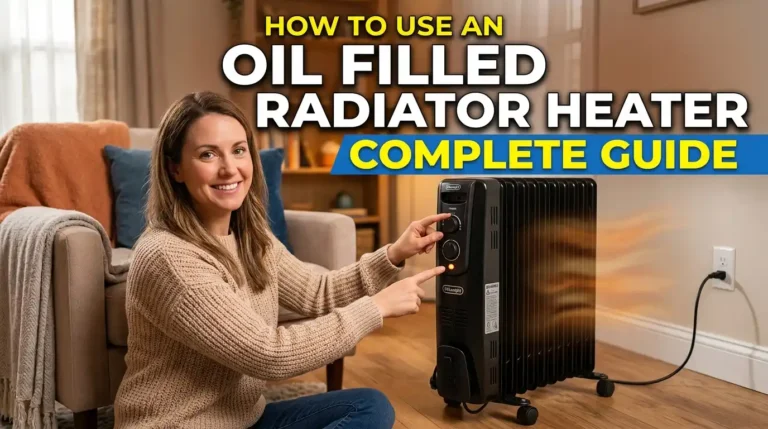
Plug every space heater straight into a wall outlet. Never use an extension cord or a power strip. Keep at least 3 feet of clear space around the heater on all sides. Keep it away from curtains, bedding, paper, and pets.
Never leave a space heater running unattended or while you sleep unless the manual for your exact model says it is safe to do so. Choose a model with tip-over shutoff and overheat protection. If a heater smells hot, sparks, or has a damaged cord, switch it off, unplug it, and stop using it. This article is general guidance, not a substitute for the safety manual that came with your heater.
Decision time
15 minutes
Difficulty
Beginner
Best for
One cold room
What you need before you buy
- A tape measure, to size the room you want to heat
- The room’s rough length and width in feet
- A free wall outlet on its own circuit if possible
- A clear floor spot with 3 feet of space on all sides
- The heater manual for the model you choose, read before first use
At a glance: your five decision steps
- Measure your room and check your outlet
- Match the heater to how long you need heat
- Check the safety features before you buy
- Set the heater up the safe way
- Test it for a week and keep notes
How a ceramic heater works
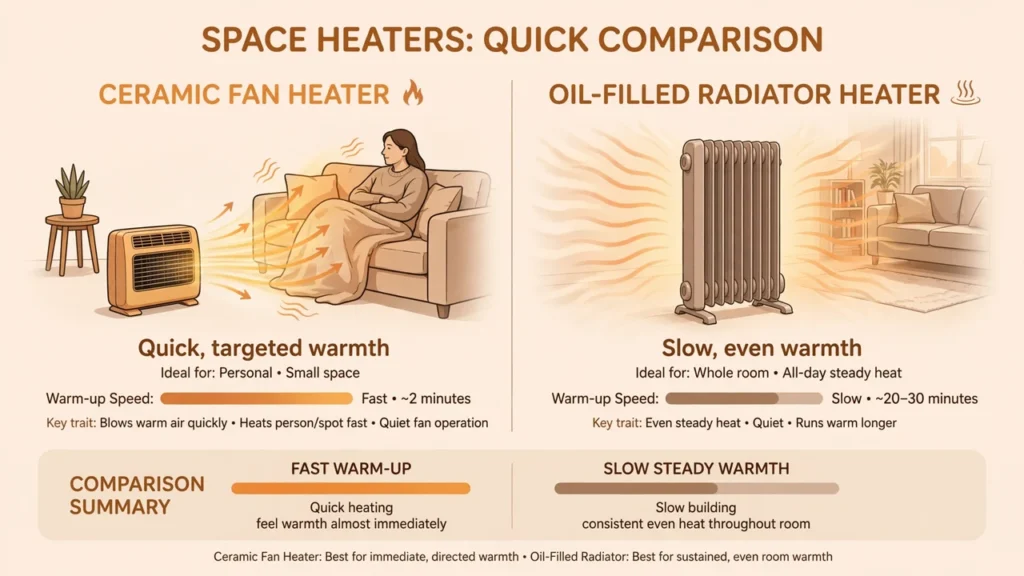
A ceramic heater warms small ceramic plates with an electric element. A fan blows room air across the hot plates and pushes warm air out into the room. You feel the warmth fast, often within a minute of switching it on. The heat is directional, so it warms the spot in front of the heater first and the rest of the room second.
Most ceramic heaters use a positive temperature coefficient element, known as PTC. The plates heat fast and cool fast. That quick response is the whole point of the design.
It also means the warmth fades within a minute or two after you switch the heater off. The fan keeps the heat moving, but it also adds a low hum that you will hear in a quiet room.
Ceramic heaters are usually small and light. Many tabletop models weigh less than 5 pounds and fit on a desk or a shelf. Tower models stand on the floor and often add oscillation, which sweeps the warm air across a wider area.
If you want fast heat in one spot, this is the heater built for that job. Our guide to the best type of space heater puts ceramic models in the same family as other fan-forced heaters, and it helps to see where each type fits.
What ceramic heaters do well
Speed is the clear win. A ceramic heater starts warming the air around you almost at once. That makes it a strong pick for a home office, a desk, or a chilly corner where you sit for an hour or two. The thermostat reacts fast too, so the heater cycles on and off in short bursts as the room warms.
Portability is the second win. A light ceramic heater moves from room to room with one hand. You can carry it to the office in the morning and to the living room at night. Small models cost less than most oil-filled radiators, though prices vary widely by brand and features, so check current prices before you buy.
Where ceramic heaters fall short
The fan is the trade-off. Even a quiet ceramic heater makes some sound, and cheap models can whine or rattle. Light sleepers often notice it at night. The heat also fades fast once the heater stops, so the room can cool between cycles on a cold night.
Because the heat is directional, a ceramic heater can leave the far side of a large room cool while the near side feels warm. That is normal for a fan-forced design. It is a spot heater at heart, even when the box calls it a room heater.
How an oil-filled heater works
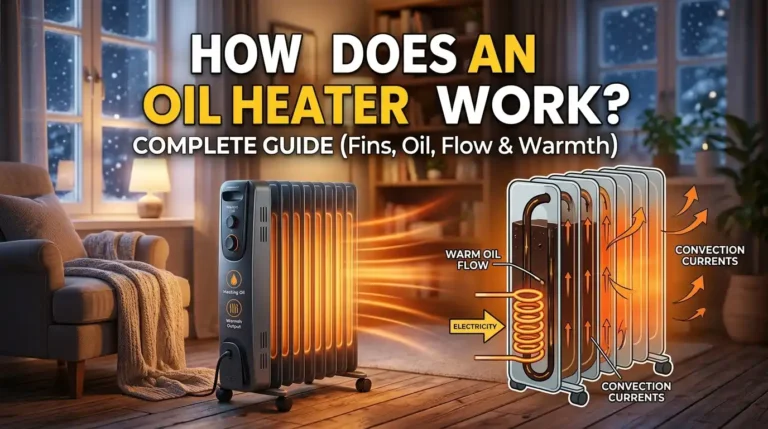
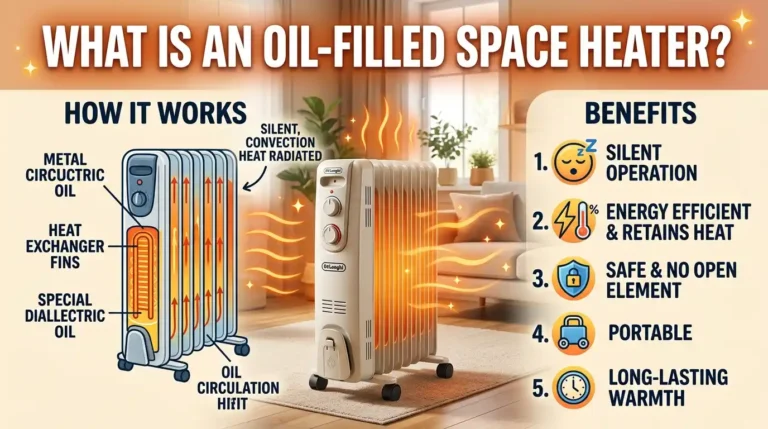
An oil-filled heater looks like an old-fashioned radiator. Inside, an electric element warms sealed diathermic oil. The oil warms the metal fins, and the fins warm the room by natural convection. Warm air rises off the fins, cool air flows in at the bottom, and the cycle repeats with no fan at all.
The oil never burns and never needs refilling. It is a sealed heat store, not a fuel. That is why the heater keeps giving off warmth long after you switch it off.
The fins can stay warm for 20 to 40 minutes, though the exact time varies by model and room temperature. If you want the full picture, our explainer on how oil-filled heaters work walks through the process step by step.
Oil-filled heaters take longer to get going. Expect 10 to 20 minutes before the room feels clearly warmer, though the fins start warming within a few minutes. That slow start is the price of steady, silent heat. Once the fins are hot, the warmth feels even across the room, with no hot blast on one side and a cold corner on the other.
What oil-filled heaters do well
Silence is the clear win. With no fan and no moving parts, an oil-filled heater makes no sound at all. That makes it a natural pick for a bedroom or a nursery, where a fan hum can disturb sleep.
The steady heat also suits long sessions. A living room that stays occupied all evening benefits from warmth that does not surge and fade.
The heat that lingers after switch-off is a real bonus. The fins keep warming the room while the element rests, which can mean fewer on-off cycles overnight. Many owners run the heater on a lower setting for hours rather than blasting a high setting for a short burst.
Where oil-filled heaters fall short
Weight is the main drawback. A full-size oil-filled radiator often weighs 15 to 25 pounds. It has wheels and a handle, but it is still a chore to carry up stairs. It also takes up more floor space than a ceramic heater, and the fins get hot to the touch, so keep children and pets from leaning on it.
Slow heat is the second drawback. If you walk into a cold room and want warmth in two minutes, an oil-filled heater will disappoint. It rewards patience and planning, not impulse. Switch it on before you need the room warm, not after.
Ceramic vs oil-filled heater: the head-to-head table
The table below sums up the comparison. Figures are typical ranges for common portable models sold in the United States. Check the label on the exact model you buy, because wattage, weight, and features vary by brand.
| Feature | Ceramic heater | Oil-filled heater |
|---|---|---|
| How it heats | Ceramic plates plus a fan push warm air out | Heated oil warms metal fins, warm air rises |
| Warm air felt | Often within a minute | Often 10 to 20 minutes for full warmth |
| Heat after switch-off | Fades in a minute or two | Fins stay warm 20 to 40 minutes |
| Noise | Fan hum, varies by model | Silent, no fan |
| Typical wattage | 750 to 1,500 watts | 600 to 1,500 watts |
| Typical weight | Often under 5 pounds | Often 15 to 25 pounds |
| Best for | Quick spot heat, desks, small rooms | Steady heat, bedrooms, long evenings |
| Running cost | Same as oil-filled at the same wattage | Same as ceramic at the same wattage |
Read the last row twice, because it surprises most buyers. At the same wattage, a ceramic heater and an oil-filled heater cost the same to run per hour. Both turn nearly all of their electricity into heat. The difference in your bill comes from how long each heater runs and how often its thermostat lets it rest, not from the type of heater on the label.
The short answer, up front
Pick a ceramic heater when you want fast warmth in one spot for a short time. Pick an oil-filled heater when you want quiet, even warmth for hours. If you heat a bedroom overnight, oil-filled usually wins. If you heat a desk for two hours, ceramic usually wins.
If you still feel torn, the room-by-room guide near the end of this article settles it for most homes.
Measure your room and check your outlet
Grab the tape measure before you open a shopping page. Measure the length and width of the room in feet, then multiply the two numbers for the floor area. A room that is 10 feet by 12 feet covers 120 square feet. Write the number down, because it anchors every choice that follows.
Most portable heaters sold in the United States top out at 1,500 watts on a standard 120-volt household circuit. That cap exists because a normal outlet and its wiring can only carry so much current safely. A heater rated above 1,500 watts needs a 240-volt circuit, which most bedrooms and living rooms do not have. If you need more heat than one 1,500-watt heater gives, the answer is a second heater or a different heating system, not a bigger plug-in box.
Check the outlet you plan to use. It should be a wall outlet in good shape, with no cracks, no loose fit, and no scorch marks. The heater needs its own outlet.
Do not share it with a hair dryer, a microwave, or another heater. If you are unsure about the size you need, our guide on what size space heater you need walks through room size and wattage in more detail.
Heads up: the outlet test takes ten seconds
Plug the heater in and run it on high for ten minutes. Touch the plug, not the cord. If the plug feels hot, switch the heater off and try a different outlet. A warm plug can point to a worn outlet, and a worn outlet is a fire risk. When in doubt, call an electrician.
Match the heater to how long you need heat
Think about your longest heating session in that room, not your shortest. A ceramic heater shines in short bursts. You sit at a desk for two hours, you want warmth now, and you switch it off when you leave. The fan gets the air warm fast, and the quick cool-down is no loss because you are done with the room anyway.
An oil-filled heater shines in long sessions. You sleep in a bedroom for seven hours, or you spend the whole evening in a living room. The slow start matters less when the heater runs for hours, and the silent, even heat matters more. The fins keep warming the room between thermostat cycles, so the temperature stays steadier through the night.
Noise belongs in this step too. A fan hum that seems fine in a busy living room can feel loud in a silent bedroom at 2 a.m. If you are a light sleeper, that single fact can settle the whole decision. Our comparison of infrared vs oil-filled heaters covers the same quiet-heat trade-off from another angle, and it is worth a read if silence is your top priority.
Check the safety features before you buy
Read the feature list on the box before you look at the price. Three features matter most.
First, tip-over shutoff, which cuts power if the heater falls over. Second, overheat protection, which cuts power if the heater gets too hot inside. Third, a thermostat with more than one heat setting, so you can run the heater on low once the room is warm.
Look for a safety certification mark from a recognized lab, such as UL or ETL. The mark means an independent lab tested the heater to a safety standard. It is not a guarantee, but it is a useful filter. Skip any heater with no certification mark, a damaged cord, or a plug that wobbles in the outlet.
Check the cord length as well. A short cord forces you to place the heater near the outlet, which may not be the spot with 3 feet of clear space. A cord that is too short tempts people to reach for an extension cord, and that is exactly what the safety rules forbid. Plan the placement first, then buy a heater whose cord reaches that spot.
Set the heater up the safe way
Place the heater on a flat, hard floor, never on carpet with a thick pile, a bed, or a rug that can bunch under it. Keep 3 feet of clear space on all sides, including above it. Curtains, bedding, towels, and paper all stay outside that circle.
Plug the heater straight into the wall outlet. Never use an extension cord or a power strip with a space heater, even a heavy-duty one. Our guide on plugging a space heater into an extension cord or power strip explains why this rule has no safe exception.
Point a ceramic heater toward the spot where you sit, not toward a wall or a curtain. A fan heater aimed at a wall wastes its warm air and can overheat the wall surface. Place an oil-filled heater where air can flow around the fins on all sides. Pushing it tight against a wall or a sofa blocks the convection that makes it work.
Run the heater on high for the first 20 minutes, then drop it to a lower setting once the room feels warm. The thermostat will cycle the heater on and off from there. Resist the urge to run it on high all day. High heat all day costs more, dries the air more, and wears the heater faster, with no extra comfort once the room is already warm.
Test it for a week and keep notes
Live with the heater for a week before you decide it was the right buy. Keep a small note on your phone. Write down the room temperature when you switch it on, the setting you used, and how long it took to feel warm. Note the noise level at night and whether the room stayed warm through the evening.
Pay attention to the thermostat cycles. A heater that runs nonstop on high in a room it should heat with ease may be too small for the space, or the room may be losing heat through a drafty window. A heater that cycles off for long stretches on low is doing its job well. Those notes tell you more than any review can, because they describe your room, your outlet, and your habits.
Most stores allow returns within a set window. Keep the box and the receipt until your test week ends. If the heater is too loud, too slow, or too small for the room, swap it for the other type. A week of notes makes that swap an easy call instead of a guess.
What a ceramic vs oil-filled heater costs to run
Running cost depends on watts, hours, and your electricity rate. The formula is simple. Divide the watts by 1,000 to get kilowatts.
Multiply by the hours the heater runs. Multiply that by your electricity rate per kilowatt-hour. The result is the cost for that session.
Here is a worked example with a stated rate, so you can swap in your own numbers. A 1,500-watt heater running for 4 hours uses 6 kilowatt-hours. At 15 cents per kilowatt-hour, that session costs 90 cents.
The same math applies to both heater types. If both run at 1,500 watts for 4 hours, both cost the same 90 cents in this example.
The real difference shows up in run time. A ceramic heater in a small office may run for 2 hours and then switch off for the day. An oil-filled heater in a bedroom may run on low for 7 hours overnight.
The bedroom heater costs more per night, not because oil-filled heaters are wasteful, but because it runs longer. Your electricity rate varies by state and by plan, so check your own bill for the rate that applies to you.
Cost at a glance: one 4-hour session at 1,500 watts
Ceramic heater, 4 hours on high, 6 kWh
90 cents at 15 cents per kWh in our example
Oil-filled heater, 4 hours on high, 6 kWh
90 cents at 15 cents per kWh in our example
The bars match on purpose. At the same wattage and the same run time, the cost is the same. Thermostat cycling and run time are what move your bill.
Myth vs fact
Myth: Oil-filled heaters cost less to run than ceramic heaters.
Fact: At the same wattage, both cost the same per hour. Oil-filled heaters can feel cheaper because the fins keep giving off heat between cycles, which can shorten run time in a well-sealed room.
Myth: Ceramic heaters are unsafe because the plates get so hot.
Fact: Both types get hot, and both need the same 3-foot clearance and the same wall-outlet rule. Safety comes from certification, tip-over shutoff, overheat protection, and placement, not from the heater type.
Myth: A bigger heater always heats a room better.
Fact: A heater that is too large for a room cycles on and off in short bursts and can leave cold spots. A heater matched to the room size holds a steadier temperature.
Which heater fits each room
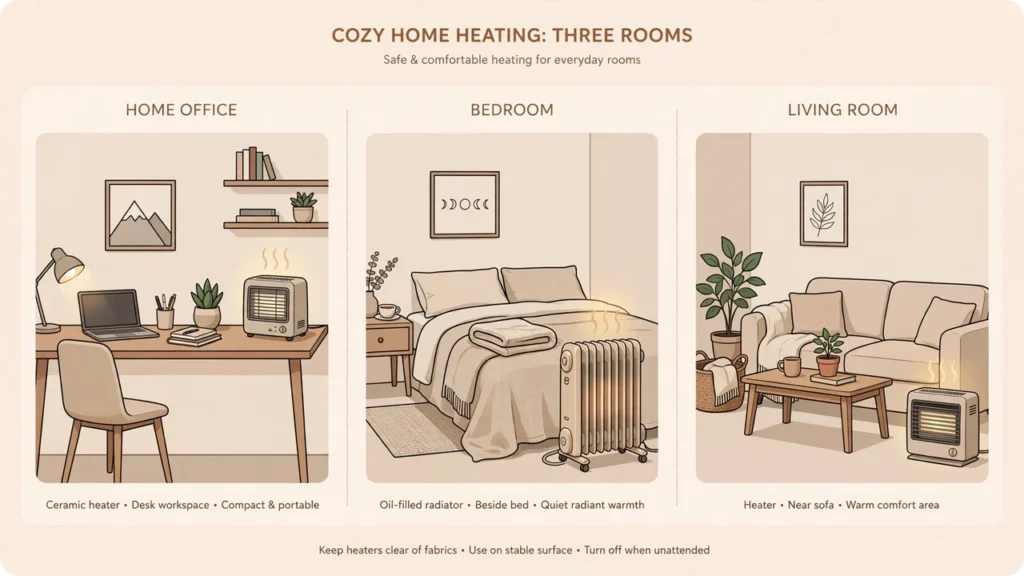
The right heater changes with the room. A bedroom rewards silence and steady heat. A home office rewards speed.
A living room rewards even heat across a wide space. Use the guide below as a starting point, then test in your own room.
Bedroom: oil-filled wins for most people
A bedroom needs quiet, steady warmth for seven or eight hours. An oil-filled heater gives exactly that. It makes no sound, it holds an even temperature, and the fins keep the room warm between cycles. Set it on a low or medium setting, switch it on 20 minutes before bed, and let the thermostat hold the temperature through the night.
Never leave any heater running while you sleep unless the manual for your exact model says it is safe and you have followed every safety rule in this article. Keep the 3-foot clearance, plug it straight into the wall, and make sure the tip-over and overheat shutoffs work. Our guide on whether oil-filled heaters are safe to leave unattended covers the overnight question in full, and it is worth reading before your first night with a new heater.
Home office or desk: ceramic wins for most people
A home office needs fast warmth for a work session of two to four hours. A ceramic heater delivers that. Switch it on when you sit down, aim it at your chair, and feel warm air within a minute.
When you leave the desk, switch it off and carry it to the next room. The light weight makes that move painless.
Fan noise can matter on video calls. Test the heater on low during a call before you rely on it. Many tower models run quieter on low, and the warm air still reaches your desk. If the hum bothers you on calls, an oil-filled heater on a low setting is the quiet fallback, though it will take longer to warm the space.
Living room: oil-filled for long evenings, ceramic for quick warmth
A living room that hosts the family all evening suits an oil-filled heater. The even, silent heat fills the space without a fan blowing on one person. Place it where air can move around the fins, switch it on before the evening starts, and let it hold the temperature.
A living room that you use for an hour after work suits a ceramic tower heater. The fan pushes warm air across the seating area fast, and oscillation spreads it wider. If the room is large, one heater of either type may not be enough. Two smaller heaters placed apart often beat one large heater pushed against a single wall.
Rooms where neither heater is the right tool
A cold garage, a workshop, or a porch is a different job. Plug-in heaters are built for insulated indoor rooms, not for spaces with open doors and thin walls. A heater that works well in a bedroom can struggle in a garage and still cost a lot to run. For those spaces, look at heating options built for them, and check local rules before you heat any space that is not a normal living room.
Bathrooms need extra care too. Most portable heaters are not rated for wet rooms, and water plus electricity is a dangerous mix. Never use a space heater in a bathroom unless the manual for your exact model says it is rated for that use. When in doubt, leave the heater out of the bathroom.
Troubleshooting: common problems and fixes
| If this happens | Try this |
|---|---|
| The room never feels warm | Check the wattage setting first, then check for drafts around windows and doors. A heater cannot beat a wide-open draft. Close the room door and give an oil-filled heater 20 minutes to reach full warmth. |
| The heater keeps switching off | Clean the air intake on a ceramic heater, because dust can trip the overheat shutoff. Check that nothing blocks the vents and that the heater has 3 feet of clear space. If it still trips, stop using it and call the maker. |
| The plug feels hot | Switch the heater off at once and unplug it. Try a different wall outlet. A hot plug can point to a worn outlet, so have an electrician check the outlet before you use it again. |
| The ceramic heater smells hot or dusty | Dust on the plates burns off when a heater runs for the first time in months. Run it in a ventilated room for 15 minutes. If the smell stays, or you see smoke, switch it off and stop using it. |
| The oil-filled heater gurgles or ticks | Light ticking as the metal warms and cools is normal. A loud gurgle or a leak of oil is not normal. Switch it off, unplug it, and do not use a heater that leaks oil. |
| One side of the room stays cold | Move the heater toward the center of the cold side, or add a second small heater on the far side. A single heater aimed at a wall cannot warm the whole room. |
Frequently asked questions
Which heats a room faster, ceramic or oil-filled?
A ceramic heater heats faster. Its fan pushes warm air into the room within a minute, while an oil-filled heater often needs 10 to 20 minutes to reach full warmth. The trade-off is that ceramic warmth fades fast once the heater stops, and oil-filled warmth lingers.
Which heater costs less to run?
Neither type costs less per hour at the same wattage. Both turn nearly all of their electricity into heat, so a 1,500-watt ceramic heater and a 1,500-watt oil-filled heater cost the same to run for the same number of hours. Your bill depends on how long the heater runs and how often its thermostat lets it rest.
Is it safe to leave an oil-filled heater on overnight?
Many people do, but only with strict safety rules in place. Use a certified model with tip-over shutoff and overheat protection, plug it straight into a wall outlet, keep 3 feet of clear space on all sides, and follow the manual for your exact model. Never leave any heater running unattended if you can avoid it, and never use an extension cord or power strip.
Can I use a ceramic heater in a bedroom?
Yes, if you follow the same safety rules as any space heater. Plug it straight into a wall outlet, keep 3 feet of clear space, and choose a model with tip-over shutoff and overheat protection. Keep in mind that the fan hum can disturb light sleepers, which is why many people pick an oil-filled heater for the bedroom instead.
Do oil-filled heaters use a lot of electricity?
It depends on the wattage setting and how long the heater runs. Most portable oil-filled heaters run at 600 to 1,500 watts. A 1,500-watt heater running for 4 hours uses 6 kilowatt-hours. Check your electricity rate on your bill to work out the cost for your own home.
Which heater is quieter?
An oil-filled heater is quieter. It has no fan and no moving parts, so it makes no sound at all. A ceramic heater always makes some fan noise, and the level varies by model. If silence matters to you, pick oil-filled.
Quick reference card: ceramic vs oil-filled heater
What you need: tape measure, room size in square feet, a free wall outlet, a clear floor spot with 3 feet of space, the heater manual.
Steps: 1. Measure your room and check your outlet. 2. Match the heater to how long you need heat. 3. Check the safety features before you buy. 4. Set the heater up the safe way. 5. Test it for a week and keep notes.
Pick ceramic for: fast warmth, desks, home offices, short sessions, easy carrying.
Pick oil-filled for: quiet warmth, bedrooms, living rooms, long evenings, steady heat.
Safety always: wall outlet only, no extension cords or power strips, 3 feet of clearance, tip-over and overheat protection, never leave a heater unattended.
The bottom line on ceramic vs oil-filled heaters
There is no single winner in the ceramic vs oil-filled heater debate, because the two heaters solve different problems. Ceramic wins on speed and portability. Oil-filled wins on silence and steady heat. Cost is a tie at the same wattage, so let your room and your routine decide.
Measure your room, pick the heater that matches how long you need heat, and set it up the safe way. Then test it for a week and keep notes. A heater that fits your room and your habits will keep you warm all winter, and that is the only result that matters.
If you want to keep learning, our guide to whether electric fireplaces are safer than space heaters compares these portable heaters with a fixed electric fireplace, which may suit you better if you want heat plus a focal point for the room.