How to Turn On a Gas Fireplace Without the Remote: Manual Switch, Key Valve, and Battery Fixes
Your remote is dead, lost, or sitting in a drawer with corroded batteries, and the room is cold. Learning how to turn on a gas fireplace without the remote takes about ten minutes once you know where the manual controls hide. Most gas fireplaces have a wall switch, a manual toggle under the unit, or a key valve that lets you light the fire with no remote at all.
This guide walks you through the checks in the order that matters, starting with the one safety check that comes before everything else. By the end, you will know which control your fireplace uses, how to swap the batteries that most often cause the problem, and when to stop and call a licensed gas professional. Keep your fireplace manual nearby if you have it, because switch locations and battery sizes vary by brand and model.
⚠️ Read This First: Gas Safety
A gas fireplace burns real fuel and can produce carbon monoxide (CO), a colorless, odorless gas. Install CO alarms on every level of your home and near sleeping areas, test them monthly, and replace them on the schedule in the alarm manual. Pets, especially birds, are more sensitive to CO and combustion fumes than people are, so CO alarms protect the whole household.
If you smell gas (a rotten-egg odor): do not touch any switch, flame, or appliance. Do not try to find the leak. Leave the home at once with everyone and every pet, then call your gas utility emergency line or 911 from outside. Only the gas utility or a licensed gas fitter handles a suspected leak.
Never open a gas line, bypass a thermocouple or oxygen-depletion sensor, block a vent, or disable a CO alarm. Gas-line, installation, conversion, and repair work belongs to a licensed gas professional. The steps below cover only the normal user controls described in your appliance manual.
Total Time
10–20 minutes
Active Time
5–10 minutes
Difficulty
Beginner
What You Need
- Fresh batteries for the remote and receiver (check the sizes below)
- A small Phillips screwdriver, if your receiver box has a screwed battery cover
- A flashlight or your phone light, for seeing under the fireplace
- Your fireplace manual, if you still have it
- The fireplace key, if your unit has a key valve in the floor or wall
No tools are needed for the wall switch or the manual toggle. If you open the access panel, keep track of the screws so the panel goes back on the same way.
At a Glance
- Sniff for gas before touching anything
- Flip the wall switch beside the fireplace
- Open the lower access panel and find the manual switch
- Swap the batteries in the remote handset
- Swap the batteries in the receiver box
- Turn the key valve, where your unit has one
- Check whether the pilot light is lit
- Stop and call a licensed gas professional
Step 1: Sniff for Gas Before Touching Anything
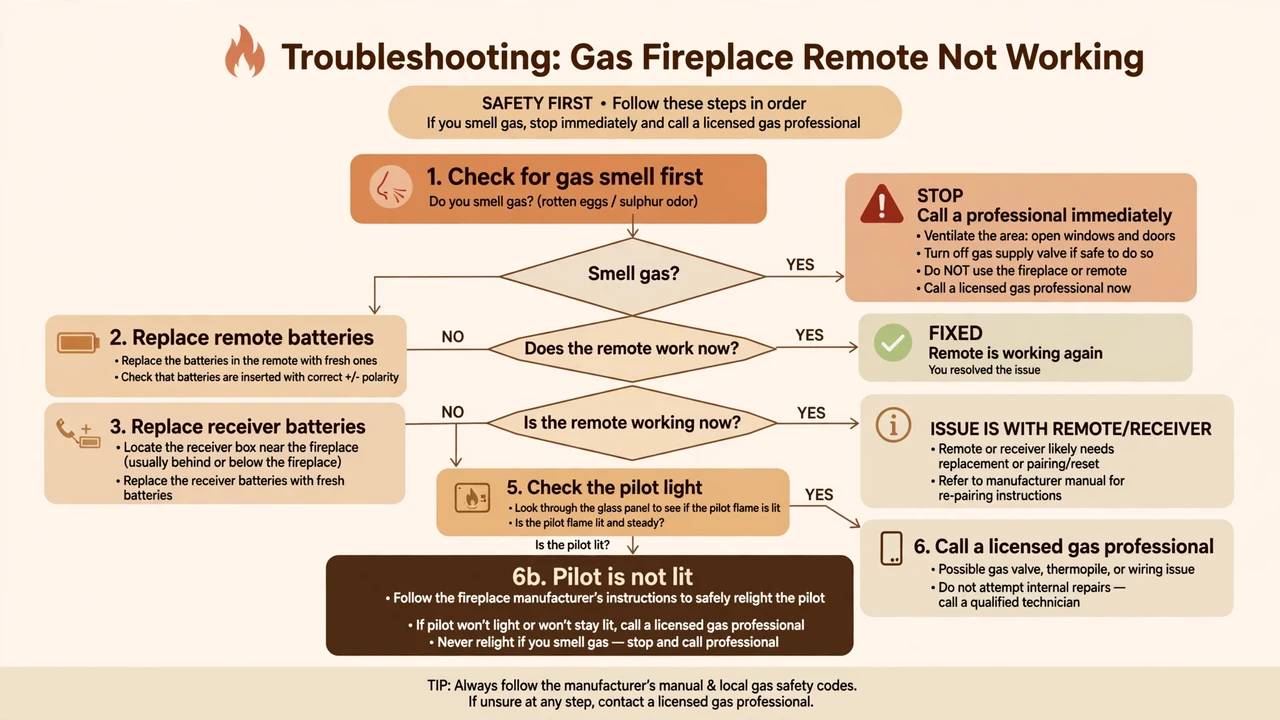
Stand near the fireplace and take a slow breath through your nose. Natural gas has no smell of its own, so suppliers add a chemical that smells like rotten eggs or sulfur. A faint whiff near the unit on a cold start can happen, but a clear or strong rotten-egg smell means gas is leaking into the room.
If the smell is strong, or if it is getting stronger, stop right there. Do not flip a switch, light a match, or use your phone inside the house. Get everyone and every pet outside, then call your gas utility emergency line or 911 from outdoors. If you only notice a very faint smell that fades in seconds, open a window, wait a few minutes, and sniff again before you go on.
Heads up: A gas smell plus a headache, dizziness, or nausea is an emergency. Leave the house at once and call 911 from outside. Do not wait to see if the feeling passes.
Step 2: Flip the Wall Switch Beside the Fireplace
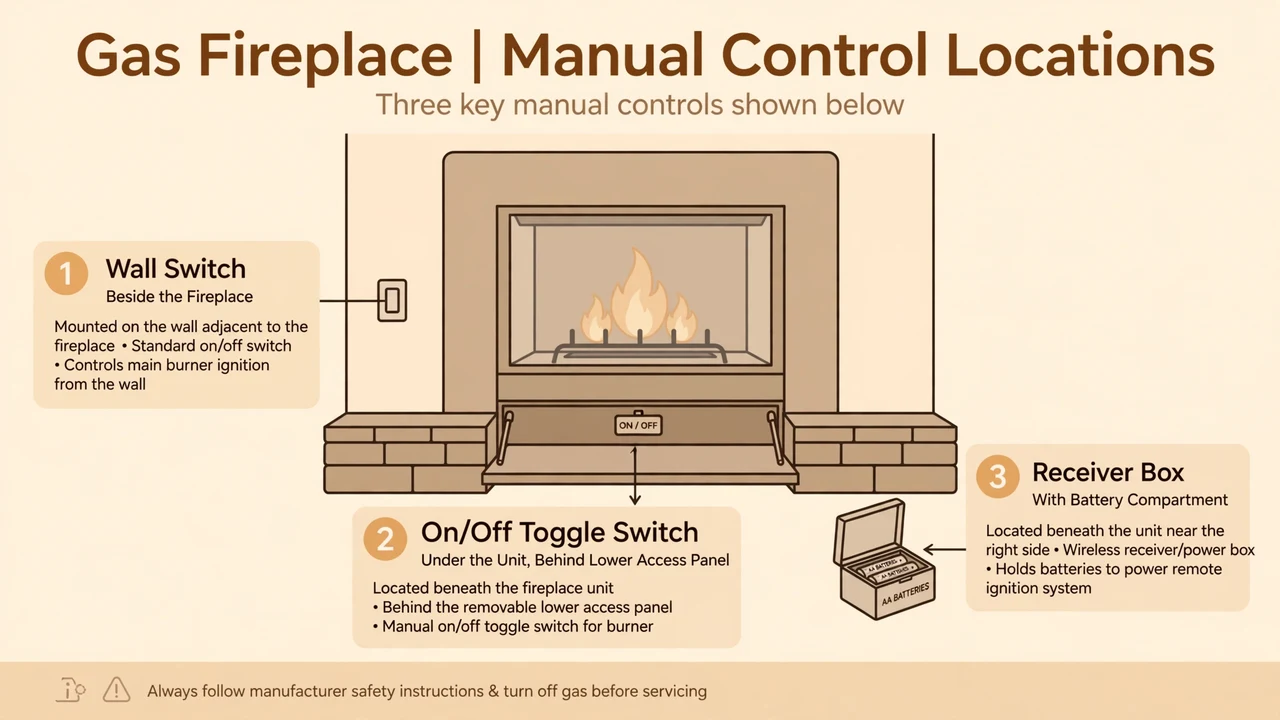
Look on the wall next to the fireplace for a small toggle switch, often a plain light-switch style plate. Many gas fireplaces wire the burner to a wall switch, and the remote only adds convenience on top of it. The wall switch works even when the remote is dead, because it talks to the gas valve directly.
Flip the switch to the on position and wait 30 seconds. Listen for a click from the valve and watch for flame at the burner. If nothing happens, flip it off and back on once more, then move to the next step. A wall switch that does nothing can point to dead receiver batteries or a pilot that has gone out.
Step 3: Open the Lower Access Panel and Find the Manual Switch
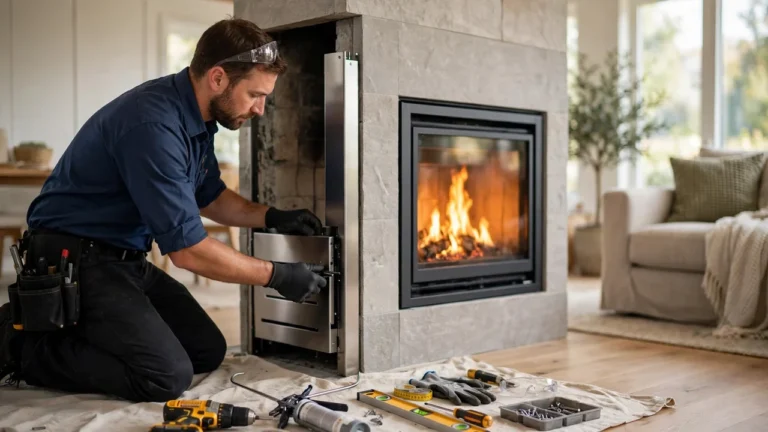
Kneel in front of the fireplace and look along the bottom edge for a removable panel, a louvered grille, or a hinged door. On most models it lifts off or swings open with a gentle pull, though a few need one or two screws removed first. Shine your flashlight inside and look for a small toggle switch marked ON / OFF, sometimes labeled REMOTE / OFF / ON.
That three-position switch is the heart of this whole fix. In the REMOTE position the receiver controls the fire, in the OFF position nothing can light it, and in the ON position the burner runs without the remote. Slide or flip it to ON and wait 30 seconds for the burner to catch. If the fire lights, the remote system was the problem, not the fireplace.
Step 4: Swap the Batteries in the Remote Handset
Dead batteries cause more remote failures than any other single fault. Slide the battery cover off the back of the remote and check what is inside. Most fireplace remotes take one CR2032 coin cell or two AAA batteries, and a few take two AA batteries. Match the size printed inside the battery compartment, not a guess.
Put in fresh batteries with the positive and negative ends lined up with the marks in the compartment. Press any button and look for the remote display or indicator light. A blank display after a fresh battery swap usually means the remote itself has failed, and the manual switch from Step 3 becomes your way to run the fire until you replace it.
Pro tip: Keep a spare set of the exact batteries your remote and receiver use in the same drawer as the fireplace key. A dead remote on a cold night is a five-minute fix when the batteries are already in the house.
Step 5: Swap the Batteries in the Receiver Box
The receiver is the small box inside the fireplace, usually tucked under the unit or behind the same access panel you opened in Step 3. It listens for the remote signal and tells the gas valve what to do. When its batteries die, the remote goes silent even with fresh batteries in the handset, and the wall switch may stop working too.
Slide the receiver out far enough to reach its battery compartment, or lift the cover off. Most receivers run on four AA batteries, though some models use a 9-volt battery instead. Swap in fresh batteries, slide the receiver back into place, and set its switch back to REMOTE. Test the remote again before you close the panel.
Which Batteries Go Where
Battery sizes vary by brand, so always check the label inside the compartment or your manual. These are the sizes found in most models.
| Part | Battery size most often used | How many | Notes |
|---|---|---|---|
| Remote handset | CR2032 coin cell, AAA, or AA | 1–2 | Size is printed inside the battery door |
| Receiver box | AA | 4 | Some models use a 9-volt battery instead |
| Wall switch | None (wired) | — | No battery to replace |
| Key valve | None (manual) | — | Works with no power at all |
Step 6: Turn the Key Valve, Where Your Unit Has One
Some gas fireplaces and gas log sets have a key valve: a small round socket in the floor or wall near the fireplace, turned with a long metal key. It controls gas flow to the burner by hand and needs no power, no remote, and no batteries. If your fireplace has one, the key is usually stored in a hook or drawer nearby.
Insert the key and turn it slowly counterclockwise to open the gas flow, about a quarter turn at first. If the pilot is lit, the burner should catch within a few seconds. Turn the key back clockwise to shut the fire off. If you turn the key and hear gas hissing with no flame, close it at once, ventilate the room, and call a licensed gas professional. Never leave a key valve open with no flame burning.
Step 7: Check Whether the Pilot Light Is Lit
If every switch and battery swap has failed, the pilot light may be out. Look through the glass or the access panel for the small blue flame near the burner assembly. A lit pilot shows as a steady blue flame about the size of a thumbnail. No flame at all means the pilot needs relighting before any switch or remote can work.
Relighting a pilot is a separate process with its own safety steps, and it is covered in full in our guide on how to light a gas fireplace. Follow that guide exactly, and do not try to light the burner directly with a match or lighter if the pilot is out. If the pilot lights and then goes out again, the thermocouple may be worn, and that is a repair for a licensed gas professional.
Step 8: Stop and Call a Licensed Gas Professional
Call a licensed gas professional if the manual switch does nothing, the pilot will not stay lit, you smell gas at any point, or you hear hissing near the valve. The same applies if the fireplace shuts itself off, the glass is cracked, or you see soot building up inside the unit. These are signs of a valve, thermocouple, or vent problem that no remote fix will solve.
When you call, tell the technician what you already tried: wall switch, manual toggle, fresh batteries, key valve, and pilot status. That short list saves diagnostic time and helps them bring the right parts. Keep the fireplace off until the visit. A fireplace that will not light on its manual controls is telling you something is wrong, and guessing at gas repairs is never worth the risk.
Troubleshooting: If This Happens, Try This
| If This Happens | Try This |
|---|---|
| Remote display is blank | Replace the remote batteries, then check the receiver batteries |
| Remote lights up but the fire does not start | Check the receiver switch is set to REMOTE, not OFF |
| Wall switch does nothing | Try the manual ON toggle under the unit, then check the pilot light |
| Fire lights, then goes out in seconds | The pilot may be out or the thermocouple may be worn, so call a licensed gas professional |
| Fireplace works on manual switch but not the remote | Replace the receiver batteries and re-pair the remote per your manual |
| You smell gas at any point | Leave the home at once with people and pets, call the gas utility or 911 from outside |
Can a Gas Fireplace Run Without Electricity?
Many gas fireplaces keep working during a power cut, because the pilot and gas valve do not need household power. Models with an electronic ignition or a blower fan may need power to start or to push warm air into the room, but the burner itself often lights from the manual switch. Our guide on whether a gas fireplace can run without electricity explains which type you own and what to expect in an outage.
If your fireplace has a standing pilot, the manual switch is your backup during an outage. If it has an intermittent pilot that needs power to spark, the manual switch will not help until power returns. Knowing which ignition type you have saves a lot of guessing on a dark winter evening.
Why the Fireplace Still Will Not Light
A fireplace that ignores the manual switch, fresh batteries, and a lit pilot usually has a deeper fault. The gas valve may have failed, the thermocouple may be worn out, or the burner ports may be blocked with dust and debris. Our guide on why a gas fireplace will not light walks through the common causes in detail.
Regular cleaning helps prevent the dust problem. Our guide on how to clean a gas fireplace covers the safe cleaning steps you can do yourself. Anything past cleaning and battery swaps belongs to a licensed gas professional, and that boundary keeps both your home and your warranty safe.
Frequently Asked Questions
Frequently Asked Questions
Can I turn on a gas fireplace without the remote?
Yes. Most gas fireplaces have a wall switch, a manual ON/OFF toggle under the unit or behind the lower access panel, or a key valve. Any of these starts the fire with no remote needed, as long as the pilot is lit and the gas supply is on.
Where is the manual switch on a gas fireplace?
Check three places: the wall beside the fireplace, a toggle switch under the unit behind the lower access panel, and the receiver box inside the unit. Many models have a three-position switch marked REMOTE / OFF / ON, and sliding it to ON runs the burner without the remote.
What batteries does a gas fireplace remote and receiver use?
Most remotes use one CR2032 coin cell or two AAA batteries, and most receiver boxes use four AA batteries. Sizes vary by brand, so check the label inside the battery compartment or your manual before buying replacements.
Can I use the key valve to light my gas fireplace?
Yes, if your unit has one. Insert the key and turn it slowly counterclockwise to open the gas flow. If the pilot is lit, the burner should catch within a few seconds. Turn the key clockwise to shut it off, and never leave the valve open with no flame burning.
What should I do if the pilot light is out?
Follow a dedicated pilot-lighting guide step by step, and never light the burner directly with a match or lighter if the pilot is out. If the pilot lights and then goes out again, the thermocouple may be worn. Call a licensed gas professional for that repair.
Quick Reference Card
What you need: fresh remote and receiver batteries, a small screwdriver, a flashlight, your fireplace key if fitted.
- Sniff for gas first. If you smell rotten eggs, leave and call for help from outside.
- Flip the wall switch beside the fireplace and wait 30 seconds.
- Open the lower access panel and set the manual toggle to ON.
- Swap the remote batteries (usually CR2032 or AAA).
- Swap the receiver batteries (usually four AA).
- Turn the key valve slowly counterclockwise, where fitted.
- Check the pilot light. Relight it per the lighting guide if it is out.
- If nothing works, stop and call a licensed gas professional.
Conclusion
You now know how to turn on a gas fireplace without the remote, using the wall switch, the manual toggle, fresh batteries, or the key valve. Most of the time the fix is a dead battery or a switch set to the wrong position, and the fire is back in minutes.
Keep the safety rules close: sniff for gas before you touch anything, keep CO alarms working on every level, and hand anything past basic controls to a licensed gas professional. If your pilot keeps going out or the fireplace shuts itself off, read our guide on whether gas fireplaces produce carbon monoxide and our guide on whether to leave the pilot light on before your next cold evening.