Standing Pilot vs Intermittent Pilot: What’s the Difference?
If your gas fireplace has a pilot light, it uses one of two ignition systems, and the standing pilot vs intermittent pilot choice shapes how much gas your fireplace burns, how it behaves in a power cut, and how you light it. A standing pilot stays lit around the clock, while an intermittent pilot lights only when you call for heat. That one difference ripples through gas use, reliability, maintenance, and cost.
Many owners never learn which system they have until something stops working. The pilot goes out, the fireplace refuses to light, or the gas bill prompts a closer look at the small flame that never seems to switch off. This guide explains both systems in plain terms, compares them side by side, and helps you decide which one fits your home.
By the end, you will know how to tell the two apart, what each one costs to run in general terms, when each one makes sense, and what to check when the pilot misbehaves. You will also know when to stop and call a licensed gas professional instead of working on the fireplace yourself.
Safety First: Read This Before You Touch Your Fireplace
Gas fireplaces carry carbon monoxide (CO) risks. CO is colorless and odorless, so you cannot see or smell it. Install CO alarms on every level of your home and near sleeping areas, test them monthly, and replace them as the maker directs. Pets, especially birds, are more sensitive to CO and combustion fumes than people are, so working alarms protect the whole household.
If you smell gas (a rotten-egg odor): do not touch switches, flames, or appliances. Leave the home at once with people and pets. Call your gas utility emergency line or 911 from outside.
Never try to find or fix a leak, open a gas line, or relight a fireplace after a strong gas smell. That work belongs to the gas utility or a licensed gas professional.
Reading Time
About 14 minutes
Active Time
About 10 minutes to check your pilot type
Difficulty
Beginner (looking and reading only)
What You Need to Identify Your Pilot Type
You need only a few basic items to work out which pilot system your fireplace uses. Gather them before you open the fireplace front, and keep the appliance manual close by if you still have it. The manual names the ignition system and shows the control knob positions.
- Flashlight: a small torch helps you see the pilot assembly behind the glass or logs.
- Appliance manual: the model and ignition details sit in the lighting instructions near the front pages.
- Phone camera: a photo of the rating plate and control knob helps when you call a technician later.
- Pen and paper: note the brand, model, and what you see at the pilot before you close the panel.
Do not remove covers, guards, or gas fittings to get a better look. If the pilot assembly sits behind a sealed panel or you cannot see it clearly, stop and ask a licensed gas professional to identify it during a service visit.
What Is a Standing Pilot?
A standing pilot is a small gas flame that burns all the time, day and night, whether the fireplace is heating the room or not. It sits near the main burner and waits for the call to light the larger flames. When you turn the fireplace on, the gas valve opens and the pilot flame lights the burner at once.
The flame stays lit because gas flows to it through a small pilot tube at a low rate. A thermocouple, a small safety sensor beside the flame, senses the heat and holds the gas valve open. If the pilot flame goes out, the thermocouple cools and shuts off the gas supply to the pilot. That shutoff is a safety feature, and it is one reason a fireplace with a standing pilot can refuse to stay lit when the thermocouple wears out or gets coated in soot.
Standing pilots have heated homes for decades, and many older gas fireplaces still use them. They need no electricity to keep the pilot alive, which is why they often keep working through a power cut. The trade-off is steady gas use, because the flame never rests. If you want a deeper look at whether that flame should stay on through the warm months, see our guide on whether to leave the pilot light on in a gas fireplace.
What Is an Intermittent Pilot?
An intermittent pilot, also called an intermittent pilot ignition (IPI) or electronic ignition, lights only when you ask the fireplace for heat. When you switch the fireplace on, a control module opens the gas valve and fires a spark at the pilot. The pilot lights, proves its flame to a sensor, and then lights the main burner. When you switch the fireplace off, the pilot goes out too.
Most intermittent systems use a spark igniter and a flame sensor, and many run on household electricity with a battery backup. Some models use batteries alone. The control module watches the flame and shuts the gas off if the pilot fails to light after a few tries. That lockout protects the room from unburned gas, and it also means a flat battery or a failed module can leave the fireplace silent until the part is replaced.
Intermittent pilots are now the common choice in new gas fireplaces. Builders and makers favor them because they cut the gas wasted by a flame that burns all year. They also pair well with remote controls, wall thermostats, and timers, since the control module can start the whole lighting sequence on its own.
Quick Answer
A standing pilot burns all the time. An intermittent pilot lights only when you turn the fireplace on. Standing pilots work without power and waste gas between uses, while intermittent pilots save gas but need electricity or batteries to spark.
Standing Pilot vs Intermittent Pilot: Side-by-Side Comparison

The table below puts the two systems next to each other across the points owners ask about most. Read the row that matters to you, then read the sections below it for the detail behind each point. No single row decides the question on its own, because the right choice depends on how often you use the fireplace and how much you value power-cut heat.
| Feature | Standing Pilot | Intermittent Pilot (IPI) |
|---|---|---|
| Flame | Burns 24 hours a day, all year unless switched off | Lights only when the fireplace is turned on |
| Gas use when idle | Uses gas all the time, even in summer | Uses no pilot gas when off |
| Power cut | Usually still lights with a manual control | Needs mains power or a working battery backup |
| Lighting method | Pilot flame lights the burner directly | Spark igniter lights the pilot, then the burner |
| Main parts | Pilot tube, thermocouple, gas valve | Control module, spark igniter, flame sensor |
| Remote or thermostat | Basic models may need manual lighting | Designed for remotes, thermostats, and timers |
| Common failure | Pilot goes out; thermocouple wears out | Flat batteries; control module or sensor fault |
| Typical age of unit | Common in older fireplaces | Standard in most new fireplaces |
Check Which Pilot Type You Have
Start with the control knob or switch panel at the base of the fireplace. A standing pilot system often has a gas valve knob marked Off, Pilot, and On, with a push button to light the pilot by hand. An intermittent system often has a simple On/Off switch, a remote receiver, or a control panel with no Pilot position at all.
Look at the pilot with the fireplace switched off and cool. If a small blue flame still burns, you have a standing pilot. If the burner area is dark and cold with no flame at all, you likely have an intermittent pilot. Take care here: never reach past the glass or logs, and never open a gas fitting to get a clearer view.
Check the rating plate or the manual when the visual clues leave you unsure. The plate sits inside the lower access panel or on the side of the unit, and it lists the model number and ignition type. A photo of that plate saves time when you ring a parts supplier or book a service visit, because the technician can confirm the system from the model number alone.
Follow How Each Pilot Lights the Burner
With a standing pilot, lighting is a short manual sequence. You turn the valve to Pilot, press and hold the knob, and light the pilot with the built-in piezo button or a long lighter as the manual directs. You hold the knob for the time the manual states, often around 30 seconds, so the thermocouple warms up and holds the valve open. Then you turn the knob to On, and the pilot lights the main burner.
With an intermittent pilot, the sequence runs itself. You press the wall switch, remote, or thermostat, and the control module opens the pilot gas valve and sparks the igniter. The pilot flame proves itself to the sensor within seconds, and the module then opens the main burner valve. If the pilot fails to light, the module tries again a set number of times and then locks out, which stops gas from flowing while the fault stays unresolved.
Both systems need a clear path for the flame to reach the burner, so dust, pet hair, and soot on the pilot or burner ports can cause weak flames or failed starts. Light cleaning of the glass and the area around the controls follows the manual, and anything that needs the burner or pilot assembly taken apart belongs to a licensed gas professional. For the full lighting sequence on a standing pilot unit, read our guide on how to light a gas fireplace.
Compare Gas Use and Running Costs
A standing pilot burns gas without pause, so it adds a steady line to the gas bill through the months you never use the fireplace. The exact amount varies with the pilot size, the gas pressure, and the model, and makers do not publish one figure that fits every unit. What stays true across models is the pattern: the flame uses gas in July exactly as it does in January, and switching it off for the warm season removes that use entirely.
An intermittent pilot uses no pilot gas while the fireplace sits idle, which is why makers describe it as the lower-use option. It still uses gas while the main burner runs, and that burner use dwarfs the pilot use in both systems during a cold evening. The saving from an intermittent pilot therefore shows up most clearly in homes where the fireplace sits unused for long stretches, such as a guest room or a holiday home.
Do not judge the saving from the pilot flame alone without looking at how you use the fireplace. A household that runs the fireplace most winter evenings will see a smaller share of its bill tied to the pilot, while a household that lights it twice a year will see the pilot take a larger share. Your gas bill before and after a summer shutdown gives the clearest local picture, and a technician can read the pilot orifice size from the model if you want a firmer estimate. For a wider look at running costs, see our guide on how much it costs to run a gas fireplace.
Gas Use at a Glance: When Each System Costs More to Run
Standing pilot costs more when
The fireplace sits unused for months, the pilot stays on through summer, or the home is a holiday home lit only a few times a year.
Intermittent pilot costs more when
The control module or igniter fails and needs a part replaced, or flat backup batteries are left unchanged for a long time.
Both cost the same when
The main burner runs for hours each evening, because burner gas use is far larger than pilot gas use in either system.
Cheapest habit either way
Switch the fireplace fully off when the season ends, and book the yearly service that keeps the burner and pilot clean.
Weigh Reliability and Power Cuts
A standing pilot earns its keep during a power cut. Because the pilot flame needs no electricity, many standing pilot fireplaces still light with a manual knob turn when the lights go out. That trait matters in areas where winter storms cut power for hours, and it is a real reason some owners keep an older unit instead of replacing it.
An intermittent pilot depends on power or batteries to spark, so a dead battery backup can leave it silent at the worst moment. Most models carry a battery pack that takes over during a cut, but the pack only helps if the batteries hold a charge. Check the battery compartment at the start of each heating season, and replace the batteries on the schedule the manual gives.
Reliability also covers how often each system needs attention. Standing pilots can blow out in a draught, and a weak thermocouple can drop the pilot again and again until it is replaced. Intermittent pilots can suffer sensor faults or module failures that need a part and a technician.
Neither system is free of faults, and the yearly service visit catches most of them before the cold weather arrives. If your fireplace keeps shutting down on its own, our guide on why a gas fireplace will not stay lit walks through the common causes.
Decide Which Pilot Type Fits Your Home
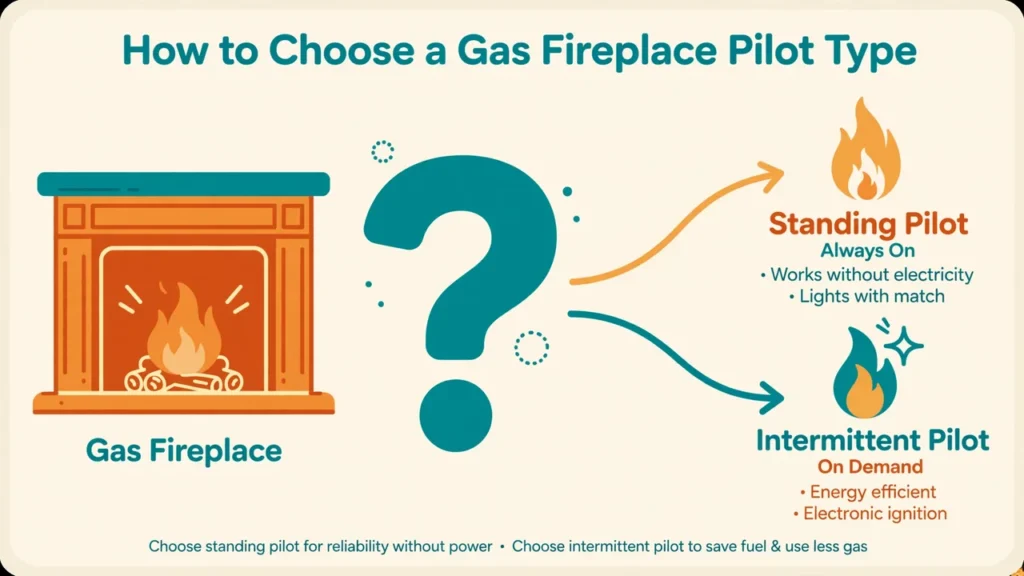
Choose a standing pilot if you value heat during power cuts above all else, you use the fireplace often through winter, and you are happy to switch the pilot off for the summer. That profile suits rural homes, storm-prone areas, and owners who like a manual control they can operate without power. The steady gas use is the price of that independence, and a summer shutdown keeps it in check.
Choose an intermittent pilot if you want lower idle gas use, remote or thermostat control, and a modern unit that starts with one press. That profile suits busy households, second homes, and anyone who lights the fireplace a few times a month rather than every night. Keep spare batteries on hand and test the backup before the first cold snap, so the convenience does not fail when you need heat most.
Think about replacement before you decide to convert an existing fireplace. Changing a standing pilot to an intermittent pilot is not a swap of one small part; it often means a new gas valve, control module, wiring, and igniter, plus a check that the fireplace model accepts the change. Ask a licensed gas professional for a quote and a safety check, and weigh the conversion cost against the gas you would save. In many older units, the honest answer is to keep the standing pilot and manage it well until the fireplace itself needs replacement.
Which Pilot Fits You? A Short Decision Check
- Power cuts are common where you live: lean toward a standing pilot.
- You light the fireplace only a few times a month: lean toward an intermittent pilot.
- You want a remote or thermostat: lean toward an intermittent pilot.
- You prefer a manual control with no batteries: lean toward a standing pilot.
- Your fireplace is old and works well: keep the standing pilot until the unit needs replacement.
Keep Both Pilot Types in Good Shape
Yearly service is the single habit that protects both systems. A licensed gas professional cleans the pilot and burner, checks the gas valve and safety devices, tests the CO alarm placement, and looks for soot or flame changes that point to a vent or burner fault. Book that visit before the heating season, not after the first cold night exposes a fault.
Between visits, keep the area around the fireplace clear and the glass clean as the manual directs. A yellow, lazy, or lifting flame, soot on the glass, or a new smell while the fireplace runs are all signs to switch the unit off and call a professional. Never adjust a gas valve beyond the normal user controls in the manual, and never bypass a thermocouple, oxygen-depletion sensor, or spill switch to keep a faulty fireplace running.
Test CO alarms monthly and replace them as the maker directs, and keep a note of the alarm age on the unit itself. The CDC advises placing CO alarms outside sleeping areas and on every level of the home, and it warns that CO is colorless and odorless. You can read the CDC guidance on carbon monoxide poisoning prevention for the full checklist.
Troubleshoot Pilot Problems
Most pilot faults fall into a small set of patterns, and the table below matches each pattern with the safe next step. Work through it only for checks the manual allows, such as replacing remote batteries or checking that the gas supply valve is open. Stop at once if you smell gas, see damage, or feel unsure about any step.
| If This Happens | Try This |
|---|---|
| Standing pilot goes out often | Check for draughts near the fireplace, then book a thermocouple and pilot cleaning check. |
| Pilot lights but will not stay lit | Hold the knob for the full time the manual states, then call a professional if it still drops out. |
| Intermittent pilot clicks but never lights | Replace the remote and backup batteries, check the power supply, then call a professional. |
| Fireplace lights, then shuts off within minutes | Switch it off, check the CO alarm, and book a service visit before using it again. |
| Flame looks yellow, lazy, or sooty | Switch the fireplace off and call a licensed gas professional. Do not keep running it. |
| You smell gas at any point | Do not touch switches or flames. Leave with people and pets and call the gas utility or 911 from outside. |
Heads Up: Do Not Force a Faulty Pilot to Stay Lit
A pilot that keeps going out is a safety device doing its job, not a nuisance to work around. Never tape, wedge, or bypass a thermocouple, sensor, or spill switch, and never relight a fireplace after a strong gas smell. Call a licensed gas professional and let them find the cause.
Frequently Asked Questions
These are the questions owners ask most once they learn the two pilot types exist. The answers stay short on purpose, so you can check one point and get back to the fireplace. Each answer matches the detail given earlier in this guide.
Does a standing pilot use a lot of gas?
It uses gas all the time, so the amount adds up across a year, especially in months when you never use the fireplace. The exact amount varies by model, so switching the pilot off for the warm season is the surest way to cut it.
Does an intermittent pilot work in a power cut?
It works only if its battery backup holds a charge, since the spark igniter needs power. Check and replace the backup batteries before each heating season.
Can I convert a standing pilot to an intermittent pilot?
Conversion is possible on some models, but it often needs a new gas valve, control module, wiring, and igniter. Ask a licensed gas professional whether your model accepts the change and what it would cost.
Which pilot type is safer?
Both are safe when installed, serviced, and used as the manual directs, and both carry CO risks that working alarms must cover. Safety depends far more on yearly service, clear vents, and working CO alarms than on the pilot type alone.
Why does my standing pilot keep going out?
A draught, a dirty pilot, or a worn thermocouple are the usual causes. Clean only what the manual allows, then book a professional to test the thermocouple and pilot assembly.
Should I turn the pilot off in summer?
Yes, switching a standing pilot off for the warm months saves gas and is a common seasonal habit. Follow the manual shutdown steps, and relight it as the manual directs when the cold weather returns.
Quick Reference Card
Standing pilot: flame always on, works without power, uses gas all year, manual lighting.
Intermittent pilot: lights on demand, saves idle gas, needs power or batteries, remote ready.
Check yours: flame burning while off means standing pilot; dark burner while off means intermittent pilot.
Season habit: switch a standing pilot off in summer; test intermittent batteries each autumn.
Safety: CO alarms on every level, test monthly, yearly service, and leave at once if you smell gas.
Final Word on Standing Pilot vs Intermittent Pilot
The standing pilot vs intermittent pilot question has no single right answer for every home. A standing pilot gives you heat without power and asks for steady gas in return. An intermittent pilot saves that idle gas and asks for working power or batteries in return. Your usage pattern, your power supply, and your comfort with manual controls tip the balance.
Find out which system you have, switch a standing pilot off when the season ends, and test the batteries on an intermittent pilot before the cold arrives. Keep the yearly service booked and the CO alarms tested, and your fireplace will stay a help rather than a worry. If you want to learn more about the wider gas fireplace family, our comparison of vented vs ventless gas fireplaces and our guide to whether gas fireplaces produce carbon monoxide are good next reads.