How Much Heat Does a Gas Fireplace Put Out? BTU Output, Room Size, and What to Expect
You flip the switch, the flames rise, and the room starts to feel warm. Then the real question hits: how much heat does a gas fireplace put out, and is it enough for the room you are sitting in? The short answer is that most gas fireplaces are rated between 10,000 and 40,000 BTU per hour of input heat, with most inserts and built-in units landing between 20,000 and 40,000 BTU. How much of that heat reaches you depends on the fireplace type, the size of the room, and a few details that are often missed.
This guide walks through the numbers in plain terms. You will learn what BTU means, how much heat each type of gas fireplace puts out, how to match output to room size, and how to check the exact rating on your own unit. You will also see why two fireplaces with the same BTU rating can feel very different in real rooms.
⚠️ Stay Safe With Gas Heat
A gas fireplace burns fuel inside your home, so treat heat output and safety as one topic. Carbon monoxide (CO) is a colorless, odorless gas that can build up if a fireplace is not vented or serviced correctly. Put a CO alarm on every level of your home and near sleeping areas, test alarms monthly, and replace them as the maker directs.
If you smell gas (a rotten egg odor): do not touch switches, flames, or appliances. Leave the home at once with people and pets, and call your gas utility emergency line or 911 from outside. Never try to find or fix a gas leak, open a gas line, or relight a fireplace after a strong gas smell. That work belongs to the gas utility or a licensed gas fitter.
Never open a gas line, bypass a safety device, or block a vent. Gas line work, venting changes, and repairs beyond basic cleaning belong to a licensed professional. Pets, and birds in particular, react to CO and fumes sooner than people do, so alarms protect the whole household.
How Much Heat Does a Gas Fireplace Put Out? The Short Answer
- Most gas fireplaces: 20,000 to 40,000 BTU per hour of input heat. Small units start near 10,000 BTU.
- Heat you actually feel: direct vent units deliver roughly 70 to 85 percent of that heat into the room. Ventless units keep nearly all of it in the room, while open gas log sets lose a large share up the chimney.
- Room size rule of thumb: plan on about 20 BTU per square foot for a room with standard ceilings and average insulation, then adjust for tall ceilings, cold climates, and open floor plans.
- Your exact number: the rating plate on your fireplace lists its input BTU. That plate beats any chart.
What a BTU Means, in Plain Terms
A BTU, or British thermal unit, is the amount of heat needed to raise one pound of water by one degree Fahrenheit. Fireplace makers use BTU per hour to state how much heat a unit can produce while it runs. A higher BTU number means more heat per hour, not a hotter flame.
Two numbers matter, and they are not the same. Input BTU is the heat the burner produces from the gas it burns. Output BTU is the heat that reaches your room. The gap between them is lost heat, and the size of that gap depends on how the fireplace is vented.
Think of it like a kettle on a stove. The burner makes a set amount of heat, but some of it escapes around the kettle. A fireplace works the same way. The rating plate shows input BTU, and the room feels output BTU.
Keep that split in mind as you read the ranges below, because it explains why a 30,000 BTU vented fireplace can feel weaker than a 30,000 BTU ventless one.
Typical Heat Output by Gas Fireplace Type
Gas fireplaces come in four common forms, and each one handles heat differently. The table below shows the input BTU ranges you will see most often on rating plates, plus the share of heat that normally reaches the room. Use these as planning ranges. Your own model may sit outside them, so check the plate.
| Fireplace type | Typical input BTU per hour | Heat that reaches the room | Best for |
|---|---|---|---|
| Direct vent insert or built-in | 20,000 to 40,000 | About 70 to 85 percent | Heating a living room or open living area |
| Ventless (vent-free) | 20,000 to 40,000 | About 99 percent stays in the room | Strong room heat where local codes allow it |
| B-vent (natural vent) | 20,000 to 40,000 | About 50 to 70 percent | Ambience with some heat in a vented setup |
| Gas log set in an open fireplace | 10,000 to 40,000 | A large share escapes up the chimney | Look and feel of a fire, modest room heat |
Ranges reflect the input ratings printed on most residential models. Output shares are typical published efficiency ranges, not a promise for any one model.
Direct vent models are the workhorses of the group. They pull combustion air from outside and send exhaust out through a sealed pipe, so most of the heat they make stays inside. If you want real warmth from a gas fireplace, this type is the usual pick. Our guide to choosing a gas fireplace walks through how to pick between these types before you buy.
Ventless models look like the heat winner on paper, and in raw numbers they are. Nearly all the heat stays in the room because there is no vent to carry it away. The trade off is that combustion byproducts, including carbon monoxide and water vapor, also stay in the room.
That is why ventless units are restricted or banned in some states and in bedrooms, and why a working oxygen depletion sensor and a CO alarm are non negotiable with them. Check your local code before you buy or run one.
Gas log sets sit at the other end. They look great in an open masonry fireplace, but the open chimney that makes them look real also carries much of the heat outside. They are best thought of as a flame feature with bonus warmth, not as a room heater.
How Much Room Can a Gas Fireplace Heat?
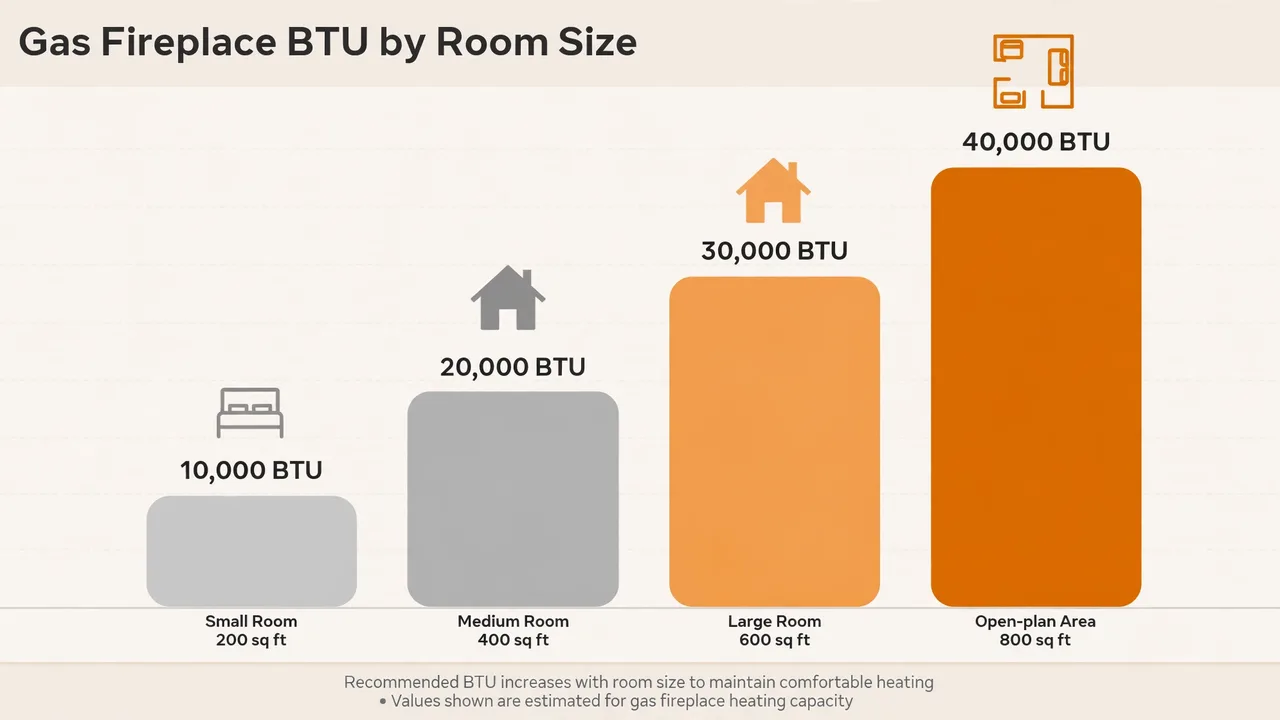
Room size is where BTU numbers turn into a buying choice. Installers often use a rough planning figure of about 20 BTU per square foot for a room with standard 8 foot ceilings and average insulation in a moderate climate. It is a starting point, not a guarantee. Cold climates, tall ceilings, and drafty rooms all push the real need higher.
The chart below shows what that planning figure looks like across common room sizes. The image gives the quick view, and the worked example under it shows the math.
| Room size | Rough BTU need (20 BTU per sq ft) | Fireplace size that fits |
|---|---|---|
| 200 sq ft bedroom or den | 10,000 BTU | Small insert or log set |
| 400 sq ft living room | 20,000 BTU | Mid size direct vent insert |
| 600 sq ft large living room | 30,000 BTU | Large direct vent insert or built-in |
| 800 sq ft open plan area | 40,000 BTU | Top end direct vent or ventless, if allowed |
Planning figures only. Real needs rise with tall ceilings, poor insulation, large windows, and cold winters.
Worked Example: A 12 by 15 Foot Living Room
Measure the room first. A room that is 12 feet by 15 feet covers 180 square feet. Multiply 180 by 20 BTU per square foot and you get 3,600 BTU of rough heat need. That sounds small next to a 30,000 BTU fireplace, and that gap is normal.
The gap exists because the planning figure assumes the fireplace delivers all its heat to the room. A direct vent unit at 75 percent efficiency turns 30,000 BTU of input into about 22,500 BTU of room heat. That still covers the 3,600 BTU planning figure many times over, which is why most gas fireplaces heat a single room with room to spare and why the flame can be turned down once the room warms up.
Open plan spaces change the math. A living room that opens into a kitchen and hallway is really one big heated space. Add up all the connected floor area before you pick a size, or the fireplace will warm the corner it sits in and leave the rest of the space cool.
Five Factors That Change How Much Heat You Feel
Two fireplaces with the same BTU rating can feel very different. These five factors explain most of the gap.
1. Ceiling Height
Heat rises. A room with 12 foot ceilings holds half again as much air as the same room with 8 foot ceilings, and the warm air gathers near the ceiling first. A ceiling fan on a low winter setting can push some of that warm air back down, but the fireplace still has more air to heat.
2. Insulation and Drafts
Insulation decides how long heat stays in the room. A well insulated room with sealed windows holds warmth for hours. A drafty room with single pane windows and gaps around doors loses heat as fast as the fireplace makes it. If your fireplace seems weak, check for drafts before you blame the unit.
3. The Blower
A blower does not add BTU. It moves warm air out of the firebox and into the room faster, so the room warms up sooner and the heat spreads further. A fireplace without a blower warms the air right in front of it and relies on slow natural air movement for the rest. If your unit has a blower, run it on low once the firebox is hot.
4. Flame Height Setting
Most gas fireplaces let you turn the flame up or down, and heat output follows the flame. A low flame on a 30,000 BTU unit may put out half that rating or less. If the room feels cool, check the flame setting before you assume the unit is too small. Our guide on running costs for a gas fireplace shows how flame height also changes what each hour of heat costs.
5. Where the Fireplace Sits
A fireplace on an outside wall loses more heat through the wall and vent than one on an inside wall. A unit tucked into a corner warms that corner first. Placement matters most in open rooms, where a fireplace at one end can leave the far end noticeably cooler.
Vented Versus Ventless: Which Puts Out More Usable Heat?
On usable heat alone, ventless wins. A ventless unit rated at 30,000 BTU puts close to 30,000 BTU into the room, while a direct vent unit at the same rating puts in roughly 21,000 to 25,500 BTU. The ventless unit also costs less to install, since it needs no vent pipe.
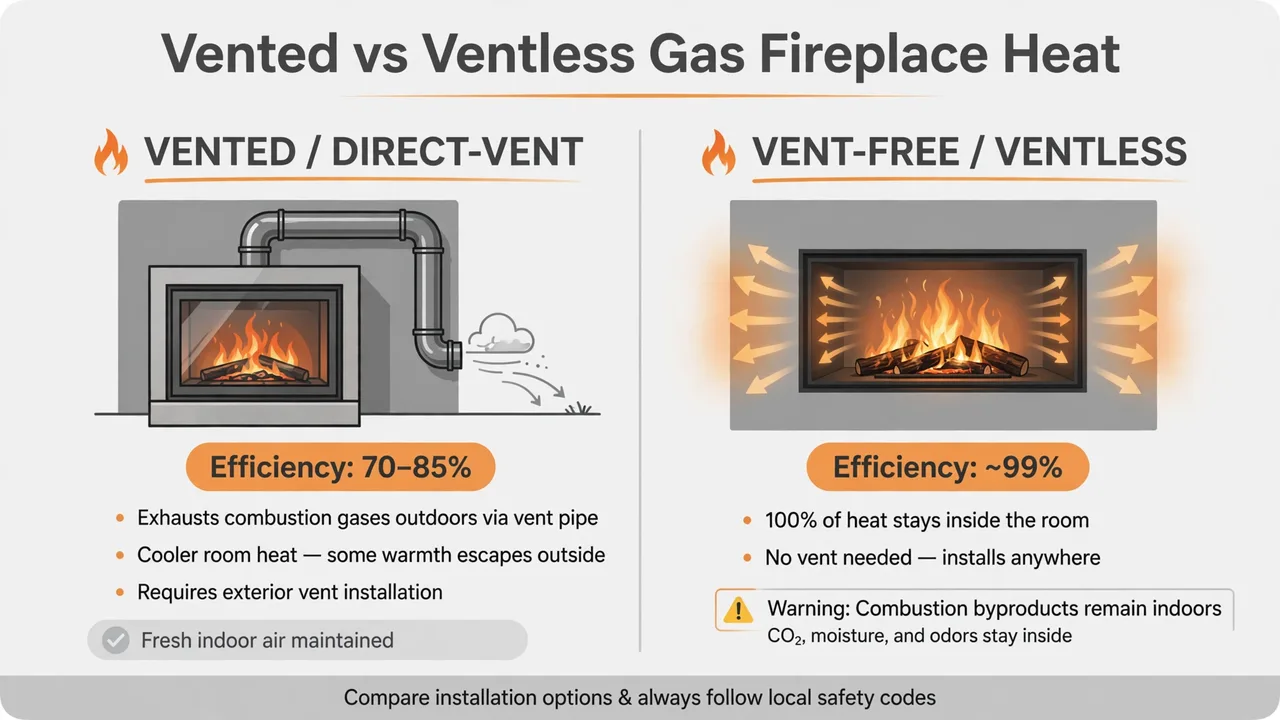
The rest of the story is about air quality and rules. A ventless fireplace releases water vapor and combustion byproducts into the room, including carbon monoxide. That is why many areas limit ventless units to well ventilated rooms, ban them in bedrooms and bathrooms, and ban them outright in some states.
A working oxygen depletion sensor shuts the unit down if oxygen in the room drops, and a CO alarm is a second layer of protection. Neither one makes a ventless unit safe in a room or a state where it is not allowed.
For most homes, a direct vent fireplace is the safer long term choice. It gives up some heat through the vent, and in return it keeps combustion air and exhaust separate from the air you breathe. Read our full vented versus ventless gas fireplace comparison before you decide which type fits your home, and read our guide on whether gas fireplaces produce carbon monoxide to see how each type handles CO risk.
Check Your Own Fireplace’s Heat Output
Charts give you ranges. The rating plate on your unit gives you the exact number. Follow these four steps to find it and make sense of it.
Step 1: Find the Rating Plate
Look inside the lower front panel, behind the removable cover, or on the side of the firebox. The plate is a metal tag or sticker that lists the model number, the gas type, and the input BTU rating. If you cannot find it, your manual lists the same numbers. Keep a photo of the plate on your phone for the next time a technician asks.
Step 2: Read the Input BTU Number
The plate may list a range, such as 20,000 to 30,000 BTU, or a single maximum. That number is the input rating at full flame. A unit with a range can be adjusted, and most people run it well below the top number once the room is warm.
Step 3: Note the Vent Type
The plate or the manual also names the vent type: direct vent, B-vent, or ventless. Match it to the table earlier in this guide to estimate how much of the input heat reaches the room. A 30,000 BTU direct vent unit at 75 percent efficiency delivers about 22,500 BTU of room heat.
Step 4: Compare It With Your Room
Multiply your room’s square feet by 20 BTU as a rough check. If your unit’s room heat number is well above that figure, the fireplace should handle the room. If it is close to or below it, and the room has tall ceilings or poor insulation, the unit may struggle on the coldest days. A licensed installer can confirm the sizing for your home.
Pro Tip: Heat the Room, Not the Whole House
A gas fireplace works best as zone heat. Close the doors to rooms you are not using, run the blower on low, and let the fireplace carry the room you live in. Turning down the central heat while the fireplace runs is where most of the savings show up.
Why Your Gas Fireplace Feels Weak
A fireplace that once warmed the room can start to feel weak. Most causes are small and fixable. Work through the table below before you call for a larger unit.
| If this happens | Try this |
|---|---|
| Flames look low and lazy | Turn the flame control up and check that the gas valve is fully open. If flames stay low, book a service visit. |
| Room warms slowly | Switch the blower on, close doors to unused rooms, and check for drafts around windows. |
| Heat stays near the fireplace | Run the blower, and use a ceiling fan on low to push warm air down and across the room. |
| Glass is black or cloudy | Clean the glass as your manual directs, and book a service visit if soot keeps coming back. |
| Fireplace shuts off on its own | Do not bypass any safety switch. Book a licensed technician to find the cause. |
Dirty burners and blocked air paths are the most common culprits. Dust and pet hair build up over a season and choke the flame. Our guide to cleaning a gas fireplace covers the safe cleaning steps you can do yourself. Anything past basic cleaning, including burner and valve work, belongs to a licensed gas professional.
One warning sign needs a fast response. If the fireplace gives off a strong gas smell, a sooty smell that will not clear, or you feel headache, dizziness, or nausea while it runs, turn the unit off, leave the home with people and pets, and call your gas utility or 911 from outside. Those symptoms can point to carbon monoxide, and the CDC and the Consumer Product Safety Commission both advise leaving the home and calling for help at once rather than hunting for the source yourself.
Can a Gas Fireplace Heat a Whole House?
For most homes, no. A gas fireplace is built to heat one room or one open living area, not a full house. A 30,000 BTU unit can warm a large living room well, but heat fades as it moves down hallways and through doorways. Bedrooms at the far end of a house will stay cool.
There are exceptions. A small, well insulated home with an open floor plan can get close to whole house heat from a large direct vent unit, mainly when the fireplace sits near the center of the home. Even then, a cold snap will show the limits. Think of a gas fireplace as your main heat for the room you live in and a helper for the rest of the house, not as a furnace replacement.
If whole house heat is the goal, talk with a licensed installer about sizing. A unit that is too small will run at full flame all day and still leave rooms cold. A unit that is far too large will cycle on and off and leave the room stuffy. The right size comes from your floor plan, your insulation, and your climate, not from a chart alone.
Frequently Asked Questions
Gas Fireplace Heat Output: Your Questions Answered
How many BTUs does a gas fireplace put out?
Most gas fireplaces are rated between 10,000 and 40,000 BTU per hour of input heat, with most inserts and built-in units rated between 20,000 and 40,000 BTU. The exact number is printed on the rating plate inside your unit.
How big a room will a 30,000 BTU gas fireplace heat?
Using the rough planning figure of 20 BTU per square foot, a 30,000 BTU direct vent unit delivering about 22,500 BTU of room heat can cover a room of roughly 1,000 square feet under good conditions. Tall ceilings, poor insulation, and open floor plans shrink that coverage.
Do ventless gas fireplaces put out more heat than vented ones?
Yes, in usable heat. A ventless unit keeps about 99 percent of its heat in the room, while a direct vent unit keeps about 70 to 85 percent. The trade off is that ventless units also keep combustion byproducts in the room, and they are restricted or banned in some places.
Why does my gas fireplace not feel warm?
Check the flame setting first, then the blower, then dust on the burner and glass. Drafts and open doors to unused rooms also steal heat. If the flame stays low or soot keeps coming back, book a licensed technician.
Does a blower make a gas fireplace put out more heat?
No. A blower moves the heat the fireplace already makes into the room faster and spreads it further, so the room warms up sooner. Total heat output stays the same.
Can a gas fireplace heat a whole house?
Usually not. A gas fireplace heats one room or one open living area well. In a small, well insulated home with an open floor plan it can come close, but most homes still need central heat for bedrooms and far rooms.
📄 Quick Reference: Gas Fireplace Heat Output
Typical input: 10,000 to 40,000 BTU per hour; most units 20,000 to 40,000 BTU.
Room heat: direct vent about 70 to 85 percent of input; ventless about 99 percent; B-vent about 50 to 70 percent.
Room size check: room square feet x 20 BTU = rough heat need.
Find your number: read the input BTU on the rating plate inside your unit.
Weak heat checks: flame setting, blower, dust on burner and glass, drafts, open doors.
Safety first: CO alarms on every level and near sleeping areas, tested monthly. Gas smell means leave at once and call the gas utility or 911 from outside.
The Bottom Line on Gas Fireplace Heat
How much heat does a gas fireplace put out? Most units are rated between 20,000 and 40,000 BTU per hour, and the heat you feel depends on the vent type, the room, and the settings. A direct vent insert in a well insulated living room will warm the space well. A gas log set in an open fireplace will look lovely and warm the seats near it, and not much more.
Read the rating plate, measure the room, and match the two with the rough 20 BTU per square foot figure. If the numbers line up and the fireplace still feels weak, work through the checks in this guide. And keep the safety habits in place: working CO alarms, a yearly service visit, and a clear plan if you ever smell gas. Warmth matters, and so does the air you breathe while you enjoy it.
Want to see how heat output fits the bigger picture? Read our guide to how long gas fireplaces last and our notes on leaving the pilot light on to keep your unit running well for years.