The 5 tips to select the ideal electric fireplace to get the right amount of heat, size, and style the first time.
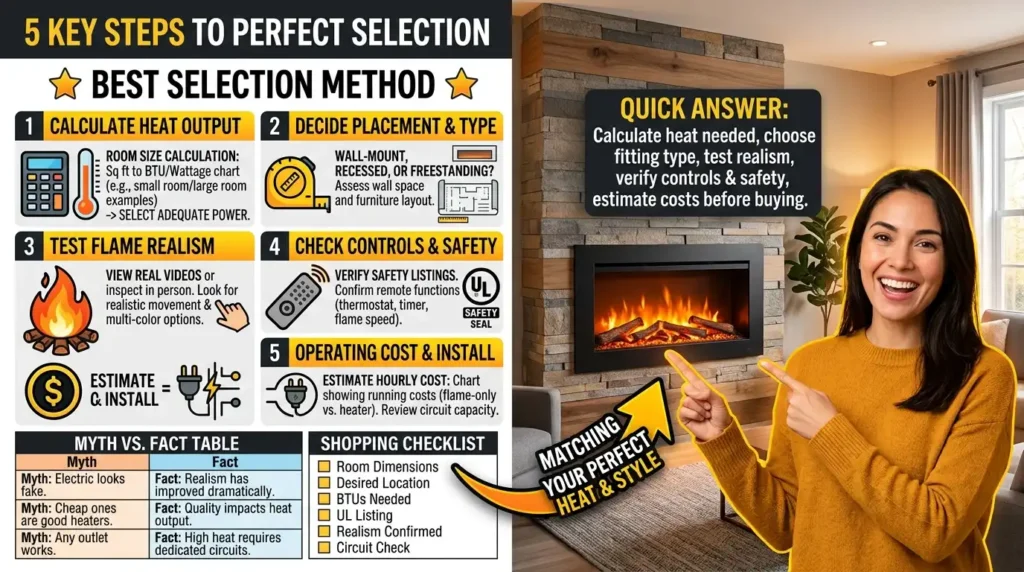
Quick answer: To select the appropriate electric fireplace,
- Calculate the heat output that you need to fit your room,
- Decide what type fits your wall and furnishing,
- Test flame realism by hand or video,
- Check the controls and safety listing, and
- Work out the electrical installation and operating cost before you make a purchase.
The majority will be buying an electric fireplace visually. They purchase a glowing photograph, press the button marked buy and discover that the device can scarcely warm the room or it blows the circuit whenever it is turned on next to a space heater.
That’s avoidable. An electric fireplace is a two-in-one product, both a decoration and a heater. Both are judged by good buyers.
These five tips take you through the most important decisions. You will receive sizing charts, a cost breakdown, a myth-vs-fact table and a checklist to go shopping with.
Key Takeaways
- The majority of electric fireplaces that are plugged in reach 1,500 watts (approximately 5,100 BTU). It is not whole-house heat, it is supplemental heat.
- Type is equal to size. Wall-mounted, recessed, freestanding, insert and TV-stand designs are appropriate in various rooms.
- There is a wide range of flame quality. Turn off the heat and test it, because that is the way you will be using it.
- Do not put one in an extension cord or power strip.
- Running cost is subject to your local rate of electricity. Calculate the cost of buying.
What Is an Electric Fireplace?
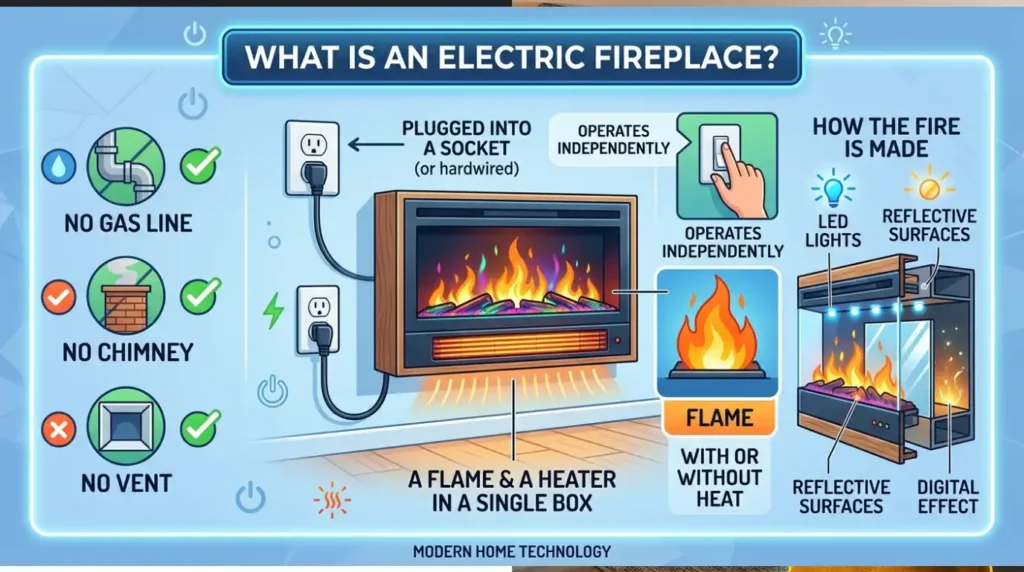
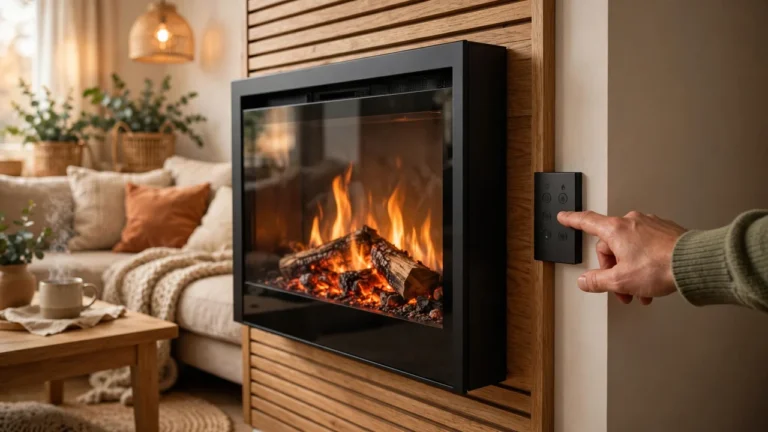
An electric fireplace is a flame and a heater in a single box. It is plugged into a socket or is hardwired into your power system, at home. It does not require gas line, chimney or vent.
The majority of models produce the “fire” using LED lights, reflective surfaces and in some cases a digital effect. The flame operates independently of the heater, thus you can have it with or without heat.
Fan-Forced vs. Infrared Quartz Heat
My 5 Tips for Choosing the Perfect Electric Fireplace
The majority of electric fireplaces have one of two heating types.
| Feature | Fan-Forced | Infrared Quartz |
| How it heats | A fan blows air over a hot element | Infrared light warms objects and people directly |
| Speed | Quick air warming | Gentle, steady warmth |
| Noise | A quiet fan hum | Typically quieter |
| Air feel | Can feel drier to some people | Often described as softer |
| Best for | Fast warm-up in a small room | Steady, comfortable warmth |
Neither is “better.” Fan-heated suits a cold room that you desire to be warm within a short time. Infrared quartz suits individuals who do not like blowing air. Look at the spec sheet, as some models come with both.
Electric vs. Gas vs. Wood: Quick Comparison
| Factor | Electric | Gas | Wood-Burning |
| Venting/chimney | None | Usually required (some ventless types exist) | Required |
| Install difficulty | Low to moderate | High (gas line, venting) | High (chimney, clearances) |
| Flame realism | Good to very good (varies) | Very good | Real fire |
| Maintenance | Very low | Moderate | High (ash, chimney cleaning) |
| Works in a power outage | No | Some models | Yes |
| Can move between rooms | Often yes (freestanding) | No | No |
Electric triumphs on simplicity. Raw heat and the experience of the real-fire go to gas and wood.
Tip 1: Match the Heat Output to Your Room
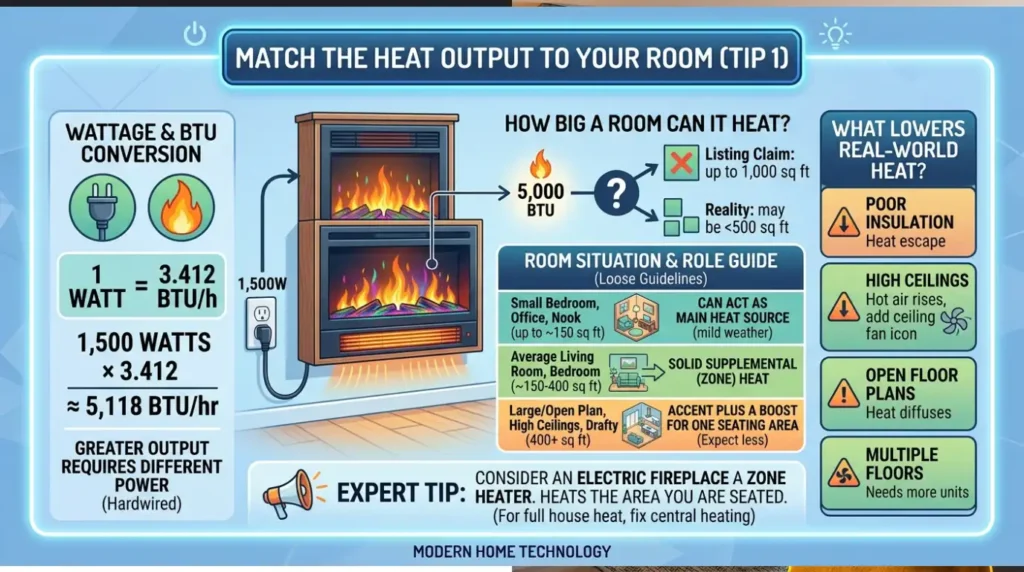
Brief answer: It depends on the wattage and not the square-footage assertion on the package. The majority of plug-in units consume 1, 500 watts. That is 5,100 BTU which is sufficient to cool one room but not to warm a floor.
Wattage and BTU
Watts are a unit of electrical power. H heat is in a measure of a BTU (British Thermal Unit). It is easy to convert: 1 watt = 3.412 BTU/h.
1,500 watts × 3.412 ≈ 5,118 BTU/hr
When a listing is making much more of a claim than a typical plug-in model, check the fine print. Greater outputs typically demand another power configuration, like hardwired connection.
How Big a Room Can It Heat?
Claims of coverage are diverse. Other listings indicate that a 5,000-BTU unit heats 1,000 square feet. Others caution that actual values might be half of the proposed area or even less. It all depends on where you live.
Guideline to rough planning:
| Room Situation | Plug-In (about 1,500W) Realistic Role |
| Small bedroom, office, or nook (up to ~150 sq ft) | Can act as the main heat source in mild weather |
| Average living room or bedroom (~150–400 sq ft), decent insulation, standard ceilings | Solid supplemental (zone) heat |
| Large or open-plan space (400+ sq ft) | Accent plus a boost for one seating area |
| High ceilings, big windows, drafty room, very cold climate | Expect less than the listing claims |
These are loose guidelines rather than figures that are tested in the lab. The result is different with your insulation, climate and layout.
What Lowers Real-World Heat
- Poor insulation. The escape of heat is more rapid than it can be replenished by the fireplace.
- High ceilings. Hot air ascends and gathers over. It can be blown down by a ceiling fan on low.
- Open floor plans. Heat diffuses into the rooms you didn’t intend to heat.
- Multiple floors. A single unit will not be enough to cover them.
Expert Tip:Consider an electric fireplace a zone heater. It heats the place where you are seated. Unless you want to heat the entire house, then repair the central heating system.
Tip 2: Pick the Type That Fits Your Space
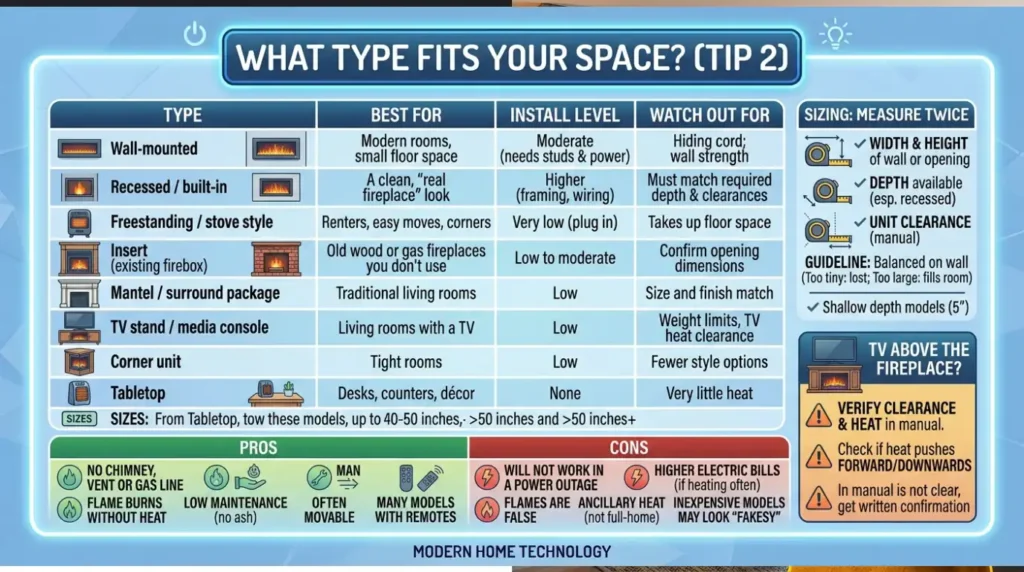
Short answer: Select according to its destination. Wall-mounted models will conserve floor space, free-standing models are easily movable, inserts can fit an existing opening, and TV-stand models provide storage and entertainment.
Comparisons of Electric Fireplace types.
| Type | Best For | Install Level | Watch Out For |
| Wall-mounted | Modern rooms, small floor space | Moderate (needs studs and a power plan) | Hiding the cord; wall strength |
| Recessed / built-in | A clean, “real fireplace” look | Higher (framing, wiring) | Must match required depth and clearances |
| Freestanding / stove style | Renters, easy moves, corners | Very low (plug in) | Takes up floor space |
| Insert (for an existing firebox) | Old wood or gas fireplaces you don’t use | Low to moderate | Confirm opening dimensions |
| Mantel / surround package | Traditional living rooms | Low | Size and finish match |
| TV stand / media console | Living rooms with a TV | Low | Weight limits, TV heat clearance |
| Corner unit | Tight rooms | Low | Fewer style options |
| Tabletop | Desks, counters, décor | None | Very little heat |
Sizes: Measure Twice
Sizing is between tabletop to models 50 inches and more. Numerous wall-mounted linear types are also extremely shallow, with some even five inches deep, as specified by the manufacturer.
Before you go shopping, measure three things:
- Width and height of the wall or opening.
- Depth available (particularly recessed designs).
- Unit clearance above and around, as indicated in the manual.
One of the handy visual guidelines is that a linear fireplace must appear to be balanced on its wall. Too tiny is lost, too large fills the room.
TV Above the Fireplace?
It is a common arrangement, not necessarily safe, or good in your TV. Clearance and heat above the unit: verify with instructions of manufacturer. Other models cause the heat to be pushed forward or downwards and they are designed to do so. Others aren’t. In case the manual is not clear, request the seller to do it in writing.
Pros and Cons of Electric Fireplaces
| Pros | Cons |
|---|---|
| No chimney, vent or gas line | Will not work in a power outage |
| Flame will burn without fire | Flames are false, like a wood fire. |
| Low maintenance (no ash) | Ideally as ancillary, not full-home, heat |
| Often movable | Higher electric bills if you run heat often |
| There are a lot of models with remote controls | Inexpensive models may appear to be fakesy |
Tip 3: Judge the Flame, Not Just the Specs
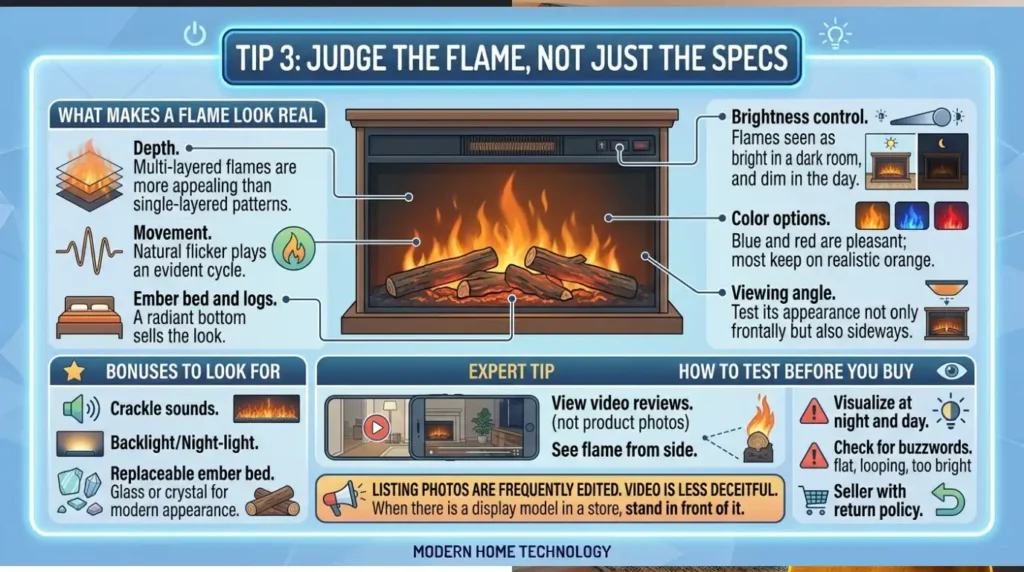
Short answer: Find layered flames, a glowing ember bed and a brightness that can be adjusted. Start the flame using no heat, as it is how you are going to use it most of the year.
That is the reason you are purchasing a fireplace rather than an ordinary heater because of the flame. It’s also the feature most likely to disappoint.
What Makes a Flame Look Real
- Depth. Multi-layered flames are more appealing than single-layered patterns.
- Movement. Natural flicker plays an evident cycle.
- Ember bed and logs. A radiant bottom sells the look.
- Brightness control. Flames are seen as bright in a dark room, and dim in the day.
- Color options. Blue and red are pleasant. Most people keep on realistic orange.
- Viewing angle. Test its appearance not only frontally but also sideways. Bonuses You can have a look at.
Certain models of higher quality include crackle sounds, backlight or a night-light feature. Others allow you to replace the ember bed material with glass or crystal one to have a modern appearance.
How to Test Before You Buy
- View video reviews taken in an actual room and not the product images.
- See the flame on its side.
- Fancy what it appears like at night and in the day.
- Read words such as flat, looping or too bright.
- Purchase with a seller who has a definite return policy. Expert Tip
Listing photos are frequently edited. Video is less deceitful. When there is a display model in a store, stand in front of it.
Tip 4: Check the Controls and Safety Features
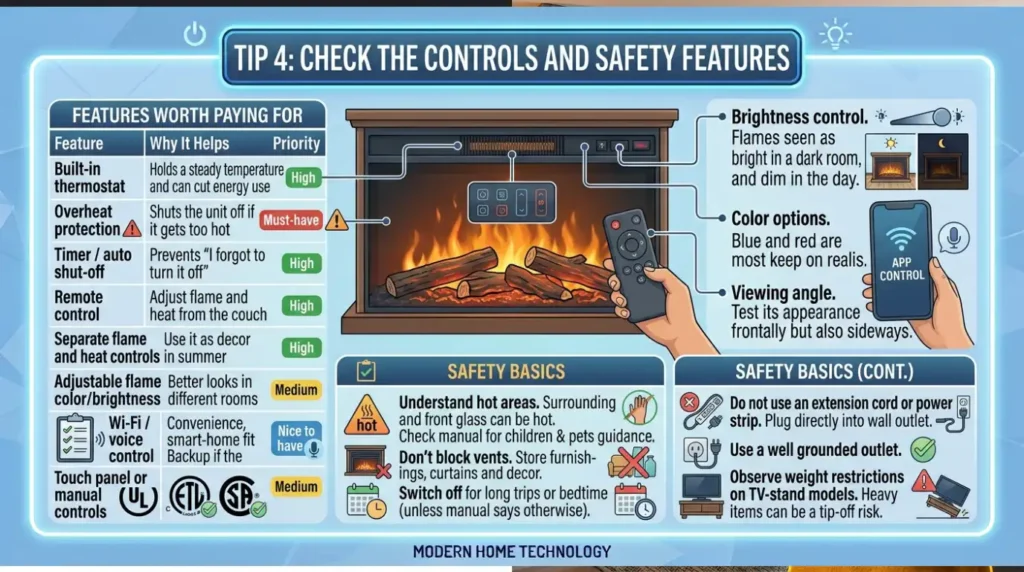
Quick answer: Find a thermostat, a timer, a remote, an overheat protection, a safety listing, by a known laboratory, like UL, ETL or CSA.
Features Worth Paying For
| Feature | Why It Helps | Priority |
| Built-in thermostat | Holds a steady temperature and can cut energy use | High |
| Overheat protection | Shuts the unit off if it gets too hot | Must-have |
| Timer / auto shut-off | Prevents “I forgot to turn it off” | High |
| Remote control | Adjust flame and heat from the couch | High |
| Separate flame and heat controls | Use it as decor in summer | High |
| Adjustable flame color/brightness | Better looks in different rooms | Medium |
| Wi-Fi / app / voice control | Convenience, smart-home fit | Nice to have |
| Touch panel or manual controls | Backup if the remote is lost | Medium |
Safety Basics
- Find a laboratory listing e.g. UL, ETL or CSA. It is an indication that the product is tested to a safety standard. Check it on the page of the product or on the manual.
- Understand what areas become hot. Areas surrounding and around the heating component can be hot and part of the front glass also gets hot. In case you have children or pets, consult the manual to find out how the device is made to work around this.
- Don’t block vents. Store furnishings, curtains and decor.
- Switch off when going away on long trips or when going to bed unless indicated in the manual.
- Do not use an extension cord or power strip. Directly plug into a wall outlet.
- Use a well grounded outlet.
- Observe weight restrictions on TV-stand models. Heavy item may also develop to be a tip-off risk.
Tip 5: Plan the Electrical Setup and True Cost
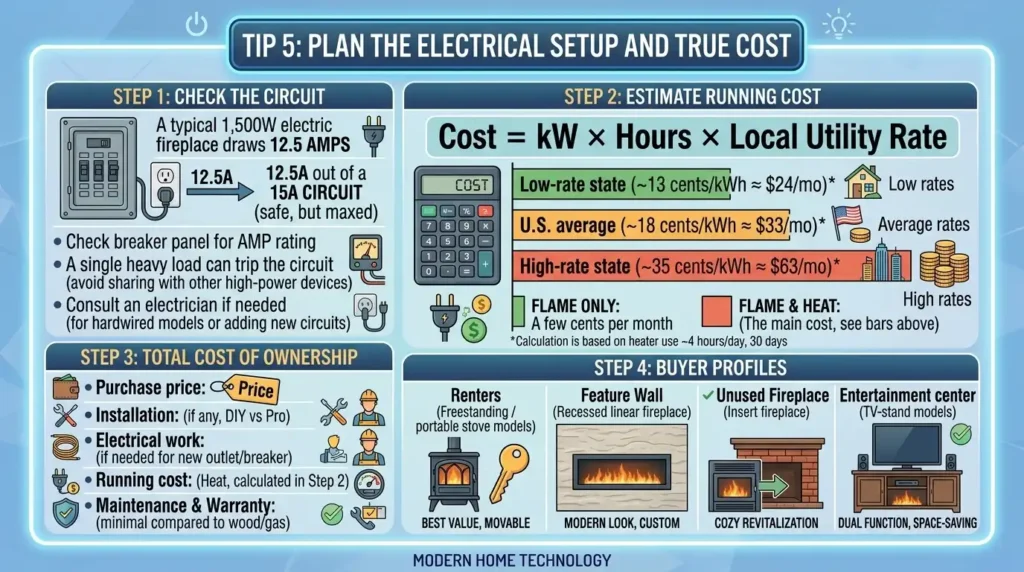
Short answer: A 1,500-watt fireplace consumes approximately 12.5 amps, or a good part of a typical 15-amp household circuit. Design the outlet and then estimate the cost of running the outlet.
Step 1: Check the Circuit
A 1,500W unit at 120 volts pulls about 12.5 amps (1,500 ÷ 120). That leaves little to be desired of other large appliances on the same circuit.
It is the error that stuns people. In case the fireplace is on the same circuit as a vacuum, hair dryer or space heater, you can switch the breaker on and off.
Do this:
- Read the manual for the circuit requirement. Certain models require a special circuit.
- Find out what else operates on that circuit.
- Consult with an electrician on whether to add a circuit or not, particularly in an older house.
- Decide where to set up the outlet, particularly where it is mounted on a wall, to avoid the cord being visible or strained.
Step 2: Estimate Your Running Cost
Use this formula:
Cost = kilowatts by hours used times your rate of electricity (dollars/kWh).
For a 1,500W (1.5 kW) heater running 4 hours a day for 30 days, that’s 180 kWh a month. Electric rates are different by state. The residential average in the U.S. in June 2026 was 18.34 cents per kilowatt-hour, with Nevada having the lowest average at 13.11 cents per kilowatt-hour, and California the second highest at 34.74 cents per kilowatt-hour.
Low-rate state (≈13¢/kWh) ██████░░░░░░░░░░ ≈ $24
U.S. average (≈18¢/kWh) ████████░░░░░░░░ ≈ $33
High-rate state (≈35¢/kWh) ████████████████ ≈ $63
Based on the above rates; your utility bill can vary. Check your personal scale on your electricity bill.
The flame-only mode consumes much less power than the heat mode as the LEDs do not consume much electricity. The spec sheet will show the precise wattage.
To get the current rate data, visit the U.S. Energy Information Administration.
Step 3: Total Cost of Ownership
| Cost Item | What to Consider |
| Purchase price | Budget plug-in models start low, and premium built-ins cost far more |
| Mantel, surround or trim | Sometimes sold separately |
| Installation | Framing, drywall and finishing for recessed models |
| Electrical work | A new outlet or circuit, if needed |
| Running cost | Use the formula above |
| Warranty | Compare length and what it covers |
Step 4: Find a Buyer Profile.
| If You Are… | Consider… |
| A renter | Freestanding or tabletop, no wall changes |
| Building a feature wall | Recessed linear or built-in with a surround |
| Replacing an unused fireplace | An electric insert |
| Wanting an entertainment center | TV-stand / media console |
| Heating a chilly bedroom | Smaller wall-mount or freestanding, with a timer |
| Focused on look, not heat | A heat-optional unit with strong flame effects |
Common Mistakes to Avoid
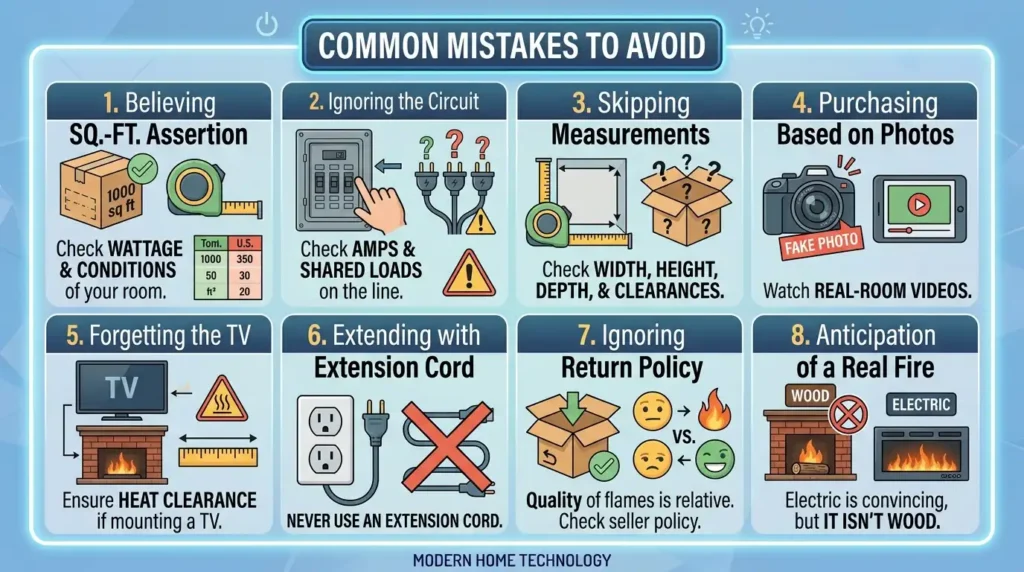
- Believing the square-footage assertion. Examine check wattage and conditions of your room.
- Ignoring the circuit. Check amps and what share the line.
- Skipping measurements. Check width, height, depth and clearances.
- Purchasing based on photos. Watch real-room videos.
- Forgetting the TV. Ensure heat clearance in case of mounting a TV.
- Extending with the help of the extension cord. Never use an extension cord.
- Ignoring return policy. The quality of flames is relative.
- Anticipation of a real fire. Electric is convincing, but it isn’t wood.
You May Also Read:
FAQs:
How do I choose the right size electric fireplace?
Measure your wall or opening, then match the unit to it. For heat, use about 1,500 watts for a typical single room. The unit should look balanced on its wall.
How many watts does an electric fireplace use?
Most plug-in models use up to 1,500 watts on high heat. Flame-only mode uses much less.
Do electric fireplaces really heat a room?
Yes, for small to medium rooms. They work best as supplemental or zone heat, not as a whole-house solution.
Are electric fireplaces expensive to run?
It depends on your electricity rate and use. At about 18¢ per kWh, a 1,500W unit costs roughly 27 cents an hour on high heat.
Can I plug an electric fireplace into a regular outlet?
Usually yes, a standard 120-volt outlet. Plug it directly into the wall, never into an extension cord or power strip. Always check your model’s manual.
Can I leave an electric fireplace on overnight?
Follow the manufacturer’s guidance. Many recommend turning it off when you leave the room for long periods or go to bed. A timer can help.
What’s the difference between fan-forced and infrared electric fireplaces?
Fan-forced blows air over a heating element. Infrared quartz warms objects and people directly with infrared light.
What is the best type of electric fireplace for a small room?
A smaller freestanding, corner or wall-mounted unit with a thermostat and timer works well.
Can I put a TV above an electric fireplace?
Sometimes. Check the manual for heat and clearance rules first.
Do electric fireplaces need to be vented?
No. They have no combustion, so they need no chimney, flue or vent.
Do electric fireplaces work in a power outage?
No, they need electricity to run.
Can an electric fireplace be used without heat?
Yes, on most models. Flames and heat have separate controls.
How long do electric fireplaces last?
It varies by brand, build quality and use. Check the warranty length as a starting signal, and read long-term reviews.
Is an electric fireplace better than a gas fireplace?
Electric is simpler and cheaper to install, with no venting. Gas usually produces more heat and a more realistic flame.
Can I install an electric fireplace insert in an old fireplace?
Yes, many are made for that purpose. Measure your firebox opening carefully and check the insert’s requirements.
Can an electric fireplace go in a bedroom or bathroom?
Some are approved for those rooms. Check the manual and listing for the specific model.
My Final Thoughts
The most preferred electric fireplace is not the largest or the least expensive one. It is the one that fits on your wall, your circuit, your real heating requirement in your room and your preference to flames.
Filter the five tips: heat, type, flame, features and safety and then electrical and cost. When one product does not pass one of them, continue searching.