Do Electric Fireplaces Require a dedicated Circuit? The Complete Electrical Guide.

Do Electric Fireplaces Need a Dedicated Circuit? Short answer: The majority of plug-in electric fireplaces (750-1500 watts) do not legally need a dedicated circuit and can operate on a typical 15-amp, 120-volt outlet provided nothing else heavy loads the same circuit. Units of higher wattage (1,500 to 2,500 or more watts), built-in/hardwired, or 240-volt fireplaces usually do require one, either by code or by the manufacturer. In a questionable situation, the plate of the rating of the fireplace and a licensed electrician resolve it within five minutes.
Most readers are satisfied with that one-paragraph answer. But it depends is not a satisfactory answer when you are at a breaker panel, and here is all that goes into the it depends.
What “Dedicated Circuit” Actually Means
Do Electric Fireplaces Need a Dedicated Circuit?
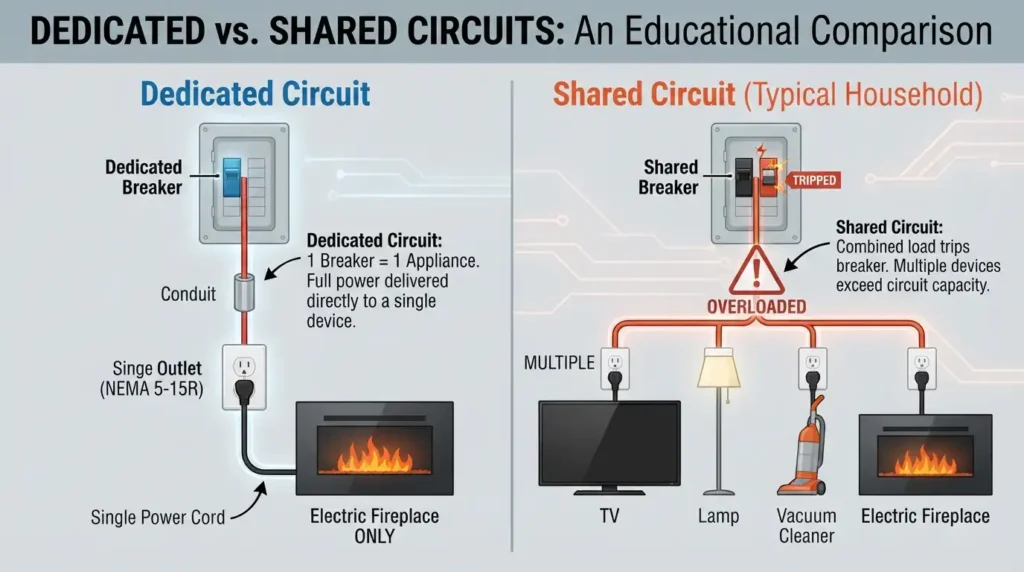
A dedicated circuit is one wire that is run between your breaker panel and one outlet, serving one appliance and nothing more. Switch that switch, and the fireplace goes off, but not the lamp, the TV or the plug on the other side of the room.
This is relevant since the majority of the household outlets are not committed. A 15-amp circuit is frequently used to serve four, six, or even eight outlets in a room or a hallway. Connect a space heater to one of them and a fireplace to another and you can even trip the breaker even though neither of the appliances is overloaded on its own, it is the combined load that is the issue.
Key Takeaway: It is not only a question of how much my fireplace draws, but also how much is already running on that circuit.
How Much Power Does an Electric Fireplace Actually Use?
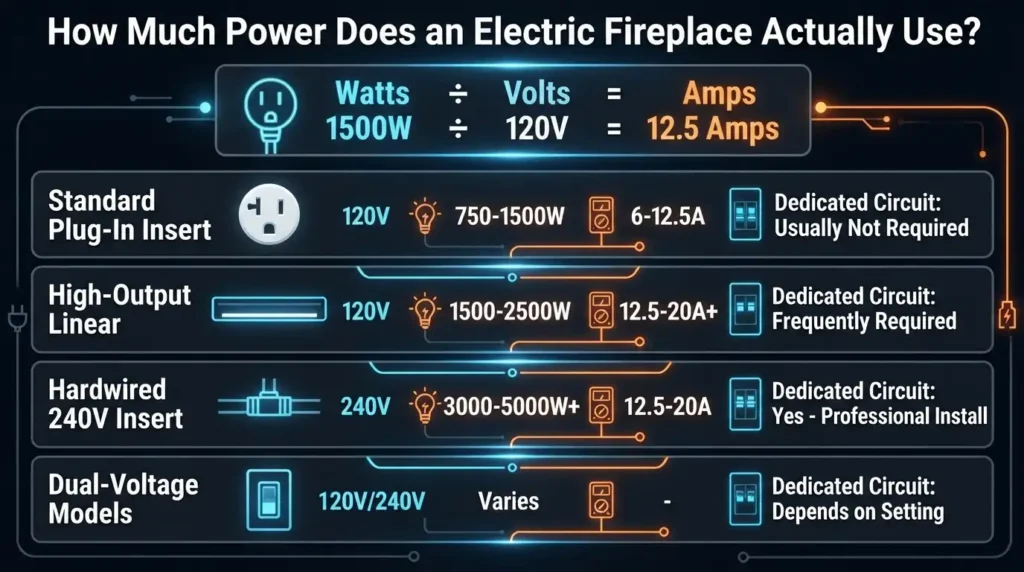
There are nearly two types of electric fireplaces on the market:
| Fireplace Type | Voltage | Typical Wattage | Typical Amp Draw | Dedicated Circuit Needed? |
| Standard plug-in insert/mantel unit | 120V | 750–1,500W | 6–12.5A | Usually not required, often recommended |
| High-output linear/built-in insert | 120V | 1,500–2,500W | 12.5–20A+ | Frequently required |
| Hardwired 240V insert (e.g., some Dimplex, Modern Flames units) | 240V | 3,000–5,000W+ | 12.5–20A | Yes — professional install required |
| Dual-voltage models (e.g., Dimplex Revillusion) | 120V or 240V | Varies by setting | Varies | Depends on the voltage tap used |
The heating element of most fireplaces is a standard 1,500-watt heating element, or the same amount of power as a typical space heater, due to the proximity of 1,500 watts to the safe limit of a typical household circuit. It is not a coincidence, manufacturers design to the outlet and not the other way around.
Some simple calculations you can make yourself: Watts/Volts=Amps. A 1,500-watt fireplace on a 120-volt circuit requires 12.5 amps.
The NEC 80% Rule Why It Matters More Than the Wattage
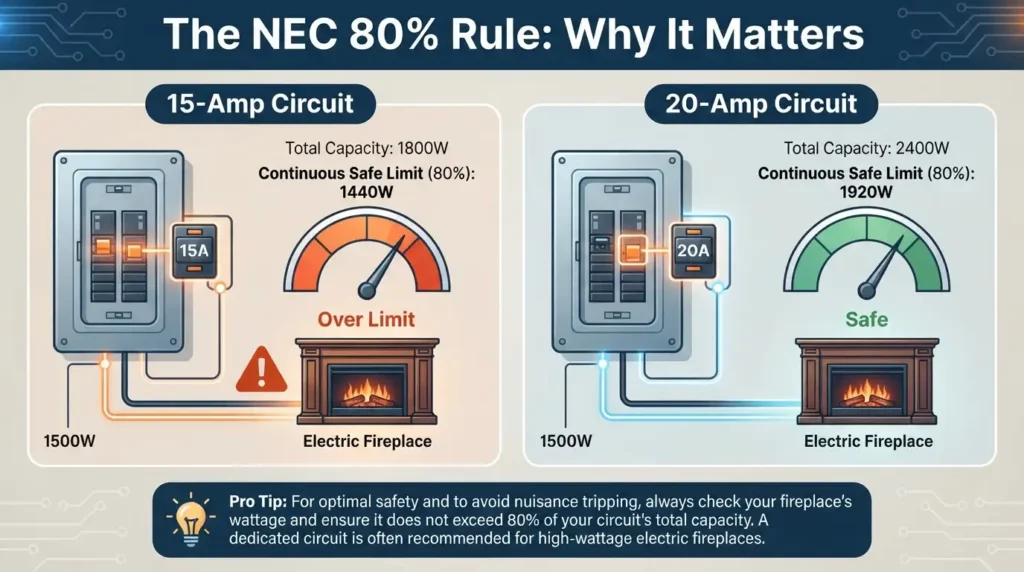
This is what nearly every rival article skips over, and it is the one fact that is most helpful in this guide.
National Electrical Code (NEC) considers any load that operates continuously in three hours or more as a continuous load. Electric fireplaces nearly always pass the test – people do not operate them five minutes, an evening. For continuous loads, code calls for the circuit to be loaded to no more than 80% of its rated capacity.
- A standard 15-amp circuit is rated for 1,800 watts (120V × 15A).
- At the 80% continuous-load mark, which is 1,440 watts safe, not 1,800.
- A typical 20-amp circuit has a 2,400 watt rating, and a continuous-load rating of 1,920 watts.
and therefore a 1,500-watt fireplace officially oversteps the 80 percent safe limit on a 15-amp circuit alone – before you do anything with it. This is why most electricians advise a special 15- or 20-amp circuit when the fireplace spec sheet does not specifically require one: it is the difference between not clearing the breaker today and not overloading the wiring over years of frequent operation.
Pro Tip: When the rating plate on your fireplace has 1,500 watts or more, consider a dedicated circuit the safe default, not the exception, even though the manual may tell you it is only recommended.
120V vs. 240V Electric Fireplaces
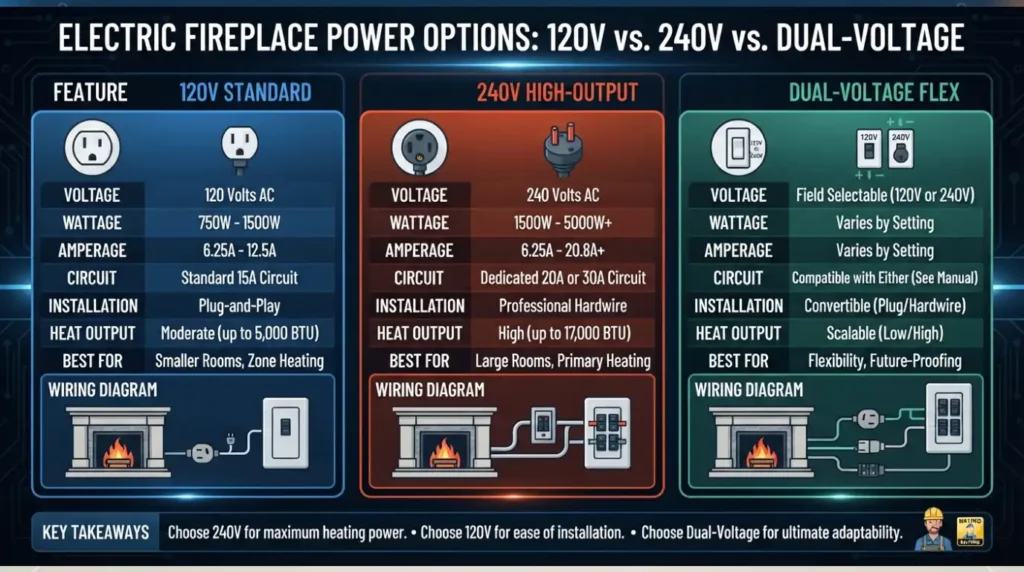
120-Volt Fireplaces
The retail sales of 120-volt fireplaces are predominantly freestanding models, mantel inserts, and the majority of linear models mounted on the wall. They are connected to a typical household outlet (assuming that the outlet and circuit can handle the load) and usually reach full capacity at about 1,500 watts since that is the safe current of a typical 15-amp circuit.
240-Volt Fireplaces
Fireplaces in 240V are typically larger built-in inserts and are intended to generate more heat (typically in BTUs similar to a small space heater or more). They are not plug-in, but hardwired, and by definition, need a dedicated circuit sized to the amperage rating of the manufacturer, like an electric dryer or water heater circuit. It is not a home project; it needs a licensed electrician and in most areas a permit and inspection.
Dual-Voltage Models
Some Dimplex Revillusion units are dual-voltage, and may be wired in either 120 V or 240 V. The circuit requirement is dependent upon which voltage tap you use.
Do You Legally Need One? A Decision Framework
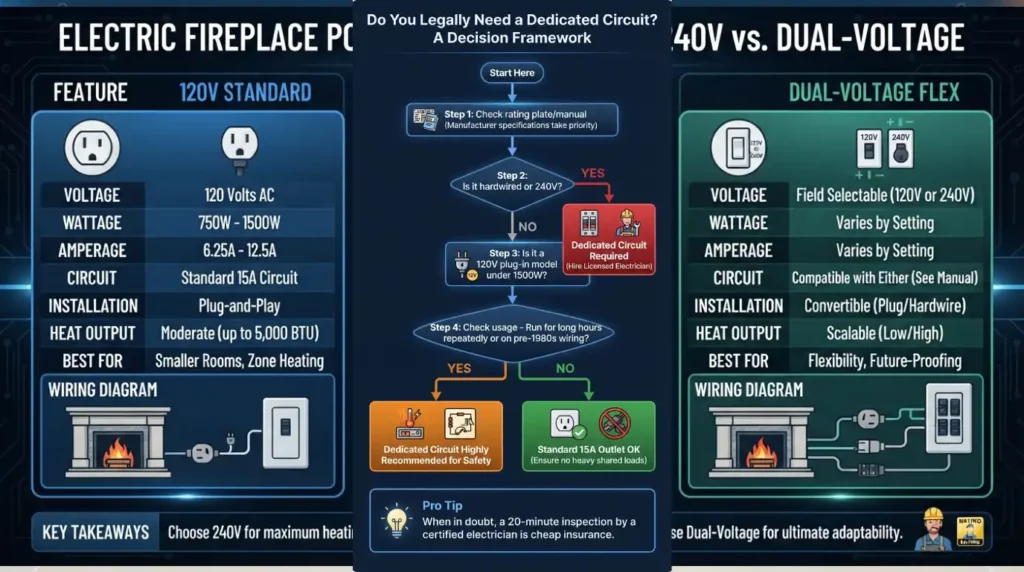
The following is the order in which to go through it:
- Check rating plate or manual. Manufacturers provide the necessary amperage and the necessity of a separate circuit. This takes precedence over any rule of thumb – always follow it.
- Is it hardwired or 240V? Yes, then a dedicated circuit is necessary, period. Jump to employment of electricians.
- Is it a 120V plug-in model under 1,500 watts? A dedicated circuit is typically not required by law, but it is important to ensure that nothing else heavy (space heater, hair dryer, window AC) is sharing that circuit.
- Do you run it hours at a time, a few times a week? Budget a dedicated circuit even when not absolutely necessary, in case of yes – to prevent nuisance trips, and to minimize long-term wear on the wiring.
- Not certain, or working with old wiring (pre-1980s houses)? Have an electrician certified to assess the panel and circuit. Older wiring has been reported to be a cause of home electrical fire, and 20 minutes of inspection is a cheap insurance.
Signs You Should Add a Dedicated Circuit (Even If Not Required)

- The breaker is tripped when the fireplace operates in the same circuit with other appliances.
- You can see flickering lights when the heater of the fireplace is on.
- Wi-Fi/app connectivity to the fireplace is sometimes unresponsive or erratic (electrical noise on a shared circuit can cause control boards to malfunction)
- You have an older panel or aluminum wiring in your house.
- You intend to operate the fireplace as a main or auxiliary source of heat to run a few hours a day, not occasional atmosphere. The Cost of adding a dedicated circuit.
What It Costs to Add a Dedicated Circuit
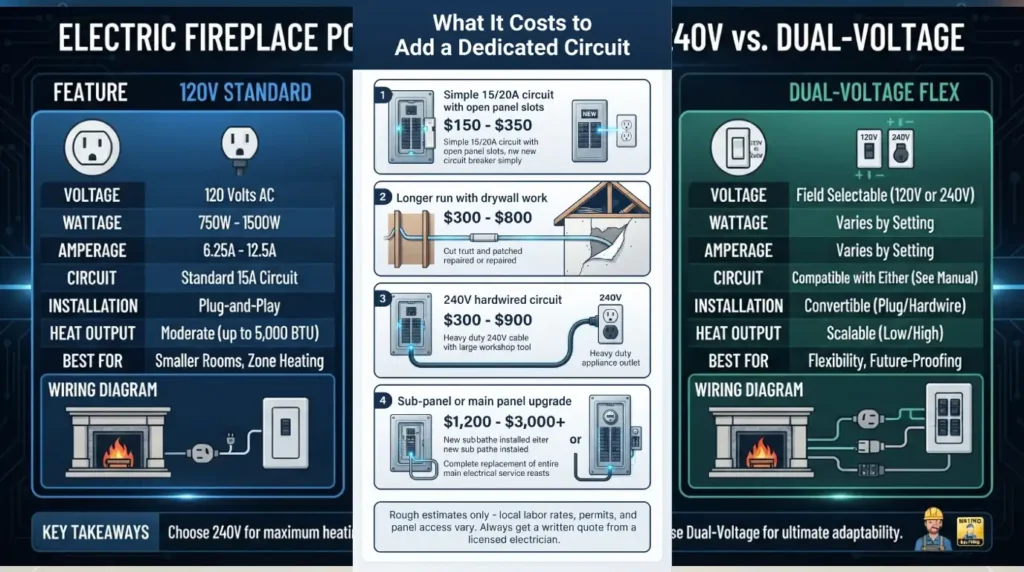
| Item | Typical Cost Range (USD) |
| Simple dedicated 15/20A circuit, panel has open slots, short run | $150–$350 |
| Longer run, finished walls requiring drywall work | $300–$800 |
| 240V circuit for a hardwired insert | $300–$900 |
| New sub-panel or panel upgrade needed | $1,200–$3,000+ |
These are rough estimates, not quotes – never accept an estimate made in writing by a local electrician who is not licensed because permit fees and labor rates differ depending on the area.
You May Also Read:
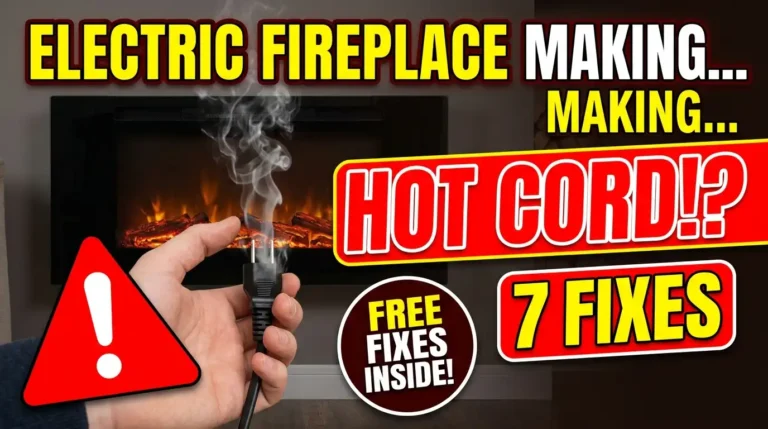
- Electric Fireplace Safety? 7 Essential Tips to Know
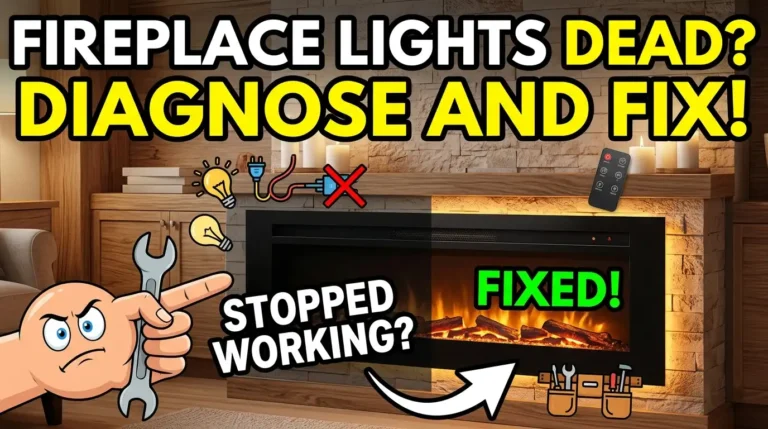
- Why Do Background Lights Stop Working on an Electric Fireplace?
FAQs:
Is it possible to use an electric fireplace in a standard wall outlet?
Yes, in 120 V plug-in models of less than about 1,500 watts, as long as the outlet is grounded and is not already occupied by other heavy appliances.
What is the size breaker of an electric fireplace?
A majority of 120 V fireplaces operate on 15-amp or 20-amp breakers, depending on the wattage of the unit. Check the rating plate and calculate amp draw from the wattage and voltage. Never use a breaker smaller than the required load.
What is the typical electric fireplace amps?
The majority draw 6–12.5 amps on a 120 V circuit, or about 750–1,500 watts. Bigger built-in or 240 V units can draw much more.
Does an inbuilt electric fireplace have to be hardwired?
A variety of built-in and linear models are intended to be hardwired, particularly 240 V units. Check your particular model, as some built-ins have a factory cord for plug-in use.
Is it possible to use an electric fireplace with an extension cord or power strip?
No. Manufacturers and electricians generally discourage this because the continuous heating load may overheat cords and power strips that are not designed for sustained high-wattage operation.
Will a special circuit give my fireplace a better run?
It will not alter the flame effect or heat output, but it can reduce voltage drop and nuisance tripping caused by sharing the circuit with other loads, particularly when Wi-Fi-connected devices are involved.
Is it safe to run an electric fireplace all day?
Most are designed for extended operation, but the circuit must be properly sized and not overloaded. NEC guidance for continuous loads is an important consideration when an appliance operates for hours at a time.
Are older homes required to be upgraded to have electrical before an electric fireplace is installed?
Homes with older wiring or aging electrical panels should be inspected by an electrician before installation. Aging wiring and overloaded electrical systems can increase electrical fire risks.
What’s the difference between a 120V and 240V electric fireplace?
120 V units typically plug into standard outlets and usually have a maximum of about 1,500 watts. 240 V units are generally hardwired, produce more heat, and require professional electrical installation.
Is my fireplace on a dedicated circuit?
First check the manufacturer’s manual and rating plate, which should specify the circuit requirement. As a general guide, units close to or above 1,500 watts on 120 V are good candidates for a dedicated circuit.
My Final Thought:
The dedicated circuit is a safety upgrade, not a legal requirement, to the typical 120 V plug-in electric fireplace, but once you start considering the 80 percent continuous-load guidance of the NEC, it ceases to be optional when you are dealing with anything approaching 1,500 watts. One is design required with hardwired and 240 V units. When the manual of your fireplace is not speaking or is unclear, a licensed electrician can verify your particular installation in a few minutes visit – inexpensive insurance against nuisance trips, and the actual insurance against fire hazard on old wiring.