How to Reset an Electric Fireplace with 5 Easy Steps
How to reset an electric fireplace? Quick answer: To reset most electric fireplaces, switch it off, unplug it out of the wall, 10-15 minutes, verify that the vents are clear, then put it back in and turn it on. This disables the internal safety of the shutdown that occurs in case of overheating or unexpected power outages of the unit. Unless it then starts again, then it is probably the outlet, breaker, or thermostat, and not something that a reset will correct.
A fireplace that all at once turns off or ceases to warm air is not normally broken. Practically all electric fireplaces available in the market, such as a 200-dollar freestanding stove up to a 3,000-dollar built-in insert, all have a safety system that intentionally closes the unit when something out of the ordinary is detected. A reset merely requests that safety system to stand by and attempt once again.
Here is the precise procedure, the meaning of the warning lights and how to distinguish between the need to do a reset and the need to do a repair.
Why Electric Fireplaces Shut Off and Need a Reset
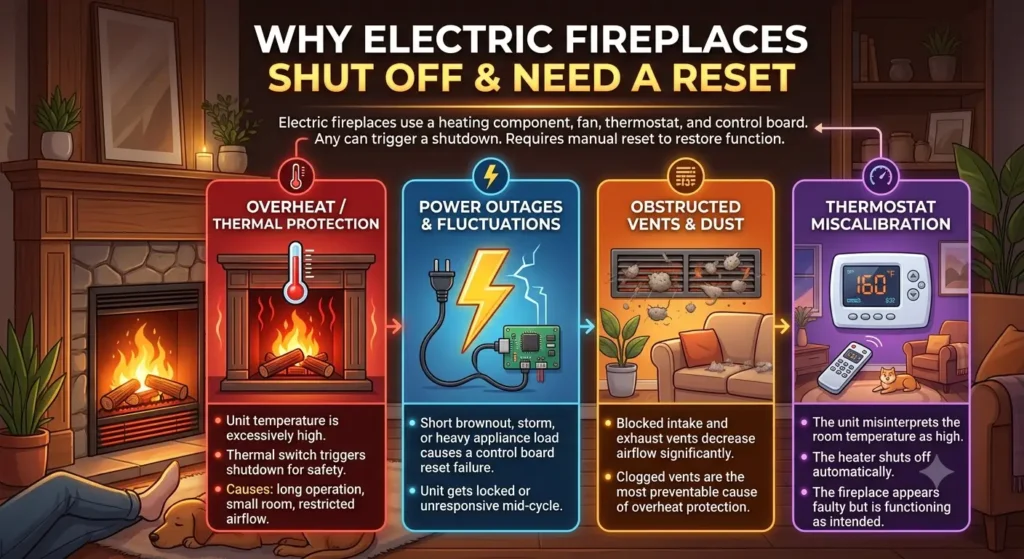
Electric fireplaces are made up of a heating component, a fan, a thermostat, and a small control board. Any of these may cause automatic shutdown.
Overheat / thermal protection. This is the most prevalent reason. A thermal cutoff switch within the unit switches when the inside temperature becomes excessively high, typically due to the constrained airflow, the room is limited and enclosed, or the fireplace has been burning a long period of time.
Power outages and fluctuations. Even a short brownout or a storm or some other device in the same circuit that consumes a lot of current may cause the control board to be left mid-cycle, putting the unit in a locked or unresponsive state until it is power cycled.
Obstructed vents and dust. Clogged intake and exhaust vents with dust, pet hair or blocked by furniture decrease airflow, the most preventable cause of overheat protection.
Thermostat miscalibration. When the room temperature is interpreted as sufficiently high by the thermostat, the heater will turn off – this may appear as a shutdown although the unit itself is not actually faulty.
Control board sync and remote board sync errors. A non-responsive operating fireplace may be caused by a lost control board with the remote, or a broken remote battery; most of the units remain operable on the manual panel on the panel itself in this situation.
How to Reset an Electric Fireplace: Step-by-Step?
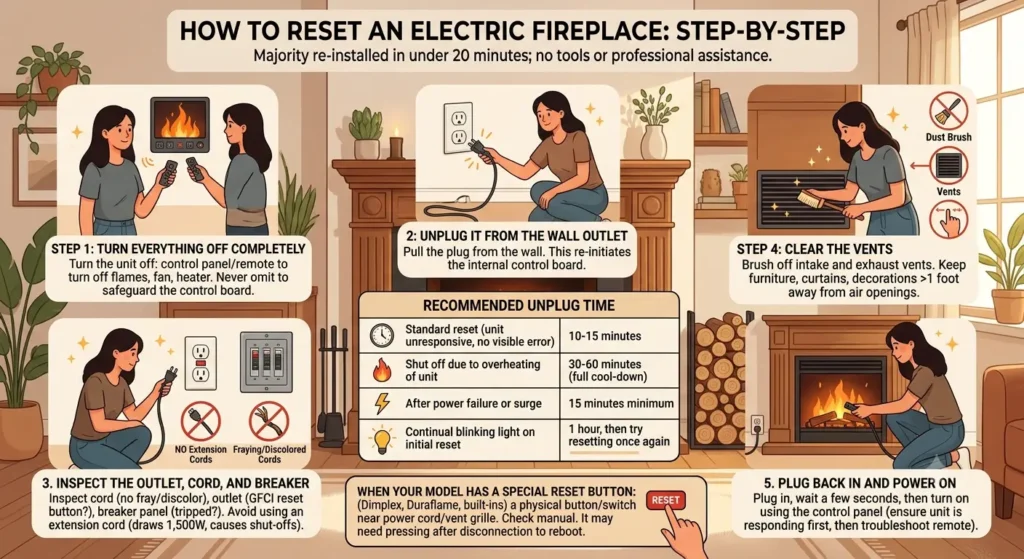
The majority of electric fireplaces can be re-installed in less than 20 minutes with no hand-tools and no professional assistance.
Step 1: Turn everything off completely
Turn the unit off as much as possible: with the control panel or remote, turn off the flames, fan, and heater. Never omit this even when you are about to switch it off; allowing the internal parts to switch off one by one will safeguard the control board.
Step 2: Unplug it from the wall outlet
Instead of turning it off at the wall, pull the plug out. It is the step that actually re-initiates the internal control board.
Here is the clean, formatted table based on your data:
| Situation | Recommended Unplug Time |
| Standard reset (unit unresponsive, no visible error) | 10–15 minutes |
| Shut off due to overheating of unit | 30–60 minutes (full cool-down) |
| After power failure or surge | 15 minutes minimum |
| Continual blinking light on initial reset | 1 hour, then try resetting once again |
Step 3: Inspect the outlet, cord, and breaker
When it is off, inspect the cord to make sure it is not fraying or even discoloured by heat, ensure that the outlet is not a GFCI tripped (it has a reset button on the outlet) and that you have a tripped breaker in your breaker panel. Always avoid using an extension cord to power an electric fireplace, most of them have a draw of 1,500 watts, which is greater than most extension cords can handle, and this by itself will lead to frequent nuisance shut-offs.
Step 4: Clear the vents
Brush off the intake and exhaust vents. Keep furniture, curtains or decorations at least a foot away around the air openings of the unit.
Step 5: Plug back in and power on
To trouble shoot the remote, reconnect the fireplace, then after a few seconds, turn it on using the control panel, not the remote, first to ensure that the unit itself is responding, and then you can troubleshoot the remote.
When your model has a special reset button: Certain inserts and stoves (especially Dimplex, Duraflame and some linear built-in models) have a small physical reset button or switch, usually near the power cord opening or at the bottom of the vent grille. The exact location will be indicated by the owner manual of your device, and to get it to turn on, it may be necessary to press the button afterwards after disconnection, since it will not completely reboot after a power cycle.
Reset Steps by Fireplace Type
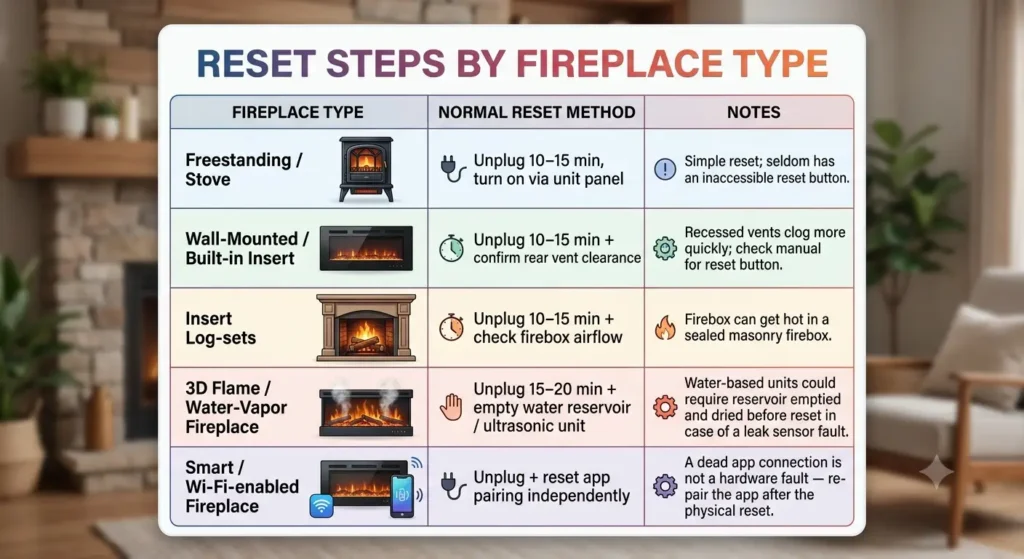
Not all electric fireplaces will reset the same way. The difference between builds in this process is as follows:
Here is the formatted table based on your data:
| Fireplace Type | Normal Reset Method | Notes |
| Freestanding / stove | Unplug 10–15 min, turn on via unit panel | Simple reset; seldom has an inaccessible reset button. |
| Wall-mounted / built-in insert | Unplug 10–15 min + confirm rear vent clearance | Recessed vents clog more quickly; check manual for reset button. |
| Insert log-sets (insert into existing fireplace) | Unplug 10–15 min + check firebox airflow | Firebox can get hot in a sealed masonry firebox. |
| 3D flame / water-vapor fireplace | Unplug 15–20 min + empty water reservoir / ultrasonic unit | Water-based units could require reservoir emptied and dried before reset in case of a leak sensor fault. |
| Smart / Wi-Fi-enabled fireplace | Unplug + reset app pairing independently | A dead app connection is not a hardware fault — re-pair the app after the physical reset. |
What Blinking Lights and Error Codes Mean
All brands do not apply the same codes and there is no standard code set that is universal amongst manufactures so use this as a guide and check against your particular owner manual.
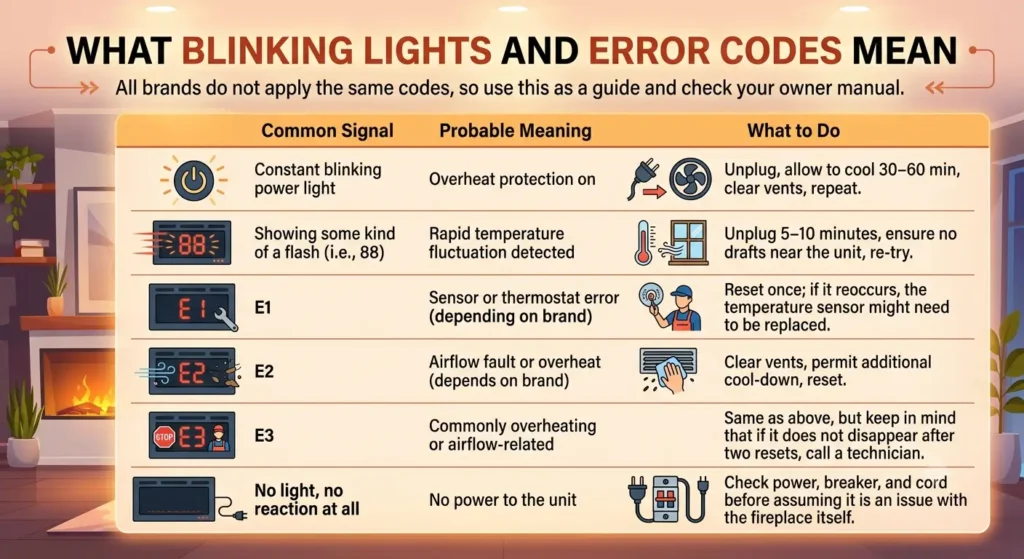
Here is the formatted table based on your data:
| Common Signal | Probable Meaning | What to Do |
| Constant blinking power light | Overheat protection on | Unplug, allow to cool 30–60 min, clear vents, repeat. |
| Showing some kind of a flash (i.e., 88) | Rapid temperature fluctuation detected | Unplug 5–10 minutes, ensure no drafts near the unit, re-try. |
| E1 | Sensor or thermostat error (depending on brand) | Reset once; if it reoccurs, the temperature sensor might need to be replaced. |
| E2 | Airflow fault or overheat (depends on brand) | Clear vents, permit additional cool-down, reset. |
| E3 | Commonly overheating or airflow-related | Same as above, but keep in mind that if it does not disappear after two resets, call a technician. |
| No light, no reaction at all | No power to the unit | Check power, breaker, and cord before assuming it is an issue with the fireplace itself. |
Since the error codes are brand specific, always refer to the manual of your brand to ensure that you have the correct meaning before you think that the above applies to your unit.
It Turns on but Won’t Heat” Troubleshooting Decision Tree
This is a very typical complaint following a reset: the flame display is on, yet no warm air is emitted.
- Do you have the thermostat set higher than room temperature? Otherwise, increase it – most units will not turn on the heater at all with a set point already satisfied.
- Do the vents of the intake and outlet pass clear? A blocked-out vent traps heat in the unit and may not allow cycling of the fan into the room.
- Has it not been less than an hour since the last shutdown?Certain units remain in the protection mode and will not re-enable the heater (although the flame effect remains on) until completely cooled.
- Have you done a second complete reset? When the initial reset re-established the flame, but not the heat, a second complete cycle, with the power off longer this time, will usually fix it.
- No heat yet, despite all the above? This indicates that there is a heating element or fan motor problem and not something that can be reset.
Common Reset Mistakes to Avoid
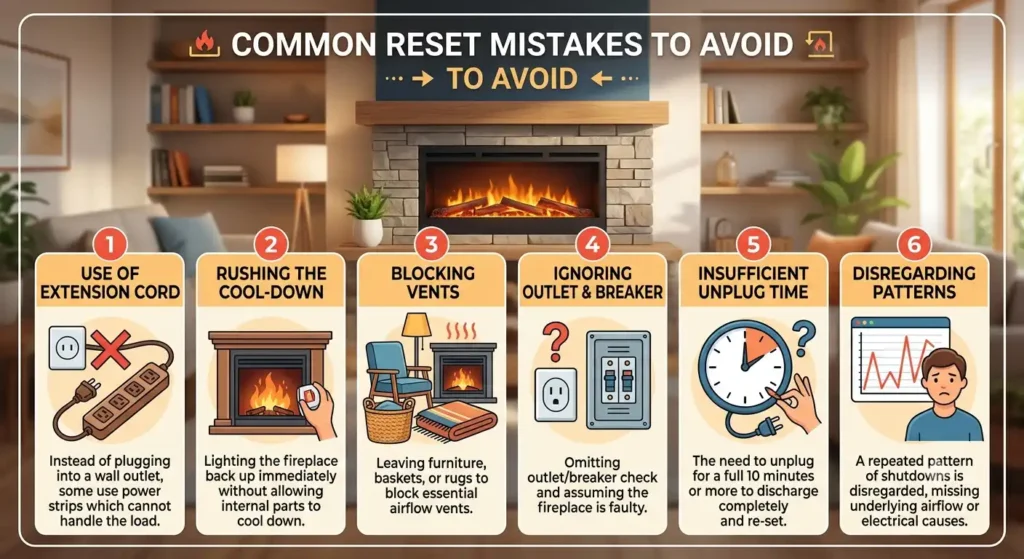
These are the common reset mistake to avoid
- Use of plug on an extension cord or power strip rather than plugging the unit into a wall outlet.
- Lighting the fireplace back up as soon as it goes off without letting it cool down.
- After the reset, leaving furniture, baskets, or rugs to block the vents.
- Omitting outlet/breaker check and assuming the fireplace is faulty.
- The need to unplug even a minute or two – most control boards require 10 minutes or more to discharge completely and re-set.
- A repeated pattern of shut downs is disregarded in favor of correcting the underlying airflow or electrical cause.
Signs You Need a Repair Tech
Most shutdowns can be solved by a reset, but it is not a universal solution. Suspect: Call a skilled electrician or the manufacturer support line in case you observe:
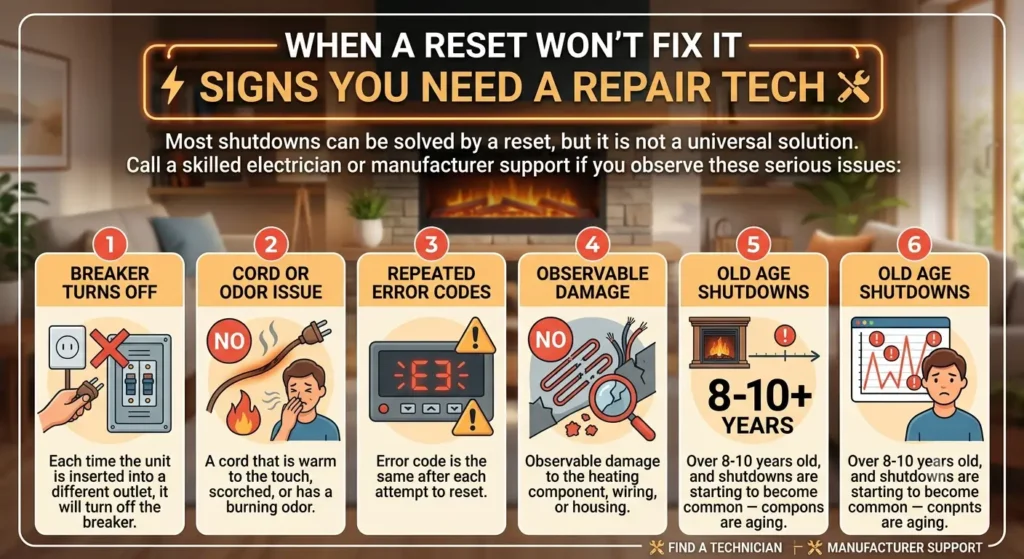
- Each time that it is inserted into a different outlet, the unit will turn off the breaker.
- A cord that is warm to the touch, scorched, or with a burning odor.
- It is possible that the error code is the same after each reset.
- Observable damage to the heating component, wiring or housing.
- The unit is over 8-10 years old, and the shutdowns are starting to become common- this should be a warning that the components are getting old and not that they have just had a one-time electrical hiccup.
How to Prevent Future Shutdowns?
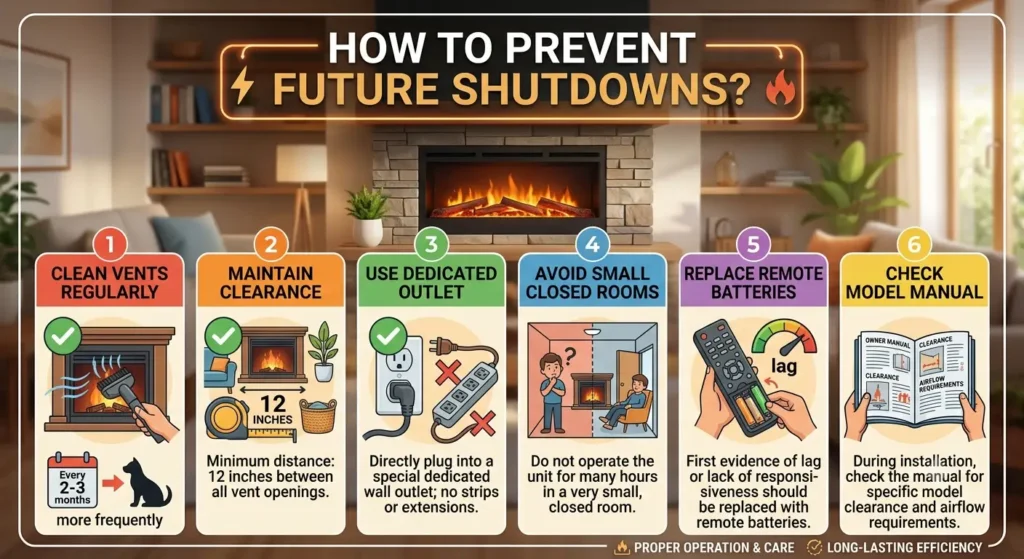
- Have vacuum intake and exhaust vents cleaned every 2-3 months (with pets, more frequently).
- Minimum distance should be 12 inches between all vent openings.
- Directly plug into a special dedicated wall outlet, not into a power strip or extension cord.
- Do not operate the unit many hours in a very small, closed room.
- First evidence of lag or lack of responsiveness should be replaced with remote batteries.
- During installation, check the manual to find out the clearance and airflow requirements specific to your model.
Myth vs. Fact
Here is the structured table for the Myths vs. Facts, followed by a summary of the Key Takeaways:
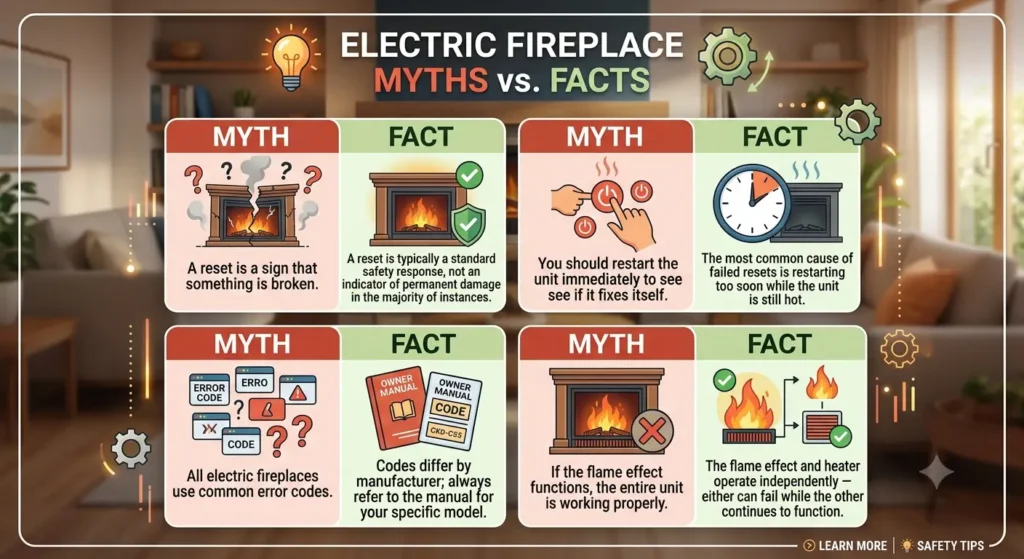
Myths vs. Facts
| Myth | Fact |
| A reset is a sign that something is broken. | A reset is typically a standard safety response, not an indicator of permanent damage in the majority of instances. |
| You should restart the unit immediately to see if it fixes itself. | The most common cause of failed resets is restarting too soon while the unit is still hot. |
| All electric fireplaces use common error codes. | Codes differ by manufacturer; always refer to the manual for your specific model. |
| If the flame effect functions, the entire unit is working properly. | The flame effect and heater operate independently — either can fail while the other continues to function. |
Key Takeaways
Know When to Call a Pro: Repeated shutdowns shortly after multiple resets usually indicate an underlying issue that requires professional repair.
Overheat Protection First: The vast majority of electric fireplace shutdowns are caused by built-in overheat protection rather than actual hardware failure.
The Universal Fix: Turn off the unit, unplug it for 10–15 minutes (longer if overheated), clear any vent blockages, and re-plug to reboot.
Check the Manual: Blinking patterns and error codes are brand-specific — avoid assuming meanings without consulting your manual.
Flame On, No Heat? Check the thermostat settings and vent clearances before assuming the heating element has failed.
YOU May Also like to Read
FAQ
What do I do to reset an electric fireplace?
Switch off, disconnect it off the wall 10-15 minutes, ensure that vents are empty, reconnect it to the wall and turn it on by using the control panel.
What is the duration of leaving my electric fireplace unplugged so that it can restart?
A typical reset takes 10-15 minutes; 30-60 when the shutdown was due to overheating hence internal components have ample time to cool completely.
Why does my electric fireplace all of a sudden stop?
It is usually a case of overheat protection, a clogged vent, a power outage, or a broken breaker, but not irreparable damage.
My electric fireplace has a blinking light, what does it mean?
It normally indicates overheat protection or sudden increase or decrease in temperature, depending on the brand.
Is it possible to use an extension cord to plug my electric fireplace?
It’s not recommended. Averagely, most units consume in excess of 1,500 watts and this surpasses the safe level of most extension cords and may create nuisance shutdowns or overheating.
Why will my electric fireplace not boot up after I reset it?
Test the outlet (with any GFCI reset button) and your home breaker panel – the problem might be above the fireplace itself.
What do I do to know when my electric fireplace requires a repair rather than a reset?
Repeat the same error right after two complete reset efforts, or smell burning or scalding, marks of scalding, a breaker that always trips: discontinue resetting and call a professional.
My Final Thought:
How to Reset an Electric Fireplace:To reboot most electric fireplaces, switch it off, unplug it out of the wall, 10-15 minutes, verify that the vents are clear, then put it back in and turn it on. This disables the internal safety of the shutdown that occurs in case of overheating or unexpected power outages of the unit. Unless it then starts again, then it is probably the outlet, breaker, or thermostat, and not something that a reset will correct.