Do Electric Fireplaces Need to Be Vented?
If you have concerns about the venting requirements of an electric fireplace and are searching for “Do electric fireplaces need to be vented?”, the simple answer is No. Electric fireplaces do not require venting, and no exceptions can be found in a typical fireplace. They do not burn fuel, hence no smoke, carbon monoxide or exhaust gases to be carried away by a chimney, flue or direct-vent pipe. Plug in- or hardwire it – and it is ready to use.
One-line answer is that. The rest of what you need to know is how electric fireplaces actually work to generate the flame and heat, how much they will cost to operate, how much space they will heat, the six types of fireplaces you can purchase, its clearance specifications, and a step-by-step installation guide.
Key Takeaways
- Electric fireplaces do not need a chimney, vent or a flue – and this is the case with all the models available.
- None of it can combust, therefore there will be no smoke, soot or carbon monoxide, so the placement is only confined by the availability of electricity and not the airflow.
- Units of 120 V output about 4,600-5,000 BTU/h; hardwired 240 V units can be about 8,900-10,000 BTU/h.
- A full power heater run will typically cost around 15-23 cents an hour based on local power charges; a flame effect only run will cost around a cent an hour.
- No venting does not mean no regulations – clearance distances, circuit capacity and (in hardwired units) an electrician is not irrelevant.
Why Electric Fireplaces Don’t Need Venting
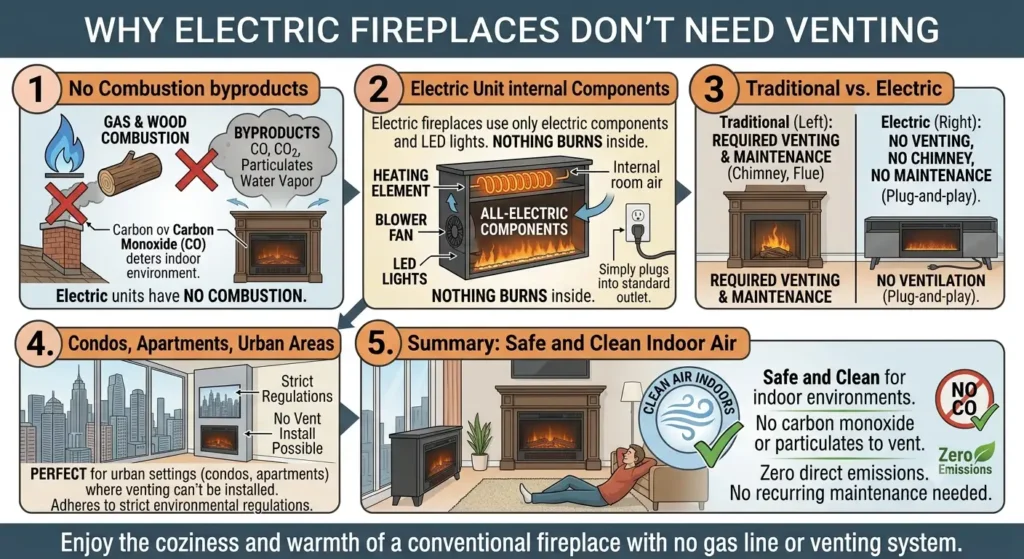
The purpose of venting is to extract combustion byproducts such as carbon monoxide, carbon dioxide, water vapor and particulates that are emitted during the burning of wood or gas. That is why those types of fireplaces have to be provided with a chimney, direct-vent pipe or flue by the building code.
With electric fireplaces, nothing burns, and thus this requirement never applies.
They provide the coziness and warmth of a conventional fireplace with no gas line or venting system (which is part of their popularity in urban settings with stringent environmental regulations) and in condos or apartments where a vent just can’t be installed. Since combustion of wood and gasses emits carbon monoxide and other byproducts, which can be detrimental to the indoor environment, such types of fireplaces should be ventilated and chimneys maintained frequently, which electric units do not need at all as nothing is being burned.
Do Electric Fireplaces Actually Create Flame and Heat
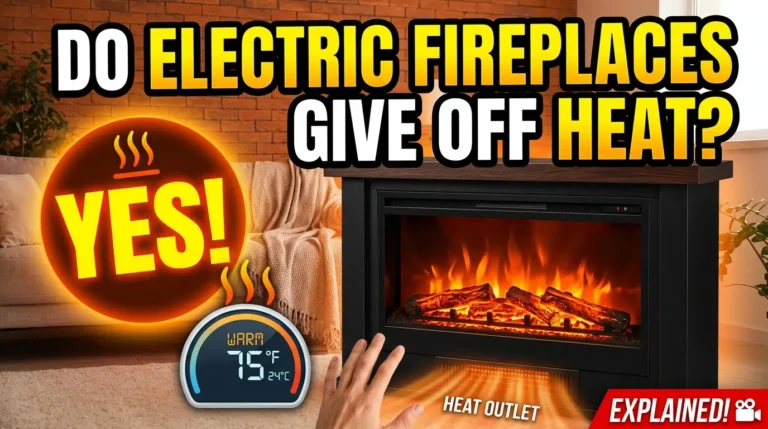
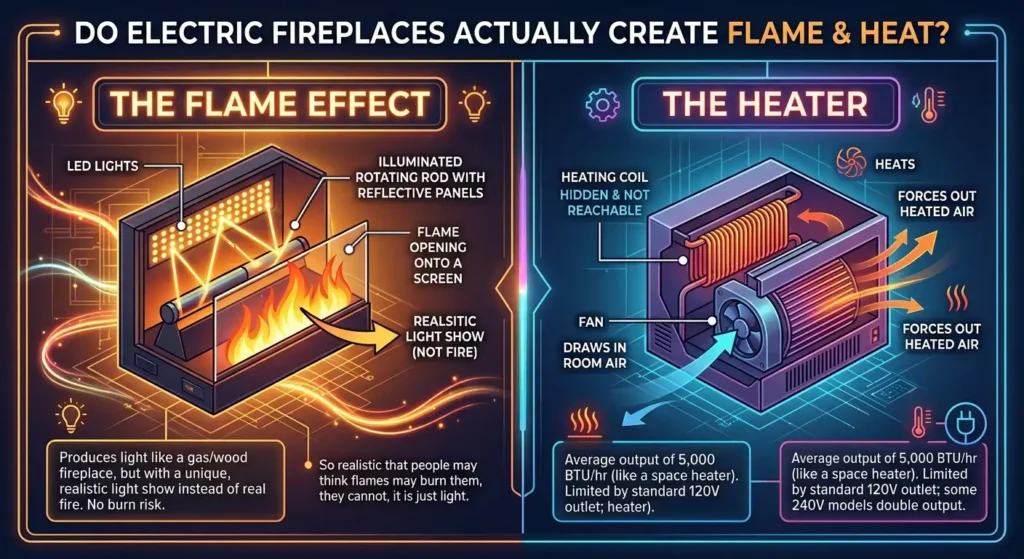
Electric fireplace produces light and warmth similar to a gas or wood fireplace except it does not have a real flame. The work is done by two separate systems.
The Flame Effect
The LED lights at the rear of the unit illuminate a rotating rod, covered with reflective panels; when the rod rotates, the light bounces off in various directions and shines through a flame-shaped opening onto a transparent screen. It is actually a miniature, constantly moving light show not fire. It has been done so well, that it is so realistic that people may think that the flames may burn them, they cannot, as it is just light.
The Heater
This heat, averaging about 5,000 BTU per hour on a typical unit (equivalent to a plug-in space heater), is provided by a distinct heating coil, hidden in a part of the unit where it is not reachable. Air in the room is drawn by a fan, heated, and forced out. There is a limit to the amount of output on a standard outlet which can be provided by 120 volts, thus some models are hardwired to 240 volts, approximately doubling the amount of heat produced.
Electric Fireplace Heat Output & Room Coverage
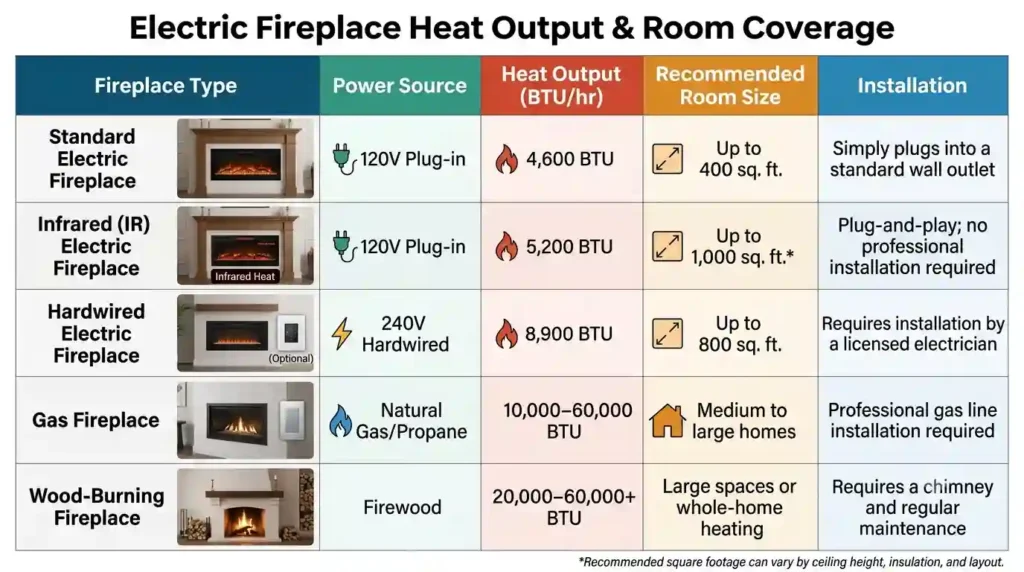
| Fireplace Type | Power Source | Heat Output (BTU/hr) | Recommended Room Size | Installation |
|---|---|---|---|---|
| Standard Electric Fireplace | 120V Plug-in | 4,600 BTU | Up to 400 sq. ft. | Simply plugs into a standard wall outlet |
| Infrared (IR) Electric Fireplace | 120V Plug-in | 5,200 BTU | Up to 1,000 sq. ft.* | Plug-and-play; no professional installation required |
| Hardwired Electric Fireplace | 240V Hardwired | 8,900 BTU | Up to 800 sq. ft. | Requires installation by a licensed electrician |
| Gas Fireplace | Natural Gas/Propane | 10,000–60,000 BTU | Medium to large homes | Professional gas line installation required |
| Wood-Burning Fireplace | Firewood | 20,000–60,000+ BTU | Large spaces or whole-home heating | Requires a chimney and regular maintenance |
Note: Electric fireplaces are primarily designed for supplemental (zone) heating, making them ideal for warming individual rooms. In contrast, gas and wood-burning fireplaces generate significantly higher heat output, making them better suited for heating larger spaces or serving as a primary heat source. Room coverage varies depending on insulation, ceiling height, outdoor temperature, and the fireplace’s efficiency.
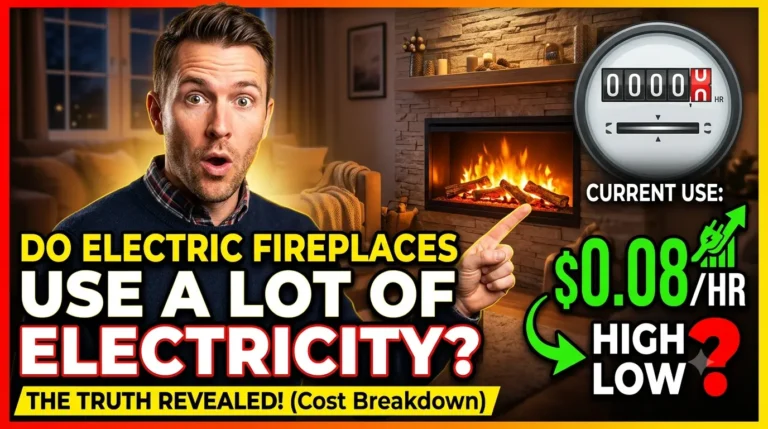
What It Actually Costs to Run?
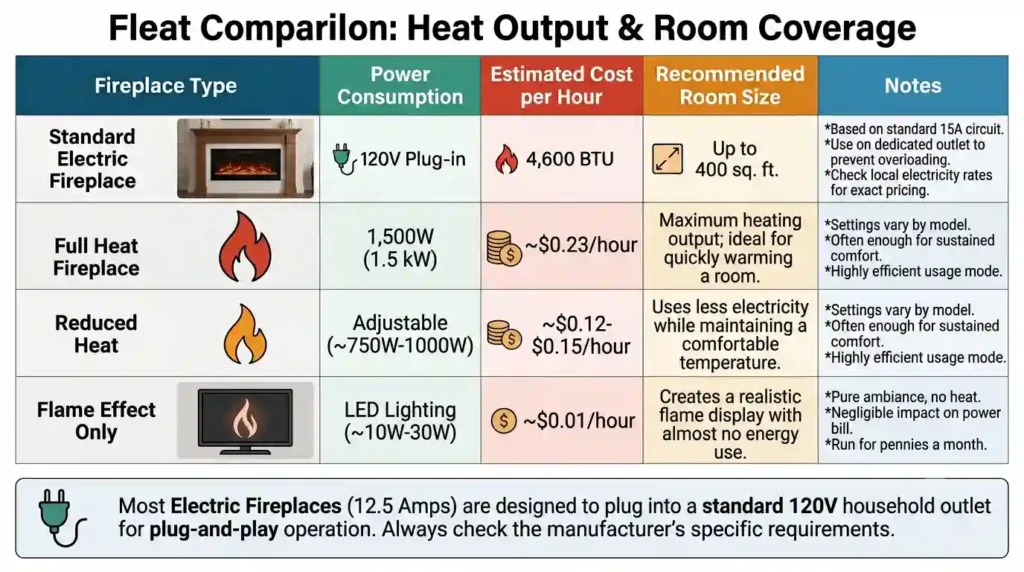
| Mode | Power Consumption | Estimated Cost per Hour | What It Means |
|---|---|---|---|
| Full Heat | 1,500W (1.5 kW) | ~$0.23/hour | Maximum heating output; ideal for quickly warming a room. |
| Reduced Heat | Adjustable | A few cents/hour | Uses less electricity while maintaining a comfortable temperature. |
| Flame Effect Only | LED Lighting | ~$0.01/hour | Creates a realistic flame display with almost no energy use. |
| Typical Power Draw | 12.5 Amps (120V Outlet) | — | Most electric fireplaces plug into a standard household outlet. |
Note: Running costs are based on an electricity rate of $0.15 per kWh. Actual costs will vary depending on your local electricity prices. For comparison, a gas fireplace typically costs around $0.30 per hour to operate and may also require expensive venting and professional installation.
The 6 Types of Electric Fireplaces
Electric fireplaces come in a variety of styles, each designed to suit different spaces, installation preferences, and home layouts. Whether you’re looking for a permanent built-in feature or a simple plug-and-play option, there’s a model to fit your needs.
The table below compares the six most common types of electric fireplaces, including how they’re installed, whether they can be removed later, and their typical power requirements.
Comparison of Electric Fireplace Types
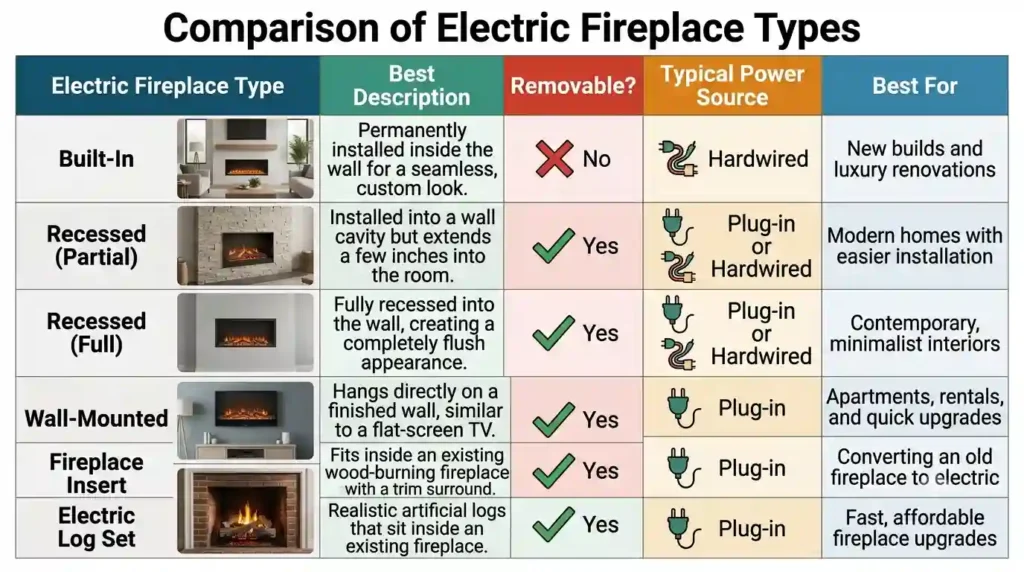
| Electric Fireplace Type | Best Description | Removable? | Typical Power Source | Best For |
|---|---|---|---|---|
| Built-In | Permanently installed inside the wall for a seamless, custom look. | No | Hardwired | New builds and luxury renovations |
| Recessed (Partial) | Installed into a wall cavity but extends a few inches into the room. | Yes | Plug-in or Hardwired | Modern homes with easier installation |
| Recessed (Full) | Fully recessed into the wall, creating a completely flush appearance. | Yes | Plug-in or Hardwired | Contemporary, minimalist interiors |
| Wall-Mounted | Hangs directly on a finished wall, similar to a flat-screen TV. | Yes | Plug-in | Apartments, rentals, and quick upgrades |
| Fireplace Insert | Fits inside an existing wood-burning fireplace opening with a trim surround. | Yes | Plug-in | Converting an old fireplace to electric |
| Electric Log Set | Realistic artificial logs that sit inside an existing fireplace. | Yes | Plug-in | Fast, affordable fireplace upgrades |
Clearance Requirements (Even Without a Vent)
Leaving out the chimney does not imply following out every spec in the manual. For a typical electric fireplace insert:
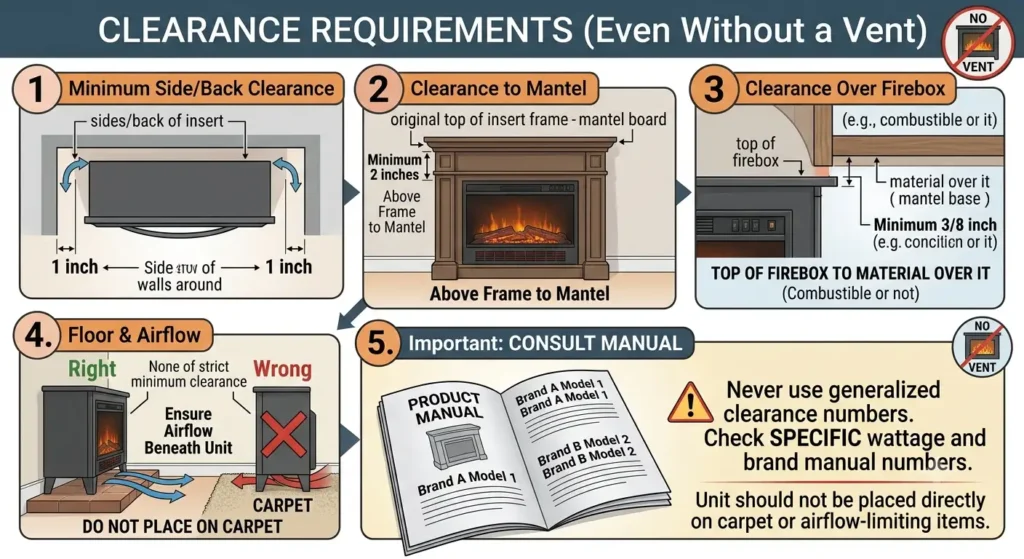
- Minimum of 1 inch between the sides/back of insert and the walls around.
- No less than 2 inches above original top of insert frame to any mantel board over it.
- At least 3/8 inch between top of firebox and any material over it, combustible or not.
- None of the strict minimum clearance to the floor, but the unit should not be placed directly on the carpet or anything that would limit the airflow beneath it.
- Never use the wrong numbers in your particular model manual -that is different with each brand and wattage.
How to Install an Electric Fireplace Insert (Step by Step)?
One of the most frequented directions to an installation is converting a former wood or gas fireplace hole into an electric one. Here’s the process:
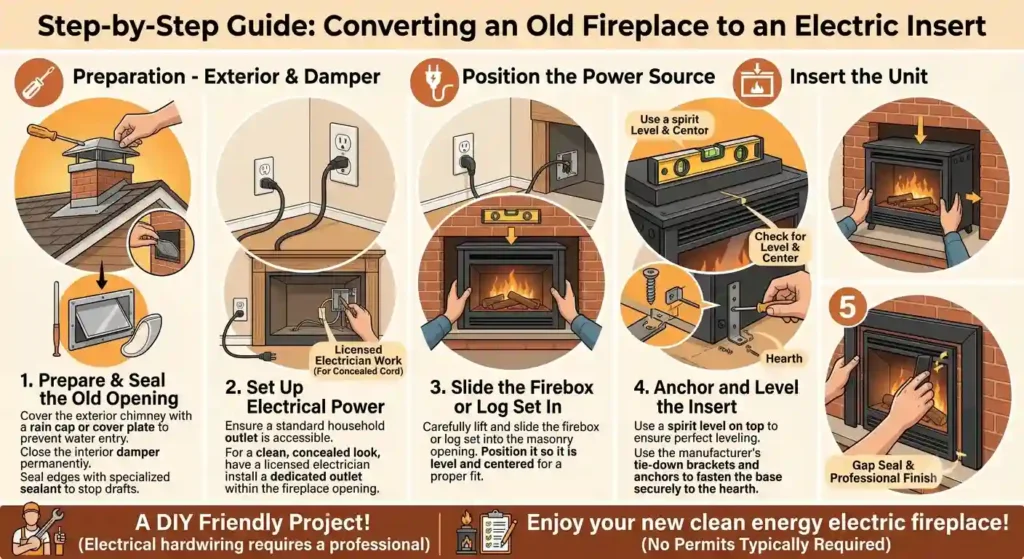
- Cover the chimney. Cover it with a cover plate or rain cap to ensure water does not enter in – even a small drip of water can break the insert, posing a fire hazard.
- Close and seal the damper. A damper is useless where there is an electric insert, and seal along the angles to prevent drafts and loss of heat.
- Set up power. Majority of the inserts fit in a typical household outlet; in case you would prefer to conceal the cord, then you would have to install an outlet within the fireplace opening which should be a licensed electricians work.
- Insert Slide. Position the firebox or log set in the opening, and level and center it; some also have tie-down brackets to hold it in place.
- Attach the trim. Fit the frame or trim kit to seal any cracks between the insert and the fireplace aperture – a matching trim is usually available in most inserts.
With basic construction knowledge and a power outlet within reach, it is typically a DIY friendly project that can be completed in a day although having a certified electrician on the hardwiring part is advisable. A typical installation does not normally need any special permits.
Electric vs. Gas vs. Wood: Full Venting & Cost Comparison
If you want the easiest, cleanest, and lowest-maintenance option, an electric fireplace stands out with no venting, zero emissions, and simple installation. Gas fireplaces provide more heat output but require a gas line and, in many cases, a venting system. Wood-burning fireplaces deliver the most traditional experience but involve the highest installation costs, ongoing maintenance, and emissions.
| Feature | Electric Fireplace | Direct-Vent Gas | Vent-Free Gas | Wood-Burning Fireplace |
|---|---|---|---|---|
| Requires Venting? | No | Yes (Horizontal or Vertical Vent) | No | Yes (Chimney Required) |
| Produces Emissions? | None | Yes | Yes (Low Levels) | Yes |
| Typical Running Cost | ~$0.23/hour | ~$0.30/hour | ~$0.20–$0.30/hour | Varies by firewood cost |
| Installation Difficulty | Easy – Plug-in or basic hardwiring | High – Gas line + sealed vent system | Moderate – Gas line + oxygen sensor | High – Chimney and masonry/prefab installation |
| Maintenance | Minimal | Annual inspection | Regular servicing | Frequent ash and chimney cleaning |
| Best For | Supplemental room heating | Efficient whole-room heating | Homes without venting options | Traditional ambiance and high heat output |
Are Electric Fireplaces safe?
Yes, as you would take with any electric appliance, with the common-sense precautions. Some details to be familiar with:
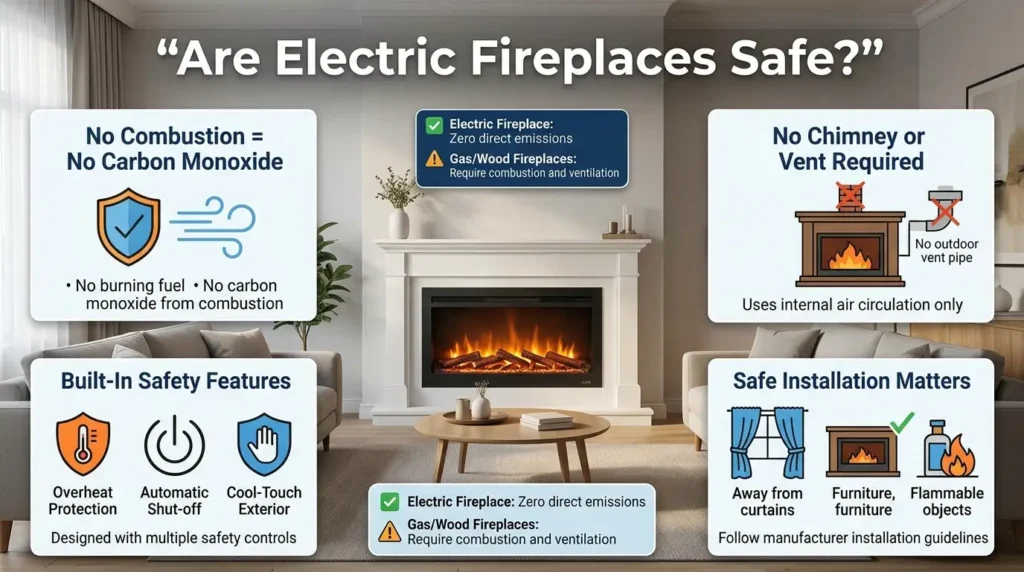
- The glass face is kept cold: unlike a real fire, the glass remains cold to the touch, and is typically safe with children and pets, since the heating unit is in a separate, screened-off area, and is not in the same location as the display.
- No open flame, no CO: there is no combustion, and therefore, no production of fumes, CO2, smoke, or any pollutants by electric fireplaces.
- Design low-maintenance: a few older models have replaceable candelabra bulbs with a lifespan of a few years; newer models have LED bulbs with a life of about 20,000 hours, which is long enough to last the average life of the fireplace.
- You can mount a TV over one: since electric units do not radiate nearby walls as gas fireplaces do, it is generally okay to mount a TV over the top of the fireplace, though it is always best to follow the clearance instructions of your particular model.
- They are movable: when put together, an electric fireplace is durable and safe to transport and it can approach an interior or exterior wall, stairs or a basement.
Myth vs Fact
| Common Myth | The Reality (Fact) |
|---|---|
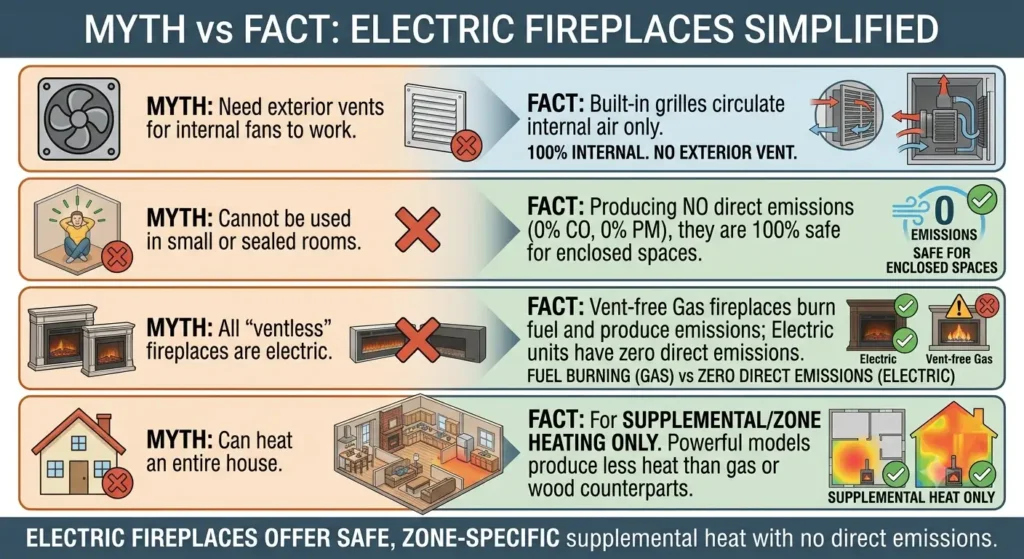
| Myth: Electric fireplaces need a small vent for the heater fan to work. | Fact: Electric fireplaces use built-in intake and outlet grilles to circulate air through the internal heater. These openings do not connect to the outdoors and do not vent combustion gases like a traditional chimney system. |
| Myth: You can’t install an electric fireplace in a small or sealed room. | Fact: Electric fireplaces produce no combustion and no carbon monoxide, making them suitable for small rooms and enclosed spaces without the need for external venting. |
| Myth: All “ventless” fireplaces are electric. | Fact: Vent-free gas fireplaces are a separate category. They burn fuel, produce emissions, and are restricted or prohibited in some areas. Electric fireplaces are the only option with zero direct emissions. |
| Myth: Electric fireplaces can heat an entire house. | Fact: Electric fireplaces are designed mainly for supplemental or zone heating. Even powerful 240V models produce much less heat than most gas or wood-burning fireplaces. |
Common Mistakes to Avoid with Your Electric Fireplace
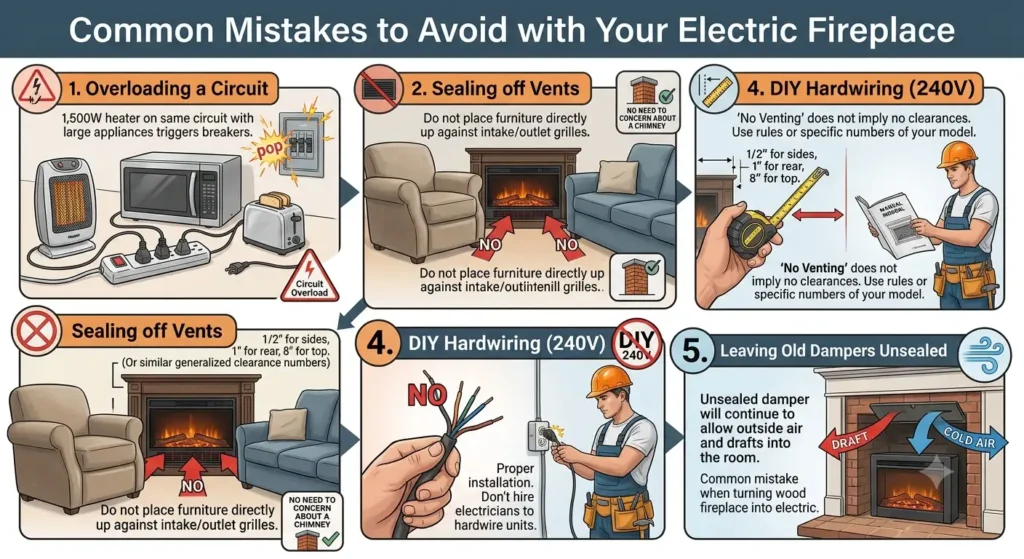
- Overloading a circuit: a 1,500-watt heater operating with other large appliances on the same circuit may cause breakers.
- Sealing off the vents: do not place furniture directly up against the intake/outlet grilles, although you need not be concerned about a chimney.
- Disregarding specification: “no venting does not imply no clearances, use the 1/2/1/8 rule above, or the specific numbers of your model.
- Don’t hire the electricians to hardwire units: DIY is all right with plug-in units, but most homeowners would not call 240 V hardwiring a DIY project.
- Leaving an old damper unsealed when turning a wood fireplace into electric – an unsealed damper will continue to allow outside air and drafts into the room.
You May Also Like to Reaed:
Frequently Asked Questions
Are electric fireplaces chimney-less?
No. There is no combustion hence no smoke or gas to escape through chimney.
Do electric fireplace inserts need to be vented?
No. Electric fireplace inserts do not need a vent, chimney, or flue, as they do not produce actual flame, smoke or carbon monoxide.
Are electric fireplaces carbon monoxide and fume producing?
No – there is not any combustion and so they do not produce fumes, CO2, smoke or any form of pollutant.
Is it possible to construct electric fireplace on a wall?
Yes — built-in electric fireplaces are designed with a specific purpose to be built into a wall.
Can electric fireplaces be converted to gas?
No – electric fireplaces aren’t designed to burn real flame, thus cannot be converted to burn gas.
Do electric fireplaces look fake?
Not as much as they used to. Early-2000s units had a reputation for looking like a flat, TV-screen flame. Modern LED and reflective-spindle systems create a more three-dimensional, realistic glow — though a true electric fireplace still won’t perfectly replicate the texture of a wood fire.
Are electric fireplaces touchable?
No – the front glass remains cold because the heating components are not located in the display space but are positioned behind a safety screen.
Are a carbon monoxide detector and electric fireplace close to each other?
Not due to the fireplace, which does not generate any CO, but a CO detector is still a good practice in general home-safety.
My Final Thought:
Do Electric Fireplaces Need to Be Vented, they have no chimney, no gas line, no combustion byproducts to regulate, whether you prefer a built-in, recessed, wall-mounted, insert or log-set design. The actual installation parameters are electrical outlet vs. hardwiring, circuit capacity, clearance requirements, but not airflow. When avoiding venting work is the determining factor in your selection of fireplace, electric is the most versatile, with the lowest cost of installation.