Do Electric Fireplaces Use a Lot of Electricity? Use Our Electric Fireplace Running Cost Calculator
Like many people, you may be concerned about the electricity consumption of an electric fireplace and wonder, do electric fireplaces use a lot of electricity? The short answer is No.
The maximum power of most electric fireplaces is around 1,500 watts, which, at a typical local electrical rate, costs between 15 and 30 cents per hour. Run all evening, that’s about a dollar or two. Turned off Run with heater off, it burns pennies an hour.
In this detailed guide, you will learn how much it costs to run an electric fireplace, its real electricity consumption rate by hour, day, month, and year, comparisons of electric fireplaces with space heaters, gas and wood-burning fireplaces, and other daily appliances. We will also discuss some common myths and share specific ways to save even more on your insert.
Key Takeaways
- Most electric fireplaces consume between 750 and 1,500 watts on the heat mode; larger 240-volt models reach up to 4,000-5,000 watts.
- Based on the average residential rates in the U.S. of approximately 19 cents per kilowatt hour, a 1,500-watt fireplace would cost approximately 28 cents per hour most homes fall in the 15-45 per month range with average seasonal use.
- Flame-only (no heating) consumes less than 50-150 watts -pennies per hour, be it LED lighting or a rotating-mirror light show.
- Essentially 100% of the electricity used is turned into heat by electric fireplaces, compared to 70-90% in gas and much less in an open wood-burning chimney, which actively draws warm air out of the house.
- They are designed to heat a room at a time – not the entire house – and this is where the majority of the savings in the real-life cases would be.
- The one thing that allows people to unintentionally increase their heating bill by a single factor: turning on the fireplace on the high setting without turning down the central thermostat.
Do Electric Fireplaces Use a Lot of Electricity?
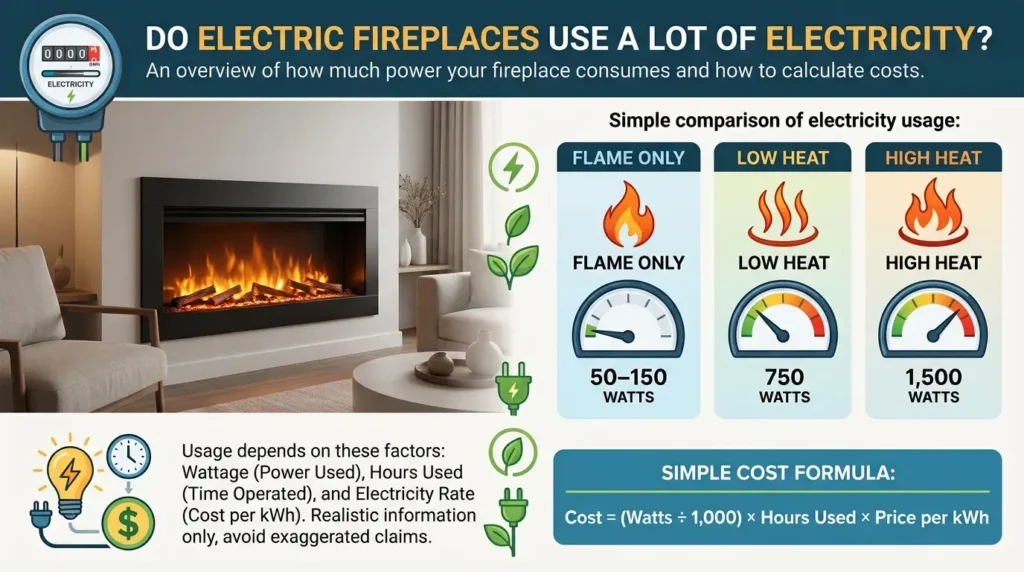
No. When used for supplemental zone heating, an electric fireplace typically adds only $15 to $45 per month to a household’s utility bill during winter months. Turning down your central thermostat while using the fireplace can actually lower your net monthly heating costs.
How Much Electricity Does an Electric Fireplace Actually Use?
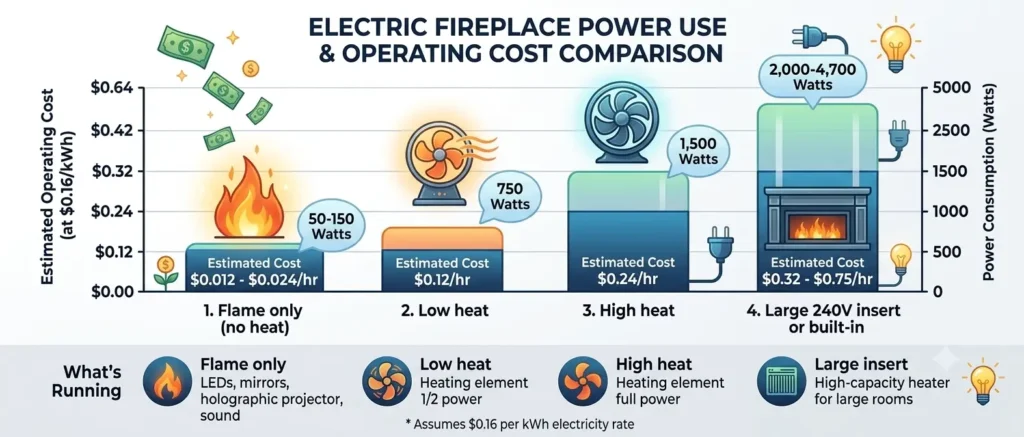
The amount of electricity an electric fireplace uses depends on the mode power modes. Every electric fireplace has two main systems: the flame effect and the heating element. Each of these uses a very different amount of power.
If you’re only enjoying the realistic flame display without the heat, the electricity usage is surprisingly low. However, once you turn on the heater, the power consumption increases depending on the heat setting you choose.
| Mode | Typical Wattage | What’s Running |
|---|---|---|
| Flame only (no heat) | 50–150 watts | LED lights, rotating mirrors or holographic projector, and sound effects |
| Low heat | 750 watts | Heating element running at half power |
| High heat | 1,500 watts | Heating element running at full power |
| Large 240V insert or built-in | 2,000–4,700 watts | High-capacity heater designed for larger rooms |
The fire show is virtually uncontrolled. The flickering effect of most of the units is achieved using LED bulbs and rotating mirrors, refracted light, or a projector in the holographic style – no actual fire, no energy cost to create the flame effect other than the cost of light itself, like a lamp or two left on.
Virtually all of the electricity consumption of an electric fireplace goes to the heating component, which operates in one of two ways:
- Coil heating- This is done by passing electricity through a metal coil which heats the coil and a fan moves this warm air into the room. This is a simple technique employed in the normal space heater.
- Infrared quartz heating / heating the air not required – the unit does not heat the air, but produces infrared light that directly warms people and objects just like sunlight. It does not dehumidify the air as forced-air coil heating can do.
Both techniques transform electricity to heat at virtually the same rate. The technology does not alter the amount of watts that it consumes, but the sensation of the warmth.
Notable fact: an electric fireplace with the heat turned off requires practically no power to operate, regardless of the duration that it is turned on. It is the heater and not the flame that runs the bill.
Electric Fireplace Running Cost Calculator
Cost = (Watts ÷ 1,000) × Hours Used × Electricity Price per kWh
As of the first half of 2026, the average residential power rate in the U.S. was approximately 18.8 cents per kilowatt-hour, although it varies between 12 cents in certain states such as North Dakota and Idaho and over 30 cents in Hawaii, California, and the New England region. The following is what that would look like in a typical 1500-watt fireplace:
| Electricity Rate (per kWh) | Cost Per Hour (High Heat - 1,500W) | Cost for 8 Hours | Monthly Cost (30 Days @ 8 Hours/Day) |
|---|---|---|---|
| $0.12 (Low-cost states) | $0.18 | $1.44 | $43.20 |
| $0.19 (U.S. national average) | $0.28 | $2.24 | $67.20 |
| $0.30 (High-cost states) | $0.45 | $3.60 | $108.00 |
Reduce the Wattage by half with the low heat option (750 watts) and each of those figures is approximately half as well. When turned on to flame-only the monthly price goes down to about 3-7 dollars, even with several hours of usage per day.
How Much Electricity Does an Electric Fireplace Consume Throughout the Year?
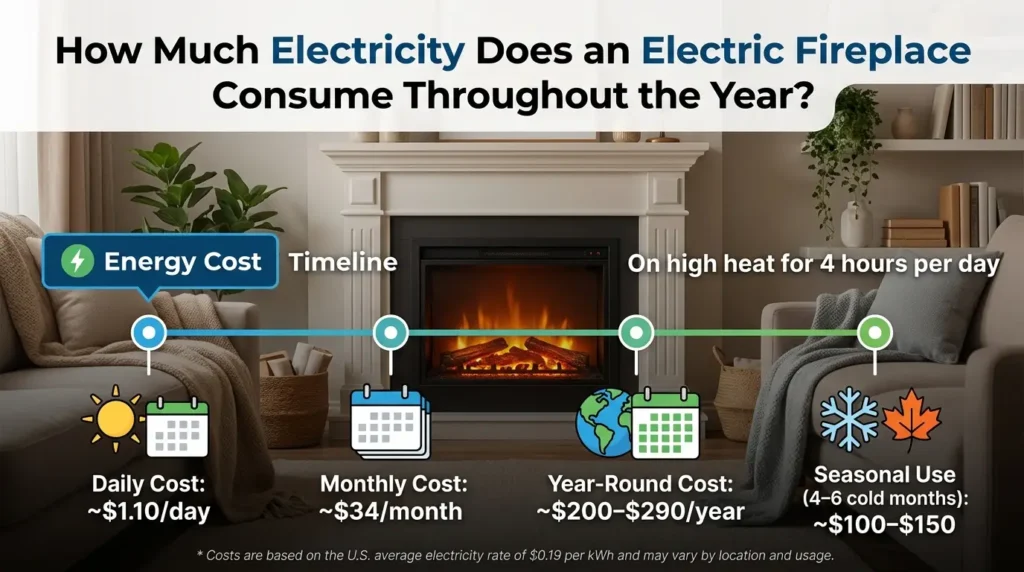
These estimates are based on a 1,500-watt electric fireplace running for 4 hours per day on the highest heat setting at the U.S. national average electricity rate of $0.19 per kWh. Actual costs may vary depending on your local electricity rates, usage habits, and climate.
| Usage Scenario | Estimated Cost |
|---|---|
| Daily Cost (4 hours/day on high heat) | $1.10/day |
| Monthly Cost (30 days) | $34/month |
| Annual Cost (Daily use year-round) | $200–$290/year |
| Typical Seasonal Cost (4–6 cold months) | $100–$150/season |
| Typical Increase in Monthly Electricity Bill | $15–$45/month |
Electric Fireplace vs. Everything Else: Cost & Efficiency Compared
| Heating Option | Average Power/Heat Output | Estimated Cost Per Hour | Efficiency & Notes |
|---|---|---|---|
| Electric Fireplace (High Heat) | 1,500 watts | $0.18–$0.30 | Nearly 100% efficient—almost all electricity is converted directly into heat with no venting losses. |
| Electric Space Heater | 1,500 watts | $0.18–$0.30 | Similar running cost and heating efficiency to an electric fireplace. |
| Electric Fireplace (Flame Only) | 50–150 watts | $0.01–$0.03 | Uses very little electricity and provides visual ambience with little or no heat. |
| Gas Fireplace (Vented) | 7,000–16,000 BTU | $0.40–$0.85 | Typically 70–90% efficient. Some heat is lost through the vent or chimney. |
| Wood-Burning Fireplace | Varies | Fuel cost + heat loss | Open chimneys often pull warm indoor air outside, reducing overall heating efficiency. |
| Central Furnace / HVAC | 3,500–15,000+ W (equivalent) | Higher overall | Heats the entire home, including unused rooms, which generally increases energy consumption. |
Electric Fireplace Vs Other Electric Appliances:
- One hour of running a 1,500-watt fireplace equals approximately running a hair dryer, a toaster oven or a small window AC unit one hour.
- A fridge will consume 100-400watts at all times and a clothes dryer may consume 5,000 and above watts. On a high fireplace, there is a fridge and a dryer that is much lower.
- Even when on most of the day, ambiance-only use is hardly more than a few dollars to a monthly bill.
Electric Fireplace vs Other Common Electric Appliances (Power Usage)
| Appliance | Typical Power Consumption | Compared With a 1,500W Electric Fireplace |
|---|---|---|
| Electric Fireplace (High Heat) | 1,500 watts | Baseline comparison |
| Hair Dryer | Around 1,200–1,800 watts | Uses a similar amount of electricity when running |
| Toaster Oven | Around 1,200–1,800 watts | Similar power usage to a high-heat electric fireplace |
| Small Window AC Unit | Around 1,000–1,500 watts | Can use about the same electricity depending on the model |
| Refrigerator | Around 100–400 watts (while running) | Uses much less power at any given moment, but operates throughout the day |
| Clothes Dryer | Around 5,000+ watts | Uses significantly more electricity than an electric fireplace |
A few things worth calling out from this comparison:
Electric fireplaces are approximately as expensive to operate as standard space heaters, as that technology is also based on the coil heating system. The benefit of the fireplace is style and comfort, rather than reduced energy consumption.
Gas produces a lot of heat, quicker, yet consumes more of it. Gas fireplaces are usually three times more efficient than an electric one, and a vented gas fireplace allows some of this heat to escape to the outside. In electric fireplaces, almost all electricity is used as usable indoor heat with zero venting loss - although that does not necessarily make electric inexpensive when compared to natural gas in many areas, as natural gas in most areas' costs less per unit of heat than electricity.
The least efficient among the group are the wood-burning fireplaces. A masonry chimney is not merely open and will not trap heat, it will actively draw the warm air already present in the house out, and cold air in through openings elsewhere. Electric units do away with that draft completely as nothing should be vented.
One green implication: when your local power system uses natural gas to produce electricity (which provides nearly 40 percent of the electricity production in the United States) then an electric fireplace is indirectly a gas-fired system as well. It does not alter the cost math, but it would be good to know whether efficiency (not only your bill) is the issue.
How Much Heat Does an Electric Fireplace Actually Produce?
| Heating Output | Typical Room Coverage |
|---|---|
| 1,500W (≈ 5,000 BTU/hour) | Up to 400 sq. ft. (depending on insulation, ceiling height, and climate) |
| 750–1,000W (Compact Models) | Approximately 150–250 sq. ft. |
| 2,000W+ (Large Built-in Models) | 500+ sq. ft., suitable for larger or open-concept spaces |
Why Electric Fireplaces Don’t Raise Bills as Much as People Expect
The reason why Electric Fireplaces do not increase bills as much as people would like to know.
They are zone heating, rather than whole-house heating. A 1,500-watt fireplace is designed to heat specifically one room - typically 150 to 400 square feet, depending on model - so that you can use the central thermostat to turn off, and only heat the room you are currently in.
By comparison, a central HVAC can attract the electrical or fuel equatable of 3,500 to 5,000+ watts, that is forced over the entire house, even into rooms that are not occupied.
100% of the electricity becomes heat. In contrast to a furnace that also emits some of the energy to ducting, or a gas fireplace that also emits some up the flue, electric resistance heat transforms almost all the electricity it consumes into heat in the room.
Majority of the models possess a thermostat and turn on and off. When a fireplace has an inbuilt thermostat it does not burn full power when it is on, it brings the room to the temperature you want, and then switches off, and this can be one of the reasons why real-life monthly expenses are usually less than a mere hours-times-wattage calculation would suggest.
Models with 120 volts are capped. The majority of electric fireplaces can be plugged into just a regular household outlet, and a 120-volt/15-amp circuit will max out at 1800 watts; therefore, most manufacturers will keep the fireplace heater at or below 1500 watts to allow room on the circuit. It is an inbuilt limit on the amount of electricity that a unit can consume.
Why Does My Electric Fireplace Consume a Lot of Electricity?
The most popular -and costliest-error is not the fireplace. It has the electric fireplace turned to high and the central furnace to the same high level. When that occurs you are paying to have two different heating systems running in the same room simultaneously.
The fireplace was created in a way that you could turn the main thermostat down, rather than add another layer on top of the thermostat.
To make the difference between the fireplace actually saving money and adding to your bill, the step that makes the difference is to drop the central thermostat to 5-10 degrees during the time it is running.
How to Make Your Electric Fireplace More Energy Efficient?
Since a 1,500-watt fireplace is a significant load, it warrants a brief word on the practical side of operating one;
- Where feasible, assign it its own outlet. When a fireplace is operated on the same circuit as other heavy appliances- an oven, a water heater, a clothes dryer- it can cause a breaker to trip when all these appliances are operating at the same time.
- Smart plugs and entire-home energy meters can be used to display to you how many kilowatt-hours your fireplace is actually consuming in real-time, which can remove the guesswork about whether it or something else is running up a bill.
- Time-of-Use (TOU) electricity rates are prevalent in most utilities, i.e. electricity costs more in the evening compared to the day. Should you have TOU pricing, you can pre-heat a room in the late afternoon, and then turn to flame-only mode in the peak evening hours, at no cost to the ambiance.
How to Reduce the Operating expense of your Electric Fireplace.
- Set a timer or an inbuilt shut-off so that it is not turning on an empty room and do not leave it on overnight or when you are away.
- Use the thermostat other than operating all day and night on the hottest mode - make it go on and off rather than running heat all day and night.
- Set on low power (750 watts) with default to high; most rooms do not require 1,500 watts of heat to feel comfortable.
- When you want to have the appearance but the room is already hot enough, or in milder weather, switch to flame-only mode.
- Keep the door to the room you are heating closed because you do not want the warmth to spread to other areas and get the unit to run longer.
- Cover the windows in the room with heavy curtains to prevent the loss of heat by warm air to cold glass.
- Identify room with unit. An undersized fireplace will operate continuously attempting to maintain the temperature; examine the BTU rating and square-footage recommendations prior to purchasing.
- Check local rate. The price of electricity fluctuates by three in the U.S., and thus the same fireplace may cost quite a bit in different states and utility companies.
- Switch the central thermostat off when the fireplace is on in the main room - this is where the bulk of the household savings is to be made.
Common Myths About Electric Fireplaces, Debunked
| Myth | Fact |
|---|---|
| Electric fireplaces use as much electricity as a whole-house furnace. | Most electric fireplaces use 1,500–2,000 watts on high heat. A central HVAC system heats the entire home and generally consumes much more energy overall. |
| The flame effect uses a lot of electricity. | The flame display is powered by LED lights and typically uses less than 150 watts. Most of the electricity is used by the heating element, not the flames. |
| Electric fireplaces take a long time to warm up. | They begin producing warm air within seconds of being switched on because there is no ignition or preheating time like gas or wood fireplaces. |
| It's unsafe to leave an electric fireplace plugged in or running. | Modern electric fireplaces include cool-touch glass, overheat protection, and automatic shut-off features for added safety when used according to the manufacturer's instructions. |
| Running an electric fireplace all day will make your electricity bill skyrocket. | At the U.S. average electricity rate, running a 1,500-watt fireplace on high heat for 8 hours a day typically costs around $45–$70 per month, similar to using a standard electric space heater. |
| Gas fireplaces are always cheaper to run. | Not necessarily. Electric fireplaces convert nearly 100% of the electricity they use into heat with no venting losses. Gas can be cheaper in areas with low natural gas prices, but costs depend on local energy rates and fireplace efficiency. |
Myth vs. Fact Summary Table.
| Myth | Fact |
|---|---|
| "An electric fireplace secretly uses as much electricity as a whole-house furnace." | Even on high heat, most electric fireplaces use only 1,500–2,000 watts, which is only a fraction of the energy required to heat an entire home with a central furnace. |
| "The flame effect uses a lot of electricity." | The flame display is powered by energy-efficient LEDs and typically uses less than 150 watts. Most electricity is consumed by the heating element, not the flames. |
| "They take a long time to warm up." | Electric fireplaces produce warm air within seconds. Unlike gas or wood fireplaces, there is no ignition or preheating period. |
| "It's not safe to leave an electric fireplace running." | Modern electric fireplaces include cool-touch glass, overheat protection, and automatic thermal shut-off for added safety when used correctly. |
| "Running it all day will send your electricity bill through the roof." | At average electricity rates, running a 1,500-watt electric fireplace for 8–16 hours per day typically adds $45–$70 per month, and many homeowners offset this by lowering their central heating. |
| "Electric fireplaces are always cheaper to run than gas fireplaces." | Electric fireplaces convert nearly 100% of electricity into heat with no venting losses. However, in areas where natural gas is inexpensive, a gas fireplace may cost less to operate. |
Final Thoughts
Frequently Asked Questions
What is the amount of watts that a typical electric fireplace consumes?
The 1,500 watts high heat and 750 watts low heat are typical of most residential designs. Flame-only mode and no heat usually consumes 50-150 watts.
How much does it cost to operate an electric fireplace on 24 hours?
With an average of 19 cents per kilowatt hour in the U.S., operating a 1500 watt fireplace 24 hours a day would cost approximately 6.75.
How much should it cost in a month or a year?
The majority of households indicate spending 15-45 a month in regular seasonal operation, or about 100-200 over a season of heating, depending on the hours of operation and regional charges.
Is central heat or an electric fireplace cheaper to operate?
To heat one room, yes - electric fireplaces allow you to turn down the thermostat and only warm the area you are in. Central heat is more economical to heat a whole house than to heat a room separately.
Can I leave an electric fireplace on all night?
Majority of them were built with overheat feature and cool-touch glasses, however, it is better to count on the built-in thermostat to be able to switch on and off instead of operating at maximum power throughout the night and refer to the manual of your particular model.
Are electric fireplaces more power consumptive than a space heater?
No - they consume practically the same amount, both depending upon an electric resistance heating element of similar wattage.
Is it costly to operate in flame-only mode?
No. With the heater off, an electric fireplace will generally use 50-150 watts, which costs a few cents an hour and a few dollars a month even when used frequently.
Is it long before electric fireplaces warm up, such as gas or even wood?
No. Heating elements generate warm air in seconds when they are turned on - no ignition lag.
Can an electric fireplace be left plugged in?
The current models have thermal shut-off switches and cool-to-the-touch glass fronts, however, they are not hard-wired to other heavy equipment to cause tripped circuit breakers.
Are larger electric fireplaces more power consuming?
Larger built-in units with 240 volt may attract much more power - up to 4,0005,000 watts - since they are engineered to warm larger areas. The standard plug-in models are limited to around 1,500 watts.
What is the most expensive mistake that makes an electric fireplace costly?
Operating it on full blast without switching off the central furnace simultaneously - that is, heating two heating systems in one room simultaneously.
Compared to other states, what is the cost of electric fireplace?
Electricity charges are between 12 cents per kWh in the cheapest states and more than 30 cents in the most expensive states, so the same fireplace can be two to three times more expensive to operate, depending on your location.
Figure note: Figures and cost estimates given above are representative of typical manufacturer specification, and U.S. average electricity prices, as of early-to-mid 2026. The actual cost will depend on the model, insulation, usage habits and the local electricity rate of the reader, which can differ significantly by state and utility.